Question
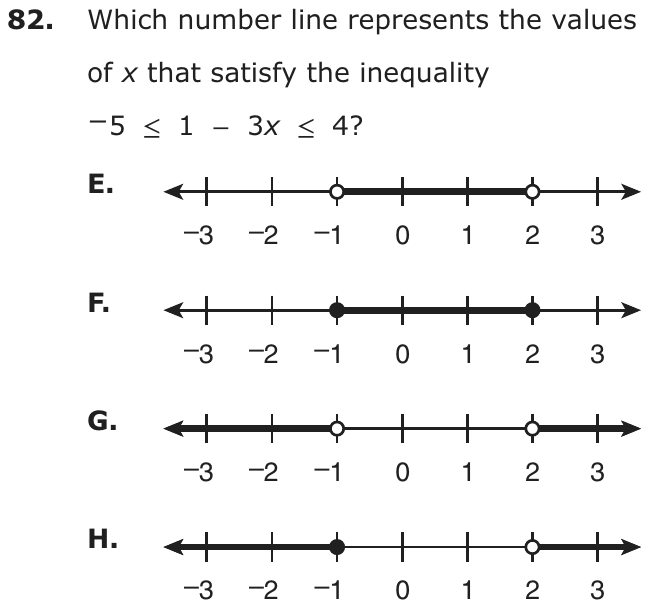
Which number line represents the values of x that satisfy the inequality ?
- A

- B

- C

- D

Show the answer
Correct answer: B
Split the compound inequality into two inequalities.
and
For each inequality, subtract 1 from each side.
and
For each inequality, divide both sides by −3. Note that dividing each side of an inequality by a negative number changes the direction of the inequality.
and
Combining the pieces gives the compound inequality .
The solution is that x is greater than or equal to −1 and less than or equal to 2, so choose the number line with filled circles at −1 and 2, with the filled segment between the circles.
Question analysis
An inequality question: choose the number line that shows the solutions of the compound inequality −5 ≤ 1 − 3x ≤ 4. Students solve an inequality whose x term has a negative coefficient, then match the endpoints, open or closed circles, and shading to one of four graphs.
- Grade level
- Grade 7 content, by NYS standard
- Compared with grade 7
- Above grade 7 Grade 7 students solve and graph two-step inequalities one at a time. This compound inequality needs two solved together and a division by a negative number, which reverses the signs, a step many grade 7 classes only touch on.
- Estimated difficulty
- Hard: combines ideas, needs a plan, and has more than one tempting wrong answer.
- Thinking it demands
- Depth of knowledge 1, recall and reproduction · mainly apply
- What makes it hard
- Error-prone arithmetic moderate
- A very close wrong answer moderate
- Reading a figure, table or graph minor
- Solution
- 4 steps
- Reading level
- Question and choices: about grade 12, 13 words.
- Students, last 30 days
- Not enough answers yet to show (it takes 10).
Why it is hard, traps and wrong answers (shows the answer)
Why it is hard
The question stacks two classic traps: reversing the inequality signs when dividing by −3, and matching filled or open circles to ≤. All four graphs use the endpoints −1 and 2, so finding those numbers proves little; the choice turns on the circles and the direction of the shading. Testing x = 0, x = 3 and the endpoint x = 2 in the original inequality checks both decisions in under a minute.
Error-prone arithmetic moderate Working it out
Dividing all three parts of −6 ≤ −3x ≤ 3 by −3 reverses both signs and the order, giving 2 ≥ x ≥ −1, which must be rewritten as −1 ≤ x ≤ 2. (Brown & Burton, 1978; Junker & Sijtsma, 2001)
A very close wrong answer moderate Choosing the answer
Two graphs share the endpoints −1 and 2 and the shading between them; only the circles, filled for ≤ and open for <, separate them. (Embretson & Wetzel, 1987; Gorin & Embretson, 2006; Ascalon et al., 2007)
Reading a figure, table or graph minor Understanding the question
Each graph must be read for three things at once: the endpoints, the fill of each circle, and whether the shading runs between them or outward. (Lesh, Post & Behr, 1987; Kirsch & Mosenthal, 1990)
Strategy: Subtract 1 from all three parts, divide all three by −3 while reversing both inequality signs, then rewrite the result from smallest to largest before matching circles and shading.
Traps
- Negatives and direction: Arithmetic with negative numbers, the order of a subtraction, or direction on a number line. (Moving a term across the equals sign without changing its sign is a faulty procedure.)
- Counting the ends: Inclusive or exclusive ends, fence posts, consecutive numbers: an answer that is one too many or too few, or an endpoint drawn open where it belongs closed (or the reverse).
The wrong answers, classified
A Counting the ends (Brown & Burton, 1978)
Solves for the right endpoints and shading but draws open circles, as if ≤ excluded −1 and 2 instead of including them.
C Negatives and direction (Brown & Burton, 1978)
Divides by −3 without reversing the signs, so the solutions seem to lie outside −1 and 2; with open circles, this graph shows exactly the values that fail.
D Negatives and direction (Brown & Burton, 1978)
Shades outward as if the signs had not reversed, but mixes the circles, filled at −1 and open at 2, which no single reading of ≤ gives.
Worked solution, step by step
Formulas used
- Subtracting from every part
- a and b are the two sides of an inequality, and c is any number. Subtracting the same number from every part keeps the inequality true. The sign does not change.
- Dividing by a negative number
- a and b are numbers, and c is a positive number, so −c is negative. When you divide both sides by a negative number, the inequality sign flips. For example, 2 is less than 3, but −2 is greater than −3.
Sort out the question
The inequality says that is between −5 and 4. The sign ≤ means less than or equal to. So −5 and 4 themselves are allowed. You need the number line that shows every x that works. To find them, get x alone in the middle.
Subtract 1 from every part
First take away the 1 in the middle. Subtract 1 from all three parts.
Divide by −3 and flip
Now x is multiplied by −3. Divide all three parts by −3. Dividing by a negative number flips each sign.
Watch out: if you forget to flip, x seems to lie outside −1 and 2. That leads to choices C and D, which are shaded outward.Read the result
Turn it around so the smaller number is on the left. It means the same thing.
So x can be any number from −1 to 2. The ends, −1 and 2, are included, because the signs are ≤.
Pick the number line
On a number line, a closed (filled-in) circle means the end number is included. An open circle means it is not. So you need closed circles at −1 and 2, with the part between them shaded. Watch out: choice A has the right shading but open circles, which leave out −1 and 2.
So the answer is B.
Check your answer
Test a few numbers in . For x = 0 you get 1, which is between −5 and 4, and 0 is shaded. For x = 2 you get −5, which is allowed, so the circle at 2 is filled in. For x = 3 you get −8, which is too small, so 3 is not shaded.
More questions like this
The original DOE question