Question
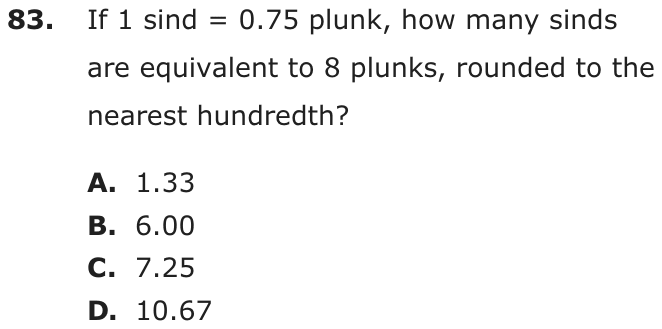
If 1 sind = 0.75 plunk, how many sinds are equivalent to 8 plunks, rounded to the nearest hundredth?
- A1.33
- B6.00
- C7.25
- D10.67
Show the answer
Correct answer: D
Set up a proportion:
Question analysis
A unit conversion question with made-up units: 1 sind equals 0.75 plunk, and students find how many sinds equal 8 plunks, rounded to the nearest hundredth. With unfamiliar unit names there is no everyday sense to lean on, so deciding whether to multiply or divide by 0.75 is the hard part.
- Grade level
- Grade 6 content, by NYS standard
- Compared with grade 7
- At grade 7 Converting units with ratio reasoning is grade 6 content, and made-up unit names are a familiar SHSAT twist. Working with a decimal rate and rounding to hundredths put it at about the level of typical grade 7 work.
- Estimated difficulty
- Moderate: several steps, or a close reading with one strong distractor.
- Thinking it demands
- Depth of knowledge 2, skills and concepts · mainly apply
- What makes it hard
- Turning words into math moderate
- Error-prone arithmetic minor
- Solution
- 2 steps
- Reading level
- Question and choices: about grade 7, 15 words.
- Students, last 30 days
- Not enough answers yet to show (it takes 10).
Why it is hard, traps and wrong answers (shows the answer)
Why it is hard
Made-up units remove the everyday sense that usually tells students which way a conversion goes, so the relationship must be reasoned out. The most tempting error multiplies by 0.75 and goes the wrong way; another finds the rate for one plunk and stops. A size check settles it: each sind is less than a plunk, so the number of sinds must exceed 8.
Turning words into math moderate Understanding the question
“1 sind = 0.75 plunk” says a sind is smaller than a plunk, so 8 plunks hold more than 8 sinds; seeing that decides between dividing and multiplying by 0.75. (Hegarty, Mayer & Monk, 1995; Koedinger & Nathan, 2004)
Error-prone arithmetic minor Working it out
8 ÷ 0.75 is easiest as 8 × 4/3 = 32/3, and the repeating decimal 10.666… must then be rounded to the nearest hundredth. (Brown & Burton, 1978; Junker & Sijtsma, 2001)
Strategy: Set up a proportion with sinds over plunks on both sides, put the 8 plunks in the matching place, solve for the sinds, and round to the nearest hundredth.
Traps
- Wrong operation: Adds instead of multiplying, divides the wrong way round, turns a ratio or rate upside down, or undoes a step in the wrong direction (subtracts what should be added back).
- Stops one step early: A choice is a number from partway through the solution.
- Numbers taken from the question: Combines the numbers in the question without a model of the situation, or is simply a number that appears in the question.
The wrong answers, classified
A Stops one step early (King et al., 2004; Gierl et al., 2017)
Finds how many sinds make one plunk, 1 ÷ 0.75 ≈ 1.33, and stops before scaling up to 8 plunks.
B Wrong operation (Hegarty, Mayer & Monk, 1995; King et al., 2004)
Multiplies 8 by 0.75 instead of dividing, converting in the wrong direction and finding the plunks in 8 sinds.
C Numbers taken from the question (Hegarty, Mayer & Monk, 1995)
Subtracts 0.75 from 8, combining the two numbers in the question without setting up a conversion.
Worked solution, step by step
Formulas used
- Cross-multiplying
- a, b, c and d are numbers or letters, and b and d are not zero. When two fractions are equal, multiply each top by the other bottom. The two products are equal. It works because it is the same as multiplying both sides by b and by d.
- Dividing by a fraction
- a is any number, and b over c is the fraction you divide by. Dividing by a fraction is the same as multiplying by its reciprocal, the fraction flipped upside down. It asks how many of that fraction fit into a.
Sort out what you know
Sinds and plunks are made-up units, like inches and feet. One sind equals 0.75 plunk, so a sind is smaller than a plunk. You need how many sinds equal 8 plunks. Round to the nearest hundredth, two places after the decimal point.
Decide if the answer is more than 8
A sind is only 3/4 of a plunk. So it takes more than 8 sinds to make 8 plunks. The answer must be more than 8. Watch out: , choice B, goes the wrong way. That is the number of plunks in 8 sinds.
Set up a proportion
A proportion says that two ratios are equal. Put sinds on top and plunks on the bottom on both sides. Let x be the number of sinds.
So .
Divide by 0.75
0.75 is the same as . Divide both sides by it. To divide by a fraction, multiply by its reciprocal.
Watch out: 1.33, choice A, is the number of sinds in just 1 plunk. Keep going to 8 plunks.Round to the nearest hundredth
Look at the third digit after the point, the thousandths digit. It is 6, which is 5 or more. So round the hundredths digit up, from 6 to 7.
So the answer is D, 10.67.
Check your answer
Multiply back. Each sind is 0.75 plunk, so 10.67 sinds are plunks. That matches the 8 plunks. The answer is also more than 8, as it must be.
More questions like this
The original DOE question