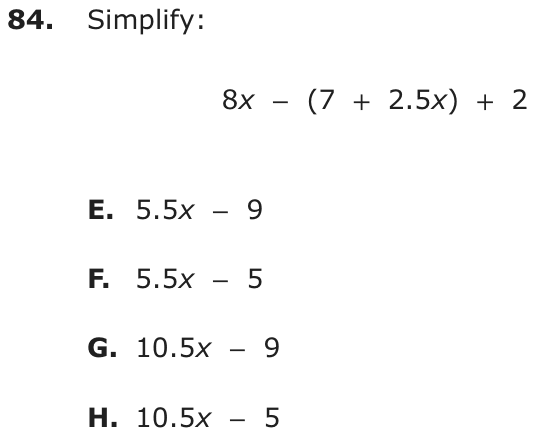
Question
Simplify:
- A
- B
- C
- D
Show the answer
Correct answer: B
First, distribute −1 over :
Then combine the like terms:
The simplified form of the expression is .
Question analysis
An algebra question asks students to simplify 8x minus the quantity 7 + 2.5x, plus 2. They remove the parentheses and combine the x terms and the constants. Decimal coefficients and a subtraction in front of a group make sign errors likely.
- NYS standards
- 7.EE.1 linear expressions with rational coefficients
- Grade level
- Grade 7 content, by NYS standard
- Compared with grade 7
- At grade 7 Simplifying a linear expression with a subtracted group and decimal coefficients is standard grade 7 work. This is a typical two-step textbook exercise, with the usual sign trap and nothing extra.
- Estimated difficulty
- Straightforward: two steps or one careful reading.
- Thinking it demands
- Depth of knowledge 1, recall and reproduction · mainly apply
- What makes it hard
- Error-prone arithmetic moderate
- A very close wrong answer moderate
- Solution
- 2 steps
- Reading level
- Question and choices: about grade 16+, 6 words.
- Students, last 30 days
- Not enough answers yet to show (it takes 10).
Why it is hard, traps and wrong answers (shows the answer)
Why it is hard
The question checks one skill, removing parentheses that follow a minus sign, and its choices are built from the two ways to get it wrong. A student who applies the minus to too few terms gets 10.5x, and one who extends it past the parentheses gets −9. Handling the x terms and the constants as two separate small checks makes each slip easy to catch.
Error-prone arithmetic moderate Working it out
The minus sign before the parentheses must turn + 2.5x into − 2.5x and 7 into − 7, while the + 2 written after the parentheses keeps its sign. (Brown & Burton, 1978; Junker & Sijtsma, 2001)
A very close wrong answer moderate Choosing the answer
The choices pair two x terms, 5.5x and 10.5x, with two constants, −9 and −5, so each wrong one differs from the right one in a single part. (Embretson & Wetzel, 1987; Gorin & Embretson, 2006; Ascalon et al., 2007)
Strategy: Change the minus in front of the parentheses into a minus on each term inside, then combine like terms, keeping the + 2 outside the group as it is.
Traps
- Order of operations: Working left to right, or distributing a minus sign wrongly, gives a choice.
The wrong answers, classified
A Order of operations (Brown & Burton, 1978)
Carries the minus sign past the parentheses onto the + 2 as well, so the constants become −7 − 2 = −9.
C Order of operations (Brown & Burton, 1978)
Makes both slips at once, keeping + 2.5x so the x terms add to 10.5x, and subtracting the outside 2 so the constants give −9.
D Order of operations (Brown & Burton, 1978)
Applies the minus sign to the 7 but not to 2.5x, so the x terms add to 10.5x while the constants come out right.
Worked solution, step by step
Formulas used
- Subtracting a group in parentheses
- a and b are the terms inside the parentheses. A minus sign in front means take away the whole group. So each term inside is taken away, and its sign flips. Terms outside the parentheses keep their own signs.
- Combining like terms
- a and b are numbers, and x is the letter. Like terms have the same letter part. You add or subtract their numbers and keep the letter. Plain numbers combine only with plain numbers.
Sort out the problem
You need to simplify . To simplify means to write it in its shortest form. The tricky part is the minus sign in front of the parentheses. It takes away everything inside.
Remove the parentheses
Both 7 and 2.5x get a minus sign. The + 2 is outside the parentheses, so it stays + 2. Watch out: 2.5x must become −2.5x. Leaving it as + 2.5x gives 10.5x, as in choices C and D.
Combine the x terms
Like terms have the same letter part. Put the two x terms together.
Combine the plain numbers
Watch out: the + 2 is not inside the parentheses. Making it −2 gives −9, as in choice A.Put the parts together: . So the answer is B, .
Check your answer
Pick x = 2 and try both forms. The first form: . Choice B: . They match. Choice D gives , so D is wrong.
More questions like this
The original DOE question