Question
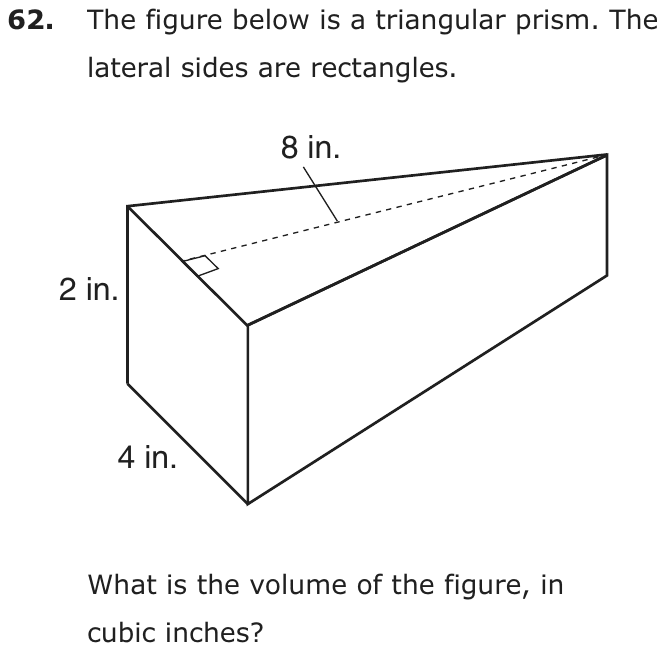
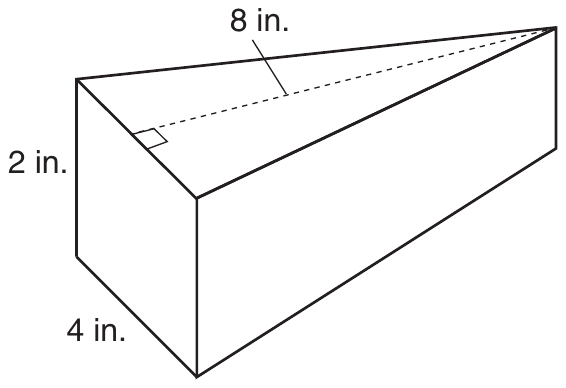
The figure below is a triangular prism. The lateral sides are rectangles.
What is the volume of the figure, in cubic inches?
Grid-in question: work out the answer and enter it as a number.
Show the answer
Correct answer: 32
The volume of a triangular prism is found by multiplying the area of the triangular base by the height of the prism.
The area of the triangular base of the prism is square inches.
The height of the triangular prism is 2 inches.
So the volume of the triangular prism, in cubic inches, is .
Question analysis
A geometry grid-in: find the volume, in cubic inches, of a triangular prism drawn with its triangular faces on top and bottom. The drawing gives a 4-inch side of the triangle, a dashed 8-inch height drawn to that side, and a 2-inch edge. Students must recall the volume formula and match each length to its role.
- NYS standards
- 7.G.6 area, surface area, and volume
- Grade level
- Grade 7 content, by NYS standard
- Compared with grade 7
- At grade 7 Finding the volume of a right triangular prism is named in the grade 7 standards, and this is a direct two-step case. The only extra demand is reading a slanted drawing to see which length plays which role.
- Estimated difficulty
- Straightforward: two steps or one careful reading.
- Thinking it demands
- Depth of knowledge 2, skills and concepts · mainly apply
- What makes it hard
- Solution
- 2 steps
- Reading level
- Question and choices: about grade 5, 22 words.
- Students, last 30 days
- Not enough answers yet to show (it takes 10).
Why it is hard, traps and wrong answers (shows the answer)
Why it is hard
The question rewards knowing that a prism's volume is its base area times its height, then matching each length to its job. The drawing lies on its side, with a short 2-inch height and the triangle flat on top, which makes the base harder to spot. Most lost points come from the one half: leaving it out doubles the volume, and stopping at the triangle's area gives half of it.
Something you must already know moderate Working it out
Neither formula is given: the volume is the area of the triangular base times the prism's height, and that area needs the one half in 1/2 × base × height. (Anderson & Krathwohl, 2001)
Reading a figure, table or graph minor Understanding the question
The prism lies with its triangles on top and bottom, so the 2-inch vertical edge is its height, while the dashed 8-inch line is the triangle's height to the 4-inch side. (Lesh, Post & Behr, 1987; Kirsch & Mosenthal, 1990)
An answer in an unexpected form minor Choosing the answer
There are no choices, so a product that forgets the one half, or one that stops at the area of the triangle, gives no warning. (Enright, Morley & Sheehan, 2002)
Strategy: Find the area of the triangular face as one half times base times height, using the 4-inch side and the dashed 8-inch height, then multiply by the 2-inch edge of the prism.
Traps
- Wrong formula: Uses a related but wrong formula: perimeter for area, diameter for radius, area for volume, or a misremembered one.
- Stops one step early: A choice is a number from partway through the solution.
- A formula you must know: Needs a formula the test does not give: area, circumference, volume, probability rules.
The wrong answers, classified
64 Wrong formula (King et al., 2004)
Multiplies 4 × 8 × 2 = 64 as for a rectangular box, leaving out the one half in the area of the triangular base.
16 Stops one step early (King et al., 2004; Gierl et al., 2017)
Finds the triangle's area, 1/2 × 4 × 8 = 16 square inches, and stops before multiplying by the prism's 2-inch height.
Worked solution, step by step
Formulas used
- Area of a triangle
- A is the area. b is the base, one side of the triangle. h is the height, the straight distance from that side to the opposite corner, at a right angle to the side. You take half because a triangle is half of a rectangle with the same base and height.
- Volume of a prism
- V is the volume, the space inside. B is the area of the base, the shape at each end. H is the height of the prism, the distance between the two ends. It works because the prism is like a stack of layers, each the shape of the base.
Sort out the figure
A prism is a solid with two matching ends joined by flat sides. Here the ends are triangles, on the top and bottom. The other sides are rectangles. You need the volume, the space inside, in cubic inches.
The dashed line on the top triangle is 8 in. It meets one side of the triangle at a right angle (the small square). The bottom edge under that side is 4 in. The edge going straight up is 2 in.
Find the triangle’s base and height
The side that the dashed line meets is the top edge of a rectangle face. Opposite sides of a rectangle are equal. So that side is 4 in., the same as the bottom edge under it.
So the triangle has a base of 4 in. Its height is the dashed line, 8 in., because it meets the base at a right angle.
Find the area of the triangle
The triangle’s area is 16 square inches. Watch out: 16 is only the area of one end. Stopping here gives the wrong answer 16.
Multiply by the prism’s height
The height of the prism is the distance between the two triangles. That is the 2 in. edge.
The volume is 32 cubic inches. Watch out: do not forget the one half. is the volume of a box, not of this prism.
So you would grid 32.
Check your answer
Picture a box that is 4 in. by 8 in. by 2 in. Its volume is cubic inches. The triangle has half the area of a 4 by 8 rectangle, so the prism holds half as much as the box. Half of 64 is 32.
More questions like this
The original DOE question