Question
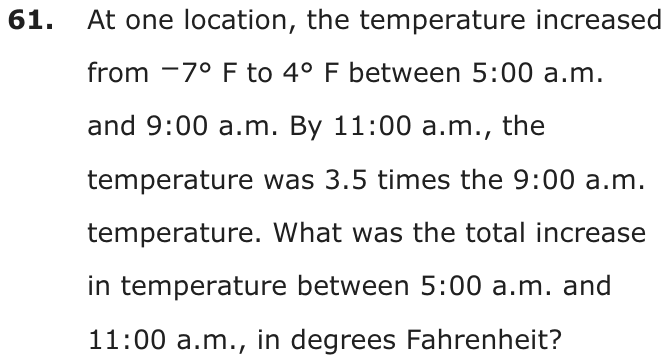
At one location, the temperature increased from −7° F to 4° F between 5:00 a.m. and 9:00 a.m. By 11:00 a.m., the temperature was 3.5 times the 9:00 a.m. temperature. What was the total increase in temperature between 5:00 a.m. and 11:00 a.m., in degrees Fahrenheit?
Grid-in question: work out the answer and enter it as a number.
Show the answer
Correct answer: 21
The 11:00 a.m. temperature is 3.5 times the 9:00 a.m. temperature. The 9:00 a.m. temperature was 4° F.
The temperature increased from −7° F at 5:00 a.m. to 14° F at 11:00 a.m., which is an increase of 21° F.
Question analysis
A temperature word problem with negative numbers: the temperature rises from −7° F to 4° F by 9:00 a.m., and by 11:00 a.m. it is 3.5 times the 9:00 a.m. reading. Students find the total rise from 5:00 to 11:00 a.m. Subtracting a negative starting temperature is where most slips happen.
- Grade level
- Grade 7 content, by NYS standard
- Compared with grade 7
- At grade 7 Using signed numbers for temperature change is standard grade 7 work. This adds a decimal multiplier and asks for a change rather than a temperature, two short steps, which keeps it at a typical grade 7 level.
- Estimated difficulty
- Moderate: several steps, or a close reading with one strong distractor.
- Thinking it demands
- Depth of knowledge 2, skills and concepts · mainly apply
- What makes it hard
- Error-prone arithmetic moderate
- Turning words into math minor
- Much to keep track of minor
- Solution
- 2 steps
- Reading level
- Question and choices: about grade 5, 43 words.
- Students, last 30 days
- Not enough answers yet to show (it takes 10).
Why it is hard, traps and wrong answers (shows the answer)
Why it is hard
Finding the 11:00 a.m. temperature is a single multiplication; the points are lost in the subtraction that follows. A rise that starts below zero has two parts, 7 degrees up to zero and 14 more above it, and students who treat −7 as 7 lose the first part. The times in the stem also invite measuring from 9:00 a.m. instead of 5:00 a.m., which covers only the last two hours.
Error-prone arithmetic moderate Working it out
The last step is 14 − (−7): subtracting the negative starting temperature means adding 7, and the part of the rise below zero is easy to leave out. (Brown & Burton, 1978; Junker & Sijtsma, 2001)
Turning words into math minor Understanding the question
“3.5 times the 9:00 a.m. temperature” multiplies the reading of 4°, not the 11-degree rise, and “total increase” runs from the 5:00 a.m. reading, not from 9:00. (Hegarty, Mayer & Monk, 1995; Koedinger & Nathan, 2004)
Much to keep track of minor Working it out
Three times of day carry three temperatures, −7°, 4° and 14°, and the answer compares the first with the last, not either of them with the middle one. (Sweller, 1988; Carpenter, Just & Shell, 1990)
Strategy: Find the 11:00 a.m. temperature from the 9:00 a.m. one, then subtract the 5:00 a.m. temperature from it, remembering that subtracting a negative number adds its size.
Traps
- Negatives and direction: Arithmetic with negative numbers, the order of a subtraction, or direction on a number line. (Moving a term across the equals sign without changing its sign is a faulty procedure.)
- Stops one step early: A choice is a number from partway through the solution.
- Answers a different question: A choice is right for another quantity: the other unknown, the rest instead of the part, the part instead of the whole.
The wrong answers, classified
7 Negatives and direction (Brown & Burton, 1978)
Finds 14° at 11:00 a.m. but subtracts 7 instead of −7, so 14 − 7 = 7, leaving out the part of the rise below zero.
14 Stops one step early (King et al., 2004; Gierl et al., 2017)
Finds the 11:00 a.m. temperature, 4 × 3.5 = 14, and grids it without subtracting the 5:00 a.m. temperature to get the increase.
10 Answers a different question (King et al., 2004; Hegarty, Mayer & Monk, 1995)
Measures the rise from 9:00 a.m. instead of 5:00 a.m., 14 − 4 = 10, which is only the last two hours of the total increase.
Worked solution, step by step
Formulas used
- Change in temperature
- End is the last temperature, and start is the first one. Subtract start from end to find how much it went up. It works with negative numbers too. A positive change means the temperature rose.
- Subtracting a negative number
- a is any number, and −b is a negative number. Taking away a negative is the same as adding its size. On a thermometer, going from −7 up to 0 is 7 degrees, so those 7 degrees get added.
Sort out what you know
There are three times and three temperatures, in degrees Fahrenheit (°F).
- 5:00 a.m.: −7°F, which is 7 degrees below zero
- 9:00 a.m.: 4°F
- 11:00 a.m.: 3.5 times the 9:00 a.m. temperature
You need the total increase from 5:00 a.m. to 11:00 a.m. That is how much warmer it got from the first time to the last.
Find the 11:00 temperature
“3.5 times the 9:00 a.m. temperature” means 3.5 times 4°F.
At 11:00 a.m. it was 14°F. Watch out: 14 is a temperature, not the increase. Gridding 14 stops too early.
Subtract the start from the end
The increase runs from 5:00 a.m. to 11:00 a.m. So it starts at −7°F and ends at 14°F.
Watch out: start at 5:00 a.m., not at 9:00 a.m. Starting from 4°F gives only 10.Subtract the negative number
Taking away a negative number is the same as adding its size.
The temperature rose 21°F. Watch out: writing 14 − 7 = 7 loses the minus sign. It skips the 7 degrees the air warmed just to reach zero.
So you would grid 21.
Check your answer
Count up on a thermometer. From −7°F up to 0°F is 7 degrees. From 0°F up to 14°F is 14 more. . Or add the two parts of the morning: it rose 11 degrees by 9:00 and 10 more by 11:00, and .
More questions like this
The original DOE question