Question
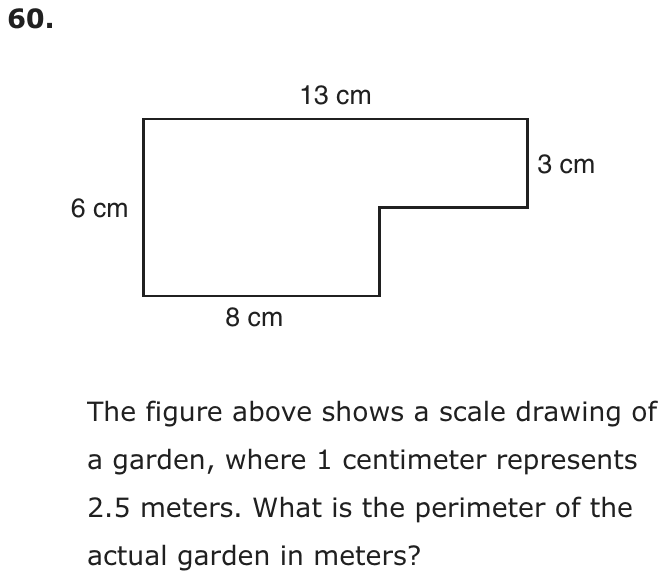
The figure above shows a scale drawing of a garden, where 1 centimeter represents 2.5 meters. What is the perimeter of the actual garden in meters?
Grid-in question: work out the answer and enter it as a number.
Show the answer
Correct answer: 95
First, find the perimeter of the figure.
Two sides do not have labels. The top of the figure measures 13 cm and the bottom shows a length measuring 8 cm, so the horizontal side without a label measures 5 cm .
The left side of the figure measures 6 cm and the right side shows a length measuring 3 cm, so the vertical side without a label measures 3 cm .
So the total perimeter of the scale drawing is
Use the scale to find the perimeter of the actual garden:
Question analysis
A grid-in on a scale drawing of an L-shaped garden, where each centimeter stands for 2.5 meters and two sides carry no labels. Students find the perimeter of the drawing, then convert it to the real garden's perimeter in meters. The unlabeled sides are easy to leave out.
- Grade level
- Grade 7 content, by NYS standard
- Compared with grade 7
- At grade 7 Scale drawings are grade 7 content, and a typical task converts one or two given lengths. Here two missing sides must be worked out and the perimeter assembled before the scale applies, more steps but nothing beyond grade 7.
- Estimated difficulty
- Moderate: several steps, or a close reading with one strong distractor.
- Thinking it demands
- Depth of knowledge 2, skills and concepts · mainly apply
- What makes it hard
- Reading a figure, table or graph moderate
- Combines ideas minor
- An answer in an unexpected form minor
- Solution
- 4 steps
- Reading level
- Question and choices: about grade 9, 24 words.
- Students, last 30 days
- Not enough answers yet to show (it takes 10).
Why it is hard, traps and wrong answers (shows the answer)
Why it is hard
The figure hides the work: it labels four of the six sides, and the missing two are short pieces of the notch that are easy to overlook. Once all six are found, the scale step is a single multiplication, but it must go the right way, since the real garden is larger than the drawing. Tracing the outline and counting six sides guards against the most common loss.
Reading a figure, table or graph moderate Understanding the question
Two sides of the notch carry no labels, so students must find them from the opposite sides: 13 − 8 = 5 cm across and 6 − 3 = 3 cm down. (Lesh, Post & Behr, 1987; Kirsch & Mosenthal, 1990)
Combines ideas minor Working it out
The perimeter of an L-shaped drawing has to be joined to a scale of 2.5 meters per centimeter, two separate skills in one answer. (Embretson, 1998; Daniel & Embretson, 2010)
An answer in an unexpected form minor Choosing the answer
With no choices, nothing flags a perimeter that is missing two sides or still in centimeters; the student must check the six-sided total alone. (Enright, Morley & Sheehan, 2002)
Strategy: Use the opposite sides to work out the two unlabeled lengths, add all six sides of the drawing, then multiply the total in centimeters by 2.5 meters per centimeter.
Traps
- Misreads the figure: Reads a value, label or tick spacing in a figure, table or graph wrongly.
- Stops one step early: A choice is a number from partway through the solution.
- Wrong operation: Adds instead of multiplying, divides the wrong way round, turns a ratio or rate upside down, or undoes a step in the wrong direction (subtracts what should be added back).
The wrong answers, classified
75 Misreads the figure (Lesh, Post & Behr, 1987; Kirsch & Mosenthal, 1990)
Adds only the four labeled sides, 13 + 3 + 8 + 6 = 30 cm, and scales that to 75 m, missing the two unlabeled sides of the notch.
38 Stops one step early (King et al., 2004; Gierl et al., 2017)
Finds the drawing's perimeter, 38 cm, correctly and grids it without applying the scale of 2.5 meters per centimeter.
15.2 Wrong operation (Hegarty, Mayer & Monk, 1995; King et al., 2004)
Divides the 38 cm perimeter by 2.5 instead of multiplying, shrinking the garden though each centimeter of the drawing stands for 2.5 meters.
Worked solution, step by step
Formulas used
- Perimeter
- P is the perimeter, the distance all the way around a shape. Add the length of every side, once each. It works for any shape with straight sides, even one with a corner cut out.
- Using a scale
- s is the scale, the number of meters that 1 centimeter on the drawing stands for. Here s is 2.5. Each centimeter on the drawing is 2.5 meters in real life, so you multiply.
Sort out what you know
The figure is a scale drawing, a small copy of the real garden. Each 1 cm on the drawing stands for 2.5 m in the real garden. You need the perimeter of the real garden in meters. The perimeter is the distance all the way around.
The shape has 6 sides. Four are labeled: 13 cm, 3 cm, 8 cm and 6 cm. The two sides around the cut-out corner have no labels.
Find the missing side across
Look at the top side, 13 cm. Below it, the bottom side (8 cm) and the short unlabeled side across the notch together reach just as far. So the missing side is the difference.
The missing side across is 5 cm.
Find the missing side going down
Now look at the left side, 6 cm. On the right, the 3 cm side and the unlabeled side going down together make the same height.
The missing side going down is 3 cm.
Add all six sides
The perimeter of the drawing is 38 cm. Watch out: adding only the four labeled sides gives 30 cm. That leads to the wrong answer 75.
Change to real meters
Each centimeter stands for 2.5 meters, so multiply by 2.5.
Here and . The real perimeter is 95 meters. Watch out: 38 is still in centimeters, so do not grid it. Dividing by 2.5 gives 15.2, which makes the garden smaller than its drawing.
So you would grid 95.
Check your answer
Slide the two notch sides out to the corner. The distance around stays the same, so it equals a 13 cm by 6 cm rectangle: . Also, 95 meters is more than 38, which fits, because each centimeter stands for more than 1 meter.
More questions like this
The original DOE question