2018
This test has the first 120 of the 228 questions that match.
Question 1 of 120
2018 Test A English, question 1Question
Read this sentence.
During a nightly news segment about a cooking contest, a reporter talked to some people who did the best in the contest.
Which revision uses the most precise language for the words talked to some people who did the best in the contest?
- Aconversed with some of the people who won the contest
- Bspoke to the three contestants who did well
- Cdiscussed the contest with some of the winners
- Dinterviewed the top three contestants
Show the answer
Correct answer: D
This is the answer.(D)
The question asks for the most precise revision for the words “talked to some people who did the best in the contest.”
Option D is the correct response because the revision precisely states both the reporter’s action (“interviewed”) and whom the reporter interviewed (“the top three contestants”).
Option A is an incorrect response because the revision does not provide precise information about the number of people interviewed.
Option B is an incorrect response because the revision uses the imprecise phrase “who did well.”
Option C is an incorrect response because the revision does not provide precise information about the number of people interviewed.
Question analysis
This revising question gives one sentence about a news report on a cooking contest and asks which rewrite of a vague phrase uses the most precise language. The tricky part is that several choices sound more formal or add one specific detail while staying vague about something else.
- NYS standards
- 7L3a precise and concise language
- Grade level
- Grade 7 reading and task
- Compared with grade 7
- Below grade 7 Choosing precise wording is a grade 7 language skill, but this item is one short sentence with everyday words and a single comparison to make. Typical grade 7 revision work asks for the same judgment inside a longer paragraph.
- Estimated difficulty
- Routine: one familiar step, little to misread.
- Thinking it demands
- Depth of knowledge 1, recall and reproduction · mainly evaluate
- What makes it hard
- Evidence
- Answered from one sentence or line
- Reading level
- Question and choices: about grade 5, 77 words.
- Students, last 30 days
- Not enough answers yet to show (it takes 10).
Why it is hard, traps and wrong answers (shows the answer)
Why it is hard
This is a quick item once a student tests two things in every rewrite: what the reporter did and exactly who was involved. Points are lost by stopping at the first concrete detail, such as the number three, or by mistaking a formal verb like “conversed” for a precise one. It rewards checking each rewrite all the way through.
Every choice must be checked minor Choosing the answer
Each rewrite repairs a different piece of “talked to some people who did the best”, so all four have to be checked for both the action and the people. (Embretson & Wetzel, 1987)
Strategy: Ask two things of each revision: does it say exactly what the reporter did, and exactly whom the reporter spoke with? Keep a revision only if it is specific on both counts.
Traps
- Wordy, vague or informal: A revision is grammatical but wordy, imprecise or too casual for the passage.
- Half right: One half of a two-part choice is right and the other is not.
The wrong answers, classified
A Wordy, vague or informal (Connors & Lunsford, 1988)
Treats the formal verb “conversed” as more precise than “talked”, but it is only a fancier synonym, and “some of the people” leaves the number as vague as before.
B Half right (King et al., 2004; Thissen, Steinberg & Fitzpatrick, 1989)
Spots the exact number in “the three contestants” and stops checking, though “spoke to” and “who did well” are as loose as the original wording.
C Wordy, vague or informal (Connors & Lunsford, 1988)
Takes “winners” as sharper than “people who did the best”, missing that “some of the winners” still gives no count and “discussed the contest with” is wordier.
Working it out, step by step
Figure out what the question asks
This question asks you to make a phrase more precise. Precise language is exact. It tells the reader exactly what happened and exactly who was there. For example, a big dog is vague, but a 90-pound sheepdog is precise. You need to fix the words “talked to some people who did the best in the contest.”
Find what is vague now
The words are vague in two ways. First, “talked to” is a plain verb. On the news, a reporter who asks people questions is doing an interview. Second, “some people who did the best” does not say who or how many. So a good fix must sharpen both parts: the action and the people.
Test each choice on both parts
- A uses “conversed with,” which is just a fancy word for “talked.” And “some of the people” is still vague.
- B gives a number, “the three contestants.” But “spoke to” and “who did well” are still loose.
- C says “some of the winners,” which still gives no number. “Discussed the contest with” is wordier, not clearer.
- D says “interviewed,” the exact action. “The top three contestants” says exactly who.
Watch out: Choice B is tempting because it has a number. Many students stop there. But it fixes only one part.
Pick the answer
Only one choice is exact about both the action and the people. The new sentence reads: During a nightly news segment about a cooking contest, a reporter interviewed the top three contestants. So the answer is D, “interviewed the top three contestants.”
Why this answer and not the closest wrong one
Choice B is the closest wrong answer. Like D, it names three contestants. But “spoke to” is as plain as “talked to,” and “who did well” is vaguer than “top.” D is exact about what the reporter did and about whom, so it is the most precise.
More questions like this
The original DOE question
Question 2 of 120
2018 Test A English, question 2Question
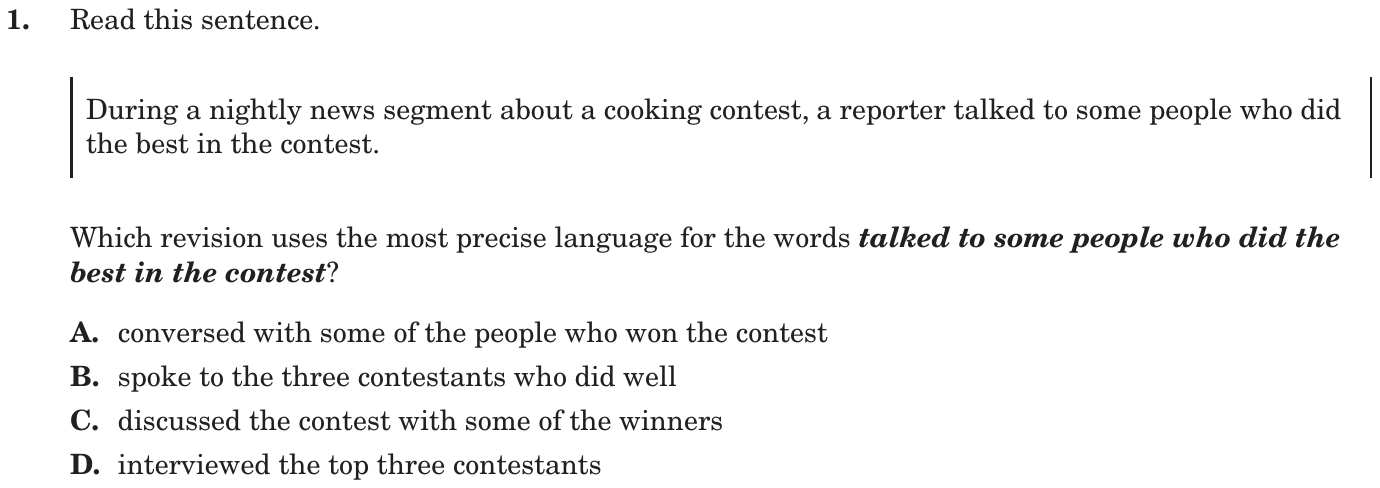
Read this paragraph.
(1) When coal was used to heat homes, it frequently left soot stains on the walls. (2) Brothers Cleo and Noah McVicker, who owned a cleaning product company created a doughy substance to help people remove this soot. (3) Over time, as natural gas becomes more common, people had little need for soot cleansers, and the McVickers’ family company struggled to stay in business. (4) Then one day Joe McVicker, Cleo’s son, learned that his sister-in-law had been using the substance for art projects in her classroom, so he remarketed the product as the toy known today as Play-Doh.
Which pair of revisions need to be made in the paragraph?
- A
Sentence 1: Delete the comma after homes.
Sentence 3: Change becomes to became.
- B
Sentence 1: Delete the comma after homes.
Sentence 4: Change remarketed to had remarketed.
- C
Sentence 2: Insert a comma after company.
Sentence 3: Change becomes to became.
- D
Sentence 2: Insert a comma after company.
Sentence 4: Change remarketed to had remarketed.
Show the answer
Correct answer: C
This is the answer (C)
The question asks for the pair of revisions needed to correct the errors in the paragraph, which appear in sentence 2 and sentence 3.
Option C is correct because it is the only choice that revises the errors in both sentence 2 and sentence 3.
In sentence 2 (Option C and Option D), a comma needs to follow the word “company” to set off the phrase “who owned a cleaning product company.” A comma is necessary because the phrase is a nonrestrictive clause: the phrase provides extra information about Cleo and Noah McVicker’s line of work, but the phrase is not necessary in order to understand the meaning of the sentence.
The second error is in sentence 3 (Option A and Option C), which incorrectly shifts the verb into the present tense. The clause “as natural gas becomes more common” should be “as natural gas became more common.”
The comma after the word “homes” in sentence 1 (Option A and Option B) is necessary for separating the subordinate clause “When coal was used to heat homes” from the main clause.
In sentence 4 (Option B and Option D), the word “remarketed” is in the past tense established in the rest of the paragraph and should not change to the past perfect tense “had remarketed.”
Question analysis
This editing question gives a short paragraph about how a soot cleaner became the toy Play-Doh and asks which pair of revisions it needs. Students must check comma use and verb tense, and because each choice pairs two edits, one correct fix can hide a wrong one.
- Grade level
- Grade 6 reading and task
- Compared with grade 7
- At grade 7 Comma rules and verb tense are taught by grade 6, but here the student must judge four separate edits and accept a choice only if both of its edits are needed, which matches grade 7 demand.
- Estimated difficulty
- Moderate: several steps, or a close reading with one strong distractor.
- Thinking it demands
- Depth of knowledge 2, skills and concepts · mainly apply
- What makes it hard
- A rule that doesn't sound wrong moderate
- A very close wrong answer moderate
- Every choice must be checked minor
- Evidence
- Answered from one paragraph or stanza
- Reading level
- Question and choices: about grade 7, 155 words.
- Students, last 30 days
- Not enough answers yet to show (it takes 10).
Why it is hard, traps and wrong answers (shows the answer)
Why it is hard
The paragraph holds two errors of different kinds, an unclosed “who” clause and a slip into present tense, and the other two proposed edits change text that is already correct. Students who catch the tense shift but not the comma are left between two pairs, and many then delete the sound comma after the opening “When” clause. The question rewards finding both errors in the paragraph before reading the pairs.
A rule that doesn't sound wrong moderate Working it out
The “who owned a cleaning product company” clause opens with a comma but never closes, and sentence 2 still reads smoothly aloud, so the missing comma after “company” is easy to miss. (Connors & Lunsford, 1988)
A very close wrong answer moderate Choosing the answer
The right pair and the pair that deletes the comma after “homes” share the “becomes” to “became” fix, so only the comma edit, after “company” or after “homes”, tells them apart. (Embretson & Wetzel, 1987; Gorin & Embretson, 2006; Ascalon et al., 2007)
Every choice must be checked minor Choosing the answer
The four pairs draw on four possible edits in four sentences, so each edit has to be judged on its own and a pair accepted only when both are needed. (Embretson & Wetzel, 1987)
Strategy: Find the errors yourself before looking at the pairs: check whether each comma is needed or missing, and check that each verb's tense fits when its event happened.
Traps
- Punctuation: A comma, semicolon, colon, dash or apostrophe used where it does not belong, or missing where it does.
- Verb tense or form: The wrong tense, an inconsistent shift of tense, or a wrong verb form.
- Fixes what isn't broken: Changes a part of the sentence that was already correct, while the real error stays; or, where the question asks which sentence has an error or should go, picks one that is correct and belongs.
The wrong answers, classified
A Punctuation (Connors & Lunsford, 1988)
Gets the “becomes” to “became” fix but, missing the unclosed “who” clause in sentence 2, deletes the comma that correctly ends the opening clause of sentence 1.
B Fixes what isn't broken (Connors & Lunsford, 1988)
Changes two correct parts, deleting the comma after an opening clause and adding a needless past perfect, while both real errors in sentences 2 and 3 stay.
D Verb tense or form (Connors & Lunsford, 1988)
Adds the needed comma after “company” but thinks the later event needs “had remarketed”, missing the real tense error, the present-tense “becomes” in sentence 3.
Working it out, step by step
Figure out what the question asks
Each choice is a pair of edits. You need the pair where both edits are needed. If even one edit in a pair changes something that was already right, that pair is wrong. The best plan is to find the errors yourself first. Then look for the pair that fixes them.
Check the comma in sentence 2
Sentence 2 says “Brothers Cleo and Noah McVicker, who owned a cleaning product company created a doughy substance.” The part “who owned a cleaning product company” is extra information. The sentence still makes sense without it. Extra information in the middle of a sentence needs a comma on both sides. Example: My aunt, who lives in Ohio, sent me a card. Sentence 2 has the first comma but not the second. So you need to add a comma after “company.”
Check the comma in sentence 1
Sentence 1 starts with “When coal was used to heat homes.” That part is a dependent clause (a group of words with a verb that can’t stand alone as a sentence). When a sentence starts with one, a comma goes after it. Example: When the bell rang, we ran outside. So the comma after “homes” is correct. Deleting it would add an error. That rules out choices A and B.
Check the verb in sentence 3
Verb tense tells when something happens. This paragraph tells a story from the past, so its verbs should stay in the past. Sentence 3 says “as natural gas becomes more common.” The word “becomes” is present tense. But the same sentence uses “had” and “struggled,” which are past tense. So change “becomes” to became.
Check the verb in sentence 4
Sentence 4 says Joe learned about the art projects, so he “remarketed” the product. Remarketed means sold it again in a new way. The form had remarketed is for something that happened before another past event. But Joe remarketed the product after he learned about the art projects. So the plain past “remarketed” is right. No change is needed.
Find the pair that matches
The two needed edits are: add a comma after “company,” and change “becomes” to “became.”
- A fixes the verb but deletes a correct comma.
- B makes two changes that are not needed.
- D adds the comma but changes a verb that was already right.
- C makes exactly the two needed edits.
So the answer is C.
Why this answer and not the closest wrong one
Choice A is the closest wrong answer, because it has the same “becomes” to “became” fix. But A also deletes the comma after “homes,” and that comma belongs after an opening “When” clause. Only C fixes both real errors and changes nothing that was already right.
More questions like this
The original DOE question
Question 3 of 120
2018 Test A English, question 3Question
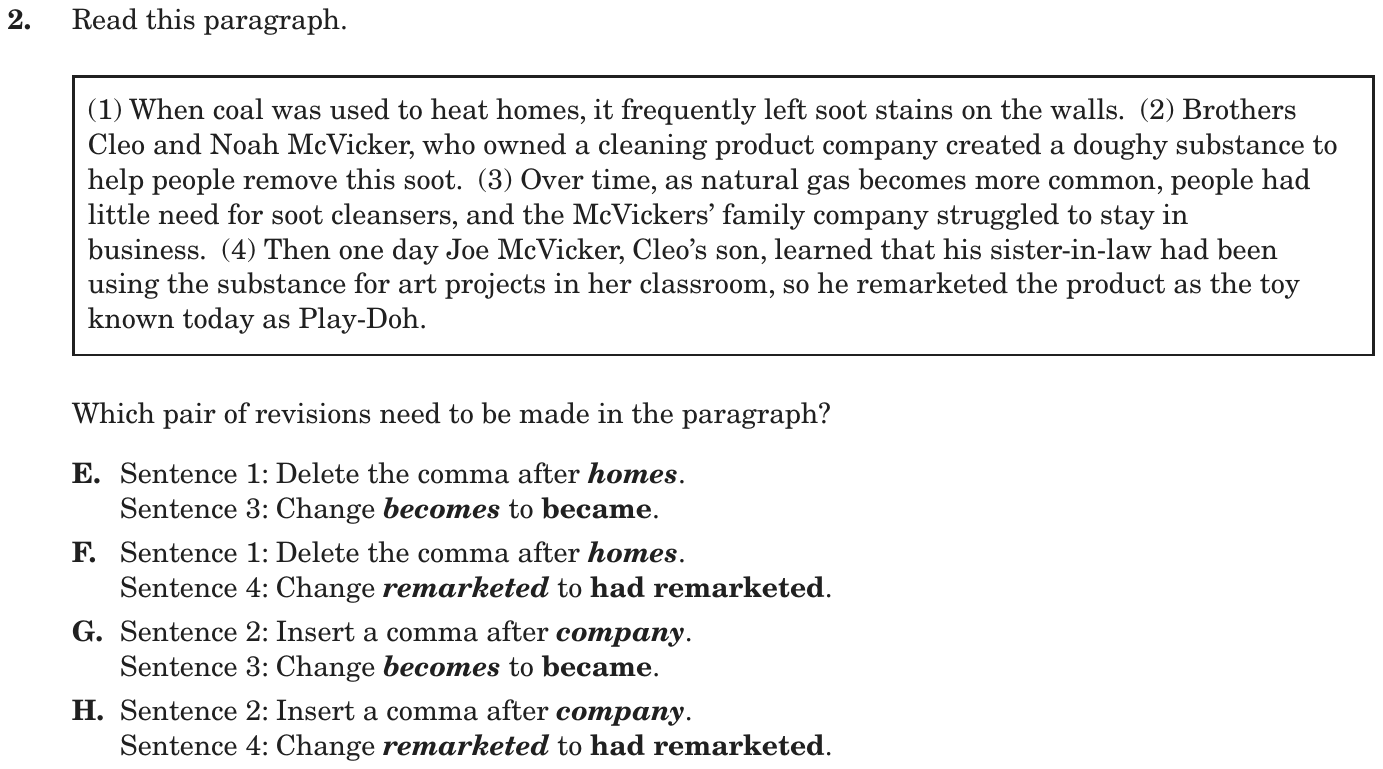
Read this paragraph.
(1) Walking dogs, cleaning kennels, hand-feeding newborn kittens, and supporting the pet-adoption process, the animal shelter is looking for volunteers to help with a variety of tasks. (2) Working at the animal shelter is a great way for young people, especially those who aspire to care for and protect animals, to gain valuable work experience. (3) In addition to hands-on training with animal care, volunteers will learn important job skills, such as punctuality, responsibility, and personal initiative. (4) Caring for animals can also help volunteers develop empathy, which is the awareness and understanding of the feelings of others.
Which sentence contains an error in its construction and should be revised?
- Asentence 1
- Bsentence 2
- Csentence 3
- Dsentence 4
Show the answer
Correct answer: A
The answer is (A)
The question asks for the identification of the sentence in the paragraph that has an error in its construction and should be revised.
Option A (sentence 1) is the correct response because sentence 1 contains a structural error. The sentence begins with a list of modifying phrases: “Walking dogs, cleaning kennels, hand-feeding newborn kittens, and supporting the pet-adoption process.” As written, this list modifies the closest noun phrase, “the animal shelter,” which is illogical because the list describes tasks at the animal shelter, not the shelter itself. The list should follow the word “tasks” at the end of the sentence, so that it is closer to the word that it modifies.
Option B, Option C, and Option D are incorrect responses because sentence 2, sentence 3, and sentence 4 do not contain structural errors.
For Option B, the phrase “especially those who aspire to care for and protect animals” in sentence 2 correctly modifies “young people.”
For Option C, the structure of sentence 3 allows the words “In addition to hands-on training with animal care” to correctly modify “volunteers will learn.”
For Option D, the phrase “which is the awareness and understanding of the feelings of others” in sentence 4 correctly modifies the word “empathy.”
Question analysis
This editing question gives a paragraph inviting young people to volunteer at an animal shelter and asks which sentence is built incorrectly and should be revised. The error is in sentence structure, not spelling or punctuation, and every sentence contains long descriptive phrases, so students must check what each phrase actually describes.
- NYS standards
- 7L1 grammar and usage conventions
- Grade level
- Grade 7 reading and task
- Compared with grade 7
- At grade 7 Spotting a misplaced or dangling modifier is the grade 7 grammar skill tested here. The faulty sentence reads smoothly and the correct sentences also hold long modifying phrases, so it matches a careful grade 7 editing task.
- Estimated difficulty
- Moderate: several steps, or a close reading with one strong distractor.
- Thinking it demands
- Depth of knowledge 2, skills and concepts · mainly analyze
- What makes it hard
- A rule that doesn't sound wrong major
- Every choice must be checked moderate
- Complex sentences minor
- Evidence
- Answered from one paragraph or stanza
- Reading level
- Question and choices: about grade 10, 113 words.
- Students, last 30 days
- Not enough answers yet to show (it takes 10).
Why it is hard, traps and wrong answers (shows the answer)
Why it is hard
The faulty sentence is the first one and the smoothest-sounding, because the mind supplies the missing volunteers who walk the dogs. Students who judge by ear pass over it and then flag a correct sentence that merely sounds busy. The question rewards asking, for every opening phrase, which noun it actually attaches to.
A rule that doesn't sound wrong major Working it out
Sentence 1's opening list, “Walking dogs, cleaning kennels, hand-feeding newborn kittens”, grammatically describes “the animal shelter”, an error that sounds natural because readers know volunteers will do those tasks. (Connors & Lunsford, 1988)
Every choice must be checked moderate Choosing the answer
The stem names no kind of error, so all four sentences must be checked, and sentences 2, 3 and 4 each contain a long phrase that could look misplaced. (Embretson & Wetzel, 1987)
Complex sentences minor Understanding the question
Every sentence carries a lengthy modifier, from the interrupting “especially those who aspire to care for and protect animals” to the closing definition of empathy, so the faulty one does not stand out. (Abedi & Lord, 2001; Freedle & Kostin, 1993; Messick, 1989)
Strategy: In each sentence, find every descriptive phrase and ask which noun sits next to it. Any phrase placed beside a noun it cannot logically describe marks the sentence to revise.
The wrong answers, classified
B Fixes what isn't broken (Connors & Lunsford, 1988)
Flags the interruption “especially those who aspire to care for and protect animals” as an error, though it correctly describes “young people” and the sentence is complete.
C Fixes what isn't broken (Connors & Lunsford, 1988)
Suspects the opening phrase “In addition to hands-on training with animal care” dangles like sentence 1's, but it leads straight into “volunteers”, who receive the training.
D Fixes what isn't broken (Connors & Lunsford, 1988)
Picks the “which is the awareness and understanding of the feelings of others” clause as misplaced, though it sits right after “empathy”, the word it defines.
Working it out, step by step
Figure out what the question asks
This asks which sentence is built wrong. The words may be fine, but the parts are in the wrong order or don’t fit together. The question doesn’t say what kind of error to look for. So you need to check all four sentences.
Learn the rule about describing phrases
A modifier is a word or phrase that describes something. It must sit right next to the thing it describes. If it sits next to the wrong word, the sentence says something silly. Example: Barking loudly, the mail carrier ran from the dog. This says the mail carrier was barking! Fix: The mail carrier ran from the dog, which was barking loudly.
Test sentence 1
Sentence 1 begins with a list: “Walking dogs, cleaning kennels, hand-feeding newborn kittens, and supporting the pet-adoption process.” Right after the comma comes “the animal shelter.” So the sentence says the shelter is walking dogs and feeding kittens. A shelter is a place. It can’t do those things. The list really describes the “tasks” at the end of the sentence. One fix moves the list after that word: …volunteers to help with a variety of tasks, such as walking dogs, cleaning kennels…
Test sentences 2, 3, and 4
- Sentence 2: “especially those who aspire to care for and protect animals” comes right after “young people.” It describes them, so it is in the right place. (To aspire means to hope or aim.)
- Sentence 3: “In addition to hands-on training with animal care” leads straight into “volunteers.” The volunteers get the training, so it fits.
- Sentence 4: “which is the awareness and understanding of the feelings of others” comes right after “empathy.” It explains that word, so it fits.
Watch out: Sentence 3 also starts with a phrase and a comma, so choice C can look like sentence 1. Ask who gets the training. The volunteers do.
Pick the answer
Only sentence 1 puts a describing phrase next to the wrong noun. So the answer is A, sentence 1.
Why this answer and not the closest wrong one
Sentence 3 is the closest trap, because it also opens with a phrase and a comma. But the word after its comma is “volunteers,” and the volunteers really do get the training. In sentence 1, the words after the comma are “the animal shelter,” and a shelter can’t walk dogs.
More questions like this
The original DOE question
Question 4 of 120
2018 Test A English, question 4Passage Moving through Mountains
Moving through Mountains
(1) An age-old proverb says that necessity is the mother of invention. (2) Centuries of human ingenuity in the face of obstacles prove this to be true. (3) For many years the Swiss Alps, a mountain range spanning southern Switzerland and northern Italy, were such an obstacle. (4) Roads and railways had to navigate around the mountains or through winding tunnels inside the mountains, making the transportation of people and goods difficult and time consuming. (5) In 2016 these burdens were eased with the completion of the Gotthard Base Tunnel.
(6) Construction of the high-speed railway tunnel began in 1996. (7) The tunnel was created through the use of tunnel-boring machines, which are giant drills with a flat rotating head called a cutter head. (8) Each of the tunnel-boring machines used during the construction of the tunnel was about the length of four football fields arranged end-to-end. (9) During the seventeen-year construction period, 28 million tons of rock were removed, enough to rebuild the Great Pyramid of Giza five times. (10) This massive construction project is reported to have cost $12 billion. (11) After that, 4 million cubic meters of concrete, or enough concrete to build eighty-four Empire State Buildings, were used to construct and support the tunnel.
(12) By 2020 the high-speed railway will carry more than 250 freight trains and 55 passenger trains a day, with most traveling at speeds of around 100 to 125 miles per hour. (13) It will be faster for people to travel between northern and southern Europe. (14) The travel time between the European cities of Zurich, Switzerland, and Milan, Italy, will be reduced by an hour. (15) Many European leaders compare the Gotthard Base Tunnel to the Channel Tunnel, a 33-mile underwater tunnel that connects the United Kingdom and France. (16) While there is no roadway in the Channel Tunnel, people can drive their cars onto special trains that will carry vehicles through to the other side.
(17) Just as traffic congestion in major cities led to the construction of underground local transportation, natural formations, such as mountain ranges, have also sent people underground for faster, easier, and cheaper methods of transportation across larger areas. (18) There is renewed interest in constructing innovative methods of transportation that will help eliminate problems associated with traveling to and from certain areas.
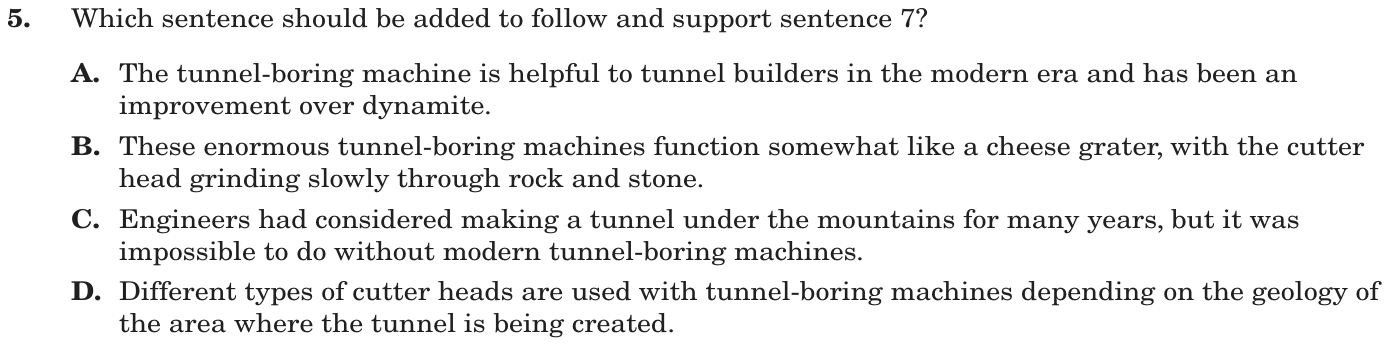
Question
Which sentence should be added after sentence 5 to introduce the main topic of the passage?
- AThe construction of the Gotthard Base Tunnel was approved by Swiss voters in 1992 and was funded by tolls, fuel taxes, and government loans.
- BLeaders from several European countries attended the opening ceremonies for the Gotthard Base Tunnel, a Swiss tunnel.
- CThe Gotthard Base Tunnel is the world’s longest and deepest railway tunnel, stretching 35.5 miles straight through the base of the Swiss Alps.
- DThe Gotthard Base Tunnel continues to help reduce the number of freight trucks on the roadways in the Swiss Alps.
Show the answer
Correct answer: C
The Answer is (C)
The question asks which sentence should be added to the end of the first paragraph in order to introduce the topic of the passage, which is the description, construction, and use of the Gotthard Base Tunnel.
Option C correctly presents and describes the Gotthard Base Tunnel.
Option A is incorrect because it offers overly detailed information about the funding used to build the Gotthard Base Tunnel, and it does not provide a description of the tunnel.
Option B is incorrect because it gives details about the opening ceremony of the tunnel, and it does not provide a description of the tunnel.
Option D is incorrect because it offers a result of completing the Gotthard Base Tunnel, rather than offering an introductory statement presenting and describing the tunnel.
Question analysis
This revising question uses a short informational passage about the Gotthard Base Tunnel through the Swiss Alps and asks which sentence best introduces the main topic at the end of the first paragraph. Several choices offer true-sounding facts about the tunnel, so students must tell an introduction apart from a supporting detail.
- NYS standards
- 7W2a introducing and organizing a topic
- Grade level
- Grade 7 reading and task
- Compared with grade 7
- At grade 7 Choosing a sentence that introduces a topic and previews what follows is standard grade 7 writing work. The passage is short and factual, and the wrong choices are related details, much like a classroom revision exercise.
- Estimated difficulty
- Straightforward: two steps or one careful reading.
- Thinking it demands
- Depth of knowledge 2, skills and concepts · mainly evaluate
- What makes it hard
- Evidence in several places moderate
- How sentences fit together minor
- Evidence
- Answered from the whole text
- Reading level
- Passage: about grade 11, 362 words; question and choices: about grade 9, 97 words.
- Students, last 30 days
- Not enough answers yet to show (it takes 10).
Why it is hard, traps and wrong answers (shows the answer)
Why it is hard
Most students find the descriptive sentence once they ask what a reader needs right after the tunnel is first named. Points are lost to sentences that follow on smoothly from the word “completion” or that name a real benefit, but which set up a passage about something else. The right sentence even adds facts the passage never states, so students should judge fit rather than hunt for repeated words.
Evidence in several places moderate Working it out
The topic the new sentence must introduce only emerges across all four paragraphs: what the Gotthard Base Tunnel is, how it was dug, and what it will do for travel. (Kirsch & Mosenthal, 1990; Gorin & Embretson, 2006)
How sentences fit together minor Working it out
The added sentence follows sentence 5, which names the tunnel only as what eased the burdens, so it should present the tunnel itself before paragraph 2 turns to its construction. (Halliday & Hasan, 1976)
Strategy: Skim the first sentence of each paragraph to see what the passage as a whole covers, then pick the sentence that would prepare a reader for all of it.
Traps
- Too narrow: A single detail offered as the central idea or a summary, or a summary that keeps minor details and leaves out an essential part.
- Off the point: Adds or keeps something that does not support the paragraph's or the passage's focus, or an introduction or conclusion that misses the main point.
The wrong answers, classified
A Off the point (Halliday & Hasan, 1976)
Picks voter approval in 1992 and funding by tolls, fuel taxes and loans, background that would set up a passage about financing, which this one never discusses.
B Off the point (Halliday & Hasan, 1976)
Follows naturally from “the completion of the Gotthard Base Tunnel” in sentence 5, but an opening ceremony with European leaders is not what the passage goes on to describe.
D Too narrow (King et al., 2004)
Offers one result, fewer freight trucks on Alpine roads, which echoes the difficult roads of sentence 4 but does not present the tunnel before the passage explains it.
Working it out, step by step
Figure out what the question asks
The new sentence goes at the end of paragraph 1, right after sentence 5. It must introduce the main topic, which is what the whole passage is mostly about. So first you need to know what the whole passage covers.
Skim the passage for its topic
Sentence 5 ends paragraph 1: “In 2016 these burdens were eased with the completion of the Gotthard Base Tunnel.” Paragraph 2 tells how the tunnel was built. Paragraph 3 tells how it will make travel faster. Paragraph 4 tells why people build tunnels like it. So the passage is about the Gotthard Base Tunnel: what it is, how it was built, and what it does.
See what sentence 5 leaves out
Sentence 5 names the tunnel, but it doesn’t say what the tunnel is. A reader doesn’t yet know how long it is or what makes it special. Then paragraph 2 jumps right into building it. So the new sentence should describe the tunnel itself. That gets the reader ready for the rest.
Check each choice
- A is about voters and money from tolls and taxes. The passage never discusses how the tunnel was paid for.
- B is about an opening ceremony. The passage never describes one.
- C says what the tunnel is: “the world’s longest and deepest railway tunnel,” running “straight through the base of the Swiss Alps.”
- D gives one result, fewer trucks on the roads. That is a detail, not an introduction.
Watch out: D links back to the slow roads in sentence 4, so it seems to fit. But it is one benefit, and the passage never mentions trucks.
Pick the answer
Choice C presents the tunnel and tells what makes it special. So the answer is C.
Why this answer and not the closest wrong one
Choice D is the closest wrong answer. It is about the tunnel, and it ties back to the hard travel in sentence 4. But it gives a result before the reader even knows what the tunnel is. C describes the tunnel itself, and that is what an introduction needs.
More questions like this
The original DOE question
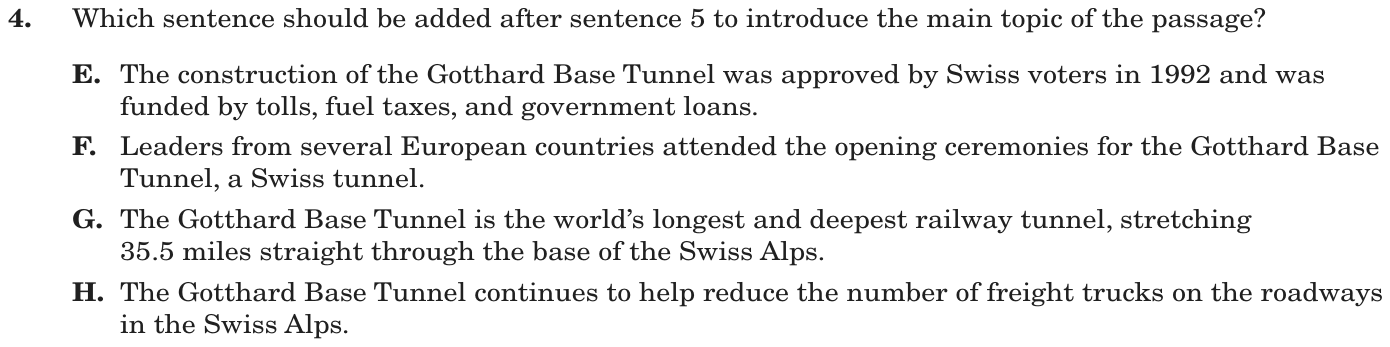
The passage “Moving through Mountains” as printed (page 48)
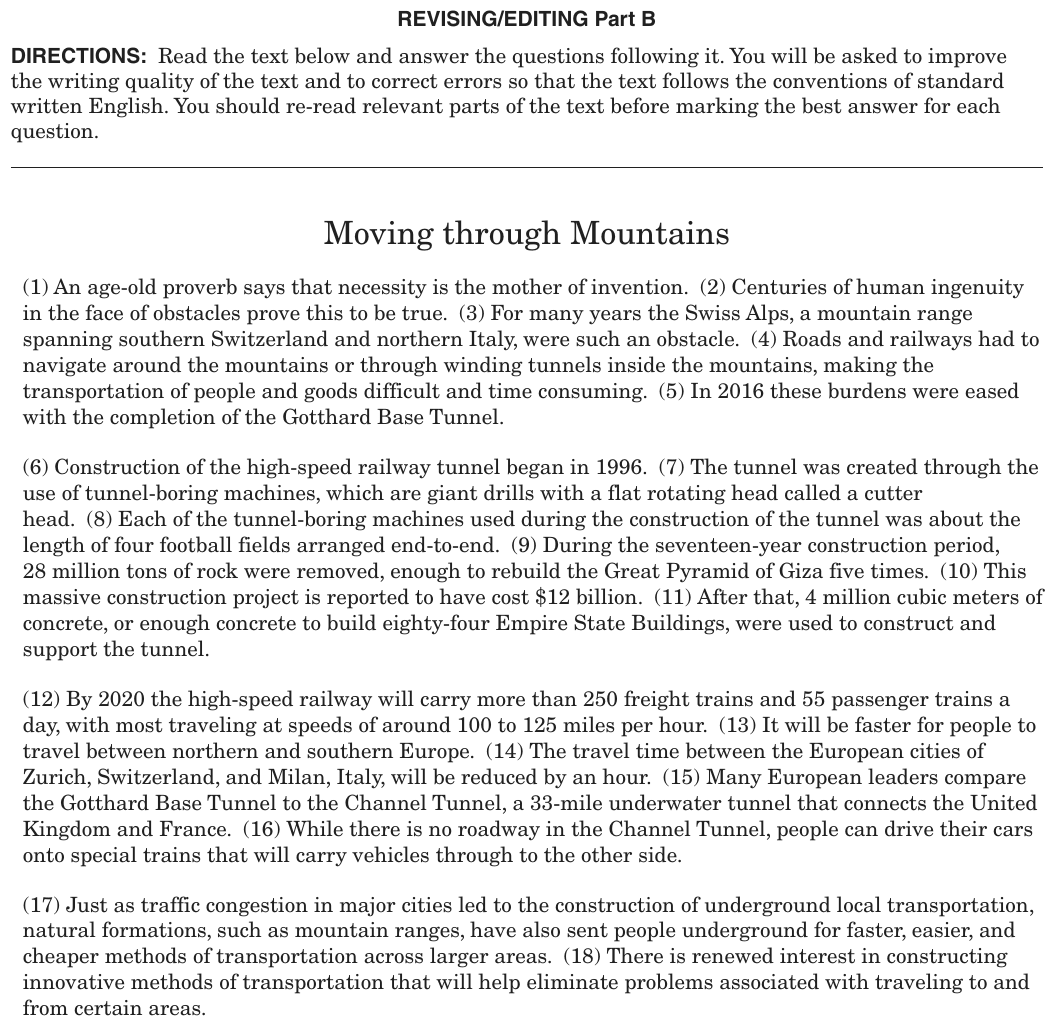
Question 5 of 120
2018 Test A English, question 5Uses the passage above: “Moving through Mountains”.
Question
Which sentence should be added to follow and support sentence 7?
- AThe tunnel-boring machine is helpful to tunnel builders in the modern era and has been an improvement over dynamite.
- BThese enormous tunnel-boring machines function somewhat like a cheese grater, with the cutter head grinding slowly through rock and stone.
- CEngineers had considered making a tunnel under the mountains for many years, but it was impossible to do without modern tunnel-boring machines.
- DDifferent types of cutter heads are used with tunnel-boring machines depending on the geology of the area where the tunnel is being created.
Show the answer
Correct answer: B
This is the answer (B)
The question asks for a sentence that provides additional details about the tunnel-boring machines used to build the Gotthard Base Tunnel in order to support the description of the machines in sentence 7.
Option B is correct because it offers specific details about how tunnel-boring machines, such as the ones used to create the Gotthard Base Tunnel, drill through rock.
Option A is incorrect because it offers information about how tunnel-boring machines were an improvement over previous methods but does not include information about how the machines work.
Option C is incorrect because it presents the idea that the tunnel could not be built until advances were made in tunnel-boring machine technology and does not describe how the machines function.
Option D is incorrect because, though it explains that there are different types of cutter heads used for different geologies, the geology of the tunnel area is not discussed in sentence 7, nor in the rest of the paragraph.
Question analysis
This revising question asks which new sentence should follow and support a description of the tunnel-boring machines used to dig the Gotthard Base Tunnel. Every choice is about the machines, so students must decide which one actually develops the sentence before it rather than drifting to a related topic.
- NYS standards
- 7W2b developing a topic
- Grade level
- Grade 7 reading and task
- Compared with grade 7
- At grade 7 Adding a detail that supports a given sentence is a regular grade 7 writing task. The demand is typical: a short paragraph, plain vocabulary, and wrong choices that stay on the subject of the machines but serve other purposes.
- Estimated difficulty
- Moderate: several steps, or a close reading with one strong distractor.
- Thinking it demands
- Depth of knowledge 2, skills and concepts · mainly evaluate
- What makes it hard
- How sentences fit together moderate
- Evidence
- Answered from one paragraph or stanza
- Reading level
- Passage: about grade 11, 362 words; question and choices: about grade 11, 94 words.
- Students, last 30 days
- Not enough answers yet to show (it takes 10).
Why it is hard, traps and wrong answers (shows the answer)
Why it is hard
All four choices are about tunnel-boring machines, so topic alone settles nothing. The right sentence shows how the machines work and leads into their size in sentence 8, while the strongest wrong one wanders into geology. Some students also distrust the cheese-grater comparison as too casual, though a vivid analogy is exactly the kind of support a definition needs.
How sentences fit together moderate Working it out
The new sentence sits between sentence 7, which defines the machines, and sentence 8, which gives their size, so it has to keep describing the machines that dug this tunnel. (Halliday & Hasan, 1976)
Strategy: Reread sentence 7 and note exactly what it describes, then test each choice by asking whether it tells the reader more about that same thing or starts a new point.
Traps
- Off the point: Adds or keeps something that does not support the paragraph's or the passage's focus, or an introduction or conclusion that misses the main point.
- Wordy, vague or informal: A revision is grammatical but wordy, imprecise or too casual for the passage.
The wrong answers, classified
A Wordy, vague or informal (Connors & Lunsford, 1988)
Accepts a general claim that the machine is “helpful to tunnel builders in the modern era”, which praises it without adding any detail about how it works.
C Off the point (Halliday & Hasan, 1976)
Explains why the tunnel could not be built earlier, turning from what the machines are to the project's history, a topic the paragraph never takes up.
D Off the point (Halliday & Hasan, 1976)
Builds on the term “cutter head” from sentence 7, but varying heads for different geology starts a new subject that the paragraph never returns to.
Working it out, step by step
Figure out what the question asks
You need a sentence to go right after sentence 7. It must support sentence 7. That means it should tell more about the same thing sentence 7 is about.
Read sentence 7 closely
Sentence 7 says: “The tunnel was created through the use of tunnel-boring machines, which are giant drills with a flat rotating head called a cutter head.” So sentence 7 is about the machines and how they dig. Now look ahead. Sentence 8 tells how long each machine was. So the new sentence sits between two sentences about the machines.
Make sense of the key words
To bore means to drill a hole. A tunnel-boring machine is a huge drill that digs a tunnel. The cutter head is the spinning front part that cuts the rock. A good supporting sentence will help you picture how this machine works.
Check each choice
- B compares the machine to a cheese grater, “with the cutter head grinding slowly through rock and stone.” It shows how the machine works.
- A says the machine is “helpful to tunnel builders in the modern era.” That is praise, with no detail about how it works.
- C is about why the tunnel could not be built earlier. That is a new topic.
- D is about different cutter heads for different kinds of rock. The paragraph never talks about kinds of rock.
Watch out: D repeats the words “cutter heads,” so it seems connected. But it starts a subject the paragraph never comes back to.
Pick the answer
Choice B keeps describing the machines from sentence 7 and leads well into sentence 8. So the answer is B.
Why this answer and not the closest wrong one
D is the closest wrong answer, because it uses the term “cutter heads” from sentence 7. But it is about choosing heads for different rock, which the paragraph drops at once. B explains how the cutter head of these machines works, and that is exactly what sentence 7 set up.
More questions like this
The original DOE question
Question 6 of 120
2018 Test A English, question 6Uses the passage above: “Moving through Mountains”.
Question
Where should sentence 11 be moved in order to improve the organization of the second paragraph (sentences 6–11)?
- Ato the beginning of the paragraph (before sentence 6)
- Bbetween sentences 6 and 7
- Cbetween sentences 8 and 9
- Dbetween sentences 9 and 10
Show the answer
Correct answer: D
The Answer is (D)
The question asks where sentence 11, which completes the detailed steps of how the tunnel was built, should be moved within the second paragraph in order to improve the organization of the paragraph.
Option D, placing the sentence between sentences 9 and 10, is correct because placing the sentence there helps the reader understand the full sequence of steps performed in constructing the tunnel before the cost of the project is introduced.
Option A, placing the sentence at the beginning of the paragraph (before sentence 6), is incorrect because it would not make sense since the process of building the tunnel has not yet been introduced.
Similarly, Option B is incorrect because placing the sentence after sentence 6 would not make sense given that adding concrete would have to happen after the rock was broken down and removed from the tunnel.
Option C, placing the sentence between sentences 8 and 9, would also be incorrect because the use of concrete did not take place before the removal of “28 million tons of rock” (sentence 9).
Question analysis
This revising question asks where to move a sentence about the concrete used to support the Gotthard Base Tunnel so the second paragraph is better organized. Students must follow the order of the construction steps and notice what the sentence's opening words refer back to, since several positions sound acceptable at a glance.
- Grade level
- Grade 7 reading and task
- Compared with grade 7
- At grade 7 Ordering sentences logically is a grade 7 writing skill. Here the student follows a sequence of construction steps and a time-order signal word, a short, typical grade 7 revision task with four nearby positions to compare.
- Estimated difficulty
- Moderate: several steps, or a close reading with one strong distractor.
- Thinking it demands
- Depth of knowledge 2, skills and concepts · mainly analyze
- What makes it hard
- How sentences fit together major
- A very close wrong answer moderate
- Much to keep track of minor
- Every choice must be checked minor
- Evidence
- Answered from one paragraph or stanza
- Reading level
- Passage: about grade 11, 362 words; question and choices: about grade 7, 33 words.
- Students, last 30 days
- Not enough answers yet to show (it takes 10).
Why it is hard, traps and wrong answers (shows the answer)
Why it is hard
The question turns on two signal phrases: what “After that” must follow, and what “This massive construction project” sums up. Students who see only that the concrete belongs with the digging often park it beside the machine details, before the rock has been cleared. Those who try each position in context see that lining the tunnel can only follow removing the rock.
How sentences fit together major Working it out
Sentence 11 opens with “After that”, so it must follow the rock removal in sentence 9, while “This massive construction project” in sentence 10 reads best as the paragraph's close. (Halliday & Hasan, 1976)
A very close wrong answer moderate Choosing the answer
Moving the sentence between sentences 8 and 9 differs from the right spot, between 9 and 10, by a single sentence, and only seeing that sentence 9's rock removal must come first tells them apart. (Embretson & Wetzel, 1987; Gorin & Embretson, 2006; Ascalon et al., 2007)
Much to keep track of minor Working it out
The construction steps, from the 1996 start through the machines, the 28 million tons of rock and the concrete, have to be kept in order across six sentences. (Sweller, 1988; Carpenter, Just & Shell, 1990)
Every choice must be checked minor Choosing the answer
Each of the four positions has to be tried by rereading the paragraph with the concrete sentence in place, since several sound acceptable at a glance. (Embretson & Wetzel, 1987)
Strategy: Look at the signal words that open sentence 11 and ask what event they must follow. Then read the paragraph with the sentence in each position to check the order of events.
Traps
- Sentence in the wrong place: Puts a sentence where it breaks the order of ideas or separates it from what it refers to.
The wrong answers, classified
A Sentence in the wrong place (Halliday & Hasan, 1976)
Moves the sentence to open the paragraph, where “After that” would follow the 2016 completion in sentence 5, putting the concrete work after the tunnel was finished.
B Sentence in the wrong place (Halliday & Hasan, 1976)
Reads “After that” as following the 1996 start of construction, which sounds smooth but has the tunnel lined with concrete before any machine had bored it.
C Sentence in the wrong place (Halliday & Hasan, 1976)
Sees that the concrete comes after the machines did their work but places it before sentence 9, so the tunnel is lined before its 28 million tons of rock are removed.
Working it out, step by step
Figure out what the question asks
Sentence 11 is in the wrong spot. You need to move it so paragraph 2 tells events in the right order. Paragraph 2 is sentences 6 to 11.
Look at the clue words in sentence 11
Sentence 11 says: “After that, 4 million cubic meters of concrete, or enough concrete to build eighty-four Empire State Buildings, were used to construct and support the tunnel.” “After that” is a transition, a word or phrase that links ideas. It tells you the concrete came after some other event. You need to find that event.
Put the building steps in order
Think about how you build a tunnel. First you dig out the rock. Then you line the hole with concrete to hold it up.
- Sentence 6: work began in 1996.
- Sentences 7 and 8: the machines that did the digging.
- Sentence 9: “28 million tons of rock were removed.”
- Sentence 10: the project cost $12 billion.
The concrete must come after the rock is removed. So sentence 11 belongs right after sentence 9.
Read the paragraph in the new order
Sentence 9 removes the rock. “After that,” the concrete is poured. Then sentence 10 sums up “This massive construction project” and its cost. The cost makes a good last point. Right now, sentence 11 comes after the cost. So “After that” seems to mean after paying. That makes no sense.
Check each choice
- A, before sentence 6: “After that” would point back to sentence 5, after the tunnel was finished.
- B, after sentence 6: the concrete would come before any digging.
- C, between 8 and 9: the tunnel would be lined before the rock was removed.
- D, between 9 and 10: the concrete comes right after the rock is removed.
Watch out: C is only one spot away from D. Ask yourself: is the rock gone yet? In C, it isn’t.
Pick the answer
So the answer is D, between sentences 9 and 10.
Now the paragraph goes: start, machines, digging, concrete, cost.
Why this answer and not the closest wrong one
Choice C is close because it puts the concrete after the machines. But sentence 9 is where the rock is removed, and you can’t line a tunnel that is still full of rock. Only D puts “After that” right after the rock removal.
More questions like this
The original DOE question

Question 7 of 120
2018 Test A English, question 7Uses the passage above: “Moving through Mountains”.
Question
Which sentence presents information that shifts away from the main topic of the third paragraph (sentences 12–16) and should be removed?
- Asentence 13
- Bsentence 14
- Csentence 15
- Dsentence 16
Show the answer
Correct answer: D
The answer is (D)
The question asks which sentence should be removed because it presents an idea that shifts away from the main idea of the third paragraph, which is about the transportation benefits of the Gotthard Base Tunnel.
Option D (sentence 16) is the correct response because, even though the sentence provides additional information about the Channel Tunnel, it does not help the reader understand the benefits of the Gotthard Base Tunnel, so it should be removed.
Option A (sentence 13) is incorrect because the idea of faster travel times is important to the development of the main idea of the paragraph.
Option B (sentence 14) is incorrect because the sentence provides a specific example of decreased travel time between two cities when traveling through the Gotthard Base Tunnel, supporting the development of ideas in the paragraph.
Option C (sentence 15) is incorrect because the sentence compares the Gotthard Base Tunnel to another tunnel that provides an important connection between places, and the sentence supports the idea that transportation innovations are beneficial.
Question analysis
This revising question looks at the paragraph describing what the Gotthard Base Tunnel will do for travel in Europe and asks which sentence shifts away from that topic and should be removed. Every sentence is related to tunnels and travel, so students must judge which one no longer serves the paragraph's main point.
- NYS standards
- 7W2b developing a topic
- Grade level
- Grade 6 reading and task
- Compared with grade 7
- Below grade 7 Cutting a sentence that strays from a paragraph's focus is practiced from grade 6. The paragraph is five sentences of plain facts with one clear topic, so this asks less than a typical grade 7 revision task.
- Estimated difficulty
- Straightforward: two steps or one careful reading.
- Thinking it demands
- Depth of knowledge 2, skills and concepts · mainly analyze
- What makes it hard
- A very close wrong answer moderate
- How sentences fit together minor
- Evidence
- Answered from one paragraph or stanza
- Reading level
- Passage: about grade 11, 362 words; question and choices: about grade 6, 24 words.
- Students, last 30 days
- Not enough answers yet to show (it takes 10).
Why it is hard, traps and wrong answers (shows the answer)
Why it is hard
The paragraph drifts gradually, which makes this harder than a plain hunt for the odd sentence out. The Channel Tunnel arrives in sentence 15 as a comparison that still concerns the Gotthard tunnel's importance, and only the next sentence leaves the Gotthard tunnel behind entirely. Students who cut at the first mention of the other tunnel lose the point, so it pays to ask which sentence says nothing about the Gotthard tunnel or the travel it speeds up.
A very close wrong answer moderate Choosing the answer
Sentence 15 is the first to mention the Channel Tunnel, so it looks like the shift, but it still compares that tunnel with the Gotthard; sentence 16 is wholly about car trains under the Channel. (Embretson & Wetzel, 1987; Gorin & Embretson, 2006; Ascalon et al., 2007)
How sentences fit together minor Working it out
The paragraph's focus, the faster travel the Gotthard tunnel will bring, has to be held while each of sentences 13 through 16 is tested against it. (Halliday & Hasan, 1976)
Strategy: State the paragraph's topic in a few words, then check each listed sentence against it. The sentence to cut is the one that talks about something other than that topic.
The wrong answers, classified
A Fixes what isn't broken (Connors & Lunsford, 1988)
Cuts sentence 13 as a vague restatement, but “It will be faster for people to travel between northern and southern Europe” is the paragraph's central claim.
B Fixes what isn't broken (Connors & Lunsford, 1988)
Treats the Zurich-to-Milan example as a side detail, though the hour saved between those cities is concrete proof of the faster travel the paragraph promises.
C Fixes what isn't broken (Connors & Lunsford, 1988)
Rightly senses the Channel Tunnel is a detour but cuts the comparison that still concerns the Gotthard tunnel, leaving in sentence 16, which is only about car-carrying trains.
Working it out, step by step
Figure out what the question asks
Every sentence in a paragraph should support its main topic. One sentence in paragraph 3 drifts to a different topic. You need to find it so it can be cut.
Find the paragraph’s main topic
Paragraph 3 is sentences 12 to 16. Sentence 12 says the railway will carry many trains at high speeds. Sentence 13 says: “It will be faster for people to travel between northern and southern Europe.” So the topic is how the Gotthard Base Tunnel will make travel faster.
Test each sentence against the topic
- Sentence 13 states the topic: faster travel.
- Sentence 14 gives an example. The trip between Zurich and Milan will be an hour shorter.
- Sentence 15 compares the Gotthard Base Tunnel to the Channel Tunnel. It still talks about the Gotthard tunnel.
- Sentence 16 says “people can drive their cars onto special trains” in the Channel Tunnel. It says nothing about the Gotthard tunnel.
Watch for the trap
Watch out: Sentence 15 is the first to name the Channel Tunnel. So it can look like the place where the paragraph shifts. But it compares that tunnel with the Gotthard tunnel. That keeps it tied to the topic. Sentence 16 leaves the Gotthard tunnel behind completely.
Pick the answer
Sentence 16 is only about car trains in the Channel Tunnel. So the answer is D, sentence 16.
Why this answer and not the closest wrong one
Choice C, sentence 15, is the closest wrong answer, since it brings in the Channel Tunnel. But it still talks about the Gotthard Base Tunnel by comparing the two. Sentence 16 talks only about the Channel Tunnel, so it is the one that shifts away.
More questions like this
The original DOE question

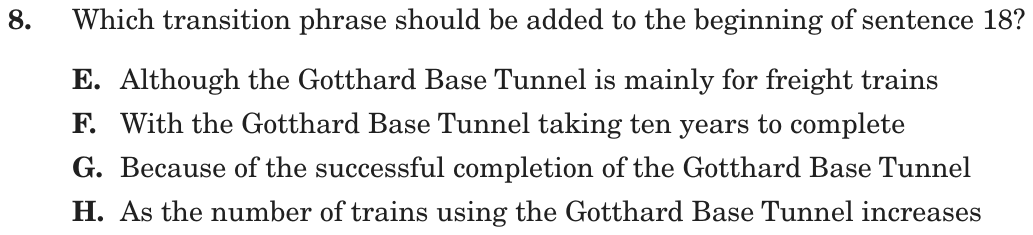
Question 8 of 120
2018 Test A English, question 8Uses the passage above: “Moving through Mountains”.
Question
Which transition phrase should be added to the beginning of sentence 18?
- AAlthough the Gotthard Base Tunnel is mainly for freight trains
- BWith the Gotthard Base Tunnel taking ten years to complete
- CBecause of the successful completion of the Gotthard Base Tunnel
- DAs the number of trains using the Gotthard Base Tunnel increases
Show the answer
Correct answer: C
The answer is (C)
The question asks for a transition that bridges the ideas between sentences 17 and 18 and accurately presents the relationship.
Option C is correct because it bridges the sentences by referring to the Gotthard Base Tunnel as a solution to the problems described in sentence 17 and logically introducing sentence 18.
Option A is incorrect because the use of the word “although” and the mention of freight trains suggest that sentence 18 will be about other types of vehicles that use the Gotthard Base Tunnel, and the transition phrase does not logically precede the sentence.
Option B is incorrect because the reference to the amount of time it took to build the tunnel does not help lead into the idea presented in sentence 18.
Option D is incorrect because it suggests that sentence 18 is related to the increasing number of trains using the Gotthard Base Tunnel, which is not accurate.
Question analysis
This revising question asks which introductory phrase should begin the last sentence of a passage about the Gotthard Base Tunnel, linking it to the idea before it. All four phrases are grammatical and mention the tunnel, so students must work out the logical relationship between the two sentences and check each phrase against the facts given earlier.
- NYS standards
- 7W2d transitions in informative writing
- Grade level
- Grade 7 reading and task
- Compared with grade 7
- At grade 7 Choosing a transition that shows how two ideas relate is a core grade 7 writing skill. The two sentences involved are short and the vocabulary is plain, so this is typical classroom revision work.
- Estimated difficulty
- Straightforward: two steps or one careful reading.
- Thinking it demands
- Depth of knowledge 2, skills and concepts · mainly evaluate
- What makes it hard
- How sentences fit together moderate
- Every choice must be checked minor
- Evidence
- Answered from one paragraph or stanza
- Reading level
- Passage: about grade 11, 362 words; question and choices: about grade 6, 52 words.
- Students, last 30 days
- Not enough answers yet to show (it takes 10).
Why it is hard, traps and wrong answers (shows the answer)
Why it is hard
The task is to see that renewed interest is a result, which calls for an opener that names a cause. Phrases that are merely true of the tunnel, or that tie interest to growing traffic, read smoothly and slip past students who do not test the logic. One opener also gives the construction time as ten years, which careful readers can reject against the seventeen-year period in sentence 9.
How sentences fit together moderate Working it out
Sentence 17 widens the view from this tunnel to tunnels in general, and sentence 18 reports renewed interest, so the opener has to name what caused that interest. (Halliday & Hasan, 1976)
Every choice must be checked minor Choosing the answer
All four openers are grammatical and name the Gotthard Base Tunnel, so each has to be read into sentence 18 and checked against facts given earlier in the passage. (Embretson & Wetzel, 1987)
Strategy: Read sentences 17 and 18 together and decide how they are connected: by contrast, by time, or by cause. Then choose the opening that expresses that link and fits facts already stated.
Traps
- Wrong transition: A connecting word or phrase that signals the wrong relationship, such as contrast where the idea continues.
The wrong answers, classified
A Wrong transition (Halliday & Hasan, 1976)
Likes the accurate freight detail from sentence 12, but “Although” promises a contrast, and nothing in sentence 18 runs against the tunnel being mainly for freight.
B Wrong transition (Halliday & Hasan, 1976)
Accepts a time detail that explains nothing about renewed interest and gets the time wrong, since sentence 9 gives a seventeen-year construction period.
D Wrong transition (Halliday & Hasan, 1976)
Senses that sentence 18 needs a cause but names growing train traffic, a plausible link the passage never makes, when the interest follows from the tunnel's completion.
Working it out, step by step
Figure out what the question asks
A transition is a word or phrase that links two ideas. Some show contrast, like although. Some show time, like then. Some show cause, like because. You need the opening for sentence 18 that shows how it links to sentence 17.
Read sentences 17 and 18 together
Sentence 17 says mountain ranges “have also sent people underground for faster, easier, and cheaper methods of transportation across larger areas.” Sentence 18 says: “There is renewed interest in constructing innovative methods of transportation.” Renewed interest means people care about something again. Innovative means new and creative.
Decide how the ideas connect
Why would people care about new kinds of travel again? Because the whole passage just showed a tunnel that worked. It solved the mountain problem. So sentence 18 is a result. The opening should name the cause.
Check each choice
- C, “Because of the successful completion of the Gotthard Base Tunnel,” names the cause. The tunnel’s success led to new interest.
- A starts with “Although,” which signals a contrast. Nothing in sentence 18 goes against the tunnel being for freight.
- B gives the building time, which doesn’t explain new interest. It is also wrong. Sentence 9 says the work took seventeen years, not ten.
- D names more trains as the cause. The passage never makes that link.
Watch out: D also sounds like a cause, so it is the most tempting wrong choice.
Pick the answer
The new sentence reads: Because of the successful completion of the Gotthard Base Tunnel, there is renewed interest in… So the answer is C.
Why this answer and not the closest wrong one
D is the closest wrong answer, because it also gives a cause. But the passage never says the number of trains made people interested. The tunnel’s success is what the whole passage builds up to, so C links the ideas best.
More questions like this
The original DOE question
Question 9 of 120
2018 Test A English, question 9Uses the passage above: “Moving through Mountains”.
Question
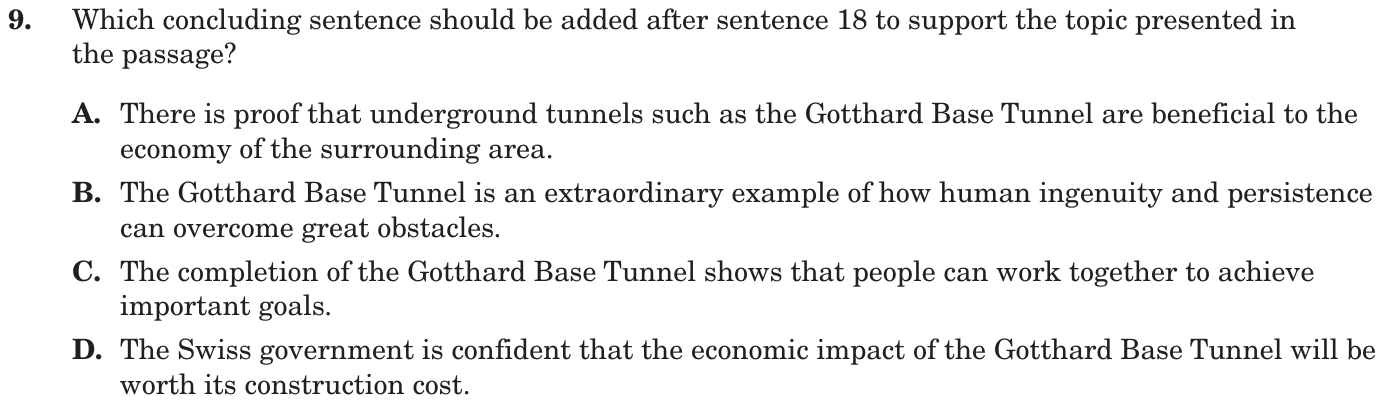
Which concluding sentence should be added after sentence 18 to support the topic presented in the passage?
- AThere is proof that underground tunnels such as the Gotthard Base Tunnel are beneficial to the economy of the surrounding area.
- BThe Gotthard Base Tunnel is an extraordinary example of how human ingenuity and persistence can overcome great obstacles.
- CThe completion of the Gotthard Base Tunnel shows that people can work together to achieve important goals.
- DThe Swiss government is confident that the economic impact of the Gotthard Base Tunnel will be worth its construction cost.
Show the answer
Correct answer: B
The answer is (B)
The question asks for a concluding sentence that supports key ideas about the topic developed earlier in the passage.
Option B is correct because it supports the points made in the introductory paragraph by affirming the idea that the Gotthard Base Tunnel is an example of a way people have improved life by overcoming obstacles.
Option A is incorrect because the economies of surrounding areas were never mentioned in the passage.
Option C is incorrect because, although the construction of the Gotthard Base Tunnel appears to have required many people to work together, the passage does not explicitly mention people or groups working together.
Option D is incorrect because it focuses on the cost of the Gotthard Base Tunnel, which is referred to only in sentence 10 of the passage.
Question analysis
This revising question asks which concluding sentence should end the passage about building the Gotthard Base Tunnel. Students must recognize the passage's overall point and choose a conclusion that sums it up, avoiding sentences that sound reasonable but add claims the passage never supports.
- NYS standards
- 7W2e concluding informative writing
- Grade level
- Grade 7 reading and task
- Compared with grade 7
- At grade 7 Picking a concluding sentence that reflects a passage's central idea is standard grade 7 writing work. Students must keep the whole short passage in mind and reject conclusions that bring in claims it never makes.
- Estimated difficulty
- Moderate: several steps, or a close reading with one strong distractor.
- Thinking it demands
- Depth of knowledge 2, skills and concepts · mainly evaluate
- What makes it hard
- Evidence in several places moderate
- A very close wrong answer moderate
- Evidence
- Answered from the whole text
- Reading level
- Passage: about grade 11, 362 words; question and choices: about grade 12, 92 words.
- Students, last 30 days
- Not enough answers yet to show (it takes 10).
Why it is hard, traps and wrong answers (shows the answer)
Why it is hard
The conclusion has to return to the idea the passage opened with, which sits at the far end of the text from where the new sentence goes. Students who have forgotten the proverb about necessity tend to choose by tone, and three choices sound like fitting final lessons or benefits. What the question rewards is matching the conclusion to the opening's own words, ingenuity and obstacles.
Evidence in several places moderate Working it out
The passage's point is set out in sentences 1 to 3, the proverb about necessity and “human ingenuity in the face of obstacles”, about fifteen sentences before the spot where the conclusion goes. (Kirsch & Mosenthal, 1990; Gorin & Embretson, 2006)
A very close wrong answer moderate Choosing the answer
The right conclusion and the teamwork one share a frame, the tunnel as proof of what people can do, and differ only in the lesson: ingenuity against obstacles, from sentences 1 to 3, or teamwork, which the passage never mentions. (Embretson & Wetzel, 1987; Gorin & Embretson, 2006; Ascalon et al., 2007)
Strategy: Say in one sentence what the whole passage is about, then choose the conclusion that restates that idea without adding claims the passage never makes.
Traps
- Off the point: Adds or keeps something that does not support the paragraph's or the passage's focus, or an introduction or conclusion that misses the main point.
- Too narrow: A single detail offered as the central idea or a summary, or a summary that keeps minor details and leaves out an essential part.
The wrong answers, classified
A Off the point (Halliday & Hasan, 1976)
Ends on a claim of “proof” that tunnels help local economies, a benefit that sounds right for a conclusion but that the passage never discusses.
C Off the point (Halliday & Hasan, 1976)
Sees that the ending should state a broad human lesson but picks teamwork, which the passage never raises, instead of the ingenuity against obstacles it opened with.
D Too narrow (King et al., 2004)
Seizes on the $12 billion cost, mentioned once in sentence 10, and adds a government opinion the passage never reports, narrowing the ending to one detail.
Working it out, step by step
Figure out what the question asks
You need a last sentence for the passage. A good conclusion sums up the main idea. It often goes back to the point made at the start. It should not add new claims that the passage never made.
Find the main idea at the start
Sentence 1 says: “An age-old proverb says that necessity is the mother of invention.” Sentence 2 says: “Centuries of human ingenuity in the face of obstacles prove this to be true.” Sentence 3 says the Swiss Alps “were such an obstacle.”
Put the main idea in plain words
A proverb is an old saying. Necessity is the mother of invention means that when people really need something, they find a clever way to get it. Ingenuity means cleverness. An obstacle is something in the way. So the passage says people use cleverness to get past what blocks them. The tunnel is the example.
Check each choice
- B says the tunnel shows “how human ingenuity and persistence can overcome great obstacles.” This repeats the opening idea. Persistence means not giving up.
- A is about the economy, meaning money and jobs, of nearby areas. The passage never discusses that.
- C is about people working together. The passage never mentions teamwork.
- D is about the cost and the government’s opinion. The cost comes up only once, in sentence 10.
Watch out: C sounds like a fine life lesson for an ending. But a conclusion must match this passage, and teamwork is not its point.
Pick the answer
Choice B restates the passage’s main idea without adding anything new. It ties the ending back to the beginning. So the answer is B.
Why this answer and not the closest wrong one
C is the closest wrong answer, because it also uses the tunnel to teach a lesson. But teamwork never comes up in the passage. B uses the passage’s own words, “human ingenuity” against “obstacles,” so it closes the passage the way it opened.
More questions like this
The original DOE question
Question 10 of 120
2018 Test A English, question 10Passage An Early Warning
An Early Warning
One of the books that has done the most to alert the world to the dangers of environmental degradation is George Perkins Marsh’s Man and Nature. Its message—that Western society is in the process of causing irreparable harm to the environment—greatly influenced ecologists during the beginning of the modern environmentalist movement in the 1960s. Marsh was not, however, part of this movement. Surprisingly, Man and Nature was first published in 1864.
Marsh first observed the environmentally destructive effects of human activities while growing up in Vermont in the early nineteenth century. The heavy demand for firewood had depleted the forests, and extensive sheep grazing had stripped the land. The result was flooding and soil erosion. Furthermore, streams were fouled by wastes dumped from numerous mills and dye houses.
Much later in his life, after careers in law, business, farming, and politics, Marsh served as ambassador to Italy. There he noticed land abuse similar to what he had seen in Vermont. Overgrazing and forest mismanagement had rendered areas that had been productive farmland since the days of the Roman Empire desolate. Marsh attributed this to what he called “man’s ignorant disregard for the laws of nature.”
In Italy, Marsh began to organize his observations and theories. He wrote in a way intended to educate readers about the impact of industrial and agricultural practices on the environment. In Man and Nature, he evaluated the important relationships between animals and plants, discussed forestry practices in great detail, and analyzed the ways natural water supplies are affected by human use.
Man and Nature challenged the popular belief that nature can heal any damage that people inflict upon it. Marsh argued that people may use and enjoy, but not destroy, the riches of the earth.
Furthermore, he asserted that everything in nature is significant and that even the tiniest organism affects the fragile environmental balance. His belief that drastic alteration of this balance would be dangerous is now accepted as a fundamental principle of modern environmental science.
Although he pointed out environmental damage caused by irresponsible human activities, Marsh did not oppose every human alteration to the environment. To him, the goal was proper management, not a return to wilderness conditions. People should consider the consequences of their actions, he wrote, and become “co-worker[s] with nature.” Marsh praised the Suez Canal, the human-made waterway between the Mediterranean Sea and the Gulf of Aden, as “the greatest and most truly cosmopolite physical improvement ever undertaken by man.” He believed that the advantages of the canal— improved transportation and commerce—would outweigh any environmental damage. Yet he also warned of possible unintended consequences, such as destructive plants and animals spreading from one body of water to the other.
Marsh was considered a radical thinker during his lifetime. By the late nineteenth century, however, his writings, along with those of John Muir, Henry David Thoreau, and others, had inspired what became known as the conservation movement. The conservationists of that time sought to educate the public that wilderness areas were worth preserving and were responsible for creating the National Park Service and the National Forest Service.
Question
Which statement best describes the central idea of the passage?
- AMarsh’s experience growing up on a farm allowed him to witness firsthand how human demands on nature can lead to problems, and as an adult he wrote one of the first books about conservation.
- BMarsh challenged the notion that nature can repair the damage people cause to it, but he also supported human-made modifications to nature that improve transportation and commerce.
- CMarsh’s ideas about the environment were considered radical in his lifetime, but they later gained popularity during the environmental movement in the twentieth century.
- DMarsh was a radical thinker who believed that people’s actions could dramatically affect nature, and his writings are considered foundational to the conservation movement.
Show the answer
Correct answer: D
The answer is (D)
The question asks for the statement that best illustrates the central idea of the passage. Paragraphs 2 through 5 focus on Marsh’s personal experiences and his ideas about nature, and paragraph 8 explains how his ideas are the basis for the conservation movement. These two aspects comprise the central idea of the passage and are best stated in Option D.
Option A is incorrect because it focuses mainly on Marsh’s early life and does not address his influence.
Option B is incorrect because, while it describes specific details about Marsh’s beliefs, it does not explain who he was or how he affected the conservation movement.
Option C is incorrect because it emphasizes that Marsh’s ideas were radical and influential but does not provide any information about what Marsh’s beliefs were.
Question analysis
This reading question asks for the central idea of an informational passage about George Perkins Marsh and his 1864 book Man and Nature, an early warning about environmental damage. Most choices state something true about Marsh, so students must judge which one sums up the whole passage instead of a single part of it.
- NYS standards
- 7R2 theme or central idea
- Grade level
- Grade 8 reading and task
- Compared with grade 7
- Above grade 7 Finding a central idea is a grade 7 standard, but this passage uses dense, abstract vocabulary and most choices are accurate about Marsh. Typical grade 7 tasks offer one clearly complete summary; here completeness must be weighed.
- Estimated difficulty
- Hard: combines ideas, needs a plan, and has more than one tempting wrong answer.
- Thinking it demands
- Depth of knowledge 3, strategic thinking · mainly understand
- What makes it hard
- A very close wrong answer major
- Every choice must be checked moderate
- A lot to read moderate
- Hard words minor
- Evidence
- Answered from the whole text
- Reading level
- Passage: about grade 12, 523 words; question and choices: about grade 14, 119 words.
- Students, last 30 days
- Not enough answers yet to show (it takes 10).
Why it is hard, traps and wrong answers (shows the answer)
Why it is hard
Each wrong statement is a fair summary of one stretch of the passage, so the question is really about completeness. Students lose the point by picking the summary of the part they remember best, whether his Vermont boyhood, his views on nature and canals, or his reputation over time. The right statement joins what Marsh believed to his lasting influence, the two halves that the opening and closing paragraphs frame.
A very close wrong answer major Choosing the answer
The right statement and the one calling his ideas “considered radical in his lifetime” share the radical-then-influential shape; only the right one adds what Marsh believed, that people's actions could dramatically affect nature. (Embretson & Wetzel, 1987; Gorin & Embretson, 2006; Ascalon et al., 2007)
Every choice must be checked moderate Choosing the answer
Every statement draws on real parts of the passage, Vermont, the Suez Canal, the 1960s, so each must be tested for whether it covers the whole text. (Embretson & Wetzel, 1987)
A lot to read moderate Understanding the question
Eight paragraphs move from Vermont to Italy, the book's contents, its claims, the Suez Canal and the conservation movement, so the whole arc has to be held at once. (Kintsch, 1998; Gorin & Embretson, 2006; Freedle & Kostin, 1993)
Hard words minor Understanding the question
Words such as “degradation”, “irreparable”, “desolate” and “cosmopolite” slow the reading of a passage whose central idea depends on the details they carry. (Perfetti, 2007; Freedle & Kostin, 1993)
Strategy: Before reading the choices, sum up the whole passage in one sentence of your own, then pick the statement that covers its beginning, middle and end rather than one section.
Traps
- Too narrow: A single detail offered as the central idea or a summary, or a summary that keeps minor details and leaves out an essential part.
The wrong answers, classified
A Too narrow (King et al., 2004)
Builds the summary on Marsh's boyhood in Vermont, recast as farm life, and on his book, leaving out his central claims and the influence the closing paragraphs describe.
B Too narrow (King et al., 2004)
Pairs two real points from paragraphs 5 and 7, his challenge to the belief that nature heals itself and his praise of the Suez Canal, but omits his influence.
C Too narrow (King et al., 2004)
Tracks how Marsh's reputation changed from radical to influential, matching paragraphs 1 and 8, but never states the belief about human harm to nature that made him matter.
Working it out, step by step
Figure out what the question asks
The central idea is the main point of the whole passage. A good statement of it covers the beginning, the middle, and the end. A choice that covers only one part is too narrow, even if it is true.
Sum up each part of the passage
- Paragraph 1: Marsh’s book Man and Nature warned that people were “causing irreparable harm to the environment.” It came out in 1864, long before the 1960s.
- Paragraphs 2 to 7: what Marsh saw in Vermont and Italy, and what he believed.
- Paragraph 8: Marsh “was considered a radical thinker during his lifetime.” But his writings “inspired what became known as the conservation movement.”
Put the big idea in plain words
Irreparable means it can’t be fixed. A radical thinker has ideas that seem extreme or very new for the time. Conservation means protecting nature and using it wisely. So the passage says: Marsh had a bold idea that people can badly harm nature. Later, that idea helped start a movement.
Check each choice
- D says what Marsh believed, that people could “dramatically affect nature.” It also says his writings are “foundational,” or a base, for the conservation movement. It covers the whole passage.
- A is mostly about his early life. It leaves out his main beliefs and his influence.
- B gives two of his views, from paragraphs 5 and 7. It leaves out how he shaped a movement.
- C tells how people saw his ideas over time. It never says what his ideas were.
Watch out: C has the same shape as D: radical then, important later. Check that a choice also says what Marsh believed.
Pick the answer
Only D covers both what Marsh believed and the effect his ideas had. So the answer is D.
Why this answer and not the closest wrong one
C is the closest wrong answer. Like D, it says Marsh’s ideas seemed radical but mattered later. But C never says what those ideas were. D adds his key belief, that people’s actions could badly change nature. So D covers the whole passage.
More questions like this
The original DOE question
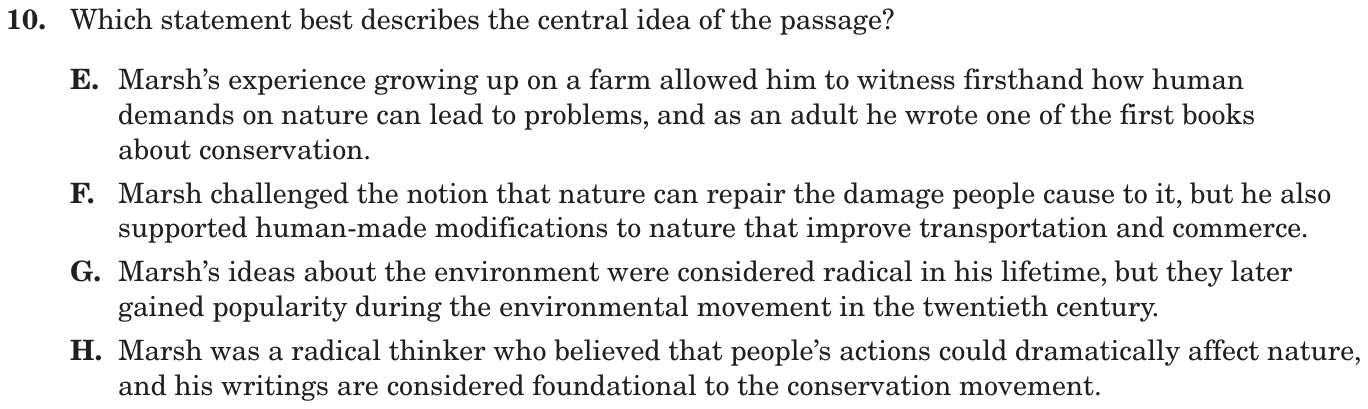
The passage “An Early Warning” as printed (page 52)
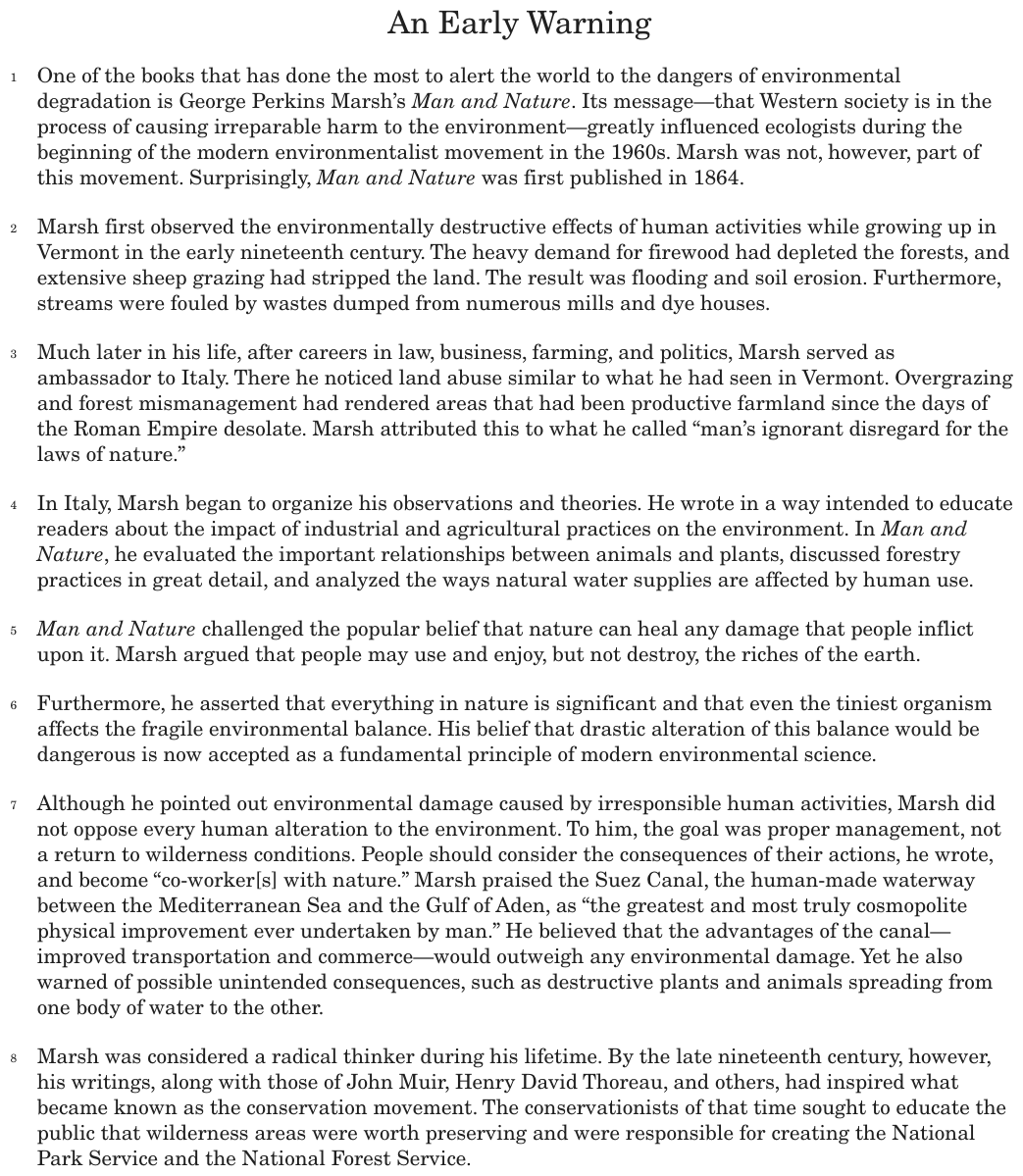
Question 11 of 120
2018 Test A English, question 11Uses the passage above: “An Early Warning”.
Question
Marsh believed that the people of his time caused harm to the environment because
- Athey assumed that future generations would solve any environmental problems.
- Bthey thought industrial progress was more important than protecting nature.
- Cthey were unwilling to change farming and waste-disposal practices.
- Dthey lacked knowledge of nature and natural processes.
Show the answer
Correct answer: D
The answer is (D)
The question asks for the specific reason Marsh believed people caused harm to the environment. Marsh credited the land abuse he observed in Vermont and Italy to people’s lack of understanding, or ignorance, of nature (paragraph 3) and “the popular belief that nature can heal any damage that people inflict upon it” (paragraph 5). This concept is stated in Option D.
Option A is incorrect because, although people are currently working to improve the environment, the passage does not state that Marsh believed that people in his time expected future generations to solve environmental problems.
Option B is incorrect because, while the people of Marsh’s time made advances in industry, Marsh did not indicate that he believed that people thought industrial progress outweighed efforts to protect the environment.
Option C is incorrect because, while many people at the time participated in “environmental degradation” (paragraph 1), none of the evidence in the passage suggests that Marsh believed that people were unwilling to change their practices.
Question analysis
This reading question asks why George Perkins Marsh thought people of his time were harming the environment, based on a passage about his book Man and Nature. The reason appears in Marsh's own words, but several choices offer causes that sound reasonable for the nineteenth century without being what the passage says.
- NYS standards
- 7R1 textual evidence and inferences
- Grade level
- Grade 7 reading and task
- Compared with grade 7
- At grade 7 Locating the reason a text gives for a person's belief is ordinary grade 7 reading. The passage's vocabulary is heavy for grade 7, but the answer rests on one short phrase that students need to interpret.
- Estimated difficulty
- Straightforward: two steps or one careful reading.
- Thinking it demands
- Depth of knowledge 2, skills and concepts · mainly understand
- What makes it hard
- The right answer is reworded moderate
- Hard words minor
- Evidence
- Answered from several paragraphs or stanzas
- Reading level
- Passage: about grade 12, 523 words; question and choices: about grade 9, 51 words.
- Students, last 30 days
- Not enough answers yet to show (it takes 10).
Why it is hard, traps and wrong answers (shows the answer)
Why it is hard
The answer rests on one quoted phrase in paragraph 3, but that phrase has to be read as a reason. A student who takes “disregard” to mean stubborn refusal will prefer reasons about unwillingness or about valuing industry, which feel like natural explanations for the damage in Vermont and Italy. Reading “ignorant” in its literal sense, not knowing, settles it.
The right answer is reworded moderate Choosing the answer
The right choice turns “man's ignorant disregard for the laws of nature” into “lacked knowledge”, while wrong choices reuse the passage's own words “industrial”, “farming” and “waste”. (Freedle & Kostin, 1993; Kirsch & Mosenthal, 1990)
Hard words minor Understanding the question
“Ignorant disregard” can be heard as deliberate neglect rather than not knowing, which pushes readers toward reasons about unwillingness or misplaced priorities. (Perfetti, 2007; Freedle & Kostin, 1993)
Strategy: Look for the words Marsh himself used to explain the damage he saw in Italy, and check them against the popular belief described in paragraph 5.
Traps
- Reads too much in: A reasonable-sounding conclusion that goes further than the text allows.
- Outside knowledge: A choice is plausible in the real world but not supported by this text.
The wrong answers, classified
A Outside knowledge (King et al., 2004; Recht & Leslie, 1988)
Supplies a modern-sounding excuse, leaving problems for future generations to solve, that appears nowhere in the passage and that Marsh never gives as a cause.
B Outside knowledge (King et al., 2004; Recht & Leslie, 1988)
Reaches for the familiar idea that the industrial age put progress before nature; the passage mentions industrial practices but never says Marsh blamed such priorities.
C Reads too much in (Graesser, Singer & Trabasso, 1994)
Combines the sheep grazing and mill waste of paragraph 2 with “disregard” read as stubbornness, concluding that people refused to change, a step the passage never takes.
Working it out, step by step
Figure out what the question asks
This asks for a reason. Why did Marsh think people of his time hurt the environment? You need the cause the passage says Marsh gave, not a cause that just sounds likely.
Find Marsh’s own words
In paragraph 3, Marsh sees ruined farmland in Italy. He blames it on what he called “man’s ignorant disregard for the laws of nature.” Paragraph 5 adds that his book challenged “the popular belief that nature can heal any damage that people inflict upon it.”
Work out what the words mean
Ignorant means not knowing. Here it does not mean rude. Disregard means not paying attention to something. The laws of nature are the ways nature works. So Marsh said people harmed the land because they did not understand how nature works. Paragraph 5 shows one thing they got wrong. They thought nature could fix any damage.
Check each choice
- D: “they lacked knowledge of nature and natural processes.” This matches “ignorant,” which means not knowing.
- A: the passage never says people expected future generations to fix things.
- B: the passage mentions “industrial and agricultural practices.” But it never says Marsh blamed people for caring more about industry.
- C: the passage describes sheep grazing and mill waste. But it never says people refused to change.
Watch out: “Ignorant disregard” can sound like people knew better and didn’t care. That reading pulls you toward C. But ignorant means they didn’t know.
Pick the answer
Marsh’s own word, “ignorant,” points to a lack of knowledge. So the answer is D.
Why this answer and not the closest wrong one
C is the closest wrong answer. Paragraph 2 does describe harmful grazing and mill waste. But nothing says people were unwilling to change. Marsh blamed “ignorant” behavior, which means people didn’t know how nature works. That matches D.
More questions like this
The original DOE question
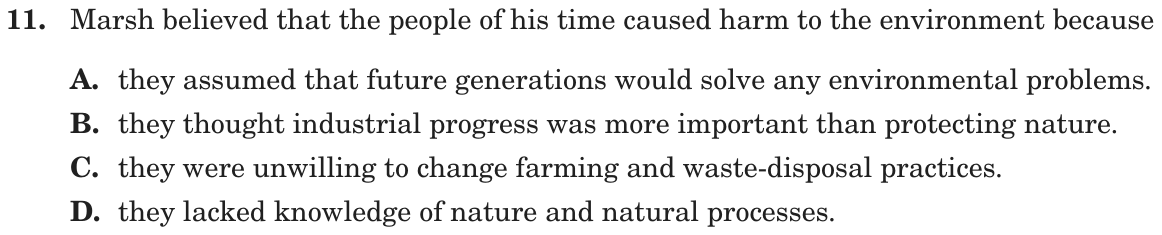
Question 12 of 120
2018 Test A English, question 12Uses the passage above: “An Early Warning”.
Question
What is the most likely reason the author uses the word “surprisingly” in paragraph 1?
- Ato argue that Marsh’s ideas are more applicable in the present than they were during his lifetime
- Bto show that Marsh introduced ideas a century before they became widely accepted
- Cto emphasize that Marsh was unaware that his ideas would help begin a conservation movement
- Dto prove that there would be fewer issues with the environment today if people had accepted Marsh’s ideas earlier
Show the answer
Correct answer: B
The answer is (B)
The question asks for the reason the word “surprisingly” was used in paragraph 1. The beginning of paragraph 1 leads the reader to expect that Marsh was part of the modern environmental movement that began in the 1960s. Therefore, the fact that Marsh’s influential book was published one hundred years earlier is surprising, and so Option B is correct.
Option A is incorrect because, while Marsh’s ideas have had a resurgence in popularity since the 1960s (paragraph 1), Marsh’s observations about deforestation in Vermont (paragraph 2) and land mismanagement in Italy (paragraph 3) indicate that his ideas were just as applicable in his time as they are today.
Option C is incorrect because, while Marsh could not have been aware that his ideas would lead to the start of a conservation movement, paragraph 1 indicates that Marsh introduced the principles of the environmentalist movement before it became popular.
Option D is incorrect because, while it is possible that a greater awareness of human impact on the environment during Marsh’s time could have prevented certain environmental issues today, this idea is conjecture and does not explain the author’s reason for using the word “surprisingly.”
Question analysis
This reading question asks why the author of a passage about the environmental thinker George Perkins Marsh uses the word surprisingly in the opening paragraph. Students must see what the earlier sentences lead a reader to expect and how the next fact contrasts with it, while avoiding choices that read too much into one word.
- Grade level
- Grade 7 reading and task
- Compared with grade 7
- At grade 7 Explaining why an author chose a particular word is common grade 7 reading work. This one rests on reading the first paragraph closely and noticing what the word contrasts, a typical grade 7 demand.
- Estimated difficulty
- Moderate: several steps, or a close reading with one strong distractor.
- Thinking it demands
- Depth of knowledge 2, skills and concepts · mainly analyze
- What makes it hard
- Reading between the lines moderate
- How, not what moderate
- Evidence
- Answered from one paragraph or stanza
- Reading level
- Passage: about grade 12, 523 words; question and choices: about grade 10, 78 words.
- Students, last 30 days
- Not enough answers yet to show (it takes 10).
Why it is hard, traps and wrong answers (shows the answer)
Why it is hard
Students have to reconstruct the expectation that the word overturns, and the paragraph sets it up quietly by naming the 1960s first. Most errors come from attaching the surprise to the wrong sentence, Marsh's absence from the movement, or from turning one adverb into a broad argument about past and present. The question rewards rereading the sentences around the word and asking which fact is unexpected.
Reading between the lines moderate Working it out
The surprise is never explained; the reader must see that the first two sentences lead one to place Marsh in the 1960s, so the date 1864 breaks that expectation. (Graesser, Singer & Trabasso, 1994; Kintsch, 1998)
How, not what moderate Working it out
The question asks why the author chose the single word “surprisingly”, a judgment about the effect of a word rather than a fact the paragraph states. (Anderson & Krathwohl, 2001)
Strategy: Reread the sentences just before the word and ask what a reader would expect at that point. The surprise is whatever breaks that expectation.
Traps
- Wrong purpose or structure: Names a purpose, structure or effect that the part does not serve, or describes what a part says when the question asks what it does.
- Too broad or too strong: A choice overstates, generalizes, or uses absolute words the text does not support.
- Reads too much in: A reasonable-sounding conclusion that goes further than the text allows.
The wrong answers, classified
A Too broad or too strong (King et al., 2004)
Stretches the point that Marsh's ideas outlived him into a claim that they fit today better than in his own time, which the paragraph never argues.
C Wrong purpose or structure (Anderson & Krathwohl, 2001)
Ties the surprise to the preceding sentence about Marsh not being part of the movement, but the word introduces the 1864 date, not anything Marsh knew or foresaw.
D Reads too much in (Graesser, Singer & Trabasso, 1994)
Builds a what-if, that the world would have fewer environmental problems had people listened sooner, which goes far beyond what a single adverb can signal.
Working it out, step by step
Figure out what the question asks
This asks why the author chose one word, “surprisingly.” A word like this tells you the next fact is not what you’d expect. So find what a reader expects, and then find the fact that breaks it.
Read what comes before the word
Paragraph 1 says the book’s message “greatly influenced ecologists during the beginning of the modern environmentalist movement in the 1960s.” Ecologists are scientists who study how living things and nature fit together. Then it says: “Marsh was not, however, part of this movement.” After reading this, you might guess Marsh wrote in the 1960s, or just a bit before.
Find the surprise
The next sentence is: “Surprisingly, Man and Nature was first published in 1864.” From 1864 to the 1960s is about 100 years, or a century. So Marsh had these ideas a whole century before most people accepted them. That is the surprise.
Check each choice
- B: Marsh introduced ideas “a century before they became widely accepted.” This matches the gap from 1864 to the 1960s.
- A: the paragraph never says his ideas fit today better than in his own time.
- C: the paragraph says nothing about what Marsh knew or expected.
- D: the paragraph never says we would have fewer problems if people had listened sooner. That is only a guess.
Watch out: C seems linked to the sentence just before, about Marsh not being in the movement. But “surprisingly” comes right before a date, 1864.
Pick the answer
The surprise is how early Marsh’s ideas came, about a hundred years ahead of the movement. So the answer is B.
Why this answer and not the closest wrong one
C is the closest wrong answer, because it also links Marsh to the later movement. But the surprising fact is a date, not something Marsh knew or didn’t know. B explains the surprise: his ideas came about a century before they caught on.
More questions like this
The original DOE question

Question 13 of 120
2018 Test A English, question 13Uses the passage above: “An Early Warning”.
Question
Which evidence supports the accuracy of Marsh’s theories about nature?
- Athe details about Marsh’s observations of environmental degradation
- Bthe details about how Marsh’s writing inspired a conservation movement
- Cthe details about how Marsh’s ideas are essential to modern environmental science
- Dthe details about Marsh’s opinions on human alterations to the environment
Show the answer
Correct answer: C
The answer is (C)
The question asks for evidence that supports Marsh’s theories about nature, based on the passage. The passage states that ideas from Marsh’s book are now considered basic knowledge in the field of environmental science (paragraph 6). This statement supports the idea that his theories about nature were accurate, making Option C correct.
Option A is incorrect because, while Marsh made observations of the harm that people were causing to the environment (paragraphs 2 and 3), the details about his observations do not provide evidence that his theories were accurate.
Option B is incorrect because, while Marsh’s writing did inspire a conservation movement (paragraph 8), these details do not call attention to the accuracy of his ideas.
Option D is incorrect because it refers to Marsh’s personal opinions (paragraph 7), not his theories.
Question analysis
This reading question asks which details in a passage about George Perkins Marsh and Man and Nature support the accuracy of his theories about nature. Every choice points to real content in the passage, so students must think carefully about what kind of evidence shows that ideas were correct.
- Grade level
- Grade 8 reading and task
- Compared with grade 7
- Above grade 7 Grade 7 students judge whether evidence supports a claim, but here the choices are abstract descriptions of passage content, and the student must decide which kind of detail could actually show a theory to be correct, a step beyond typical grade 7 work.
- Estimated difficulty
- Hard: combines ideas, needs a plan, and has more than one tempting wrong answer.
- Thinking it demands
- Depth of knowledge 3, strategic thinking · mainly evaluate
- What makes it hard
- A very close wrong answer moderate
- Reading between the lines moderate
- Evidence in several places moderate
- Evidence
- Answered from several paragraphs or stanzas
- Reading level
- Passage: about grade 12, 523 words; question and choices: about grade 12, 51 words.
- Students, last 30 days
- Not enough answers yet to show (it takes 10).
Why it is hard, traps and wrong answers (shows the answer)
Why it is hard
The choices are labels for kinds of detail, not quotations, so the student has to translate each one back into the passage and then ask a harder question: does it show the ideas were right? Influence and firsthand observation both feel like proof, and they separate students who confuse popularity or origin with confirmation from those who do not. Only acceptance by modern science judges the theories after the fact.
A very close wrong answer moderate Choosing the answer
The right choice and the one about inspiring a conservation movement are worded alike, details about how Marsh's ideas fared later, and differ only in whether they show acceptance by science or mere influence. (Embretson & Wetzel, 1987; Gorin & Embretson, 2006; Ascalon et al., 2007)
Reading between the lines moderate Working it out
The student must work out what kind of fact could show a theory accurate, later acceptance by a science, and then spot it in paragraph 6's “fundamental principle of modern environmental science”. (Graesser, Singer & Trabasso, 1994; Kintsch, 1998)
Evidence in several places moderate Working it out
The four kinds of detail sit in different paragraphs, observations in 2 and 3, science in 6, opinions in 7 and the movement in 8, and each must be found. (Kirsch & Mosenthal, 1990; Gorin & Embretson, 2006)
Strategy: Decide first what kind of fact would prove a theory accurate, then test each choice against that standard rather than against whether it is true of Marsh.
Traps
- Supports only part of the claim: In a question about evidence: a line that backs one half of the claim but not the other, or a related point rather than the claim itself.
- Reads too much in: A reasonable-sounding conclusion that goes further than the text allows.
- True but not the answer: A choice says something accurate about the text that does not answer this question.
The wrong answers, classified
A Supports only part of the claim (King et al., 2004; Thissen, Steinberg & Fitzpatrick, 1989)
Takes the degradation Marsh saw in Vermont and Italy as proof, but those observations are what his theories were built on, not a later test of them.
B Reads too much in (Graesser, Singer & Trabasso, 1994)
Reasons that ideas which inspired a conservation movement must be correct, mistaking influence for accuracy; many followers show that an idea spread, not that it was true.
D True but not the answer (King et al., 2004; Embretson & Wetzel, 1987)
Points to Marsh's views on canals and other changes to nature in paragraph 7, which are further opinions of his, not evidence that his theories held up.
Working it out, step by step
Figure out what the question asks
This asks what shows that Marsh’s theories were accurate, or correct. A theory is an idea that tries to explain how something works. So you need a detail that shows his ideas turned out to be true. A detail that is just true about Marsh is not enough.
Decide what counts as proof
How can you show an idea is correct? A strong way is when experts study it later and agree with it. Being popular does not make an idea correct. And the facts that gave someone an idea can’t also prove that idea.
Find that proof in the passage
Paragraph 6 says: “His belief that drastic alteration of this balance would be dangerous is now accepted as a fundamental principle of modern environmental science.” A drastic alteration is a big change. A fundamental principle is a basic rule. So scientists today treat Marsh’s idea as a basic truth. That supports its accuracy.
Check each choice
- C: Marsh’s ideas are “essential to modern environmental science.” This matches paragraph 6.
- A: his observations in Vermont and Italy are what he built his theories on. They don’t show the theories were right.
- B: inspiring a movement shows his ideas were popular. Popular is not the same as correct.
- D: his opinions about changing nature, such as praising a canal, are more of his views. They are not proof.
Watch out: A is tempting because the damage Marsh saw was real. But it came before his theories, so it can’t test them.
Pick the answer
Only C shows experts in a science accepting Marsh’s ideas as true. So the answer is C.
Why this answer and not the closest wrong one
B is close because it is also about how Marsh’s ideas did later. But many people can follow an idea that is wrong. C shows that scientists, who test ideas, now accept his belief as a basic rule. That is evidence of accuracy, not just of popularity.
More questions like this
The original DOE question

Question 14 of 120
2018 Test A English, question 14Uses the passage above: “An Early Warning”.
Question
Which detail about Marsh provides support for the author’s statement in paragraph 5?
- Ahis reputation as a radical thinker
- Bhis contribution to the conservation movement
- Chis experience working as an ambassador
- Dhis approval of beneficial human-made projects in nature
Show the answer
Correct answer: D
The answer is (D)
The question asks for a specific detail that supports the author’s statement in paragraph 5. In paragraph 5, the author states that “Marsh argued that people may use and enjoy, but not destroy, the riches of the earth.” Marsh’s approval of the Suez Canal shows that Marsh did not oppose certain human innovations, because the advantages—improved transportation and commerce—enriched human life and outweighed environmental damage (paragraph 7). Option D describes that idea.
Option A is incorrect because it is not relevant to the statement in question.
Option B is incorrect because, while it acknowledges Marsh’s contributions to the conservation movement, it does not relate to his attitudes about certain alterations to the environment.
Option C is incorrect because it relates to a time when Marsh observed environmental degradation in Italy.
Question analysis
This reading question asks which detail about George Perkins Marsh supports a statement the author makes in paragraph 5 of a passage about his book Man and Nature. Students must pin down the exact claim first, then find the detail elsewhere in the passage that illustrates it, since all four choices are true facts about Marsh.
- Grade level
- Grade 8 reading and task
- Compared with grade 7
- Above grade 7 Matching a supporting detail to a claim is grade 7 work, but here the student must first decide which statement in paragraph 5 is meant and then connect it to a detail elsewhere, with choices given as brief labels.
- Estimated difficulty
- Hard: combines ideas, needs a plan, and has more than one tempting wrong answer.
- Thinking it demands
- Depth of knowledge 3, strategic thinking · mainly evaluate
- What makes it hard
- Evidence in several places moderate
- Reading between the lines moderate
- Evidence
- Answered from several paragraphs or stanzas
- Reading level
- Passage: about grade 12, 523 words; question and choices: about grade 11, 38 words.
- Students, last 30 days
- Not enough answers yet to show (it takes 10).
Why it is hard, traps and wrong answers (shows the answer)
Why it is hard
Paragraph 5 contains two statements, and the question does not say which one it means, so a student must settle that first. Anchored to the first sentence, the radical-thinker detail looks like a fit; anchored to “use and enjoy, but not destroy”, only the approval of the Suez Canal works. The brief labels hide which paragraph each detail comes from, so every one has to be traced.
Evidence in several places moderate Working it out
The claim is in paragraph 5 but its support, Marsh's praise of the Suez Canal, is two paragraphs later, and the choices are brief labels that must be traced back. (Kirsch & Mosenthal, 1990; Gorin & Embretson, 2006)
Reading between the lines moderate Working it out
Praise for a canal does not mention the earth's riches; the student must see that approving a useful human-made change shows “use and enjoy” in practice. (Graesser, Singer & Trabasso, 1994; Kintsch, 1998)
Strategy: Restate paragraph 5's claim in your own words, then ask of each detail whether it shows Marsh holding that view, rather than simply being true about him.
Traps
- Supports only part of the claim: In a question about evidence: a line that backs one half of the claim but not the other, or a related point rather than the claim itself.
- True but not the answer: A choice says something accurate about the text that does not answer this question.
The wrong answers, classified
A Supports only part of the claim (King et al., 2004; Thissen, Steinberg & Fitzpatrick, 1989)
Links going against “the popular belief” with being a radical thinker, which is true of Marsh but says nothing about using nature without destroying it.
B Supports only part of the claim (King et al., 2004; Thissen, Steinberg & Fitzpatrick, 1989)
Equates “use and enjoy, but not destroy” with conservation, yet the movement Marsh inspired preserved wilderness, and his part in it does not show his view on use.
C True but not the answer (King et al., 2004; Embretson & Wetzel, 1987)
Picks his years as ambassador to Italy, which explain where he saw land abuse but say nothing about how he thought people should use the earth.
Working it out, step by step
Figure out what the question asks
First find the author’s statement in paragraph 5. Then find the detail about Marsh that backs it up, or shows it is true.
Find the statement in paragraph 5
Paragraph 5 says: “Marsh argued that people may use and enjoy, but not destroy, the riches of the earth.” The riches of the earth are nature’s gifts, like land, water, and forests. In plain words: it is fine to use nature, as long as you don’t wreck it.
Look for that view in action
Paragraph 7 says: “Marsh did not oppose every human alteration to the environment.” He praised the Suez Canal, a waterway people dug so ships could pass. He believed its benefits, “improved transportation and commerce,” would outweigh any harm. Commerce means trade, or buying and selling. So Marsh was fine with people using nature in a helpful way.
Check each choice
- D: his approval of helpful human-made projects shows “use and enjoy” in action.
- A: he was a radical thinker, but that says nothing about how people should use nature.
- B: he helped inspire the conservation movement, but that doesn’t show his view on using nature.
- C: his job in Italy explains where he saw land damage. It says nothing about how to use the earth.
Watch out: Paragraph 5 says Marsh’s book challenged a “popular belief,” which can make you think of “radical.” But A doesn’t show the use-but-don’t-destroy idea.
Pick the answer
Praising a useful canal shows Marsh believed people may use nature. So the answer is D.
Why this answer and not the closest wrong one
A is the closest wrong answer. Marsh was a radical thinker, and paragraph 5 does say his book challenged a popular belief. But being radical doesn’t show that people may use nature. Praising a useful canal does, so D gives real support.
More questions like this
The original DOE question

Question 15 of 120
2018 Test A English, question 15Uses the passage above: “An Early Warning”.
Question
Which of Marsh’s ideas most influenced the environmental movement of the 1960s?
- ASome human alterations to the environment are necessary.
- BPeople lack an understanding of the environment.
- CHuman activities could damage the environment.
- DEnvironmental degradation has been occurring for many years.
Show the answer
Correct answer: C
The answer is (C)
The question asks for the idea Marsh had that was the most influential on the movement in the 1960s. Marsh’s main contribution to the modern environmental movement—the idea that Western society is causing irreversible harm to the environment—is given in paragraph 1, making Option C correct.
Option A is incorrect because, while Marsh did believe that some human alterations to the environment are necessary (paragraph 7), the negative impact of human activity was his most influential idea.
Option B is incorrect because, while Marsh believed that people lacked an understanding of nature (paragraph 3), this belief is a detail in support of his overall claim.
Option D is incorrect because, while Marsh observed firsthand that environmental degradation had been occurring for many years (paragraph 3), that was not the focus of his most influential idea.
Question analysis
This reading question asks which of George Perkins Marsh's ideas most influenced the environmental movement of the 1960s, according to a passage about his book Man and Nature. All four choices are ideas the passage connects to Marsh, so students must find the one the text links to that later movement.
- Grade level
- Grade 7 reading and task
- Compared with grade 7
- At grade 7 Identifying an idea that a text says shaped later events is routine grade 7 reading. Each choice is one of Marsh's real ideas, so the demand is matching the question to the passage's exact statement, not interpretation.
- Estimated difficulty
- Straightforward: two steps or one careful reading.
- Thinking it demands
- Depth of knowledge 1, recall and reproduction · mainly understand
- What makes it hard
- The right answer is reworded moderate
- Every choice must be checked minor
- Evidence
- Answered from one paragraph or stanza
- Reading level
- Passage: about grade 12, 523 words; question and choices: about grade 12, 41 words.
- Students, last 30 days
- Not enough answers yet to show (it takes 10).
Why it is hard, traps and wrong answers (shows the answer)
Why it is hard
The link to the 1960s is stated outright in the second sentence of the passage, so a student who goes back to it can answer quickly. Points are lost by answering from memory, since every choice is a genuine Marsh idea, including his view that people misunderstand nature. Matching the paraphrase rather than the familiar wording is the whole task.
The right answer is reworded moderate Choosing the answer
The right choice restates paragraph 1's message, “causing irreparable harm to the environment”, in plain words, while wrong ones echo “environmental degradation” and “human alteration to the environment”. (Freedle & Kostin, 1993; Kirsch & Mosenthal, 1990)
Every choice must be checked minor Choosing the answer
All four choices are ideas the passage connects to Marsh, so recognizing one as his is not enough; each must be checked for a link to the 1960s. (Embretson & Wetzel, 1987)
Strategy: Find where the passage mentions the movement of the 1960s and read exactly what it says influenced it, then match that wording to a choice.
Traps
- True but not the answer: A choice says something accurate about the text that does not answer this question.
- Word match: Repeats striking words or phrases from the text, so it looks supported, but its meaning does not fit the question.
The wrong answers, classified
A True but not the answer (King et al., 2004; Embretson & Wetzel, 1987)
Recalls paragraph 7's point that Marsh accepted some changes to nature, such as the Suez Canal, a real view of his but not the message credited with shaping the 1960s.
B True but not the answer (King et al., 2004; Embretson & Wetzel, 1987)
Remembers Marsh blaming “man's ignorant disregard for the laws of nature”, a real belief, but the passage ties the 1960s to his warning about harm, not to ignorance.
D Word match (Freedle & Kostin, 1993)
Repeats “environmental degradation” from the passage's first sentence, so it looks anchored in paragraph 1, but long-standing damage is an observation, not the message that influenced ecologists.
Working it out, step by step
Figure out what the question asks
All four choices are ideas linked to Marsh. You need the one the passage says shaped the environmental movement of the 1960s. So find where the passage talks about the 1960s.
Find the 1960s in the passage
Paragraph 1 says: “Its message—that Western society is in the process of causing irreparable harm to the environment—greatly influenced ecologists during the beginning of the modern environmentalist movement in the 1960s.”
Put the sentence in plain words
“Its message” means the book’s main point. Irreparable means it can’t be repaired. Western society means the countries of Europe and North America. So the message was: people are doing damage to nature that can’t be undone. That message is what influenced the 1960s ecologists.
Check each choice
- C: “Human activities could damage the environment.” This says the same thing in simpler words.
- A: Marsh did accept some changes, like the Suez Canal (paragraph 7). But the passage doesn’t link that to the 1960s.
- B: Marsh did blame “man’s ignorant disregard for the laws of nature” (paragraph 3). But that is a reason for the harm, not the message that shaped the 1960s.
- D: “environmental degradation,” or damage, appears in paragraph 1. But saying damage has gone on for years is only an observation.
Watch out: B is a real belief of Marsh’s, so it feels right. Make sure a choice answers this question, about the 1960s.
Pick the answer
The passage directly says the message about harm influenced the 1960s. So the answer is C.
Why this answer and not the closest wrong one
B is the closest wrong answer, because Marsh really did think people didn’t understand nature. But paragraph 1 says the message that influenced the 1960s was about harm: people were “causing irreparable harm to the environment.” C states that idea.
More questions like this
The original DOE question
Question 16 of 120
2018 Test A English, question 16Passage Champion of the Channel
Champion of the Channel
In 1926 an editor at the London Daily News predicted that Gertrude Ederle, an American swimmer with eighteen world records and three Olympic medals, would fail in her attempt to swim across the English Channel. He claimed that “even the most uncompromising champion of the rights and capacities of women must admit that in contests of physical skill, speed and endurance they must remain forever the weaker sex.” Yet, at only nineteen years old, Ederle not only became the first woman to accomplish this feat, she also broke the men’s record by two hours. Gertrude Ederle’s triumphant swim across the English Channel was a testimony to her determination, innovative spirit, and passion for swimming.
Crossing the English Channel is a daunting task for any swimmer. At its narrowest point, the channel measures twenty-one miles across. Its icy waters hover around sixty degrees Fahrenheit, and its unruly tides and currents toss swimmers about like bobbing corks. Stinging jellyfish, seaweed, and floating debris from shipwrecks and lost cargoes present added hazards.
For decades the channel’s perils have defeated countless swimmers. Ederle, too, failed in her first attempt to cross the channel in 1925. Just six miles short of finishing, she became ill, and her coach had to haul her out of the water. Undeterred, Ederle decided to try again. Ederle knew that if she did not complete the challenge this time, she might never get the opportunity to set this record, because a rival female swimmer was preparing to make her second attempt at the crossing as well.
To prepare for the marathon swim, Ederle found ways to improve her equipment. She and her sister Meg discovered that melted candle wax perfectly sealed goggle edges, effectively waterproofing Ederle’s goggles against hammering waves. The sisters also designed a two-piece silk swimsuit for Ederle. During her first channel-crossing attempt she had worn a standard one-piece swimsuit that, after the lengthy hours of swimming across the channel, had stretched out, filling with water and creating drag, making an already challenging task almost insurmountable. Unlike the cumbersome typical bathing suit, this silk invention weighed little and allowed for easy movement.
On August 6, 1926, Ederle waded into the channel near Cape Gris-Nez, France. At first she shivered in the bone-chilling water even though she had covered her body in eight layers of grease for insulation. Her limbs felt stiff. Her strokes were irregular. Driving forward, she fought to clear her mind and find what she called her “sphere,” a place where the sea became her only companion and the shrieks of gulls and the humming of boat engines faded away. Using a new overhand stroke called the American crawl, Ederle eventually settled into a steady pace, briskly breaking through waves.
Throughout Ederle’s swim, two tugboats accompanied her. One carried newspaper reporters who wired dispatches of her progress to shore. The other, displaying a sign that read “This way, ole kid!” with an arrow pointing forward, transported her coach, family, and friends. Her coach played songs, such as “Yes, We Have No Bananas,” on a phonograph so that Ederle could time her strokes to the rhythm. Using a net, her coach also passed her baby bottles of broth for nourishment.
For hours Ederle swam, dodging debris with an amused smile. However, as she neared the English shore, a sudden fierce storm erupted. The tides and waves forced Ederle backward, and she fought the stubborn swells for several hours. The salty water caused her tongue to swell and inflamed her ears. Yet Ederle felt indescribably happy as she churned through the sea. Finally, as she neared the English shore, the storm abated, and the tide turned. No longer fighting against her, the sea pushed her toward the shore and victory.
After fourteen hours and thirty-one minutes, Ederle, on wobbly legs, stepped onto the English shore. The waiting crowd roared, honked their automobile horns, blasted their tugboat whistles, and set off flares that flashed in the sky. Ederle had swum into history.
When Ederle returned to New York, she received a parade, where thousands of people shouted “Trudy!” Not only were everyday American citizens proud of Ederle, but she also inspired them to be more active. Over the next few years, more than 60,000 people credited her with motivating them to earn their American Red Cross swimming certificates. Gertrude Ederle’s accomplishment proved to the world that with determination and passion, it was possible for a person to achieve his or her goals.
SOLO SWIMS ACROSS THE ENGLISH CHANNEL
|
Earliest Speed Records |
||
| Year | Swimmer | Time |
| 1875 | Matthew Webb (M) | 21 hours, 45 minutes |
| 1923 | Enrico Tiraboschi (M) | 16 hours, 33 minutes |
| 1926 | Gertrude Ederle (F) | 14 hours, 31 minutes |
| 1926 | Arnst Vierkotter (M) | 12 hours, 38 minutes |
| Current Speed Records | ||
| Year | Swimmer | Time |
| 2012 | Trent Grimsey (M) | 6 hours, 55 minutes |
| 2006 | Yvetta Hlavacova (F) | 7 hours, 25 minutes |
Question
Read this sentence from paragraph 1.
In 1926 an editor at the London Daily News predicted that Gertrude Ederle, an American swimmer with eighteen world records and three Olympic medals, would fail in her attempt to swim across the English Channel.
What does the editor’s comment reveal about the challenges Ederle faced in attempting her feat?
- ARegardless of her ability, being an American put Ederle at a serious disadvantage over a Londoner, who would be more familiar with the English Channel.
- BAt the time, Ederle still needed more training in order to succeed in the daunting task of swimming the English Channel.
- CWhile Ederle could participate in athletic competition, some people were not comfortable with her attempt to swim the channel because no woman had ever attempted it before.
- DIn spite of her previous achievements, Ederle still experienced social as well as physical obstacles in attempting to swim the channel.
Show the answer
Correct answer: D
This is the answer (D)
The question asks what the sentence reveals about Ederle’s challenges leading up to her attempt to swim across the channel.
Option D is correct because the sentence implies a lack of social support since many people believed that a woman, no matter how skilled a swimmer, did not have the strength to overcome the physical challenges that the dangerous channel waters presented (paragraph 1: “He claimed that ‘even the most uncompromising champion of the rights and capacities of women must admit that in contests of physical skill, speed and endurance they must remain forever the weaker sex.’”).
Option A is incorrect because the idea that Ederle was at a disadvantage because she was American rather than English, and thus less familiar with the channel, was not the basis for the newspaper editor’s prediction about the outcome of her swim.
Option B is incorrect because the passage establishes that Ederle was a highly accomplished swimmer who had won major world competitions (paragraph 1: “. . . Gertrude Ederle, an American swimmer with eighteen world records and three Olympic medals . . .”).
Option C is incorrect; the newspaper editor’s point was that it would be impossible for Ederle to complete the swim because she was a woman, not because people were uncomfortable with the idea since no woman had attempted it before.
Question analysis
This reading question quotes a 1926 newspaper editor's prediction that swimmer Gertrude Ederle would fail to cross the English Channel and asks what it reveals about the challenges she faced. Students must infer what lay behind the editor's prediction, and one tempting choice gets the attitude partly right but the reason wrong.
- Grade level
- Grade 7 reading and task
- Compared with grade 7
- At grade 7 Inferring what a quoted opinion reveals is standard grade 7 work. The demand is typical, though the editor's full reasoning, with words like uncompromising, comes in the sentence after the one quoted in the question.
- Estimated difficulty
- Moderate: several steps, or a close reading with one strong distractor.
- Thinking it demands
- Depth of knowledge 2, skills and concepts · mainly understand
- What makes it hard
- Reading between the lines moderate
- A very close wrong answer moderate
- Complex sentences minor
- Evidence
- Answered from one paragraph or stanza
- Reading level
- Passage: about grade 9, 790 words; question and choices: about grade 13, 148 words.
- Students, last 30 days
- Not enough answers yet to show (it takes 10).
Why it is hard, traps and wrong answers (shows the answer)
Why it is hard
The quoted sentence on its own suggests only that someone doubted Ederle, so students who stay inside it guess at why. Those who read the editor's next sentence find the reason, his belief that women are the weaker sex, and can see social prejudice as an obstacle. The near miss gets the prejudice right but invents its cause, and the right answer adds the physical challenge that the second paragraph details.
Reading between the lines moderate Working it out
The quoted sentence gives only a prediction; its reason, women as “the weaker sex”, comes in the next sentence and must be read as a social obstacle alongside the channel's physical ones. (Graesser, Singer & Trabasso, 1994; Kintsch, 1998)
A very close wrong answer moderate Choosing the answer
The right choice and the one about people being uncomfortable both find a social obstacle in spite of her ability, and they part only on its cause: the editor's view of women, or no woman having tried. (Embretson & Wetzel, 1987; Gorin & Embretson, 2006; Ascalon et al., 2007)
Complex sentences minor Understanding the question
The editor's claim is one long, formal sentence beginning “even the most uncompromising champion of the rights and capacities of women”, with its point delayed to the end. (Abedi & Lord, 2001; Freedle & Kostin, 1993; Messick, 1989)
Strategy: Read the editor's full claim in the sentence that follows, then ask what his reasoning was based on and what it suggests about the challenges she faced.
Traps
- Half right: One half of a two-part choice is right and the other is not.
- Outside knowledge: A choice is plausible in the real world but not supported by this text.
The wrong answers, classified
A Outside knowledge (King et al., 2004; Recht & Leslie, 1988)
Reads a London editor doubting an American as national rivalry and local knowledge of the channel, a plausible guess that the editor's own words about women rule out.
B Word match (Freedle & Kostin, 1993)
Borrows “daunting task” from paragraph 2 and assumes a predicted failure means too little training, despite the eighteen world records and three Olympic medals in the same sentence.
C Half right (King et al., 2004; Thissen, Steinberg & Fitzpatrick, 1989)
Rightly senses social doubt but gives the wrong reason: the editor says women are weaker, and women, including Ederle in 1925, had already attempted the crossing.
Working it out, step by step
Figure out what the question asks
The editor predicted that Ederle would fail. You need to work out what his prediction shows about the challenges she faced. This is an inference: a smart guess based on clues in the text.
Read the editor’s reason
The very next sentence gives his reason. He said that “even the most uncompromising champion of the rights and capacities of women must admit that in contests of physical skill, speed and endurance they must remain forever the weaker sex.”
Put his words in plain English
A champion here means a supporter of a cause. Uncompromising means not giving in at all. Capacities means abilities. So he said: even the strongest supporter of women must admit that women will always be weaker in sports. He expected her to fail just because she was a woman.
See the two kinds of challenge
The editor ignored her skill. She had “eighteen world records and three Olympic medals.” So she faced a social obstacle, one that comes from what other people think. People doubted her because she was a woman. She also faced physical obstacles. Paragraph 2 describes the icy water, the tides, and the jellyfish.
Check each choice
- D: in spite of her past wins, she faced “social as well as physical obstacles.” This matches.
- A: the editor never mentions her being American or knowing the channel.
- B: her records show she was well trained. Training was not the editor’s reason.
- C: people did doubt her, but not because no woman had tried. Ederle herself had tried in 1925 (paragraph 3).
Watch out: C spots the social problem but gives the wrong reason for it.
Pick the answer
The editor’s view of women was a social obstacle, added to the hard swim itself. So the answer is D.
Why this answer and not the closest wrong one
C is the closest wrong answer, since it also points to a social problem. But the editor’s reason was that women are “the weaker sex,” not that no woman had tried. In fact, Ederle tried in 1925. D names the real social obstacle and the physical ones too.
More questions like this
The original DOE question
The passage “Champion of the Channel” as printed (pages 56–57)
Question 17 of 120
2018 Test A English, question 17Uses the passage above: “Champion of the Channel”.
Question
Which sentence is the best summary of the steps that Ederle took to prepare for her second attempt to swim across the English Channel?
- AWorking with her sister, Ederle waterproofed her goggles using melted candle wax to seal the edges and designed a two-piece silk bathing suit that was lightweight and would not stretch out during the long swim.
- BEderle covered her body in numerous layers of grease for insulation and focused on finding her “sphere” during her swim.
- CEderle began training with her coach, who played music while she swam to help her time her strokes to the music.
- DEderle focused on developing better equipment than the standard swimsuit that proved cumbersome during her first attempt to cross the channel.
Show the answer
Correct answer: A
The answer is (A)
The question asks for the best summary of Ederle’s steps to prepare for her second attempt to swim across the English Channel. Ederle’s preparation is outlined in paragraph 4.
Option A is correct because it acknowledges the idea that Ederle involved her sister in this process, and it details the efforts the two took to improve Ederle’s equipment, including waxing her goggles and designing a better swimsuit.
Option B is incorrect because it focuses on Ederle’s actions in the moments before (covering her body with grease for insulation) and during her swim (finding her “sphere”), not her overall preparation methods.
Option C is incorrect because it refers to a practice that was employed to help Ederle keep her strokes in rhythm during her swim.
Option D is incorrect because it does not refer to the series of steps that Ederle took to prepare for her swim but rather to just one of the efforts made (improving equipment) without acknowledging her sister’s contributions.
Question analysis
This reading question asks for the best summary of the steps swimmer Gertrude Ederle took to prepare for her second attempt to cross the English Channel. The passage describes many things Ederle and her helpers did, so students must sort out which ones were preparation and which summary covers them most completely.
- NYS standards
- 7R2 theme or central idea
- Grade level
- Grade 6 reading and task
- Compared with grade 7
- Below grade 7 Summarizing the steps described in one paragraph is a grade 6 skill; grade 7 summaries usually cover a whole text and how it develops. The demand here is a careful match between details and choices.
- Estimated difficulty
- Straightforward: two steps or one careful reading.
- Thinking it demands
- Depth of knowledge 2, skills and concepts · mainly understand
- What makes it hard
- A very close wrong answer moderate
- Every choice must be checked minor
- Evidence
- Answered from one paragraph or stanza
- Reading level
- Passage: about grade 9, 790 words; question and choices: about grade 12, 121 words.
- Students, last 30 days
- Not enough answers yet to show (it takes 10).
Why it is hard, traps and wrong answers (shows the answer)
Why it is hard
The preparation is confined to paragraph 4, but the passage keeps describing things Ederle and her team did, so students must separate getting ready from the swim itself. The grease is the trickiest, since she put it on before entering the water. Between the two equipment summaries, the one that lists the goggles, the suit and her sister's help is the fuller account.
A very close wrong answer moderate Choosing the answer
The right summary and the one about better equipment than the standard swimsuit describe the same work, and only the waxed goggles and Meg's help, missing from the shorter one, tell them apart. (Embretson & Wetzel, 1987; Gorin & Embretson, 2006; Ascalon et al., 2007)
Every choice must be checked minor Choosing the answer
Two choices take real details from the swim itself, the grease and the phonograph, so each must be placed in time, before the swim or during it. (Embretson & Wetzel, 1987)
Strategy: Find the paragraph that describes how Ederle got ready, list its steps in order, and choose the summary that matches that list most completely.
Traps
- Wrong part of the text: A choice is true of another paragraph, stanza or speaker than the one asked about.
- Too narrow: A single detail offered as the central idea or a summary, or a summary that keeps minor details and leaves out an essential part.
The wrong answers, classified
B Wrong part of the text (Kirsch & Mosenthal, 1990)
Takes the grease she wore on the day and her search for her “sphere” in the water, both from paragraph 5's account of the swim, as preparation.
C Twists what the text says (King et al., 2004)
Turns the phonograph her coach played from a tugboat during the crossing into training sessions, which the passage never describes.
D Too narrow (King et al., 2004)
Captures the idea of better equipment but mentions only the swimsuit, leaving out the waxed goggles and her sister Meg, so it summarizes one step of several.
Working it out, step by step
Figure out what the question asks
A summary tells the main points in a short way. This asks for the steps Ederle took to get ready for her second try. So focus on what she did before the swim, not during it.
Find the paragraph about getting ready
Paragraph 4 begins: “To prepare for the marathon swim, Ederle found ways to improve her equipment.” That word “prepare” tells you this is the paragraph you need.
List the steps in paragraph 4
- She and her sister Meg found that “melted candle wax perfectly sealed goggle edges.” That kept water out of her goggles.
- The sisters “designed a two-piece silk swimsuit” for her.
- Her old suit had “stretched out, filling with water and creating drag.” Drag is a pull that slows you down.
- The new suit “weighed little and allowed for easy movement.”
Check each choice
- A names her sister, the waxed goggles, and the light silk suit. It covers every step.
- B: the grease and her “sphere” come from paragraph 5, the day of the swim itself.
- C: her coach played music on a phonograph, an old record player, during the swim (paragraph 6). The passage never describes training sessions.
- D is about better gear, but it mentions only the swimsuit.
Watch out: D is true, but it leaves out the goggles and Meg’s help. A summary of the steps should name the steps.
Pick the answer
Choice A matches the full list of steps from paragraph 4, with nothing missing. So the answer is A.
Why this answer and not the closest wrong one
D is the closest wrong answer, because better equipment is the main idea of paragraph 4. But D tells only about the swimsuit. It leaves out the waxed goggles and her sister Meg. A includes every step, so it is the best summary.
More questions like this
The original DOE question
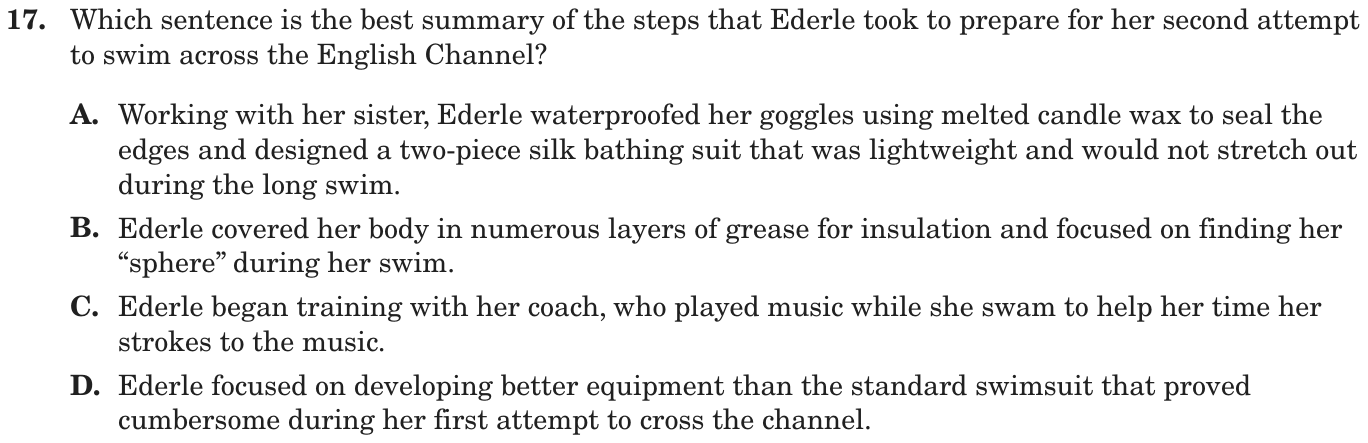
Question 18 of 120
2018 Test A English, question 18Uses the passage above: “Champion of the Channel”.
Question
Read this sentence from paragraph 3.
Ederle knew that if she did not complete the challenge this time, she might never get the opportunity to set this record, because a rival female swimmer was preparing to make her second attempt at the crossing as well.
How does this sentence fit into the overall structure of the passage?
- AIt emphasizes that Ederle’s attempt to swim across the channel led other female swimmers to attempt the challenge.
- BIt presents the reason why Ederle prepared to cross the channel again immediately after her initial failure.
- CIt shows Ederle’s realization that she had to rethink her methods if she wanted to be the first woman to cross the channel.
- DIt indicates that Ederle had learned from her mistakes and was working to fix them before her next attempt.
Show the answer
Correct answer: B
The answer is (B)
The question asks how the sentence from paragraph 3 fits into the overall structure of the passage.
Option B is correct because it explains that Ederle’s awareness of another female swimmer preparing to make an attempt to swim the channel directly influenced Ederle’s decision to make her second attempt as quickly as possible. Ederle wanted to be the first woman to successfully swim across the channel.
Option A is incorrect because the passage does not provide information about other female swimmers who were inspired by Ederle to swim across the channel.
Option C is incorrect because, although Ederle did rethink her methods between her first and second attempts, the sentence does not show any sort of realization nor does it address her reasoning for rethinking her methods.
Option D is incorrect because the sentence is not related to Ederle’s process for learning from her mistakes.
Question analysis
This reading question quotes a sentence about a rival swimmer from a passage on Gertrude Ederle's English Channel swim and asks how it fits the passage's overall structure. Students must see how the sentence connects her failed first attempt to what came next, and the choices differ in small but important ways.
- Grade level
- Grade 8 reading and task
- Compared with grade 7
- Above grade 7 Explaining how one sentence fits a passage's structure is a grade 7 standard, but the choices differ by shades of meaning and the sentence must be read against the paragraphs on either side, which goes beyond typical grade 7 work.
- Estimated difficulty
- Hard: combines ideas, needs a plan, and has more than one tempting wrong answer.
- Thinking it demands
- Depth of knowledge 3, strategic thinking · mainly analyze
- What makes it hard
- A very close wrong answer major
- How, not what moderate
- Reading between the lines moderate
- Evidence
- Answered from several paragraphs or stanzas
- Reading level
- Passage: about grade 9, 790 words; question and choices: about grade 10, 133 words.
- Corrected from the DOE handbook
- The handbook’s answer key was corrected, because its own explanation supports a different choice.
- Students, last 30 days
- Not enough answers yet to show (it takes 10).
Why it is hard, traps and wrong answers (shows the answer)
Why it is hard
The sentence sits at a hinge, right before a paragraph about new goggles and a new swimsuit, so it is easy to read that paragraph's content back into it. What the sentence itself offers is a motive, the rival's plans, for trying again without delay. Students who paraphrase the sentence before reading the choices avoid the trap; those who match choices to the surrounding story fall into it.
A very close wrong answer major Choosing the answer
The right choice and the rethinking-methods one both tie the sentence to her next attempt and to being first across; only the sentence's silence about methods separates them, and even the DOE handbook keyed the wrong one. (Embretson & Wetzel, 1987; Gorin & Embretson, 2006; Ascalon et al., 2007)
How, not what moderate Working it out
The question asks what the sentence does in the passage, bridging the failed 1925 attempt and the new equipment of paragraph 4, rather than what it says. (Anderson & Krathwohl, 2001)
Reading between the lines moderate Working it out
The “because” clause gives a motive for urgency, a rival preparing her second attempt, which the student must connect to Ederle's decision to try again. (Graesser, Singer & Trabasso, 1994; Kintsch, 1998)
Strategy: Reread the sentence along with the two sentences before it, put what this sentence itself says into your own words, and only then compare the choices with it.
Traps
- Half right: One half of a two-part choice is right and the other is not.
- Wrong part of the text: A choice is true of another paragraph, stanza or speaker than the one asked about.
- Reversed relationship: Cause and effect, or the order of events, turned around.
The wrong answers, classified
A Reversed relationship (King et al., 2004)
Reads the rival's attempt as a result of Ederle's, reversing the sentence, in which the rival's plans come first and spur Ederle on.
C Half right (King et al., 2004; Thissen, Steinberg & Fitzpatrick, 1989)
Gets the aim right, being the first woman to cross, but adds a realization about rethinking her methods that the sentence never mentions and paragraph 4 only implies.
D Wrong part of the text (Kirsch & Mosenthal, 1990)
Brings in the fixes of paragraph 4, the waxed goggles and the silk suit, though this sentence is about a rival's threat and says nothing about past mistakes.
What was corrected from the DOE handbook, and why
- Answer key: The handbook keys this question G (C on this site). But its explanation of the correct answer, that knowing a rival was preparing her own attempt made Ederle decide to make her second attempt as quickly as possible, describes F (B here), and its reason for rejecting F, that the sentence shows no realization about rethinking her methods, describes G (C here). The quoted sentence gives a reason for urgency and says nothing about her methods, which the passage turns to in paragraph 4. The key is now B, and the explanation’s option letters were swapped to match its reasoning.
Working it out, step by step
Figure out what the question asks
This asks what job the sentence does in the passage. It’s not just what the sentence says, but why it is there. So look at what comes right before it and right after it.
Read the sentence in its place
Paragraph 3 says Ederle failed in 1925. Then: “Undeterred, Ederle decided to try again.” Undeterred means not discouraged. Next comes the sentence: “Ederle knew that if she did not complete the challenge this time, she might never get the opportunity to set this record, because a rival female swimmer was preparing to make her second attempt at the crossing as well.”
Put it in your own words
A rival is someone trying to reach the same goal. Another woman was getting ready to try again too. If she made it first, Ederle could never be the first woman across. So Ederle had to try again, and soon. The sentence gives the reason she hurried to try again.
Notice what the sentence leaves out
The sentence says nothing about her goggles, her swimsuit, or her methods. It doesn’t mention any mistakes she made. Those ideas come later, in paragraph 4. So any choice about fixing her methods goes beyond this sentence.
Check each choice
- B: it gives the reason she got ready to cross again so soon. A rival might beat her.
- A has it backward. Here the rival’s plan pushes Ederle, not the other way around. Nothing says Ederle led other women to try.
- C is about rethinking her methods. The sentence never mentions methods.
- D is about learning from mistakes. The sentence never mentions mistakes either.
Watch out: C is the trickiest. It gets her goal right, to be the first woman across. But “rethink her methods” is not in this sentence.
Pick the answer
The sentence explains why Ederle rushed to try again after she failed. So the answer is B.
Why this answer and not the closest wrong one
C is the closest wrong answer. Ederle did improve her gear later, and she did want to be first. But this sentence never says she needed new methods. It gives only her reason to hurry: a rival was about to try again. That is exactly what B says.
More questions like this
The original DOE question
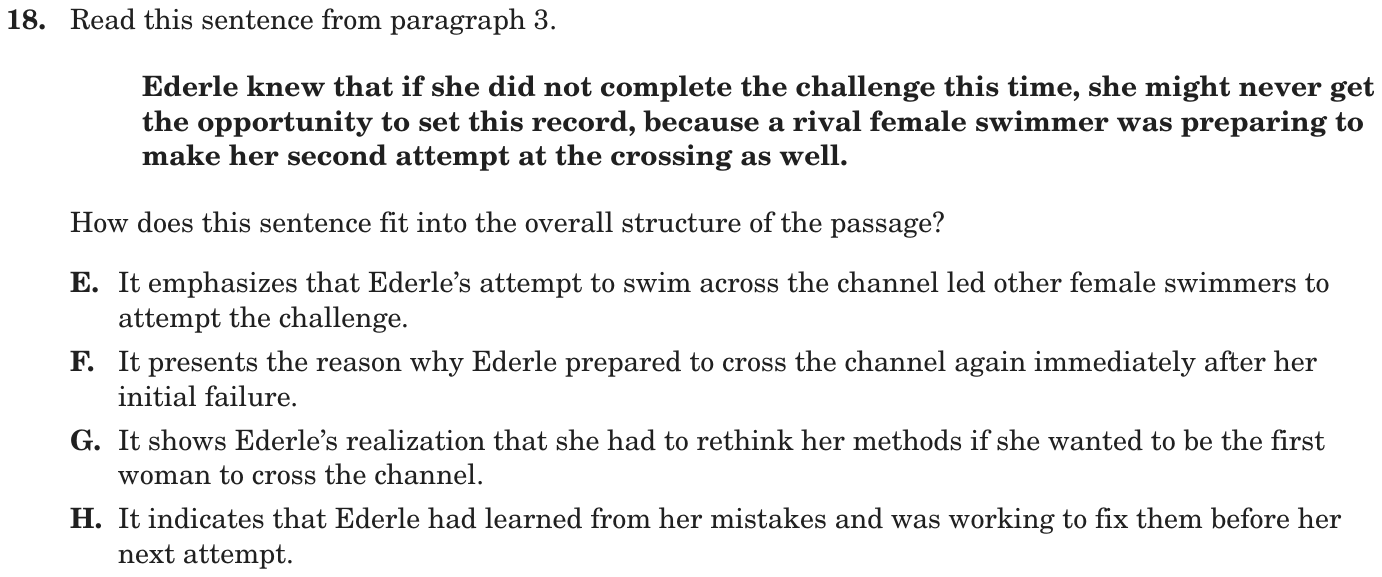
Question 19 of 120
2018 Test A English, question 19Uses the passage above: “Champion of the Channel”.
Question
Which sentence best supports the idea that Ederle succeeded in swimming across the channel because of her innovative approach to the challenge?
- A“Yet, at only nineteen years old, Ederle not only became the first woman to accomplish this feat, she also broke the men’s record by two hours.” (paragraph 1)
- B“At first she shivered in the bone-chilling water even though she had covered her body in eight layers of grease for insulation.” (paragraph 5)
- C“Using a new overhand stroke called the American crawl, Ederle eventually settled into a steady pace, briskly breaking through waves.” (paragraph 5)
- D“No longer fighting against her, the sea pushed her toward the shore and victory.” (paragraph 7)
Show the answer
Correct answer: C
The answer is (C)
The question asks for the best support for the idea that Ederle’s swim across the channel was successful because of her innovative approach to the challenge.
Option C is correct because the sentence from paragraph 5 explains that Ederle employed a newly developed type of stroke that allowed her to maintain her pace through the rough water.
Option A is incorrect because the sentence from paragraph 1 shows that her performance was groundbreaking but not necessarily creative.
Option B is incorrect because the layers of grease primarily served to help maintain Ederle’s body temperature in the water, and there is nothing in the passage to suggest that this was an innovative practice.
Option D is incorrect because the sentence from paragraph 7 simply states that Ederle fought against the waves and completed her swim, and it does not describe how Ederle employed innovative techniques.
Question analysis
This reading question asks which quoted sentence best supports the idea that Gertrude Ederle crossed the English Channel because of an innovative approach. Each quotation describes a real moment of her story, so students must test each one against what innovative actually means.
- NYS standards
- 7R1 textual evidence and inferences
- Grade level
- Grade 7 reading and task
- Compared with grade 7
- At grade 7 Choosing the sentence that best supports an idea is a core grade 7 reading task. The quotations come with paragraph numbers, so the demand is a careful check of each against the key word innovative, as in typical grade 7 practice.
- Estimated difficulty
- Straightforward: two steps or one careful reading.
- Thinking it demands
- Depth of knowledge 2, skills and concepts · mainly evaluate
- What makes it hard
- Evidence
- Answered from several paragraphs or stanzas
- Reading level
- Passage: about grade 9, 790 words; question and choices: about grade 12, 108 words.
- Corrected from the DOE handbook
- A wrong paragraph number in the explanation was corrected.
- Students, last 30 days
- Not enough answers yet to show (it takes 10).
Why it is hard, traps and wrong answers (shows the answer)
Why it is hard
The claim has two parts, success and an innovative cause, and only one quotation shows both. The record-breaking sentence proves the success but says nothing about method, while the grease is a technique the passage never calls new and that did not keep her from shivering. The word “new” in the crawl sentence is the signal careful readers use.
Every choice must be checked minor Choosing the answer
Each quotation shows a real part of the swim, so each must pass two tests: it shows something new that Ederle did, and that thing helped her finish. (Embretson & Wetzel, 1987)
Strategy: Pin down what innovative means in your own words, then ask of each quoted sentence whether it shows an innovative approach of Ederle's at work and helping her succeed.
Traps
- Reads too much in: A reasonable-sounding conclusion that goes further than the text allows.
- Supports only part of the claim: In a question about evidence: a line that backs one half of the claim but not the other, or a related point rather than the claim itself.
The wrong answers, classified
A Supports only part of the claim (King et al., 2004; Thissen, Steinberg & Fitzpatrick, 1989)
Picks the passage's headline result, first woman and two hours under the men's record, which proves she succeeded but shows no new method behind it.
B Reads too much in (Graesser, Singer & Trabasso, 1994)
Treats eight layers of grease as an innovation, though the passage never calls it new and says she shivered despite it, so it is not shown driving her success.
D Supports only part of the claim (King et al., 2004; Thissen, Steinberg & Fitzpatrick, 1989)
Chooses the turning tide that carried her to “victory”, which helped her finish but was a change in the sea, not an approach Ederle devised.
What was corrected from the DOE handbook, and why
- Explanation: The handbook says the sentence in choice D comes from paragraph 6. The choice itself and the passage place it in paragraph 7 (“No longer fighting against her, the sea pushed her toward the shore and victory.”), so the explanation now says paragraph 7.
Working it out, step by step
Figure out what the question asks
Innovative means new and creative, a fresh way of doing something. You need a sentence that shows two things. First, Ederle used something new. Second, that new thing helped her succeed.
Look for something new
- A says she was the first woman across and beat the men’s record. That shows she succeeded, but not how.
- B says she wore grease “for insulation,” a layer that keeps heat in. The passage never calls the grease new.
- C says she used “a new overhand stroke called the American crawl” (paragraph 5). Here is the word “new.”
- D says the sea pushed her to shore. That is the tide changing, not something Ederle did.
Check that it helped her
Choice C goes on: she “eventually settled into a steady pace, briskly breaking through waves.” A stroke is the way you move your arms to swim. Briskly means quickly and with energy. So the new stroke gave her a steady, quick pace. That helped her get across.
Rule out the grease
Watch out: B can seem clever, since the grease was meant to keep her warm. But the same sentence says she still “shivered in the bone-chilling water.” So the passage does not call it new, and it does not show it helping her win.
Pick the answer
Only C shows a new method that helped her succeed. So the answer is C.
Why this answer and not the closest wrong one
B is the closest wrong answer, because grease for warmth sounds smart. But the passage never says it was new, and she shivered anyway. C has both parts: the word “new” and a result, a “steady pace” through the waves.
More questions like this
The original DOE question
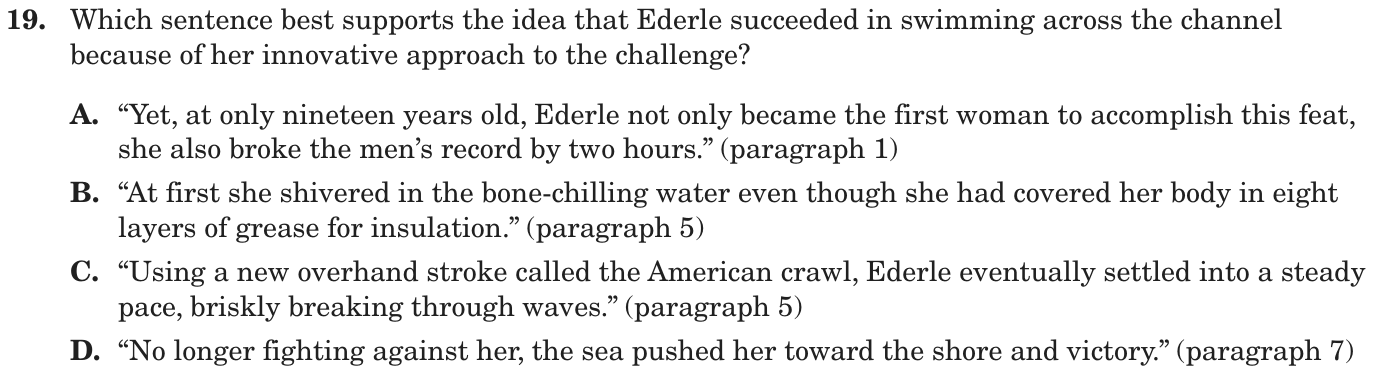
Question 20 of 120
2018 Test A English, question 20Uses the passage above: “Champion of the Channel”.
Question
In paragraph 4, the word “insurmountable” is used to highlight
- Ahow the bathing suit made it impossible for Ederle to make it across the channel.
- Bhow Ederle and her sister decided to improve Ederle’s swimming equipment in a creative way.
- Cthat the flaws in Ederle’s bathing suit made a difficult task even more complicated.
- Dthat the swimming equipment Ederle used needed to be custom made for her attempt.
Show the answer
Correct answer: C
The answer is (C)
The question asks about the effect of the word “insurmountable,” which means “incapable of being overcome,” in paragraph 4.
Option C is correct because the suit Ederle wore during her first attempt to swim the channel “stretched out, filling with water and creating drag” (paragraph 4), which likely contributed to her failed attempt to swim across the channel.
Option A is incorrect; Ederle did not complete her first swim because she became ill (paragraph 3: “Just six miles short of finishing, she became ill, and her coach had to haul her out of the water.”), not because the suit made it impossible for Ederle to complete her swim.
Option B is incorrect because the author uses the word “insurmountable” to draw attention to the increased difficulty caused by the swimsuit, not to draw attention to the sisters’ creativity in solving the problem.
Option D is incorrect because the passage does not address whether the original swimsuit was custom made, simply that the swimsuit created additional difficulties for Ederle in a situation that was already difficult.
Question analysis
This vocabulary-in-context question asks what the author highlights by using the word insurmountable in a passage about Gertrude Ederle's English Channel swim. Students must read the word as it is used in its sentence about her first swimsuit and decide what point it stresses, which takes close attention to the surrounding words.
- Grade level
- Grade 7 reading and task
- Compared with grade 7
- At grade 7 Working out the effect of a difficult word from its context is standard grade 7 work. The word is advanced, but the sentence around it explains the situation clearly, so the overall demand is typical.
- Estimated difficulty
- Moderate: several steps, or a close reading with one strong distractor.
- Thinking it demands
- Depth of knowledge 2, skills and concepts · mainly analyze
- What makes it hard
- Hard words moderate
- Complex sentences moderate
- A very close wrong answer moderate
- Evidence
- Answered from one sentence or line
- Reading level
- Passage: about grade 9, 790 words; question and choices: about grade 9, 67 words.
- Students, last 30 days
- Not enough answers yet to show (it takes 10).
Why it is hard, traps and wrong answers (shows the answer)
Why it is hard
Knowing what insurmountable means is necessary but not sufficient, because the phrase is “almost insurmountable” and the point is how much harder the old suit made a hard swim. The commonest error takes the word at full strength and blames the suit for a failure that paragraph 3 attributes to illness. Choices about the sisters' fix describe the paragraph's next move rather than what this word stresses.
Hard words moderate Understanding the question
The question turns on “insurmountable”, impossible to overcome, and on the “almost” in front of it, which turns impossible into extremely hard. (Perfetti, 2007; Freedle & Kostin, 1993)
Complex sentences moderate Understanding the question
The word ends a 38-word sentence whose “that” clause is interrupted by “after the lengthy hours of swimming across the channel”, so its link to the swimsuit is easy to lose. (Abedi & Lord, 2001; Freedle & Kostin, 1993; Messick, 1989)
A very close wrong answer moderate Choosing the answer
The right choice and the one saying the suit made crossing impossible make the same point about the old suit and differ only in degree, which turns on the word “almost”. (Embretson & Wetzel, 1987; Gorin & Embretson, 2006; Ascalon et al., 2007)
Strategy: Read the whole sentence containing the word, along with the sentences around it, then ask what point about the old swimsuit the author is stressing.
Traps
- Dictionary meaning, not meaning here: A common meaning of the word that does not fit its use in this text.
- Reads too much in: A reasonable-sounding conclusion that goes further than the text allows.
- Wrong purpose or structure: Names a purpose, structure or effect that the part does not serve, or describes what a part says when the question asks what it does.
The wrong answers, classified
A Dictionary meaning, not meaning here (Perfetti, 2007)
Applies the word's full sense, impossible to overcome, and ignores “almost”; the suit made the swim harder, and paragraph 3 says illness ended the first attempt.
B Wrong purpose or structure (Anderson & Krathwohl, 2001)
Answers with the paragraph's main point, the sisters' creative new gear, when the word stresses the problem the old suit caused, not the solution.
D Reads too much in (Graesser, Singer & Trabasso, 1994)
Leaps from the old suit's failure to a claim that her equipment had to be custom made, a conclusion the word itself does not carry.
Working it out, step by step
Figure out what the question asks
This asks why the author used the word “insurmountable.” First you need to know what the word means. Then you need to see what point it helps the author make.
Find the word in its sentence
Paragraph 4 says her old suit “had stretched out, filling with water and creating drag, making an already challenging task almost insurmountable.” Drag is a pull that slows you down in the water.
Work out what the word means
To surmount something means to get over it, like climbing over a wall. So insurmountable means impossible to get over or beat. But the author wrote “almost insurmountable.” Almost means not quite. Also notice “already challenging.” The swim was hard to begin with. So the suit made a hard job even harder. It did not make it fully impossible.
Check each choice
- C: the suit’s flaws made “a difficult task even more complicated.” This matches “already challenging” plus “almost insurmountable.”
- A says the suit made the swim “impossible.” That ignores “almost.” Also, paragraph 3 says her first try ended because “she became ill.”
- B: the sisters’ creative fix is in other sentences. This word describes the problem, not the fix.
- D: the passage never says her gear had to be custom made.
Watch out: A uses the dictionary meaning of the word. But always read the words around it, like “almost.”
Pick the answer
The word stresses how much harder the old suit made the swim. So the answer is C.
Why this answer and not the closest wrong one
A is the closest wrong answer, because it uses the word’s full meaning, impossible. But the author wrote “almost,” and Ederle’s first try ended when she got sick, not because of her suit. C keeps the right amount: a hard task made even harder.
More questions like this
The original DOE question

Question 21 of 120
2018 Test A English, question 21Uses the passage above: “Champion of the Channel”.
Question
Which statement describes how the author’s use of problem-and-solution in paragraph 5 contributes to the development of ideas in the passage?
- ADetailing the challenges that the cold channel waters presented highlights how effective Ederle’s training was.
- BDescribing Ederle’s physical difficulties during her swim provides evidence of the team effort required in order to ensure her safety.
- CExplaining the difficulties that arose early in the effort helps predict the additional problems that occurred during Ederle’s attempt.
- DIllustrating Ederle’s process of blocking out her discomfort shows that swimming the channel was both a mental and a physical challenge.
Show the answer
Correct answer: D
The answer is (D)
The question asks how a problem-and-solution structure in paragraph 5 contributes to the ideas presented in the passage.
Option D is correct because the paragraph describes how the water’s temperature made Ederle uncomfortable and made it difficult for her to regulate her stroke. The paragraph continues with the explanation of how she overcame these issues by focusing her mind on the sea and tuning out the distractions in her surroundings (paragraph 5: “. . . the sea became her only companion and the shrieks of gulls and the humming of boat engines faded away.”).
Option A is incorrect because the details in paragraph 5 do not provide a connection between the cold temperature of the water and the effectiveness of Ederle’s training.
Option B is incorrect because the difficulties Ederle encountered were only partially relieved by her team, and her team’s efforts to ensure Ederle’s safety are not explained in the passage.
Option C is incorrect because the paragraph does not focus on the relationship between the problems Ederle encountered at the start of her swim and the problems she encountered during or near the end of her swim.
Question analysis
This reading question asks how the problem-and-solution structure of one paragraph about Gertrude Ederle's English Channel swim helps develop the passage's ideas. Students must identify the difficulties she faced at the start of the swim and how she overcame them, then judge which abstract statement describes that pattern without adding details the paragraph lacks.
- Grade level
- Grade 8 reading and task
- Compared with grade 7
- Above grade 7 Analyzing how a paragraph's structure develops ideas is grade 7 content, but the choices are abstract claims about purpose, the paragraph's problems and solutions must be identified first, and every choice mentions real difficulties, more than typical grade 7 work.
- Estimated difficulty
- Hard: combines ideas, needs a plan, and has more than one tempting wrong answer.
- Thinking it demands
- Depth of knowledge 3, strategic thinking · mainly analyze
- What makes it hard
- How, not what major
- Every choice must be checked moderate
- Figurative or literary language minor
- Evidence
- Answered from one paragraph or stanza
- Reading level
- Passage: about grade 9, 790 words; question and choices: about grade 14, 95 words.
- Corrected from the DOE handbook
- A grammar slip in the explanation was corrected.
- Students, last 30 days
- Not enough answers yet to show (it takes 10).
Why it is hard, traps and wrong answers (shows the answer)
Why it is hard
The first halves of the choices are all true, which pushes the whole judgment onto what each says the paragraph accomplishes. The paragraph's solution is mental, clearing her mind until the noise faded, so a reading that sees only physical problems reaches for training, teamwork or foreshadowing. Students who list the problems and the fixes before reading the choices see that only one statement accounts for both.
How, not what major Working it out
The question asks how a problem-and-solution pattern in paragraph 5 develops the passage's ideas, so the student must name the pattern's effect, not retell the cold and the stiffness. (Anderson & Krathwohl, 2001)
Every choice must be checked moderate Choosing the answer
Every choice opens with an accurate phrase about paragraph 5's difficulties, the cold water or the early struggle, so only each choice's second half can be tested. (Embretson & Wetzel, 1987)
Figurative or literary language minor Understanding the question
The solution is told in images, finding her “sphere”, where “the sea became her only companion”, which must be read as a mental strategy. (Graesser, Singer & Trabasso, 1994; Kintsch, 1998)
Strategy: List the problems paragraph 5 names and how Ederle got past each one, then choose the statement that accounts for the problems and the solutions alike.
Traps
- Wrong purpose or structure: Names a purpose, structure or effect that the part does not serve, or describes what a part says when the question asks what it does.
- Outside knowledge: A choice is plausible in the real world but not supported by this text.
- Wrong part of the text: A choice is true of another paragraph, stanza or speaker than the one asked about.
The wrong answers, classified
A Outside knowledge (King et al., 2004; Recht & Leslie, 1988)
Assumes that getting through the cold shows good training, a natural idea from sports, but paragraph 5 never mentions training and credits her mind and stroke instead.
B Wrong part of the text (Kirsch & Mosenthal, 1990)
Imports the support team from paragraph 6's tugboats, while paragraph 5 centres on Ederle's own body and mind and says nothing about a team or her safety.
C Wrong purpose or structure (Anderson & Krathwohl, 2001)
Reads the early stiffness and shivering as foreshadowing of the later storm, a structural link the paragraph never makes, while ignoring how she overcame the cold.
What was corrected from the DOE handbook, and why
- Explanation: The handbook reads “her team’s efforts to ensure Ederle’s safety is not explained”. It now reads “are not explained”, since the subject is “efforts”.
Working it out, step by step
Figure out what the question asks
In a problem-and-solution pattern, the author shows a problem and then how someone deals with it. You need to say what this pattern in paragraph 5 adds to the passage. So first find the problems. Then find the solutions.
Find the problems
At first Ederle “shivered in the bone-chilling water.” Then: “Her limbs felt stiff. Her strokes were irregular.” Limbs are arms and legs. Irregular means uneven. These are problems with her body.
Find the solutions
Next, “she fought to clear her mind” and find her “sphere.” Her sphere was “a place where the sea became her only companion and the shrieks of gulls and the humming of boat engines faded away.” That is a calm place in her mind. She shut out the noise and her discomfort. Then, with the American crawl, she “settled into a steady pace.”
Decide what the pattern shows
The problems are in her body: cold, stiff, and uneven. Much of the solution is in her mind: focusing and shutting out the world. So the paragraph shows that the swim tested both her body and her mind.
Check each choice
- D: blocking out her discomfort shows the swim was “both a mental and a physical challenge.” Mental means of the mind.
- A: paragraph 5 never mentions her training.
- B: the team on the tugboats is in paragraph 6. Paragraph 5 is about Ederle alone.
- C: paragraph 5 doesn’t use the early trouble to hint at later problems. It shows her getting past it.
Watch out: A storm does come later, in paragraph 7, so C can seem right. But paragraph 5 ends with her solving the problem, not with a warning.
Pick the answer
Only D explains both the problems and the way she solved them. So the answer is D.
Why this answer and not the closest wrong one
C is the closest wrong answer, because more trouble does come later, in the storm. But paragraph 5 doesn’t hint at the storm. It ends with Ederle “briskly breaking through waves.” D explains the whole pattern: body problems solved partly by the mind.
More questions like this
The original DOE question
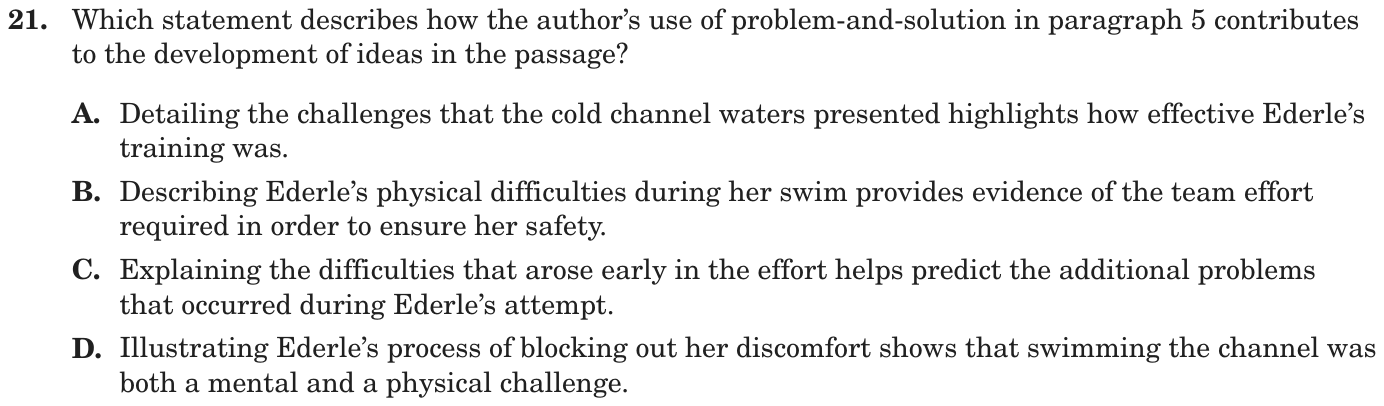
Question 22 of 120
2018 Test A English, question 22Uses the passage above: “Champion of the Channel”.
Question
Paragraph 7 contributes to the development of the central idea of the passage by
- Aillustrating that Ederle’s physical strength and mental fortitude allowed her to stay focused on her goal.
- Bconveying that Ederle pushed herself to the edge of her physical capabilities in order to complete the swim.
- Chighlighting the impact the severe weather had on Ederle’s emotions during her swim.
- Demphasizing the surge of emotions Ederle felt as she came closer to achieving a personal goal.
Show the answer
Correct answer: D
The answer is (D)
The question asks for an explanation of how paragraph 7 contributes to the development of a central idea of the passage. Paragraph 7 is mainly about Ederle’s physical and emotional state as she pushed through a difficult portion of her swim and realized her goal was in sight. A central idea of the passage is that Ederle’s passion and determination allowed her to accomplish her goal of being the first woman to cross the English Channel.
Option D is correct because it emphasizes her passion by referring to the overwhelming emotions Ederle felt as she progressed during her swim, despite the unfavorable conditions (paragraph 7: “For hours Ederle swam, dodging debris with an amused smile” and “Yet Ederle felt indescribably happy as she churned through the sea.”).
Option A is incorrect because, although Ederle needed physical strength and mental fortitude to complete the swim, the paragraph contributes to a central idea because it highlights her emotion as she swam, not her physical strength or mental fortitude.
Option B is incorrect because the paragraph focuses on Ederle’s emotional response to the challenging circumstances and not the idea that Ederle was at the “edge of her physical capabilities.”
Option C is incorrect because Ederle’s feelings of happiness and amusement were caused by her anticipation and excitement as she approached achieving her goal, not by the severe weather.
Question analysis
This reading question asks how the paragraph about the storm near the end of Gertrude Ederle's English Channel swim contributes to the passage's central idea. Students must decide what the paragraph mainly does and connect it to the larger point, while every choice sounds like a fair description of a hard swim.
- Grade level
- Grade 8 reading and task
- Compared with grade 7
- Above grade 7 Explaining how one paragraph develops a central idea is a grade 7 standard, but here several choices sound true of a hard swim through a storm, and the student must see what the paragraph is mainly about, beyond typical grade 7 work.
- Estimated difficulty
- Hard: combines ideas, needs a plan, and has more than one tempting wrong answer.
- Thinking it demands
- Depth of knowledge 3, strategic thinking · mainly analyze
- What makes it hard
- A very close wrong answer major
- Evidence in several places moderate
- How, not what moderate
- Evidence
- Answered from several paragraphs or stanzas
- Reading level
- Passage: about grade 9, 790 words; question and choices: about grade 11, 76 words.
- Students, last 30 days
- Not enough answers yet to show (it takes 10).
Why it is hard, traps and wrong answers (shows the answer)
Why it is hard
Paragraph 7 is crowded with hardship, a storm, a swollen tongue and inflamed ears, so the obvious reading is that it shows toughness. The author's pointed “Yet Ederle felt indescribably happy” turns it toward emotion, which ties it to the passion named in the thesis. Several choices are fair about the swim in general, and this is one of the closer calls on the test, since strength is also on display.
A very close wrong answer major Choosing the answer
The right choice and the strength-and-fortitude one both describe Ederle's inner state as she nears her goal, and only whether paragraph 7 stresses her feelings or her toughness separates them, since she does fight “the stubborn swells for several hours”. (Embretson & Wetzel, 1987; Gorin & Embretson, 2006; Ascalon et al., 2007)
Evidence in several places moderate Working it out
The central idea, her “determination, innovative spirit, and passion for swimming”, is stated in paragraph 1, six paragraphs before the storm it must be connected to. (Kirsch & Mosenthal, 1990; Gorin & Embretson, 2006)
How, not what moderate Working it out
The question asks how paragraph 7 develops the central idea, so the student must weigh what its details stress, the “amused smile” and “indescribably happy”, not just what happens. (Anderson & Krathwohl, 2001)
Strategy: Mark the words in paragraph 7 that describe how Ederle felt and what she endured, decide which the author stresses, then connect that to the passage's stated central idea.
Traps
- True but not the answer: A choice says something accurate about the text that does not answer this question.
- Too broad or too strong: A choice overstates, generalizes, or uses absolute words the text does not support.
The wrong answers, classified
A True but not the answer (King et al., 2004; Embretson & Wetzel, 1987)
Credits strength and mental fortitude, which the hours against the swells partly show, but the paragraph's turn on “Yet” stresses her joy, not her toughness.
B Too broad or too strong (King et al., 2004)
Inflates the swollen tongue and inflamed ears into reaching “the edge of her physical capabilities”, an extreme the paragraph never claims.
C Twists what the text says (King et al., 2004)
Sees both the storm and her feelings but makes the weather the cause of her emotions, when she felt happy in spite of it.
Working it out, step by step
Figure out what the question asks
You need to explain how paragraph 7 helps build the central idea, the main point of the passage. So first find the central idea. Then see what paragraph 7 stresses.
Find the central idea
The last sentence of paragraph 1 says: “Gertrude Ederle’s triumphant swim across the English Channel was a testimony to her determination, innovative spirit, and passion for swimming.” A testimony here means proof. Passion means a strong love for something.
See what happens in paragraph 7
A fierce storm pushes Ederle backward. She fights “the stubborn swells for several hours.” Swells are big, rolling waves. Salt water makes her tongue swell and her ears sore. Then the storm ends, and the sea pushes her “toward the shore and victory.”
Notice what the author stresses
Look at the feeling words. She swims “dodging debris with an amused smile.” In the middle of the pain, the author writes: “Yet Ederle felt indescribably happy as she churned through the sea.” Indescribably means too much to put into words. The word “Yet” shows a surprise. She felt joy in spite of the pain. That shows her passion for swimming.
Check each choice
- D: a “surge of emotions” as she came closer to her goal. A surge is a sudden rush. This matches the smile and the happiness.
- A: strength and “mental fortitude,” or toughness. She was tough, but the paragraph stresses her joy.
- B: the paragraph never says she reached “the edge of her physical capabilities.”
- C says the storm caused her feelings. She was happy in spite of the storm, not because of it.
Watch out: A is tempting because she fought for hours. But the “Yet” sentence turns to how she felt.
Pick the answer
Paragraph 7 builds the passage’s idea of her passion by showing her feelings. So the answer is D.
Why this answer and not the closest wrong one
A is the closest wrong answer, because she does fight “the stubborn swells for several hours.” But the paragraph’s key words are about feeling: “amused smile” and “indescribably happy.” Those link to her “passion for swimming” in paragraph 1. D names those emotions.
More questions like this
The original DOE question
Question 23 of 120
2018 Test A English, question 23Uses the passage above: “Champion of the Channel”.
Question
Ederle’s victorious swim across the English Channel influenced American attitudes mainly by
- Asparking interest in physical activity and in seeking swimming certification.
- Bencouraging other swimmers to seek out and achieve challenging feats.
- Cdemonstrating that women could achieve and even surpass feats accomplished by men.
- Dshowing that determination and perseverance are necessary to overcome previous failures.
Show the answer
Correct answer: A
The answer is (A)
The question asks for an explanation of how Ederle’s successful swim across the channel affected American attitudes.
Option A is correct because the passage indicates that there was a large increase in the number of American men and women who became physically active and who obtained swimming certificates shortly after Ederle’s swim (paragraph 9: “Over the next few years, more than 60,000 people credited her with motivating them to earn their American Red Cross swimming certificates.”).
Option B is incorrect because, although there was an increase in the number of people learning to swim, the passage does not provide details about people who were inspired by Ederle to take on extreme challenges such as swimming across the channel.
Option C is incorrect because, although Ederle did, in fact, surpass the men’s time for the swim by two hours, the passage does not provide information about how this achievement affected the American people’s perception of the capabilities of men and women.
Option D is incorrect because, although the passage does explain how Ederle’s determination and perseverance led to her eventual success, it does not demonstrate how this affected American attitudes toward overcoming failures.
Question analysis
This reading question asks how Gertrude Ederle's record-setting English Channel swim mainly influenced American attitudes, according to the final paragraph of the passage. Students must stick to what the passage actually reports about Americans' reactions, since several choices sound plausible for such a famous swim.
- Grade level
- Grade 7 reading and task
- Compared with grade 7
- At grade 7 Explaining how a person influenced others is typical grade 7 reading. The evidence sits in one paragraph near the end, and the main demand is matching each choice to what that paragraph actually says.
- Estimated difficulty
- Moderate: several steps, or a close reading with one strong distractor.
- Thinking it demands
- Depth of knowledge 2, skills and concepts · mainly understand
- What makes it hard
- A very close wrong answer moderate
- The right answer is reworded minor
- Evidence
- Answered from one paragraph or stanza
- Reading level
- Passage: about grade 9, 790 words; question and choices: about grade 13, 55 words.
- Students, last 30 days
- Not enough answers yet to show (it takes 10).
Why it is hard, traps and wrong answers (shows the answer)
Why it is hard
The answer is reported plainly in the last paragraph, but the passage's opening primes a different expectation. Because the editor dismissed women and Ederle then beat the men's record, many students expect her swim to have changed how Americans saw women, an effect the passage never reports. The question rewards sticking to what the text says Americans actually did afterward.
A very close wrong answer moderate Choosing the answer
The right choice and the one about encouraging other swimmers both say Ederle moved people to take up swimming, and differ only in scale: earning swimming certificates or chasing “challenging feats”. (Embretson & Wetzel, 1987; Gorin & Embretson, 2006; Ascalon et al., 2007)
The right answer is reworded minor Choosing the answer
The answer recasts paragraph 9's “inspired them to be more active” and “swimming certificates” in new words, while one wrong choice echoes the closing word “determination”. (Freedle & Kostin, 1993; Kirsch & Mosenthal, 1990)
Strategy: Go to the paragraph about her return to New York and note exactly what it says Americans did or felt afterward, then match that report to a choice.
Traps
- Reads too much in: A reasonable-sounding conclusion that goes further than the text allows.
- Too broad or too strong: A choice overstates, generalizes, or uses absolute words the text does not support.
- Twists what the text says: Uses the text's topic and ideas but changes what it says: who did it, how much, when, or why.
The wrong answers, classified
B Too broad or too strong (King et al., 2004)
Stretches the 60,000 people she motivated to earn swimming certificates into swimmers chasing “challenging feats”, a bigger claim than the passage makes about anyone.
C Reads too much in (Graesser, Singer & Trabasso, 1994)
Combines the editor's “weaker sex” remark with her beating the men's record and concludes Americans changed their views of women, an effect the passage never describes.
D Twists what the text says (King et al., 2004)
Echoes the closing line about determination but changes “it was possible” to “necessary” and adds overcoming failure, a lesson the passage gives the world, not American habits.
Working it out, step by step
Figure out what the question asks
This asks how Ederle’s swim changed the way Americans thought or acted. You need the effect the passage actually reports. So look at what happened after she came home.
Find the effect in paragraph 9
Paragraph 9 says: “Not only were everyday American citizens proud of Ederle, but she also inspired them to be more active.” It goes on: “Over the next few years, more than 60,000 people credited her with motivating them to earn their American Red Cross swimming certificates.”
Put it in plain words
To credit someone means to say they were the reason for something. A swimming certificate is a paper that shows you passed a swimming course. So Americans got more active. Many worked to earn swimming certificates because of her.
Check each choice
- A: “sparking interest in physical activity and in seeking swimming certification.” This matches both parts of paragraph 9.
- B says swimmers went after “challenging feats.” The passage talks about certificates, not big feats.
- C: Ederle did beat the men’s record. But the passage never says this changed what Americans thought about women.
- D echoes the last sentence about determination. But that sentence is about what she proved “to the world,” and it says “possible,” not “necessary.”
Watch out: C feels right because of the editor in paragraph 1. But the passage never reports a change in how Americans saw women.
Pick the answer
Paragraph 9 reports that Americans became more active and earned swimming certificates. So the answer is A.
Why this answer and not the closest wrong one
B is close because it also says people were moved to swim. But it says they chased “challenging feats,” like crossing the channel. The passage only says people got more active and earned swimming certificates. A matches that exactly.
More questions like this
The original DOE question

Question 24 of 120
2018 Test A English, question 24Uses the passage above: “Champion of the Channel”.
Question
Which sentence from the passage best conveys the author’s perspective regarding the impact of Ederle’s accomplishment?
- A“Gertrude Ederle’s triumphant swim across the English Channel was a testimony to her determination, innovative spirit, and passion for swimming.” (paragraph 1)
- B“For hours Ederle swam, dodging debris with an amused smile.” (paragraph 7)
- C“Yet Ederle felt indescribably happy as she churned through the sea.” (paragraph 7)
- D“Ederle had swum into history.” (paragraph 8)
Show the answer
Correct answer: D
The answer is (D)
The question asks for the sentence from the passage that best conveys the author’s perspective about the impact of Ederle’s swim.
Option D is correct because, throughout the passage, the author emphasizes that Ederle’s accomplishment was memorable and great, which is best stated in the sentence from paragraph 8.
The sentence presented in Option A is incorrect because it focuses on Ederle’s personal attributes that allowed her to successfully complete her swim, not the author’s perspective about the impact of her achievement.
The sentence presented in Option B is incorrect because the details in the sentence relate to Ederle’s state of mind as she came closer to achieving her goal and do not provide details about the author’s opinion of the impact of Ederle’s accomplishment.
The sentence presented in Option C is incorrect because it simply presents Ederle’s emotional state as she nears her goal and does not provide information about the author’s perspective.
Question analysis
This reading question asks which quoted sentence best conveys the author's own perspective on the impact of Gertrude Ederle's English Channel swim. Every quotation shows the swim in a positive light, so students must tell the author's judgment apart from description and keep the question's focus on impact in mind.
- Grade level
- Grade 7 reading and task
- Compared with grade 7
- At grade 7 Identifying an author's own perspective is typical grade 7 point-of-view work. The quotations are short and labeled, and the main demand is attending to the word impact in the question.
- Estimated difficulty
- Moderate: several steps, or a close reading with one strong distractor.
- Thinking it demands
- Depth of knowledge 2, skills and concepts · mainly analyze
- What makes it hard
- How, not what moderate
- Figurative or literary language minor
- Evidence
- Answered from several paragraphs or stanzas
- Reading level
- Passage: about grade 9, 790 words; question and choices: about grade 12, 66 words.
- Corrected from the DOE handbook
- A grammar slip in the explanation was corrected.
- Students, last 30 days
- Not enough answers yet to show (it takes 10).
Why it is hard, traps and wrong answers (shows the answer)
Why it is hard
Two tests apply at once: whose view a sentence gives and whether that view concerns impact. The thesis sentence passes the first and fails the second, which makes it the main trap, while the two sentences from paragraph 7 report Ederle's feelings, not the author's judgment. The short sentence in paragraph 8 is easy to skim past because it states impact in five words and a figure of speech.
How, not what moderate Working it out
The question asks for the author's perspective, so narration of Ederle's own feelings, her “amused smile” and being “indescribably happy”, has to be set apart from the author's judgment. (Anderson & Krathwohl, 2001)
Figurative or literary language minor Understanding the question
“Ederle had swum into history” states the impact through a figure of speech, so the student must read it as a claim that the swim earned a lasting place. (Graesser, Singer & Trabasso, 1994; Kintsch, 1998)
Strategy: Ask two questions of each quotation: whose view does it express, and is it about the swim's impact or about something else? Only one quotation passes both tests.
Traps
- True but not the answer: A choice says something accurate about the text that does not answer this question.
- Wrong tone or attitude: Misjudges the tone, attitude or point of view, such as reading admiration as criticism, or taking a character's or subject's feelings for the author's.
The wrong answers, classified
A True but not the answer (King et al., 2004; Embretson & Wetzel, 1987)
Picks the passage's thesis, a real statement of the author's view, but it praises her determination and passion rather than saying what the swim meant or changed.
B Wrong tone or attitude (Graesser, Singer & Trabasso, 1994)
Takes Ederle's “amused smile” while dodging debris as the author's opinion, but it describes her mood mid-swim, not any judgment about the swim's impact.
C Wrong tone or attitude (Graesser, Singer & Trabasso, 1994)
Reads “indescribably happy” as the author's enthusiasm, but the sentence reports how Ederle felt during the storm, not how the author sees her achievement's impact.
What was corrected from the DOE handbook, and why
- Explanation: In the reason for rejecting F (B on this site), the handbook reads “the details in the sentence relate to … and does not provide details”. It now reads “do not provide”, to agree with “details”.
Working it out, step by step
Figure out what the question asks
A perspective is a point of view. Impact means the effect something has. So you need a sentence that shows the author’s opinion about what Ederle’s swim meant. A sentence about how Ederle felt does not count.
Ask two questions of each quote
For each choice, ask: Whose view is this, the author’s or Ederle’s? Then ask: Is it about the effect of the swim, or about something else? Only one choice will pass both tests.
Check each choice
- A: the swim was “a testimony to her determination, innovative spirit, and passion for swimming.” This is the author’s view, but it is about her qualities, not the swim’s effect.
- B: “dodging debris with an amused smile” describes Ederle’s mood during the swim.
- C: “Ederle felt indescribably happy” describes her feelings, not the author’s judgment.
- D: “Ederle had swum into history” (paragraph 8). This is the author speaking about what the swim meant.
Explain the key phrase
“Swum into history” is a figure of speech, words that mean more than their exact sense. She didn’t really swim into a history book. It means her swim was so important that people will remember it for a long time. That is a judgment about its impact.
Pick the answer
Watch out: A is the author’s main claim, so it is tempting. But it explains what made her succeed, not what her success meant. So the answer is D.
Why this answer and not the closest wrong one
A is the closest wrong answer, because it is also the author’s own opinion. But it tells what the swim showed about Ederle: her determination and passion. D tells what the swim meant: it made history. Only D is about impact.
More questions like this
The original DOE question
Question 25 of 120
2018 Test A English, question 25Uses the passage above: “Champion of the Channel”.
Question
The table contributes to the development of the topic of the passage mainly by
- Aemphasizing that people have continued to swim across the channel and have significantly reduced the speed record.
- Bsuggesting that Ederle inspired women to swim across the channel in an attempt to break the current speed record.
- Crevealing that Ederle is not the only woman who has set a record time for swimming across the English Channel.
- Dproviding a comparison between channel-swimming records of the early twentieth century and current records.
Show the answer
Correct answer: A
The answer is (A)
The question asks for an explanation of how the table at the end of the passage contributes to the development of the topic of the passage. The table provides information about the earliest speed records set for crossing the channel, including Ederle’s, and information about present-day records, which are much faster.
Option A is correct because the information in the table develops the topic of Ederle’s historic swim across the channel by indicating that people have continued to swim the channel and have found new ways to set speed records over time.
Option B is incorrect because, even though the table presents the time for the current female record holder, there is no indication in the passage or in the table that the record holder was inspired by Ederle.
Option C is incorrect because, although the table shows that another woman, Yvetta Hlavacova, set a record time, the passage itself does not discuss other female swimmers’ successful swims across the channel, so this detail is not the main way the table develops the topic.
Option D is incorrect because, although the table allows for the comparison of times, the topic of the passage is related to Ederle’s record in comparison with other swimmers of her time, not present-day swimmers.
Question analysis
This reading question asks how the table of English Channel swim records at the end of the Gertrude Ederle passage contributes to the topic. Students must read times from two eras, compare them, and decide what the table mainly adds, which is harder than it looks because several choices say something true about the table.
- Grade level
- Grade 8 reading and task
- Compared with grade 7
- Above grade 7 Explaining how a table adds to a passage goes beyond typical grade 7 reading questions: the student must compare times across eras, notice who set them, and choose among statements several of which are partly true of the table.
- Estimated difficulty
- Hard: combines ideas, needs a plan, and has more than one tempting wrong answer.
- Thinking it demands
- Depth of knowledge 3, strategic thinking · mainly analyze
- What makes it hard
- A very close wrong answer major
- Reading a figure, table or graph moderate
- How, not what moderate
- Evidence
- Answered from the whole text
- Reading level
- Passage: about grade 9, 790 words; question and choices: about grade 11, 84 words.
- Corrected from the DOE handbook
- An inaccurate statement in the explanation was corrected.
- Students, last 30 days
- Not enough answers yet to show (it takes 10).
Why it is hard, traps and wrong answers (shows the answer)
Why it is hard
Every choice says something about the table, and two are literally true of it, so the question hinges on the word “mainly”. Students lose the point by describing what the table holds, a comparison or a second woman, instead of what the comparison shows: the record has kept falling since Ederle's day. Reading the times, not just the headings, makes that drop visible.
A very close wrong answer major Choosing the answer
The right choice and the comparison one cover the same contrast between old and current records; the right one states its result, a much faster record, while the other only names the comparison and its “early twentieth century” leaves out 1875. (Embretson & Wetzel, 1987; Gorin & Embretson, 2006; Ascalon et al., 2007)
Reading a figure, table or graph moderate Understanding the question
The table splits records into earliest and current sets, and the student must compare times across them, from 21 hours 45 minutes in 1875 down to 6 hours 55 minutes in 2012. (Lesh, Post & Behr, 1987; Kirsch & Mosenthal, 1990)
How, not what moderate Working it out
The question asks how the table develops the passage's topic, so the student must say what it adds beyond the text, not just what it lists. (Anderson & Krathwohl, 2001)
Strategy: Read the table's headings and compare the times, then ask what a reader learns from it that the passage alone does not say, and pick the choice that names that.
Traps
- Wrong purpose or structure: Names a purpose, structure or effect that the part does not serve, or describes what a part says when the question asks what it does.
- Too narrow: A single detail offered as the central idea or a summary, or a summary that keeps minor details and leaves out an essential part.
- Reads too much in: A reasonable-sounding conclusion that goes further than the text allows.
The wrong answers, classified
B Reads too much in (Graesser, Singer & Trabasso, 1994)
Assumes Ederle inspired later women to chase the record, but neither the table nor the passage connects Yvetta Hlavacova or any other swimmer to her.
C Too narrow (King et al., 2004)
Notices Yvetta Hlavacova, a second woman among the record holders, which is true of the table but is one entry, not its main contribution.
D Wrong purpose or structure (Anderson & Krathwohl, 2001)
Describes what the table contains, early and current records side by side, rather than what that comparison adds, and its “early twentieth century” leaves out Webb's 1875 swim.
What was corrected from the DOE handbook, and why
- Explanation: The handbook rejects choice C because “the passage does not provide information about other female swimmers’ successful swims across the channel.” But the table lists a second woman, Yvetta Hlavacova (2006, 7 hours, 25 minutes), so C is true of the table. The explanation now says C is wrong because that one detail is not the table’s main contribution: the passage does not discuss other female swimmers, and the table mainly shows how far the record has fallen since Ederle’s time.
Working it out, step by step
Figure out what the question asks
This asks what the table adds to the passage. Don’t just say what is in the table. Say what you learn from it that the passage itself does not tell you.
Read the key rows of the table
The table has two parts, “Earliest Speed Records” and “Current Speed Records.” Here are three of its rows:
Year Swimmer Time 1875 Matthew Webb 21 hours, 45 minutes 1926 Gertrude Ederle 14 hours, 31 minutes 2012 Trent Grimsey 6 hours, 55 minutes Compare the times
Ederle took about 14 and a half hours. Half of that is about 7 and a quarter hours. The 2012 record is under 7 hours. So today’s record is less than half of Ederle’s time. This shows two things. People kept swimming the channel long after Ederle. And they got much faster.
See what the passage leaves out
The passage ends with Ederle’s parade and the people she inspired. It never says what happened to the record later. The table adds that part of the story: the record kept falling, by a lot.
Check each choice
- A: people kept swimming the channel and “significantly reduced the speed record.” Significantly means by a lot. The table shows this.
- B: nothing says later women were inspired by Ederle.
- C: the table does show another woman, Yvetta Hlavacova, with a record. But that is one row, not the table’s main point.
- D only names what is in the table, not what it shows. Also, the first record is from 1875, not the twentieth century.
Watch out: D describes the table’s contents. The question asks what the table contributes, or adds.
Pick the answer
The table shows that the record has fallen a long way since Ederle’s time. So the answer is A.
Why this answer and not the closest wrong one
D is the closest wrong answer, because the table does set old and new records side by side. But D stops at naming the comparison. A says what the comparison shows. The record dropped from over 21 hours to under 7 hours. That is what the table adds to the passage.
More questions like this
The original DOE question
Question 26 of 120
2018 Test A English, question 26Passage Excerpt from A Tramp Abroad
Excerpt from A Tramp Abroad
by Mark Twain
Now and then, while we rested, we watched the laborious ant at his work. I found nothing new in him—certainly nothing to change my opinion of him. It seems to me that in the matter of intellect the ant must be a strangely overrated bird. During many summers now I have watched him, when I ought to have been in better business, and I have not yet come across a living ant that seemed to have any more sense than a dead one. I refer to the ordinary ant, of course; I have had no experience of those wonderful Swiss and African ones which vote, keep drilled armies, . . . and dispute about religion. Those particular ants may be all that the naturalist paints them, but I am persuaded that the average ant is a sham.
I admit his industry, of course; he is the hardest working creature in the world—when anybody is looking—but his leather-headedness is the point I make against him. He goes out foraging, he makes a capture, and then what does he do? Go home? No; he goes anywhere but home. He doesn’t know where home is. His home may be only three feet away; no matter, he can’t find it. He makes his capture, as I have said; it is generally something which can be of no sort of use to himself or anybody else; it is usually seven times bigger than it ought to be; he hunts out the awkwardest place to take hold of it; he lifts it bodily up in the air by main force, and starts—not toward home, but in the opposite direction; not calmly and wisely, but with a frantic haste which is wasteful of his strength; he fetches up against a pebble, and, instead of going around it, he climbs over it backwards, dragging his booty after him, tumbles down on the other side, jumps up in a passion, kicks the dust off his clothes, moistens his hands, grabs his property viciously, yanks it this way, then that, shoves it ahead of him a moment, turns tail and lugs it after him another moment, gets madder and madder, then presently hoists it into the air and goes tearing away in an entirely new direction; comes to a weed; it never occurs to him to go around it. No; he must climb it, and he does climb it, dragging his worthless property to the top—which is as bright a thing to do as it would be for me to carry a sack of flour from Heidelberg to Paris by way of Strasburg steeple; when he gets up there he finds that that is not the place; takes a cursory glance at the scenery, and either climbs down again or tumbles down, and starts off once more—as usual, in a new direction. At the end of half an hour he fetches up within six inches of the place he started from, and lays his burden down. Meantime, he has been over all the ground for two yards around, and climbed all the weeds and pebbles he came across. Now he wipes the sweat from his brow, strokes his limbs, and then marches aimlessly off, in as violent a hurry as ever. He traverses a good deal of zig-zag country, and by and by stumbles on his same booty again. He does not remember to have ever seen it before; he looks around to see which is not the way home, grabs his bundle, and starts. He goes through the same adventures he had before; finally stops to rest, and a friend comes along.
Evidently the friend remarks that a last year’s grasshopper leg is a very noble acquisition, and inquires where he got it. Evidently the proprietor does not remember exactly where he did get it, but thinks he got it “around here somewhere.” Evidently the friend contracts to help him freight it home. Then, with a judgment peculiarly antic (pun not intentional), they take hold of opposite ends of that grasshopper leg and begin to tug with all their might in opposite directions. Presently they take a rest, and confer together. They decide that something is wrong, they can’t make out what. Then they go at it again, just as before. Same result. Mutual recriminations follow. Evidently each accuses the other of being an obstructionist. They warm up, and the dispute ends in a fight. They lock themselves together and chew each other’s jaws for a while; then they roll and tumble on the ground till one loses a horn or a leg and has to haul off for repairs. They make up and go to work again in the same old insane way, but the crippled ant is at a disadvantage; tug as he may, the other one drags off the booty and him at the end of it. Instead of giving up, he hangs on, and gets his shins bruised against every obstruction that comes in the way. By and by, when that grasshopper leg has been dragged all over the same old ground once more, it is finally dumped at about the spot where it originally lay. The two perspiring ants inspect it thoughtfully and decide that dried grasshopper legs are a poor sort of property after all, and then each starts off in a different direction to see if he can’t find an old nail or something else that is heavy enough to afford entertainment and at the same time valueless enough to make an ant want to own it. . . .
Science has recently discovered that the ant does not lay up anything for winter use. . . . He does not work, except when people are looking, and only then when the observer has a green, naturalistic look, and seems to be taking notes. This amounts to deception, and will injure him for the Sunday schools. He has not judgment enough to know what is good to eat from what isn’t. This amounts to ignorance, and will impair the world’s respect for him. . . . He cannot stroll around a stump and find his way home again. This amounts to idiocy, and once the damaging fact is established, thoughtful people will cease to look up to him. It is strange beyond comprehension that so manifest a humbug as the ant has been able to fool so many nations and keep it up so many ages without being found out.
we: the author and his fictional travel companion
From A TRAMP ABROAD by Mark Twain—Public Domain
Question
The phrase “those wonderful Swiss and African ones which vote, keep drilled armies, . . . and dispute about religion” in paragraph 1 shows that the author
- Abelieves that the behavior of the ants is reflected in other living creatures.
- Backnowledges that his observations of a few do not necessarily apply to all.
- Cknows that disproving a commonly held belief is challenging.
- Daccepts that there are flaws in his interpretation of the behavior of the ants.
Show the answer
Correct answer: B
The answer is (B)
The question asks about the phrase, which highlights the behavior of ants from different parts of the world, and about what the inclusion of the phrase shows about the author.
Option B is correct because the phrase is meant to communicate a caution that while the author believes most ants are foolish, his observations in the excerpt do not apply to all types of ants.
Option A is incorrect because, in the excerpt, the author is comparing species of ants to one another and not to other living creatures.
Option C is incorrect because the author never comments in the excerpt that challenging common or strongly held beliefs is, in general, difficult.
Option D is incorrect because the author never expresses in the excerpt the idea that the conclusions drawn about the ants’ behavior are flawed; the reference to Swiss and African ants is meant to show that those ants are an exception.
Question analysis
In this Mark Twain excerpt about ants, students must decide what a mocking aside about Swiss and African ants that “vote” and “keep drilled armies” reveals about the author's point of view. The tricky part is reading past the sarcasm to see what the aside does for his larger case against ants.
- Grade level
- Grade 8 reading and task
- Compared with grade 7
- Above grade 7 Grade 7 readers usually judge a narrator's stance from direct statements. Here the stance sits inside a sarcastic aside in long nineteenth-century sentences, so students must separate what Twain means from what he mocks, which goes beyond typical grade 7 work.
- Estimated difficulty
- Hard: combines ideas, needs a plan, and has more than one tempting wrong answer.
- Thinking it demands
- Depth of knowledge 2, skills and concepts · mainly analyze
- What makes it hard
- Figurative or literary language major
- A very close wrong answer moderate
- Reading between the lines moderate
- Evidence
- Answered from one sentence or line
- Reading level
- Passage: about grade 9, 1099 words; question and choices: about grade 8, 72 words.
- Students, last 30 days
- Not enough answers yet to show (it takes 10).
Why it is hard, traps and wrong answers (shows the answer)
Why it is hard
Most misses come from reading the aside as a sincere comparison or as a confession. Twain mocks the naturalists' stories of voting, warring ants while making clear that his verdict covers only the ordinary ant he has watched, so the phrase narrows his claim without weakening it. The key's wording, “observations of a few,” is abstract and does not echo the text, and students who catch the concession but not its limits drift to the choice about flaws in his interpretation.
Figurative or literary language major Understanding the question
The aside is mock praise: “wonderful” ants that “vote” and “dispute about religion” poke fun at the naturalists, so students must see that the joke also fences off which ants his verdict covers. (Graesser, Singer & Trabasso, 1994; Kintsch, 1998)
A very close wrong answer moderate Choosing the answer
B and D both read the aside as a concession about his conclusions; they part only on its kind, since B narrows which ants his verdict covers while D admits the verdict itself is flawed. (Embretson & Wetzel, 1987; Gorin & Embretson, 2006; Ascalon et al., 2007)
Reading between the lines moderate Working it out
The phrase says nothing about the author directly; his stance comes from its frame, “I refer to the ordinary ant, of course” before it and “the average ant is a sham” after. (Graesser, Singer & Trabasso, 1994; Kintsch, 1998)
Strategy: Reread the whole sentence the quoted phrase sits in, not just the quoted words, and decide what job the aside does there; then drop any choice describing an idea the paragraph never expresses.
Traps
- Twists what the text says: Uses the text's topic and ideas but changes what it says: who did it, how much, when, or why.
- Taking figurative language literally: A choice reads a figure of speech or image at face value.
The wrong answers, classified
A Taking figurative language literally (Graesser, Singer & Trabasso, 1994)
Takes the voting, army-keeping ants at face value as a likeness between ants and people, though the aside mocks those claims and compares only kinds of ants.
C Reads too much in (Graesser, Singer & Trabasso, 1994)
Carries the closing complaint that the ant has fooled “so many nations” into this sentence and decides the author finds disproving the belief hard, which he never says.
D Twists what the text says (King et al., 2004)
Rightly hears a concession in “I have had no experience,” but turns a limit on which ants he means into an admission that his reading of ants is wrong.
Working it out, step by step
Figure out what the question asks
This question is about the author’s point of view. In paragraph 1, Twain mentions some very special ants. You need to decide what that mention shows about Twain himself.
Read the whole sentence
Don’t read only the quoted words. Read the whole sentence in paragraph 1: “I refer to the ordinary ant, of course; I have had no experience of those wonderful Swiss and African ones which vote, keep drilled armies, . . . and dispute about religion.”
Then read the next sentence: “Those particular ants may be all that the naturalist paints them, but I am persuaded that the average ant is a sham.”
Work out what the phrase means
Twain is joking. No ant really votes or argues about religion. He is poking fun at wild stories told by naturalists (people who study nature).
But the joke also does a job. Twain says his opinion is about the “ordinary ant,” the kind he has watched. He has never seen those other ants. So he limits his claim to the ants he knows. He does not say his claim is wrong.
Check each choice
- A says ant behavior shows up in other creatures. No. Twain compares kinds of ants, not ants and other animals.
- B fits. He has watched only some ants, so his verdict may not fit every ant.
- C says he finds it hard to disprove a common belief. He never says that.
- D says he admits his view of ants is flawed. He doesn’t. He stays sure the ant is a sham.
Choose the answer
The phrase shows that Twain knows what he saw in the ants he watched may not be true of all ants. So the answer is B.
Why this answer and not the closest wrong one
D is the closest trap. Both B and D hear Twain admitting something. But D says he admits he is wrong. B says only that he limits which ants he means. Right after the phrase he writes, “I am persuaded that the average ant is a sham.” He is not backing down.
More questions like this
The original DOE question

The passage “Excerpt from A Tramp Abroad” as printed (pages 62–63)
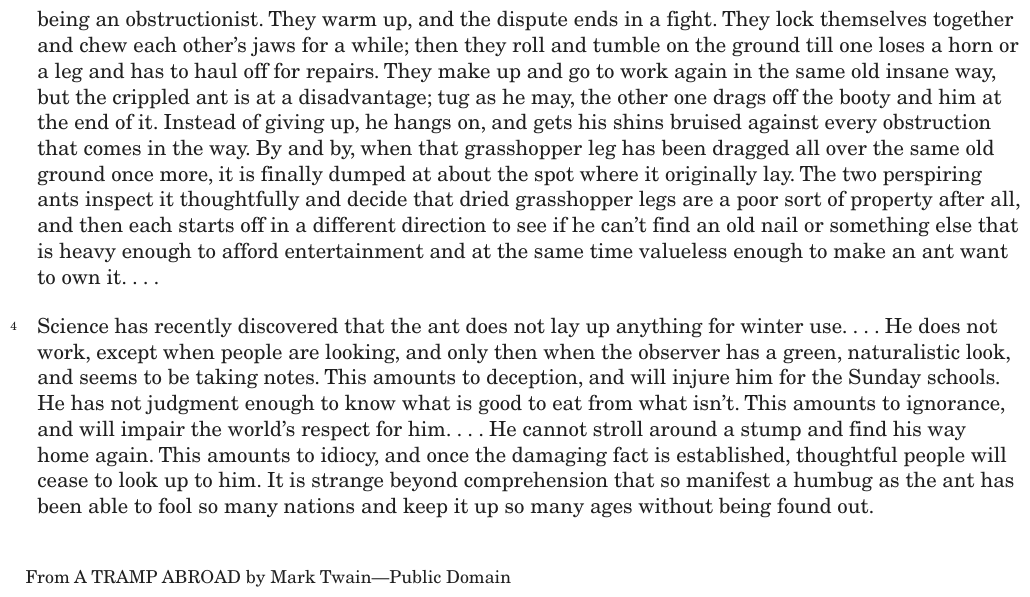
Question 27 of 120
2018 Test A English, question 27Uses the passage above: “Excerpt from A Tramp Abroad”.
Question
The central idea that “the average ant is a sham” (paragraph 1) is conveyed mainly through the
- Acomical descriptions of the inability of the ants to accomplish the task at hand.
- Bcomparison between ants from other countries and the ants being observed.
- Ckeen observations that the level of intelligence of ants is mostly overstated.
- Dconclusion that ants value objects that are of little practical use to them.
Show the answer
Correct answer: A
The answer is (A)
The question asks how the central idea that “the average ant is a sham” (paragraph 1) is expressed in the excerpt. The excerpt focuses on the author’s humorous explanation of the ineffective struggles of two ants to accomplish a task, and the excerpt concludes with the statement that ants are not as smart as people think: “the ant has been able to fool so many nations” (paragraph 4). This point is stated in Option A.
Option B is incorrect because the reference to ants in other locations is a detail mentioned only in paragraph 1 and is not directly related to the central idea mentioned in the question.
Option C is incorrect because, while the narrator does observe the ants, the observations made are highly opinionated and not characterized as especially insightful or perceptive.
Option D refers to the detail in paragraph 2 that states that the objects ants seek out are “generally something which can be of no sort of use to himself or anybody else” (paragraph 2), but this is not the main way the author conveys the premise that ants are a sham or false, and therefore, Option D is incorrect.
Question analysis
This central idea question hands students Mark Twain's claim that “the average ant is a sham” and asks how the excerpt mainly conveys it. Every choice points to something that really appears in the text, so students must judge which one does most of the work across the whole excerpt.
- Grade level
- Grade 7 reading and task
- Compared with grade 7
- At grade 7 Typical grade 7 central idea work asks students to find the idea; here it is supplied, so the task is tracing how it is developed. The long, old-fashioned passage adds reading load, but the task itself is standard.
- Estimated difficulty
- Moderate: several steps, or a close reading with one strong distractor.
- Thinking it demands
- Depth of knowledge 3, strategic thinking · mainly analyze
- What makes it hard
- How, not what moderate
- A lot to read moderate
- Every choice must be checked minor
- Evidence
- Answered from the whole text
- Reading level
- Passage: about grade 9, 1099 words; question and choices: about grade 9, 66 words.
- Students, last 30 days
- Not enough answers yet to show (it takes 10).
Why it is hard, traps and wrong answers (shows the answer)
Why it is hard
The question is less about finding the idea than about weighing how much of the excerpt each choice accounts for. Three choices name something that really appears, so a student who checks only whether a choice is true will keep two or three of them. The one that covers the long comic narratives in paragraphs 2 and 3 wins, and the trap is a choice that sounds analytical because it repeats the claim.
How, not what moderate Working it out
The idea is handed over in the stem, so the task is naming the method: the comic accounts of the lone ant's trip and the two ants' tug-of-war fill paragraphs 2 and 3. (Anderson & Krathwohl, 2001)
A lot to read moderate Understanding the question
The answer rests on the whole 1,100-word excerpt, including a 183-word sentence in paragraph 2, so students must judge what most of the text does rather than recall one line. (Kintsch, 1998; Gorin & Embretson, 2006; Freedle & Kostin, 1993)
Every choice must be checked minor Choosing the answer
Each wrong choice points to something real, the Swiss and African ants, the observing, the useless loot, so none can be dismissed without asking how much of the excerpt it explains. (Embretson & Wetzel, 1987)
Strategy: Note in a few words what each paragraph mostly does, then test every choice against those notes, checking each of its words rather than its general idea.
Traps
- Twists what the text says: Uses the text's topic and ideas but changes what it says: who did it, how much, when, or why.
- Too narrow: A single detail offered as the central idea or a summary, or a summary that keeps minor details and leaves out an essential part.
The wrong answers, classified
B Too narrow (King et al., 2004)
Picks the comparison sitting in the same sentence as the quoted claim, the Swiss and African ants, a one-line aside rather than the excerpt's main method.
C Twists what the text says (King et al., 2004)
Gets the claim right, that the ant is “strangely overrated,” but calls Twain's slapstick “keen observations” and restates the idea instead of naming how it is conveyed.
D Too narrow (King et al., 2004)
Seizes on the ant's taste for worthless loot, a real motif from the grasshopper leg to the old nail, but only one strand of the comic accounts.
Working it out, step by step
Figure out what the question asks
The question hands you the central idea: “the average ant is a sham.” A sham is a fake, something that is not what it seems. You don’t need to find the idea. You need to find how Twain mostly gets it across.
Note what each paragraph does
- Paragraph 1: Twain says ants are overrated.
- Paragraph 2: One ant drags his prize up weeds, over pebbles and the wrong way. After half an hour he is “within six inches of the place he started from.”
- Paragraph 3: Two ants tug one grasshopper leg in opposite directions, then fight.
- Paragraph 4: Twain sums up his charges against the ant.
See how the idea is shown
Paragraphs 2 and 3 are by far the longest. They are funny stories. In each one, ants work very hard and get nowhere. The jokes show that the ant is not smart, even though people think he is. That is how Twain proves the ant is a sham.
Check each choice
- A fits. The funny stories of ants failing at their task fill most of the excerpt.
- B The Swiss and African ants appear in just one sentence of paragraph 1.
- C only repeats the idea that ants are overrated. It does not say how the idea is shown.
- D The worthless loot is real, but it is only one detail inside the funny stories.
Choose the answer
Twain shows the ant is a sham mainly through comical, or funny, descriptions of ants failing at their job. So the answer is A.
Why this answer and not the closest wrong one
C is the closest trap, because it sounds smart and matches Twain’s opinion. But the question asks how the idea is shown, and C just says the idea again. Also, Twain’s stories are silly exaggerations, not “keen observations” (sharp, careful ones). A names the real method: the funny stories.
More questions like this
The original DOE question

Question 28 of 120
2018 Test A English, question 28Uses the passage above: “Excerpt from A Tramp Abroad”.
Question
In paragraph 2, how do the words “grabs,” “yanks,” and “tearing away” contribute to the meaning of the excerpt?
- AThey highlight the ant’s belief that his work is important.
- BThey illustrate that the ant is more efficient working on his own.
- CThey indicate the speed with which the ant completes his tasks.
- DThey emphasize the ant’s anxious efforts to be productive.
Show the answer
Correct answer: D
The answer is (D)
The question asks for an explanation of how the words “grabs,” “yanks,” and “tearing away” (paragraph 2) contribute to the meaning of the excerpt.
Option D is correct because these words convey sudden movements as the ant becomes more upset in his efforts to transport the grasshopper leg.
Option A is incorrect because the ant is never described in the excerpt as believing his work to be important.
Option B is incorrect because the ant’s inability to make progress while transporting the grasshopper leg by himself demonstrates the ant’s inefficiency (paragraph 2: “At the end of half an hour he fetches up within six inches of the place he started from”).
Option C is incorrect because the ant does not complete his tasks despite moving in a hurried and determined way (paragraph 2: “not calmly and wisely, but with a frantic haste which is wasteful of his strength”).
Question analysis
This word-choice question asks how three action words from Mark Twain's ant story, “grabs,” “yanks” and “tearing away,” add to the excerpt's meaning. The verbs are buried in one very long sentence that lists dozens of actions, so students must find them and decide what their connotations add to the picture of the ant.
- Grade level
- Grade 7 reading and task
- Compared with grade 7
- At grade 7 Grade 7 word-choice items usually ask about one word in a short passage. This one asks for the shared effect of three verbs scattered through a very long sentence, though their tone is fairly clear once found, which keeps it at grade 7.
- Estimated difficulty
- Moderate: several steps, or a close reading with one strong distractor.
- Thinking it demands
- Depth of knowledge 2, skills and concepts · mainly analyze
- What makes it hard
- Complex sentences moderate
- Figurative or literary language moderate
- A very close wrong answer minor
- Evidence
- Answered from one paragraph or stanza
- Reading level
- Passage: about grade 9, 1099 words; question and choices: about grade 6, 60 words.
- Corrected from the DOE handbook
- A wrong option letter in the explanation was corrected.
- A missing comma in the explanation was restored.
- Students, last 30 days
- Not enough answers yet to show (it takes 10).
Why it is hard, traps and wrong answers (shows the answer)
Why it is hard
The verbs themselves are easy words; the difficulty is deciding what they add. Their speed is obvious, which is why the choice about how fast the ant finishes his tasks catches readers who stop at speed and miss that nothing gets finished. The key reads the verbs together with “in a passion” and “madder and madder” around them, so it rewards looking at the words' surroundings rather than the words alone.
Complex sentences moderate Understanding the question
All three verbs are buried in one 183-word sentence of paragraph 2, strung through semicolons among about twenty other actions, so students must find them before judging them. (Abedi & Lord, 2001; Freedle & Kostin, 1993; Messick, 1989)
Figurative or literary language moderate Understanding the question
The verbs' force reads as a comic tantrum, “grabs his property viciously” soon after he “jumps up in a passion,” so their connotation of agitation, not skill, carries the meaning. (Graesser, Singer & Trabasso, 1994; Kintsch, 1998)
A very close wrong answer minor Choosing the answer
A and D both tie the verbs to the ant caring about his work; they differ in one part, since the verbs show his anxious efforts, as D says, but never reveal a belief, as A claims. (Embretson & Wetzel, 1987; Gorin & Embretson, 2006; Ascalon et al., 2007)
Strategy: Locate the three verbs in paragraph 2, read the clauses around each one, and describe their effect in your own words before looking at the choices.
Traps
- Twists what the text says: Uses the text's topic and ideas but changes what it says: who did it, how much, when, or why.
- Reads too much in: A reasonable-sounding conclusion that goes further than the text allows.
The wrong answers, classified
A Reads too much in (Graesser, Singer & Trabasso, 1994)
Reads the ant's vigor as proof that he thinks his work important, a belief the excerpt never gives him; the verbs show agitation, not conviction.
B Wrong tone or attitude (Graesser, Singer & Trabasso, 1994)
Hears the forceful verbs as signs of a capable worker and contrasts him with the bickering pair, though alone he ends six inches from where he began.
C Twists what the text says (King et al., 2004)
Rightly senses speed in “tearing away,” but the ant completes nothing; Twain calls it “a frantic haste which is wasteful of his strength.”
What was corrected from the DOE handbook, and why
- Explanation: The handbook’s last reason begins “Option H is incorrect because the ant does not complete his tasks despite moving in a hurried and determined way”, but H is its correct answer. The reason is about G, “They indicate the speed with which the ant completes his tasks,” so this site reads Option C (G relettered). This was already corrected on the site before this review.
- Explanation: The handbook quotes the words as “grabs” “yanks,” and “tearing away”. The comma after “grabs” is restored, as in the question.
Working it out, step by step
Figure out what the question asks
This is a word-choice question. It asks what three action words add to the excerpt. Think about how the words feel, not just what they mean.
Find the words in paragraph 2
All three words are in the very long sentence in paragraph 2. Look at the words around them. The ant “jumps up in a passion,” then “grabs his property viciously, yanks it this way, then that.” Soon he “gets madder and madder” and goes “tearing away in an entirely new direction.”
Work out what the words show
“In a passion” means in a fit of anger. “Viciously” means fiercely. So the words show a worked-up, frantic ant. He moves fast and rough, like a kid having a tantrum. He badly wants to get his job done.
But Twain also says the ant moves “with a frantic haste which is wasteful of his strength.” All that rushing gets him nowhere.
Check each choice
- A The excerpt never tells us what the ant believes about his work. The words show he is upset, not what he thinks.
- B Working alone, he ends up six inches from where he started. That is not efficient (getting a lot done without waste).
- C The words do show speed. But the ant never finishes anything.
- D fits. The words show anxious, frantic effort to get the job done.
Choose the answer
The rough, fast verbs show an upset ant trying hard to be productive. So the answer is D.
Why this answer and not the closest wrong one
C is the closest trap, because “tearing away” does sound fast. But C says the ant completes his tasks, and he never does. D keeps the speed and the worry but does not claim success. That is why D fits better.
More questions like this
The original DOE question

Question 29 of 120
2018 Test A English, question 29Uses the passage above: “Excerpt from A Tramp Abroad”.
Question
Read this text from paragraph 2.
He . . . comes to a weed; it never occurs to him to go around it. No; he must climb it, and he does climb it, dragging his worthless property to the top—which is as bright a thing to do as it would be for me to carry a sack of flour from Heidelberg to Paris by way of Strasburg steeple;
These details convey the central idea in the excerpt by showing that the ant
- Aoften wastes his strength when working on a task.
- Bis surprised by the effort he needs in order to move the object.
- Cis oblivious to the most practical solution to his problem.
- Dfocuses more on obtaining the object than getting it back home efficiently.
Show the answer
Correct answer: C
The answer is (C)
The question asks for an explanation of how the details in the sentence convey the central idea, which is that the ant makes poor choices because of his lack of intelligence and his inability to understand even the most basic problem or obstacle.
Option C is correct because the author’s description of the ant climbing up and over the weed rather than simply going around the weed supports the central idea.
Option A is incorrect because, although the ant does waste much of his strength, the idea conveyed in the sentences is more related to the ant’s inability to solve a problem in the simplest way (paragraph 2: “which is as bright a thing to do as it would be for me to carry a sack of flour from Heidelberg to Paris by way of Strasburg steeple”).
Option B is incorrect because the idea that the ant is surprised by the amount of effort needed to carry the object is not a central idea of the excerpt; nor does the excerpt suggest that the ant is surprised by this in the first place.
Option D is incorrect because the ant has already acquired the object, and the details in the sentence do not convey an idea about the ant’s unnecessary effort.
Question analysis
Students read Mark Twain's description of an ant hauling its load up and over a weed and must explain how these details support the excerpt's central idea. The comparison to carrying flour from Heidelberg to Paris by way of a church steeple is unfamiliar, and one choice is true of the ant elsewhere without being the point of these lines.
- Grade level
- Grade 7 reading and task
- Compared with grade 7
- At grade 7 Linking a quoted detail to a central idea is routine grade 7 work, and the lines are printed in the question. The extra hurdle is decoding an old comparison about lugging flour between European cities over a steeple.
- Estimated difficulty
- Moderate: several steps, or a close reading with one strong distractor.
- Thinking it demands
- Depth of knowledge 2, skills and concepts · mainly analyze
- What makes it hard
- Evidence
- Answered from one sentence or line
- Reading level
- Passage: about grade 9, 1099 words; question and choices: about grade 6, 123 words.
- Students, last 30 days
- Not enough answers yet to show (it takes 10).
Why it is hard, traps and wrong answers (shows the answer)
Why it is hard
The lines are printed in the question, so the challenge is interpreting them rather than finding them. Students who know the ant wastes his strength will find that idea here too and stop, while the comparison actually mocks choosing the hardest route: going up and over instead of around. The question rewards asking what the weed and the steeple have in common before reading the choices.
Figurative or literary language moderate Understanding the question
The point hides in sarcasm: climbing the weed is “as bright a thing to do” as hauling flour from Heidelberg to Paris “by way of Strasburg steeple,” so “bright” means foolish. (Graesser, Singer & Trabasso, 1994; Kintsch, 1998)
Something you must already know minor Working it out
The joke lands faster for readers who know that a steeple is a church's tall spire and that Strasbourg lies on the road from Heidelberg to Paris. (Anderson & Krathwohl, 2001)
Strategy: Work out what the flour-and-steeple comparison mocks by picturing the route it describes, then match that judgment to what the ant does at the weed.
Traps
- True but not the answer: A choice says something accurate about the text that does not answer this question.
- Twists what the text says: Uses the text's topic and ideas but changes what it says: who did it, how much, when, or why.
The wrong answers, classified
A True but not the answer (King et al., 2004; Embretson & Wetzel, 1987)
Recalls that his “frantic haste” is “wasteful of his strength,” true earlier in paragraph 2, but these lines mock his route over the weed, not his spent energy.
B Reads too much in (Graesser, Singer & Trabasso, 1994)
Imagines the ant startled by how heavy his load is, but no line shows surprise; he climbs because going around “never occurs to him.”
D Twists what the text says (King et al., 2004)
Rightly sees the ant failing to get the load home efficiently, but he already holds the object, so nothing here is about obtaining it.
Working it out, step by step
Figure out what the question asks
This question asks how a few printed lines support the central idea. The central idea is that the ant is not as smart as people think.
Find the key words
The lines are from paragraph 2. The ant “comes to a weed; it never occurs to him to go around it.” Instead, he climbs it. Then Twain says this is “as bright a thing to do” as carrying “a sack of flour from Heidelberg to Paris by way of Strasburg steeple.”
Picture the comparison
A steeple is the tall, pointed tower on top of a church. Heidelberg, Strasburg and Paris are cities, and Strasburg is on the way. Picture carrying a heavy sack between cities. Now picture climbing up and over a church tower on the way, instead of walking around it. That is silly.
So when Twain calls the climb “bright,” he means the opposite. This is sarcasm (saying the opposite of what you mean, to poke fun).
Check each choice
- A The ant does waste strength elsewhere in paragraph 2. But these lines mock his choice of route.
- B Nothing shows the ant is surprised. Going around just never occurs to him.
- C fits. Going around the weed is the easy fix, and the ant never thinks of it. Oblivious means not noticing.
- D He already has the object, so these lines are not about getting it.
Choose the answer
The lines show an ant who misses the simple solution right in front of him. So the answer is C.
Why this answer and not the closest wrong one
A is the closest trap, since the ant really does waste his strength. But the weed and the steeple share one point: each is climbed when you could simply walk around it. That is about missing the easy solution, which is choice C.
More questions like this
The original DOE question
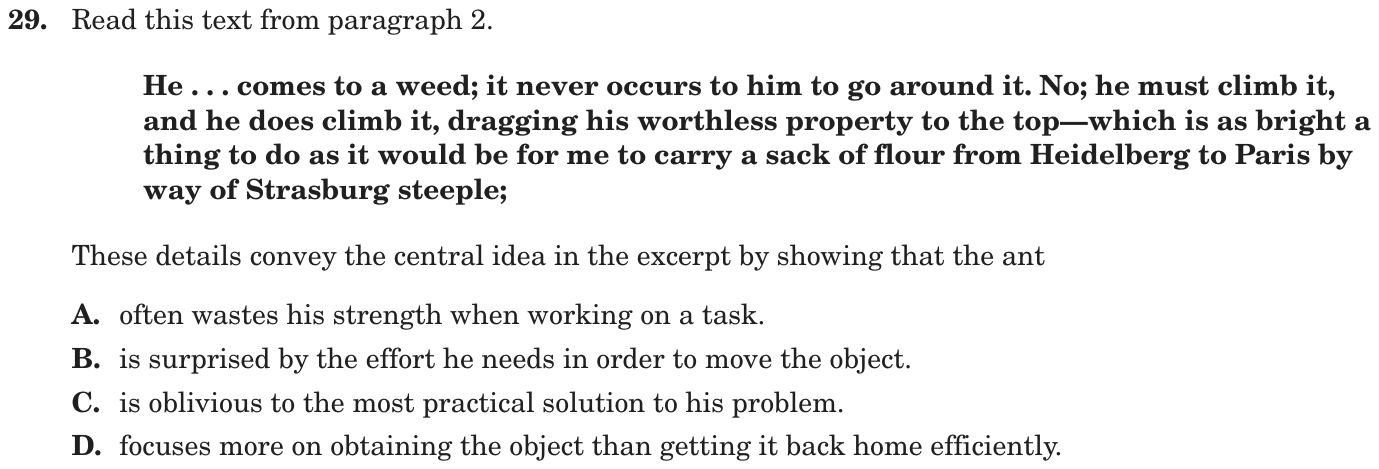
Question 30 of 120
2018 Test A English, question 30Uses the passage above: “Excerpt from A Tramp Abroad”.
Question
Which of the following best explains the author’s fascination with the ants?
- A“During many summers now I have watched him, when I ought to have been in better business, and I have not yet come across a living ant that seemed to have any more sense than a dead one.” (paragraph 1)
- B“I admit his industry, of course; he is the hardest working creature in the world—” (paragraph 2)
- C“Science has recently discovered that the ant does not lay up anything for winter use.” (paragraph 4)
- D“It is strange beyond comprehension that so manifest a humbug as the ant has been able to fool so many nations and keep it up so many ages without being found out.” (paragraph 4)
Show the answer
Correct answer: D
The answer is (D)
The question asks for the text from the passage that explains why the author finds the behavior of the ants fascinating. The author’s purpose in describing the excessively foolish actions of the ants is to prove his argument that in spite of what people have long believed, ants are completely lacking in intelligence.
Option D is correct because the quoted text in Option D shows the author’s interest in the difference between public opinion and observed truth.
Option A is incorrect because the quoted text in Option A provides details that reflect the author’s basic interest, but this observation does not extend to the level of fascination.
Option B is incorrect because the author’s main message in the excerpt is that the ant, however industrious, is foolish.
Option C is incorrect because the quoted text in Option C also provides details that would reflect a basic interest and observation but that do not extend to fascination.
Question analysis
This textual evidence question asks which of four quotations from Mark Twain's ant excerpt best explains why the narrator is so fascinated by ants. Nowhere does the excerpt say outright what draws him to them, so students must infer it and then weigh quotations that all show him paying attention to ants.
- Grade level
- Grade 8 reading and task
- Compared with grade 7
- Above grade 7 Grade 7 evidence questions usually match a quotation to a claim the text states. Here the claim, the narrator's fascination, is never named, so students must infer its cause from four quotations in a satirical, old-fashioned text.
- Estimated difficulty
- Among the hardest on the SHSAT: a non-obvious approach, heavy reading, or a well-hidden trap.
- Thinking it demands
- Depth of knowledge 3, strategic thinking · mainly evaluate
- What makes it hard
- Reading between the lines major
- Hard words moderate
- A lot to read minor
- Evidence
- Answered from the whole text
- Reading level
- Passage: about grade 9, 1099 words; question and choices: about grade 10, 116 words.
- Students, last 30 days
- Not enough answers yet to show (it takes 10).
Why it is hard, traps and wrong answers (shows the answer)
Why it is hard
The stem's word “fascination” clashes with a narrator who sneers at ants, and that clash is what makes the item hard. Students must recast fascination as puzzled interest and then look for the quotation that names its cause, the gap between the ant's reputation and its behavior. The quotation about years of watching is the trap: it shows interest without explaining it, and many careful readers settle on it.
Reading between the lines major Working it out
The excerpt never says the author is fascinated, and his tone is contempt, so students must infer that what holds his attention is the puzzle of how a “humbug” fooled whole nations. (Graesser, Singer & Trabasso, 1994; Kintsch, 1998)
Hard words moderate Understanding the question
The key turns on “so manifest a humbug,” meaning so obvious a fraud, and “strange beyond comprehension”; a student who skips those words cannot see that the line expresses wonder. (Perfetti, 2007; Freedle & Kostin, 1993)
A lot to read minor Understanding the question
Each choice is a full quotation, the longest 38 words, so the four together form a short passage of archaic prose to weigh. (Kintsch, 1998; Gorin & Embretson, 2006; Freedle & Kostin, 1993)
Strategy: Before reading the quotations, state in your own words what most seems to interest the narrator about ants; then pick the quotation that gives the reason behind his interest.
Traps
- Supports only part of the claim: In a question about evidence: a line that backs one half of the claim but not the other, or a related point rather than the claim itself.
- Wrong tone or attitude: Misjudges the tone, attitude or point of view, such as reading admiration as criticism, or taking a character's or subject's feelings for the author's.
The wrong answers, classified
A Supports only part of the claim (King et al., 2004; Thissen, Steinberg & Fitzpatrick, 1989)
Shows he has watched ants for many summers, real evidence of interest, but it describes his habit and verdict rather than what makes ants fascinating to him.
B Wrong tone or attitude (Graesser, Singer & Trabasso, 1994)
Treats the grudging “I admit his industry” as admiration, missing the dig “when anybody is looking” that follows and the attack on his “leather-headedness.”
C Supports only part of the claim (King et al., 2004; Thissen, Steinberg & Fitzpatrick, 1989)
Picks a scientific finding that the author uses as a charge against the ant; it belongs to his case, not to the reason the ant intrigues him.
Working it out, step by step
Figure out what the question asks
This question is about the author’s point of view. Twain sounds mostly annoyed with ants. So what keeps him so interested in them? You need the quote that gives the reason for his interest.
Think about the word fascination
Fascination means a strong interest, the kind that makes you keep watching. Twain mocks ants, so he does not admire them. What puzzles him is their good name. People all over the world think ants are wise. Twain thinks they are not.
Find the reason in paragraph 4
Look at the last sentence of paragraph 4: “It is strange beyond comprehension that so manifest a humbug as the ant has been able to fool so many nations.”
A humbug is a fake or a fraud. Manifest means plain to see. “Beyond comprehension” means too strange to understand. So Twain is amazed that such an obvious fake has fooled people for ages.
Check each choice
- A shows he has watched ants for years. It shows interest, but not the reason for it.
- B sounds like praise, but he adds “when anybody is looking.” It is really a dig at the ant.
- C is one fact he uses against the ant. It does not explain his interest.
- D fits. It names the puzzle: how a plain fake fooled so many people.
Choose the answer
Only choice D gives the reason Twain can’t stop thinking about ants. So the answer is D.
Why this answer and not the closest wrong one
A is the strongest trap, because watching ants for “many summers” shows real interest. But A only tells what he did. D tells why: he is amazed that the ant fooled “so many nations.” A question about fascination wants the cause.
More questions like this
The original DOE question
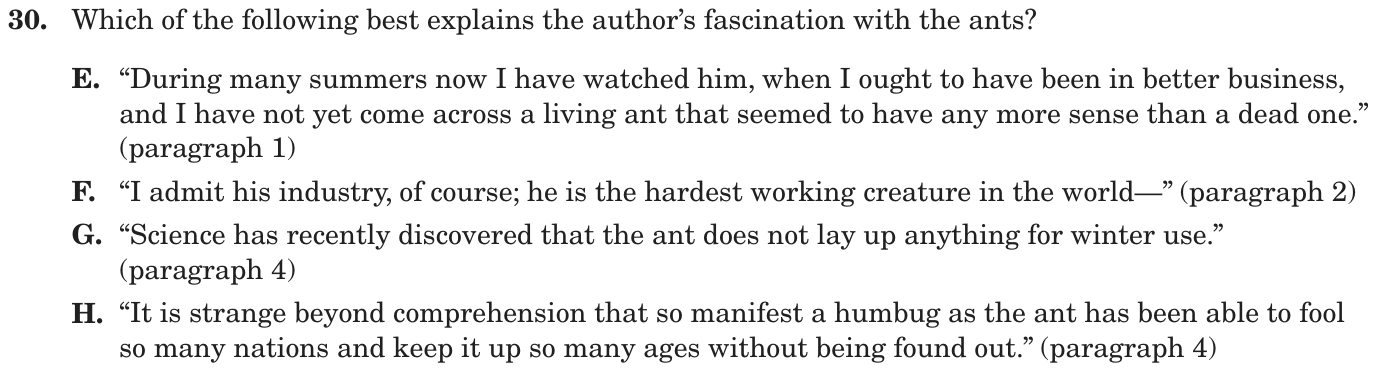
Question 31 of 120
2018 Test A English, question 31Uses the passage above: “Excerpt from A Tramp Abroad”.
Question
Read this sentence from paragraph 2.
At the end of half an hour he fetches up within six inches of the place he started from, and lays his burden down.
How does the sentence contribute to the development of the central idea of the excerpt?
- AIt reveals that the ant is aware of the purposelessness of his efforts and that he does not enjoy his work.
- BIt highlights how little the ant accomplishes despite the great amount of effort he exerts.
- CIt suggests that the ant has an industrious attitude and does not easily give up.
- DIt emphasizes that the ant does not thoughtfully consider how difficult it would be to carry his capture for such a long period of time.
Show the answer
Correct answer: B
The answer is (B)
The question asks how the sentence, which states that the ant ends up only six inches from his original starting point, contributes to the central idea of the excerpt.
Option B is correct because it explains how the idea in the sentence supports the central idea that “the average ant is a sham” (paragraph 1) by emphasizing his lack of progress and wasted effort.
Option A is incorrect because, while the author recognizes the pointlessness of the efforts, the ant never becomes aware that his efforts are purposeless.
Option C is incorrect because the ant ending up only six inches from his starting point suggests pointless effort, not an industrious or productive attitude.
Option D is incorrect because the emphasis of the sentence is on the ant’s wasted effort, not the difficulty and time involved, which the ant never realizes or evaluates.
Question analysis
Students read one sentence from paragraph 2 of Mark Twain's ant story, about where the ant finally sets down his burden, and explain how it develops the excerpt's central idea. The choices differ subtly on the ant's awareness, attitude and effort, so each must be checked closely against the sentence.
- Grade level
- Grade 7 reading and task
- Compared with grade 7
- At grade 7 Explaining how one sentence develops a central idea is standard grade 7 work, and this sentence is short and quoted in full. Twain's long, winding style adds some load, but the reasoning needed is brief.
- Estimated difficulty
- Straightforward: two steps or one careful reading.
- Thinking it demands
- Depth of knowledge 2, skills and concepts · mainly analyze
- What makes it hard
- How, not what moderate
- Every choice must be checked minor
- Evidence
- Answered from one sentence or line
- Reading level
- Passage: about grade 9, 1099 words; question and choices: about grade 8, 120 words.
- Corrected from the DOE handbook
- A wrong paragraph number in the explanation was corrected.
- Students, last 30 days
- Not enough answers yet to show (it takes 10).
Why it is hard, traps and wrong answers (shows the answer)
Why it is hard
Once a student reads the sentence as the punch line of the half hour before it, the key is close to obvious: thirty minutes of hauling have moved the ant six inches. Errors come from importing ideas from elsewhere, such as the narrator's grudging praise of the ant's industry, or from latching onto the time words and missing that the sentence measures distance gained, not effort planned.
How, not what moderate Working it out
The stem asks how the sentence develops the central idea, so students must connect “within six inches of the place he started from” to the claim that the average ant is a sham. (Anderson & Krathwohl, 2001)
Every choice must be checked minor Choosing the answer
The wrong choices differ from the key in one claim each, the ant's awareness, his persistence, his failure to plan, so each must be tested against the sentence. (Embretson & Wetzel, 1987)
Strategy: Read the sentences just before this one to see what filled the ant's half hour, then put the sentence's effect in your own words before checking the choices against the paragraph.
Traps
- Wrong part of the text: A choice is true of another paragraph, stanza or speaker than the one asked about.
- Twists what the text says: Uses the text's topic and ideas but changes what it says: who did it, how much, when, or why.
The wrong answers, classified
A Twists what the text says (King et al., 2004)
Hands the narrator's insight to the ant: the narrator sees the effort is pointless, but the ant never realizes it, and nothing says whether he enjoys working.
C Wrong part of the text (Kirsch & Mosenthal, 1990)
Recalls the grudging “I admit his industry” and the ant's later restarts, found elsewhere in paragraph 2, but this sentence shows half an hour gaining six inches.
D Twists what the text says (King et al., 2004)
Rightly sees a thoughtless ant and is drawn by “half an hour,” but the sentence stresses how little ground he gained, not the difficulty of a long carry.
What was corrected from the DOE handbook, and why
- Explanation: The handbook places “the average ant is a sham” in paragraph 2. The phrase ends paragraph 1, as question 27 on the same excerpt says, so the explanation now reads “(paragraph 1)”.
Working it out, step by step
Figure out what the question asks
This question asks how one sentence helps build the central idea. The central idea is that “the average ant is a sham.” He looks busy and wise, but he is not smart.
Read the sentence and what comes before
The sentence is in paragraph 2: “At the end of half an hour he fetches up within six inches of the place he started from, and lays his burden down.”
Read the sentences before it too. The ant has climbed weeds, tumbled down and changed direction again and again.
Work out what it means
“Fetches up” means ends up. A “burden” is a heavy load. So after thirty minutes of hard work, the ant is only six inches from where he began. All that effort got him almost nowhere. This is the punch line of his trip. It shows the ant works hard but gets almost nothing done.
Check each choice
- A The narrator sees that the work is pointless. The ant never does, and we never learn if he enjoys it.
- B fits. Half an hour of effort moves him only six inches.
- C The ant does keep going, but this sentence stresses failure, not a good attitude.
- D The sentence measures how little ground he gained. It is not about planning a long carry.
Choose the answer
The sentence shows how little the ant achieves for so much effort. So the answer is B.
Why this answer and not the closest wrong one
D is tempting because the sentence says “half an hour,” which sounds like a long carry. But the key fact is the distance: six inches from the start. That fact is about results, not about thinking ahead. B is about results, so it fits better.
More questions like this
The original DOE question
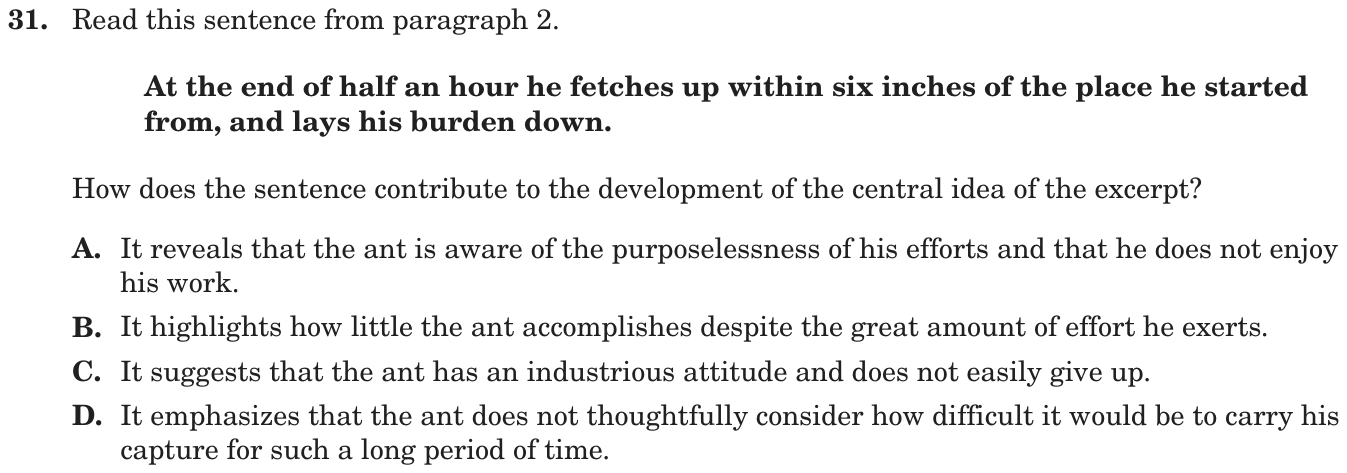
Question 32 of 120
2018 Test A English, question 32Uses the passage above: “Excerpt from A Tramp Abroad”.
Question
Which sentence from paragraph 2 best supports the idea that sheer “leather-headedness” (paragraph 2) amounts to “ignorance” and “idiocy” (paragraph 4)?
- A“He goes out foraging, he makes a capture, and then what does he do?”
- B“He lifts it bodily up in the air by main force,”
- C“When he gets up there he finds that that is not the place;”
- D“Now he wipes the sweat from his brow, strokes his limbs, and then marches aimlessly off, in as violent a hurry as ever.”
Show the answer
Correct answer: C
The answer is (C)
The question asks for a sentence in the excerpt that supports the idea that the ant’s “leather-headedness” (paragraph 2), or the ant’s stubborn determination to engage in foolish and worthless actions, amounts to ignorance and idiocy.
Option C is correct because, in the sentence in Option C, the ant realizes he is in the wrong place only after wasting effort and strength, which reveals his stupidity and lack of awareness.
Option A is incorrect because the sentence in Option A poses the question that the ant should ask himself and does not demonstrate the ant’s ignorance and idiocy.
Option B is incorrect because the sentence in Option B simply describes the ant’s action of lifting the grasshopper leg into a position to carry it.
Option D is incorrect because, while the sentence in Option D describes the ant’s exhaustion, which is caused by his stubborn determination, the sentence does not provide a connection to the ant’s leather-headedness.
Question analysis
This textual evidence question asks which sentence from paragraph 2 best shows that the ant's “leather-headedness” amounts to the “ignorance” and “idiocy” named later in Mark Twain's excerpt. Students must work out an old-fashioned insult and then choose among quotations that all describe the ant behaving oddly.
- Grade level
- Grade 8 reading and task
- Compared with grade 7
- Above grade 7 On a typical grade 7 test, an evidence question pairs a clear claim with one obviously fitting quotation. Here students must first decode an old-fashioned insult and connect it to judgments made two paragraphs later, which demands more interpretation.
- Estimated difficulty
- Hard: combines ideas, needs a plan, and has more than one tempting wrong answer.
- Thinking it demands
- Depth of knowledge 3, strategic thinking · mainly evaluate
- What makes it hard
- Hard words moderate
- Evidence in several places moderate
- Evidence
- Answered from several paragraphs or stanzas
- Reading level
- Passage: about grade 9, 1099 words; question and choices: about grade 7, 79 words.
- Corrected from the DOE handbook
- A wrong paragraph number in the explanation was corrected.
- Students, last 30 days
- Not enough answers yet to show (it takes 10).
Why it is hard, traps and wrong answers (shows the answer)
Why it is hard
Every quotation comes from the ant's absurd trip, so the question is which one shows a failure of sense on its own. Two are fragments cut just before the foolish part, and students who remember the full sentence credit them with more than they show. The marching-aimlessly line is the strongest rival; the key wins because it records a mistake the ant discovers only after great effort, matching paragraph 4's ant that cannot find his way.
Hard words moderate Understanding the question
“Leather-headedness” is an old insult meaning thick-headed stupidity; a student who reads it as toughness or stubbornness will look for force or persistence instead of foolishness. (Perfetti, 2007; Freedle & Kostin, 1993)
Evidence in several places moderate Working it out
The claim joins a word in paragraph 2 to “ignorance” and “idiocy” in paragraph 4, where idiocy is an ant that cannot “find his way home again.” (Kirsch & Mosenthal, 1990; Gorin & Embretson, 2006)
Strategy: Work out from context what “leather-headedness” means, then ask of each quotation whether it clearly shows that quality, and how it connects to the judgments in paragraph 4.
Traps
- Supports only part of the claim: In a question about evidence: a line that backs one half of the claim but not the other, or a related point rather than the claim itself.
- Wrong part of the text: A choice is true of another paragraph, stanza or speaker than the one asked about.
The wrong answers, classified
A Wrong part of the text (Kirsch & Mosenthal, 1990)
Remembers that this question leads into the ant going “anywhere but home,” but the quoted words only ask it; the foolish answer lies in the sentences after.
B Supports only part of the claim (King et al., 2004; Thissen, Steinberg & Fitzpatrick, 1989)
Picks the ant hoisting his prize “by main force,” which shows brute effort; the wrong-way start that would show poor sense comes after the quoted words.
D Supports only part of the claim (King et al., 2004; Thissen, Steinberg & Fitzpatrick, 1989)
Is drawn by “aimlessly,” but the sentence mostly shows the ant wiping sweat and hurrying off, not a misjudgment exposed the way the pointless climb is.
What was corrected from the DOE handbook, and why
- Explanation: The handbook places the ant’s “leather-headedness” in paragraph 4. The word is in paragraph 2, as the question itself says, so the explanation now reads “(paragraph 2)”.
Working it out, step by step
Figure out what the question asks
This is an evidence question. You need the sentence from paragraph 2 that best proves the ant is foolish. First you must know what the three insults mean.
Learn what the insults mean
In paragraph 2 Twain says, “his leather-headedness is the point I make against him.” Leather-headed is an old insult. It means thick-headed or dim. Watch out: it does not mean tough or strong.
In paragraph 4 he calls the ant’s acts “ignorance” (not knowing things) and “idiocy” (being very foolish). His example of idiocy is this: “He cannot stroll around a stump and find his way home again.”
Look for a foolish mistake
So look for a quote that, by itself, shows the ant making a foolish mistake. Choice C does. The ant drags his load to the top of a weed. Then “he finds that that is not the place.” He learns he is wrong only after all that work. That is a lot like an ant who can’t find his way home.
Check each choice
- A only asks a question. The foolish answer comes in later words.
- B shows the ant is strong, lifting his load “by main force.” Strength is not foolishness.
- C fits. It shows a mistake he finds only after wasting effort.
- D shows him sweaty and in a hurry. “Aimlessly” hints that he has no plan, but the quote shows no clear mistake.
Choose the answer
Choice C gives the clearest proof of a thick-headed ant. So the answer is C.
Why this answer and not the closest wrong one
D is the closest wrong choice, because “aimlessly” means without a goal. But D mostly shows the ant wiping sweat and rushing off. C shows a real error: he works hard to reach a spot, and it is the wrong spot. That matches “ignorance” and “idiocy” best.
More questions like this
The original DOE question
Question 33 of 120
2018 Test A English, question 33Uses the passage above: “Excerpt from A Tramp Abroad”.
Question
Read this sentence from paragraph 3.
Evidently the friend remarks that a last year’s grasshopper leg is a very noble acquisition, and inquires where he got it.
Which statement best describes how the sentence fits into the overall structure of the excerpt?
- AIt indicates a shift to the realization that the ants place great importance on an item that has little value.
- BIt emphasizes a shift from an analysis of the actions of the individual ant to a commentary on the actions of the ants working together.
- CIt introduces a transition to the idea that specific observations about one ant allow for generalizations about all ants.
- DIt provides a transition to the observation that the ant’s friend is just as purposeful in his efforts toward a futile ending as the first ant.
Show the answer
Correct answer: B
The answer is (B)
The question asks for an explanation of how the sentence, which highlights the second ant’s interest in the grasshopper leg, fits into the structure of the excerpt.
Option B is correct because the sentence shows a shift from paragraph 2, which analyzes the actions of the first ant alone, to paragraph 3, which comments on the conversation between the two ants and the ensuing efforts of the two ants together.
Option A is incorrect because the idea that the ant seeks out worthless items, such as a grasshopper leg, is established in paragraph 2 (“it is generally something which can be of no sort of use to himself or anybody else”).
Option C is incorrect because paragraph 3 is a continuation of the author’s tale and not an expansion of the focus of his commentary.
Option D is incorrect because the author does not compare the purposefulness of the two ants.
Question analysis
Students must explain how one sentence, in which a second ant praises a grasshopper leg as “a very noble acquisition,” fits into the overall structure of Mark Twain's excerpt. Every choice describes a shift or transition, so students must track what really changes between paragraphs 2 and 3 and what stays the same.
- NYS standards
- 7R5 structure and genre features
- Grade level
- Grade 8 reading and task
- Compared with grade 7
- Above grade 7 Grade 7 structure questions often ask what a paragraph does. This one asks how a single sentence turns the excerpt, and the choices are abstract and close in meaning, which makes it harder than typical grade 7 work.
- Estimated difficulty
- Hard: combines ideas, needs a plan, and has more than one tempting wrong answer.
- Thinking it demands
- Depth of knowledge 2, skills and concepts · mainly analyze
- What makes it hard
- How, not what major
- Every choice must be checked moderate
- Evidence
- Answered from several paragraphs or stanzas
- Reading level
- Passage: about grade 9, 1099 words; question and choices: about grade 11, 131 words.
- Students, last 30 days
- Not enough answers yet to show (it takes 10).
Why it is hard, traps and wrong answers (shows the answer)
Why it is hard
Every choice is phrased as a structural move, which makes them sound equally plausible, and the sentence's own content, mock praise of junk, pulls toward a choice that describes what it says rather than what changes. The key depends on noticing that a second ant enters here and the rest of paragraph 3 is about the two working, and failing, together. Students who weigh each choice's idea against paragraph 2 find that only the shift from one ant to two is new.
How, not what major Working it out
The question asks what the sentence does in the excerpt's structure, so students must compare paragraph 2's lone ant with paragraph 3's pair instead of paraphrasing the friend's remark. (Anderson & Krathwohl, 2001)
Every choice must be checked moderate Choosing the answer
All four choices describe a shift or a transition in similar abstract terms, so each has to be checked for whether its idea is really new at this point. (Embretson & Wetzel, 1987)
Strategy: Compare the main subject of paragraph 2 with that of paragraph 3, then ask what new element this opening sentence brings in, and check whether each choice's idea is actually new here.
Traps
- Wrong purpose or structure: Names a purpose, structure or effect that the part does not serve, or describes what a part says when the question asks what it does.
- Reads too much in: A reasonable-sounding conclusion that goes further than the text allows.
- Twists what the text says: Uses the text's topic and ideas but changes what it says: who did it, how much, when, or why.
The wrong answers, classified
A Wrong purpose or structure (Anderson & Krathwohl, 2001)
Describes what the sentence says, that ants prize a worthless leg, and calls it a shift, though paragraph 2 already showed the ant hauling useless loot.
C Reads too much in (Graesser, Singer & Trabasso, 1994)
Reads paragraph 3 as a move from one ant to rules about all ants, when it simply continues the story with a second ant.
D Twists what the text says (King et al., 2004)
Rightly notes that the friend joins an equally futile effort, but the excerpt never weighs his purposefulness against the first ant's; the sentence's job is to add a partner.
Working it out, step by step
Figure out what the question asks
This is a structure question. It asks what job one sentence does in the whole excerpt. Don’t just restate the sentence. Ask what changes when it arrives.
Find where the sentence sits
The sentence opens paragraph 3: “Evidently the friend remarks that a last year’s grasshopper leg is a very noble acquisition, and inquires where he got it.”
Paragraph 2 ends just before it. The ant “finally stops to rest, and a friend comes along.”
Compare the two paragraphs
Paragraph 2 is all about one ant working alone. Paragraph 3 is about two ants. They tug the leg in opposite directions, fight, make up and fail together. This sentence is where the second ant joins in. So it moves the excerpt from one ant to two ants working together.
Check each choice
- A Ants chasing worthless things is not new here. Paragraph 2 already said his prize is “of no sort of use.”
- B fits. The focus moves from a single ant to two ants together.
- C Paragraph 3 makes no rules about all ants. It just goes on with the story.
- D Twain never compares how purposeful (set on a goal) the two ants are.
Choose the answer
The sentence marks the shift from one ant to a pair of ants. So the answer is B.
Why this answer and not the closest wrong one
A is the strongest trap, because the sentence does praise a worthless leg as “a very noble acquisition.” But a shift needs something new. The worthless prize was already in paragraph 2. The only new thing here is the friend, which is choice B.
More questions like this
The original DOE question
Question 34 of 120
2018 Test A English, question 34Uses the passage above: “Excerpt from A Tramp Abroad”.
Question
Read this sentence from paragraph 3.
The two perspiring ants inspect it thoughtfully and decide that dried grasshopper legs are a poor sort of property after all, and then each starts off in a different direction to see if he can’t find an old nail or something else that is heavy enough to afford entertainment and at the same time valueless enough to make an ant want to own it.
How does the word choice in the sentence contribute to the overall meaning of the excerpt?
- AIt creates a humorous critique of the ants’ intense attitude toward their pointless work.
- BIt illustrates the ants’ confusion over their lack of positive results compared with their level of effort.
- CIt highlights the ants’ frustration as they repeatedly chose a difficult task over one that could be accomplished more easily.
- DIt illustrates the ants’ stubborn determination to hold on to the worthless object.
Show the answer
Correct answer: A
The answer is (A)
The question asks for an explanation of how the word choice in the sentence adds to the meaning of the excerpt. The image the author creates of two sweating ants abandoning the grasshopper leg to look for “an old nail,” which an ant would want because it is “valueless,” is comical, as suggested in Option A.
Option B is incorrect because it is a misinterpretation of the excerpt, as the ants are not confused but are acting decisively (paragraph 3: “Then they go at it again, just as before”).
Option C is incorrect because the ants find moving heavy objects to be an amusing way to spend their time and are not aware enough to feel frustrated (paragraph 3: “something else that is heavy enough to afford entertainment and at the same time valueless enough to make an ant want to own it”).
Option D is incorrect because the ants are willingly giving up on their object (paragraph 3: “decide that dried grasshopper legs are a poor sort of property after all”).
Question analysis
This question asks how Mark Twain's word choice in one long sentence, where two sweating ants give up on a grasshopper leg and go looking for something else to carry, shapes the excerpt's meaning. Students must judge the tone of words such as “thoughtfully,” “entertainment” and “valueless” and relate it to the excerpt as a whole.
- Grade level
- Grade 7 reading and task
- Compared with grade 7
- At grade 7 Grade 7 students regularly judge how word choice shapes tone, so the skill is familiar. What adds demand is one very long sentence whose effect depends on reading its adjectives against the situation they describe.
- Estimated difficulty
- Moderate: several steps, or a close reading with one strong distractor.
- Thinking it demands
- Depth of knowledge 2, skills and concepts · mainly analyze
- What makes it hard
- Figurative or literary language major
- Complex sentences moderate
- Evidence
- Answered from one sentence or line
- Reading level
- Passage: about grade 9, 1099 words; question and choices: about grade 11, 149 words.
- Students, last 30 days
- Not enough answers yet to show (it takes 10).
Why it is hard, traps and wrong answers (shows the answer)
Why it is hard
The sentence comes after a brawl, so readers expect frustration or confusion, and two wrong choices supply exactly those moods from earlier in paragraph 3. Here, though, the ants are calm and deliberate, and the joke is that their calm reasoning picks the heaviest, most worthless thing to haul. Students who judge the words of this sentence, not the paragraph's general mood, see that it mocks the ants' earnest attitude toward pointless work.
Figurative or literary language major Understanding the question
The humor is ironic logic: the ants inspect “thoughtfully,” then seek something “heavy enough to afford entertainment” and “valueless enough” to own, praising the very qualities that make their work pointless. (Graesser, Singer & Trabasso, 1994; Kintsch, 1998)
Complex sentences moderate Understanding the question
The effect builds across one 67-word sentence whose key phrases come at the very end, after a chain of clauses about inspecting, deciding and setting off. (Abedi & Lord, 2001; Freedle & Kostin, 1993; Messick, 1989)
Strategy: Underline the words that describe the ants' thinking and goals, decide what effect they have in this sentence, and then compare that effect with each choice.
Traps
- Half right: One half of a two-part choice is right and the other is not.
- Wrong part of the text: A choice is true of another paragraph, stanza or speaker than the one asked about.
The wrong answers, classified
B Wrong part of the text (Kirsch & Mosenthal, 1990)
Carries over “they can't make out what” from earlier in the paragraph, but in this sentence the ants inspect the leg thoughtfully and decide calmly.
C Half right (King et al., 2004; Thissen, Steinberg & Fitzpatrick, 1989)
Correctly sees the ants choosing heavy loads, but the frustration belongs to the earlier fight; here they want heavy things “to afford entertainment,” not out of anger.
D Wrong part of the text (Kirsch & Mosenthal, 1990)
Recalls the crippled ant who “hangs on” earlier in the paragraph, missing that here both ants drop the leg as “a poor sort of property.”
Working it out, step by step
Figure out what the question asks
This is a word-choice question. It asks how the words in one sentence add to the meaning of the excerpt. Pay attention to the tone, which is the feeling the words give.
Find the key words
The sentence ends paragraph 3. First the ants “inspect it thoughtfully.” Then each one looks for “an old nail or something else that is heavy enough to afford entertainment and at the same time valueless enough to make an ant want to own it.”
Work out the joke
“Afford entertainment” means give them fun. “Valueless” means worth nothing. Twain makes the ants sound careful and wise. Then they decide to look for something heavy and worthless.
That is the joke. The very things that make their work pointless are what they want most. Twain is making fun of how seriously the ants take their silly work.
Check each choice
- A fits. The words make a funny critique (a judgment) of the ants’ serious attitude toward pointless work.
- B In this sentence the ants are not confused. They think it over and decide calmly.
- C They do pick heavy things, but for fun, not out of frustration.
- D They give the leg up. They decide it is “a poor sort of property after all.”
Choose the answer
The sentence pokes fun at how hard the ants work at nothing. So the answer is A.
Why this answer and not the closest wrong one
C is the closest trap, since the ants really do choose heavy loads. But the anger came earlier in the paragraph, during the fight. In this sentence the ants are calm. They want something heavy to have fun with. Fun, not frustration, is the point, and Twain makes it funny. That matches A.
More questions like this
The original DOE question
Question 35 of 120
2018 Test A English, question 35Uses the passage above: “Excerpt from A Tramp Abroad”.
Question
How does the presence of the friend in paragraph 3 influence the first ant’s behavior?
- AThe friend distracts the ant from finding the correct path home.
- BThe friend inspires the ant to consider a new approach to the situation.
- CThe friend encourages the ant to continue his worthless efforts.
- DThe friend tries to prevent the ant from finishing his task.
Show the answer
Correct answer: C
The answer is (C)
The question asks how the second ant, a friend, influences the first ant.
Option C is correct because the friend’s complimentary remark about the grasshopper leg serves to encourage the first ant to continue his efforts to drag the useless object home (paragraph 3: “Evidently the friend remarks that a last year’s grasshopper leg is a very noble acquisition”).
Option A is incorrect because the first ant does not know where his home is (paragraph 2: “He doesn’t know where home is. His home may be only three feet away; no matter, he can’t find it”).
Option B is incorrect because, while the friend offers to help the first ant (paragraph 3: “Evidently the friend contracts to help him freight it home”), he does not inspire a new approach to resolving the situation.
Option D is incorrect because, while the friend does make it difficult for the first ant to transport the grasshopper leg, the friend is not intentionally trying to prevent the first ant from reaching home (paragraph 3: “Then, with a judgment peculiarly antic [pun not intentional], they take hold of opposite ends of that grasshopper leg and begin to tug with all their might in opposite directions”).
Question analysis
This question asks how a second ant, the “friend” who arrives in paragraph 3 of Mark Twain's excerpt, affects the first ant's behavior. Students must follow cause and effect through a tug-of-war in which the two ants pull a grasshopper leg in opposite directions.
- NYS standards
- 7R3 plot elements and ideas
- Grade level
- Grade 7 reading and task
- Compared with grade 7
- At grade 7 Explaining how one character affects another is everyday grade 7 work, and the interaction here unfolds within a single paragraph. Reading the friend's remark about the grasshopper leg in context is the only subtle step.
- Estimated difficulty
- Straightforward: two steps or one careful reading.
- Thinking it demands
- Depth of knowledge 2, skills and concepts · mainly analyze
- What makes it hard
- Reading between the lines moderate
- Hard words minor
- Evidence
- Answered from one paragraph or stanza
- Reading level
- Passage: about grade 9, 1099 words; question and choices: about grade 6, 59 words.
- Corrected from the DOE handbook
- A wrong paragraph number in the explanation was corrected.
- Students, last 30 days
- Not enough answers yet to show (it takes 10).
Why it is hard, traps and wrong answers (shows the answer)
Why it is hard
The paragraph is chaotic, with tugging, a fight and a lost leg, and that chaos makes the friend look like an obstacle. What the question rewards is seeing that every move the friend makes, praising the leg and offering to help carry it, keeps the first ant hauling a worthless object. Students who judge the friend by the results of the tug-of-war, rather than by what he says and intends, are drawn away from the key.
Reading between the lines moderate Working it out
The effect is never stated: students must infer from the friend calling the leg “a very noble acquisition” and offering to “freight it home” that he spurs the first ant on. (Graesser, Singer & Trabasso, 1994; Kintsch, 1998)
Hard words minor Understanding the question
Mock-formal words such as “proprietor,” “contracts,” “recriminations” and “obstructionist” narrate the ants' exchange, and a student who stumbles on them loses track of who helps whom. (Perfetti, 2007; Freedle & Kostin, 1993)
Strategy: Trace what the first ant does before the friend arrives and what he does after; then ask how the friend's remark and offer change, or fail to change, that pattern.
Traps
- Twists what the text says: Uses the text's topic and ideas but changes what it says: who did it, how much, when, or why.
- Reads too much in: A reasonable-sounding conclusion that goes further than the text allows.
The wrong answers, classified
A Outside knowledge (King et al., 2004; Recht & Leslie, 1988)
Assumes the familiar idea that a chatty friend distracts you from your route, but paragraph 2 says the ant never knew “where home is” to begin with.
B Reads too much in (Graesser, Singer & Trabasso, 1994)
Takes the friend's offer to help as a fresh strategy, though the two ants go back to work “in the same old insane way.”
D Twists what the text says (King et al., 2004)
Turns the accidental tug in opposite directions, and the charge of being “an obstructionist,” into deliberate sabotage, though the friend set out to help carry the leg home.
What was corrected from the DOE handbook, and why
- Explanation: The handbook places “Evidently the friend remarks that a last year’s grasshopper leg is a very noble acquisition” in paragraph 2. The sentence opens paragraph 3, the paragraph the question asks about, so the explanation now reads “(paragraph 3: …)”.
Working it out, step by step
Figure out what the question asks
This question asks how one character affects another. You need to see how the friend changes, or doesn’t change, what the first ant does.
See what the ant does first
At the end of paragraph 2, the first ant has dragged the grasshopper leg around for a long time. He has gotten nowhere. He “finally stops to rest, and a friend comes along.” This rest is the moment he might have quit.
See what the friend says and does
In paragraph 3, the friend says the leg “is a very noble acquisition.” An acquisition is something you got. Noble means fine and grand. So the friend praises a worthless leg.
Then he “contracts to help him freight it home.” Contracts means agrees, and freight means carry. With this praise and help, the first ant goes right back to hauling the leg.
Check each choice
- A The ant was never on the right path, so the friend can’t pull him off it: “He doesn’t know where home is.”
- B No new plan appears. They work “in the same old insane way.”
- C fits. The friend’s praise and help keep the ant going at his useless task.
- D The tug in opposite directions is an accident. The friend meant to help, not to stop him.
Choose the answer
The friend cheers the ant on and helps him keep hauling junk. So the answer is C.
Why this answer and not the closest wrong one
D is the closest trap, because the friend does get in the way. Each ant even calls the other an obstructionist (someone who blocks things). But that happens by accident. What the friend chooses to do is praise the leg and help carry it. That pushes the ant to keep going, so C fits better.
More questions like this
The original DOE question

Question 36 of 120
2018 Test A English, question 36Passage Ruins of a Fabled City
Ruins of a Fabled City
The African country of Zimbabwe took its name from the Shona word meaning “stone enclosures” or “venerated houses.” In fact, today dozens of stone ruins are scattered throughout Zimbabwe and other areas in southeastern Africa. One of these ruins, known as Great Zimbabwe, was once a fabled city that inspired tales that circulated throughout Europe. Where was this remarkable city, and who had built it? For centuries the mystery occupied the minds of explorers and treasure seekers.
The first reports to Europeans of Great Zimbabwe were spread a thousand years ago by Arab traders sailing between the Middle East and the east coast of Africa. The traders told of the fabulous wealth of a mysterious stone city in the African interior. In the trader’s tales, that city became associated with the Europeans’ understanding of Middle Eastern history—the Queen of Sheba, King Solomon and his legendary gold mines, long since lost to the world. By the sixteenth century, Portuguese explorers regularly visited East Africa, searching for King Solomon’s gold, but they never found Great Zimbabwe. In 1552, a Portuguese historian, João de Barros, recorded a story told by Arabs about a city with a “square fortress of masonry within and without, built of stones of marvelous size, and there appears to be no mortar joining them.”
In fact, Great Zimbabwe was a marvel. In one area a massive wall more than thirty feet high and twenty feet thick created a great enclosure. Another area contained a fortress-like series of walls, corridors, and steps built into the bluff that overlooks the ruins. Throughout the city, each stone was precisely fitted to the others without the use of mortar.
In the 1870s Karl Mauch, a German geologist, was the first European to see Great Zimbabwe, by then in ruins. Mauch realized that he had “rediscovered” the fabled city from de Barros’s story. He jumped to the conclusion that Great Zimbabwe had been built by the Queen of Sheba. British authorities sent a British journalist, Richard Hall, to Great Zimbabwe to investigate Mauch’s report. Archaeology was still in its infancy, and Hall, convinced that the structures had been built by ancient people from the Middle East, dug up and discarded archaeological deposits that would have revealed much about the true history of Great Zimbabwe. Later European excavations destroyed even more valuable evidence.
In the twentieth century, after excavating areas that had not been disturbed, David Randall-MacIver, a Scottish Egyptologist, and Gertrude Caton-Thompson, an English archaeologist, concluded that the ruins were unmistakably African in origin. Great Zimbabwe was most likely built during the fourteenth or fifteenth century by the ancestors of the present-day Shona people. Recent carbon-14 dating supports their conclusion. Great Zimbabwe was once home to an estimated 20,000 people, the center of a great Shona kingdom. Wealthy Shona kings traded their ivory and gold in coastal towns for other goods, thus accounting for the discovery of beads and other foreign wares in the ruins.
One mystery of Great Zimbabwe had been solved. Another mystery remains: why was the settlement at Great Zimbabwe abandoned, leaving the magnificent stone architecture to fall into ruins?
Question
Which statement best describes the central idea of the passage?
- AGreat Zimbabwe was an enormous stone city thought to be home to some of the greatest treasure of ancient history.
- BMysteries related to Great Zimbabwe continue to interest historians and explorers even though archaeologists have confirmed its origins.
- CThe history of Great Zimbabwe was subject to much speculation until modern archaeologists definitively determined its origins.
- DEarly missteps in the study and excavation of the Great Zimbabwe ruins led to the loss of valuable evidence about the city.
Show the answer
Correct answer: C
The answer is (C)
The question asks for the sentence that best summarizes the central idea of the passage. The idea that there was much speculation about Great Zimbabwe is explained at the end of paragraph 1 and in paragraph 2, and the details about how modern archaeologists determined its origins are explained in paragraph 5.
Option C best represents the central idea that is developed and supported throughout the passage.
Option A is incorrect because it does not fully express the central idea of the passage: it includes facts from only the beginning of the passage and does not take into account the discoveries revealed about Great Zimbabwe in paragraph 5.
Option B is incorrect because it focuses mainly on the idea that archaeologists are still interested in the mysteries of Great Zimbabwe (paragraph 6) and does not fully explain the central idea.
Option D is incorrect because the fact that early excavations of Great Zimbabwe caused the destruction of valuable evidence is a detail from paragraph 4, and the option does not fully convey the central idea of the passage.
Question analysis
This central idea question asks which statement best sums up “Ruins of a Fabled City,” an informational passage about Great Zimbabwe, the stone ruins in southeastern Africa. Students must weigh the whole passage, from traders' legends to later excavations and a final unsolved question, and decide which choice best covers it.
- NYS standards
- 7R2 theme or central idea
- Grade level
- Grade 7 reading and task
- Compared with grade 7
- At grade 7 Finding the central idea of a six-paragraph informational text is core grade 7 work. The passage is dense with names, dates and theories, which adds reading load, but the task matches what grade 7 state tests routinely ask.
- Estimated difficulty
- Moderate: several steps, or a close reading with one strong distractor.
- Thinking it demands
- Depth of knowledge 2, skills and concepts · mainly understand
- What makes it hard
- A lot to read moderate
- A very close wrong answer moderate
- Every choice must be checked minor
- Evidence
- Answered from the whole text
- Reading level
- Passage: about grade 11, 524 words; question and choices: about grade 12, 87 words.
- Students, last 30 days
- Not enough answers yet to show (it takes 10).
Why it is hard, traps and wrong answers (shows the answer)
Why it is hard
Every choice is drawn from the passage, so the work is judging scope. Two choices summarize one stage of the story well, and one blends the solved question with the unsolved one in a way that sounds like a full summary. The key is the only one that runs from the early speculation to the twentieth-century finding, and students who sketch the passage's arc before reading the choices spot it fastest.
A lot to read moderate Understanding the question
Six paragraphs span a thousand years and a crowd of names, from Arab traders and de Barros to Mauch, Hall, Randall-MacIver and Caton-Thompson, and the summary must hold them together. (Kintsch, 1998; Gorin & Embretson, 2006; Freedle & Kostin, 1993)
A very close wrong answer moderate Choosing the answer
B and C both say archaeologists settled the city's origins; they differ in the other half, where C traces the speculation before that finding and B claims historians and explorers are still chasing mysteries. (Embretson & Wetzel, 1987; Gorin & Embretson, 2006; Ascalon et al., 2007)
Every choice must be checked minor Choosing the answer
The treasure-city and destroyed-evidence choices are each accurate for a paragraph or two, so each must be measured against the whole passage rather than checked for truth. (Embretson & Wetzel, 1987)
Strategy: Jot a few words for what each of the six paragraphs does, then pick the statement that accounts for most of them; one true of only a paragraph or two is too narrow.
Traps
- Too narrow: A single detail offered as the central idea or a summary, or a summary that keeps minor details and leaves out an essential part.
- Half right: One half of a two-part choice is right and the other is not.
The wrong answers, classified
A Too narrow (King et al., 2004)
Sums up only the opening legends of a treasure city and stops before the passage settles who built it.
B Half right (King et al., 2004; Thissen, Steinberg & Fitzpatrick, 1989)
Rightly says archaeologists settled the city's origins, but the claim that mysteries keep drawing historians and explorers inflates the final paragraph's one open question.
D Too narrow (King et al., 2004)
Promotes paragraph 4's account of careless digging that destroyed evidence to the main point, though it is one stage in a longer story.
Working it out, step by step
Figure out what the question asks
This question asks for the central idea. That is the main point of the whole passage, not of one paragraph. The right choice must cover most of the passage.
Note what each paragraph does
- Paragraph 1: Great Zimbabwe was a “fabled city,” a city from legends. Who built it was a mystery.
- Paragraph 2: Traders told tales and linked it to King Solomon’s gold.
- Paragraph 3: Its stone walls were amazing.
- Paragraph 4: Mauch and Hall guessed wrong and destroyed evidence.
- Paragraph 5: Scientists showed that Africans built it.
- Paragraph 6: Why people left is still unknown.
See the shape of the passage
Most of the passage is about guesses: tales, legends and wrong ideas about who built the city. Speculation means guessing without proof.
Then, in paragraph 5, archaeologists (scientists who dig up and study old things) found that the ruins were “unmistakably African in origin.” So the passage moves from guessing to an answer.
Check each choice
- A covers only the early legends. It stops before the answer.
- B blows up the one open question in paragraph 6. The passage never says explorers are still chasing mysteries.
- C fits. It runs from the guessing to the answer.
- D is true, but it covers only paragraph 4.
Choose the answer
The passage is about guesses that lasted until archaeologists found the truth. So the answer is C.
Why this answer and not the closest wrong one
B is the closest choice. Like C, it says archaeologists found the city’s origins. But B adds that mysteries “continue to interest historians and explorers.” The passage names only one open question and never says that. C covers paragraphs 1 through 5, so it fits better.
More questions like this
The original DOE question
The passage “Ruins of a Fabled City” as printed (page 68)
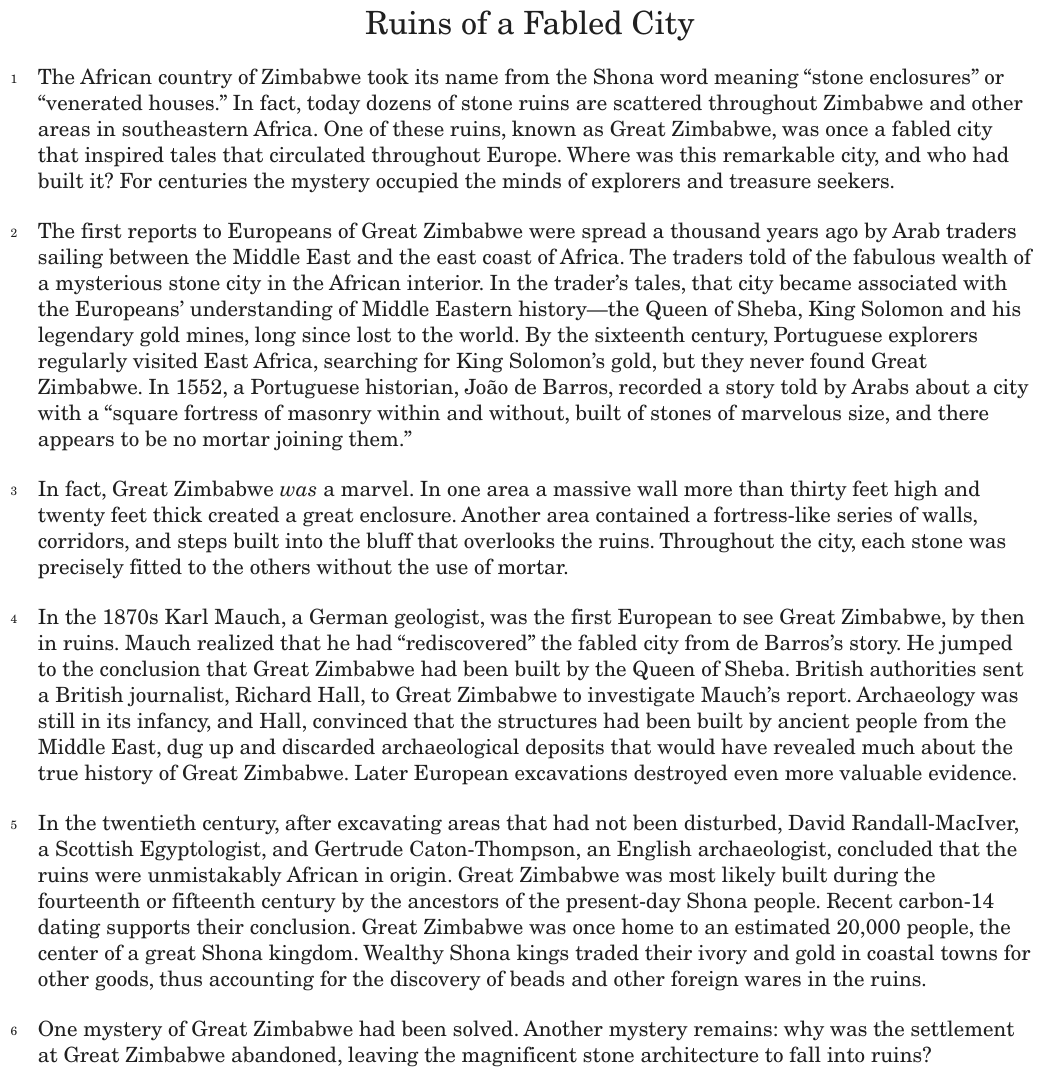
Question 37 of 120
2018 Test A English, question 37Uses the passage above: “Ruins of a Fabled City”.
Question
What was the main way that Karl Mauch’s conclusions about Great Zimbabwe in paragraph 4 affected later archaeological investigations?
- AArchaeologists from all over Europe became interested in excavating the area.
- BArchaeologists made assumptions about the history of the ruins before excavating.
- CArchaeologists started to believe that many of the past accounts recorded about the ruins were true.
- DArchaeologists realized it was unlikely that an ancient culture could build such grand structures.
Show the answer
Correct answer: B
The answer is (B)
The question asks for an explanation of how Mauch’s conclusions influenced later investigations.
Option B is the best option because Mauch’s conclusion that Great Zimbabwe “had been built by the Queen of Sheba” (paragraph 4) affected later investigations of the ruins by causing archaeologists to destroy evidence without examining it, as they assumed that Mauch’s conclusions were accurate (paragraph 4).
Option A is incorrect because, while archaeologists were interested in the area, this was not the main effect of Mauch’s conclusions, as described in the passage.
Option C is incorrect because people searched for Great Zimbabwe because they already believed the stories told by Arab traders and historians like de Barros (paragraph 2), not because of Mauch’s conclusions.
Option D is incorrect because, although the city was considered impressive (paragraph 3), Mauch’s conclusions did not influence whether people believed an ancient culture could have built the city.
Question analysis
This cause-and-effect question asks how Karl Mauch's 1870s conclusions about Great Zimbabwe shaped the investigations that came after him. Students must trace the effect through paragraph 4, where later visitors dug at the site, while keeping the older traders' tales and Portuguese searches in their proper order.
- Grade level
- Grade 7 reading and task
- Compared with grade 7
- At grade 7 Grade 7 informational reading asks how events and ideas influence one another, which is exactly this task. The effect is implied rather than stated, but it sits in one paragraph, keeping the demand typical for grade 7.
- Estimated difficulty
- Moderate: several steps, or a close reading with one strong distractor.
- Thinking it demands
- Depth of knowledge 2, skills and concepts · mainly analyze
- What makes it hard
- Reading between the lines moderate
- A very close wrong answer moderate
- Much to keep track of minor
- Evidence
- Answered from one paragraph or stanza
- Reading level
- Passage: about grade 11, 524 words; question and choices: about grade 11, 70 words.
- Students, last 30 days
- Not enough answers yet to show (it takes 10).
Why it is hard, traps and wrong answers (shows the answer)
Why it is hard
The cause and effect is implied across two sentences of paragraph 4, so students must connect Mauch's leap to the Queen of Sheba with Hall's conviction and the evidence he threw away. The passage's long run of legends makes the older accounts feel like a consequence of Mauch, when they came first. The key rewards reading for what investigators did differently because of him, not what anyone believed at some point.
Reading between the lines moderate Working it out
The passage never says Mauch's conclusion caused anything; the link comes from Hall being sent “to investigate Mauch's report” and arriving “convinced” of Middle Eastern builders. (Graesser, Singer & Trabasso, 1994; Kintsch, 1998)
A very close wrong answer moderate Choosing the answer
B and C both say later investigators took beliefs about the ruins' history for granted; C differs in one detail, since trust in the old accounts began centuries before Mauch rather than because of him. (Embretson & Wetzel, 1987; Gorin & Embretson, 2006; Ascalon et al., 2007)
Much to keep track of minor Working it out
Students must keep the order of believers straight: Arab traders, Portuguese explorers, de Barros in 1552, Mauch in the 1870s, then Hall and later European diggers. (Sweller, 1988; Carpenter, Just & Shell, 1990)
Strategy: Find what Mauch concluded, then read the sentences about the next people to dig at the site and ask how his conclusion shows up in what they did.
Traps
- Reversed relationship: Cause and effect, or the order of events, turned around.
- Too broad or too strong: A choice overstates, generalizes, or uses absolute words the text does not support.
- Outside knowledge: A choice is plausible in the real world but not supported by this text.
The wrong answers, classified
A Too broad or too strong (King et al., 2004)
Inflates the British inquiry and the “later European excavations” into archaeologists from all over Europe, and treats their interest as Mauch's main effect.
C Reversed relationship (King et al., 2004)
Flips the order: trust in the traders' tales and de Barros's account came long before Mauch and shaped his conclusion, not the other way round.
D Outside knowledge (King et al., 2004; Recht & Leslie, 1988)
Echoes the real colonial-era doubt that Africans built the city, but in the passage Hall credits ancient Middle Eastern builders, so investigators did think an ancient culture built it.
Working it out, step by step
Figure out what the question asks
This is a cause-and-effect question. It asks how Karl Mauch’s ideas changed what later people did at the ruins.
Find the evidence in paragraph 4
Mauch “jumped to the conclusion that Great Zimbabwe had been built by the Queen of Sheba.” Then Richard Hall was sent “to investigate Mauch’s report.”
Hall arrived “convinced that the structures had been built by ancient people from the Middle East.” So he “dug up and discarded archaeological deposits.” Later digs “destroyed even more valuable evidence.”
Work out the effect
To jump to a conclusion is to decide something before you have proof. Mauch did that. Hall came to check Mauch’s report, already sure of a story like Mauch’s. He decided the answer before he dug. So he threw away clues. “Deposits” here means layers of old things in the ground. They could have shown the true history.
Check each choice
- A The passage never says people from all over Europe became interested.
- B fits. The diggers made assumptions (beliefs taken as true without proof) before they dug.
- C People trusted the old tales centuries before Mauch, so he did not cause that.
- D Hall still thought an ancient people built the city, just not Africans.
Choose the answer
Mauch’s guess led later diggers to decide the city’s history before they dug. So the answer is B.
Why this answer and not the closest wrong one
C is the closest trap. It also says people trusted ideas about the ruins. But trust in the old tales began with Arab traders, and de Barros wrote his story down in 1552. Mauch came in the 1870s. C gets the order backward. B names what changed after Mauch.
More questions like this
The original DOE question
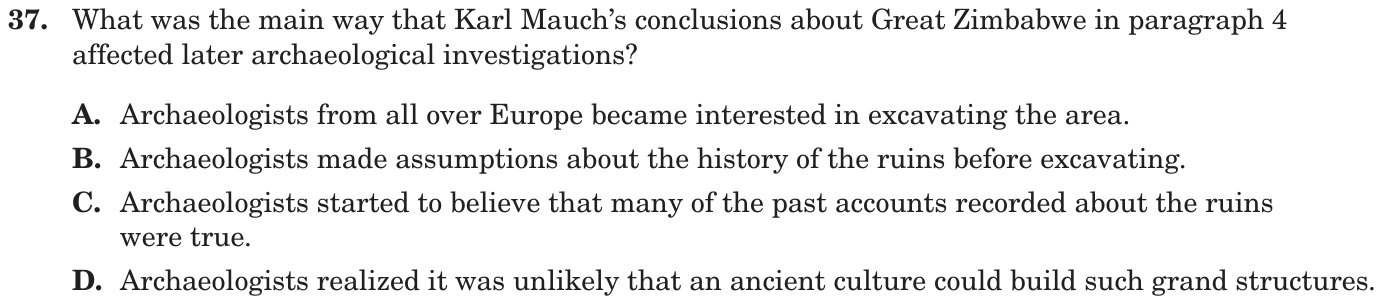
Question 38 of 120
2018 Test A English, question 38Uses the passage above: “Ruins of a Fabled City”.
Question
Which statement best describes Portuguese explorers’ experience searching for Great Zimbabwe?
- AThey routinely visited East Africa but never located the city.
- BThey were motivated by the hope of finding a mysterious city.
- CThey used details from de Barros’s story in order to determine the city’s exact location.
- DThey studied history books in order to gather information about the city.
Show the answer
Correct answer: A
The answer is (A)
The question asks for the statement that best summarizes the Portuguese explorers’ experience.
Option A is correct; the Portuguese repeatedly searched for King Solomon’s gold, which they associated with East Africa, but they never found the city (paragraph 2).
Option B is incorrect because, while they did hope to find a city, the explorers’ overall experience was focused on finding wealth.
Option C is incorrect because the information in paragraph 2 does not support the idea that the explorers used details from de Barros’s story to find the city’s location.
Option D is incorrect because the explorers heard stories about the possible wealthy city, but they did not study “history books in order to gather information about the city.”
Question analysis
In this key details question on an informational passage about Great Zimbabwe, students pick the statement that best describes the Portuguese explorers' search for the city. The key facts sit in one sentence of paragraph 2, but that paragraph is crowded with traders, legends and a historian's report that are easy to blur together.
- NYS standards
- 7R1 textual evidence and inferences
- Grade level
- Grade 6 reading and task
- Compared with grade 7
- Below grade 7 This is a locate-and-restate task that depends on one sentence. Typical grade 7 questions ask for more interpretation, so it sits below grade 7 even though the passage itself is dense with history.
- Estimated difficulty
- Routine: one familiar step, little to misread.
- Thinking it demands
- Depth of knowledge 1, recall and reproduction · mainly understand
- What makes it hard
- A lot to read minor
- Evidence
- Answered from one sentence or line
- Reading level
- Passage: about grade 11, 524 words; question and choices: about grade 10, 59 words.
- Students, last 30 days
- Not enough answers yet to show (it takes 10).
Why it is hard, traps and wrong answers (shows the answer)
Why it is hard
The answer nearly restates paragraph 2's sentence that the explorers “regularly visited East Africa” but “never found Great Zimbabwe” while hunting for King Solomon's gold. Errors come from mixing that sentence with its neighbors: the traders' talk of a mysterious city, de Barros's record, and the words history and historian. A student who rereads that one sentence and checks each choice against it should not miss this.
A lot to read minor Understanding the question
Paragraph 2 packs Arab traders, the Queen of Sheba, King Solomon, Portuguese explorers and de Barros into five sentences, so the explorers' one sentence is easy to blur with its neighbors. (Kintsch, 1998; Gorin & Embretson, 2006; Freedle & Kostin, 1993)
Strategy: Scan paragraph 2 for the Portuguese explorers and read that sentence closely; keep only a choice whose every part the sentence states.
Traps
- Twists what the text says: Uses the text's topic and ideas but changes what it says: who did it, how much, when, or why.
- Word match: Repeats striking words or phrases from the text, so it looks supported, but its meaning does not fit the question.
The wrong answers, classified
B Twists what the text says (King et al., 2004)
Swaps their stated goal, King Solomon's gold, for the mysterious city of the traders' tales, and leaves out that they never found it.
C Reads too much in (Graesser, Singer & Trabasso, 1994)
Links de Barros's 1552 record to the explorers because they share a paragraph, though the passage never connects them and the explorers never found the city.
D Word match (Freedle & Kostin, 1993)
Picks up “history” and “historian” from paragraph 2 and invents a research step; the passage never says the explorers studied books.
Working it out, step by step
Figure out what the question asks
This is a key-detail question. The answer is stated in the passage. You just need to find the right sentence and read it closely.
Find the sentence about the Portuguese
Paragraph 2 has one sentence about them: “By the sixteenth century, Portuguese explorers regularly visited East Africa, searching for King Solomon’s gold, but they never found Great Zimbabwe.”
Put it in your own words
The sixteenth century means the 1500s. “Regularly” means often, again and again. So the explorers kept coming to East Africa. They were looking for gold. But they never found the city.
Check each choice
- A fits. “Routinely” means regularly, and they never located, or found, the city.
- B The sentence says they wanted King Solomon’s gold, not a mysterious city.
- C The passage never links the explorers to de Barros’s story. They never found the city anyway.
- D The passage never says they studied history books.
Choose the answer
The Portuguese explorers kept visiting East Africa but never found the city. So the answer is A.
Why this answer and not the closest wrong one
B is the closest trap, because traders did tell of a “mysterious stone city.” But that is about the traders. The Portuguese were “searching for King Solomon’s gold.” B also leaves out the main fact: they never found the city. A matches the sentence closely.
More questions like this
The original DOE question

Question 39 of 120
2018 Test A English, question 39Uses the passage above: “Ruins of a Fabled City”.
Question
What was “one mystery of Great Zimbabwe” (paragraph 6) that had been solved?
- Awhy the settlement was abandoned
- Bwhere the ivory and gold from the city went
- Cwhy the ruins remained undiscovered until the 1870s
- Dwho had built the settlement
Show the answer
Correct answer: D
The answer is (D)
The question asks for the specific conclusion that was able to be drawn from the excavations at Great Zimbabwe.
Option D is the correct answer because paragraph 5 states that carbon-14 dating supports Randall-MacIver and Caton-Thompson’s conclusion that Great Zimbabwe was built by ancestors of the Shona people during the fourteenth or fifteenth century.
Option A is incorrect because the mystery behind “why the settlement was abandoned” has not been solved.
Option B is incorrect because the passage never presents the city’s ivory and gold as a mystery; paragraph 5 simply states that Shona kings traded them in coastal towns for other goods.
Option C is incorrect because the reason that Europeans did not discover Great Zimbabwe until the 1870s has not been explained.
Question analysis
This question asks students to identify the “one mystery of Great Zimbabwe” that the final paragraph calls solved. Students need to connect the final paragraph with the findings described before it, keeping track of which questions the passage answers and which it leaves open.
- NYS standards
- 7R1 textual evidence and inferences
- Grade level
- Grade 6 reading and task
- Compared with grade 7
- Below grade 7 Matching a phrase to the fact it refers to is a short, routine task, easier than most grade 7 reading questions. The only demand is linking the last paragraph back to earlier ones rather than reading it alone.
- Estimated difficulty
- Straightforward: two steps or one careful reading.
- Thinking it demands
- Depth of knowledge 2, skills and concepts · mainly understand
- What makes it hard
- Evidence
- Answered from several paragraphs or stanzas
- Reading level
- Passage: about grade 11, 524 words; question and choices: about grade 5, 39 words.
- Corrected from the DOE handbook
- An inaccurate statement in the explanation was corrected.
- An overstatement of the passage in the explanation was corrected.
- Students, last 30 days
- Not enough answers yet to show (it takes 10).
Why it is hard, traps and wrong answers (shows the answer)
Why it is hard
The final paragraph names two mysteries in back-to-back sentences, one solved and one open, but only spells out the open one. Students have to look back to the excavations and carbon dating in paragraph 5 to see which question was answered. Rushing produces the most common wrong pick, the abandonment question, because its words sit right beside the phrase the stem quotes.
Evidence in several places minor Working it out
“One mystery” points back to paragraph 1's question “who had built it?” and to paragraph 5's finding, so the answer lies outside the paragraph the stem cites. (Kirsch & Mosenthal, 1990; Gorin & Embretson, 2006)
Strategy: Before reading the choices, find the paragraph that reports what excavation and carbon dating showed, note which question it settles, and compare that with each choice.
Traps
- Word match: Repeats striking words or phrases from the text, so it looks supported, but its meaning does not fit the question.
- True but not the answer: A choice says something accurate about the text that does not answer this question.
The wrong answers, classified
A Word match (Freedle & Kostin, 1993)
Grabs the question printed right after the quoted phrase, why the settlement was abandoned, missing “Another mystery remains,” which marks it as unsolved.
B True but not the answer (King et al., 2004; Embretson & Wetzel, 1987)
Remembers that the passage explains where the ivory and gold went, traded in coastal towns, but it never treats that as a mystery.
C Twists what the text says (King et al., 2004)
Turns paragraph 1's “Where was this remarkable city” into why it went unseen until the 1870s, a question the passage never answers.
What was corrected from the DOE handbook, and why
- Explanation: The handbook rejects choice B because “the disappearance of the city’s ivory and gold is a mystery that has not been solved.” The passage presents no such mystery: paragraph 5 says Shona kings traded their ivory and gold in coastal towns for other goods. The explanation now says the passage never presents the ivory and gold as a mystery.
- Explanation: The handbook says paragraph 5 states that carbon-14 dating “proved” Randall-MacIver and Caton-Thompson’s conclusion. The passage says only that recent carbon-14 dating “supports their conclusion,” so the explanation now says “supports”.
Working it out, step by step
Figure out what the question asks
This asks you to find a key detail. Paragraph 6 says one mystery was solved, but it doesn’t say which one. You have to look back to find it.
Find the mystery and its answer
Paragraph 1 asks: “Where was this remarkable city, and who had built it?”
Paragraph 5 answers part of that. Scientists concluded “that the ruins were unmistakably African in origin.” The city was built “by the ancestors of the present-day Shona people.” Carbon-14 dating, a lab test that tells how old something is, supports this.
Match it to paragraph 6
Paragraph 6 says: “One mystery of Great Zimbabwe had been solved.” The solved mystery is the one paragraph 5 answers: who built the city. The next sentence starts, “Another mystery remains.” That one, why people left, is still open.
Check each choice
- A is the mystery that “remains,” so it is not solved.
- B The passage tells where the ivory and gold went, but never calls it a mystery.
- C The passage never explains why Europeans didn’t see the ruins until the 1870s.
- D fits. Paragraph 5 shows who built it.
Choose the answer
The mystery that had been solved is who built Great Zimbabwe: the ancestors of the Shona. So the answer is D.
Why this answer and not the closest wrong one
Watch out for A. Its words sit right next to the quoted phrase in paragraph 6, so it is easy to grab. But that sentence says “Another mystery remains,” which means it is still open. Only D is a question the passage actually answers.
More questions like this
The original DOE question
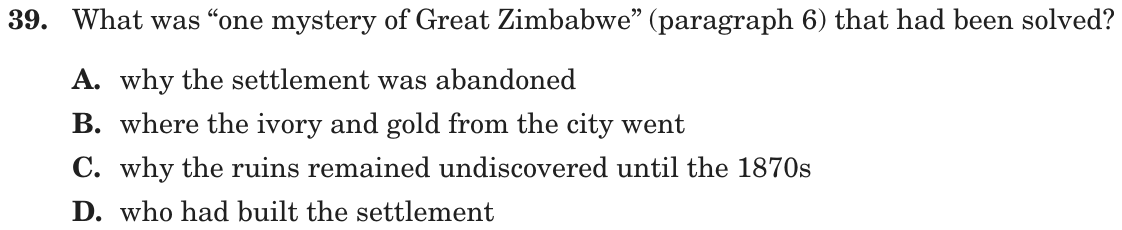
Question 40 of 120
2018 Test A English, question 40Uses the passage above: “Ruins of a Fabled City”.
Question
Which statement about the Shona people is best supported by the passage?
- AThey live along the east coast of Africa.
- BThey are descendants of the people who built Great Zimbabwe.
- CThey lived in the Middle East before settling in Africa.
- DThey were once ruled by King Solomon and the Queen of Sheba.
Show the answer
Correct answer: B
The answer is (B)
The question asks for the best supported evidence the passage provides about the Shona people. The Shona people are discussed in paragraph 5, where it is explained that Great Zimbabwe was discovered to have been built by the ancient ancestors of the Shona people, making Option B correct.
Option A is incorrect because the ancient Shona people lived in the African interior, not on the coast, and the passage does not give specific details about where the Shona people live presently.
Option C is incorrect because the passage does not give a detailed history about the origins and locations of the Shona people in Africa.
Option D is incorrect because, while early explorers were looking for King Solomon’s gold and evidence of the Queen of Sheba in Africa, the Shona people were not found to be linked to these people.
Question analysis
Students must decide which statement about the Shona people is best supported by the passage on Great Zimbabwe. The Shona appear in only a few sentences of a text crowded with explorers, legends and rival theories, so each choice must be checked against exactly what those sentences say.
- NYS standards
- 7R1 textual evidence and inferences
- Grade level
- Grade 6 reading and task
- Compared with grade 7
- Below grade 7 Locating what a passage says about one group and restating it is a grade 6 skill. The supporting sentence is short and clear, so this falls below typical grade 7 demand despite the passage's crowded content.
- Estimated difficulty
- Routine: one familiar step, little to misread.
- Thinking it demands
- Depth of knowledge 1, recall and reproduction · mainly understand
- What makes it hard
- Evidence
- Answered from one sentence or line
- Reading level
- Passage: about grade 11, 524 words; question and choices: about grade 5, 52 words.
- Students, last 30 days
- Not enough answers yet to show (it takes 10).
Why it is hard, traps and wrong answers (shows the answer)
Why it is hard
The Shona are named only in paragraph 5, and the sentence that matters says the city was built by their ancestors. The one real hurdle is the reversal of that relation in the key, which a student who mixes up ancestors and descendants may reject. Every wrong choice borrows a place or name tied to someone else in the passage: the traders' coast, Hall's Middle East, the European legends.
The right answer is reworded minor Choosing the answer
The key flips the passage's “ancestors of the present-day Shona people” into “descendants of the people who built,” while wrong choices reuse “east coast,” “Middle East” and “King Solomon.” (Freedle & Kostin, 1993; Kirsch & Mosenthal, 1990)
Strategy: Search the passage for every mention of the Shona and read those sentences closely; choose the statement they directly support, not one that merely sounds historical.
Traps
- Wrong part of the text: A choice is true of another paragraph, stanza or speaker than the one asked about.
- Word match: Repeats striking words or phrases from the text, so it looks supported, but its meaning does not fit the question.
The wrong answers, classified
A Wrong part of the text (Kirsch & Mosenthal, 1990)
Moves the Shona to the coast because Shona kings traded “in coastal towns” and Arab traders sailed the “east coast,” though the city stood in the interior.
C Twists what the text says (King et al., 2004)
Attaches Hall's discredited theory of Middle Eastern builders to the Shona, giving them an origin the passage never mentions.
D Word match (Freedle & Kostin, 1993)
Repeats the striking names King Solomon and the Queen of Sheba, which belong to the legends Europeans told, not to Shona history.
Working it out, step by step
Figure out what the question asks
This asks which statement about the Shona people the passage supports. Trust only what the passage says, not what sounds right.
Find every mention of the Shona
The Shona appear only in paragraph 5. Great Zimbabwe “was most likely built during the fourteenth or fifteenth century by the ancestors of the present-day Shona people.” Later: “Wealthy Shona kings traded their ivory and gold in coastal towns.”
Turn the sentence around
Your ancestors are family members who lived long before you, like your great-great-grandparents. Your descendants are the people who come after you, like your grandchildren.
So if the builders were the ancestors of the Shona, then the Shona today are the descendants of the builders. Choice B flips the words, but it says the same thing.
Check each choice
- A The kings traded in coastal towns. But the city was in the African interior, away from the coast.
- B fits. It restates paragraph 5.
- C Builders from the Middle East was Hall’s wrong idea. It is not Shona history.
- D King Solomon and the Queen of Sheba come from European legends, not Shona history.
Choose the answer
The passage supports the idea that the Shona today are descendants of the city’s builders. So the answer is B.
Why this answer and not the closest wrong one
A is tempting because Shona kings traded “in coastal towns.” But trading in a place is not living there. The passage never says where the Shona live now. B is the only choice the passage states, just turned around from “ancestors” to “descendants.”
More questions like this
The original DOE question
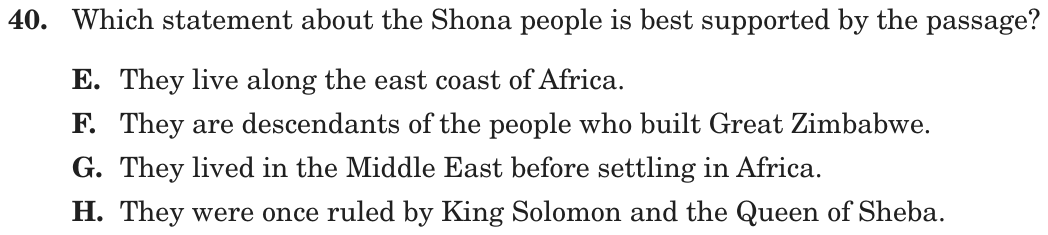
Question 41 of 120
2018 Test A English, question 41Uses the passage above: “Ruins of a Fabled City”.
Question
The conclusions of David Randall-MacIver and Gertrude Caton-Thompson were significant because they
- Aproved that Great Zimbabwe was much older than previously thought.
- Bquestioned why the Shona people left Great Zimbabwe.
- Csupported the idea that the ancient Shona had a robust society at Great Zimbabwe.
- Drevealed that Great Zimbabwe was African in origin.
Show the answer
Correct answer: D
The answer is (D)
The question asks for the impact of Randall-MacIver and Caton-Thompson’s discovery. David Randall-MacIver and Gertrude Caton-Thompson’s conclusions were significant because their excavation of the ruins revealed that Great Zimbabwe was most certainly built by the ancestors of modern-day Africans (paragraph 5), discrediting the long-standing idea that the structure was Middle Eastern in origin. This conclusion is stated in Option D.
Option A is incorrect because paragraph 5 states that Randall-MacIver and Caton-Thompson determined that the city was likely built in the fourteenth or fifteenth century, which was later than earlier explorers had assumed.
Option B is incorrect because the question of why the great city was abandoned was not part of Randall-MacIver and Caton-Thompson’s discovery.
Option C is incorrect because, while paragraph 5 also indicates that the Shona society was strong and healthy, this idea was not the main focus of Randall-MacIver and Caton-Thompson’s discovery.
Question analysis
This question asks why the conclusions of David Randall-MacIver and Gertrude Caton-Thompson about Great Zimbabwe mattered. Students must judge significance, not just recall facts, by weighing several details from paragraph 5 and deciding which one the passage treats as most important.
- Grade level
- Grade 7 reading and task
- Compared with grade 7
- At grade 7 Weighing why a finding matters is typical grade 7 informational reading. The researchers' conclusion is easy to find, but students must use the earlier theories to see why it mattered, which keeps the task at grade 7.
- Estimated difficulty
- Straightforward: two steps or one careful reading.
- Thinking it demands
- Depth of knowledge 2, skills and concepts · mainly analyze
- What makes it hard
- Evidence
- Answered from one paragraph or stanza
- Reading level
- Passage: about grade 11, 524 words; question and choices: about grade 9, 52 words.
- Students, last 30 days
- Not enough answers yet to show (it takes 10).
Why it is hard, traps and wrong answers (shows the answer)
Why it is hard
The finding itself is stated almost word for word, so the work is judging significance. Paragraph 5 piles several facts after the conclusion, a date, a population and trading kings, and one of them invites the reading that the researchers' point was a thriving society. Students who remember what Mauch and Hall believed see that overturning the Middle Eastern theory is what the passage treats as the turning point.
Reading between the lines minor Working it out
“Significant” is never explained; students must set “unmistakably African in origin” against the Queen of Sheba and Middle Eastern theories of paragraph 4 to see why it mattered. (Graesser, Singer & Trabasso, 1994; Kintsch, 1998)
Strategy: Read paragraph 5 alongside paragraph 4, note what earlier investigators believed, and judge each choice by how much it changes or confirms that earlier picture.
Traps
- True but not the answer: A choice says something accurate about the text that does not answer this question.
- Reversed relationship: Cause and effect, or the order of events, turned around.
- Wrong part of the text: A choice is true of another paragraph, stanza or speaker than the one asked about.
The wrong answers, classified
A Reversed relationship (King et al., 2004)
Gets the time relation backward: a fourteenth- or fifteenth-century date makes the city far younger than the King Solomon and Queen of Sheba legends implied.
B Wrong part of the text (Kirsch & Mosenthal, 1990)
Borrows the open question of why the settlement was abandoned, which the author raises in the last paragraph, not something these researchers addressed.
C True but not the answer (King et al., 2004; Embretson & Wetzel, 1987)
Picks the true picture of a large, wealthy Shona kingdom from the same paragraph, but that detail follows the conclusion and is not what made it significant.
Working it out, step by step
Figure out what the question asks
This asks why the two scientists’ conclusion was significant, or important. To see why it mattered, compare it with what people believed before.
Recall the earlier beliefs
Paragraph 4 tells what people believed. Mauch thought the city “had been built by the Queen of Sheba.” Hall was sure it was built “by ancient people from the Middle East.” For centuries, who built the city was a mystery.
Find what they concluded
Paragraph 5 says Randall-MacIver and Caton-Thompson dug in places no one had disturbed. They “concluded that the ruins were unmistakably African in origin.”
Unmistakably means with no doubt. Origin means where something comes from. Their finding proved the old Middle East ideas wrong. That is why it was so important.
Check each choice
- A The passage dates the city to the 1300s or 1400s. That makes it much younger than the King Solomon legends, not older.
- B Why the Shona left is the open question in paragraph 6. These two did not study it.
- C Paragraph 5 does describe a rich kingdom. But that detail is not what made their finding important.
- D fits. They showed the city was African in origin.
Choose the answer
Their work was significant because it revealed that Great Zimbabwe was African in origin. So the answer is D.
Why this answer and not the closest wrong one
C is the closest trap, because paragraph 5 does show a strong Shona kingdom of “an estimated 20,000 people.” But that detail comes after their conclusion. What mattered most was proving the city African, which overturned the Middle East theories. That is D.
More questions like this
The original DOE question
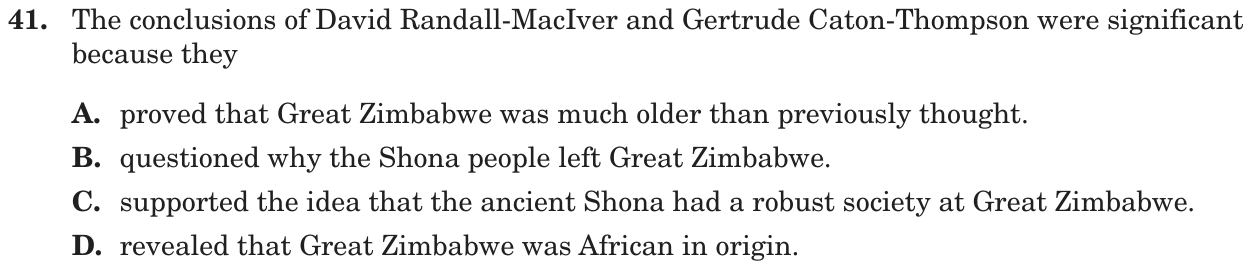
Question 42 of 120
2018 Test A English, question 42Passage Cross-Purposes
Cross-Purposes
What I am is built: concrete and steel.
I defy gravity. I am what every athlete
wants: to remain at the apex of the leap,
up in the air. And yet I am useful, too:
cars, trucks, people, even trains
make their way across my broad back.
Swallows and ospreys nest in my trusses.
What I am is motion. I am water, and I am older
than anything else you know. No human
built me. I am gravity’s best friend; I pool
and flow wherever gravity takes me.
I am the blood flowing in the runner’s chest,
and I catch everything: from the hills,
the mountains. It all washes down through me.
What you are is an accident,
what happens to rain when rain gives in
to Earth’s gravitational pull.
You are some tears dribbling from a mountain’s
eye, running down the pavements
of small towns, into the cities, to the sea.
You are the path of least resistance.
What I am is power. You, of course,
have none: you are a static lump, an artifact
slowly decaying. But my regal flow
nourishes grasses, permits empires to rise.
Those who made you will break you,
in time, replacing you with yet another
clumsy structure. I have seen. I know.
“Clumsy”? Being rebuilt makes me
a friend of time, does it not? And it means
that I have siblings—those “clumsy” structures,
my sisters and brothers.
We stitch across the rip you make.
We are steel thread to the human needle.
We bind you up. We sew you.
And I sow into you; in every cranny
of your superstructure my vapors cling.
They bring out your softness, your rust.
Boast your best, and boast better yet.
I am listening to the bright hum
of the wind in your wires. Because I am,
above all else, patient. I will wait for you.
ospreys: large birds
Question
How does the similar construction of the sentence in line 1 and the sentence in line 8 contribute to the meaning of the poem?
- AIt introduces the intended permanence of the structure and the ever-changing fluidity of the water.
- BIt shows that the structure can bridge the gap caused by the water.
- CIt suggests that the structure has more limitations than the water.
- DIt contrasts the stability of the structure with the instability of the water.
Show the answer
Correct answer: A
The answer is (A)
The question asks how the similarity in the construction of lines 1 and 8 contributes to the meaning of the poem. By beginning lines 1 and 8 with “What I am is,” each speaker establishes its defining feature, both of which are stated in Option A.
Option B is incorrect because the focus of the lines is defining the speakers’ individuality, not how one speaker resolves a problem created by the other.
Option C is incorrect because the structure is not stating in line 1 that it is limited because it was built to stand in place; on the contrary, the structure is stating that this sense of purpose and permanence is its strength.
Option D is incorrect because, in these lines, each speaker is trying to establish its stability, which for the structure is based on strength and for the water is based on longevity.
Question analysis
In the poem “Cross-Purposes,” a built structure and a body of water speak in turn, and both of their opening stanzas begin “What I am is.” This question asks how that matching sentence pattern adds to the poem's meaning. Students must judge precisely how each speaker describes itself, since the choices differ in small but important words.
- Grade level
- Grade 8 reading and task
- Compared with grade 7
- Above grade 7 Grade 7 poetry questions often ask what a repeated phrase emphasizes. Here the repetition sets up two opposed speakers, and the choices hinge on fine distinctions of connotation, which pushes the task above typical grade 7 work.
- Estimated difficulty
- Among the hardest on the SHSAT: a non-obvious approach, heavy reading, or a well-hidden trap.
- Thinking it demands
- Depth of knowledge 3, strategic thinking · mainly analyze
- What makes it hard
- A very close wrong answer major
- How, not what moderate
- Figurative or literary language moderate
- Hard words minor
- Evidence
- Answered from several paragraphs or stanzas
- Reading level
- Passage: 316 words (a poem; reading level not measured); question and choices: about grade 8, 74 words.
- Corrected from the DOE handbook
- A grammar slip in the explanation was corrected.
- Students, last 30 days
- Not enough answers yet to show (it takes 10).
Why it is hard, traps and wrong answers (shows the answer)
Why it is hard
Two choices describe the same contrast, built versus moving, and differ only in the judgment their words carry. Students who see the contrast quickly can still lose the point by choosing the version that calls the water unstable, since nothing in the water's stanza treats motion as a weakness; it boasts of being older than anything. The question rewards weighing the connotation of each word in a choice, not just its overall direction.
A very close wrong answer major Choosing the answer
A and D describe the same contrast in near-synonyms, permanence and stability against fluidity and instability; they differ only in the word “instability,” a weakness the proud water never claims. (Embretson & Wetzel, 1987; Gorin & Embretson, 2006; Ascalon et al., 2007)
How, not what moderate Working it out
The stem asks what the shared opening “What I am is” does, so students must see that it sets up two self-definitions, “built” and “motion,” as rival claims. (Anderson & Krathwohl, 2001)
Figurative or literary language moderate Understanding the question
The speakers are personified and the structure is never named, so students must infer from “concrete and steel” and the trains on its “broad back” that a bridge is speaking. (Graesser, Singer & Trabasso, 1994; Kintsch, 1998)
Hard words minor Understanding the question
The choices turn on abstract words such as “permanence,” “fluidity” and “instability” that never appear in the poem. (Perfetti, 2007; Freedle & Kostin, 1993)
Strategy: Read the opening sentences of the first two stanzas side by side, name each speaker's defining quality in a word, and test every choice's wording against what the speakers actually claim.
Traps
- Half right: One half of a two-part choice is right and the other is not.
- Wrong part of the text: A choice is true of another paragraph, stanza or speaker than the one asked about.
The wrong answers, classified
B Wrong part of the text (Kirsch & Mosenthal, 1990)
Jumps to the fifth stanza, where the structures “stitch across the rip you make”; lines 1 and 8 only define each speaker and mention no gap.
C Reads too much in (Graesser, Singer & Trabasso, 1994)
Infers from “built” versus “motion” that the structure is the more limited, a judgment the water makes later but these parallel lines do not.
D Half right (King et al., 2004; Thissen, Steinberg & Fitzpatrick, 1989)
Gets the structure's stability right, but “instability” casts the water's motion as a flaw, while the water presents motion as a strength.
What was corrected from the DOE handbook, and why
- Explanation: The handbook reads “how the similarity in the construction of lines 1 and 8 contribute”. It now reads “contributes”, to agree with “similarity”.
Working it out, step by step
Figure out what the question asks
This is a question about the poem’s structure. Lines 1 and 8 are built the same way. You need to see what that sameness does for the meaning.
Compare lines 1 and 8
Line 1 opens the first stanza (a group of lines in a poem): “What I am is built: concrete and steel.”
Line 8 opens the second stanza: “What I am is motion. I am water.”
Both start with the same words, “What I am is.” Each speaker is telling you the one thing that defines it.
Work out who is talking
Two things talk in this poem. The first is a structure, most likely a bridge. It is made of “concrete and steel,” and trains cross its “broad back.” The second is water. Giving human traits, like speech, to things that are not human is called personification.
The bridge is “built”: made to stay in place for a long time. The water is “motion”: always moving and changing.
Check each choice
- A fits. “Built” suggests permanence (lasting). “Motion” suggests fluidity (flowing like a liquid).
- B The bridge closing a gap comes later, in lines 33–35. Lines 1 and 8 mention no gap.
- C The bridge is proud of being built. It admits no limits here.
- D “Instability” makes moving sound like a weakness. The water is proud of its motion.
Choose the answer
The matching lines set the structure’s lasting strength against the water’s constant flow. So the answer is A.
Why this answer and not the closest wrong one
D is the closest trap, because it describes the same contrast. But instability means being shaky or weak. The water never sees itself that way. It brags that it is “older / than anything else you know.” A uses “fluidity,” which treats motion as a strength.
More questions like this
The original DOE question
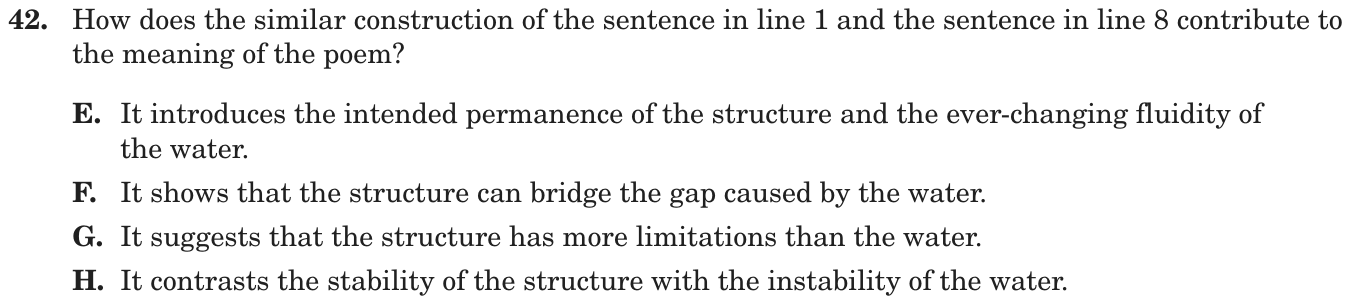
The passage “Cross-Purposes” as printed (pages 72–73)
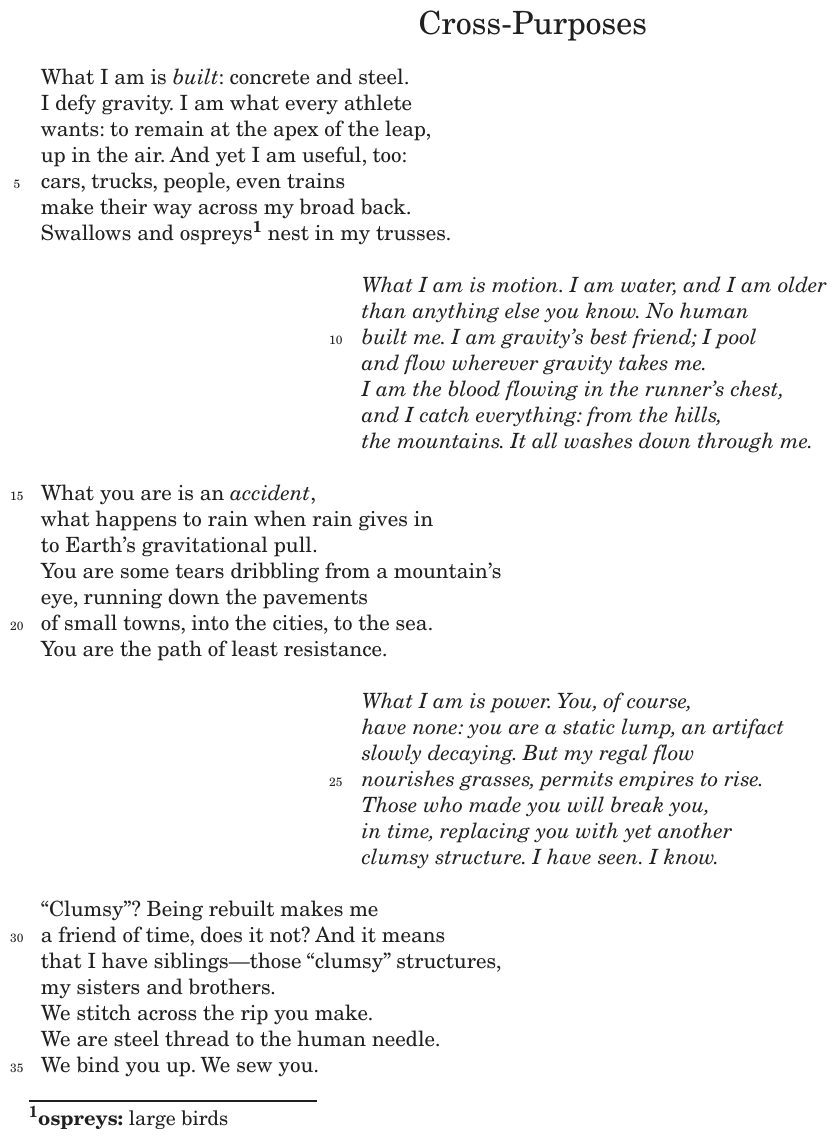
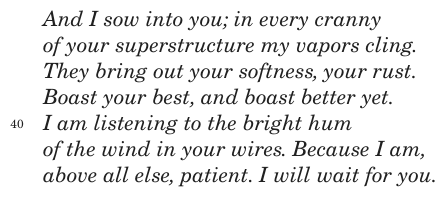
Question 43 of 120
2018 Test A English, question 43Uses the passage above: “Cross-Purposes”.
Question
Read lines 2–4 and lines 12–14 from the poem.
I am what every athlete
wants: to remain at the apex of the leap,
up in the air.
I am the blood flowing in the runner’s chest,
and I catch everything: from the hills,
the mountains.
How do the lines contribute to the development of a central idea of the poem?
- AThey establish that both the structure and the water have endurance and control.
- BThey highlight that both the structure and the water are powerful and impressive.
- CThey suggest that the structure and the water are unaware of how similar they are.
- DThey reveal that the structure and the water are surprised that they are interrelated.
Show the answer
Correct answer: B
The answer is (B)
The question asks how the lines contribute to the development of a central idea in the poem. The lines “I am what every athlete / wants” (lines 2–3) and “I am the blood flowing in the runner’s chest” (line 12) communicate that each speaker is an object of admiration and a powerful force, so Option B is correct.
Option A is incorrect because nothing in the language of the lines communicates control.
Option C is incorrect because the lines describe opposing characteristics: the structure’s description conveys stillness—remaining “up in the air” (line 4)—while the water’s description conveys movement—“flowing in the runner’s chest” (line 12). Additionally, the idea that the speakers fail to recognize similarities is not part of a central idea.
Option D is incorrect because there is no evidence in the poem that the two speakers understand that they are interrelated.
Question analysis
Students compare two sets of lines from the poem “Cross-Purposes” in which the structure and the water each describe themselves through athletes, one leaping and one running. The question asks how these lines develop a central idea, which means comparing two images that seem opposite and deciding what the pairing adds.
- Grade level
- Grade 8 reading and task
- Compared with grade 7
- Above grade 7 Typical grade 7 work asks what one image suggests. This question pairs images from two speakers in a two-voice poem and asks for a shared idea, with abstract choices that all sound plausible, which is above grade 7.
- Estimated difficulty
- Hard: combines ideas, needs a plan, and has more than one tempting wrong answer.
- Thinking it demands
- Depth of knowledge 3, strategic thinking · mainly analyze
- What makes it hard
- Figurative or literary language major
- Combines ideas moderate
- A very close wrong answer moderate
- Evidence
- Answered from several paragraphs or stanzas
- Reading level
- Passage: 316 words (a poem; reading level not measured); question and choices: about grade 7, 113 words.
- Students, last 30 days
- Not enough answers yet to show (it takes 10).
Why it is hard, traps and wrong answers (shows the answer)
Why it is hard
The athlete images point in opposite directions, one frozen in the air and one in motion, so students may look for a contrast when the question wants what the two share. Both speakers are borrowing the glamour of athletes to boast, which is what makes them powerful and impressive. The other choices either add a quality, control, that neither image carries, or credit the speakers with feelings the poem never shows.
Figurative or literary language major Understanding the question
Both claims are metaphors: the bridge is the athlete's dream of staying “at the apex of the leap,” and the water is “the blood flowing in the runner's chest,” so each image must be translated into a quality. (Graesser, Singer & Trabasso, 1994; Kintsch, 1998)
Combines ideas moderate Working it out
The two sets of lines come from rival speakers in different stanzas, and the answer has to name one idea true of both, not of either alone. (Embretson, 1998; Daniel & Embretson, 2010)
A very close wrong answer moderate Choosing the answer
A and B share the frame “both the structure and the water” plus two qualities; A's endurance is close to B's power, and only its added “control” finds no support in the lines. (Embretson & Wetzel, 1987; Gorin & Embretson, 2006; Ascalon et al., 2007)
Strategy: For each set of lines, ask what the speaker claims about itself through the athlete image; then keep only a choice that fits both speakers and these exact words.
Traps
- Half right: One half of a two-part choice is right and the other is not.
- Reads too much in: A reasonable-sounding conclusion that goes further than the text allows.
The wrong answers, classified
A Half right (King et al., 2004; Thissen, Steinberg & Fitzpatrick, 1989)
Hears stamina in the runner and in staying aloft, which is defensible, but nothing in either set of lines suggests control.
C Reads too much in (Graesser, Singer & Trabasso, 1994)
Notices that both speakers use athletes and assumes they miss the likeness, an idea the poem never develops; the images actually set stillness against motion.
D Wrong tone or attitude (Graesser, Singer & Trabasso, 1994)
Reads surprise into lines whose tone is boastful; neither speaker shows any sign of noticing a connection, let alone being surprised by it.
Working it out, step by step
Figure out what the question asks
This asks how two sets of lines build a central idea. The structure speaks one set, and the water speaks the other. You need one idea that fits both.
Read both sets of lines
The structure says, in lines 2–4: “I am what every athlete / wants: to remain at the apex of the leap, / up in the air.”
The water says, in lines 12–14: “I am the blood flowing in the runner’s chest, / and I catch everything.”
Work out what each speaker claims
The apex is the very top. Every athlete wishes they could stay at the top of a jump. The structure stays up there all the time. So it brags that it does what athletes dream of.
The water says it is the blood that keeps a runner going. Both speakers compare themselves to strong athletes. Both are showing off how powerful and impressive they are.
Check each choice
- A Endurance (lasting a long time) could fit. But nothing in the lines shows control.
- B fits. Both speakers boast of being powerful and impressive.
- C The poem never says they don’t notice how alike they are.
- D Neither speaker shows surprise. Their tone is proud.
Choose the answer
Both sets of lines show the speakers bragging about their power. So the answer is B.
Why this answer and not the closest wrong one
A is the closest choice. Like B, it says something good about both speakers. But A adds “control,” and neither set of lines shows either speaker controlling anything. Every part of B fits both sets of lines, with nothing extra.
More questions like this
The original DOE question
Question 44 of 120
2018 Test A English, question 44Uses the passage above: “Cross-Purposes”.
Question
Read line 7 from the first stanza.
Swallows and ospreys nest in my trusses.
How does the line contribute to the development of ideas in the stanza?
- AThe line supports the structure’s claim that it is beneficial to nature.
- BThe line reveals that the structure secretly envies the water’s importance in nature.
- CThe line emphasizes that the structure is more valuable to nature than the water is.
- DThe line reveals the kinship that nature shares with the structure.
Show the answer
Correct answer: A
The answer is (A)
The question asks how the line contributes to the development of ideas in the stanza. The line mentions swallows and ospreys, birds that use the structure’s trusses as their home; this reference supports the claim that the structure is beneficial to nature, so Option A is correct.
Option B is incorrect because the line doesn’t hint at jealousy in the tone or language, but rather the line is promoting the structure’s helpful characteristic.
Option C is incorrect because, in the line, the structure is not making a comparison with the water.
Option D is incorrect because, in the line, the structure is not implying that it is related to nature but rather that it is helpful to nature.
Question analysis
This question focuses on the first stanza of “Cross-Purposes,” in which a built structure describes itself, and asks what the line about swallows and ospreys nesting in its trusses adds. The line is short and plain, but students need to read it as part of the whole stanza and know that trusses are a structure's load-bearing framework.
- NYS standards
- 7R5 structure and genre features
- Grade level
- Grade 6 reading and task
- Compared with grade 7
- Below grade 7 Explaining what one line adds to its own stanza matches the grade 6 standard on how a sentence fits into a text. The line is plain and the stanza short, so this is below typical grade 7 demand.
- Estimated difficulty
- Straightforward: two steps or one careful reading.
- Thinking it demands
- Depth of knowledge 2, skills and concepts · mainly analyze
- What makes it hard
- How, not what minor
- Figurative or literary language minor
- A very close wrong answer minor
- Evidence
- Answered from one paragraph or stanza
- Reading level
- Passage: 316 words (a poem; reading level not measured); question and choices: about grade 6, 77 words.
- Students, last 30 days
- Not enough answers yet to show (it takes 10).
Why it is hard, traps and wrong answers (shows the answer)
Why it is hard
The line is plain and follows directly from the stanza's claim that the structure is useful, so most students who read the stanza in order find the key. The wrong choices import the poem's later rivalry with the water, or a sense of family that comes later and refers to other structures. Students who keep to the first stanza, where the water has not yet spoken, avoid them.
How, not what minor Working it out
The line follows “And yet I am useful, too,” so its job is to extend the structure's usefulness from cars and trains to birds. (Anderson & Krathwohl, 2001)
Figurative or literary language minor Understanding the question
The speaker is a personified bridge boasting about itself, and the birds in its “trusses” are offered as one more reason to admire it. (Graesser, Singer & Trabasso, 1994; Kintsch, 1998)
A very close wrong answer minor Choosing the answer
A and C both say the line shows the structure's value to nature; C differs only in adding “than the water is,” a comparison the first stanza, where the water has not yet spoken, never makes. (Embretson & Wetzel, 1987; Gorin & Embretson, 2006; Ascalon et al., 2007)
Strategy: Read the stanza's sentences in order and note what each says about the speaker; then ask what the line about the birds adds to that picture.
Traps
- Wrong part of the text: A choice is true of another paragraph, stanza or speaker than the one asked about.
- Reads too much in: A reasonable-sounding conclusion that goes further than the text allows.
The wrong answers, classified
B Wrong tone or attitude (Graesser, Singer & Trabasso, 1994)
Imagines envy of the water, but the first stanza never mentions the water and its tone is proud, not jealous.
C Wrong part of the text (Kirsch & Mosenthal, 1990)
Brings in the later contest over usefulness to nature, when the water says its flow “nourishes grasses”; the first stanza makes no comparison.
D Reads too much in (Graesser, Singer & Trabasso, 1994)
Reads nesting birds as a family bond, a step beyond the line, which shows the structure helping nature; the “siblings” come later and are other structures.
Working it out, step by step
Figure out what the question asks
This asks what one line adds to the first stanza. A stanza is a group of lines in a poem, a bit like a paragraph. Read the whole stanza to see where the line fits.
Read the stanza in order
Line 4 says: “And yet I am useful, too.” Lines 5–6 list who uses the structure: “cars, trucks, people, even trains.” Then line 7 says: “Swallows and ospreys nest in my trusses.”
The footnote says ospreys are large birds. Swallows are small birds. Trusses are the frame of beams that holds up a bridge.
Work out what the line adds
Lines 4–7 list ways the structure is useful. First it helps people and their cars and trains get across. Line 7 adds that it helps animals too: birds make their homes in it. So the line shows the structure is good for nature, not just for people.
Check each choice
- A fits. Birds nesting there support the claim that the structure helps nature.
- B The water isn’t even mentioned yet, and the tone is proud, not jealous.
- C This stanza makes no comparison with the water.
- D Kinship means being family. The line shows help, not family. The “siblings” come later, and they are other structures.
Choose the answer
The line backs up the structure’s claim that it is good for nature. So the answer is A.
Why this answer and not the closest wrong one
C is the closest trap. Like A, it says the structure helps nature. But C adds “than the water is.” In the first stanza the water has not spoken yet, so no comparison is made. A says only what the line shows.
More questions like this
The original DOE question
Question 45 of 120
2018 Test A English, question 45Uses the passage above: “Cross-Purposes”.
Question
Read lines 18–20 from the poem.
You are some tears dribbling from a mountain’s
eye, running down the pavements
of small towns, into the cities, to the sea.
What impact do the phrases “some tears dribbling” and “running down” have on the meaning of the poem?
- AThey suggest that naturally flowing water is a problem in populated areas.
- BThey highlight the different types of naturally flowing water.
- CThey imply that the flow of water is weak and influenced by the landscape.
- DThey highlight that the flow of water from the mountains is minimal compared with that of the seas.
Show the answer
Correct answer: C
The answer is (C)
The question asks for the impact that the phrases have on the meaning of the poem. The phrases “some tears dribbling” and “running down” (lines 18–19) imply weakness in form and being influenced by the landscape, making Option C correct.
Option A is incorrect because, while the lines do describe the water in populated areas, they do not describe the water as a problem for the people living there.
Option B is incorrect because the lines do more than bring attention to different types of water; the lines make a judgment about the strength and importance of the water.
Option D is incorrect because a comparison is not made based on the volume of water streaming from the mountains and the volume of water in the seas.
Question analysis
In this question about figurative language in “Cross-Purposes,” students explain the impact of the phrases “some tears dribbling” and “running down,” used to describe the water. They must first work out which of the poem's two speakers is talking, then judge the connotations of the words rather than only the picture they paint.
- Grade level
- Grade 7 reading and task
- Compared with grade 7
- At grade 7 Judging the connotation of a few words is standard grade 7 work. The two-voice format adds one step, since the speakers are never named, but the lines are quoted and short, so the demand stays typical.
- Estimated difficulty
- Moderate: several steps, or a close reading with one strong distractor.
- Thinking it demands
- Depth of knowledge 2, skills and concepts · mainly analyze
- What makes it hard
- Figurative or literary language moderate
- A very close wrong answer moderate
- Reading between the lines minor
- Evidence
- Answered from one paragraph or stanza
- Reading level
- Passage: 316 words (a poem; reading level not measured); question and choices: about grade 6, 98 words.
- Students, last 30 days
- Not enough answers yet to show (it takes 10).
Why it is hard, traps and wrong answers (shows the answer)
Why it is hard
The lines can be read as a simple picture of water running from mountains to the sea, and that reading leads to choices about kinds of water, flooding or volume. The phrases matter for what they say about the water's strength: it dribbles, it runs downhill, it goes where the land sends it. Students who ask how the speaker feels about the water, and remember the stanza's “path of least resistance,” arrive at the key.
Figurative or literary language moderate Understanding the question
“Some tears dribbling from a mountain's eye” turns a river into a weak trickle of tears, so the judgment lies in the connotation of “some” and “dribbling,” not in the picture. (Graesser, Singer & Trabasso, 1994; Kintsch, 1998)
A very close wrong answer moderate Choosing the answer
C and D both say the water's flow is weak, D's “minimal” matching “dribbling”; they differ in the second part, where D adds a comparison with the seas that the lines never make. (Embretson & Wetzel, 1987; Gorin & Embretson, 2006; Ascalon et al., 2007)
Reading between the lines minor Working it out
The stanza is unlabeled, so students must work out from its roman type and its “you” that the structure is speaking and belittling the water. (Graesser, Singer & Trabasso, 1994; Kintsch, 1998)
Strategy: Compare “dribbling” with a neutral word such as “flowing,” and ask what the difference suggests about how this stanza's speaker regards the water.
Traps
- Reads too much in: A reasonable-sounding conclusion that goes further than the text allows.
- Taking figurative language literally: A choice reads a figure of speech or image at face value.
The wrong answers, classified
A Taking figurative language literally (Graesser, Singer & Trabasso, 1994)
Reads water “running down the pavements” of towns and cities as literal flooding, a problem for people, though the speaker is belittling the water, not warning of harm.
B Wrong purpose or structure (Anderson & Krathwohl, 2001)
Lists what the lines show, tears, streets and sea, as kinds of water, describing the content instead of the judgment the phrases make.
D Reads too much in (Graesser, Singer & Trabasso, 1994)
Catches the weakness in “dribbling,” but the lines never set the mountain trickle against the sea's volume; the sea is simply where the water ends up.
Working it out, step by step
Figure out what the question asks
This is a word-choice question. It asks what two phrases suggest about the water. Notice how the words make the water seem.
Work out who is speaking
Lines 15–21 are spoken by the structure. It talks to the water as “you.” It starts: “What you are is an accident.” It ends: “You are the path of least resistance.” The path of least resistance is the easiest way, the one that takes no effort.
Look closely at the phrases
Lines 18–19 say the water is “some tears dribbling from a mountain’s eye, running down the pavements.”
To dribble is to drip a little at a time. “Some tears” sounds small and weak. “Running down” means the water just goes downhill, wherever the land sends it. So the structure is putting the water down. It calls the water weak and pushed around by the land.
Check each choice
- A The lines mention towns, but they never call the water a problem for people.
- B The lines do more than list kinds of water. They judge the water.
- C fits. The water is weak and goes where the landscape sends it.
- D The lines never compare how much water is in mountains and in seas.
Choose the answer
The phrases make the water seem weak and controlled by the land. So the answer is C.
Why this answer and not the closest wrong one
D is the closest trap, since “dribbling” does sound small, like “minimal.” But D adds a comparison with the seas. The sea is just where the water ends up. C keeps the weakness and adds the land, which matches “running down” and “the path of least resistance.”
More questions like this
The original DOE question
Question 46 of 120
2018 Test A English, question 46Uses the passage above: “Cross-Purposes”.
Question
The comparison to sewing in lines 33–35 helps show that the structure
- Aenhances the beauty of the natural landscape.
- Bbrings people together more effectively than nature does.
- Cprovides clear boundaries for natural environments.
- Dserves as a means for people to overcome an obstacle created by nature.
Show the answer
Correct answer: D
The answer is (D)
The question asks what the comparison in lines 33–35 shows about the structure. The speaker states, “We are steel thread to the human needle” (line 34), which illustrates that the structure (and others like it) is a tool used by humans to “bind . . . up” (line 35) or overcome “the rip” (line 33) that the water creates in the earth, making Option D correct.
Option A is incorrect because the language in the lines is used only to imply the flaw that the water creates—“the rip you make” (line 33).
Option B is incorrect because, while the water states that it enables “empires to rise” (line 25), implying that it is needed for society to thrive, it never shares a purpose of bringing people together through its existence.
Option C is incorrect because the language used for sewing (“We stitch across the rip you make” [line 33]) indicates the repair of a flaw and not the establishment of boundaries.
Question analysis
This figurative language question asks what the comparison to sewing, “We stitch across the rip you make,” shows about the structure in the poem “Cross-Purposes.” Students must work out what the speaker and the rip stand for, since the poem never names either, before the thread-and-needle metaphor makes sense.
- Grade level
- Grade 7 reading and task
- Compared with grade 7
- At grade 7 Interpreting an extended metaphor is standard grade 7 work, and the sewing words are concrete and familiar. One inference about what the speaker really is comes first, which keeps the task typical rather than hard.
- Estimated difficulty
- Moderate: several steps, or a close reading with one strong distractor.
- Thinking it demands
- Depth of knowledge 2, skills and concepts · mainly understand
- What makes it hard
- Figurative or literary language major
- Reading between the lines moderate
- Evidence
- Answered from one paragraph or stanza
- Reading level
- Passage: 316 words (a poem; reading level not measured); question and choices: about grade 8, 45 words.
- Corrected from the DOE handbook
- A misstatement of the question in the explanation was corrected.
- Two small typos in the explanation were corrected.
- Students, last 30 days
- Not enough answers yet to show (it takes 10).
Why it is hard, traps and wrong answers (shows the answer)
Why it is hard
Students who see that the structure is a bridge usually find the metaphor's sense: a river tears the land, and bridges stitch it closed for people to cross. The danger is the choice that also talks about connecting people, which matches the general idea of bridges but slips in a comparison with nature. The other choices treat stitching as decoration or as drawing lines, which a reader who pictures a needle closing a tear will not accept.
Figurative or literary language major Understanding the question
The sewing image runs over three lines: the river is a “rip,” bridges are “steel thread,” builders are “the human needle,” so each part must be mapped before the meaning appears. (Graesser, Singer & Trabasso, 1994; Kintsch, 1998)
Reading between the lines moderate Working it out
The poem never says the structure is a bridge or the rip a river gorge; students must infer both from earlier clues such as trains crossing its “broad back.” (Graesser, Singer & Trabasso, 1994; Kintsch, 1998)
Strategy: Use the earlier stanzas to work out what kind of structure is speaking and what the rip is, then translate the thread-and-needle comparison into plain terms.
Traps
- Reads too much in: A reasonable-sounding conclusion that goes further than the text allows.
- Twists what the text says: Uses the text's topic and ideas but changes what it says: who did it, how much, when, or why.
The wrong answers, classified
A Outside knowledge (King et al., 2004; Recht & Leslie, 1988)
Assumes bridges beautify a landscape, a common real-world view, but the lines describe repairing a tear, not adding beauty.
B Reads too much in (Graesser, Singer & Trabasso, 1994)
Rightly sees bridges joining people across water, but adds that they do it better than nature does, a comparison these lines never draw.
C Twists what the text says (King et al., 2004)
Treats stitches as lines that divide, while stitching across a rip pulls its two sides together rather than marking a boundary.
What was corrected from the DOE handbook, and why
- Explanation: The handbook says the question asks what the comparison “shows about the structure of the poem.” The question asks what it shows about the structure that speaks in the poem, not about the poem’s form, so “of the poem” was removed.
- Explanation: “(lines 25)” now reads “(line 25)”, and a stray closing parenthesis after “establishment of boundaries.” was removed.
Working it out, step by step
Figure out what the question asks
This asks what a comparison means. In lines 33–35 the structure compares itself to sewing. You need to turn that picture into plain words.
Read the sewing lines
The lines say: “We stitch across the rip you make. / We are steel thread to the human needle. / We bind you up. We sew you.”
“We” means the structure and its “siblings,” other structures like it. “You” is the water.
Match each part to the real thing
- The “rip” stands for the gap a river cuts through the land.
- The “steel thread” stands for the bridges.
- The “human needle” stands for the people who build them.
When you sew a rip, you pull the two sides back together. Bridges do the same. They join the land on both sides of a river, so people can cross.
Check each choice
- A The lines are about fixing a tear, not about adding beauty.
- B Bridges do bring people together, but the lines never say they do it better than nature.
- C Stitching across a rip pulls the sides together. It does not mark boundaries (lines that divide).
- D fits. The structure helps people get past the gap the water made.
Choose the answer
The sewing picture shows the structure helps people get past an obstacle the water created. So the answer is D.
Why this answer and not the closest wrong one
B is the closest trap, because bridges really do connect people. But B says they do it “more effectively than nature does.” The lines never compare the two that way. D sticks to what the picture shows: a tear made by water, closed by the structure so people can cross.
More questions like this
The original DOE question
Question 47 of 120
2018 Test A English, question 47Uses the passage above: “Cross-Purposes”.
Question
The last stanza (lines 36–42) conveys a central idea of the poem by
- Ademonstrating that both the structure and the water depend on each other to fulfill their functions.
- Bimplying that a stronger structure would be able to resist the degradation caused by the water.
- Crevealing that the passage of time will render both the structure and the water obsolete.
- Dsuggesting that the water will eventually weaken the structure and will continue to exist after the structure is gone.
Show the answer
Correct answer: D
The answer is (D)
The question asks how the last stanza conveys a central idea of the poem. In lines 36–38, the speaker (the water) describes how its “vapors cling” to the structure, bringing out the structure’s “softness” and “rust,” thus destroying the structure over time. Also, in line 42, the speaker says it is “patient” and “will wait for you,” suggesting that the speaker will be around after the structure is gone. These phrases in the last stanza indicate that Option D is correct.
Option A is incorrect because the last stanza includes no indication that the structure and the water depend on each other.
Option B is incorrect because the last stanza refers to the opposing speaker (the structure) and not to any other structure.
Option C is incorrect because the last stanza addresses only the idea that the structure will grow weak and obsolete over time.
Question analysis
Students must explain how the final stanza of “Cross-Purposes,” spoken by the water, conveys a central idea of the poem. The stanza mixes a pun on sewing and sowing, images of vapor and rust, and a taunt about boasting, so students must read past the wordplay to the stanza's main claim.
- Grade level
- Grade 7 reading and task
- Compared with grade 7
- At grade 7 Linking a stanza to a poem's central idea is standard grade 7 work. The stanza's wordplay takes some decoding, but each choice can be checked against the stanza itself, so the overall demand is typical.
- Estimated difficulty
- Moderate: several steps, or a close reading with one strong distractor.
- Thinking it demands
- Depth of knowledge 2, skills and concepts · mainly analyze
- What makes it hard
- Figurative or literary language major
- A very close wrong answer moderate
- Hard words minor
- Evidence
- Answered from one paragraph or stanza
- Reading level
- Passage: 316 words (a poem; reading level not measured); question and choices: about grade 9, 78 words.
- Students, last 30 days
- Not enough answers yet to show (it takes 10).
Why it is hard, traps and wrong answers (shows the answer)
Why it is hard
The stanza's meaning is a quiet threat: moisture works into the structure, rusts it, and the water simply waits. Students who decode the rust and the waiting usually reach the key, but one wrong choice gets the decay right and then sweeps the water into it too. The taunt to “boast better yet” is the other snare, since read straight it sounds like an invitation to build a stronger structure.
Figurative or literary language major Understanding the question
The stanza works through wordplay and images: “I sow into you” puns on the structure's “We sew you,” vapors cling to bring out “your rust,” and “I will wait for you” is a threat. (Graesser, Singer & Trabasso, 1994; Kintsch, 1998)
A very close wrong answer moderate Choosing the answer
C and D agree that time will wear the structure down; they differ only in the water's fate, which D says outlasts the structure and C says becomes obsolete too, against “above all else, patient.” (Embretson & Wetzel, 1987; Gorin & Embretson, 2006; Ascalon et al., 2007)
Hard words minor Understanding the question
“Cranny” and “superstructure” in the stanza, and “degradation” and “obsolete” in the choices, are words a seventh grader may not know. (Perfetti, 2007; Freedle & Kostin, 1993)
Strategy: Paraphrase each sentence of the last stanza in plain words, then check both halves of every choice, since a choice can fit one speaker and not the other.
Traps
- Half right: One half of a two-part choice is right and the other is not.
- Taking figurative language literally: A choice reads a figure of speech or image at face value.
The wrong answers, classified
A Reads too much in (Graesser, Singer & Trabasso, 1994)
Reads the sew-and-sow echo as mutual need, but the last stanza shows the water acting on the structure, with no dependence either way.
B Taking figurative language literally (Graesser, Singer & Trabasso, 1994)
Takes the taunt “boast better yet” at face value, as if a stronger structure could resist, though the water's answer to any boast is that it will wait.
C Half right (King et al., 2004; Thissen, Steinberg & Fitzpatrick, 1989)
Gets the structure's decline right but makes the water obsolete as well, though it is “patient” and plans to outlast the structure.
Working it out, step by step
Figure out what the question asks
This asks how the last stanza shows a central idea. The water is speaking. You need to work out what it is really saying to the structure.
Read the last stanza
Lines 36–38 say: “And I sow into you; in every cranny / of your superstructure my vapors cling. / They bring out your softness, your rust.”
Lines 41–42 end the poem: “Because I am, / above all else, patient. I will wait for you.”
Work out the hidden threat
A cranny is a small crack. Vapors are tiny drops of water in the air, like mist. The superstructure is the main body of the structure. So the water’s mist creeps into every crack and makes the steel rust and weaken.
“Sow” sounds like “sew,” but it means to plant seeds. The water plants rust. Then it says it will wait. It expects to still be here after the structure is gone.
Check each choice
- A The stanza shows the water harming the structure, not needing it.
- B No stronger structure is mentioned. “Boast better yet” is a dare, not advice.
- C The structure will wear down, but the water won’t. It is patient and waiting.
- D fits. The water will rust the structure and outlast it.
Choose the answer
The water will slowly weaken the structure and still be around after it is gone. So the answer is D.
Why this answer and not the closest wrong one
C is the closest trap. C and D agree that time will wear down the structure. But C says the water will become obsolete, or useless, too. The water says the opposite: “I will wait for you.” Only D gets both speakers right.
More questions like this
The original DOE question
Question 48 of 120
2018 Test A English, question 48Uses the passage above: “Cross-Purposes”.
Question
Read lines 41–42 from the poem.
Because I am,
above all else, patient. I will wait for you.
Which of the following supports what is implied in these lines?
- A“I am older / than anything else you know.” (lines 8–9)
- B“No human / built me.” (lines 9–10)
- C“It all washes down through me.” (line 14)
- D“Those who made you will break you,” (line 26)
Show the answer
Correct answer: A
The answer is (A)
The question asks how the implication in lines 41–42 is supported by other lines in the poem. The words “patient” and “wait” in line 42 suggest that the speaker (the water) has the ability to outlast the other speaker because the water doesn’t weaken as it ages, making Option A (lines 8–9) the correct response.
Option B is incorrect because the promise made in line 42 is not affected by whether the water was built by humans (lines 9–10).
Option C is incorrect because, in line 14, the water’s ability to wait longer than the structure is not enhanced by what flows through the water.
Option D is incorrect because, in line 26, the water’s knowledge does not make its ability to wait any stronger—rather, its seemingly unending lifespan does.
Question analysis
This textual evidence question gives the water's closing words in “Cross-Purposes,” that it is patient and will wait, and asks which earlier line supports what they imply. Students must first state the implication in their own words, then choose among four lines spoken by the water that each say something true about it.
- NYS standards
- 7R1 textual evidence and inferences
- Grade level
- Grade 8 reading and task
- Compared with grade 7
- Above grade 7 Most grade 7 evidence items back up a claim the text states outright. Here the claim is only implied, and all four lines come from the same speaker, so students must reason about what patience would achieve, which goes beyond typical grade 7 work.
- Estimated difficulty
- Hard: combines ideas, needs a plan, and has more than one tempting wrong answer.
- Thinking it demands
- Depth of knowledge 3, strategic thinking · mainly evaluate
- What makes it hard
- Reading between the lines major
- Every choice must be checked moderate
- Evidence
- Answered from several paragraphs or stanzas
- Reading level
- Passage: 316 words (a poem; reading level not measured); question and choices: about grade 1, 57 words.
- Students, last 30 days
- Not enough answers yet to show (it takes 10).
Why it is hard, traps and wrong answers (shows the answer)
Why it is hard
The difficulty is in the first step: putting “I will wait for you” into words as a claim about time, that the water will still be there after the structure is gone. Students who read it as a prediction about the structure's end pick the line about humans breaking it, and those who read it as a contrast with built things pick the line about no human building the water. Only age directly supports a promise to outwait.
Reading between the lines major Working it out
Lines 41–42 never say the water will outlast the structure; students must state that implication of “patient” and “wait for you” before they can judge which earlier line supports it. (Graesser, Singer & Trabasso, 1994; Kintsch, 1998)
Every choice must be checked moderate Choosing the answer
All four lines are the water's own boasts from different stanzas, each true of it, so every one must be tested against the specific claim of lasting longer. (Embretson & Wetzel, 1987)
Strategy: Put the implied claim of the final two lines into your own words, then ask which earlier line gives a reason to believe that claim rather than just describing the water.
Traps
- Supports only part of the claim: In a question about evidence: a line that backs one half of the claim but not the other, or a related point rather than the claim itself.
- Reads too much in: A reasonable-sounding conclusion that goes further than the text allows.
The wrong answers, classified
B Supports only part of the claim (King et al., 2004; Thissen, Steinberg & Fitzpatrick, 1989)
Sees that being unbuilt sets the water apart from the structure, but having no human maker says nothing about its capacity to wait.
C Reads too much in (Graesser, Singer & Trabasso, 1994)
Reads “washes down through me” as slow erosion that will wear the structure away, though the line describes what the water carries, not how long it lasts.
D Supports only part of the claim (King et al., 2004; Thissen, Steinberg & Fitzpatrick, 1989)
Supports the structure's eventual end, but the implied claim is about the water outlasting it, which needs evidence of the water's long life.
Working it out, step by step
Figure out what the question asks
This is an evidence question. First, figure out what lines 41–42 hint at. Then find the earlier line that best supports that hint.
Work out the hint
The water says: “Because I am, / above all else, patient. I will wait for you.” Patient means able to wait calmly for a long time.
The water is telling the structure that it will still be here after the structure is gone. So the hidden claim is that the water will outlast the structure.
Find a line that supports it
To outlast something, you need a very long life. So look for a line about the water’s age. In lines 8–9 the water says: “I am older / than anything else you know.” It has already lasted longer than anything else. So it makes sense that it can outlast a bridge too.
Check each choice
- A fits. Great age backs up the claim that the water can wait the structure out.
- B “No human / built me” tells who made the water, not how long it lasts.
- C “It all washes down through me” tells what the water carries, not how long it lasts.
- D shows the structure will end, but not that the water will still be here.
Choose the answer
The water’s great age supports its promise to outwait the structure. So the answer is A.
Why this answer and not the closest wrong one
D is the closest trap, because “Those who made you will break you” also points to the structure’s end. But the hint in lines 41–42 is about the water lasting. D says nothing about the water. Only A gives proof of the water’s long life.
More questions like this
The original DOE question
Question 49 of 120
2018 Test A English, question 49Uses the passage above: “Cross-Purposes”.
Question
How does the poet develop the points of view of the structure and the water?
- Aby relating a discussion between them about the future of human civilization
- Bby narrating a debate they have over their impact on the environment
- Cby illustrating the unique power they each possess over nature
- Dby using personification to allow them to debate who is more important
Show the answer
Correct answer: D
The Answer is (D)
The question asks how the poet develops the two points of view. The poet develops the two speakers’ points of view by personifying (giving human characteristics to something nonhuman, such as an object or animal) the structure and the water, allowing them to debate by criticizing each other and declaring their own importance. Thus, Option D is correct.
Option A is incorrect because future civilizations do not play a significant role in the development of points of view.
Option B is incorrect because, while the speakers do discuss their impact on the environment, there is no narrator speaking for them.
Option C is incorrect because these details do not convey points of view.
Question analysis
This question asks how the poet of “Cross-Purposes” develops the points of view of its two speakers, a structure and the water. Students must decide both how the poet presents the two voices and what the exchange between them is mainly about, and each choice sounds partly true.
- Grade level
- Grade 7 reading and task
- Compared with grade 7
- At grade 7 Analyzing how a writer develops and contrasts two speakers' points of view is exactly what the grade 7 standard describes. The choices are short, though each mixes a method with a topic, so the demand is typical for grade 7.
- Estimated difficulty
- Moderate: several steps, or a close reading with one strong distractor.
- Thinking it demands
- Depth of knowledge 3, strategic thinking · mainly analyze
- What makes it hard
- How, not what moderate
- Something you must already know minor
- Every choice must be checked minor
- Evidence
- Answered from the whole text
- Reading level
- Passage: 316 words (a poem; reading level not measured); question and choices: about grade 9, 61 words.
- Students, last 30 days
- Not enough answers yet to show (it takes 10).
Why it is hard, traps and wrong answers (shows the answer)
Why it is hard
Each choice joins a way of presenting the speakers with a subject for their exchange, and most get one half right. The poem gives no narrator and no neutral voice, only two personified things arguing about which of them matters more, so students must check the method and the topic separately. The close miss is the debate described as narrated and as being about the environment.
How, not what moderate Working it out
The question asks for the poet's method, so a choice must name how the voices are built, personified speakers trading boasts and insults, not just what they talk about. (Anderson & Krathwohl, 2001)
Something you must already know minor Working it out
The key uses the literary term “personification,” which the poem never names, so students must recognize talking concrete and water as that device. (Anderson & Krathwohl, 2001)
Every choice must be checked minor Choosing the answer
Each choice pairs a method with a topic, a discussion, a debate, an illustration, so both halves must be checked against the six stanzas. (Embretson & Wetzel, 1987)
Strategy: Reread the stanzas in order and note who speaks, to whom, and what each speaker says; then test both halves of each choice against those notes.
Traps
- Half right: One half of a two-part choice is right and the other is not.
- Wrong purpose or structure: Names a purpose, structure or effect that the part does not serve, or describes what a part says when the question asks what it does.
The wrong answers, classified
A Too narrow (King et al., 2004)
Takes passing mentions, “permits empires to rise” and “the human needle,” as the subject of the exchange, though the speakers argue about themselves, not civilization's future.
B Half right (King et al., 2004; Thissen, Steinberg & Fitzpatrick, 1989)
Gets the debate right but adds a narrator, though the speakers talk for themselves, and the argument is over who matters more, not the environment.
C Wrong purpose or structure (Anderson & Krathwohl, 2001)
Describes the powers each speaker claims, what the poem says, rather than the device the poet uses to develop their viewpoints.
Working it out, step by step
Figure out what the question asks
This asks about the poet’s method. How does the poet show us what each speaker thinks? The right choice must name both the method and the topic correctly.
Notice who speaks
Read the stanzas in order. The structure speaks first, then the water, and they take turns. There is no narrator (a storyteller outside the action). Each one talks to the other as “you” and brags about itself. The structure says, “I am useful, too.” The water says, “What I am is power.”
Name the method
A bridge and water can’t really talk. The poet gives them human voices. That is personification: giving human traits to things that are not human.
Through those voices, they argue. Each tries to prove it matters more. The water calls the structure “a static lump,” which means a lump that doesn’t move. The structure calls the water “an accident.”
Check each choice
- A Empires come up only once. The speakers argue about themselves, not the future.
- B There is a debate, but no narrator tells it. And it is about who matters more, not the environment.
- C This names powers the speakers claim. It does not say how the poet builds their views.
- D fits. Personification lets them argue about who is more important.
Choose the answer
The poet uses personification so the two can argue about who matters more. So the answer is D.
Why this answer and not the closest wrong one
B is the closest trap, because there really is a debate. But “narrating” means a storyteller tells it, and no one does. The speakers talk for themselves. B also gets the topic wrong. D gets both the method and the topic right.
More questions like this
The original DOE question
Question 50 of 120
2018 Test A English, question 50Uses the passage above: “Cross-Purposes”.
Question
How does the form of the poem contribute to its meaning?
- AThe use of an equal number of lines in each stanza emphasizes that both speakers are equally important.
- BThe use of italics in some of the stanzas indicates the increasing tension between the structure and the water.
- CThe alternating positions of the stanzas highlight the opposing points of view of the speakers.
- DThe lack of a regular rhyme scheme or meter reflects the way the water changes the structure and the way the water itself changes.
Show the answer
Correct answer: C
The answer is (C)
The question asks how the form of the poem contributes to its meaning. The alternating positions of the stanzas create the appearance of a conversation in which the speakers share their opposing points of view, making Option C correct.
Option A is incorrect because the number of lines for each stanza does not emphasize the importance of the two speakers.
Option B is incorrect because italics are used mainly to designate the voice of the second speaker (the water).
Option D is incorrect because the lack of rhyme scheme or meter is intended to create a conversational tone, rather than reflect the changes the water causes or experiences.
Question analysis
This question about poetic form asks how the shape of “Cross-Purposes” on the page contributes to its meaning. Students must consider features such as stanza length, placement, italics and the lack of rhyme, and decide which one the poem actually uses to create meaning.
- Grade level
- Grade 8 reading and task
- Compared with grade 7
- Above grade 7 Grade 7 standards ask how genre features such as stanza form shape meaning, but most classroom questions point to one feature. Here students must weigh four features of the poem and the meaning each choice assigns, which is above typical grade 7 work.
- Estimated difficulty
- Hard: combines ideas, needs a plan, and has more than one tempting wrong answer.
- Thinking it demands
- Depth of knowledge 3, strategic thinking · mainly analyze
- What makes it hard
- How, not what major
- Every choice must be checked moderate
- Something you must already know minor
- Evidence
- Answered from the whole text
- Reading level
- Passage: 316 words (a poem; reading level not measured); question and choices: about grade 9, 87 words.
- Students, last 30 days
- Not enough answers yet to show (it takes 10).
Why it is hard, traps and wrong answers (shows the answer)
Why it is hard
All four choices point to something true about how the poem looks, so checking features against the page eliminates nothing. The real test is whether the meaning each choice assigns follows from the poem: equal stanzas do not make the rivals equal, italics mark the water's voice from its first stanza, and free verse is not a picture of erosion. Only the alternating placement maps directly onto two opposed speakers taking turns.
How, not what major Working it out
The question is about form, not content: students must ask what the page layout, indented italic stanzas against flush roman ones, does for the meaning. (Anderson & Krathwohl, 2001)
Every choice must be checked moderate Choosing the answer
Each choice names a feature that really exists, seven lines in every stanza, italics, alternating positions, no rhyme or meter, so every feature and the meaning given to it must be tested. (Embretson & Wetzel, 1987)
Something you must already know minor Working it out
Terms such as “stanza,” “rhyme scheme” and “meter” are assumed, and a student unsure what meter means cannot judge the choice about free verse. (Anderson & Krathwohl, 2001)
Strategy: For each feature named in the choices, first confirm it is really in the poem, then ask whether the meaning the choice gives it fits what happens in the poem.
Traps
- Wrong purpose or structure: Names a purpose, structure or effect that the part does not serve, or describes what a part says when the question asks what it does.
- Reads too much in: A reasonable-sounding conclusion that goes further than the text allows.
The wrong answers, classified
A Wrong purpose or structure (Anderson & Krathwohl, 2001)
Counts seven lines in every stanza, which is true, and reads that balance as equal importance, though the speakers spend the poem disputing which of them matters more.
B Wrong purpose or structure (Anderson & Krathwohl, 2001)
Notices the italics but misreads their job: they mark the water's voice from its first stanza onward, not a rising level of tension.
D Reads too much in (Graesser, Singer & Trabasso, 1994)
Applies the habit of treating free verse as a mirror of the subject, reading the missing rhyme and meter as the water's changes, which nothing in the poem supports.
Working it out, step by step
Figure out what the question asks
This asks about form: how the poem looks on the page, not just what it says. You need the feature that adds to the meaning.
Look at the page
Notice four things about the form.
- Every stanza has seven lines.
- Stanzas 2, 4 and 6 are in italics (slanted letters).
- Those italic stanzas are pushed to the right. The others sit on the left.
- The lines don’t rhyme and have no steady beat. That beat is called meter.
Work out what the layout shows
The stanzas on the left are the structure speaking. The italic stanzas on the right are the water. The two sides take turns, like two people arguing face to face. The back-and-forth placement makes it easy to see two opposite points of view.
Check each choice
- A The stanzas all have seven lines. But the speakers argue that they are not equal.
- B The italics mark the water’s voice from its first stanza to its last. They don’t show tension growing.
- C fits. The switching positions show the two opposing views.
- D Nothing suggests the missing rhyme stands for the water’s changes.
Choose the answer
The stanzas switch sides to show the speakers’ opposite views. So the answer is C.
Why this answer and not the closest wrong one
A is the closest trap, because every stanza really does have seven lines. But the speakers spend the whole poem arguing that they are not equal. Each one says it matters more. So equal stanzas can’t mean equal importance. C links the layout to what really happens: two sides taking turns.
More questions like this
The original DOE question
Question 51 of 120
2018 Test A English, question 51Passage The Year without a Summer
The Year without a Summer
The eruption of the Philippine volcano Mount Pinatubo in June 1991 sent a huge cloud of gas and dust encircling the globe. The dust and ash from Mount Pinatubo was blamed for a two-year decrease in global temperature, changes in weather patterns, and damage to the ozone layer. The situation brings to mind a time now remembered as “The Year without a Summer,” a meteorological event that occurred 175 years earlier. At that time, harsh weather conditions plagued much of eastern North America and, to a lesser extent, northern Europe.
April 1816 brought typical spring weather to upstate New York and New England; trees budded, and farmers prepared to plow and plant. In May, however, the expected warm temperatures failed to arrive. Most people remained optimistic, waiting for the summer that was “just around the corner.” They waited in vain. During the first week of June, ten inches of snow fell on New England. Throughout the month, temperatures rarely rose above the 30s. Many farmers replanted crops several times, only to see them stunted or destroyed by sleet, hail, and icy winds. July and August brought little improvement. During most days the temperature stayed in the 40s. Farmers’ diaries document the farmers’ daily struggles with near-freezing temperatures, failing crops, and dying farm animals. The few crops that managed to survive were killed by frost in mid-September. Winter came early in New England and was unusually severe. Even the South was affected; on July 4, the high temperature for Savannah, Georgia, was only 46 degrees Fahrenheit!
Some religious leaders warned their congregations that the unusual weather meant that the end of the world was drawing near. Other leaders attributed the cool weather to unusual sunspot activity. The proliferation of the newly invented lightning rod was also blamed as some people believed that lightning rods had interrupted the natural temperature balance of Earth, causing the cooler temperatures.
It was not until October that the first plausible explanation for “The Year without a Summer” was suggested. Friedrich Bessel, a German astronomer, reported seeing thick clouds of dust in the upper atmosphere. He theorized that these dust particles screened portions of Earth from the warming rays of the sun. It was discovered that in April 1815, Mount Tambora, an Indonesian volcano, had erupted with such force that it had sent an estimated 100 cubic miles of fine dust into the atmosphere. Witnesses to the eruption reported that the sky remained dark for two days. The dust then rose high into the stratosphere, where it encircled the world for several years to come.
Skeptics in 1816 doubted that a faraway volcano could steal their summer. However, most present-day researchers believe Bessel’s explanation to be generally correct, demonstrating the global nature of weather. The dust in the atmosphere eventually settled, and the spring of 1817 was back to normal.
Question
Which of the following best tells what this passage is about?
- Athe belief of some religious leaders that the end of the world was coming in 1816
- Ba summer of strange weather and its probable cause
- Cthe importance of summer weather to agriculture in New England
- Da comparison of the weather of 1816 and 1991
Show the answer
Correct answer: B
The answer is (B)
The question asks for the best summary sentence for the passage. The passage is mostly about the strange, cold summer of 1816 and speculation around its cause, which is best stated in Option B.
Option A is incorrect because it is a detail in paragraph 3 about one theory regarding the cause of the weather.
Option C is incorrect because the passage is about more than agriculture in New England (paragraphs 1 and 2).
Option D is incorrect because it is a detail in the passage mentioned only in paragraph 1.
Question analysis
This central idea question asks students to choose the best summary of “The Year without a Summer,” a short informational passage about weather history. The passage brings in several groups of people and more than one time period, and the right summary has to cover all of it.
- NYS standards
- 7R2 theme or central idea
- Grade level
- Grade 6 reading and task
- Compared with grade 7
- Below grade 7 Summarizing a short, clearly organized informational passage is a grade 6 skill. The text is plain and the choices are short, so the demand is lower than most grade 7 central idea work.
- Estimated difficulty
- Routine: one familiar step, little to misread.
- Thinking it demands
- Depth of knowledge 2, skills and concepts · mainly understand
- What makes it hard
- Evidence
- Answered from the whole text
- Reading level
- Passage: about grade 9, 469 words; question and choices: about grade 6, 52 words.
- Students, last 30 days
- Not enough answers yet to show (it takes 10).
Why it is hard, traps and wrong answers (shows the answer)
Why it is hard
The passage is short and plainly organized, and the key names its two halves, the cold summer and its cause. The wrong choices each enlarge one detail into the whole: the 1991 eruption that opens the passage, the farmers' struggles, the religious warnings. Students most likely to slip are those who let the first paragraph's Mount Pinatubo set the topic.
Evidence in several places minor Working it out
The strange weather fills paragraph 2, but its probable cause arrives only in paragraphs 4 and 5, so a summary must reach the end to cover both halves. (Kirsch & Mosenthal, 1990; Gorin & Embretson, 2006)
Strategy: Before reading the choices, sum up the passage in a sentence of your own, then pick the choice closest to it in scope and meaning.
Traps
- Too narrow: A single detail offered as the central idea or a summary, or a summary that keeps minor details and leaves out an essential part.
The wrong answers, classified
A Too narrow (King et al., 2004)
Fixes on the religious leaders' end-of-the-world warnings, one of three 1816 guesses in paragraph 3, and treats it as the topic.
C Too narrow (King et al., 2004)
Expands the farmers' failing crops in paragraph 2 into a theme about agriculture, though the passage is about the weather and what caused it.
D Too narrow (King et al., 2004)
Takes the opening mention of Mount Pinatubo as the subject, though 1991 only introduces the 1816 story and the two years' weather is never compared.
Working it out, step by step
Figure out what the question asks
This asks what the whole passage is about. The right answer must cover the full passage, not just one detail.
Note what each paragraph does
- Paragraph 1: A volcano in 1991 brings to mind “The Year without a Summer.”
- Paragraph 2: In 1816, snow and frost hit New England all summer.
- Paragraph 3: People at the time guessed at the cause.
- Paragraph 4: Bessel blamed dust from a volcano.
- Paragraph 5: Scientists today agree with him.
See the two halves
The passage has two halves. First it describes the strange, cold summer of 1816. Then it explains the likely cause: dust from Mount Tambora. A good summary needs both parts. “Probable” means likely.
Check each choice
- A The end-of-the-world warning is one guess in paragraph 3.
- B fits. It covers the strange summer and its likely cause.
- C Farming comes up in paragraph 2, but the passage is about the weather and its cause.
- D 1991 is mentioned only to start the passage. The two years’ weather is never compared.
Choose the answer
The passage tells about a summer of strange weather and what probably caused it. So the answer is B.
Why this answer and not the closest wrong one
D is a trap if you let the first paragraph decide the topic. Mount Pinatubo in 1991 only leads into the 1816 story. Paragraphs 2 to 5 are all about 1816. B covers all of that, so it fits best.
More questions like this
The original DOE question
The passage “The Year without a Summer” as printed (page 76)
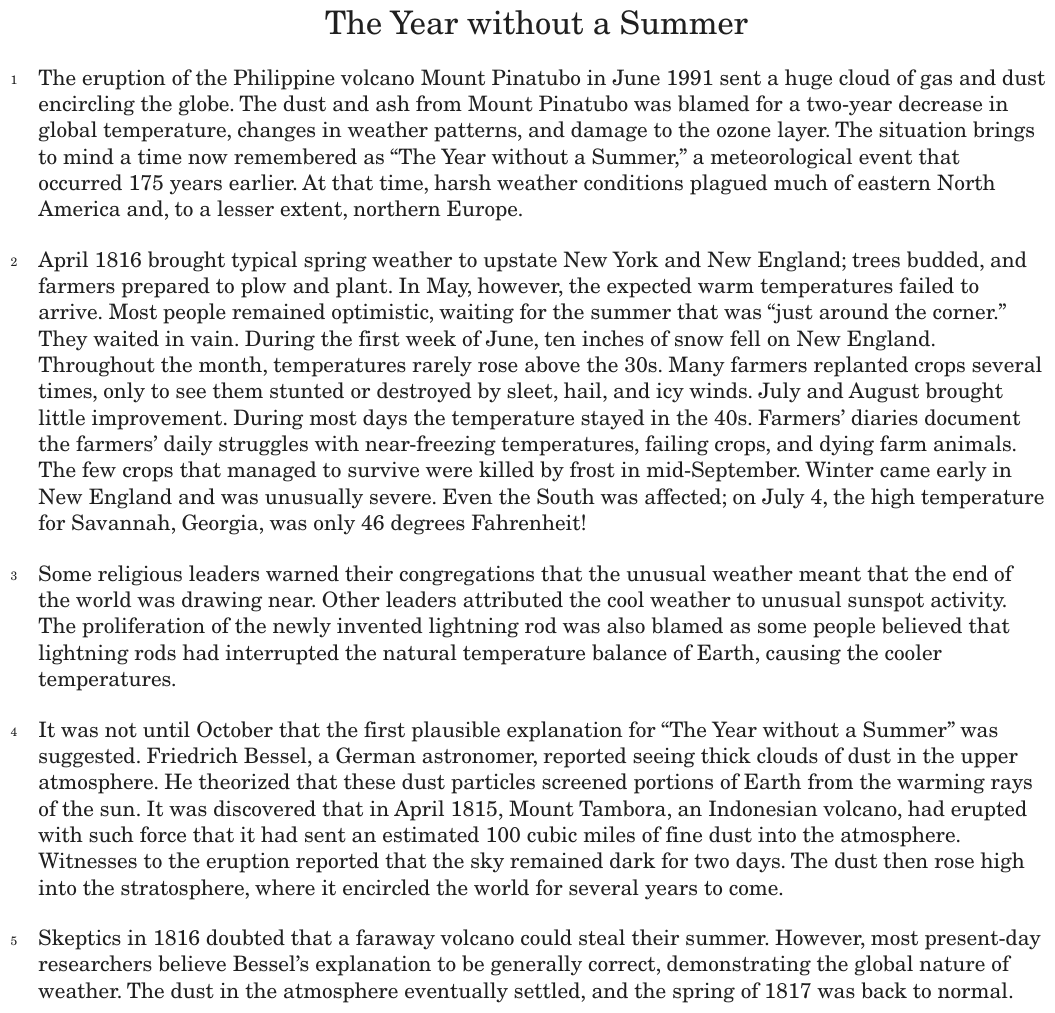
Question 52 of 120
2018 Test A English, question 52Uses the passage above: “The Year without a Summer”.
Question
What is the most likely reason farmers persisted in replanting their crops?
- AThey believed that the cold weather could not continue all summer long.
- BThey thought that crops would be able to survive even though the weather remained cold.
- CThey believed that the improved weather conditions of July would last.
- DThey thought the June snowfalls would provide needed moisture.
Show the answer
Correct answer: A
The answer is (A)
The question asks for the sentence that provides the best reason for the farmers replanting their crops. Paragraph 2 states that “farmers prepared to plow and plant” because they “expected warm temperatures” and were “optimistic.” This suggests that the farmers kept replanting their crops because they expected the weather to return to normal, which is reflected in Option A.
Option B is incorrect because the cold weather and the snow actually worsened growing conditions (paragraph 2).
Option C is incorrect because, while “July and August brought little improvement” (paragraph 2), it is throughout the month of June that farmers replanted crops.
Option D is incorrect because, while the farmers kept replanting their crops with the expectation of normal weather to return, the passage does not state that was because the farmers thought the snow would provide moisture.
Question analysis
This inference question asks why New England farmers kept replanting their crops during the cold summer of 1816. The reason is never stated outright, so students must infer it from paragraph 2's month-by-month account while keeping track of when the replanting took place.
- NYS standards
- 7R1 textual evidence and inferences
- Grade level
- Grade 7 reading and task
- Compared with grade 7
- At grade 7 Inferring a group's motive from nearby clues is routine grade 7 work. The clue sits a few sentences before the replanting, and only the order of the months needs care, so the demand is typical.
- Estimated difficulty
- Straightforward: two steps or one careful reading.
- Thinking it demands
- Depth of knowledge 2, skills and concepts · mainly understand
- What makes it hard
- Reading between the lines moderate
- Much to keep track of minor
- A very close wrong answer minor
- Evidence
- Answered from one paragraph or stanza
- Reading level
- Passage: about grade 9, 469 words; question and choices: about grade 6, 59 words.
- Students, last 30 days
- Not enough answers yet to show (it takes 10).
Why it is hard, traps and wrong answers (shows the answer)
Why it is hard
The clue to the farmers' motive sits a few sentences before their replanting, in the optimism of people waiting for a summer that never came. Students who answer from farming sense rather than the passage reach for crops that tolerate cold or snow that waters fields. Keeping the months in order also matters, since the July and August sentence says conditions barely improved.
Reading between the lines moderate Working it out
The reason is never stated beside the replanting; it comes two sentences earlier, where people “remained optimistic, waiting for the summer that was ‘just around the corner.’” (Graesser, Singer & Trabasso, 1994; Kintsch, 1998)
Much to keep track of minor Working it out
Paragraph 2 runs month by month, April buds, May's missing warmth, June snow, a cold July and August, September frost, and students must place the replanting in that sequence. (Sweller, 1988; Carpenter, Just & Shell, 1990)
A very close wrong answer minor Choosing the answer
A and C both say the farmers counted on warm weather coming; C differs in one detail, an improvement in July, which the passage denies with “July and August brought little improvement.” (Embretson & Wetzel, 1987; Gorin & Embretson, 2006; Ascalon et al., 2007)
Strategy: Read paragraph 2 in order, noting what people expected each month and when the replanting happened; the best reason fits both.
Traps
- Reads too much in: A reasonable-sounding conclusion that goes further than the text allows.
- Twists what the text says: Uses the text's topic and ideas but changes what it says: who did it, how much, when, or why.
- Outside knowledge: A choice is plausible in the real world but not supported by this text.
The wrong answers, classified
B Reads too much in (Graesser, Singer & Trabasso, 1994)
Assumes the farmers trusted new plantings to survive the cold, a guess the passage never supports; it says people waited for warmth that never came.
C Twists what the text says (King et al., 2004)
Misreads “July and August brought little improvement” as an improvement, and moves the reason for June's replanting to a later month.
D Outside knowledge (King et al., 2004; Recht & Leslie, 1988)
Applies real farming sense that snow brings moisture, but nothing in the passage links the June snowfall to the farmers' decisions.
Working it out, step by step
Figure out what the question asks
This is an inference question. An inference is a smart guess based on clues. The passage doesn’t say outright why the farmers kept replanting. You must figure it out.
Find the clues in paragraph 2
Paragraph 2 goes month by month. In May, “the expected warm temperatures failed to arrive.” Still, people “remained optimistic.” They were waiting for a summer that seemed “just around the corner.”
Then snow fell in June. That month, “Many farmers replanted crops several times.”
Work out what the clues mean
Optimistic means hopeful that things will turn out well. “Just around the corner” means coming very soon. So people expected warm weather any day.
That explains the replanting. Farmers kept planting again because they believed the cold had to end soon. Summer, they thought, was on its way.
Check each choice
- A fits. They believed the cold could not last all summer.
- B The passage shows crops dying in the cold, not farmers trusting them to survive it.
- C The replanting was in June. And “July and August brought little improvement.”
- D The passage never says the farmers wanted the snow for water.
Choose the answer
The farmers kept replanting because they expected the cold to end soon. So the answer is A.
Why this answer and not the closest wrong one
C is the closest trap. Like A, it says farmers expected warm weather. But C says July got better and they trusted that. The passage says “July and August brought little improvement,” and the replanting was in June. A fits the hopeful waiting the passage describes.
More questions like this
The original DOE question

Question 53 of 120
2018 Test A English, question 53Uses the passage above: “The Year without a Summer”.
Question
In the winter that followed the summer of 1816, New Englanders most likely experienced
- Anew weather events that they had not encountered before.
- Btemperatures that were warmer than usual for that time of year.
- Cshortages of fruits, vegetables, and other essential crops.
- Ddifficulty adjusting to a different timeline for planting crops.
Show the answer
Correct answer: C
The answer is (C)
The question asks for the outcome that is best implied by the situation the New Englanders faced in 1816.
Option C is the correct answer because, with many crops “stunted or destroyed” (paragraph 2) in the summer of 1816, one would expect food shortages the following winter.
Option A is incorrect because cold weather was familiar to the population in New England, just not for such an extended period of time.
Option B is incorrect because there is no evidence in the passage that people experienced warmer temperatures.
Option D is incorrect because, although some farmers did replant their crops, there is no evidence in the passage that they struggled to adjust to a different timeline for farming.
Question analysis
Students must predict what New Englanders most likely faced in the winter after the cold summer of 1816, an inference question on an informational passage about a historic cold spell. The passage says little about daily life that winter, so students must reason one step beyond the text from what it reports about the summer.
- Grade level
- Grade 7 reading and task
- Compared with grade 7
- At grade 7 Drawing a likely consequence from stated facts is typical grade 7 inference work. The needed step goes just beyond what the passage reports, and the text is short and clear, so the demand matches grade 7.
- Estimated difficulty
- Moderate: several steps, or a close reading with one strong distractor.
- Thinking it demands
- Depth of knowledge 2, skills and concepts · mainly understand
- What makes it hard
- Reading between the lines moderate
- Something you must already know minor
- Evidence
- Answered from one paragraph or stanza
- Reading level
- Passage: about grade 9, 469 words; question and choices: about grade 9, 50 words.
- Corrected from the DOE handbook
- A spelling error in the explanation was corrected.
- Students, last 30 days
- Not enough answers yet to show (it takes 10).
Why it is hard, traps and wrong answers (shows the answer)
Why it is hard
This inference goes one step past the text, from destroyed crops to a hungry winter, and the passage never makes that step for the reader. Meanwhile the one sentence about the winter, early and unusually severe, tempts students toward an answer about unheard-of weather. Students who ask what the summer's losses would mean for daily life months later find the key; those who look only for the word “winter” do not.
Reading between the lines moderate Working it out
The passage says nothing about food that winter; students must reason from “The few crops that managed to survive were killed by frost in mid-September” to empty stores months later. (Graesser, Singer & Trabasso, 1994; Kintsch, 1998)
Something you must already know minor Working it out
The inference needs the everyday fact that a farm family's winter food comes from the autumn harvest, which the passage leaves unsaid. (Anderson & Krathwohl, 2001)
Strategy: List the consequences of the cold summer that paragraph 2 reports, then ask which would still affect people months later, in winter.
Traps
- Too broad or too strong: A choice overstates, generalizes, or uses absolute words the text does not support.
- Wrong part of the text: A choice is true of another paragraph, stanza or speaker than the one asked about.
The wrong answers, classified
A Too broad or too strong (King et al., 2004)
Stretches “unusually severe” into weather never encountered before, but New Englanders knew cold winters well; this one was harsher, not new.
B Twists what the text says (King et al., 2004)
Reverses the passage's statement that winter “came early” and “was unusually severe,” which rules out warmer temperatures.
D Wrong part of the text (Kirsch & Mosenthal, 1990)
Carries the summer's repeated replanting into winter, though planting is not a winter task and the passage never mentions a changed planting timeline.
What was corrected from the DOE handbook, and why
- Explanation: The handbook’s “some famers did replant their crops” now reads “some farmers”.
Working it out, step by step
Figure out what the question asks
This is an inference question. The passage never says what life was like that winter. You must reason from what it does say.
Find what happened to the crops
Paragraph 2 tells the story. Crops were “stunted or destroyed by sleet, hail, and icy winds.” Then: “The few crops that managed to survive were killed by frost in mid-September.” Finally, “Winter came early in New England and was unusually severe.”
Work out the result
Stunted means stopped from growing to full size. In 1816, families ate food they grew in summer and saved for winter. But almost all the crops died. So there was very little food to save. That means the winter would bring shortages: not enough food to go around.
Check each choice
- A New Englanders knew cold winters well. This one was harsher, not a new kind of weather.
- B The passage says the winter was severe, so it was not warmer.
- C fits. With the crops gone, food would run short.
- D Nobody plants crops in winter. The passage says nothing about a new planting schedule.
Choose the answer
With the crops destroyed, people likely ran short of food that winter. So the answer is C.
Why this answer and not the closest wrong one
A is the closest trap, because the winter was “unusually severe.” But severe means harsh, not new. Cold winters were normal in New England. C follows from the clearest facts in paragraph 2: the crops died, so there would be little food.
More questions like this
The original DOE question

Question 54 of 120
2018 Test A English, question 54Uses the passage above: “The Year without a Summer”.
Question
How does paragraph 3 contribute to the passage?
- AIt presents the most probable cause of the 1816 weather.
- BIt shows how nineteenth-century people explained the 1816 weather.
- CIt presents a theory about the 1816 weather that some skeptics doubted.
- DIt includes eyewitness reports to describe the source of the 1816 weather.
Show the answer
Correct answer: B
The answer is (B)
The question asks for the purpose and importance of paragraph 3 to the passage. Paragraph 3 describes how nineteenth-century religious and other leaders tried to account for the cooler weather in 1816. Some leaders thought it was “the end of the world,” “sunspot activity,” or the proliferation of a new invention. How this information contributed to the passage is stated in Option B.
Option A is incorrect because the causes described in paragraph 3 were not the most probable cause, as “the first plausible explanation”—Bessel’s—is described later in the passage.
Option C is incorrect because more than one theory is presented in paragraph 3.
Option D is incorrect because the ideas described are not included in paragraph 3.
Question analysis
This text structure question asks what paragraph 3 of “The Year without a Summer” contributes to the passage. Students must place the paragraph within the passage's account of the cold summer, which means knowing what the paragraphs before and after it do.
- NYS standards
- 7R5 structure and genre features
- Grade level
- Grade 7 reading and task
- Compared with grade 7
- At grade 7 Explaining a paragraph's role is standard grade 7 structure work. The paragraph is short, but nearby paragraphs also discuss causes of the cold, so students must keep them apart; overall the demand is typical.
- Estimated difficulty
- Straightforward: two steps or one careful reading.
- Thinking it demands
- Depth of knowledge 2, skills and concepts · mainly analyze
- What makes it hard
- Much to keep track of moderate
- How, not what minor
- A very close wrong answer minor
- Evidence
- Answered from several paragraphs or stanzas
- Reading level
- Passage: about grade 9, 469 words; question and choices: about grade 7, 46 words.
- Students, last 30 days
- Not enough answers yet to show (it takes 10).
Why it is hard, traps and wrong answers (shows the answer)
Why it is hard
Paragraph 3 is short and clear on its own, but the paragraphs around it also deal with causes, and the wrong choices are built from those neighbors: the plausible explanation and eyewitnesses from paragraph 4, the skeptics from paragraph 5. A student who summarizes paragraph 3 before reading the choices, as three guesses made at the time, has little trouble; one who checks choices against a general memory of the passage can be caught.
Much to keep track of moderate Working it out
Paragraphs 3, 4 and 5 all deal with explanations, the guesses of 1816, Bessel's dust theory, the skeptics, and each wrong choice borrows from one of them. (Sweller, 1988; Carpenter, Just & Shell, 1990)
How, not what minor Working it out
The stem asks what paragraph 3 contributes, so students must name its role, a record of how people at the time accounted for the cold, not just list its theories. (Anderson & Krathwohl, 2001)
A very close wrong answer minor Choosing the answer
A and B both say paragraph 3 explains the 1816 weather; they differ in one phrase, since A calls it “the most probable cause,” a label the passage gives only to Bessel's dust theory in paragraph 4. (Embretson & Wetzel, 1987; Gorin & Embretson, 2006; Ascalon et al., 2007)
Strategy: Summarize paragraph 3 in a few words, do the same for the paragraphs around it, and pick the choice that matches paragraph 3's own job.
Traps
- Wrong part of the text: A choice is true of another paragraph, stanza or speaker than the one asked about.
The wrong answers, classified
A Wrong part of the text (Kirsch & Mosenthal, 1990)
Credits paragraph 3 with Bessel's dust theory from paragraph 4, which the passage calls “the first plausible explanation.”
C Wrong part of the text (Kirsch & Mosenthal, 1990)
Borrows the skeptics from paragraph 5, who doubted the volcano theory, and overlooks that paragraph 3 offers several guesses, not one doubted theory.
D Wrong part of the text (Kirsch & Mosenthal, 1990)
Brings in the witnesses to the Tambora eruption from paragraph 4; paragraph 3 contains no eyewitness reports.
Working it out, step by step
Figure out what the question asks
This is a structure question. It asks what job paragraph 3 does in the passage. Sum it up first, then compare it with the paragraphs around it.
Read paragraph 3
Paragraph 3 lists three guesses from 1816. Some religious leaders said “the end of the world was drawing near.” Others blamed “unusual sunspot activity.” Some people blamed the new lightning rod.
Work out its job
All three ideas come from people living at the time, in the nineteenth century (the 1800s). None of them turned out to be right. So the paragraph shows how people back then tried to explain the cold.
The real cause comes next. Paragraph 4 calls Bessel’s idea “the first plausible explanation.” Plausible means believable.
Check each choice
- A The most probable cause, Bessel’s dust, is in paragraph 4, not 3.
- B fits. It shows how people of the 1800s explained the weather.
- C Paragraph 3 gives several guesses, not one theory. The skeptics (doubters) come in paragraph 5.
- D The eyewitness reports, about Mount Tambora, are in paragraph 4.
Choose the answer
Paragraph 3 shows how people at the time explained the strange weather. So the answer is B.
Why this answer and not the closest wrong one
A is the closest trap. A and B both say paragraph 3 explains the weather. But A calls it “the most probable cause.” The passage saves that label for Bessel’s idea in paragraph 4, “the first plausible explanation.” Paragraph 3’s guesses were wrong, so B fits.
More questions like this
The original DOE question
Question 55 of 120
2018 Test A English, question 55Uses the passage above: “The Year without a Summer”.
Question
The author includes the details in paragraph 4 about the eruption of Mount Tambora in order to
- Asuggest that the aftermath of the eruption still affects the environment today.
- Bhighlight the severe impact that the eruption had on the atmosphere.
- Cprovide a description of what happens during a volcanic eruption.
- Demphasize how differently people perceive natural events in various parts of the world.
Show the answer
Correct answer: B
The answer is (B)
The question asks why the details about the eruption of Mount Tambora are included in the passage. The details in paragraph 4 about the eruption highlight the severity of the eruption and how it clouded the atmosphere and eventually encircled the world, making Option B the correct answer.
Option A is incorrect because the passage does not support the idea that the effects are still present today.
Option C is incorrect because the details may include information about what happens during an eruption, but the author is specifically describing the event at Mount Tambora as the inception of weather issues all over the world.
Option D is incorrect because, while it is possible that people perceive natural events in various parts of the world differently, the specific details about the force and magnitude of the eruption do not emphasize this idea.
Question analysis
This author's purpose question asks why “The Year without a Summer” includes details about the 1815 eruption of Mount Tambora in Indonesia. Students must work out the job those details do in the passage's larger explanation, which takes more than noticing what they describe.
- Grade level
- Grade 7 reading and task
- Compared with grade 7
- At grade 7 Explaining why an author includes certain details is core grade 7 work. The paragraph is short and factual, and its purpose follows from its place in the passage, so the demand is typical for grade 7.
- Estimated difficulty
- Straightforward: two steps or one careful reading.
- Thinking it demands
- Depth of knowledge 2, skills and concepts · mainly analyze
- What makes it hard
- How, not what moderate
- Evidence
- Answered from one paragraph or stanza
- Reading level
- Passage: about grade 9, 469 words; question and choices: about grade 10, 62 words.
- Students, last 30 days
- Not enough answers yet to show (it takes 10).
Why it is hard, traps and wrong answers (shows the answer)
Why it is hard
The details are vivid, a blast, 100 cubic miles of dust, two days of darkness, and a student can easily answer what they show rather than why they are there. Their job is to make Bessel's dust theory believable by showing how much material reached the atmosphere and how far it spread. The passage's own ending, with the dust settling and spring of 1817 back to normal, rules out any lasting effect.
How, not what moderate Working it out
The stem asks why the author includes the eruption details, so students must tie the force, the 100 cubic miles of dust and the darkened sky to the cold summer they explain. (Anderson & Krathwohl, 2001)
Strategy: Reread paragraph 4 and ask how the eruption details connect to the cold summer the passage is explaining; the purpose must serve that connection.
Traps
- Wrong purpose or structure: Names a purpose, structure or effect that the part does not serve, or describes what a part says when the question asks what it does.
- Wrong part of the text: A choice is true of another paragraph, stanza or speaker than the one asked about.
The wrong answers, classified
A Reads too much in (Graesser, Singer & Trabasso, 1994)
Stretches dust that “encircled the world for several years” into effects still felt today, though the passage says the dust settled and spring of 1817 was normal.
C Wrong purpose or structure (Anderson & Krathwohl, 2001)
Notes what the details are, a description of an eruption, rather than why they are there, to show how the dust could chill summers worldwide.
D Wrong part of the text (Kirsch & Mosenthal, 1990)
Draws on the skeptics in paragraph 5, but the eruption details stress the event's force and reach, not how people in different places perceived it.
Working it out, step by step
Figure out what the question asks
This asks about the author’s purpose: why the author put certain details in. Don’t just say what the details are. Ask what job they do.
Find the details in paragraph 4
Mount Tambora “had erupted with such force that it had sent an estimated 100 cubic miles of fine dust into the atmosphere.” Witnesses said “the sky remained dark for two days.” The dust “encircled the world for several years to come.”
Work out their job
The atmosphere is the layer of air around Earth. These details show how huge the eruption was. A hundred cubic miles of dust is enough to block sunlight around the whole world.
That makes Bessel’s idea easy to believe. Dust from far away really could steal a summer in New England.
Check each choice
- A The dust settled, and “the spring of 1817 was back to normal.” So the effects did not last until today.
- B fits. The details show how hard the eruption hit the atmosphere.
- C They describe one eruption to explain the cold. They don’t teach how all eruptions work.
- D The details are about the eruption’s force, not how people see events.
Choose the answer
The details show the eruption’s severe impact on the atmosphere. So the answer is B.
Why this answer and not the closest wrong one
C is the closest trap. The details do describe an eruption. But C tells what the details are, not why they are there. The author is not teaching how volcanoes work. The details show how much dust reached the sky, which explains the cold summer. That is B.
More questions like this
The original DOE question

Question 56 of 120
2018 Test A English, question 56Uses the passage above: “The Year without a Summer”.
Question
Which of the following is implied by the phrase “the global nature of weather” (paragraph 5)?
- AUnderstanding weather events around the world is important for making weather predictions.
- BExtreme weather conditions in some parts of the world can have a lasting impact on a geographical area.
- CNatural disasters tend to occur in different parts of the world at the same time.
- DConditions in one part of the world can affect weather in another part of the world.
Show the answer
Correct answer: D
The answer is (D)
The question asks for the implied meaning behind the phrase “the global nature of weather” (paragraph 5). This phrase refers to how conditions in one part of the world can affect weather in another part of the world.
Option D is correct because it clarifies “global” by explaining the relationship between weather and conditions all over the world. Option A is incorrect because the phrase in paragraph 5 is about the effects of weather conditions around the world, not about making weather predictions.
Option B is incorrect because it discusses the lasting impact on specific geographical areas, while the phrase “the global nature of weather” refers to events that affect the entire world.
Option C is incorrect because, while weather events (the unusually cold summer in New England in 1816) can be related to natural disasters (a volcano eruption), there is no support in the passage for the idea that natural disasters tend to occur at the same time.
Question analysis
This question about word meaning in context asks what the phrase “the global nature of weather” implies in the final paragraph of “The Year without a Summer.” Students have to work out its meaning from the events the passage has described, not from a general sense of the word “global.”
- Grade level
- Grade 7 reading and task
- Compared with grade 7
- At grade 7 Determining a phrase's meaning from context is standard grade 7 work. The phrase draws on the passage's main explanation, which is clearly laid out, so the demand is typical for grade 7.
- Estimated difficulty
- Straightforward: two steps or one careful reading.
- Thinking it demands
- Depth of knowledge 2, skills and concepts · mainly understand
- What makes it hard
- Reading between the lines moderate
- Evidence in several places minor
- A very close wrong answer minor
- Evidence
- Answered from several paragraphs or stanzas
- Reading level
- Passage: about grade 9, 469 words; question and choices: about grade 9, 76 words.
- Students, last 30 days
- Not enough answers yet to show (it takes 10).
Why it is hard, traps and wrong answers (shows the answer)
Why it is hard
“Global” alone suggests anything worldwide, and the wrong choices offer several worldwide-sounding ideas: forecasting, lasting local damage, simultaneous disasters. The phrase means something narrower, that what happens in one place can change the weather far away, as Tambora did to New England. Students who read the phrase in its sentence, where it is what Bessel's explanation demonstrates, find the key; those who define the word in isolation do not.
Reading between the lines moderate Working it out
The phrase must be read through the example the passage just gave: an Indonesian volcano filled the stratosphere with dust and New England lost its summer. (Graesser, Singer & Trabasso, 1994; Kintsch, 1998)
Evidence in several places minor Working it out
The meaning depends on facts from paragraph 4, Tambora's location and its dust circling the world, and from paragraph 2, snow in New England, not on paragraph 5 alone. (Kirsch & Mosenthal, 1990; Gorin & Embretson, 2006)
A very close wrong answer minor Choosing the answer
B and D are worded almost alike, conditions in some part of the world affecting somewhere; they differ in what is affected, since B makes it a lasting impact on one area rather than weather elsewhere. (Embretson & Wetzel, 1987; Gorin & Embretson, 2006; Ascalon et al., 2007)
Strategy: Reread the sentence with the phrase and the paragraph before it, ask what Bessel's explanation demonstrated, and choose the paraphrase that fits that example.
Traps
- Outside knowledge: A choice is plausible in the real world but not supported by this text.
- Dictionary meaning, not meaning here: A common meaning of the word that does not fit its use in this text.
The wrong answers, classified
A Outside knowledge (King et al., 2004; Recht & Leslie, 1988)
Offers a sensible real-world point about forecasting, but the passage never discusses predicting weather; the phrase is about cause and effect across distance.
B Twists what the text says (King et al., 2004)
Keeps the idea of extreme events having effects but makes them local and lasting, dropping the link between distant places that “global” refers to here.
C Dictionary meaning, not meaning here (Perfetti, 2007)
Reads “global” as disasters striking many places at once, though the passage's two eruptions were more than 170 years apart and one caused effects far away.
Working it out, step by step
Figure out what the question asks
This asks what a phrase implies, or hints at. Read the phrase in its sentence, not by itself.
Read the phrase in its sentence
Paragraph 5 says researchers “believe Bessel’s explanation to be generally correct, demonstrating the global nature of weather.”
So Bessel’s explanation is the example. Recall it. In 1815, a volcano in Indonesia erupted. Its dust spread around the world. In 1816, New England had snow in June.
Work out what it means
Global means having to do with the whole world. Indonesia is in Asia, very far from New England. Yet the eruption there changed the weather in America. So the phrase means that something in one part of the world can change the weather in a faraway part.
Check each choice
- A The passage never talks about predicting weather.
- B It keeps the effects in one area. The point here is that effects travel far.
- C The two eruptions in the passage were 176 years apart. Nothing says disasters strike at the same time.
- D fits. Conditions in Indonesia changed the weather in New England.
Choose the answer
The phrase means events in one place can change the weather far away. So the answer is D.
Why this answer and not the closest wrong one
B is the closest trap, because it also says extreme conditions have effects. But B keeps those effects in one area. The passage’s example crosses the world: dust from Indonesia chilled New England. D names that link between faraway places.
More questions like this
The original DOE question
Question 57 of 120
2018 Test A English, question 57Uses the passage above: “The Year without a Summer”.
Question
The cold summer of 1816 was most likely caused by
- Aunusual sunspot activity.
- Bthe excessive use of lightning rods.
- Cdamage to the ozone layer.
- Dan increase of dust in the atmosphere.
Show the answer
Correct answer: D
The answer is (D)
The question asks for the likely cause of the cold summer of 1816, based on the reason given in the passage. Researchers today believe that Bessel’s theory that “dust particles screened portions of Earth from the warming rays of the sun” is the most logical and probable (paragraph 5). His ideas are summarized in paragraph 4, and Option D restates his theory, making Option D the correct answer.
Option A is incorrect because this was a possibility considered by some leaders, but there is no evidence in the passage that this theory was supported by thorough scientific research.
Option B is incorrect because this theory was thought to be a possible cause by some people, but Bessel’s theory is the most probable.
Option C explains damage that was caused by the Mount Pinatubo eruption in 1991 (paragraph 1), but that damage is not the cause of the cold summer of 1816.
Question analysis
Students must identify the most likely cause of the cold summer of 1816 according to “The Year without a Summer.” The passage reports several explanations from different people and times, so students must notice which one the author and today's researchers treat as correct.
- NYS standards
- 7R1 textual evidence and inferences
- Grade level
- Grade 6 reading and task
- Compared with grade 7
- Below grade 7 This asks for a cause the passage names and endorses, a quick locate task below typical grade 7 demand. The only care needed is to separate the accepted explanation from theories the passage sets aside.
- Estimated difficulty
- Routine: one familiar step, little to misread.
- Thinking it demands
- Depth of knowledge 1, recall and reproduction · mainly understand
- What makes it hard
- Evidence
- Answered from several paragraphs or stanzas
- Reading level
- Passage: about grade 9, 469 words; question and choices: about grade 5, 30 words.
- Students, last 30 days
- Not enough answers yet to show (it takes 10).
Why it is hard, traps and wrong answers (shows the answer)
Why it is hard
The passage settles this question in plain terms, calling Bessel's idea the first plausible explanation and saying present-day researchers accept it. The wrong choices are causes the passage mentions without endorsing, two of them in its exact words, so a student matching phrases rather than following the argument can be misled. The 1991 ozone damage is the trap for anyone who blends the two eruptions.
Much to keep track of minor Working it out
The passage mentions four proposed causes, the end of the world, sunspots, lightning rods and Bessel's dust, plus the ozone damage of 1991, and only the dust is endorsed by today's researchers. (Sweller, 1988; Carpenter, Just & Shell, 1990)
The right answer is reworded minor Choosing the answer
Two wrong choices copy the passage exactly, “unusual sunspot activity” and “damage to the ozone layer,” while the key recasts Bessel's “thick clouds of dust” as “an increase of dust.” (Freedle & Kostin, 1993; Kirsch & Mosenthal, 1990)
Strategy: Find where the passage calls an explanation “plausible” and where present-day researchers weigh in, then match the explanation they accept to a choice.
Traps
- Wrong part of the text: A choice is true of another paragraph, stanza or speaker than the one asked about.
The wrong answers, classified
A Wrong part of the text (Kirsch & Mosenthal, 1990)
Picks the sunspot theory some 1816 leaders proposed, which the passage reports in its exact words but never calls plausible.
B Wrong part of the text (Kirsch & Mosenthal, 1990)
Chooses the lightning rod theory, a belief of 1816 that the passage mentions only to show how people guessed at the cause.
C Wrong part of the text (Kirsch & Mosenthal, 1990)
Borrows the ozone damage blamed on Mount Pinatubo in 1991 from paragraph 1, mixing up the two eruptions.
Working it out, step by step
Figure out what the question asks
This is a key-detail question. It asks what most likely caused the cold summer. Careful: the passage mentions several causes, but it backs only one.
Find the cause the passage backs
Paragraph 4 gives “the first plausible explanation.” Bessel saw “thick clouds of dust in the upper atmosphere.” He thought “these dust particles screened portions of Earth from the warming rays of the sun.”
Paragraph 5 adds that “most present-day researchers believe Bessel’s explanation to be generally correct.”
Put it in your own words
Plausible means believable. Screened means blocked, like a window shade. Portions means parts. So the dust blocked some sunlight, and parts of Earth got colder. The dust came from the Mount Tambora eruption. Scientists today agree with this idea.
Check each choice
- A Sunspots were a guess from 1816. The passage never calls it likely.
- B Lightning rods were another 1816 guess. The passage doesn’t back it either.
- C Ozone damage was blamed on Mount Pinatubo in 1991. It had nothing to do with 1816.
- D fits. More dust in the atmosphere blocked the sun.
Choose the answer
Dust from the volcano is the cause today’s scientists accept. So the answer is D.
Why this answer and not the closest wrong one
A is a trap because its words, “unusual sunspot activity,” come straight from paragraph 3. But the passage only reports that guess. It never says the guess was right. C mixes up the two volcanoes. D is the one cause the passage calls “plausible” and says scientists accept.
More questions like this
The original DOE question
Question 58 of 120
2018 Test A Math, question 1Question
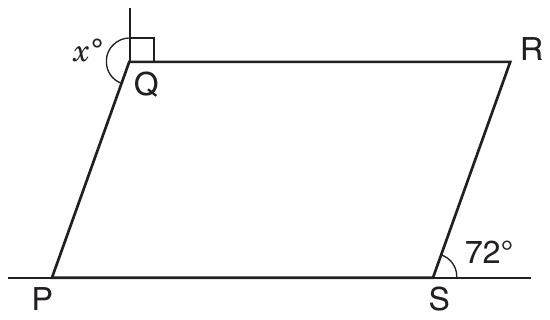
In the figure above, PQRS is a parallelogram. What is the value of ?
Grid-in question: work out the answer and enter it as a number.
Show the answer
Correct answer: 162
First, find the measure of angle PQR. The measure of angle PQR is equal to the measure of angle PSR.
m∠PSR = 180 − 72 = 108.
So, the measure of angle PQR is also 108.
108 + 90 + x = 360
198 + x = 360
x = 162
Question analysis
A grid-in geometry question about angles around a parallelogram PQRS. A 72° angle sits outside corner S on the extended base, and at corner Q a right angle and the unknown angle x complete the turn around the point. Students chain three angle facts, and the angle asked for lies outside the shape, not inside it.
- NYS standards
- Grade level
- Grade 8 content, by NYS standard
- Compared with grade 7
- Above grade 7 Grade 7 angle work usually applies one or two facts, such as supplementary or vertical angles, to find an angle. This chains three, and needs the equal opposite angles of a parallelogram, which rest on grade 8 parallel-line facts.
- Estimated difficulty
- Hard: combines ideas, needs a plan, and has more than one tempting wrong answer.
- Thinking it demands
- Depth of knowledge 2, skills and concepts · mainly apply
- What makes it hard
- Reading a figure, table or graph major
- Combines ideas moderate
- An answer in an unexpected form minor
- Solution
- 3 steps
- Reading level
- Question and choices: about grade 7, 14 words.
- Students, last 30 days
- Not enough answers yet to show (it takes 10).
Why it is hard, traps and wrong answers (shows the answer)
Why it is hard
The arithmetic is two subtractions; the difficulty is seeing which angles the marks refer to. Students lose points by treating the 72° as the parallelogram's own angle at S, or by stopping at angle PQR, the most natural number to grid. The question rewards tracing a route from S to Q before computing anything, and checking at the end that x is the angle outside the shape that the arc marks.
Reading a figure, table or graph major Understanding the question
The 72° is marked outside the parallelogram, between side SR and the base extended past S, and x sits outside corner Q, between QP and a vertical ray that meets QR at a right-angle mark. (Lesh, Post & Behr, 1987; Kirsch & Mosenthal, 1990)
Combines ideas moderate Working it out
Three angle facts have to be chained: a straight line gives the angle inside S, opposite angles of a parallelogram carry it to Q, and the angles around Q make a full 360° turn. (Embretson, 1998; Daniel & Embretson, 2010)
An answer in an unexpected form minor Choosing the answer
As a grid-in there are no choices to check against, so a student who stops at angle PQR, inside the parallelogram, gets no signal that the job is unfinished. (Enright, Morley & Sheehan, 2002)
Strategy: Use the straight line at S to find the parallelogram's angle there, carry it to the opposite corner Q, then take that angle and the right angle away from 360.
Traps
- Stops one step early: A choice is a number from partway through the solution.
The wrong answers, classified
108 Stops one step early (King et al., 2004; Gierl et al., 2017)
Finds angle PSR = 180 − 72 = 108 and carries it to angle PQR, then grids that interior angle instead of the angle x outside it.
198 Misreads the figure (Lesh, Post & Behr, 1987; Kirsch & Mosenthal, 1990)
Reads the 72° as the parallelogram's interior angle at S, so takes angle PQR as 72 and grids 360 − 90 − 72 = 198.
252 Misreads the figure (Lesh, Post & Behr, 1987; Kirsch & Mosenthal, 1990)
Overlooks the right-angle mark at Q and subtracts only the 108° angle PQR from 360, giving 252.
Worked solution, step by step
Formulas used
- Angles on a straight line
- a and b are two angles side by side on a straight line. Together they make a half turn, so they always add up to 180 degrees. Use it when an angle you need shares a straight line with an angle you know.
- Opposite angles of a parallelogram
- The symbol ∠ means angle. ∠PQR is the angle at corner Q, between sides QP and QR. ∠PSR is the angle at the opposite corner, S. In a parallelogram, opposite corners always have equal angles, because the shape leans the same way at both.
- Angles around a point
- a, b and c are angles that fit around one point with no gaps and no overlaps. Going all the way around is a full turn, which is 360 degrees. So the angles add up to 360.
Sort out what the figure shows
PQRS is a parallelogram. That is a four-sided shape whose opposite sides are parallel, which means they never meet. You need the value of x, in degrees.
Look closely at the marks. The 72° angle is outside the shape, at S. It sits between side SR and the base line, which keeps going past S. At Q, a vertical line meets side QR. The small square means a right angle, 90°. The angle x is outside the shape too. It runs from that vertical line around to side QP.
Find the angle inside corner S
Angle PSR is the shape’s own angle at S. It sits right next to the 72° angle, on the same straight base line. So the two angles add up to 180°.
So angle PSR is 108°. Watch out: 72° is not the inside angle at S. Using 72 as the inside angle leads to the wrong answer 198.
Carry the angle over to Q
Corners Q and S are opposite each other. In a parallelogram, opposite angles are equal. So angle PQR matches angle PSR.
So angle PQR is 108°. Watch out: this is not x. Angle PQR is inside the shape, and x is outside it. Stopping here and gridding 108 is the most common mistake.
Add the angles around Q
Three angles fill the space all the way around point Q. They are the right angle (90°), angle PQR (108°) and x. Together they make a full turn.
Watch out: don’t skip the right angle at Q. Leaving out the 90 gives 252.
Solve for x
Subtract 198 from 360 to find what is left for x.
So x is 162°. So you would grid 162.
Check your answer
Add the three angles at Q: . That is a full turn. Also, the arc for x is wider than a right angle but not as wide as a straight line. So x should be between 90° and 180°, and 162° is.
More questions like this
The original DOE question
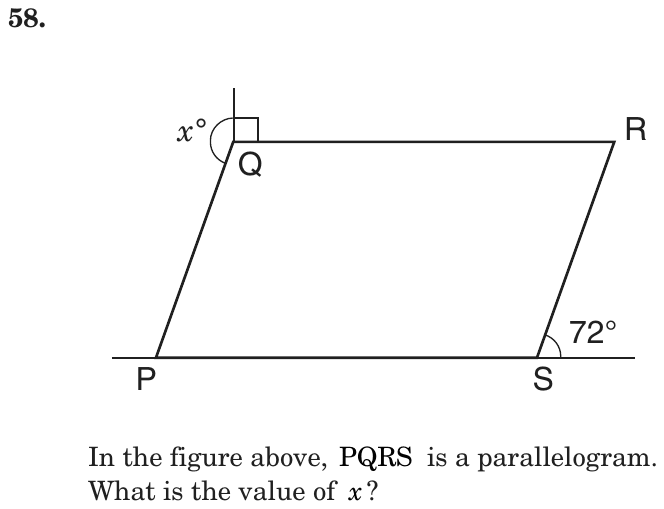
Question 59 of 120
2018 Test A Math, question 2Question
The owner of a tree farm plants pine trees and oak trees in a ratio of . How many oak trees are planted if 264 pine trees are planted?
Grid-in question: work out the answer and enter it as a number.
Show the answer
Correct answer: 99
Let be the number of oak trees when 264 pine trees are planted. Set up a proportion and solve for :
Question analysis
A ratio word problem about a tree farm that plants pine and oak trees in a fixed ratio of 8 to 3. Given how many pine trees are planted, students find the matching number of oak trees and grid it in. The main risk is pairing each number with the wrong kind of tree.
- Grade level
- Grade 6 content, by NYS standard
- Compared with grade 7
- Below grade 7 This is a one-ratio proportion with whole numbers, the kind of problem grade 6 students solve with equivalent ratios. A typical grade 7 task adds rates with fractions or a multistep percent; this has neither.
- Estimated difficulty
- Routine: one familiar step, little to misread.
- Thinking it demands
- Depth of knowledge 2, skills and concepts · mainly apply
- What makes it hard
- Solution
- 2 steps
- Reading level
- Question and choices: about grade 4, 28 words.
- Corrected from the DOE handbook
- An arithmetic slip in the explanation was corrected.
- Students, last 30 days
- Not enough answers yet to show (it takes 10).
Why it is hard, traps and wrong answers (shows the answer)
Why it is hard
This is a one-ratio scaling problem with friendly numbers: 264 splits into 8 equal parts of 33. The only real risk is matching 264 to the wrong term of 8:3, and a quick sense check catches it, since oak trees are the smaller group and must number fewer than 264. Students who grid the one-part value or the total of both kinds of tree have answered a question that was not asked.
Turning words into math minor Understanding the question
The ratio 8:3 lists pine first, so the 264 pine trees match the 8 and the oak count matches the 3; reading the terms in the other order flips the setup. (Hegarty, Mayer & Monk, 1995; Koedinger & Nathan, 2004)
An answer in an unexpected form minor Choosing the answer
As a grid-in it offers no choices, so an upside-down proportion that gives 704 oak trees, far more than the 264 pines, has to be caught by the student's own check. (Enright, Morley & Sheehan, 2002)
Strategy: Divide the number of pine trees by the pine part of the ratio to get the size of one part, then multiply by the oak part.
Traps
- Answers a different question: A choice is right for another quantity: the other unknown, the rest instead of the part, the part instead of the whole.
- Stops one step early: A choice is a number from partway through the solution.
The wrong answers, classified
704 Wrong operation (Hegarty, Mayer & Monk, 1995; King et al., 2004)
Turns the ratio upside down, treating the 264 pines as 3 parts: 264 ÷ 3 = 88, then 88 × 8 = 704.
33 Stops one step early (King et al., 2004; Gierl et al., 2017)
Divides 264 by 8 to get the size of one part, 33 trees, and stops before multiplying by the 3 parts that are oak.
363 Answers a different question (King et al., 2004; Hegarty, Mayer & Monk, 1995)
Finds the 99 oak trees correctly and then adds the 264 pines, gridding the total number of trees planted.
What was corrected from the DOE handbook, and why
- Explanation: The handbook goes from x/264 = 3/8 to “8x = 762”. Cross-multiplying gives 8x = 3 × 264 = 792, so that line now reads 8x = 792. The handbook’s final answer, x = 99, was already right (792 ÷ 8 = 99).
Worked solution, step by step
Formulas used
- Equal ratios
- a and b are the two numbers in a ratio, written as a fraction. n is any number you choose, except zero. Multiplying both numbers by the same n gives an equal ratio. This is how you scale a small ratio up to real counts.
Sort out the ratio
A ratio compares two amounts. Here the ratio of pine trees to oak trees is 8:3. Pine comes first, so pine goes with the 8. Oak goes with the 3. So for every 8 pine trees, there are 3 oak trees.
The farm planted 264 pine trees. You need the number of oak trees.
Find the size of one part
Think of the trees in equal groups, called parts. Pine trees fill 8 parts, and oak trees fill 3 parts. The 264 pine trees are the 8 parts, so divide by 8.
Each part is 33 trees. Watch out: 33 is one part, not the number of oak trees. Don’t stop here.
Find the number of oak trees
Oak trees fill 3 parts. Multiply the part size by 3.
You can see the same thing with equal ratios. Multiply both numbers of 8:3 by 33.
So 264 pine trees go with 99 oak trees.
Avoid the traps and answer
Watch out: if you match 264 to the 3 instead of the 8, you flip the ratio. That gives 704 oak trees. Watch out: the question asks only for oak trees. Adding the 264 pines gives 363. So you would grid 99.
Check your answer
The ratio 8:3 says there are fewer oak trees than pine trees. 99 is less than 264, so that fits. Also, divide both counts by 33: and . That gives back 8:3.
More questions like this
The original DOE question

Question 60 of 120
2018 Test A Math, question 3Question
For what value of is ?
Grid-in question: work out the answer and enter it as a number.
Show the answer
Correct answer: -4
Question analysis
A one-line algebra grid-in: find the value of w that makes 4w equal to 2w minus 8. Students solve a linear equation with the variable on both sides by collecting the w terms and dividing. Errors come from handling the subtraction sign or stopping before w stands alone.
- Grade level
- Grade 8 content, by NYS standard
- Compared with grade 7
- At grade 7 Equations with the variable on both sides are formally a grade 8 topic, but this one takes two short steps with whole numbers. It asks about as much as a typical grade 7 two-step equation.
- Estimated difficulty
- Routine: one familiar step, little to misread.
- Thinking it demands
- Depth of knowledge 1, recall and reproduction · mainly apply
- What makes it hard
- Solution
- 2 steps
- Reading level
- Question and choices: about grade 7, 7 words.
- Students, last 30 days
- Not enough answers yet to show (it takes 10).
Why it is hard, traps and wrong answers (shows the answer)
Why it is hard
One of the easiest questions on the test: collect the w terms on one side and divide. Errors come from carelessness rather than method, such as dropping the negative sign or gridding −8 after the first step because it already looks like a finished answer. Substituting the result back into both sides of the equation takes seconds and catches both.
Error-prone arithmetic minor Working it out
The only constant is −8, so the answer is negative; dividing −8 by the coefficient 2 is the step where the sign is most often lost. (Brown & Burton, 1978; Junker & Sijtsma, 2001)
An answer in an unexpected form minor Choosing the answer
The grid-in needs the negative sign filled in its own column, and there are no choices to show that the answer lies below zero. (Enright, Morley & Sheehan, 2002)
Strategy: Subtract 2w from both sides so the variable appears only once, divide by the remaining coefficient, and check by substituting into both sides.
Traps
- Negatives and direction: Arithmetic with negative numbers, the order of a subtraction, or direction on a number line. (Moving a term across the equals sign without changing its sign is a faulty procedure.)
- Stops one step early: A choice is a number from partway through the solution.
The wrong answers, classified
4 Negatives and direction (Brown & Burton, 1978)
Gets 2w = −8 correctly but drops the sign when dividing by 2, gridding 4 instead of a negative value.
-8 Stops one step early (King et al., 2004; Gierl et al., 2017)
Subtracts 2w from both sides to reach 2w = −8 and grids −8 without dividing by the coefficient 2.
Worked solution, step by step
Formulas used
- Keeping an equation balanced
- a and b are the two sides of an equation, and c is any number or term. An equation is like a balanced scale. If you subtract the same thing from both sides, it stays balanced. The same is true if you add the same thing, or divide both sides by the same number that is not zero.
Sort out the equation
An equation says two things are equal. You need the value of w that makes equal to . Here 4w means 4 times w, and 2w means 2 times w. The answer may be a negative number, so keep track of the signs.
Get w on one side
w is on both sides. Subtract 2w from both sides. Then w is only on the left, and the equation stays balanced.
Now 2 times w is −8.
Divide both sides by 2
To undo times 2, divide both sides by 2. A negative number divided by a positive number is negative.
Watch out: keep the minus sign. Dropping it gives 4. Also, don’t stop at and grid −8. So you would grid -4, with the minus sign in its own column.
Check your answer
Put −4 back in for w. Left side: . Right side: . Both sides are −16, so −4 works.
More questions like this
The original DOE question

Question 61 of 120
2018 Test A Math, question 4Question
A survey asked students what pets they have. Based on the results, the following statements are all true.
- 20 students have cats.
- 23 students have dogs.
- 3 students have both dogs and cats.
- 5 students have no dogs or cats.
How many students were surveyed?
Grid-in question: work out the answer and enter it as a number.
Show the answer
Correct answer: 45
Let x = number of students with only cats as pets.
Let y = number of students with only dogs as pets.
Calculate x and y using the given information:
There are 20 students who have cats, and of those 20 students, 3 have both cats and dogs.
Thus,
There are 23 students who have dogs, and of those 23 students, 3 have both cats and dogs.
Thus,
To find the total number of students surveyed, add the number of students who only have cats (x), the number of students who only have dogs (y), the number of students who have both (3), and the number of students who have neither (5):
Question analysis
A grid-in counting question about a survey of students' pets: some have cats, some dogs, some both, and some neither. Students find how many were surveyed by sorting everyone into groups without counting anyone twice. The students who own both pets are the trap in this classic Venn diagram problem.
- NYS standards
- 7.SP.8b sample spaces for compound events
- Grade level
- Grade 7 content, by NYS standard
- Compared with grade 7
- At grade 7 Grade 7 classes organize outcomes in lists and tables, but overlapping groups like these are rarely taught directly. The arithmetic is simple whole-number addition and subtraction; the demand lies in spotting the double count.
- Estimated difficulty
- Moderate: several steps, or a close reading with one strong distractor.
- Thinking it demands
- Depth of knowledge 2, skills and concepts · mainly apply
- What makes it hard
- Turning words into math moderate
- Much to keep track of minor
- An answer in an unexpected form minor
- Solution
- 3 steps
- Reading level
- Question and choices: about grade 3, 41 words.
- Students, last 30 days
- Not enough answers yet to show (it takes 10).
Why it is hard, traps and wrong answers (shows the answer)
Why it is hard
The arithmetic is small; the trap is in the wording. Because each bullet reads like a separate group, students tend to add the numbers as listed and count the students with both pets twice. A Venn diagram with the overlap filled in first solves the problem, and the remaining risk is forgetting that students with no pets were surveyed too.
Turning words into math moderate Understanding the question
The statement "20 students have cats" already includes the 3 who have both pets, and so does "23 students have dogs", which the separate bulleted list hides. (Hegarty, Mayer & Monk, 1995; Koedinger & Nathan, 2004)
Much to keep track of minor Working it out
Four facts, two overlapping groups, their overlap and an outside group of 5 with neither pet, all have to be placed before anything is added. (Sweller, 1988; Carpenter, Just & Shell, 1990)
An answer in an unexpected form minor Choosing the answer
As a grid-in it gives no choices, so a total that counts the 3 twice or leaves out the 5 looks just as finished as the right one. (Enright, Morley & Sheehan, 2002)
Strategy: Draw two overlapping circles: put the both-pets group in the middle, subtract it from each pet total to fill the outer parts, then add every region and the students with neither.
Traps
- Overlapping groups: Things in two groups at once are counted twice, or not subtracted.
The wrong answers, classified
48 Overlapping groups (King et al., 2004)
Adds 20 + 23 + 5 = 48, counting the 3 students with both pets once among the cat owners and again among the dog owners.
40 Answers a different question (King et al., 2004; Hegarty, Mayer & Monk, 1995)
Removes the overlap correctly, 20 + 23 − 3 = 40, but counts only the pet owners, leaving out the 5 surveyed students with no dogs or cats.
51 Numbers taken from the question (Hegarty, Mayer & Monk, 1995)
Adds all four numbers in the list, 20 + 23 + 3 + 5 = 51, treating the both-pets group as an extra group of students.
Worked solution, step by step
Formulas used
- Counting two groups that overlap
- T is the total number of students. C is the number with cats, and D is the number with dogs. B is the number with both pets, and N is the number with neither. Students with both are counted in C and again in D, so you subtract B once. Then add N.
Sort out the four facts
You need the number of students who were surveyed. Here is what you know:
- 20 students have cats.
- 23 students have dogs.
- 3 students have both dogs and cats.
- 5 students have no dogs or cats.
The tricky part: the 3 students with both pets are already inside the 20 and inside the 23.
Split the pet owners into groups
Picture two circles that overlap, one for cats and one for dogs. The overlap holds the 3 students with both pets. Take them out of each pet total to find who has only one kind of pet.
So 17 students have only cats.
So 20 students have only dogs.
Add every group once
Now every student is in exactly one group.
Group Students Only cats 17 Only dogs 20 Both pets 3 Neither pet 5 The formula gives the same total.
Avoid the traps and answer
Watch out: adding counts the 3 students with both pets twice. That gives 48. Watch out: the 5 students with no pets were surveyed too. Leaving them out gives 40. Adding all four numbers in the list gives 51, which is also wrong. So you would grid 45.
Check your answer
Check each fact against your groups. Cat owners: . Dog owners: . Both: 3. Neither: 5. Every fact matches, so 45 students were surveyed.
More questions like this
The original DOE question
Question 62 of 120
2018 Test A Math, question 5Question
The sum of two consecutive integers is −15. If 1 is added to the smaller integer and 2 is subtracted from the larger integer, what is the product of the two resulting integers?
Grid-in question: work out the answer and enter it as a number.
Show the answer
Correct answer: 63
If x is the smaller consecutive integer, then
is the larger consecutive integer. Use their sum (−15) to find x:
The two consecutive integers are −8 and −7. One is added to the smaller integer:
and 2 is subtracted from the larger integer:
Find the product:
Question analysis
A grid-in problem about two consecutive integers whose sum is −15. Students find the two integers, add 1 to the smaller and subtract 2 from the larger, then multiply the results. Deciding which negative integer is the smaller one, and keeping signs straight through every step, are what make it tricky.
- Grade level
- Grade 7 content, by NYS standard
- Compared with grade 7
- Above grade 7 A typical grade 7 task solves one two-step equation or multiplies signed numbers. This links both: set up a consecutive-integer equation, solve it with negatives, adjust each integer, and multiply, with no choices to check against.
- Estimated difficulty
- Hard: combines ideas, needs a plan, and has more than one tempting wrong answer.
- Thinking it demands
- Depth of knowledge 2, skills and concepts · mainly apply
- What makes it hard
- Error-prone arithmetic moderate
- Turning words into math moderate
- Many steps moderate
- Solution
- 4 steps
- Reading level
- Question and choices: about grade 9, 30 words.
- Students, last 30 days
- Not enough answers yet to show (it takes 10).
Why it is hard, traps and wrong answers (shows the answer)
Why it is hard
Every step is routine, yet the question collects most of the ways students lose points with negatives. The crucial judgment is which of −8 and −7 is the smaller; a student who picks −7 still produces a tidy, wrong product. Gridding the product of the original pair, or giving a negative product, are the other usual losses. Writing each intermediate pair down, rather than holding them in mind, protects against all three.
Error-prone arithmetic moderate Working it out
Every number in play is negative: −8 and −7, then −7 and −9, and a product of two negatives that must come out positive. (Brown & Burton, 1978; Junker & Sijtsma, 2001)
Turning words into math moderate Understanding the question
"1 is added to the smaller integer and 2 is subtracted from the larger" depends on knowing that −8, not −7, is the smaller, since it lies farther below zero. (Hegarty, Mayer & Monk, 1995; Koedinger & Nathan, 2004)
Many steps moderate Working it out
Four linked steps: set up x + (x + 1) = −15, solve for x, adjust each integer, then multiply; an error early in the chain carries through to the product. (Daniel & Embretson, 2010; Enright, Morley & Sheehan, 2002)
Strategy: Halve the sum to see which two integers sit on either side of it, remember that the smaller negative is farther from zero, then adjust each and multiply.
Traps
- Negatives and direction: Arithmetic with negative numbers, the order of a subtraction, or direction on a number line. (Moving a term across the equals sign without changing its sign is a faulty procedure.)
- Misreads the question: Misses or misreads a condition or a word in the question: "at least", "each", "remaining", "not".
The wrong answers, classified
60 Negatives and direction (Brown & Burton, 1978)
Takes −7 as the smaller integer because 7 is less than 8, so adjusts to −7 + 1 = −6 and −8 − 2 = −10, and multiplies to 60.
56 Misreads the question (Hegarty, Mayer & Monk, 1995)
Finds −8 and −7 and multiplies them to get 56, skipping the sentence that adds 1 to one integer and subtracts 2 from the other.
-63 Negatives and direction (Brown & Burton, 1978)
Finds the adjusted integers −7 and −9 correctly but gives their product a negative sign, gridding −63.
Worked solution, step by step
Formulas used
- Consecutive integers
- Integers are whole numbers and their opposites, like −2, −1, 0, 1 and 2. Consecutive integers come one right after another. If n is the smaller one, the next one is n + 1, because each step up the number line adds 1.
- Multiplying two negative numbers
- a and b are positive numbers, so −a and −b are negative. When you multiply two negative numbers, the answer is positive. The two minus signs cancel out.
Sort out the question
Two consecutive integers add up to −15. Integers are whole numbers and their negatives. Consecutive means one comes right after the other, like 4 and 5. You need to do three things:
- Find the two integers.
- Add 1 to the smaller one. Subtract 2 from the larger one.
- Find the product of the two new numbers. The product is the answer when you multiply.
Find the two integers
Call the smaller integer n. Then the larger one is n + 1. Their sum is −15.
Subtract 1 from both sides. Then divide both sides by 2.
So the integers are −8 and −7.
Decide which one is smaller
On a number line, −8 is to the left of −7. Numbers to the left are smaller. So −8 is the smaller integer, and −7 is the larger one. Watch out: 8 is bigger than 7, but −8 is smaller than −7. Mixing them up gives −6 and −10, and the wrong answer 60.
Change each integer
Add 1 to the smaller integer.
Subtract 2 from the larger integer.
The two new numbers are −7 and −9.
Multiply the new numbers
Both numbers are negative, so their product is positive.
Watch out: the answer is not −63, because two negatives make a positive. Also, don’t multiply the first pair, −8 and −7. That gives 56 and skips the changes. So you would grid 63.
Check your answer
Check the pair: , and they are one apart. Half of −15 is −7.5, and −8 and −7 sit on either side of it. Then , and the sign is positive.
More questions like this
The original DOE question
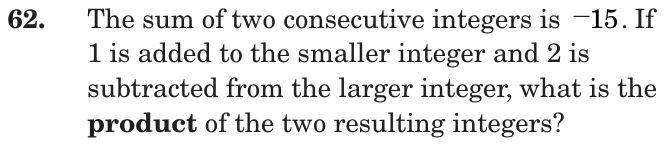
Question 63 of 120
2018 Test A Math, question 6Question
The set of possible values of is . What is the set of possible values of if ?
- A
- B
- C
- D
Show the answer
Correct answer: B
so
Substitute each value of m to find the values of k:
The set k is { 4, 5, 6}.
Question analysis
An algebra question about substitution: m can be 5, 7 or 9, and an equation links k to m. Students find every possible value of k by substituting each value of m and solving. The curly-brace set notation can look unfamiliar, and each value has to be carried all the way through the solve.
- Grade level
- Grade 6 content, by NYS standard
- Compared with grade 7
- At grade 7 Each substitution leads to a one-step grade 6 equation, easier than a typical grade 7 two-step problem. What adds demand is doing it three times and reading the answer as a set of values, which grade 7 rarely uses.
- Estimated difficulty
- Straightforward: two steps or one careful reading.
- Thinking it demands
- Depth of knowledge 1, recall and reproduction · mainly apply
- What makes it hard
- Solution
- 2 steps
- Reading level
- Question and choices: about grade 9, 24 words.
- Students, last 30 days
- Not enough answers yet to show (it takes 10).
Why it is hard, traps and wrong answers (shows the answer)
Why it is hard
The equation is simple, and the main hazard is stopping one step short: m + 3 gives 8, 10 and 12, a listed choice even though those are values of 2k. Checking a single value of m is the other risk, since k = 4 and k = 5 both appear in the first two sets. Students who substitute all three values and halve each result finish quickly.
Variables instead of numbers minor Understanding the question
There is no single unknown: m stands for the set {5, 7, 9}, and the answer is the matching set for k, so the equation has to be applied to three values. (Koedinger & Nathan, 2004; Enright, Morley & Sheehan, 2002)
Strategy: Rewrite the equation so k equals m plus 3, all divided by 2, then evaluate it for each of the three values of m.
Traps
- Stops one step early: A choice is a number from partway through the solution.
The wrong answers, classified
A Checks only one number (Schoenfeld, 1985)
Checks only m = 5, gets k = 4, and takes the first set containing 4; m = 9, giving k = 6, would rule it out.
C Stops one step early (King et al., 2004; Gierl et al., 2017)
Adds 3 to each value of m to get 8, 10 and 12, which are the values of 2k, and forgets to divide by 2.
D Wrong operation (Hegarty, Mayer & Monk, 1995; King et al., 2004)
Doubles each value of m to get 10, 14 and 18, moving the 2 onto m instead of dividing by it, and drops the + 3.
Worked solution, step by step
Formulas used
- Getting k by itself
- k and m are the letters from the equation 2k = m + 3. The fraction bar means divide. If 2 times k equals m + 3, then k is half of m + 3. You get this by dividing both sides of the equation by 2.
Sort out the question
The letter m can be 5, 7 or 9. The curly braces { } show a set, which is a list of numbers. The equation links k to m. You need every value k can have, one for each value of m.
Get k by itself
2k means 2 times k. To undo times 2, divide both sides by 2. Doing the same thing to both sides keeps the equation true.
Try each value of m
Put each value of m into the formula. Add 3 first, then divide by 2.
Watch out: 8, 10 and 12 are the values of m + 3, which equal 2k, not k. Stopping before you divide by 2 gives choice C.
Pick the matching set
The values of k are 4, 5 and 6. Watch out: try all three values of m. If you only try m = 5, you get k = 4, and choice A has a 4 too. So the answer is B, {4, 5, 6}.
Check your answer
Put each k back into the equation. . . . All three work, so the set is right.
More questions like this
The original DOE question
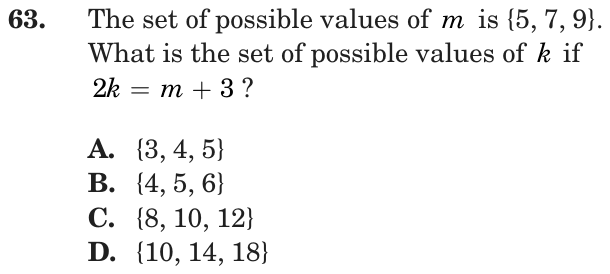
Question 64 of 120
2018 Test A Math, question 7Question
- A
- B
- C
- D
Show the answer
Correct answer: A
Question analysis
An expression question: simplify a sum and difference of two linear expressions in n. Students remove the parentheses, subtract every term inside the second group, and combine like terms. The minus sign in front of the second parentheses is the trap, since it has to change the sign of both terms inside.
- NYS standards
- Grade level
- Grade 7 content, by NYS standard
- Compared with grade 7
- At grade 7 Simplifying linear expressions with a subtracted group is standard grade 7 work. This is a typical textbook exercise in length, with the usual sign trap and no extra steps or real-world context.
- Estimated difficulty
- Straightforward: two steps or one careful reading.
- Thinking it demands
- Depth of knowledge 1, recall and reproduction · mainly apply
- What makes it hard
- Error-prone arithmetic moderate
- A very close wrong answer moderate
- Solution
- 2 steps
- Reading level
- Question and choices: about grade 16+, 5 words.
- Corrected from the DOE handbook
- The handbook’s answer key for this question was corrected.
- Students, last 30 days
- Not enough answers yet to show (it takes 10).
Why it is hard, traps and wrong answers (shows the answer)
Why it is hard
There are only five terms, but two signs decide the answer: the minus in front of the second parentheses and the sign left after 3n − 4n. Each wrong choice comes from one or both of those sign decisions, so all of them look plausible, and checking needs care rather than time. Even the DOE handbook keyed the version with the wrong sign on n.
Error-prone arithmetic moderate Working it out
The minus sign before (4n + 8) has to reach both terms, making −4n and −8, and 3n − 4n leaves a negative n term. (Brown & Burton, 1978; Junker & Sijtsma, 2001)
A very close wrong answer moderate Choosing the answer
5 − n and 5 + n are written alike and share the constant 5; only the sign of the n term, from 3n − 4n, separates them, and the DOE handbook's own key picked the wrong one. (Embretson & Wetzel, 1987; Gorin & Embretson, 2006; Ascalon et al., 2007)
Strategy: Rewrite the subtraction as adding the opposite of each term in the second parentheses, then group the constants and the n terms separately.
Traps
- Order of operations: Working left to right, or distributing a minus sign wrongly, gives a choice.
- Negatives and direction: Arithmetic with negative numbers, the order of a subtraction, or direction on a number line. (Moving a term across the equals sign without changing its sign is a faulty procedure.)
The wrong answers, classified
B Negatives and direction (Brown & Burton, 1978)
Gets the constants right, 7 + 6 − 8 = 5, but writes 3n − 4n as +n, subtracting the smaller coefficient from the larger and keeping a plus sign.
C Order of operations (Brown & Burton, 1978)
Applies the minus sign to 4n but not to 8, so the constants become 7 + 6 + 8 = 21 while the n term comes out right.
D Order of operations (Brown & Burton, 1978)
Makes both mistakes: adds the 8 instead of subtracting it, for 21, and also writes 3n − 4n as +n.
What was corrected from the DOE handbook, and why
- Answer key: The handbook (its question 64) keys this question as F, which is 5 + n (choice B here), in its answer key and in the heading of its explanation. Its own working gives 7 + 3n + 6 − 4n − 8 = 5 − n, which is the handbook’s choice E and choice A here, and that is correct. The key here is A.
Worked solution, step by step
Formulas used
- Subtracting a group in parentheses
- a and b are the terms inside the parentheses. A term is a number, a letter, or a number times a letter. The minus sign in front means you subtract the whole group. So you subtract every term inside, not just the first one.
- Combining like terms
- n stands for an unknown number, and 3n means 3 times n. Like terms have the same letter part, like 3n and 4n. To combine them, add or subtract the numbers in front and keep the letter. Plain numbers combine only with plain numbers.
Sort out the question
You need to simplify the expression, which means write it in a shorter form. An expression is a math phrase made of numbers, letters and signs. Here n stands for an unknown number. Find the choice that matches the short form.
Remove the parentheses
The first group has a plus sign in front. Adding a group changes nothing, so is just . The second group has a minus sign in front. You must subtract both terms inside it.
Watch out: the minus reaches the 8 too. Adding the 8 instead gives 21 for the plain numbers. That leads to choice C or D.
Combine the plain numbers
Group the numbers without a letter. Work them out from left to right.
The plain numbers make 5.
Combine the n terms
You have 3 n’s, and you take away 4 n’s. The numbers in front give 3 − 4 = −1. So you are left with −1n, which is written −n.
Watch out: it is easy to write +n here. That gives 5 + n, choice B.
Put the two parts together
Join the number part and the n part. Adding a negative is the same as subtracting.
So the answer is A, 5 − n.
Check your answer
Pick any number for n and test it. Try n = 1. The original: . Choice A: . They match. Choice B gives , which does not.
More questions like this
The original DOE question
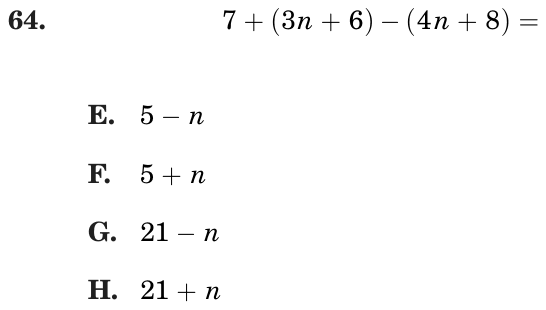
Question 65 of 120
2018 Test A Math, question 8Question
In a certain school, course grades range from 0 to 100. Adrianna took 4 courses and her mean course grade was 90. Roberto took 5 courses. If both students have the same sum of course grades, what was Roberto’s mean?
- A72
- B80
- C90
- D92
Show the answer
Correct answer: A
The sum of Adrianna’s course grades equals 4 times the mean (average) of her grades:
90 × 4 = 360
Roberto has the same sum (360) as Adrianna. Find the mean of his course grades:
360 ÷ 5 = 72
Question analysis
This averages word problem compares two students' course grades. One student's number of courses and mean grade are given, and a second student has the same total over a different number of courses. Students work back from a mean to a sum, then find a new mean, while the stated grade range plays no part.
- Grade level
- Grade 6 content, by NYS standard
- Compared with grade 7
- Below grade 7 Finding a mean is grade 6 content, and this needs only the step back from a mean to a total and one division. Typical grade 7 statistics work compares two data sets, which asks more.
- Estimated difficulty
- Straightforward: two steps or one careful reading.
- Thinking it demands
- Depth of knowledge 2, skills and concepts · mainly apply
- What makes it hard
- Turning words into math moderate
- Something you must already know minor
- Solution
- 2 steps
- Reading level
- Question and choices: about grade 2, 35 words.
- Students, last 30 days
- Not enough answers yet to show (it takes 10).
Why it is hard, traps and wrong answers (shows the answer)
Why it is hard
The question turns on one idea, that a mean times the number of items gives the total, and the numbers are easy. Students who skim "the same sum" as "the same mean" carry Adrianna's 90 straight across, and the 0-to-100 range in the first sentence offers a second number to misuse. Converting to the shared total of 360 first makes the rest a single division.
Turning words into math moderate Understanding the question
"Both students have the same sum of course grades" is the bridge: Adrianna's mean of 90 must be turned into a total, 4 × 90, before it says anything about Roberto. (Hegarty, Mayer & Monk, 1995; Koedinger & Nathan, 2004)
Something you must already know minor Working it out
The link between a mean and a total, sum = mean × number of courses, is not given and has to be used in both directions. (Anderson & Krathwohl, 2001)
Strategy: Multiply the first student's mean by her number of courses to get the shared total, then divide that total by Roberto's number of courses.
Traps
- Misunderstands the concept: A wrong belief about a concept: that percents can be added, that area grows like length, that averages can be averaged, that a bigger denominator means a bigger fraction.
- Information you don't need: The question gives numbers or facts that play no part in the answer.
The wrong answers, classified
B Numbers taken from the question (Hegarty, Mayer & Monk, 1995)
Uses 100, the top of the grade range, in place of Adrianna's mean of 90: 4 × 100 = 400, and 400 ÷ 5 = 80.
C Misunderstands the concept (Smith, diSessa & Roschelle, 1993; De Bock et al., 1998; Ni & Zhou, 2005)
Assumes an equal sum means an equal mean and gives Adrianna's 90, ignoring that Roberto's 360 points are spread over 5 courses, not 4.
D Numbers taken from the question (Hegarty, Mayer & Monk, 1995)
Adds a fifth grade of 100, the top of the stated range, to Adrianna's total: (360 + 100) ÷ 5 = 92.
Worked solution, step by step
Formulas used
- Mean (average)
- M is the mean, also called the average. S is the sum, all the values added together. n is how many values there are. Dividing shares the total out equally, so the mean is what each value would be if they were all the same.
- Sum from the mean
- This is the mean formula turned around. S is the sum, M is the mean, and n is how many values there are. If n values were each equal to the mean, they would add up to M times n. That is the same as the real sum.
Sort out the question
Adrianna took 4 courses, and her mean grade was 90. The mean is the average. Roberto took 5 courses. The key fact is that both have “the same sum of course grades”. The sum is all the grades added together. You need Roberto’s mean. The 0 to 100 range is not needed.
Find Adrianna’s total
You know her mean and her number of courses. Use the sum formula.
Her grades add up to 360 points.
Find Roberto’s mean
Roberto’s grades also add up to 360 points. But he spreads them over 5 courses. Use the mean formula.
His mean is 72.
Avoid the traps and answer
Watch out: the same sum does not mean the same mean. Roberto has more courses sharing the points, so his mean is lower. Choosing 90 is choice C. Watch out: don’t use 100, the top grade, in place of 90. That leads to 80, choice B. So the answer is A, 72.
Check your answer
More courses share the same 360 points, so Roberto’s mean must be lower than 90. 72 is lower. Multiply back: , which matches Adrianna’s total.
More questions like this
The original DOE question
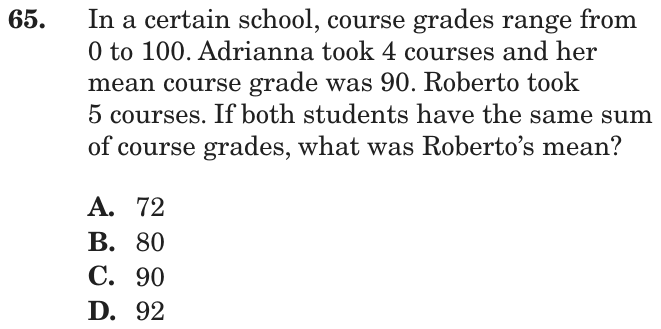
Question 66 of 120
2018 Test A Math, question 9Question
Jenny starts a game with twice as many marbles as Keiko. Jenny gives Keiko 5 marbles, but she still has 10 more than Keiko. How many marbles did Jenny have to start with?
- A25
- B30
- C35
- D40
Show the answer
Correct answer: D
Set up some equations. Jenny (J) has twice as many marbles as Keiko (K):
Jenny gives Keiko 5 marbles, so now they each have: J − 5 and K + 5 marbles. Jenny still has 10 more than Keiko:
To find how many marbles Jenny had to start with, solve J = 2K for K and substitute that into the second equation:
In equation J = 2K, solve for K:
Substitute in for K.
marbles
Question analysis
A two-variable word problem about marbles: Jenny starts with twice as many as Keiko, gives Keiko 5, and still has 10 more. Students set up equations for before and after the trade and solve for Jenny's starting number. The trade changes both players' counts, and the question asks about the start, not the end.
- Grade level
- Grade 8 content, by NYS standard
- Compared with grade 7
- Above grade 7 Grade 7 students solve one equation in one unknown. This needs two related unknowns and a before-and-after change, which leads to a system of equations or a variable on both sides, both grade 8 skills.
- Estimated difficulty
- Hard: combines ideas, needs a plan, and has more than one tempting wrong answer.
- Thinking it demands
- Depth of knowledge 2, skills and concepts · mainly apply
- What makes it hard
- Turning words into math major
- Much to keep track of moderate
- Solution
- 4 steps
- Reading level
- Question and choices: about grade 4, 31 words.
- Students, last 30 days
- Not enough answers yet to show (it takes 10).
Why it is hard, traps and wrong answers (shows the answer)
Why it is hard
Most of the difficulty is in setting up the equations, not solving them. The gift of 5 marbles changes both counts, so the gap between the girls shrinks by 10, not 5, and students who take the marbles from Jenny without giving them to Keiko reach a consistent but wrong answer. Two other choices are true counts from after the trade, so finishing the algebra is not the same as answering the question. Testing the choices backward is a fast, safe alternative.
Turning words into math major Understanding the question
Three relations hide in two sentences: "twice as many", the gift of 5 that lowers Jenny's count and raises Keiko's, and "still has 10 more", which compares the counts after the gift. (Hegarty, Mayer & Monk, 1995; Koedinger & Nathan, 2004)
Much to keep track of moderate Working it out
Each girl has a count before and after the trade, four quantities in all, and the question asks for only one of them, Jenny's at the start. (Sweller, 1988; Carpenter, Just & Shell, 1990)
Strategy: Work backward from the choices: halve each one for Keiko's start, move 5 marbles from Jenny to Keiko, and check whether Jenny ends with exactly 10 more.
Traps
- Misreads the question: Misses or misreads a condition or a word in the question: "at least", "each", "remaining", "not".
- Answers a different question: A choice is right for another quantity: the other unknown, the rest instead of the part, the part instead of the whole.
The wrong answers, classified
A Answers a different question (King et al., 2004; Hegarty, Mayer & Monk, 1995)
Solves correctly for Keiko's start, 20, then reports her count after receiving the 5 marbles, 25, instead of Jenny's starting count.
B Misreads the question (Hegarty, Mayer & Monk, 1995)
Subtracts the 5 marbles from Jenny but forgets that Keiko gains them, solving 2K − 5 = K + 10 to get K = 15 and J = 30.
C Answers a different question (King et al., 2004; Hegarty, Mayer & Monk, 1995)
Gives Jenny's count after she hands over 5 marbles, 40 − 5 = 35, instead of the number she had at the start.
Worked solution, step by step
Formulas used
- Twice as many
- J is the number of marbles Jenny starts with, and K is the number Keiko starts with. Twice as many means 2 times as many, so J equals 2 times K. Because J and 2K are equal, you can write 2K anywhere you see J.
- Keeping an equation balanced
- a and b are the two sides of an equation, and c is any number or term. An equation is like a balanced scale. If you subtract the same thing from both sides, it stays balanced. The same is true if you add the same thing, or divide both sides by the same number that is not zero.
Sort out the question
Let K be Keiko’s marbles at the start. Jenny starts with twice as many, so she has 2K. Then Jenny gives Keiko 5 marbles. After that, “she still has 10 more than Keiko”. You need Jenny’s count at the start, before the gift.
Write the counts after the gift
The gift changes both counts. Jenny loses 5, and Keiko gains 5.
- Jenny now has .
- Keiko now has .
Jenny has 10 more than Keiko. So Jenny’s count equals Keiko’s count plus 10.
Watch out: Keiko gains the 5 marbles too. Taking 5 from Jenny but not adding 5 to Keiko leads to 30, choice B.
Solve for K
Add the numbers on the right side first.
Subtract K from both sides. Then add 5 to both sides. Each move keeps the equation balanced.
Keiko started with 20 marbles.
Find Jenny’s starting count
Jenny started with twice as many as Keiko.
Watch out: 25 is Keiko’s count after the gift, choice A. 35 is Jenny’s count after the gift, choice C. The question asks about the start. So the answer is D, 40.
Check your answer
Start: Jenny has 40 and Keiko has 20, and 40 is twice 20. After the gift, Jenny has 35 and Keiko has 25. , so Jenny still has 10 more. Every fact fits.
More questions like this
The original DOE question
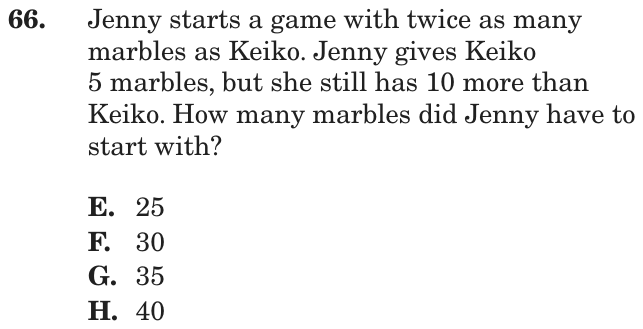
Question 67 of 120
2018 Test A Math, question 10Question
In a scale diagram, inch represents feet. How many inches represent foot?
- A
- B
- C
- D
Show the answer
Correct answer: A
Let be the number of inches representing 1 foot. Set up a proportion and solve for :
in.
Question analysis
This scale drawing question uses decimals: on a diagram, 0.125 inch stands for 125 feet. Students find how many inches represent just 1 foot, which is the unit rate of the scale. Dividing a decimal by a large whole number makes the decimal point easy to misplace.
- Grade level
- Grade 7 content, by NYS standard
- Compared with grade 7
- At grade 7 Scale drawings and unit rates are core grade 7 topics, and this is a single division. The demand matches typical grade 7 work, with decimal place value as the only real hurdle.
- Estimated difficulty
- Straightforward: two steps or one careful reading.
- Thinking it demands
- Depth of knowledge 2, skills and concepts · mainly apply
- What makes it hard
- Error-prone arithmetic moderate
- A very close wrong answer moderate
- Solution
- 1 step
- Reading level
- Question and choices: about grade 11, 19 words.
- Students, last 30 days
- Not enough answers yet to show (it takes 10).
Why it is hard, traps and wrong answers (shows the answer)
Why it is hard
A single division settles this question, and the choices are built to punish a misplaced decimal point, since three of them are each a power of ten apart. Students who see that 0.125 is one-thousandth of 125 can answer at once; students who divide by hand often lose a zero. Multiplying the chosen answer back by 125 is a quick check.
Error-prone arithmetic moderate Working it out
The one step is 0.125 ÷ 125, a decimal divided by a large whole number, where the place of the decimal point decides between 0.001, 0.01 and 0.1. (Brown & Burton, 1978; Junker & Sijtsma, 2001)
A very close wrong answer moderate Choosing the answer
0.001 and 0.01 look almost the same, differing by one zero after the decimal point; only exact placement of the point in 0.125 ÷ 125 separates them. (Embretson & Wetzel, 1987; Gorin & Embretson, 2006; Ascalon et al., 2007)
Strategy: Divide the inches by the feet to get inches per foot, then check by multiplying your result by 125 to see whether you get back 0.125.
Traps
- Units or scale: The answer is wanted in other units, or a rate or scale must be converted first.
The wrong answers, classified
B An arithmetic slip (Junker & Sijtsma, 2001)
Divides 0.125 by 125 but loses one zero in placing the decimal point, giving 0.01, ten times too large.
C A faulty procedure (Brown & Burton, 1978; Tatsuoka, 1983)
Sees that 125 ÷ 125 = 1 and puts the 1 in the tenths place, where 0.125 begins, instead of the thousandths place.
D Units or scale (King et al., 2004)
Treats the 0.125 inch as if it already stood for 1 foot, never dividing by the 125 feet it represents, and picks the choice closest to it.
Worked solution, step by step
Formulas used
- Unit rate
- r is the unit rate, the amount that goes with just 1 unit. a is the first amount, here 0.125 inch. b is the matching second amount, here 125 feet. Dividing shares the inches out equally, one share for each foot.
Sort out the scale
A scale diagram is a drawing where small lengths stand for real lengths. Here 0.125 inch on the drawing stands for 125 real feet. You need how many inches stand for just 1 foot. That is a unit rate, an amount for 1 unit.
Set up the division
Divide the inches by the feet. That splits the 0.125 inch into 125 equal shares, one for each foot.
Divide carefully
Write 0.125 as a fraction. It is 125 thousandths.
Now divide by 125. Split 125 thousandths into 125 shares, and each share is 1 thousandth.
So 1 foot is shown by 0.001 inch.
Match the decimal places
0.001 has the 1 in the third place after the decimal point. That place is thousandths. Watch out: 0.01 and 0.1 put the decimal point in the wrong place. They are choices B and C, and each is too big. So the answer is A, 0.001.
Check your answer
Multiply back. inch, which matches the scale. Choice B would give inches. That is ten times too long.
More questions like this
The original DOE question
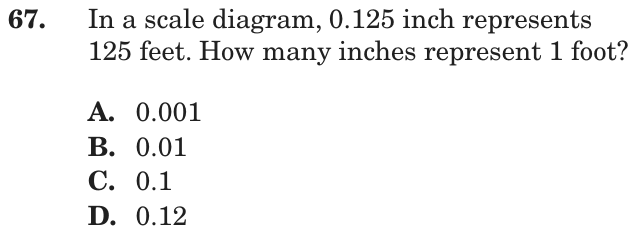
Question 68 of 120
2018 Test A Math, question 11Question
PEOPLE PER VEHICLE AT CHECKPOINT
| Number of People in Vehicle | Percent of Vehicles |
| 1 | 40% |
| 2 | 35% |
| 3 | 15% |
| 4 | 7% |
| 5 or more | 3% |
A researcher recorded the number of people in each vehicle that passed through a checkpoint. The table above shows the percent distribution for the 420 vehicles that passed through the checkpoint yesterday morning. How many of the 420 vehicles contained at least 3 people?
- A42
- B63
- C105
- D315
Show the answer
Correct answer: C
First, add the percentage of cars containing 3 people, 4 people, and 5 or more people:
15% + 7% + 3% = 25%
Thus, 25% of the cars contained at least 3 people, so use that to calculate the number of cars:
420 × 0.25 = 105 cars.
Question analysis
A data table question with percents: a table gives the percent of 420 vehicles carrying 1, 2, 3, 4, or 5 or more people. Students find how many vehicles held at least 3 people by adding the right rows and taking that percent of 420. Reading at least correctly decides which rows count.
- Grade level
- Grade 6 content, by NYS standard
- Compared with grade 7
- At grade 7 Taking a percent of a number is grade 6 work, and grade 7 adds multistep percent problems. This two-step table problem sits at that level, with the phrase at least as the careful-reading point.
- Estimated difficulty
- Moderate: several steps, or a close reading with one strong distractor.
- Thinking it demands
- Depth of knowledge 2, skills and concepts · mainly apply
- What makes it hard
- Turning words into math moderate
- Reading a figure, table or graph moderate
- Solution
- 2 steps
- Reading level
- Question and choices: about grade 7, 56 words.
- Students, last 30 days
- Not enough answers yet to show (it takes 10).
Why it is hard, traps and wrong answers (shows the answer)
Why it is hard
The arithmetic is easy, since 25% of 420 is a quarter of it; the points are lost on the phrase "at least 3". Each common misreading, more than 3, exactly 3 or fewer than 3, gives a listed choice, so a wrong reading never leads to a dead end. Adding the percents before converting saves time and avoids three separate multiplications.
Turning words into math moderate Understanding the question
The bold "at least 3" has to become the rows for 3, 4 and "5 or more", taking in both the 3-person row and the open-ended last row. (Hegarty, Mayer & Monk, 1995; Koedinger & Nathan, 2004)
Reading a figure, table or graph moderate Understanding the question
The table gives percents, not counts, so the rows have to be added as percents and then taken of the 420 vehicles named only in the text below the table. (Lesh, Post & Behr, 1987; Kirsch & Mosenthal, 1990)
Strategy: Add the percents for every row that meets the condition first, then take that single percent of 420 instead of working row by row.
Traps
- Counting the ends: Inclusive or exclusive ends, fence posts, consecutive numbers: an answer that is one too many or too few, or an endpoint drawn open where it belongs closed (or the reverse).
- Answers a different question: A choice is right for another quantity: the other unknown, the rest instead of the part, the part instead of the whole.
The wrong answers, classified
A Counting the ends (Brown & Burton, 1978)
Reads at least 3 as more than 3 and leaves out the 3-person row, adding only 7% + 3% = 10%, and 10% of 420 is 42.
B Misreads the question (Hegarty, Mayer & Monk, 1995)
Matches the 3 in the question to the row for exactly 3 people, 15% of 420 = 63, missing the 4-person and 5-or-more rows.
D Answers a different question (King et al., 2004; Hegarty, Mayer & Monk, 1995)
Adds the 40% and 35% rows to get 75% and takes 75% of 420 = 315, which counts the vehicles with fewer than 3 people.
Worked solution, step by step
Formulas used
- Percent of a number
- W is the whole amount. p is the percent, and x is the part you want. Percent means out of 100, so p percent is the fraction p over 100. Multiplying the whole by that fraction gives the part.
Sort out the question
420 vehicles passed the checkpoint. The table gives the percent of vehicles with each number of people. You need how many vehicles had “at least 3” people. At least 3 means 3 or more. So count vehicles with 3 people, 4 people, and 5 or more.
Pick the right rows
Three rows fit: 3 people (15%), 4 people (7%), and 5 or more (3%). Watch out: at least 3 includes 3 itself. Leaving out the 3 row gives 42, choice A. Using only the 3 row gives 63, choice B.
Add the percents first
Adding the percents first saves work. Then you only multiply once.
So 25% of the vehicles had at least 3 people.
Find 25% of 420
Use the percent formula with p = 25 and W = 420.
25% is one quarter, so this is the same as . Watch out: 315 is the number of vehicles with fewer than 3 people, choice D. So the answer is C, 105.
Check your answer
The other rows, 1 and 2 people, make . 75% of 420 is 315. Then , which is all the vehicles. The two groups fit together.
More questions like this
The original DOE question
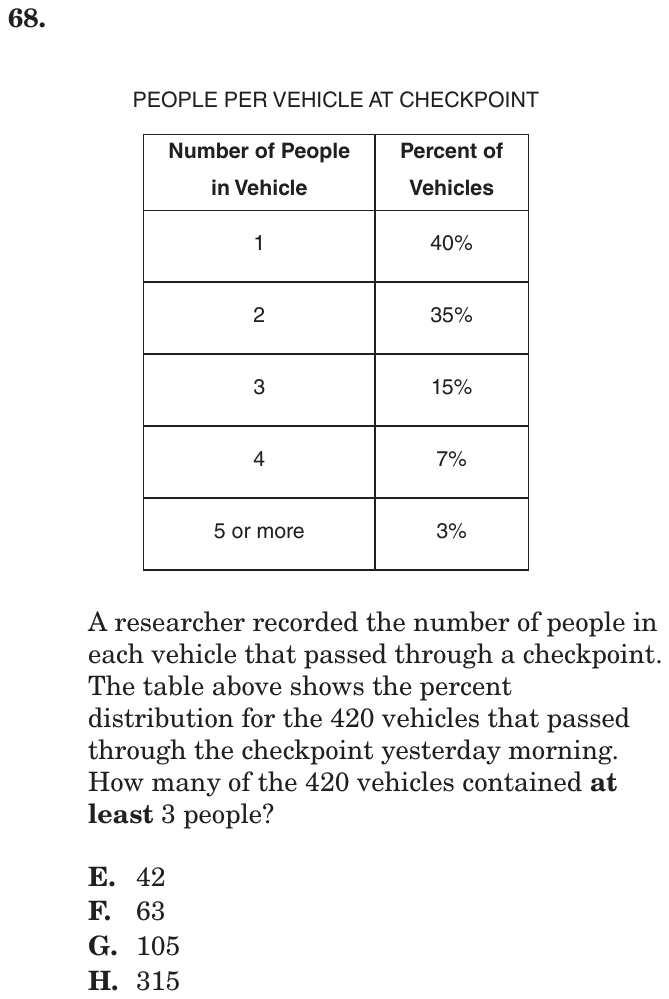
Question 69 of 120
2018 Test A Math, question 12Question
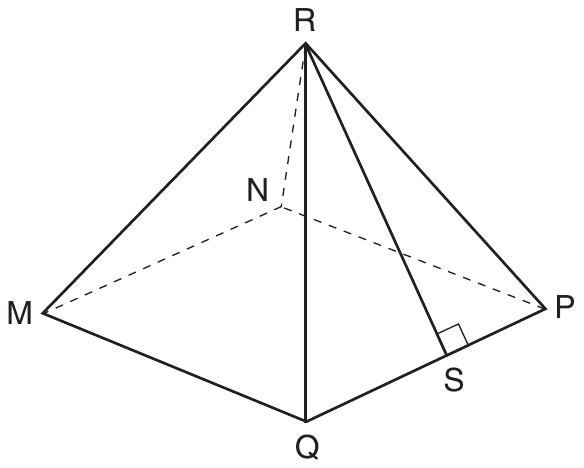
In the pyramid above, each triangular face has the same area, and the base MNPQ is a square that measures 8 centimeters on each side. If the length of = 6 centimeters, what is the surface area of the pyramid excluding the base?
- A48 sq cm
- B96 sq cm
- C128 sq cm
- D160 sq cm
Show the answer
Correct answer: B
Line segment is the altitude, or height, of triangle QRP. The length of is 8 cm. Use that information to find the area of triangle QRP:
sq cm.
There are 4 congruent triangles in the pyramid, so the surface area is
4 × 24 = 96 sq cm
Question analysis
A geometry question about the surface area of a square pyramid, leaving out its base. The base edges are 8 cm and segment RS, the height of one triangular face drawn from the top to a base edge, is 6 cm. Students find one face's area and multiply by the number of faces, reading excluding the base carefully.
- Grade level
- Grade 7 content, by NYS standard
- Compared with grade 7
- At grade 7 Surface area of a right pyramid from its faces is named in the grade 7 standards, and this is a direct two-step case. It matches typical grade 7 work, though the drawing's slant height must be read correctly.
- Estimated difficulty
- Moderate: several steps, or a close reading with one strong distractor.
- Thinking it demands
- Depth of knowledge 2, skills and concepts · mainly apply
- What makes it hard
- Solution
- 2 steps
- Reading level
- Question and choices: about grade 5, 49 words.
- Students, last 30 days
- Not enough answers yet to show (it takes 10).
Why it is hard, traps and wrong answers (shows the answer)
Why it is hard
Once RS is read as the height of a face, the computation is short: one triangle, then four of them. Points go to the figure and to one word. Students who count only the faces drawn in front, or who include the square base, reach listed choices, and the bold "excluding" is all that separates the lateral area from the total. The statement that every face has the same area is what makes multiplying by four valid.
Reading a figure, table or graph moderate Understanding the question
The drawing shows two lateral faces in front and two behind dashed edges, and RS, with its right-angle mark at S, is the height of face QRP, not of the pyramid. (Lesh, Post & Behr, 1987; Kirsch & Mosenthal, 1990)
Something you must already know minor Working it out
The triangle area formula, one half times base times height, and the fact that a square pyramid has four lateral faces are both assumed, not given. (Anderson & Krathwohl, 2001)
Strategy: Find the area of one triangular face with one half times base times height, using RS as the height, then multiply by the four congruent faces.
Traps
- Misreads the question: Misses or misreads a condition or a word in the question: "at least", "each", "remaining", "not".
- A formula you must know: Needs a formula the test does not give: area, circumference, volume, probability rules.
The wrong answers, classified
A Misreads the figure (Lesh, Post & Behr, 1987; Kirsch & Mosenthal, 1990)
Finds one face as ½ × 8 × 6 = 24 but counts only the two faces drawn in front, 2 × 24 = 48, missing the two hidden ones.
C Numbers taken from the question (Hegarty, Mayer & Monk, 1995)
Uses only the 8 cm edge, as both base and height of each face, 4 × ½ × 8 × 8 = 128, and never uses RS.
D Misreads the question (Hegarty, Mayer & Monk, 1995)
Finds the four faces, 96 sq cm, then adds the 8 × 8 = 64 sq cm base that the question says to exclude.
Worked solution, step by step
Formulas used
- Area of a triangle
- A is the area. b is the base, the side the triangle sits on. h is the height: the straight-up distance from the base to the top corner, at a right angle to the base. You take half because a triangle is half of a rectangle with the same base and height.
Sort out the pyramid
The pyramid sits on a square base, MNPQ. Each side of the square is 8 cm. Four triangle faces rise from the base and meet at the top point, R. Every face has the same area. Segment RS is 6 cm. You need the area of the four faces, “excluding the base”. Excluding means leaving it out.
See what RS measures
RS runs from R down face QRP to point S on edge QP. The small square at S marks a right angle. So RS is the height of triangle QRP. The base of that triangle is QP, one side of the square, so it is 8 cm.
Find the area of one face
Use the triangle formula with base 8 cm and height 6 cm.
One face has an area of 24 sq cm.
Add the four faces
All four faces are the same, so multiply by 4.
Watch out: only two faces are drawn in front. The other two hide behind the dashed lines. Counting just two faces gives 48, choice A. Watch out: don’t add the base, . That gives 160, choice D. So the answer is B, 96 sq cm.
Check your answer
Each face fits inside an 8 by 6 rectangle, with an area of 48 sq cm. The triangle is half of that, 24 sq cm, and four faces make 96 sq cm. That is less than 160, which would include the base.
More questions like this
The original DOE question
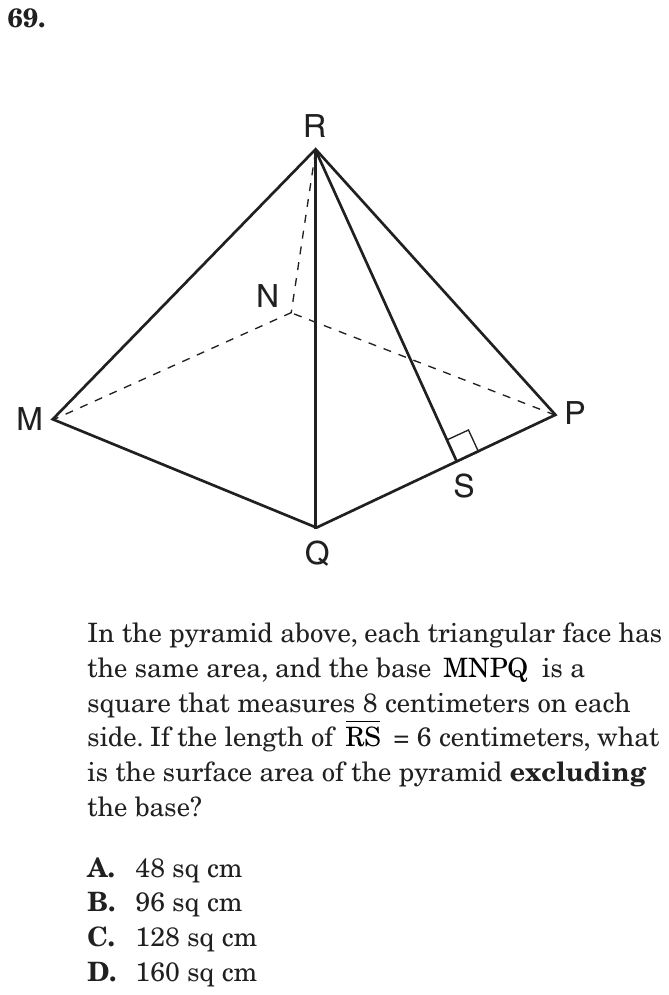
Question 70 of 120
2018 Test A Math, question 13Question
The perimeter of a rectangle is 510 centimeters. The ratio of the length to the width is 3:2. What are the dimensions of this rectangle?
- A150 cm by 105 cm
- B153 cm by 102 cm
- C158 cm by 97 cm
- D165 cm by 90 cm
Show the answer
Correct answer: B
Let = the width and = the length.
Draw the rectangle to help visualize.
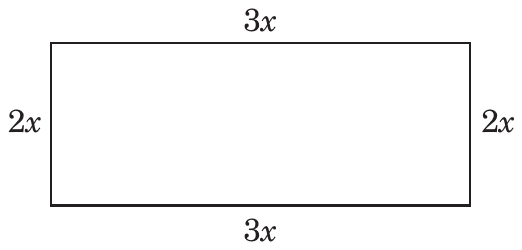
Since 2 times width + 2 times length = perimeter, we get
cm and cm
Question analysis
A rectangle word problem that combines perimeter with a ratio: the perimeter is 510 centimeters and the length and width are in the ratio 3 to 2. Students find the rectangle's dimensions. Every choice has the correct perimeter, so only the ratio separates them.
- Grade level
- Grade 7 content, by NYS standard
- Compared with grade 7
- At grade 7 Perimeter and ratio are each familiar from grades 6 and 7, and combining them with a five-part split is a typical grade 7 multistep ratio problem. It asks about the same as classroom work.
- Estimated difficulty
- Moderate: several steps, or a close reading with one strong distractor.
- Thinking it demands
- Depth of knowledge 2, skills and concepts · mainly apply
- What makes it hard
- A very close wrong answer moderate
- Turning words into math minor
- Solution
- 3 steps
- Reading level
- Question and choices: about grade 3, 35 words.
- Students, last 30 days
- Not enough answers yet to show (it takes 10).
Why it is hard, traps and wrong answers (shows the answer)
Why it is hard
The question is built so that the perimeter, the easier condition, rules nothing out: every choice adds to 255. A student who tests the choices against 510 alone will accept whichever comes first, and the first is 150 by 105. Solving with ratio parts, or checking each pair's ratio, avoids that; 3:2 means the length is exactly one and a half times the width.
A very close wrong answer moderate Choosing the answer
153 by 102 and 150 by 105 differ by just 3 cm in each side and give the same 510 cm perimeter; only the ratio, exactly 3:2 against 10:7, separates them. (Embretson & Wetzel, 1987; Gorin & Embretson, 2006; Ascalon et al., 2007)
Turning words into math minor Understanding the question
"The ratio of the length to the width is 3:2" has to become 3 parts and 2 parts of the half-perimeter, 255, not of the full 510. (Hegarty, Mayer & Monk, 1995; Koedinger & Nathan, 2004)
Strategy: Halve the perimeter to get length plus width, split that sum into 5 equal parts, and give the length 3 parts and the width 2.
Traps
- Misreads the question: Misses or misreads a condition or a word in the question: "at least", "each", "remaining", "not".
The wrong answers, classified
A Misreads the question (Hegarty, Mayer & Monk, 1995)
Checks only the perimeter, 2 × (150 + 105) = 510, and accepts the first pair that fits; 150 to 105 is 10:7, not 3:2.
C Misreads the question (Hegarty, Mayer & Monk, 1995)
Confirms that 158 + 97 = 255, half the perimeter, but never tests the ratio; 1.5 × 97 is 145.5, not 158.
D Misreads the question (Hegarty, Mayer & Monk, 1995)
Matches the perimeter, since 165 + 90 = 255, but a 3:2 rectangle 90 cm wide would be 135 cm long, not 165.
Worked solution, step by step
Formulas used
- Perimeter of a rectangle
- P is the perimeter, the distance all the way around the shape. l is the length and w is the width. A rectangle has two lengths and two widths. So you add one length and one width, then double it.
- Sharing a total in a ratio
- In a ratio like 3:2, the amounts are made of equal-sized parts. Add the numbers in the ratio to count the parts. Divide the total by that count to get the size of one part. Then multiply by how many parts each amount has.
Sort out the question
The perimeter of the rectangle is 510 cm. The perimeter is the distance all the way around. The ratio of length to width is 3:2. That means the length is 3 equal parts, and the width is 2 of the same parts. You need the length and the width.
Find length plus width
The perimeter counts each side twice, once for each matching side. So halve it to get one length plus one width.
Length plus width is 255 cm.
Find the size of one part
Length and width together are parts. Share the 255 cm equally among them.
Each part is 51 cm.
Find the length and width
The length is 3 parts and the width is 2 parts.
The length is 153 cm and the width is 102 cm.
Check the ratio, then answer
Watch out: every choice has a perimeter of 510 cm. For example, too. So checking only the perimeter can trick you into choice A. The ratio decides it. 153 is exactly 1.5 times 102, but 150 is not 1.5 times 105. So the answer is B, 153 cm by 102 cm.
Check your answer
Check both facts. Perimeter: . Ratio: and , so 153 to 102 is 3:2.
More questions like this
The original DOE question
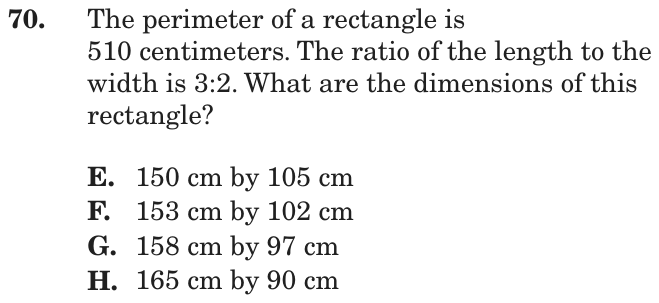
Question 71 of 120
2018 Test A Math, question 14Question
Which number line below shows the solution to the inequality ?
- A

- B

- C

- D

Show the answer
Correct answer: D
Multiply each term by 2 to eliminate the fraction, and isolate :
Therefore, must be between −8 and 4.
Question analysis
An inequality question: choose the number line that shows the solution of a compound inequality in which x divided by 2 lies between −4 and 2. Students undo the division in every part and match the graph's endpoints and shading. The four number lines differ in their endpoints and in which part of the line is shaded.
- Grade level
- Grade 7 content, by NYS standard
- Compared with grade 7
- At grade 7 Grade 7 students solve two-step inequalities and graph them on a number line. This compound inequality needs only one operation applied to all three parts at once, so it matches typical grade 7 work.
- Estimated difficulty
- Straightforward: two steps or one careful reading.
- Thinking it demands
- Depth of knowledge 1, recall and reproduction · mainly apply
- What makes it hard
- Reading a figure, table or graph moderate
- Error-prone arithmetic minor
- Solution
- 2 steps
- Reading level
- Question and choices: about grade 11, 11 words.
- Students, last 30 days
- Not enough answers yet to show (it takes 10).
Why it is hard, traps and wrong answers (shows the answer)
Why it is hard
Solving takes one step, multiplying through by 2, so most of the work is matching the result to a picture. The choices pair each common slip with a graph: the bounds left as written, the bounds halved, and the right bounds shaded on the wrong side. Reading the open circles against the labeled ticks at −5 and 5 settles it.
Reading a figure, table or graph moderate Understanding the question
The four number lines are labeled only at −10, −5, 0, 5 and 10, so open circles at −8 and 4, or at −4 and 2, have to be located by counting ticks. (Lesh, Post & Behr, 1987; Kirsch & Mosenthal, 1990)
Error-prone arithmetic minor Working it out
All three parts of −4 < x/2 < 2 must be multiplied by 2, and the negative bound −4 becomes −8; halving instead gives −2. (Brown & Burton, 1978; Junker & Sijtsma, 2001)
Strategy: Multiply all three parts of the inequality by 2 to isolate x, then pick the graph whose open circles and shading match the new bounds.
Traps
- Stops one step early: A choice is a number from partway through the solution.
- Negatives and direction: Arithmetic with negative numbers, the order of a subtraction, or direction on a number line. (Moving a term across the equals sign without changing its sign is a faulty procedure.)
The wrong answers, classified
A Wrong operation (Hegarty, Mayer & Monk, 1995; King et al., 2004)
Divides each part of the inequality by 2 instead of multiplying, getting −2 < x < 1, so the open circles land at −2 and 1.
B Stops one step early (King et al., 2004; Gierl et al., 2017)
Graphs −4 and 2 as the bounds of x, stopping before the step of multiplying through by 2 to clear the fraction x/2.
C Negatives and direction (Brown & Burton, 1978)
Finds −8 and 4 correctly but shades the two rays outside them, as if x had to be less than −8 or greater than 4.
Worked solution, step by step
Formulas used
- Multiplying an inequality by a positive number
- a and b are numbers, and the less-than sign means the left side is smaller. If you multiply both sides by the same positive number, like 2, the smaller side stays smaller. So the sign keeps pointing the same way. A negative number would flip it, but 2 is positive.
Sort out the inequality
An inequality compares two amounts that may not be equal. The sign means less than. Here means x divided by 2. The inequality says x divided by 2 is between −4 and 2. You need the values of x itself. Then you pick the number line that shows them.
Multiply all three parts by 2
To undo dividing by 2, multiply by 2. Multiply all three parts, so the whole statement stays true.
Watch out: multiply, don’t divide. Dividing gives −2 and 1, choice A. Leaving the ends at −4 and 2 is choice B.
Read what the answer means
x is greater than −8 and less than 4. So x is any number between −8 and 4. x cannot equal −8 or 4 exactly. On a number line, that means open circles at −8 and 4, with the part between them shaded.
Find the matching number line
The number lines are labeled only at −10, −5, 0, 5 and 10. Count the tick marks. −8 is 3 ticks left of −5, and 4 is 1 tick left of 5. Watch out: choice C has circles at −8 and 4 but shades the parts outside them. So the answer is D.
Check your answer
Test a number from the shaded part, like 0. , and 0 is between −4 and 2. Now test 6, which is outside. , and 3 is not less than 2. So only the part between −8 and 4 works.
More questions like this
The original DOE question
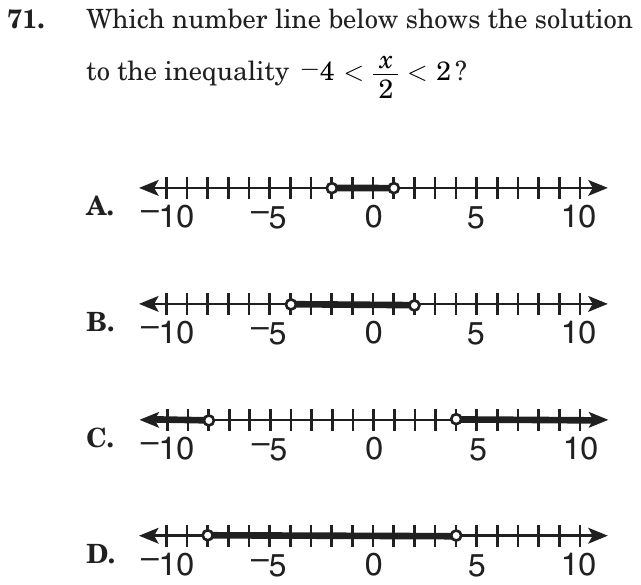
Question 72 of 120
2018 Test A Math, question 15Question
1 dollar = 7 lorgs
1 dollar = 0.5 dalt
Kevin has 140 lorgs and 16 dalts. If he exchanges the lorgs and dalts for dollars according to the rates above, how many dollars will he receive?
- A$28
- B$52
- C$182
- D$282
Show the answer
Correct answer: B
Use proportions to make the conversions:
Lorgs to dollars:
Dalts to dollars:
Total dollars = 20 + 32 = $52
Question analysis
A unit conversion word problem with made-up currencies, lorgs and dalts, each with an exchange rate to dollars. Students convert two amounts into dollars and add them. One rate is a decimal less than 1, which makes it easy to multiply where dividing is needed.
- Grade level
- Grade 6 content, by NYS standard
- Compared with grade 7
- At grade 7 Converting units with ratio reasoning is grade 6 content. Two conversions and a sum make it typical grade 7 work, with the decimal rate as the step most likely to trip students up.
- Estimated difficulty
- Moderate: several steps, or a close reading with one strong distractor.
- Thinking it demands
- Depth of knowledge 2, skills and concepts · mainly apply
- What makes it hard
- Turning words into math moderate
- Error-prone arithmetic minor
- Solution
- 3 steps
- Reading level
- Question and choices: about grade 4, 29 words.
- Students, last 30 days
- Not enough answers yet to show (it takes 10).
Why it is hard, traps and wrong answers (shows the answer)
Why it is hard
The two conversions look alike but run in different directions in students' minds: 140 lorgs at 7 per dollar is plainly a division, while 0.5 dalt per dollar looks like a price. Most wrong answers come from the dalts. The safest approach is to ask how many dollars one coin is worth, a seventh of a dollar for a lorg and 2 dollars for a dalt, before multiplying.
Turning words into math moderate Understanding the question
"1 dollar = 0.5 dalt" means a dalt is worth 2 dollars, but read word by word it suggests a dalt is half a dollar, inviting multiplication by 0.5. (Hegarty, Mayer & Monk, 1995; Koedinger & Nathan, 2004)
Error-prone arithmetic minor Working it out
Dividing 16 by 0.5 means dividing by a decimal less than 1, which makes the result larger, a step many students do the other way by habit. (Brown & Burton, 1978; Junker & Sijtsma, 2001)
Strategy: Read each rate as coins per dollar, divide each coin amount by its own rate, and only then add the two dollar amounts.
Traps
- Wrong operation: Adds instead of multiplying, divides the wrong way round, turns a ratio or rate upside down, or undoes a step in the wrong direction (subtracts what should be added back).
- Units or scale: The answer is wanted in other units, or a rate or scale must be converted first.
The wrong answers, classified
A Wrong operation (Hegarty, Mayer & Monk, 1995; King et al., 2004)
Converts the lorgs correctly, 140 ÷ 7 = 20, but multiplies the dalts by the rate, 16 × 0.5 = 8, and adds to get $28.
C Numbers taken from the question (Hegarty, Mayer & Monk, 1995)
Multiplies each coin amount by the other coin's rate, 140 × 0.5 + 16 × 7 = 70 + 112 = 182, combining the numbers without a model.
D Units or scale (King et al., 2004)
Divides each amount by the other coin's rate, 140 ÷ 0.5 = 280 and 16 ÷ 7 ≈ 2.3, and rounds the total to $282.
Worked solution, step by step
Formulas used
- Changing coins into dollars
- d is the number of dollars. c is how many coins you have. r is the rate: how many of those coins make 1 dollar. Each dollar uses up r coins, so dividing tells how many dollars the coins fill.
Sort out the rates
The rates tell how many coins make 1 dollar. 1 dollar = 7 lorgs. 1 dollar = 0.5 dalt, which is half a dalt. Kevin has 140 lorgs and 16 dalts. You need how many dollars he gets for all of them.
Change the lorgs to dollars
It takes 7 lorgs to make 1 dollar. So divide the lorgs by 7.
The lorgs are worth 20 dollars.
Think about what a dalt is worth
Half a dalt makes 1 dollar. So a whole dalt makes 2 dollars. A dalt is worth more than a dollar, not less. Watch out: don’t read the rate as a dalt being worth half a dollar. That leads to and a total of $28, choice A.
Change the dalts to dollars
Use the same formula, with a rate of 0.5 dalt for each dollar.
Dividing by one half is the same as multiplying by 2, so this is . The dalts are worth 32 dollars.
Add the two amounts
Add the dollars from the lorgs and the dollars from the dalts.
Kevin gets 52 dollars. So the answer is B, $52.
Check your answer
Work backward. 20 dollars trade for lorgs. 32 dollars trade for dalts. Both match what Kevin has, so $52 is right.
More questions like this
The original DOE question
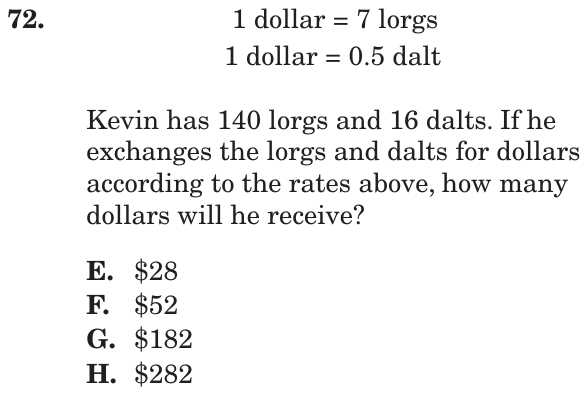
Question 73 of 120
2018 Test A Math, question 16Question
A box of colored pencils contains exactly 6 red pencils. The probability of choosing a red pencil from the box is . How many of the pencils in the box are not red?
- A5
- B15
- C21
- D30
Show the answer
Correct answer: B
Let be the total number of colored pencils in the box. Set up a proportion to find :
If there are 6 red pencils, then the number of pencils that are not red is
21 − 6 = 15.
Question analysis
A probability word problem: a box holds exactly 6 red pencils, and the chance of drawing a red one is 2/7. Students work backward from the probability to the number of pencils in the box, then answer the question actually asked, which is about the pencils that are not red.
- Grade level
- Grade 6 content, by NYS standard
- Compared with grade 7
- At grade 7 Simple probability is grade 6 content in New York. Reversing it to find a total is a step beyond plugging counts into a fraction, which puts this at about the level of typical grade 7 work.
- Estimated difficulty
- Straightforward: two steps or one careful reading.
- Thinking it demands
- Depth of knowledge 2, skills and concepts · mainly apply
- What makes it hard
- Turning words into math moderate
- Something you must already know minor
- Solution
- 2 steps
- Reading level
- Question and choices: about grade 6, 32 words.
- Corrected from the DOE handbook
- A spelling mistake in the explanation was corrected.
- Students, last 30 days
- Not enough answers yet to show (it takes 10).
Why it is hard, traps and wrong answers (shows the answer)
Why it is hard
Students have to treat a probability as a ratio and scale it up: 6 red pencils is three times the 2 in 2/7. The common loss is choosing the total number of pencils, which appears naturally halfway through the work and is a listed choice. Reading the 7 as a pencil count, or scaling by 6 instead of 3, leads to the other wrong answers.
Turning words into math moderate Understanding the question
"The probability of choosing a red pencil from the box is 2/7" has to become a part-to-whole ratio: 2 of every 7 pencils are red, so the 6 red pencils are 2 parts. (Hegarty, Mayer & Monk, 1995; Koedinger & Nathan, 2004)
Something you must already know minor Working it out
The question assumes students know that a probability is favorable outcomes over all outcomes, here used in reverse to find the total from the red count. (Anderson & Krathwohl, 2001)
Strategy: Since 2 parts out of 7 are red, find how many pencils one part stands for, then count the parts that are not red.
Traps
- Stops one step early: A choice is a number from partway through the solution.
The wrong answers, classified
A Numbers taken from the question (Hegarty, Mayer & Monk, 1995)
Reads 2/7 as 2 red pencils among exactly 7 and takes 7 − 2 = 5, ignoring the stated 6 red pencils.
C Stops one step early (King et al., 2004; Gierl et al., 2017)
Solves 2/7 = 6/x to get 21 pencils in all and stops before subtracting the 6 red ones that the bold not excludes.
D A faulty procedure (Brown & Burton, 1978; Tatsuoka, 1983)
Treats the 6 red pencils as one share of the 7 instead of two, so each share is 6 and the 5 non-red shares make 30.
What was corrected from the DOE handbook, and why
- Explanation: The handbook says “the number of pencils that are not read is 21 − 6 = 15”. “read” now reads “red”.
Worked solution, step by step
Formulas used
- Probability
- P is the probability, the chance that something happens. Favorable is the number of ways to get what you want, here a red pencil. Total is the number of all possible picks, here every pencil in the box. It works when every pick is equally likely.
Sort out the question
A probability is a number that tells how likely something is. The box has exactly 6 red pencils. The chance of picking a red one is . You need the number of pencils that are not red.
Read the probability as parts
means 2 out of every 7 pencils are red. Picture the box split into 7 equal parts. Red pencils fill 2 of the parts. The other 5 parts are not red. Watch out: the box does not hold just 7 pencils. It has 6 red ones alone. Taking is choice A.
Find the size of one part
The 6 red pencils fill 2 parts. Divide to find one part.
Each part is 3 pencils. So the whole box has pencils.
Check with the probability formula
Put the counts into the formula to make sure.
Divide the top and bottom of 6/21 by 3 to get 2/7. It matches.
Count the pencils that are not red
That is the same as 5 parts of 3 pencils each. Watch out: 21 is all the pencils, choice C. The question asks only for the ones that are not red. So the answer is B, 15.
Check your answer
Red and not red should make the whole box: . Red is less likely than not red, since 2/7 is less than half. 6 red against 15 not red fits that.
More questions like this
The original DOE question
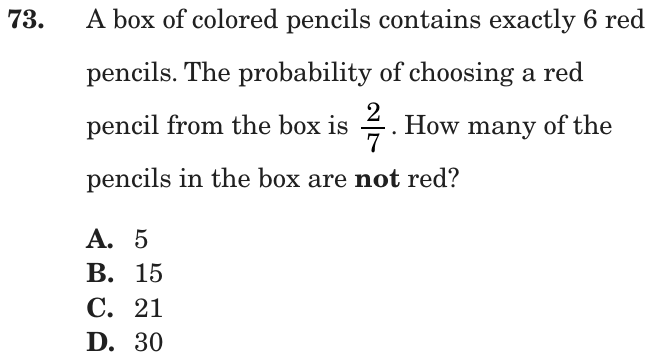
Question 74 of 120
2018 Test A Math, question 17Question
The sum of the numbers x, y, and z is 50. The ratio of x to y is 1:4, and the ratio of y to z is 4:5. What is the value of y ?
- A4
- B8
- C10
- D20
Show the answer
Correct answer: D
Since both ratios have in common, solve for and in terms of in both equations. Using , solve for in terms of .
Using the ratio , solve for in terms of :
The question states . Substitute from the two equations above and solve for .
Question analysis
A ratio problem with three unknowns: x, y and z add to 50, x to y is 1 to 4, and y to z is 4 to 5. Students merge the two ratios into one three-part ratio and use the sum to find y. The step that is easy to skip is turning ratio parts into actual values.
- Grade level
- Grade 7 content, by NYS standard
- Compared with grade 7
- At grade 7 Grade 7 ratio problems usually involve one ratio. Here two ratios share a term and must be merged before the total is used, though the shared term already matches, which keeps it near typical grade 7 work.
- Estimated difficulty
- Moderate: several steps, or a close reading with one strong distractor.
- Thinking it demands
- Depth of knowledge 2, skills and concepts · mainly apply
- What makes it hard
- No obvious method moderate
- Variables instead of numbers minor
- Many steps minor
- Solution
- 3 steps
- Reading level
- Question and choices: about grade 2, 31 words.
- Students, last 30 days
- Not enough answers yet to show (it takes 10).
Why it is hard, traps and wrong answers (shows the answer)
Why it is hard
The question rewards noticing that y has the same term in both ratios, which turns two ratios into one three-part ratio in a single move. Students who miss this often write x and z in terms of y, as the explanation does, which works but is slower. The wrong choices are numbers taken from the ratios themselves, so a student who never scales up to the total of 50 finds an answer waiting.
No obvious method moderate Working it out
The two ratios have to be merged into one, x : y : z = 1 : 4 : 5, which works only because y is 4 in both; nothing in the wording says to combine them. (Schoenfeld, 1985)
Variables instead of numbers minor Understanding the question
x, y and z are given only through two ratios and their sum of 50, so there is no actual count to anchor the work until the parts are scaled. (Koedinger & Nathan, 2004; Enright, Morley & Sheehan, 2002)
Many steps minor Working it out
Adding the parts, dividing 50 by their total and scaling y's 4 parts are three steps, and the count of parts after the first step is itself a listed choice. (Daniel & Embretson, 2010; Enright, Morley & Sheehan, 2002)
Strategy: Since y is 4 in both ratios, write x : y : z as one combined ratio, find the value of one part from the total of 50, and scale up.
Traps
- Numbers taken from the question: Combines the numbers in the question without a model of the situation, or is simply a number that appears in the question.
- Answers a different question: A choice is right for another quantity: the other unknown, the rest instead of the part, the part instead of the whole.
The wrong answers, classified
A Numbers taken from the question (Hegarty, Mayer & Monk, 1995)
Takes y's term in the ratios, 4, as y's actual value, never using the sum of 50.
B Numbers taken from the question (Hegarty, Mayer & Monk, 1995)
Adds the two 4s that stand for y in the two ratios, 4 + 4 = 8, treating ratio terms as amounts.
C Answers a different question (King et al., 2004; Hegarty, Mayer & Monk, 1995)
Combines the ratios into 1 : 4 : 5 and gives the total number of parts, 1 + 4 + 5 = 10, instead of y's share of the 50.
Worked solution, step by step
Formulas used
- Sharing a total in a ratio
- In a ratio like 3:2, the amounts are made of equal-sized parts. Add the numbers in the ratio to count the parts. Divide the total by that count to get the size of one part. Then multiply by how many parts each amount has.
Sort out the question
The three numbers x, y and z add up to 50. The ratio of x to y is 1:4. The ratio of y to z is 4:5. A ratio compares sizes. You need the actual value of y.
Join the two ratios
y is 4 in both ratios. So the two ratios use the same size parts, and you can join them into one.
This means x is 1 part, y is 4 parts, and z is 5 parts.
Count the parts
There are 10 parts in all. Watch out: 10 is the number of parts, not the value of y. Picking it is choice C.
Find the size of one part
Use the sharing formula. The 10 parts share the total of 50.
Each part is worth 5.
Find y
y is 4 parts.
Watch out: the 4 in the ratio counts parts. It is not the value of y. Picking 4 is choice A. So the answer is D, 20.
Check your answer
Find all three: x = 5, y = 20, z = 25. They add up: . x to y is 5 to 20, which is 1:4. y to z is 20 to 25, which is 4:5. Everything fits.
More questions like this
The original DOE question
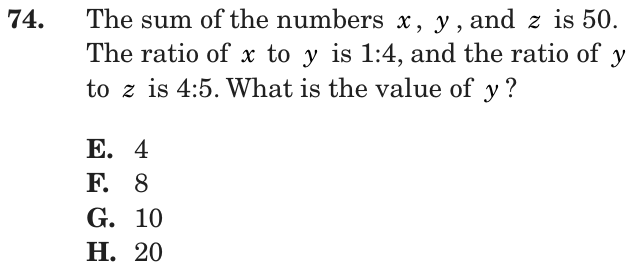
Question 75 of 120
2018 Test A Math, question 18Question
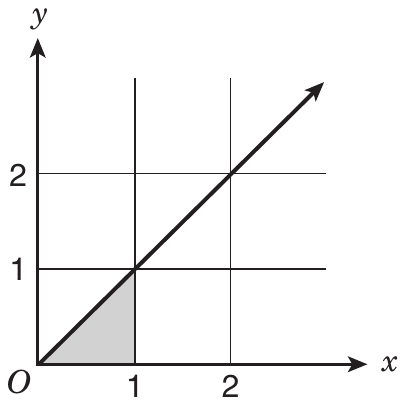
What is the area of the shaded region in the graph above?
- A0.25 square unit
- B0.5 square unit
- C1 square unit
- D1.5 square units
Show the answer
Correct answer: B
The shaded region is a right triangle. Each leg is 1 unit in length.
So the area is
or 0.5 sq unit
Question analysis
A coordinate grid question: find the area of a shaded right triangle with corners at the origin, (1, 0) and (1, 1), under a diagonal line. Students read the base and height from the grid and apply the triangle area formula. The figure does most of the work; the task is recalling the formula correctly.
- Grade level
- Grade 6 content, by NYS standard
- Compared with grade 7
- Below grade 7 Finding a triangle's area from a grid is grade 6 work, and this takes one step with whole-unit legs. It is easier than typical grade 7 area problems, which use composite figures or scale drawings.
- Estimated difficulty
- Routine: one familiar step, little to misread.
- Thinking it demands
- Depth of knowledge 1, recall and reproduction · mainly apply
- What makes it hard
- Solution
- 1 step
- Reading level
- Question and choices: about grade 2, 20 words.
- Students, last 30 days
- Not enough answers yet to show (it takes 10).
Why it is hard, traps and wrong answers (shows the answer)
Why it is hard
This is a quick formula question with legs of 1. The main risk is the one-half in the triangle formula: leaving it out gives the area of the whole grid square, which is a listed choice. Seeing that the diagonal cuts the unit square exactly in half gives a check that needs no formula at all.
Reading a figure, table or graph minor Understanding the question
The legs of the shaded triangle, from O to (1, 0) and up to (1, 1), are read off the grid lines; the line running on to (2, 2) is not part of the region. (Lesh, Post & Behr, 1987; Kirsch & Mosenthal, 1990)
Something you must already know minor Working it out
The triangle area formula, one half times base times height, is needed and not given; the shaded triangle is half of one grid square. (Anderson & Krathwohl, 2001)
Strategy: Read the two legs straight off the grid, then apply the triangle area formula, base times height divided by two.
Traps
- A formula you must know: Needs a formula the test does not give: area, circumference, volume, probability rules.
The wrong answers, classified
A Misreads the figure (Lesh, Post & Behr, 1987; Kirsch & Mosenthal, 1990)
Judges the shaded triangle by eye as a quarter of the 1-by-1 grid square instead of the half that the diagonal from O to (1, 1) cuts off.
C Wrong formula (King et al., 2004)
Multiplies base by height, 1 × 1 = 1, and leaves out the one-half, giving the whole unit square instead of the triangle.
D Little reason to choose it (Haladyna & Downing, 1993; Rodriguez, 2005)
No common working gives 1.5, which is more than the whole grid square around the shaded triangle; it mostly draws guesses.
Worked solution, step by step
Formulas used
- Area of a triangle
- A is the area. b is the base, the side the triangle sits on. h is the height: the straight-up distance from the base to the top corner, at a right angle to the base. You take half because a triangle is half of a rectangle with the same base and height.
Sort out the shaded region
The shaded region is a triangle. Its corners are O, the point (1, 0) and the point (1, 1). O is the origin, the point (0, 0) where the axes meet. The line keeps going up to (2, 2), but only the small triangle is shaded. You need its area in square units.
Read the base and height
The base lies along the x-axis, from O to 1. So the base is 1 unit. The height goes straight up from (1, 0) to (1, 1). So the height is 1 unit too. The base and height meet at a right angle, as the grid lines show.
Use the triangle formula
The area is 0.5 square unit. Watch out: don’t forget the one half. is the whole grid square, choice C. So the answer is B, 0.5 square unit.
Check your answer
The grid square from 0 to 1 has an area of 1 square unit. The slanted line cuts it corner to corner into two equal triangles. The shaded one is half the square, so 0.5 square unit.
More questions like this
The original DOE question
Question 76 of 120
2018 Test A Math, question 19Question
In Centerville, 45% of the population is female, and 60% of the population commutes to work daily. Of the total Centerville population, 21% are females who commute to work daily. What percentage of the total Centerville population are males who do not commute to work daily?
- A15%
- B16%
- C24%
- D39%
Show the answer
Correct answer: B
Create a table with the information provided in the problem and use subtraction to fill in the rest of the table:
| Female | Male | TOTAL | |
| Commutes to work | 21% | 39% (60 − 21) |
60% |
| Does not commute to work | 24% (45 − 21) |
16% (40 − 24) |
40% (100 − 60) |
| TOTAL | 45% | 100% |
16% of the population is male and does not commute to work.
Question analysis
A percent problem about overlapping groups in a town's population: the percents who are female, who commute daily, and who are female commuters are given. Students find the percent who are male and do not commute. A two-way table helps, since several of its cells are easy to confuse with the one asked for.
- Grade level
- Grade 7 content, by NYS standard
- Compared with grade 7
- Above grade 7 Grade 7 percent problems usually take a percent of one quantity. This needs two overlapping categories organized in a two-way table, which is not in New York's grade 7 standards, with three subtractions and two tempting cells.
- Estimated difficulty
- Hard: combines ideas, needs a plan, and has more than one tempting wrong answer.
- Thinking it demands
- Depth of knowledge 2, skills and concepts · mainly analyze
- What makes it hard
- No obvious method moderate
- Much to keep track of moderate
- Turning words into math moderate
- Solution
- 3 steps
- Reading level
- Question and choices: about grade 12, 43 words.
- Students, last 30 days
- Not enough answers yet to show (it takes 10).
Why it is hard, traps and wrong answers (shows the answer)
Why it is hard
The question gives three overlapping percents and asks for the one group none of them describes directly. Without a table, students tend to subtract the given numbers in some order, and several orders yield a listed choice. The last trap is the word "not", since the males who do commute are one cell away. Filling every cell of a two-by-two table before answering takes under a minute and leaves nothing to guess.
No obvious method moderate Working it out
Nothing in the wording points to a two-way table, yet the four groups, female or male by commuting or not, fall into place only once one is drawn. (Schoenfeld, 1985)
Much to keep track of moderate Working it out
Three given percents, 45, 60 and 21, plus their complements, 55 and 40, have to be kept straight while the cells are filled in by subtraction. (Sweller, 1988; Carpenter, Just & Shell, 1990)
Turning words into math moderate Understanding the question
"Of the total Centerville population, 21% are females who commute" is a share of everyone, not of the females, and belongs in a single cell of the table. (Hegarty, Mayer & Monk, 1995; Koedinger & Nathan, 2004)
Strategy: Make a two-by-two table of female and male against commutes and does not commute, fill in the totals, and complete each cell by subtraction.
Traps
- Misreads the question: Misses or misreads a condition or a word in the question: "at least", "each", "remaining", "not".
- Stops one step early: A choice is a number from partway through the solution.
The wrong answers, classified
A Numbers taken from the question (Hegarty, Mayer & Monk, 1995)
Subtracts one given percent from another, 60 − 45 = 15, without placing the 21% of female commuters anywhere.
C Stops one step early (King et al., 2004; Gierl et al., 2017)
Fills in the first empty cell, females who do not commute, 45 − 21 = 24, and stops before using it to reach the males' cell.
D Misreads the question (Hegarty, Mayer & Monk, 1995)
Finds the males who commute, 60 − 21 = 39, missing the word not in the question.
Worked solution, step by step
Formulas used
- Parts add up to the whole
- In a two-way table, every row and every column splits a group into two parts. a and b are the two parts, and W is the whole group. If you know the whole and one part, subtract to find the other part.
Sort out the question
Every number is a percent of the whole town. 45% of people are female. 60% commute, which means they travel to work every day. 21% are females who commute. You need the percent who are “males who do not commute to work daily”.
Make a two-way table
A two-way table sorts people two ways at once: female or male, and commutes or not. Put in what you know. The whole town is 100%.
Female Male Total Commute 21% ? 60% Do not commute ? ? ? Total 45% ? 100% Fill in the two totals
Everyone is female or male, so the males are what is left.
Everyone either commutes or does not.
So 55% are male, and 40% do not commute.
Find the males who commute
Use the commute row. All commuters are 60%, and the female commuters are 21%.
So 39% are males who commute. Watch out: the question says do not commute. Picking 39% is choice D.
Find the males who do not commute
Use the male column. All males are 55%, and the males who commute are 39%.
Watch out: 24% is the females who do not commute, . That is choice C. So the answer is B, 16%.
Check your answer
Find the same cell another way. Females who do not commute: . All who do not commute: 40%. So males who do not commute: . The answers match.
More questions like this
The original DOE question
Question 77 of 120
2018 Test A Math, question 20Question
Mrs. Cranston bought five bottles of water for $0.90 each and 8 pounds of meat. She paid a total of $26.90 for these items, not including tax. What was the price per pound of the meat?
- A$2.80
- B$3.25
- C$14.40
- D$22.40
Show the answer
Correct answer: A
Let be the price per pound for the meat. Set up an equation to show what Mrs. Cranston spent:
The price per pound for the meat is $2.80.
Question analysis
This money word problem has a shopper buying five bottles of water at a set price plus 8 pounds of meat, for a known total. Students write and solve a two-step equation to find the price per pound of the meat. The decimals call for care, and the question wants a price per pound rather than a total.
- Grade level
- Grade 7 content, by NYS standard
- Compared with grade 7
- At grade 7 Word problems that lead to an equation like px + q = r are the core of grade 7 algebra. This is a standard example with money decimals and no extra twist.
- Estimated difficulty
- Straightforward: two steps or one careful reading.
- Thinking it demands
- Depth of knowledge 2, skills and concepts · mainly apply
- What makes it hard
- Turning words into math minor
- Error-prone arithmetic minor
- Solution
- 3 steps
- Reading level
- Question and choices: about grade 2, 33 words.
- Students, last 30 days
- Not enough answers yet to show (it takes 10).
Why it is hard, traps and wrong answers (shows the answer)
Why it is hard
This is a two-step money problem: take away the water, then divide by the pounds. The listed wrong answers come from doing one of those steps wrongly or not at all, especially stopping at the total cost of the meat, which looks like a finished dollar amount. Checking that 8 pounds at the chosen price plus $4.50 makes $26.90 confirms the answer.
Turning words into math minor Understanding the question
"five bottles of water for $0.90 each" has to become 5 × 0.90 before the total is split, and the unknown is a price per pound, not the meat's total cost. (Hegarty, Mayer & Monk, 1995; Koedinger & Nathan, 2004)
Error-prone arithmetic minor Working it out
Every amount is a decimal of dollars, so 26.90 − 4.50 and 22.40 ÷ 8 must be lined up and worked carefully without a calculator. (Brown & Burton, 1978; Junker & Sijtsma, 2001)
Strategy: Subtract the cost of all five bottles from the total, then divide what is left by the 8 pounds of meat.
Traps
- Stops one step early: A choice is a number from partway through the solution.
The wrong answers, classified
B Misreads the question (Hegarty, Mayer & Monk, 1995)
Misses the word each and subtracts one bottle's $0.90, then divides: (26.90 − 0.90) ÷ 8 = 3.25.
C Wrong operation (Hegarty, Mayer & Monk, 1995; King et al., 2004)
Finds the $22.40 spent on meat and subtracts the 8 pounds from it instead of dividing, getting 14.40.
D Stops one step early (King et al., 2004; Gierl et al., 2017)
Subtracts the five bottles from the total, 26.90 − 4.50 = 22.40, and stops at the meat's total cost without dividing by 8 pounds.
Worked solution, step by step
Formulas used
- Total cost
- C is the total cost. p is the price of one item, or of one pound. q is the quantity, how many items or pounds you buy. Each one costs p, so q of them cost p times q.
Sort out the question
Mrs. Cranston bought five bottles of water “for $0.90 each”. She also bought 8 pounds of meat. Everything cost $26.90 in all. You need the price per pound of the meat, the cost of just 1 pound.
Find the cost of the water
Each bottle costs $0.90, and there are 5 bottles. Use the cost formula.
The water cost $4.50. Watch out: each means every bottle costs $0.90. Taking away just one $0.90 leads to $3.25, choice B.
Find the cost of the meat
Take the water away from the total. What is left paid for the meat.
All 8 pounds of meat cost $22.40. Watch out: this is the cost of all the meat, not of one pound. Stopping here gives choice D.
Find the price per pound
Use the cost formula again. Now C is 22.40 and q is 8 pounds. Divide to find p.
Each pound costs $2.80. So the answer is A, $2.80.
Check your answer
Put it all back together. Meat: . Water: 4.50. Total: . That is exactly what she paid.
More questions like this
The original DOE question
Question 78 of 120
2018 Test A Math, question 21Question
In a sample of 10 cards, 4 are red and 6 are blue. If 2 cards are selected at random from the sample, one at a time without replacement, what is the probability that both cards are not blue?
- A
- B
- C
- D
Show the answer
Correct answer: A
The probability that both cards are not blue is the same as the probability that both cards are red. There are 4 red cards out of the 10, so the probability of the first card being red is
Now there are 9 cards left, and 3 of those are red, so the probability of the second card being red is
Multiply the two probabilities to find the probability that both cards are red (not blue):
Question analysis
This probability question draws 2 cards, one at a time and without replacement, from 10 cards: 4 red and 6 blue. Students find the chance that neither card drawn is blue. The second draw has one fewer card, and the word not changes which color to count.
- NYS standards
- Grade level
- Grade 7 content, by NYS standard
- Compared with grade 7
- Above grade 7 Grade 7 compound probability is usually found with a list or tree of equally likely outcomes. Dependent draws without replacement, plus a negative phrasing to translate, go beyond that typical work.
- Estimated difficulty
- Hard: combines ideas, needs a plan, and has more than one tempting wrong answer.
- Thinking it demands
- Depth of knowledge 2, skills and concepts · mainly apply
- What makes it hard
- Something you must already know moderate
- A very close wrong answer moderate
- Turning words into math minor
- An answer in an unexpected form minor
- Solution
- 3 steps
- Reading level
- Question and choices: about grade 5, 39 words.
- Students, last 30 days
- Not enough answers yet to show (it takes 10).
Why it is hard, traps and wrong answers (shows the answer)
Why it is hard
Two ideas stack here: restating not blue as red, and changing the second draw's numbers after a card is removed. Students who know to multiply but forget the removal reach a listed choice, and so do students who compute both blue. Writing the second fraction explicitly as 3 red out of 9 cards, before multiplying, is what separates right from nearly right.
Something you must already know moderate Working it out
Multiplying the first draw's chance by the second draw's, with the second adjusted for the card already taken, is a rule the test assumes and does not give. (Anderson & Krathwohl, 2001)
A very close wrong answer moderate Choosing the answer
2/15 and 4/25 are about 0.13 and 0.16, too close to tell apart by estimate; only the second draw's fraction, 3 red of 9 cards rather than 4 of 10, separates them. (Embretson & Wetzel, 1987; Gorin & Embretson, 2006; Ascalon et al., 2007)
Turning words into math minor Understanding the question
"Both cards are not blue" has to be restated as both cards red, and the bold not also invites computing the chance that both are blue. (Hegarty, Mayer & Monk, 1995; Koedinger & Nathan, 2004)
An answer in an unexpected form minor Choosing the answer
The product comes out as 12/90, and it has to be reduced to lowest terms before it matches any of the listed fractions. (Enright, Morley & Sheehan, 2002)
Strategy: Restate not blue as red, then multiply the chance of red on the first draw by the chance of red on the second, with one card fewer.
Traps
- Without replacement: In a second pick there is one fewer item, which changes the probability.
- Misreads the question: Misses or misreads a condition or a word in the question: "at least", "each", "remaining", "not".
The wrong answers, classified
B Without replacement (Fischbein & Schnarch, 1997)
Multiplies 4/10 × 4/10 = 16/100 = 4/25, as if the first red card were put back before the second draw.
C Little reason to choose it (Haladyna & Downing, 1993; Rodriguez, 2005)
No standard working gives 3/10: it is not the chance of red or of blue on one draw or on two, so it mostly catches guesses.
D Misreads the question (Hegarty, Mayer & Monk, 1995)
Computes the chance that both cards are blue, 6/10 × 5/9 = 30/90 = 1/3, missing the bold word not.
Worked solution, step by step
Formulas used
- Probability
- P is the probability, the chance that something happens. Favorable is the number of ways to get what you want, here a red card. Total is the number of all possible picks, here all the cards you can pick from. It works when every pick is equally likely.
- Two events in a row
- A is the first event and B is the second. P( ) means the probability of what is inside. The chance that both happen is the first chance times the second. For the second chance, count only what is left after the first event.
Sort out the question
There are 10 cards: 4 red and 6 blue. You pick 2 cards “one at a time without replacement”. That means the first card is not put back. “Both cards are not blue” means both are red, since red is the only other color. You need the probability, or chance, of that.
Find the chance the first card is red
4 of the 10 cards are red. Each card is equally likely to be picked. Use the probability formula.
Find the chance the second card is red
One red card is gone now, and it is not put back. So 9 cards are left, and 3 of them are red.
Watch out: using 4/10 again acts as if the card went back. That gives 4/25, choice B.
Multiply the two chances
Both cards must be red. So multiply the first chance by the second. To multiply fractions, multiply the tops, then multiply the bottoms.
Simplify the fraction
None of the choices is 12/90, so simplify it. Divide the top and the bottom by 6, the biggest number that goes into both.
Watch out: the chance that both are blue is , choice D. The question says not blue. So the answer is A, .
Check your answer
Count the ways. There are ways to pick two cards in order. Red then red has ways. That gives 12/90, or 2/15. The answer is small, which makes sense, because there are fewer red cards than blue ones.
More questions like this
The original DOE question
Question 79 of 120
2018 Test A Math, question 22Question
1 sind = 4 lorgs
2 plunks = 5 dalts
5 sinds = 2 harps
1 plunk = 3 harps
A nation has five types of coins: sinds, dalts, lorgs, harps, and plunks. The relationship between the coins is shown above. Which coin is most valuable?
- Asind
- Bdalt
- Charp
- Dplunk
Show the answer
Correct answer: D
1 sind = 4 lorgs,
so 1 sind > 1 lorg.
2 harps = 5 sinds,
so 1 harp > 1 sind.
1 plunk = 3 harps,
so 1 plunk > 1 harp,
meaning that 1 plunk > 1 sind and 1 lorg.
2 plunks = 5 dalts,
so 1 plunk > 1 dalt.
Therefore, the plunk is the most valuable.
Question analysis
This reasoning question invents a money system: four exchange rates link five made-up coins. Students compare the coins step by step to find which one is worth the most. The rates run in different directions, so it is easy to misjudge which side of an equation holds the more valuable coin.
- Grade level
- Grade 6 content, by NYS standard
- Compared with grade 7
- At grade 7 Grade 6 and 7 ratio work converts between two units at a time. Chaining four invented rates and comparing values with no common unit given is less familiar, though the arithmetic stays simple.
- Estimated difficulty
- Moderate: several steps, or a close reading with one strong distractor.
- Thinking it demands
- Depth of knowledge 2, skills and concepts · mainly analyze
- What makes it hard
- Turning words into math moderate
- Much to keep track of moderate
- No obvious method minor
- Solution
- 3 steps
- Reading level
- Question and choices: about grade 1, 38 words.
- Students, last 30 days
- Not enough answers yet to show (it takes 10).
Why it is hard, traps and wrong answers (shows the answer)
Why it is hard
There is little arithmetic, but the relationships have to be read the right way round and chained. Students who think a larger count means a more valuable coin rank the coins backward, and students who stop after one or two links pick a coin that beats only its neighbor. Writing each coin's worth in lorgs, 4 for a sind, 10 for a harp, 12 for a dalt and 30 for a plunk, makes the ranking plain.
Turning words into math moderate Understanding the question
In "2 plunks = 5 dalts" the coin with the larger count is worth less, the reverse of what the bigger number suggests, and the same holds in all four equations. (Hegarty, Mayer & Monk, 1995; Koedinger & Nathan, 2004)
Much to keep track of moderate Working it out
Five coins and four exchange rates have to be linked into one ranking; dalts connect only through plunks, and lorgs only through sinds. (Sweller, 1988; Carpenter, Just & Shell, 1990)
No obvious method minor Working it out
Nothing says how to compare coins that never appear in the same equation; converting every coin to lorgs, or chaining inequalities, has to be chosen. (Schoenfeld, 1985)
Strategy: Rewrite every coin in terms of lorgs, which only ever appear as the smaller unit, following the rates one link at a time, then compare.
Traps
- Equation written backwards: Writes a comparison the wrong way round, word for word: "six times as many students as professors" as 6S = P. The bigger quantity gets the bigger number.
- Stops one step early: A choice is a number from partway through the solution.
The wrong answers, classified
A Equation written backwards (Clement, Lochhead & Monk, 1981)
Reads every equation backward, giving more value to the coin with the larger count, so 5 sinds = 2 harps puts sinds above harps and 1 plunk = 3 harps puts harps above plunks.
B Equation written backwards (Clement, Lochhead & Monk, 1981)
Reads 2 plunks = 5 dalts backward, giving the bigger value to the coin with the bigger count, so the dalt seems to outrank the plunk.
C Stops one step early (King et al., 2004; Gierl et al., 2017)
Sees from 5 sinds = 2 harps that a harp beats a sind and stops, missing the last line, 1 plunk = 3 harps.
Worked solution, step by step
Formulas used
- Value of a group of coins
- V is what a group of coins is worth. n is the number of coins, and v is what one coin is worth. Here every value is counted in lorgs, the smallest coin. Using one unit for all the coins lets you compare them.
Sort out the question
There are five coins and four trading rules. You need the coin that is worth the most. Read each rule carefully. In 2 plunks = 5 dalts, it takes more dalts to match. So each dalt is worth less than a plunk. More coins on one side means each of those coins is worth less.
Pick one coin to measure with
Measure every coin in lorgs, the way you might measure every length in inches. The first rule says 1 sind = 4 lorgs. So one sind is worth 4 lorgs.
Find a harp’s value in lorgs
The rule 5 sinds = 2 harps links harps to sinds. First find what 5 sinds are worth.
So 2 harps are worth 20 lorgs, and 1 harp is worth half of that.
One harp is worth 10 lorgs.
Find a plunk’s value in lorgs
The rule 1 plunk = 3 harps says a plunk is worth 3 harps.
One plunk is worth 30 lorgs.
Find a dalt’s value in lorgs
The rule 2 plunks = 5 dalts links dalts to plunks. Two plunks are worth lorgs. So 5 dalts are worth 60 lorgs too.
One dalt is worth 12 lorgs.
Compare all five coins
Coin Value in lorgs lorg 1 sind 4 harp 10 dalt 12 plunk 30 Watch out: 5 dalts trade for only 2 plunks, so a dalt is worth less. Reading that rule backward leads to choice B. Watch out: the harp beats the sind, but the plunk beats the harp. Stopping early gives choice C. So the answer is D, plunk.
Check your answer
Test each rule with the lorg values. 2 plunks = 60 lorgs, and 5 dalts = 60 lorgs. 5 sinds = 20 lorgs, and 2 harps = 20 lorgs. 1 plunk = 30 lorgs, and 3 harps = 30 lorgs. Every rule balances.
More questions like this
The original DOE question
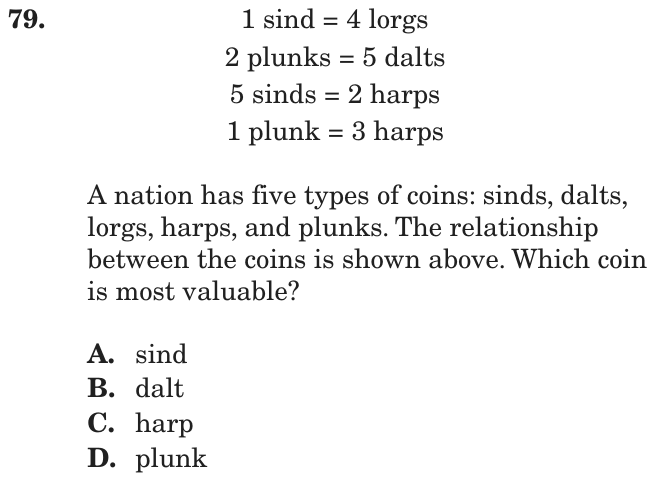
Question 80 of 120
2018 Test A Math, question 23Question
SCORES ON MATH QUIZ
| Score | Number of Students |
| 85 | 4 |
| 75 | 4 |
| 65 | 2 |
What is the mean score of the 10 students in the table above?
- A22.5
- B75
- C77
- D85
Show the answer
Correct answer: C
For each row, multiply the number of students by the score. Then add those together and divide by the total number of students to find the mean (average) of the 10 students.
Question analysis
This statistics question gives a frequency table of quiz scores: three scores and how many of the 10 students earned each. Students find the mean score of all 10 students. Each score has to count as many times as students earned it, which is easy to overlook when only three scores are listed.
- Grade level
- Grade 6 content, by NYS standard
- Compared with grade 7
- Below grade 7 Computing a mean is grade 6 work, and this weighted version from a table takes two short steps. It is a little easier than typical grade 7 statistics, which compares whole data sets.
- Estimated difficulty
- Straightforward: two steps or one careful reading.
- Thinking it demands
- Depth of knowledge 2, skills and concepts · mainly apply
- What makes it hard
- A very close wrong answer moderate
- Reading a figure, table or graph minor
- Solution
- 2 steps
- Reading level
- Question and choices: about grade 2, 20 words.
- Students, last 30 days
- Not enough answers yet to show (it takes 10).
Why it is hard, traps and wrong answers (shows the answer)
Why it is hard
The procedure is routine once students see that the table lists counts, not separate students. The tempting shortcut is to average the three scores in the first column, which gives a listed choice close to the right one. Multiplying each score by its count, then dividing by 10, takes well under a minute.
A very close wrong answer moderate Choosing the answer
77 and 75 are only 2 points apart, so a rough sense of the middle score cannot choose between them; only weighting each score by its 4, 4 or 2 students does. (Embretson & Wetzel, 1987; Gorin & Embretson, 2006; Ascalon et al., 2007)
Reading a figure, table or graph minor Understanding the question
The table pairs each score with a number of students, so the 10 students are 4, 4 and 2, and each score must be weighted by its count. (Lesh, Post & Behr, 1987; Kirsch & Mosenthal, 1990)
Strategy: Multiply each score by its number of students, add the three products, and divide by the 10 students.
Traps
- Misunderstands the concept: A wrong belief about a concept: that percents can be added, that area grows like length, that averages can be averaged, that a bigger denominator means a bigger fraction.
The wrong answers, classified
A Numbers taken from the question (Hegarty, Mayer & Monk, 1995)
Adds the three scores, 85 + 75 + 65 = 225, and divides by the 10 students, an average lower than every score in the table.
B Misunderstands the concept (Smith, diSessa & Roschelle, 1993; De Bock et al., 1998; Ni & Zhou, 2005)
Averages the three listed scores, (85 + 75 + 65) ÷ 3 = 75, ignoring that 4, 4 and 2 students earned them.
D Numbers taken from the question (Hegarty, Mayer & Monk, 1995)
Picks the top score, which 4 students earned, instead of computing a mean of all 10 scores.
Worked solution, step by step
Formulas used
- Mean (average)
- M is the mean, also called the average. S is the sum, all the values added together. n is how many values there are. Dividing shares the total out equally, so the mean is what each value would be if they were all the same.
Sort out the table
The table lists 3 scores and how many students got each one. 4 students scored 85. 4 students scored 75. 2 students scored 65. That is students. You need the mean, or average, of all 10 scores.
Find the sum of all 10 scores
Each score counts once for every student who got it. So multiply each score by its number of students.
Add the three results.
All 10 scores add up to 770 points.
Divide by the number of students
Watch out: averaging just the three scores gives , choice B. That acts as if only one student got each score. So the answer is C, 77.
Check your answer
More students scored 85 than 65. So the mean should be a little above the middle score, 75. 77 fits. A mean must also be between the lowest and highest scores, 65 and 85. That rules out 22.5.
More questions like this
The original DOE question
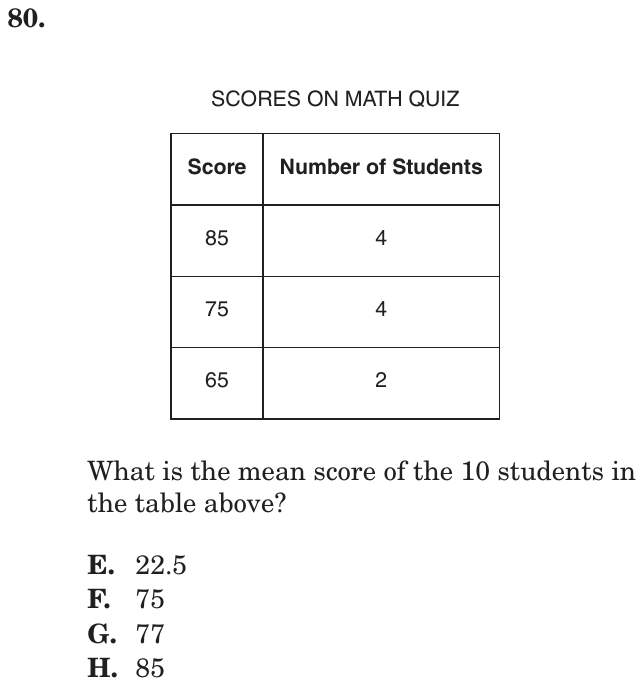
Question 81 of 120
2018 Test A Math, question 24Question
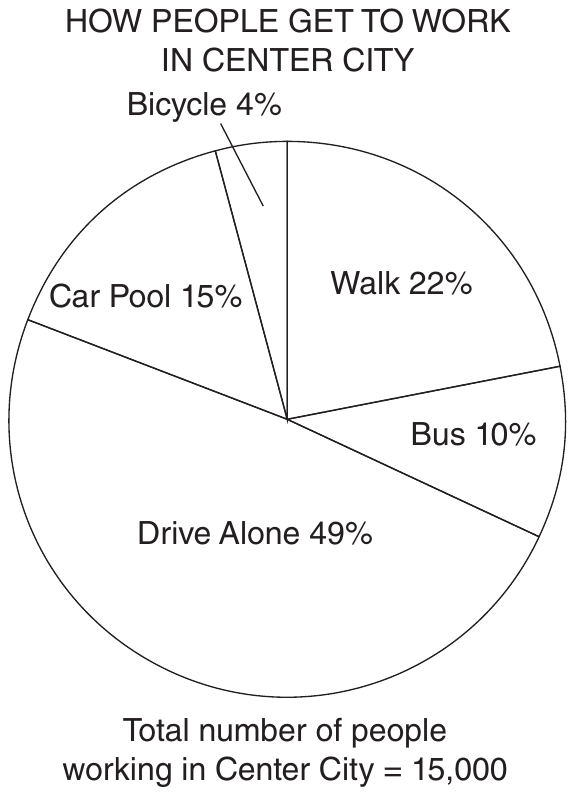
How many more people in Center City walk to work than ride their bicycle to work?
- A2,500
- B2,700
- C2,800
- D3,000
Show the answer
Correct answer: B
According to the chart, 22% of people walk to work and 4% ride a bicycle. Subtract to find the percentage of how many more people walk than bicycle:
22% − 4% = 18%
To find the exact number of people, multiply 18% (0.18) by the number of people working in Center City (15,000):
Question analysis
This circle graph question shows how the 15,000 people working in Center City get to work, with 22% walking and 4% riding a bicycle. Students find how many more people walk than bike by combining a percent difference with a percent of a total. The choices are close together, so estimating is risky.
- Grade level
- Grade 6 content, by NYS standard
- Compared with grade 7
- Below grade 7 Reading a circle graph and taking a percent of a total are grade 6 skills. With only two short steps and friendly numbers, this is easier than typical grade 7 multistep percent work.
- Estimated difficulty
- Straightforward: two steps or one careful reading.
- Thinking it demands
- Depth of knowledge 2, skills and concepts · mainly apply
- What makes it hard
- A very close wrong answer moderate
- Reading a figure, table or graph minor
- Error-prone arithmetic minor
- Solution
- 2 steps
- Reading level
- Question and choices: about grade 7, 16 words.
- Students, last 30 days
- Not enough answers yet to show (it takes 10).
Why it is hard, traps and wrong answers (shows the answer)
Why it is hard
The method is short: subtract the percents first, or find both groups and subtract, and both reach the same number. What makes the question less safe than it looks is the tight spread of choices, all within 500 of each other, so rounding 18% or slipping on one product lands on a wrong answer. Subtracting the percents first leaves one multiplication to get right instead of two.
A very close wrong answer moderate Choosing the answer
2,700 sits only 100 from 2,800 and 300 from 3,000, so estimating 18% of 15,000 as about a fifth cannot pick it; only the exact product does. (Embretson & Wetzel, 1987; Gorin & Embretson, 2006; Ascalon et al., 2007)
Reading a figure, table or graph minor Understanding the question
The Walk 22% and Bicycle 4% labels must be picked out of five sectors, and the 15,000 total sits in a caption below the circle graph. (Lesh, Post & Behr, 1987; Kirsch & Mosenthal, 1990)
Error-prone arithmetic minor Working it out
The percent gap has to become a count, 0.18 × 15,000, a decimal times a five-digit number worked by hand without a calculator. (Brown & Burton, 1978; Junker & Sijtsma, 2001)
Strategy: Subtract the two percents first, then take that single percent of 15,000, instead of finding each group and subtracting.
The wrong answers, classified
A Little reason to choose it (Haladyna & Downing, 1993; Rodriguez, 2005)
No common working gives 2,500, which is 1/6 of 15,000 and matches no sector or difference of sectors; it mostly catches estimates.
C An arithmetic slip (Junker & Sijtsma, 2001)
Takes 4% of 15,000 as 500 instead of 600 and subtracts it from the 3,300 walkers, getting 2,800.
D Rounds too early (King et al., 2004)
Rounds the 18-point gap up to 20% to make the multiplication easy and takes 20% of 15,000, which is 3,000.
Worked solution, step by step
Formulas used
- Percent of a number
- W is the whole amount. p is the percent, and x is the part you want. Percent means out of 100, so p percent is the fraction p over 100. Multiplying the whole by that fraction gives the part.
Sort out the circle graph
A circle graph shows how a whole splits into parts. This one shows how 15,000 workers get to work. Walk is 22%. Bicycle is 4%. You need how many more people walk than ride a bicycle.
Subtract the percents first
Both percents are parts of the same 15,000 people. So you can subtract the percents first. Then you only need one multiplication.
The difference is 18% of all the workers.
Find 18% of 15,000
First find 1% by dividing by 100. Then multiply by 18.
That is 2,700 people.
Avoid rounding and answer
Watch out: don’t round 18% up to 20% to make it easy. 20% of 15,000 is 3,000, choice D. The choices are close together, so you need the exact number. So the answer is B, 2,700.
Check your answer
Find each group, then subtract. Walkers: 22% of 15,000 is 3,300. Bike riders: 4% of 15,000 is 600. . You get the same answer.
More questions like this
The original DOE question
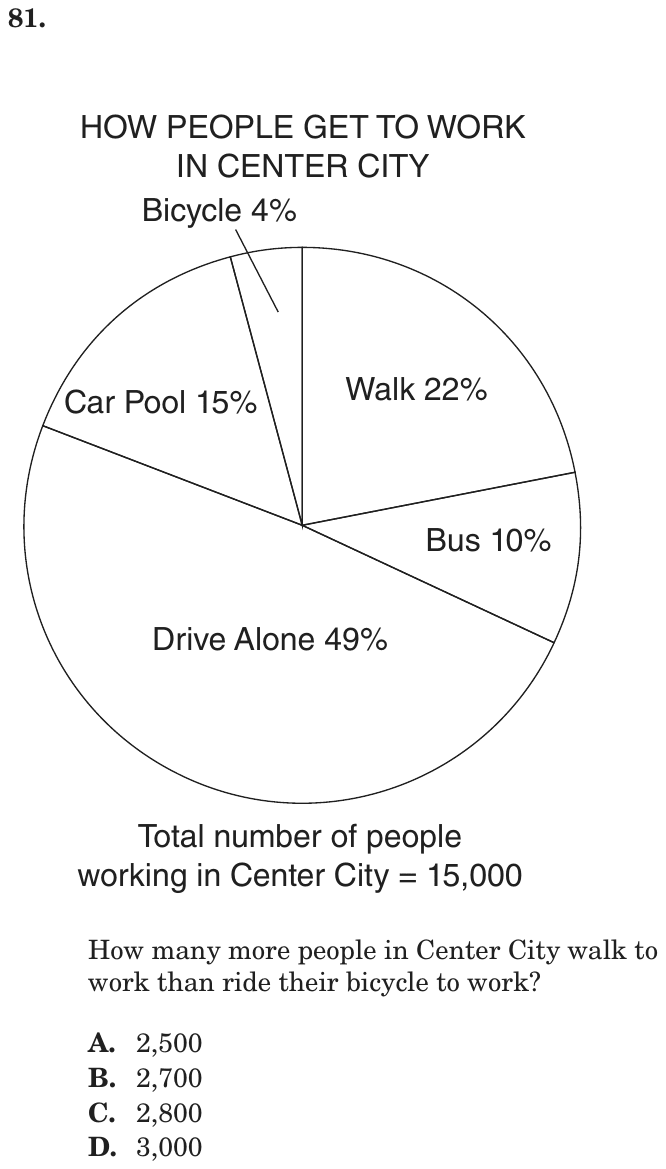
Question 82 of 120
2018 Test A Math, question 25Question
Which of the following numbers has factors that include the smallest factor (other than 1) of 91?
- A30
- B35
- C39
- D44
Show the answer
Correct answer: B
To find the smallest factor of 91, list the factors:
1, 7, 13, and 91
The smallest factor (other than 1) is 7.
Of the options listed (30, 35, 39, and 44), only 35 is a multiple of 7.
Question analysis
A number properties question about factors: students find the smallest factor of 91 other than 1, then pick the number that shares it. Because 91 looks like a prime number, many students skip the factoring, and the choices include numbers built from factors that 91 might seem to have.
- NYS standards
- 6.NS.4 common factors and multiples
- Grade level
- Grade 6 content, by NYS standard
- Compared with grade 7
- Below grade 7 Factors and divisibility are grade 4 to 6 skills, and this takes two quick checks. It is easier than typical grade 7 work, though recognizing that 91 is not prime catches many students.
- Estimated difficulty
- Moderate: several steps, or a close reading with one strong distractor.
- Thinking it demands
- Depth of knowledge 2, skills and concepts · mainly apply
- What makes it hard
- Complex sentences moderate
- Something you must already know moderate
- Solution
- 2 steps
- Reading level
- Question and choices: about grade 8, 15 words.
- Students, last 30 days
- Not enough answers yet to show (it takes 10).
Why it is hard, traps and wrong answers (shows the answer)
Why it is hard
The question tests a grade 6 skill inside a hard-to-parse sentence. Once the stem is unpacked, the work is finding the smallest prime factor of 91 and checking the choices for it. Students lose points in two ways: 91 looks prime or divisible by 3, so they guess at its factors, or they find 13 before 7 and accept the choice that shares it.
Complex sentences moderate Understanding the question
The stem nests three ideas, "has factors that include the smallest factor (other than 1) of 91", so it has to be unpacked before any math; this is reading difficulty, not number difficulty. (Abedi & Lord, 2001; Freedle & Kostin, 1993; Messick, 1989)
Something you must already know moderate Working it out
Students must find that 91 = 7 × 13, and 91 is a number many students wrongly take to be prime or a multiple of 3. (Anderson & Krathwohl, 2001)
Strategy: Test 91 against the small primes in order, starting with 2, until one divides it evenly, then check which choice is a multiple of that prime.
Traps
- Misreads the question: Misses or misreads a condition or a word in the question: "at least", "each", "remaining", "not".
The wrong answers, classified
A An arithmetic slip (Junker & Sijtsma, 2001)
Wrongly takes 91 as a multiple of 3, as 90 is, and picks 30, which 3 divides; in fact 91 ÷ 3 is not a whole number.
C Misreads the question (Hegarty, Mayer & Monk, 1995)
Factors 91 as 7 × 13 but matches 39 = 3 × 13, which shares the larger factor, overlooking the word smallest.
D Little reason to choose it (Haladyna & Downing, 1993; Rodriguez, 2005)
Neither of its prime factors, 2 and 11, divides 91, an odd number, so no common working leads to 44; it mostly draws guesses.
Worked solution, step by step
Formulas used
- What a factor is
- a, b and c are whole numbers. If b = a × c, then a and c are factors of b. That means a divides b evenly, with no remainder. Every whole number has 1 and itself as factors.
Unpack the long sentence
A factor of a number divides it evenly, with nothing left over. For example, 3 is a factor of 12, because . The question has two steps. First, find “the smallest factor (other than 1) of 91”. Then find the choice that also has that factor.
Test small numbers on 91
Try dividing 91 by 2, 3, 5 and so on, until one works.
- 2: no. 91 is odd. That also rules out 4 and 6, which are even.
- 3: no. A number is a multiple of 3 only if its digits add to a multiple of 3. Here 9 + 1 = 10, which is not.
- 5: no. 91 does not end in 0 or 5.
- 7: yes!
So 7 is the smallest factor of 91 other than 1.
Avoid the 3 trap
Watch out: 91 is close to 90, and 3 goes into 90. But is 30 with 1 left over. So 3 is not a factor of 91. That trap leads to 30, choice A.
Check each choice for 7
Now look for a multiple of 7 among the choices.
- 30: no. and .
- 35: yes. .
- 39: no. .
- 44: no. .
Watch out: 39 shares 13 with 91, but 13 is the larger factor, not the smallest. That is choice C. So the answer is B, 35.
Check your answer
Multiply to be sure: and . So 7 goes into both numbers evenly. No number from 2 to 6 goes into 91, so 7 really is the smallest.
More questions like this
The original DOE question
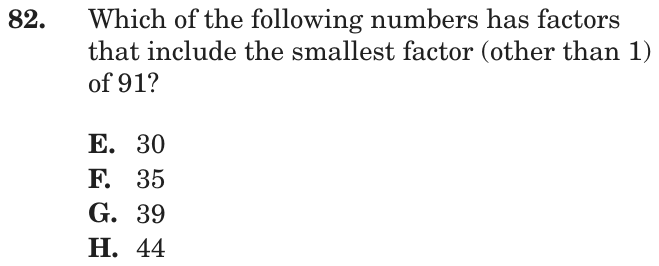
Question 83 of 120
2018 Test A Math, question 26Question
In a scale drawing of a triangular banner, one side measures 16 centimeters and the other two sides each measure 12 centimeters. On the actual banner, these two sides each measure 36 feet. What is the length of the remaining side of the actual banner?
- A16 ft
- B32 ft
- C40 ft
- D48 ft
Show the answer
Correct answer: D
Let be the remaining side of the actual banner.
Set up a proportion:
ft
Question analysis
A scale drawing word problem about a triangular banner: the drawing's sides are 16 cm, 12 cm and 12 cm, and the two equal sides are 36 feet on the real banner. Students find the actual length of the remaining side. The key is using a scale factor, not adding the difference between lengths.
- Grade level
- Grade 7 content, by NYS standard
- Compared with grade 7
- At grade 7 Scale drawings are a named grade 7 topic, and this is a direct one-factor problem. It matches typical grade 7 work; the only pull away is reasoning by differences instead of by multiplication.
- Estimated difficulty
- Straightforward: two steps or one careful reading.
- Thinking it demands
- Depth of knowledge 2, skills and concepts · mainly apply
- What makes it hard
- Turning words into math minor
- Solution
- 2 steps
- Reading level
- Question and choices: about grade 4, 46 words.
- Students, last 30 days
- Not enough answers yet to show (it takes 10).
Why it is hard, traps and wrong answers (shows the answer)
Why it is hard
A scale drawing multiplies every length by the same factor, here 3 feet per centimeter, and the question checks whether students use that factor or a difference. The 16 cm side is 4 cm longer than the others, and adding 4 to 36 feels natural but treats the scale as an addition. Students who find the factor from the matching sides first have one multiplication left.
Turning words into math minor Understanding the question
"These two sides each measure 36 feet" refers back to the 12 cm sides, so the scale pairs 12 cm with 36 ft, centimeters on the drawing against feet on the banner. (Hegarty, Mayer & Monk, 1995; Koedinger & Nathan, 2004)
Strategy: Find the scale from the matching sides, feet per centimeter, then multiply the 16 cm side by that same factor.
Traps
- Misunderstands the concept: A wrong belief about a concept: that percents can be added, that area grows like length, that averages can be averaged, that a bigger denominator means a bigger fraction.
- Units or scale: The answer is wanted in other units, or a rate or scale must be converted first.
The wrong answers, classified
A Units or scale (King et al., 2004)
Copies the 16 cm from the drawing as 16 feet, without applying the scale that turns each centimeter into 3 feet.
B Misunderstands the concept (Smith, diSessa & Roschelle, 1993; De Bock et al., 1998; Ni & Zhou, 2005)
Reasons with differences instead of a scale factor and also subtracts, 36 − 4 = 32, though the 16 cm side is the longest.
C Misunderstands the concept (Smith, diSessa & Roschelle, 1993; De Bock et al., 1998; Ni & Zhou, 2005)
Adds the 4 cm difference between 16 and 12 to the 36 feet, keeping a constant difference instead of a constant ratio.
Worked solution, step by step
Formulas used
- Scale factor
- k is the scale factor: how many real units match 1 unit on the drawing. Divide a real length by its matching length on the drawing to find it. Every length on the drawing gets multiplied by the same k. That keeps the real shape the same as the drawing.
Sort out the question
A scale drawing is a smaller copy with the same shape. The drawing is a triangle with sides of 16 cm, 12 cm and 12 cm. On the real banner, the two 12 cm sides are 36 feet each. You need the real length of the 16 cm side.
Find the scale factor
Use the matching sides: 12 cm on the drawing is 36 feet on the banner.
So every 1 cm on the drawing stands for 3 feet on the banner.
Scale up the third side
Multiply the 16 cm side by the same scale factor.
The third side is 48 feet. Watch out: a scale multiplies lengths. It does not add to them. 16 is 4 more than 12, but adding 4 to 36 gives 40, choice C. So the answer is D, 48 ft.
Check your answer
The 16 cm side is the longest side on the drawing. So it must be the longest on the banner too, longer than 36 feet. 48 fits. Also, , the same scale as .
More questions like this
The original DOE question
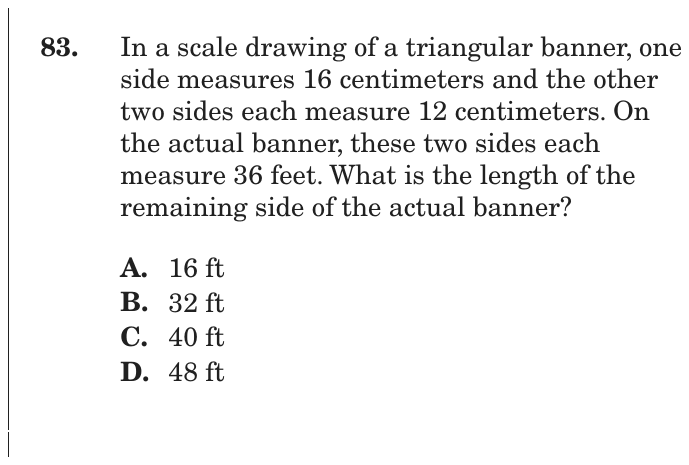
Question 84 of 120
2018 Test A Math, question 27Question
The faculty of a certain four-year college consists of 179 teachers. There are 663 first-year students. The student-to-faculty ratio for the entire college is 15 to 1. What is the total number of second-, third-, and fourth-year students?
- A1,989
- B2,022
- C2,652
- D2,685
Show the answer
Correct answer: B
Let be the number of second-, third-, and fourth-year students.
Then the total number of students in the college is
Set up a proportion and solve for :
Question analysis
A ratio word problem about a four-year college with 179 teachers, 663 first-year students and a student-to-faculty ratio of 15 to 1. Students use the ratio to find the total number of students, then remove the first-year class. The phrase four-year invites the wrong assumption that every year is the same size.
- Grade level
- Grade 7 content, by NYS standard
- Compared with grade 7
- At grade 7 Using a ratio to find a total and then subtracting a part is a standard two-step grade 7 ratio problem. The three-digit multiplication and the four-year detail add little beyond typical classwork.
- Estimated difficulty
- Moderate: several steps, or a close reading with one strong distractor.
- Thinking it demands
- Depth of knowledge 2, skills and concepts · mainly apply
- What makes it hard
- Turning words into math moderate
- Error-prone arithmetic minor
- Solution
- 2 steps
- Reading level
- Question and choices: about grade 7, 34 words.
- Students, last 30 days
- Not enough answers yet to show (it takes 10).
Why it is hard, traps and wrong answers (shows the answer)
Why it is hard
The question hinges on what the ratio describes: the whole college, not one class of students. Students who see that multiply, subtract and are done; those who stop at the total, or assume each year matches the 663 first-years, find their number listed. Because the choices come in close pairs, a careless multiplication can also land on a wrong one.
Turning words into math moderate Understanding the question
"The student-to-faculty ratio for the entire college is 15 to 1" covers students in all four years, so 15 × 179 is every student, and the 663 first-years must come out. (Hegarty, Mayer & Monk, 1995; Koedinger & Nathan, 2004)
Error-prone arithmetic minor Working it out
179 × 15 and the subtraction of 663 are multi-digit computations by hand, and the choices come in pairs only 33 apart. (Brown & Burton, 1978; Junker & Sijtsma, 2001)
Strategy: Multiply the 179 faculty by 15 to get the number of all students, then subtract the 663 first-year students to leave the other three years.
Traps
- Stops one step early: A choice is a number from partway through the solution.
The wrong answers, classified
A Numbers taken from the question (Hegarty, Mayer & Monk, 1995)
Ignores the ratio and assumes each of the other three years also has 663 students, 663 × 3 = 1,989.
C Numbers taken from the question (Hegarty, Mayer & Monk, 1995)
Assumes all four years have 663 students and multiplies 663 × 4 = 2,652, which also counts the first-year class the question leaves out.
D Stops one step early (King et al., 2004; Gierl et al., 2017)
Multiplies 179 × 15 = 2,685 to get every student in the college and stops before subtracting the 663 first-year students.
Worked solution, step by step
Formulas used
- Using a ratio to find an amount
- s is the number of students, and f is the number of faculty, the teachers. A ratio of 15 to 1 means 15 students for every 1 teacher. So each teacher goes with 15 students, and you multiply the teachers by 15.
Sort out the question
The faculty means the teachers. The college has 179 of them. The ratio of students to faculty is 15 to 1 “for the entire college”. So there are 15 students for every teacher, counting all four years. 663 students are first-years. You need the second-, third- and fourth-year students together.
Find every student in the college
Multiply the teachers by 15.
Break it into easy pieces: and .
There are 2,685 students in all four years.
Take away the first-years
That leaves 2,022 second-, third- and fourth-year students. Watch out: 2,685 still includes the first-years. Stopping there gives choice D. Watch out: don’t assume each year has 663 students. That leads to 1,989, choice A. So the answer is B, 2,022.
Check your answer
Add back: students. Then . That is 15 students for each teacher, the ratio in the question.
More questions like this
The original DOE question
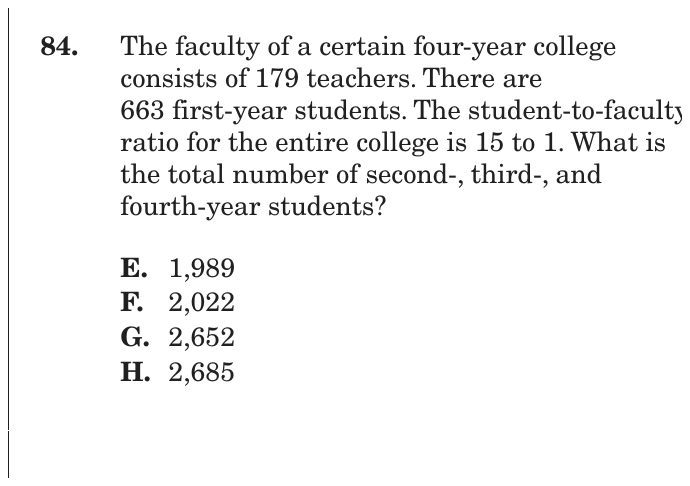
Question 85 of 120
2018 Test A Math, question 28Question
What is the value of the expression shown above?
- A
- B
- C
- D
Show the answer
Correct answer: D
Convert all the fractions to a common denominator (10):
Question analysis
A fractions question: add four mixed numbers whose fractions have denominators of 5, 10, 5 and 2. Students rewrite the fractions over a common denominator, add the whole numbers and the fractions, regroup any extra whole, and simplify. Regrouping and lowest terms both matter, since the choices differ in exactly those places.
- NYS standards
- Grade level
- Grade 7 content, by NYS standard
- Compared with grade 7
- Below grade 7 Adding mixed numbers with unlike denominators is grade 5 content. With four terms and a regrouping step it takes care, but it asks less than typical grade 7 work with negative rational numbers.
- Estimated difficulty
- Straightforward: two steps or one careful reading.
- Thinking it demands
- Depth of knowledge 1, recall and reproduction · mainly apply
- What makes it hard
- Error-prone arithmetic moderate
- A very close wrong answer moderate
- An answer in an unexpected form minor
- Solution
- 3 steps
- Reading level
- Question and choices: about grade 9, 14 words.
- Students, last 30 days
- Not enough answers yet to show (it takes 10).
Why it is hard, traps and wrong answers (shows the answer)
Why it is hard
The numbers are friendly: every fraction converts to tenths, and the whole parts add to 14. The risk is in the bookkeeping, either forgetting to carry the extra whole from the fractions or adding numerators over a made-up denominator. Converting to decimals, 2.2 + 3.3 + 4.4 + 5.5, is a fast check that avoids both.
Error-prone arithmetic moderate Working it out
Four mixed numbers with denominators 5, 10, 5 and 2 must be rewritten as tenths, 2 + 3 + 4 + 5 tenths, and the 14/10 regrouped into a whole and a fraction. (Brown & Burton, 1978; Junker & Sijtsma, 2001)
A very close wrong answer moderate Choosing the answer
15 2/5 and 14 2/5 are written alike and share the fraction 2/5; only the whole carried from 14/10 separates them, so a missed carry is invisible at a glance. (Embretson & Wetzel, 1987; Gorin & Embretson, 2006; Ascalon et al., 2007)
An answer in an unexpected form minor Choosing the answer
The fractions total 1 4/10, but every choice is in lowest terms, so the 4/10 has to be reduced to 2/5 before it matches. (Enright, Morley & Sheehan, 2002)
Strategy: Convert each mixed number to a decimal, since these fractions all convert exactly, add them, and turn the decimal part back into a fraction in lowest terms.
Traps
- Answer in another form: The right answer is written differently from the way you worked it out.
The wrong answers, classified
A A faulty procedure (Brown & Burton, 1978; Tatsuoka, 1983)
Adds the numerators straight across, 1 + 3 + 2 + 1 = 7, and puts them over 20, a common denominator (10 × 2), without rescaling them, so nothing carries.
B An arithmetic slip (Junker & Sijtsma, 2001)
Adds the fractions to 14/10 but keeps only the 4/10 = 2/5 left over, forgetting to carry the whole 1 into 14.
C Little reason to choose it (Haladyna & Downing, 1993; Rodriguez, 2005)
Pairs a correct carry into 15 with the 7/20 from adding numerators, two steps no single line of working combines; it mostly catches guesses.
Worked solution, step by step
Formulas used
- Equal fractions
- a is the top number, called the numerator. b is the bottom number, called the denominator. n is any whole number except zero. Multiplying the top and bottom by the same n gives an equal fraction. Use it to give fractions the same denominator so you can add them.
Sort out the question
You need to add four mixed numbers. A mixed number is a whole number plus a fraction, like . The fractions have different denominators, or bottom numbers: 5, 10, 5 and 2. To add fractions, they need the same denominator.
Add the whole numbers
Add the whole numbers first. You will add the fractions on their own after that.
The whole numbers make 14.
Rewrite each fraction in tenths
Use 10 as the denominator, since 5 and 2 both go into 10.
is already in tenths. Watch out: when you change a bottom number, change the top too. Adding the old tops, 1 + 3 + 2 + 1 = 7, and putting them over 20 gives 7/20. That is in choices A and C.
Add the fractions
14 tenths is more than 1 whole. Ten tenths make 1, so 14 tenths is 1 whole and 4 tenths.
To simplify 4/10, divide the top and bottom by 2.
Put it all together
Add the 14 wholes to the sum of the fractions.
Watch out: carry the extra whole into the 14. Missing it gives , choice B. So the answer is D, .
Check your answer
Change each mixed number to a decimal: . The 0.4 is 4 tenths, which is 2/5. So the sum is .
More questions like this
The original DOE question
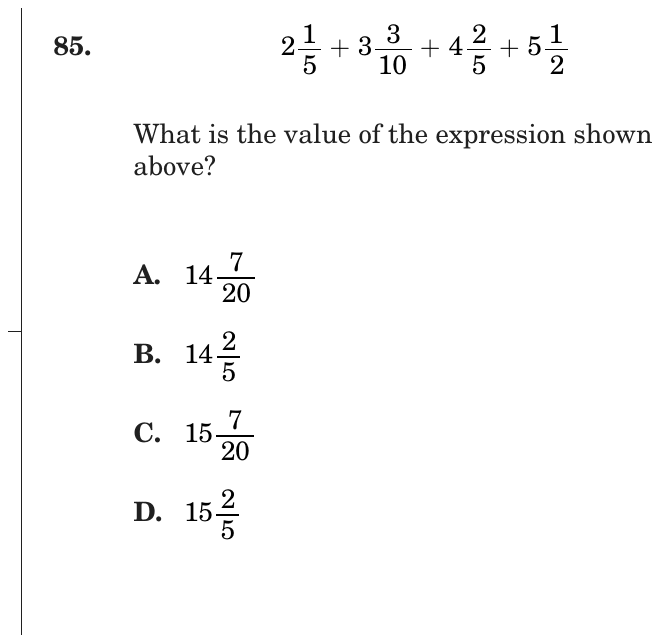
Question 86 of 120
2018 Test A Math, question 29Question
A car is traveling 55 miles per hour, and 1 mile = 5,280 feet. Which of the following calculations would give the car’s speed in feet per second?
- A
- B
- C
- D
Show the answer
Correct answer: B
Divide the rate by the number of seconds in an hour. (Since there are 60 minutes in an hour and 60 seconds in a minute, multiply 60 × 60 = 3,600 seconds in an hour):
miles per second
Multiply by the number of feet in a mile (5,280):
feet per second
Question analysis
This unit conversion question gives a car's speed of 55 miles per hour and asks which calculation expresses it in feet per second. Students have to change miles to feet and hours to seconds in one expression. The tricky part is converting both units at once and keeping each conversion factor on the correct side of the fraction bar.
- Grade level
- Grade 6 content, by NYS standard
- Compared with grade 7
- At grade 7 Grade 7 students usually convert one unit at a time, such as feet to inches. This item converts both parts of a rate at once, miles per hour into feet per second, and asks students to recognize the right setup.
- Estimated difficulty
- Straightforward: two steps or one careful reading.
- Thinking it demands
- Depth of knowledge 2, skills and concepts · mainly apply
- What makes it hard
- A very close wrong answer moderate
- Something you must already know minor
- Solution
- 2 steps
- Reading level
- Question and choices: about grade 6, 28 words.
- Students, last 30 days
- Not enough answers yet to show (it takes 10).
Why it is hard, traps and wrong answers (shows the answer)
Why it is hard
Nothing has to be calculated; the work is judging which setup turns miles per hour into feet per second. Students who convert only part of the way find a choice waiting, whether they stop at feet per hour or go from hours to minutes instead of seconds. Tracking which unit each factor cancels, rather than computing, is what the question rewards.
A very close wrong answer moderate Choosing the answer
The answer, 55 · 5,280/3,600, and the choice 55 · 5,280/60 are written identically except for the denominator, so only knowing that an hour has 3,600 seconds, not 60, separates them. (Embretson & Wetzel, 1987; Gorin & Embretson, 2006; Ascalon et al., 2007)
Something you must already know minor Working it out
The stem gives 5,280 feet per mile but not the 3,600 seconds in an hour, which students must build from 60 × 60 themselves. (Anderson & Krathwohl, 2001)
Strategy: Write the speed as 55 miles over 1 hour and multiply by unit fractions such as 5,280 feet over 1 mile, checking that miles and hours cancel and only feet per second remain.
Traps
- Units or scale: The answer is wanted in other units, or a rate or scale must be converted first.
- Stops one step early: A choice is a number from partway through the solution.
The wrong answers, classified
A Stops one step early (King et al., 2004; Gierl et al., 2017)
Converts miles to feet with 55 × 5,280 but never changes hours to seconds, leaving the speed in feet per hour.
C Wrong operation (Hegarty, Mayer & Monk, 1995; King et al., 2004)
Turns both conversion factors upside down, multiplying by 3,600 and dividing by 5,280, so miles and hours never cancel.
D Units or scale (King et al., 2004)
Divides by 60, converting hours to minutes and stopping there, which gives the speed in feet per minute rather than feet per second.
Worked solution, step by step
Formulas used
- Speed
- r is the speed, or rate. d is the distance traveled. t is the time it took. Speed tells how far something goes in one unit of time, so you divide the distance by the time.
Sort out what you know
The car goes 55 miles in 1 hour. One mile is 5,280 feet. You need the speed in feet per second. That means how many feet the car goes in 1 second.
The choices are setups, not numbers. So you only need to pick the right setup. You do not have to work out the final number.
Change the miles to feet
Each mile is 5,280 feet. So 55 miles is 55 groups of 5,280 feet. Multiply to get the distance in feet:
That is how many feet the car goes in 1 hour. Watch out: if you stop here, you have feet per hour, not feet per second. That is choice A.
Change the hour to seconds
The question gives you miles to feet. It does not give you hours to seconds, so you build that yourself. An hour has 60 minutes, and each minute has 60 seconds:
So 1 hour is 3,600 seconds. Watch out: 60 is the number of minutes in an hour, not seconds. Dividing by 60 gives feet per minute. That is choice D.
Divide the distance by the time
Use the speed formula. The distance is 55 × 5,280 feet. The time is 3,600 seconds:
Feet on top and seconds on the bottom give feet per second. Watch out: choice C turns both changes upside down, so the miles and hours never cancel. So the answer is B, .
Check your answer
Estimate. 55 × 5,280 is about 290,000 feet in an hour. Divide by 3,600 seconds and you get about 80 feet each second. A car on a highway covering 80 feet in one second sounds right.
More questions like this
The original DOE question
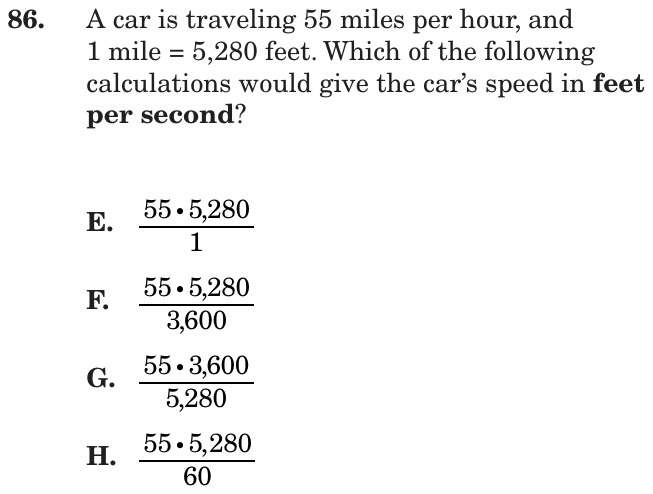
Question 87 of 120
2018 Test A Math, question 30Question
Today, Tien’s age is of Jordan’s age. In 2 years, Tien’s age will be of Jordan’s age. How old is Jordan today?
- A4 years old
- B6 years old
- C12 years old
- D16 years old
Show the answer
Correct answer: D
First, set up an equation to express Tien’s age () and Jordan’s age () today:
Two years from now, Tien’s age will be , and Jordan’s age will be .
Set up an equation about the relationship between Tien’s age and Jordan’s age in two years:
Solve the above equation for :
Now set the two equations equal to each other and solve for :
Question analysis
This age word problem says Tien is one fourth of Jordan's age today and will be one third of Jordan's age in two years, then asks for Jordan's current age. Students must turn two fractional relationships into equations and solve them together. Both people age by the same two years, and it is easy to solve for the wrong person.
- NYS standards
- Grade level
- Grade 8 content, by NYS standard
- Compared with grade 7
- Above grade 7 Grade 7 equations have one unknown on one side, like 3x + 5 = 20. This one links two unknown ages with fractional coefficients and leads to a variable on both sides, which is grade 8 algebra.
- Estimated difficulty
- Hard: combines ideas, needs a plan, and has more than one tempting wrong answer.
- Thinking it demands
- Depth of knowledge 2, skills and concepts · mainly apply
- What makes it hard
- Turning words into math major
- Error-prone arithmetic moderate
- Solution
- 4 steps
- Reading level
- Question and choices: about grade 1, 31 words.
- Students, last 30 days
- Not enough answers yet to show (it takes 10).
Why it is hard, traps and wrong answers (shows the answer)
Why it is hard
The difficulty is in the setup: two fractional relationships at two different times, with both people aging. Once the equations are right, the algebra is short, but it ends with two ages and only one is asked for. Testing the choices against both conditions is a reliable alternative that avoids the algebra entirely.
Turning words into math major Understanding the question
The second sentence must become T + 2 = (J + 2)/3; writing J/3, or forgetting that Jordan also ages two years, breaks the equation. (Hegarty, Mayer & Monk, 1995; Koedinger & Nathan, 2004)
Error-prone arithmetic moderate Working it out
Substituting J/4 for T leaves J/4 + 2 = (J + 2)/3, an equation with fractions on both sides that must be cleared, usually by multiplying by 12. (Brown & Burton, 1978; Junker & Sijtsma, 2001)
Strategy: Let Jordan's age be J, write Tien's age as J/4, and set J/4 + 2 equal to one third of (J + 2); or test each choice against both conditions.
Traps
- Answers a different question: A choice is right for another quantity: the other unknown, the rest instead of the part, the part instead of the whole.
The wrong answers, classified
A Answers a different question (King et al., 2004; Hegarty, Mayer & Monk, 1995)
Solves the equations correctly but reports Tien's age today, 4, which is one fourth of Jordan's 16, instead of Jordan's age.
B Answers a different question (King et al., 2004; Hegarty, Mayer & Monk, 1995)
Gives Tien's age two years from now, 4 + 2 = 6, answering for the wrong person and the wrong time.
C Numbers taken from the question (Hegarty, Mayer & Monk, 1995)
Picks 12 because it is a multiple of both 4 and 3, but then Tien would be 3 and later 5, not a third of 14.
Worked solution, step by step
Formulas used
- Distributive property
- a, b and c are any numbers. To multiply a sum by a number, multiply each part of the sum, then add. It works because a groups of (b + c) is the same as a groups of b plus a groups of c.
Sort out what you know
Today, Tien’s age is of Jordan’s age. That means Jordan is 4 times as old as Tien.
In 2 years, both of them will be 2 years older. Then Tien’s age will be of Jordan’s. So Jordan will be 3 times as old as Tien. You need Jordan’s age today.
Name the ages with a letter
Let t stand for Tien’s age today. Jordan is 4 times as old, so his age is 4t, which means 4 times t. Add 2 years to each age:
Person Today In 2 years Tien Jordan Watch out: Jordan gets 2 years older too. Do not forget to add 2 to his age.
Write an equation for later
In 2 years, Jordan’s age will be 3 times Tien’s age. Write that as an equation:
Use the distributive property on the right side. Multiply both t and 2 by 3:
Solve for Tien’s age
Take 3t away from both sides. Doing the same thing to both sides keeps them equal:
Now take 2 away from both sides:
So Tien is 4 years old today. Watch out: 4 is Tien’s age, not Jordan’s. Choice A, 4 years old, is a trap.
Find Jordan’s age
Jordan is 4 times as old as Tien:
So the answer is D, 16 years old.
Check your answer
Put 16 back into the story. Today, Tien is 16 ÷ 4 = 4. In 2 years, Tien is 6 and Jordan is 18. Is 6 one third of 18? Yes, because 18 ÷ 3 = 6. Choice C fails: Tien would be 3, then 5, and 5 is not a third of 14.
More questions like this
The original DOE question
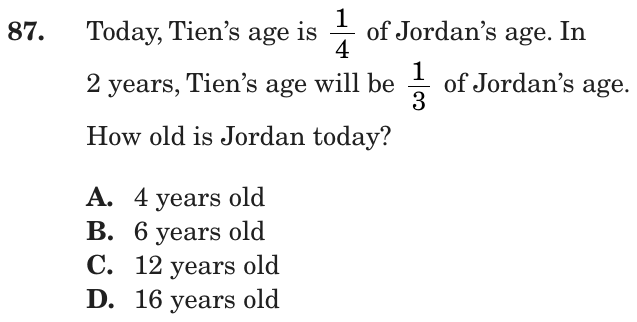
Question 88 of 120
2018 Test A Math, question 31Question
How many positive even factors of 48 are greater than 24 and less than 48?
- A0
- B1
- C2
- D12
Show the answer
Correct answer: A
List the factors of 48:
1 and 48, 2 and 24, 3 and 16, 4 and 12, 6 and 8
There are no factors greater than 24 and less than 48.
Question analysis
This number properties question asks how many positive even factors of 48 are greater than 24 and less than 48. Students list the factors of 48 and test which ones fall strictly inside that range. Reading both conditions precisely, and listing every factor without skipping any, is what matters.
- NYS standards
- 6.NS.4 common factors and multiples
- Grade level
- Grade 6 content, by NYS standard
- Compared with grade 7
- Below grade 7 Listing the factors of a two-digit number is grade 6 work, and here it takes one short list. The only demand beyond routine is reading both conditions exactly, which grade 7 students already do regularly.
- Estimated difficulty
- Straightforward: two steps or one careful reading.
- Thinking it demands
- Depth of knowledge 1, recall and reproduction · mainly apply
- What makes it hard
- A very close wrong answer moderate
- Much to keep track of minor
- Solution
- 2 steps
- Reading level
- Question and choices: about grade 7, 12 words.
- Students, last 30 days
- Not enough answers yet to show (it takes 10).
Why it is hard, traps and wrong answers (shows the answer)
Why it is hard
The factor list is short, so the question is decided by the conditions. The pairs 2 and 24 and 1 and 48 put the only candidates exactly on the boundaries, and the strict words "greater than" and "less than" exclude them. Students also tend to distrust an answer of zero, which nudges them toward counting an endpoint.
A very close wrong answer moderate Choosing the answer
The choices 0 and 1 differ by a single factor, so the count cannot be sized up; only checking whether 48 itself, or 24, falls strictly inside the range separates them. (Embretson & Wetzel, 1987; Gorin & Embretson, 2006; Ascalon et al., 2007)
Much to keep track of minor Working it out
Each factor must pass three tests at once, even, greater than 24 and less than 48, and the factor list itself must be complete. (Sweller, 1988; Carpenter, Just & Shell, 1990)
Strategy: List the factors of 48 in pairs, starting from 1 × 48, then check each one against both conditions: it must be even and lie strictly between 24 and 48.
Traps
- Counting the ends: Inclusive or exclusive ends, fence posts, consecutive numbers: an answer that is one too many or too few, or an endpoint drawn open where it belongs closed (or the reverse).
- Misreads the question: Misses or misreads a condition or a word in the question: "at least", "each", "remaining", "not".
The wrong answers, classified
B Counting the ends (Brown & Burton, 1978)
Counts one boundary factor, usually 48 itself, as inside the range, reading "less than 48" as "48 or less".
C Counting the ends (Brown & Burton, 1978)
Counts both 24 and 48, treating "greater than 24 and less than 48" as if the range included both of its ends.
D Misreads the question (Hegarty, Mayer & Monk, 1995)
Drops the condition that the numbers be factors of 48 and counts the even numbers from 26 up to and including 48, which makes 12.
Worked solution, step by step
Formulas used
- Factor pairs
- n is the number you start with, here 48. If two whole numbers a and b multiply to make n, both are factors of n. A factor divides n with nothing left over. Listing factors in pairs makes sure you skip none.
Sort out what the question asks
A factor of 48 is a whole number that divides 48 with nothing left over. You need factors that pass three tests. They must be even. They must be greater than 24. They must be less than 48.
“Less than 48” means 48 itself does not count. “Greater than 24” means 24 does not count either.
List the factors of 48 in pairs
Start with 1 and work up. Each pair multiplies to 48:
The next number, 7, does not divide 48. After 6 and 8 the pairs repeat. So the factors are 1, 2, 3, 4, 6, 8, 12, 16, 24 and 48.
Look between 24 and 48
In the list, the factor right after 24 is 48. Nothing falls between them.
Here is why. A factor bigger than 24 must pair with a number smaller than 2. The only such number is 1, and it pairs with 48. So no factor of 48 is between 24 and 48, even or odd.
Give the answer
Watch out: 24 and 48 are both factors, but they sit on the edges. Counting 48 gives 1, which is choice B. Counting both gives 2, which is choice C.
So the answer is A, 0.
Check your answer
Try the even numbers 26, 28, and so on up to 46. Dividing 48 by any of them gives more than 1 but less than 2. That is never a whole number, so none of them is a factor. Choice D, 12, counts even numbers without checking that they are factors.
More questions like this
The original DOE question
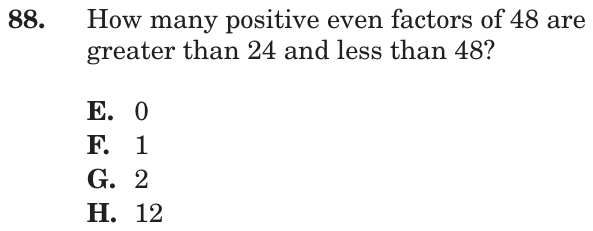
Question 89 of 120
2018 Test A Math, question 32Question
The least of 5 consecutive integers is , and the greatest is . What is the value of in terms of ?
- A
- B
- C
- D
Show the answer
Correct answer: C
The first integer is , so the second is , the third is , then , and finally .
Since is the fifth and greatest of the integers,
Substitute for and simplify:
Question analysis
This algebra question about five consecutive integers calls the least one l and the greatest g, then asks for (l + g)/2 written in terms of l. Students must express g using l and simplify a fraction that contains a variable. Counting how far the fifth integer is from the first is where many students slip.
- NYS standards
- Grade level
- Grade 7 content, by NYS standard
- Compared with grade 7
- At grade 7 Grade 7 students combine like terms in expressions such as 3(x + 4) − x. This item first asks them to build the expression from a description of consecutive integers, then simplify it, with only letters to work with.
- Estimated difficulty
- Moderate: several steps, or a close reading with one strong distractor.
- Thinking it demands
- Depth of knowledge 2, skills and concepts · mainly apply
- What makes it hard
- Variables instead of numbers moderate
- Turning words into math minor
- Every choice must be checked minor
- Solution
- 3 steps
- Reading level
- Question and choices: about grade 8, 26 words.
- Students, last 30 days
- Not enough answers yet to show (it takes 10).
Why it is hard, traps and wrong answers (shows the answer)
Why it is hard
The algebra is short once g is written as l + 4, so most errors come from the fence-post count or from testing numbers carelessly. The wrong choices in front of the answer are exactly the ones a single test value cannot rule out, which punishes students who stop at the first match. Using two test values, or simplifying (2l + 4)/2 directly, avoids both traps.
Variables instead of numbers moderate Understanding the question
Every expression is in l, so the simplification of (l + l + 4)/2 has to be done with letters and cannot be checked against a single number. (Koedinger & Nathan, 2004; Enright, Morley & Sheehan, 2002)
Turning words into math minor Understanding the question
The description "the least of 5 consecutive integers is l, and the greatest is g" must become g = l + 4, four steps up, not five. (Hegarty, Mayer & Monk, 1995; Koedinger & Nathan, 2004)
Every choice must be checked minor Choosing the answer
A single test value fits two choices: l = 1 makes 3l and l + 2 both 3, and l = 2 makes 2l and l + 2 both 4. (Embretson & Wetzel, 1987)
Strategy: Write the integers as l, l + 1, and so on up to the fifth, substitute for g and simplify; then test two different starting values, since one value can match a wrong choice by coincidence.
Traps
- Counting the ends: Inclusive or exclusive ends, fence posts, consecutive numbers: an answer that is one too many or too few, or an endpoint drawn open where it belongs closed (or the reverse).
The wrong answers, classified
A Checks only one number (Schoenfeld, 1985)
Tests only l = 2, where 2 through 6 give (2 + 6)/2 = 4, and takes 2l, the first choice that also equals 4.
B Checks only one number (Schoenfeld, 1985)
Tests only l = 1, where 1 through 5 give (1 + 5)/2 = 3, and stops at 3l, which matches before l + 2 is checked.
D Counting the ends (Brown & Burton, 1978)
Writes the greatest integer as l + 5, counting five steps for five integers, then halves only the 2l in (2l + 5)/2, leaving l + 5.
Worked solution, step by step
Formulas used
- Greatest of 5 consecutive integers
- l is the least (smallest) integer and g is the greatest. Consecutive integers go up by 1 each time. Five integers have only 4 jumps from the first to the last, so you add 4, not 5.
- Dividing a sum
- a and b are the two parts of the top, and c is the number you divide by. To divide a sum, divide each part. You must divide every part of the top, not just one.
Sort out the words
Integers are whole numbers, like −2, 0 and 7. Consecutive integers come one right after another, like 8, 9, 10. There are 5 of them here.
The smallest is called l and the biggest is called g. You must write using only the letter l.
Write all five integers
Each integer is 1 more than the one before:
The fifth one is the greatest, so g = l + 4. Watch out: five integers have only four jumps between them. Writing g = l + 5 leads to choice D.
Put l + 4 in place of g
Swap g for l + 4 in the fraction:
Here l + l is 2l, which means 2 times l.
Split the fraction
Divide each part of the top by 2:
So the answer is C, .
Check your answer
Test two starting numbers. If l = 1, the integers are 1 to 5, and (1 + 5) ÷ 2 = 3, which is 1 + 2. If l = 10, they are 10 to 14, and (10 + 14) ÷ 2 = 12, which is 10 + 2. Use two tests, because l = 1 also makes 3l equal 3, choice B.
More questions like this
The original DOE question
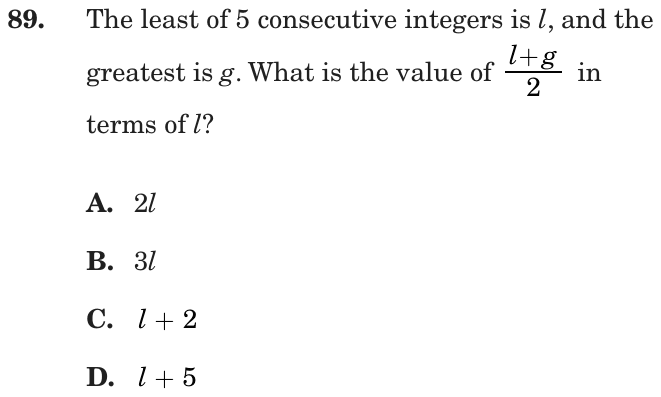
Question 90 of 120
2018 Test A Math, question 33Question
Johan leased a car for three years. He paid a one-time fee of $1,000, and an additional $300 per month for the full three years. At the end of the three years, what is the total amount Johan paid for leasing this car?
- A$1,900
- B$4,600
- C$10,800
- D$11,800
Show the answer
Correct answer: D
Three years is 36 months (12 × 3).
Set up an expression to find the total amount Johan paid:
Question analysis
This word problem about leasing a car combines a one-time fee with a monthly payment over three years and asks for the total amount paid. Students must convert years to months, multiply by the monthly payment and add the fee. Leaving out one piece of the cost, or mixing years with months, is the usual slip.
- NYS standards
- Grade level
- Grade 6 content, by NYS standard
- Compared with grade 7
- Below grade 7 This is a short total-cost calculation with whole numbers, easier than typical grade 7 word problems, which bring in percents, negative numbers or fractions. The only care needed is turning years into months.
- Estimated difficulty
- Routine: one familiar step, little to misread.
- Thinking it demands
- Depth of knowledge 2, skills and concepts · mainly apply
- What makes it hard
- Much to keep track of minor
- A very close wrong answer minor
- Solution
- 3 steps
- Reading level
- Question and choices: about grade 4, 41 words.
- Students, last 30 days
- Not enough answers yet to show (it takes 10).
Why it is hard, traps and wrong answers (shows the answer)
Why it is hard
This is the easiest kind of multi-step word problem: whole numbers, a familiar money situation and a direct method. The only places to slip are changing three years into 36 months and remembering the one-time fee after the long multiplication. Each slip has its own choice, so a quick check that both costs are in the total is worth the seconds.
Much to keep track of minor Working it out
The $1,000 fee is paid once while the $300 repeats monthly, so it must be held aside while 36 × 300 is computed. (Sweller, 1988; Carpenter, Just & Shell, 1990)
A very close wrong answer minor Choosing the answer
The choices $11,800 and $10,800 differ by only $1,000 out of about $11,000, so a rough total cannot separate them; only including the one-time fee does. (Embretson & Wetzel, 1987; Gorin & Embretson, 2006; Ascalon et al., 2007)
Strategy: Count the months in the lease first, multiply the monthly payment by that number, and then add the one-time fee.
Traps
- Stops one step early: A choice is a number from partway through the solution.
- Units or scale: The answer is wanted in other units, or a rate or scale must be converted first.
The wrong answers, classified
A Units or scale (King et al., 2004)
Multiplies $300 by 3 years instead of 36 months, getting $900, then adds the $1,000 fee to reach $1,900.
B Misreads the question (Hegarty, Mayer & Monk, 1995)
Charges the $300 for only 12 months, one year rather than the full three, so 3,600 + 1,000 gives $4,600.
C Stops one step early (King et al., 2004; Gierl et al., 2017)
Finds the 36 monthly payments, 36 × $300 = $10,800, and stops before adding the one-time $1,000 fee.
Worked solution, step by step
Formulas used
- Total cost with a fee
- T is the total paid. f is the one-time fee, paid only once. m is the monthly payment. n is the number of months. You multiply first because the monthly payment repeats every month. Then you add the fee once.
Sort out what you know
Johan paid $1,000 one time. He also paid $300 every month for 3 years. You need the total he paid.
The payments are counted by the month, but the time is given in years. So first change the years to months.
Count the months
Each year has 12 months:
So Johan made 36 monthly payments. Watch out: multiplying $300 by 3 years instead of 36 months gives $900. Adding the fee then gives $1,900, which is choice A.
Add up the monthly payments
Multiply the monthly payment by the number of months:
The monthly payments add up to $10,800.
Add the one-time fee
Use the formula. The fee goes in once:
Watch out: $10,800 is choice C. It leaves out the $1,000 fee. So the answer is D, $11,800.
Check your answer
Round to check. $300 a month for 36 months is a bit more than $10,000. Add the $1,000 fee and you get a bit more than $11,000. $11,800 fits. Choices A and B are far too small for three years of payments.
More questions like this
The original DOE question
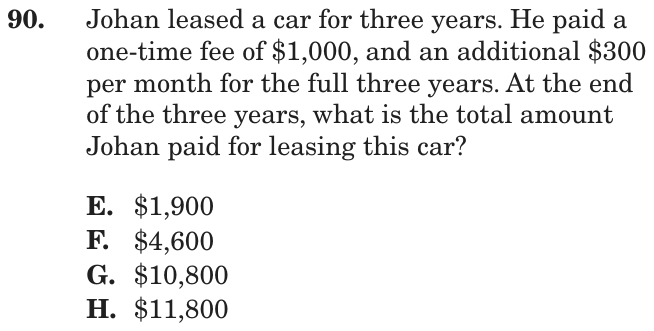
Question 91 of 120
2018 Test A Math, question 34Question
There are 6 different cookies on a plate. Aiden will choose 2 of these cookies to pack in his lunch. How many different pairs of 2 cookies can he choose from the 6?
- A12
- B15
- C30
- D36
Show the answer
Correct answer: B
Create a list of the possible pairs. Let the cookies be named A, B, C, D, E, and F.
AB, AC, AD, AE, AF
BC, BD, BE, BF
CD, CE, CF
DE, DF
EF
There are a total of 15 possible pairs of cookies that Aiden can choose.
Question analysis
This counting question asks how many different pairs of cookies Aiden can choose from six different cookies on a plate. Students must count combinations, where taking the same two cookies in a different order is not a new pair. The challenge is that the order of picking does not matter, so each pair must be counted once.
- NYS standards
- 7.SP.8b sample spaces for compound events
- Grade level
- Grade 7 content, by NYS standard
- Compared with grade 7
- At grade 7 Grade 7 students list the outcomes of compound events with organized lists and tree diagrams. Counting pairs is close to that work, but students must notice that the order of choosing does not matter.
- Estimated difficulty
- Moderate: several steps, or a close reading with one strong distractor.
- Thinking it demands
- Depth of knowledge 2, skills and concepts · mainly apply
- What makes it hard
- Much to keep track of moderate
- Solution
- 2 steps
- Reading level
- Question and choices: about grade 4, 29 words.
- Students, last 30 days
- Not enough answers yet to show (it takes 10).
Why it is hard, traps and wrong answers (shows the answer)
Why it is hard
Students who know the multiplication principle are the most at risk, because it counts each pair twice. The question rewards noticing that a pair has no order, either by listing systematically or by halving 6 × 5. The list of 15 pairs takes under a minute, so there is no time pressure to justify a shortcut.
Much to keep track of moderate Working it out
Listing all pairs by hand means tracking which have been written so none is repeated or skipped, which an organized list such as AB to AF handles. (Sweller, 1988; Carpenter, Just & Shell, 1990)
Strategy: Name the cookies with letters and list the pairs systematically: the first cookie with every later one, then the second with every later one, and so on.
Traps
- Overlapping groups: Things in two groups at once are counted twice, or not subtracted.
- Without replacement: In a second pick there is one fewer item, which changes the probability.
The wrong answers, classified
A Numbers taken from the question (Hegarty, Mayer & Monk, 1995)
Multiplies the 6 cookies by the 2 being chosen, a product of the stem's numbers that does not count any pairs.
C Overlapping groups (King et al., 2004)
Counts ordered picks, 6 choices then 5, so every pair such as AB and BA is counted twice, giving 30 instead of half that.
D Without replacement (Fischbein & Schnarch, 1997)
Uses 6 × 6, as if the first cookie went back on the plate, which counts order and also allows the same cookie twice.
Worked solution, step by step
Formulas used
- Number of pairs
- n is how many things you choose from. Each of the n things can pair with the n − 1 others. That counts every pair twice, once from each side, so you divide by 2.
Sort out the question
There are 6 different cookies. Aiden picks 2 of them. A pair is just two cookies together.
Order does not matter. Picking cookie 1 then cookie 2 gives the same pair as cookie 2 then cookie 1. You need to count the different pairs.
List the pairs in order
Number the cookies 1 to 6. Pair cookie 1 with every cookie after it. Then pair cookie 2 with every cookie after it, and so on. Only pairing with later numbers stops you from listing a pair twice.
Start with Pairs How many 1 1-2, 1-3, 1-4, 1-5, 1-6 5 2 2-3, 2-4, 2-5, 2-6 4 3 3-4, 3-5, 3-6 3 4 4-5, 4-6 2 5 5-6 1 Add up the pairs
Each row has one fewer pair than the row above it. That is because one fewer cookie comes after it. Add the last column of the table:
There are 15 different pairs.
Check with the pairs formula
Put n = 6 into the formula:
Watch out: 6 × 5 = 30 counts each pair twice, once for each order. Stopping there gives choice C. And 6 × 6 = 36, choice D, lets Aiden pick the same cookie twice. So the answer is B, 15.
Check your answer
Think of handshakes. Each of 6 people shakes hands with the 5 others. That looks like 30 handshakes, but each handshake has two people in it, so it was counted twice. 30 ÷ 2 = 15, which matches the list.
More questions like this
The original DOE question
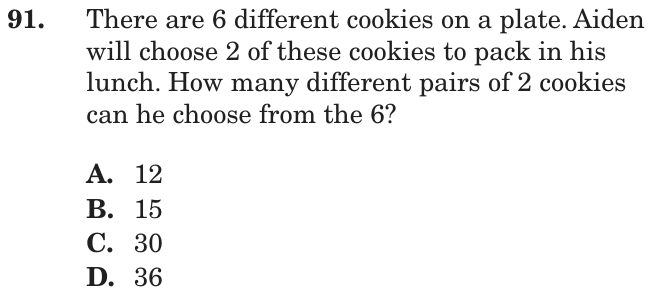
Question 92 of 120
2018 Test A Math, question 35Question
For a presentation, Deion can create 5 slides in 20 minutes, working at a constant rate. Kyra can create 3 slides in 10 minutes, working at her own constant rate. What is the total number of slides the two of them can create in one hour?
- A16
- B30
- C33
- D55
Show the answer
Correct answer: C
Set up proportions to figure out how many slides Deion and Kyra can create in 1 hour:
Deion
Deion can create 15 slides in 1 hour.
Kyra
Kyra can create 18 slides in 1 hour.
Add Deion and Kyra to figure out how many slides they can create together in 1 hour:
15 + 18 = 33.
Question analysis
This rate word problem says how many slides Deion makes in 20 minutes and Kyra makes in 10 minutes, then asks how many slides they make together in one hour. Students must scale each person's rate to an hour before combining. Because their time periods differ, the two rates cannot simply be added as given.
- NYS standards
- 6.RP.3b unit rate problems
- Grade level
- Grade 6 content, by NYS standard
- Compared with grade 7
- At grade 7 Grade 7 rate problems often ask for a single unit rate. This one needs two rates over different time periods, each scaled to an hour and then combined, which is typical grade 7 work built on grade 6 content.
- Estimated difficulty
- Straightforward: two steps or one careful reading.
- Thinking it demands
- Depth of knowledge 2, skills and concepts · mainly apply
- What makes it hard
- Much to keep track of moderate
- Many steps minor
- A very close wrong answer minor
- Solution
- 3 steps
- Reading level
- Question and choices: about grade 5, 42 words.
- Students, last 30 days
- Not enough answers yet to show (it takes 10).
Why it is hard, traps and wrong answers (shows the answer)
Why it is hard
The arithmetic is easy once each person is scaled to an hour on their own; the trouble is the urge to combine first. Adding the slides and the minutes into one rate treats two different rates like fractions added across the top and bottom, and it gives a listed answer. Keeping the two workers separate until the last step avoids every trap.
Much to keep track of moderate Working it out
Deion's rate is given per 20 minutes and Kyra's per 10, so each needs its own scale factor to an hour, 3 and 6, before the totals can be added. (Sweller, 1988; Carpenter, Just & Shell, 1990)
Many steps minor Working it out
Two scalings and an addition: 5 × 3 = 15 for Deion, 3 × 6 = 18 for Kyra, then the sum, each a simple step. (Daniel & Embretson, 2010; Enright, Morley & Sheehan, 2002)
A very close wrong answer minor Choosing the answer
The choices 33 and 30 differ by only 3 slides, so a rough sense of the total cannot separate them; only scaling Kyra's own rate to 18 an hour, not 15, does. (Embretson & Wetzel, 1987; Gorin & Embretson, 2006; Ascalon et al., 2007)
Strategy: Find how many 20-minute blocks and how many 10-minute blocks fit in 60 minutes, scale each person's slides by that number, and then add the two totals.
Traps
- A faulty procedure: A systematic but wrong procedure: adding fractions straight across, applying an exponent to each term of a sum, dropping a sign when moving a term.
- Units or scale: The answer is wanted in other units, or a rate or scale must be converted first.
The wrong answers, classified
A A faulty procedure (Brown & Burton, 1978; Tatsuoka, 1983)
Adds the rates straight across, 5 + 3 slides in 20 + 10 minutes, then doubles 8 slides per 30 minutes to get 16 in an hour.
B Misreads the question (Hegarty, Mayer & Monk, 1995)
Finds Deion's 15 slides an hour and doubles it for the two of them, missing that Kyra works at her own, faster rate.
D Units or scale (King et al., 2004)
Adds the per-minute rates, 0.25 + 0.3 = 0.55 slides, then scales by 100 instead of 60 minutes, getting 55.
Worked solution, step by step
Formulas used
- Amount of work
- a is the amount of work done, here slides. r is the rate: how much gets done in one block of time. t is the number of those blocks. Use it when someone works at a steady speed.
Sort out what you know
Deion makes 5 slides every 20 minutes. Kyra makes 3 slides every 10 minutes. Each works at a constant rate, which means a steady speed that does not change.
One hour is 60 minutes. You need how many slides they make together in 60 minutes.
Find Deion’s slides in an hour
Deion’s rate is 5 slides per 20-minute block. An hour holds 3 of those blocks, since 60 ÷ 20 = 3:
Deion makes 15 slides in an hour.
Find Kyra’s slides in an hour
Kyra’s rate is 3 slides per 10-minute block. An hour holds 6 of those blocks, since 60 ÷ 10 = 6:
Kyra makes 18 slides in an hour. Watch out: Kyra has her own rate. Doubling Deion’s 15 to get 30, choice B, treats her as if she worked at his speed.
Add the two amounts
Together they make 33 slides. Watch out: do not add the slides and the minutes first. Mixing 5 + 3 slides with 20 + 10 minutes blends two different rates and leads to choice A, 16.
So the answer is C, 33.
Check your answer
Compare per minute. Deion makes 5 ÷ 20 = 0.25 slide a minute, and Kyra makes 3 ÷ 10 = 0.3. Together that is 0.55 slide a minute. Times 60 minutes gives 33. Choice D, 55, comes from multiplying by 100 instead of 60.
More questions like this
The original DOE question
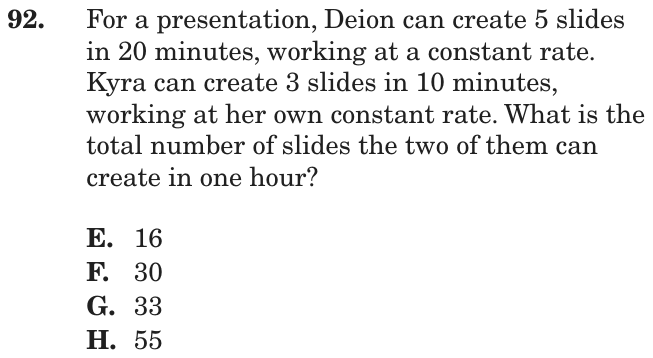
Question 93 of 120
2018 Test A Math, question 36Question
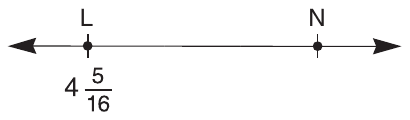
On the number line above, LN = . Point M (not shown) is located between point L and point N. Which value below is a possible value for M?
- A4.26
- B4.31
- C4.35
- D4.58
Show the answer
Correct answer: C
Since , point is located at
.
So must be between point , , and point , . Point can also be written as 4.3125, and point can be written as 4.4375. The only option given that lies between those two points is 4.35.
Question analysis
This number line question says the distance from point L to point N is one eighth and asks which decimal could be the position of a point M between them. Students take L's position, a mixed number in sixteenths, find N, and compare with decimal choices. Converting sixteenths to decimals precisely is the tricky part.
- NYS standards
- Grade level
- Grade 7 content, by NYS standard
- Compared with grade 7
- At grade 7 Grade 7 students convert fractions to decimals and compare them. This item needs an exact conversion of sixteenths and a comparison to the thousandths, where rounding too early can mislead, but it stays within grade 7 content.
- Estimated difficulty
- Moderate: several steps, or a close reading with one strong distractor.
- Thinking it demands
- Depth of knowledge 2, skills and concepts · mainly apply
- What makes it hard
- Error-prone arithmetic moderate
- A very close wrong answer moderate
- Reading a figure, table or graph minor
- Solution
- 3 steps
- Reading level
- Question and choices: about grade 5, 28 words.
- Students, last 30 days
- Not enough answers yet to show (it takes 10).
Why it is hard, traps and wrong answers (shows the answer)
Why it is hard
The interval from L to N is only an eighth wide, and three of the four choices crowd near it, so precision decides the question. Students comfortable working in sixteenths can avoid decimals until the end, since 4.35 lies between 4 5/16 and 4 7/16. Those who convert loosely, or who misread a mixed number as a decimal, are pulled to a neighboring choice.
Error-prone arithmetic moderate Working it out
Converting 4 5/16 to 4.3125 and N to 4.4375 needs four decimal places, while the choices stop at hundredths, so early rounding blurs the left boundary. (Brown & Burton, 1978; Junker & Sijtsma, 2001)
A very close wrong answer moderate Choosing the answer
The choices 4.31 and 4.35 both lie within 0.04 of L, so estimating cannot separate them; only the exact 4.3125 shows 4.31 just outside the interval and 4.35 inside. (Embretson & Wetzel, 1987; Gorin & Embretson, 2006; Ascalon et al., 2007)
Reading a figure, table or graph minor Understanding the question
L's value appears only on the number line, and the picture shows N to the right of L, which fixes which way the one-eighth gap runs. (Lesh, Post & Behr, 1987; Kirsch & Mosenthal, 1990)
Strategy: Add one eighth, or two sixteenths, to L's position to locate N, convert both endpoints to four-place decimals, and keep only a choice strictly between them.
Traps
- Rounds too early: Rounds a value partway through, or rounds the wrong way, so the final answer drifts from the exact one.
- Answer in another form: The right answer is written differently from the way you worked it out.
- A faulty procedure: A systematic but wrong procedure: adding fractions straight across, applying an exponent to each term of a sum, dropping a sign when moving a term.
The wrong answers, classified
A Negatives and direction (Brown & Burton, 1978)
Measures the one-eighth gap to the left of L, giving 4.1875 to 4.3125, an interval that contains 4.26 but contradicts the figure.
B Rounds too early (King et al., 2004)
Rounds L's 4.3125 to 4.31 and treats 4.31 as inside the interval, missing that it lies slightly to the left of L.
D A faulty procedure (Brown & Burton, 1978; Tatsuoka, 1983)
Writes 4 5/16 as 4.516 by placing the fraction's digits after the decimal point, so N becomes about 4.641 and 4.58 appears to fit.
Worked solution, step by step
Formulas used
- Equal fractions
- a is the top number (numerator) and b is the bottom number (denominator). Multiplying both by the same number k gives an equal fraction. It is like cutting each piece into k smaller pieces. Use it to give fractions the same bottom before you add or subtract.
- Fraction to decimal
- A fraction bar means divide. a is the top number and b is the bottom number. Dividing the top by the bottom turns the fraction into a decimal. Then you can compare it with decimal choices.
Sort out what you know
Point L is at . Point N is to the right of L. The distance from L to N, called LN, is .
Point M is somewhere between L and N. You need a choice that fits between them. The choices are decimals, so you will change the fractions into decimals.
Find where N is
N is to the right of L, so add. First give a bottom of 16, to match L:
Watch out: N is to the right of L in the figure. Going left instead gives a gap that holds 4.26, choice A.
Change both points to decimals
Divide the top of each fraction by the bottom:
So L is at 4.3125 and N is at 4.4375.
Test each choice
M must be bigger than 4.3125 and smaller than 4.4375.
- 4.26 is smaller than 4.3125. It is left of L.
- 4.31 is 4.3100, just smaller than 4.3125. It is a hair left of L.
- 4.35 is between them. It fits.
- 4.58 is bigger than 4.4375. It is right of N.
Watch out: if you round L to 4.31, choice B seems to fit. Keep all four decimal places. So the answer is C, 4.35.
Check your answer
Subtract to be sure. 4.35 − 4.3125 = 0.0375, which is more than 0, so 4.35 is right of L. 4.4375 − 4.35 = 0.0875, which is also more than 0, so 4.35 is left of N. It sits between them.
More questions like this
The original DOE question
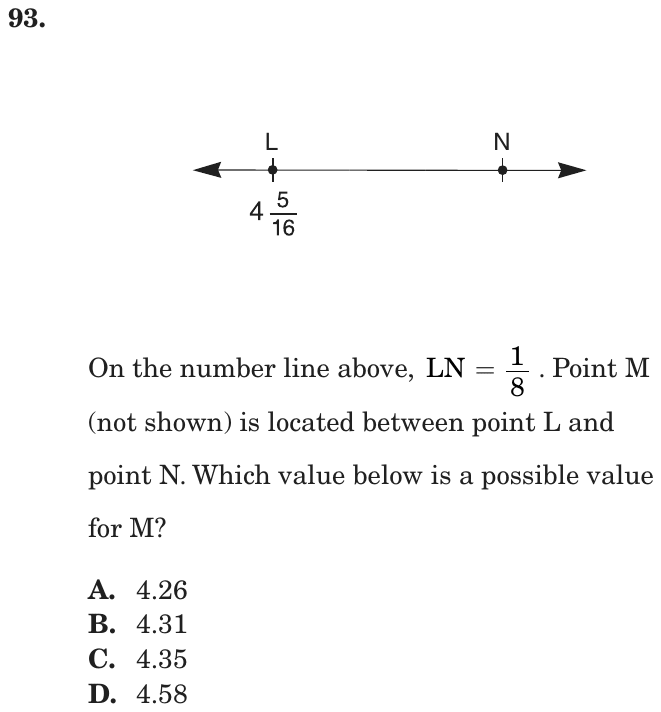
Question 94 of 120
2018 Test A Math, question 37Question
An unmarked straight stick will be laid end over end to measure a distance of exactly 72 feet. The same stick will be used in the same way to measure a distance of exactly 30 feet. What is the length of the longest possible stick that can be used for both measurements?
- A3 ft
- B4 ft
- C6 ft
- D8 ft
Show the answer
Correct answer: C
The length of the stick must be the greatest common factor of 72 and 30.
The factors of 30 are
1, 2, 3, 5, 6, 10, 15, and 30.
Of those, only 1, 2, 3, and 6 are also factors of 72. The greatest of these is 6.
Question analysis
This word problem asks for the longest stick that can be laid end over end to measure exactly 72 feet and exactly 30 feet. Students must recognize that the stick's length has to divide both distances evenly, so the task is finding a greatest common factor. The story wording hides the factor idea.
- NYS standards
- 6.NS.4 common factors and multiples
- Grade level
- Grade 6 content, by NYS standard
- Compared with grade 7
- Below grade 7 Finding a greatest common factor is a sixth-grade skill, and the arithmetic is light. The question is a little less routine than a bare factor problem only because students must see that the story calls for one.
- Estimated difficulty
- Straightforward: two steps or one careful reading.
- Thinking it demands
- Depth of knowledge 2, skills and concepts · mainly apply
- What makes it hard
- No obvious method moderate
- Hard words minor
- Solution
- 2 steps
- Reading level
- Question and choices: about grade 3, 54 words.
- Students, last 30 days
- Not enough answers yet to show (it takes 10).
Why it is hard, traps and wrong answers (shows the answer)
Why it is hard
Once the story is recognized as a greatest common factor problem, the arithmetic is light and the choices can simply be tested. The trap is checking only one of the two distances, because the longest choice works for 72 feet but not for 30. A student who lists the factors of 30 first, the smaller number, sees the answer quickly.
No obvious method moderate Working it out
Nothing in the stick story says "common factor"; students must see that laying the stick a whole number of times along 72 and 30 feet means it divides both. (Schoenfeld, 1985)
Hard words minor Understanding the question
The phrases "unmarked straight stick" and "laid end over end" are unusual wording for a math item; they describe whole-stick lengths, a reading hurdle rather than more math. (Perfetti, 2007; Freedle & Kostin, 1993)
Strategy: Translate 'measures both distances exactly' into 'divides both numbers evenly', list the factors of the smaller number, 30, and take the largest that also divides 72.
Traps
- Misreads the question: Misses or misreads a condition or a word in the question: "at least", "each", "remaining", "not".
- Answers a different question: A choice is right for another quantity: the other unknown, the rest instead of the part, the part instead of the whole.
The wrong answers, classified
A Answers a different question (King et al., 2004; Hegarty, Mayer & Monk, 1995)
Finds a length that divides both 72 and 30, 3 feet, but not the longest one, missing that 6 also divides both.
B Misreads the question (Hegarty, Mayer & Monk, 1995)
Checks only that 4 divides 72, giving 18 sticks, and misses that 30 feet would take 7.5 sticks.
D Misreads the question (Hegarty, Mayer & Monk, 1995)
Takes the longest choice that divides 72 evenly, nine 8-foot lengths, without checking that 30 feet is not a whole number of 8-foot sticks.
Worked solution, step by step
Formulas used
- Number of sticks
- d is the distance to measure. s is the length of the stick. n is how many times you lay the stick down. For an exact measure, n must be a whole number. So s must divide d evenly.
Sort out the story
You lay a stick down again and again, end to end, like taking steps. The stick has no marks, so you can only count whole stick lengths.
It must fit exactly into 72 feet and exactly into 30 feet. You need the longest stick that does both.
Turn it into factors
Fitting exactly means no piece is left over. So the stick length must divide 72 evenly and divide 30 evenly.
A number that divides both is a common factor. You want the greatest common factor: the biggest number that divides both.
List the factors of 30
Start with the smaller number, 30, since its list is shorter. Its factors are 1, 2, 3, 5, 6, 10, 15 and 30.
Now test them on 72, starting from the biggest. 30, 15, 10 and 5 leave a remainder. But 6 works:
So 6 is the greatest common factor.
Check the other choices
Watch out: 8 feet fits 72 feet, 9 times. But 30 ÷ 8 = 3.75, not a whole number, so choice D fails. Choice B fails too, since 30 ÷ 4 = 7.5. A 3-foot stick works, but it is not the longest, so choice A is wrong.
So the answer is C, 6 ft.
Check your answer
Use the stick. A 6-foot stick goes down 12 times for 72 feet, since 12 × 6 = 72. It goes down 5 times for 30 feet, since 5 × 6 = 30. Both counts are whole numbers, so 6 feet works.
More questions like this
The original DOE question
Question 95 of 120
2018 Test A Math, question 38Question
Ryan must read 150 pages for school this weekend. It took him 30 minutes to read the first 20 pages. At this rate, how much additional time will it take him to finish the reading?
- A
- B
- C
- D
Show the answer
Correct answer: B
Ryan has 130 pages left to read (150 − 20). He read 20 pages in 30 minutes, which means he read at a rate of 40 pages per 1 hour. To find out how much longer it will take him to finish the assignment, divide the total number of pages remaining (130) by the number of pages he is able to read per hour (40):
Question analysis
This reading-rate word problem says Ryan read 20 of his 150 pages in 30 minutes and asks how much additional time he needs to finish at that rate. Students must find the pages left, use the rate, and convert minutes to hours. The word 'additional' is easy to overlook.
- Grade level
- Grade 6 content, by NYS standard
- Compared with grade 7
- At grade 7 Unit rate problems like this are grade 6 content and common in grade 7. It adds a subtraction step and a conversion to hours, and the word 'additional' must be read closely, which keeps it at grade 7 level.
- Estimated difficulty
- Moderate: several steps, or a close reading with one strong distractor.
- Thinking it demands
- Depth of knowledge 2, skills and concepts · mainly apply
- What makes it hard
- Many steps moderate
- A very close wrong answer moderate
- An answer in an unexpected form minor
- Solution
- 3 steps
- Reading level
- Question and choices: about grade 3, 36 words.
- Students, last 30 days
- Not enough answers yet to show (it takes 10).
Why it is hard, traps and wrong answers (shows the answer)
Why it is hard
The bold word "additional" carries the question, and missing it costs the point even when the rate work is perfect. The rate itself mixes pages, minutes and hours, so students who skip writing units drift into answers that count half-hour blocks or minutes as hours. Subtracting the pages already read before anything else keeps the work on the right quantity.
Many steps moderate Working it out
The solution chains four moves: subtract the 20 pages read, double 20 pages per half hour to 40 per hour, divide 130 by 40, and write the result in hours. (Daniel & Embretson, 2010; Enright, Morley & Sheehan, 2002)
A very close wrong answer moderate Choosing the answer
The choices 3 1/4 and 3 3/4 hours differ by exactly the half hour already spent on the first 20 pages, so only subtracting those pages first separates them. (Embretson & Wetzel, 1987; Gorin & Embretson, 2006; Ascalon et al., 2007)
An answer in an unexpected form minor Choosing the answer
A student who works in minutes gets 195 minutes and must convert it to the mixed number 3 1/4 hours to find it among the choices. (Enright, Morley & Sheehan, 2002)
Strategy: Subtract the pages already read, work out how many pages he reads per hour, and divide the remaining pages by that hourly rate.
Traps
- Answers a different question: A choice is right for another quantity: the other unknown, the rest instead of the part, the part instead of the whole.
- Units or scale: The answer is wanted in other units, or a rate or scale must be converted first.
The wrong answers, classified
A Units or scale (King et al., 2004)
Divides the 130 remaining pages by 60, treating the rate as one page a minute, which gives 2 1/6 hours.
C Answers a different question (King et al., 2004; Hegarty, Mayer & Monk, 1995)
Times all 150 pages at 40 pages an hour, ignoring the bold "additional", and gets the whole assignment's 3 3/4 hours instead of the time left.
D Units or scale (King et al., 2004)
Divides 150 pages by 20 to get 7.5 blocks of reading and reports them as hours, though each 20-page block takes half an hour.
Worked solution, step by step
Formulas used
- Time from a rate
- t is the time needed. p is the number of pages to read. r is the rate: the pages read in one hour. Dividing tells you how many hours of reading the pages need.
Sort out what you know
Ryan must read 150 pages in all. He read the first 20 pages in 30 minutes. The word additional is in bold. It means extra time, after the 30 minutes he already spent.
So you need the time for the pages he has not read yet.
Find the pages left
He still has 130 pages to read. Watch out: timing all 150 pages gives hours, which is choice C. That counts pages he already read.
Find his rate per hour
The choices are in hours, so find how many pages he reads in an hour. 30 minutes is half an hour. In a full hour he reads twice as much:
His rate is 40 pages per hour.
Divide the pages by the rate
Dividing tells you how many hours the 130 pages take at 40 pages an hour:
It will take more hours. So the answer is B, hr.
Check your answer
Work in minutes. 130 pages is 6.5 groups of 20 pages. Each group takes 30 minutes, so 6.5 × 30 = 195 minutes. That is 3 hours and 15 minutes. And 15 minutes is a quarter of an hour, so it matches.
More questions like this
The original DOE question
Question 96 of 120
2018 Test A Math, question 39Question
Suppose , , and , and do not equal 0. What is in terms of , and ?
- A
- B
- C
- D
Show the answer
Correct answer: C
It is easier to rewrite
as
since they are both fractions.
Question analysis
This algebra question defines M and N as fractions built from the letters w, x, y and z, and asks for M divided by N in terms of those letters. Students must divide one fraction by another using only variables. Without numbers to check against, it is easy to multiply instead of divide or flip the wrong fraction.
- Grade level
- Grade 7 content, by NYS standard
- Compared with grade 7
- At grade 7 Grade 7 students divide numeric fractions such as 2/3 ÷ 4/5. This item applies the same rule with four letters instead of numbers, which adds abstraction but no new steps.
- Estimated difficulty
- Straightforward: two steps or one careful reading.
- Thinking it demands
- Depth of knowledge 1, recall and reproduction · mainly apply
- What makes it hard
- Variables instead of numbers moderate
- A very close wrong answer moderate
- Solution
- 2 steps
- Reading level
- Question and choices: about grade 10, 23 words.
- Students, last 30 days
- Not enough answers yet to show (it takes 10).
Why it is hard, traps and wrong answers (shows the answer)
Why it is hard
This is fraction division in disguise, and students who recognize M/N as M ÷ N need one rule. The difficulty is that every choice is built from the same four letters, so a wrong rule still produces something that looks like a reasonable answer. Substituting small numbers, such as w = 1, x = 2, y = 3 and z = 4, checks the result in seconds.
Variables instead of numbers moderate Understanding the question
All four letters stand for unknown nonzero numbers, so dividing w/x by y/z must be done symbolically, with no value to check the result against. (Koedinger & Nathan, 2004; Enright, Morley & Sheehan, 2002)
A very close wrong answer moderate Choosing the answer
All four choices arrange w, x, y and z as one fraction, and xy/wz is wz/xy turned over, so only carrying out the division in the right order tells them apart. (Embretson & Wetzel, 1987; Gorin & Embretson, 2006; Ascalon et al., 2007)
Strategy: Rewrite M/N as M ÷ N, then multiply by the reciprocal of the second fraction; substituting small numbers for the letters checks the result.
Traps
- A faulty procedure: A systematic but wrong procedure: adding fractions straight across, applying an exponent to each term of a sum, dropping a sign when moving a term.
- Wrong operation: Adds instead of multiplying, divides the wrong way round, turns a ratio or rate upside down, or undoes a step in the wrong direction (subtracts what should be added back).
The wrong answers, classified
A Numbers taken from the question (Hegarty, Mayer & Monk, 1995)
Stacks M's letters over N's letters, writing wx over yz, without carrying out any fraction division.
B Wrong operation (Hegarty, Mayer & Monk, 1995; King et al., 2004)
Multiplies M by N straight across, top times top and bottom times bottom, instead of dividing.
D A faulty procedure (Brown & Burton, 1978; Tatsuoka, 1983)
Flips the first fraction instead of the second, computing x/w × y/z, which gives N divided by M.
Worked solution, step by step
Formulas used
- Dividing fractions
- a, b, c and d are numbers that are not 0. To divide by a fraction, multiply by its reciprocal (the fraction flipped upside down). It works because dividing by a number is the same as multiplying by 1 over that number.
- Multiplying fractions
- a and c are the tops and b and d are the bottoms. Multiply the tops together and the bottoms together. Use it after you flip the second fraction.
Sort out what you know
M is the fraction w over x. N is the fraction y over z. The letters stand for numbers that are not 0.
The fraction bar in means M divided by N. So you must divide one fraction by another.
Write it as a division
Rewrite the big fraction as a division. Then put in the fractions for M and N. This lets you use the rule for dividing fractions:
Flip the second fraction
Use the rule for dividing fractions. Keep the first fraction. Flip only the second one, and change divide to multiply:
Watch out: flipping the first fraction instead gives choice D, which is N ÷ M. Multiplying without flipping at all gives choice B.
Multiply across
Multiply the tops and the bottoms:
Here wz means w times z. So the answer is C, .
Check your answer
Try small numbers. Let w = 1, x = 2, y = 3 and z = 4. Then M = 1/2 and N = 3/4. So M ÷ N = 1/2 × 4/3 = 4/6. Choice C gives (1 × 4) ÷ (2 × 3) = 4/6 too. They match.
More questions like this
The original DOE question
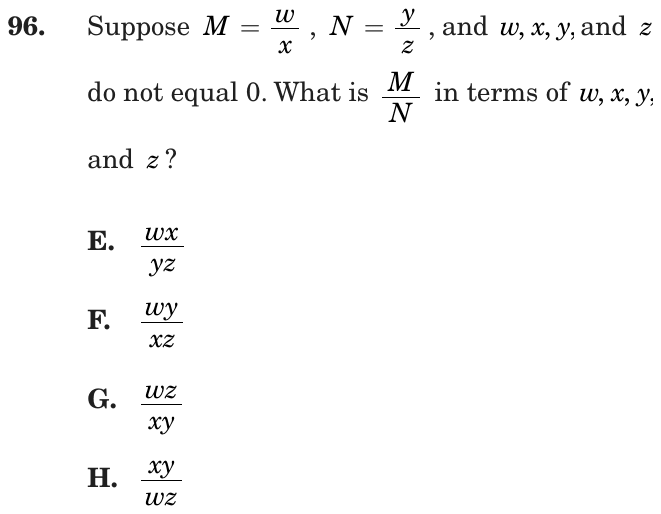
Question 97 of 120
2018 Test A Math, question 40Question
In the set of consecutive integers from 12 to 30, inclusive, there are four integers that are multiples of both 2 and 3. How many integers in this set are multiples of neither 2 nor 3?
- A5
- B6
- C13
- D15
Show the answer
Correct answer: B
The question asks for integers from 12 to 30 that are not divisible by 2 or 3. The set of consecutive integers is
{12, 13, 14, 15, 16, 17, 18, 19, 20, 21, 22, 23, 24, 25, 26, 27, 28, 29, 30}
Since all even numbers are divisible by 2, eliminate all even numbers, leaving the odd numbers in the set:
{13, 15, 17, 19, 21, 23, 25, 27, 29}
Eliminate those integers that are multiples of 3 (15, 21, and 27). The remaining integers are:
{13, 17, 19, 23, 25, 29}
Therefore, there are 6 numbers in the set that are multiples of neither 2 nor 3.
Question analysis
This number properties question takes the integers from 12 to 30, inclusive, and asks how many are multiples of neither 2 nor 3. Students must count the whole set, remove multiples of 2 and of 3 without removing any number twice, and count what remains. Inclusive endpoints and the overlap make it easy to miscount.
- NYS standards
- 6.NS.4 common factors and multiples
- Grade level
- Grade 6 content, by NYS standard
- Compared with grade 7
- Above grade 7 Multiples are sixth-grade content, but grade 7 problems rarely ask students to count a set under two overlapping conditions. The inclusive range and the numbers that are multiples of both make this longer and trickier than usual.
- Estimated difficulty
- Hard: combines ideas, needs a plan, and has more than one tempting wrong answer.
- Thinking it demands
- Depth of knowledge 2, skills and concepts · mainly apply
- What makes it hard
- Much to keep track of moderate
- A very close wrong answer moderate
- Solution
- 3 steps
- Reading level
- Question and choices: about grade 9, 30 words.
- Students, last 30 days
- Not enough answers yet to show (it takes 10).
Why it is hard, traps and wrong answers (shows the answer)
Why it is hard
The question gives the overlap, four multiples of both 2 and 3, which invites a subtraction method with three places to go wrong: the count of the set, the overlap, and the final complement. Each of those errors has its own choice. Listing the 19 numbers and crossing out evens and then odd multiples of 3 is slower to describe but faster and safer to do.
Much to keep track of moderate Working it out
Each of the 19 integers must be checked against two conditions, and the four multiples of 6 meet both, so they must be removed once, not twice. (Sweller, 1988; Carpenter, Just & Shell, 1990)
A very close wrong answer moderate Choosing the answer
The choices 5 and 6 differ by one, the result of counting 30 − 12 = 18 integers instead of 19, so only counting the inclusive set exactly separates them. (Embretson & Wetzel, 1987; Gorin & Embretson, 2006; Ascalon et al., 2007)
Strategy: Cross out every even number first, then cross out the odd multiples of 3 that remain, and count the survivors; listing all nineteen numbers is quick enough.
Traps
- Answers a different question: A choice is right for another quantity: the other unknown, the rest instead of the part, the part instead of the whole.
- Counting the ends: Inclusive or exclusive ends, fence posts, consecutive numbers: an answer that is one too many or too few, or an endpoint drawn open where it belongs closed (or the reverse).
The wrong answers, classified
A Counting the ends (Brown & Burton, 1978)
Counts 30 − 12 = 18 integers instead of 19, then subtracts the 13 multiples of 2 or 3 and gets 5.
C Answers a different question (King et al., 2004; Hegarty, Mayer & Monk, 1995)
Counts the integers that are multiples of 2 or 3, the 13 to be crossed out, and gives that count instead of the 6 left over.
D Misreads the question (Hegarty, Mayer & Monk, 1995)
Subtracts only the four multiples of both 2 and 3 from the 19 integers, reading "neither 2 nor 3" as "not both 2 and 3".
Worked solution, step by step
Formulas used
- Counting whole numbers in a list
- a is the first number and b is the last. n is how many whole numbers there are, counting both ends. You add 1 because subtracting counts the gaps, and there is one more number than gaps.
Sort out the question
The set is every integer (whole number) from 12 to 30. “Inclusive” means 12 and 30 are both in.
A multiple of 2 is an even number. A multiple of 3 is a number in the 3 times table. You need the numbers that are neither: not even, and not in the 3 times table.
Count the numbers in the set
There are 19 integers. Watch out: 30 − 12 = 18 forgets one end. That slip leads to choice A, 5.
Cross out the even numbers
Every even number is a multiple of 2, so remove them all. The odd numbers are left:
13, 15, 17, 19, 21, 23, 25, 27, 29
That is 9 numbers.
Cross out the multiples of 3
Check each odd number for 3. A quick test: add its digits. If the sum is in the 3 times table, so is the number. That removes 15, 21 and 27. These are left:
13, 17, 19, 23, 25, 29
Watch out: only 12, 18, 24 and 30 are multiples of both. Removing just those gives 19 − 4 = 15, choice D. “Neither” means you remove every multiple of 2 and every multiple of 3.
Count what is left
Six numbers are left. Watch out: 13 is how many you crossed out, choice C. The question asks for the ones left. So the answer is B, 6.
Check your answer
Count another way. Of the 19 numbers, 10 are even. Of the 9 odd ones, 3 are multiples of 3. So 10 + 3 = 13 are crossed out, and 19 − 13 = 6 are left. Same answer.
More questions like this
The original DOE question
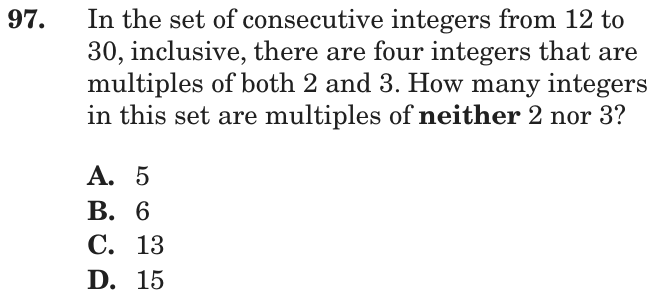
Question 98 of 120
2018 Test A Math, question 41Question
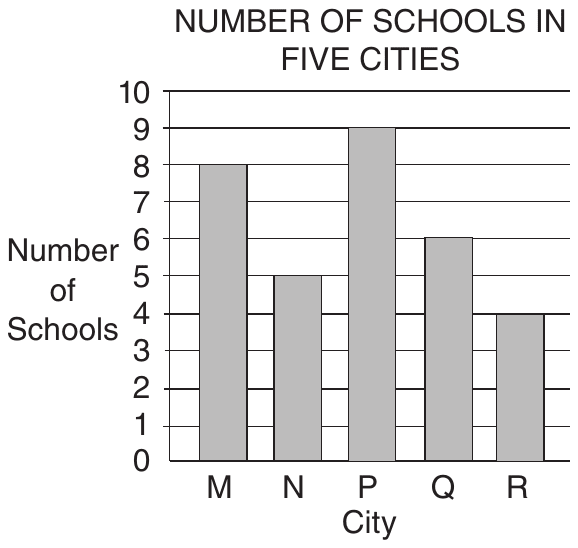
The graph above shows the number of schools per city for five small cities. Cities M and N each have 500 students per school. City P has 400 students per school. Cities Q and R each have 700 students per school. Which of the five cities has the greatest number of students?
- ACity M
- BCity P
- CCity Q
- DCity R
Show the answer
Correct answer: C
Take each city’s number of schools and multiply by the number of students. It is not necessary to calculate all 5 of these.
Cities M and N have the same number of students per school, so just calculate the number of students in City M because it has more schools than City N.
The same goes for Q and R — only Q needs to be calculated because it has more schools than R.
M= 8 × 500 = 4,000
P = 9 × 400 = 3,600
Q = 6 × 700 = 4,200
City Q has the greatest number of students.
Question analysis
This graph question shows the number of schools in each of five small cities and gives the number of students per school for each city. Students multiply schools by students per school to compare the total number of students. Comparing only the bars, or only the rates, can mislead.
- Grade level
- Grade 6 content, by NYS standard
- Compared with grade 7
- Below grade 7 Reading a bar graph and multiplying is familiar from grade 6. Grade 7 data tasks often add percents or compare distributions; this one needs only a few whole-number products, so it is easier than typical grade 7 work.
- Estimated difficulty
- Straightforward: two steps or one careful reading.
- Thinking it demands
- Depth of knowledge 2, skills and concepts · mainly apply
- What makes it hard
- A very close wrong answer moderate
- Much to keep track of minor
- Reading a figure, table or graph minor
- Solution
- 3 steps
- Reading level
- Question and choices: about grade 2, 57 words.
- Corrected from the DOE handbook
- A misstatement in the explanation was corrected.
- Students, last 30 days
- Not enough answers yet to show (it takes 10).
Why it is hard, traps and wrong answers (shows the answer)
Why it is hard
Neither the tallest bar nor the highest rate wins, which is the point of the question: total students depend on both. The explanation's shortcut, comparing only M, P and Q because N and R each share a rate with a taller bar, cuts the work to three products. The top two totals are close, so the products must actually be computed rather than estimated.
A very close wrong answer moderate Choosing the answer
City M's 4,000 students and City Q's 4,200 differ by only 200, so judging from bar heights and rates cannot separate them; only computing 8 × 500 and 6 × 700 does. (Embretson & Wetzel, 1987; Gorin & Embretson, 2006; Ascalon et al., 2007)
Much to keep track of minor Working it out
The rates come in three groups in the stem, 500 for M and N, 400 for P, 700 for Q and R, and each must be matched to its bar. (Sweller, 1988; Carpenter, Just & Shell, 1990)
Reading a figure, table or graph minor Understanding the question
The number of schools comes only from the bar heights, read against gridlines from 0 to 10; all five bars end exactly on a gridline. (Lesh, Post & Behr, 1987; Kirsch & Mosenthal, 1990)
Strategy: For each city, multiply the number of schools read from the graph by its students per school and compare the products; cities that share a rate need only their school counts compared.
Traps
- Stops one step early: A choice is a number from partway through the solution.
- Answers a different question: A choice is right for another quantity: the other unknown, the rest instead of the part, the part instead of the whole.
The wrong answers, classified
A Stops one step early (King et al., 2004; Gierl et al., 2017)
Computes M's 8 × 500 = 4,000 and P's 9 × 400 = 3,600 and stops, never working out Q's 6 × 700 = 4,200.
B Answers a different question (King et al., 2004; Hegarty, Mayer & Monk, 1995)
Picks the tallest bar, P's nine schools, which answers which city has the most schools rather than the most students.
D Numbers taken from the question (Hegarty, Mayer & Monk, 1995)
Picks a city with the stem's highest rate, 700 students per school, without noticing that R has only 4 schools to Q's 6.
What was corrected from the DOE handbook, and why
- Explanation: The handbook says “Cities M and N have the same number of students”. They have the same number of students per school (500), not the same total: M has 8 × 500 = 4,000 and N has 5 × 500 = 2,500, which is why only City M, with more schools, needs to be calculated. The sentence now says “the same number of students per school”.
Worked solution, step by step
Formulas used
- Total students in a city
- S is the total number of students in a city. n is the number of schools, read from the bar. s is the number of students in each school. You multiply because every school in that city has the same number of students.
Read the graph
The bar graph shows how many schools each city has. Read the top of each bar against the numbers on the left. M has 8, N has 5, P has 9, Q has 6 and R has 4.
The question gives the students per school. You need the city with the most students in all.
Multiply for each city
Use the formula for each city:
City Schools Students per school Total students M 8 500 4,000 N 5 500 2,500 P 9 400 3,600 Q 6 700 4,200 R 4 700 2,800 Compare the totals
The biggest total is 4,200, for City Q.
Watch out: City P has the tallest bar, but that means the most schools, not the most students. That leads to choice B. City M’s 4,000 is close, so do not stop before you work out Q. That is choice A.
So the answer is C, City Q.
Check your answer
A shortcut: M and N both have 500 per school, and M has more schools, so M beats N. Q and R both have 700, and Q beats R. So only M, P and Q matter: 4,000, 3,600 and 4,200. Q still wins.
More questions like this
The original DOE question
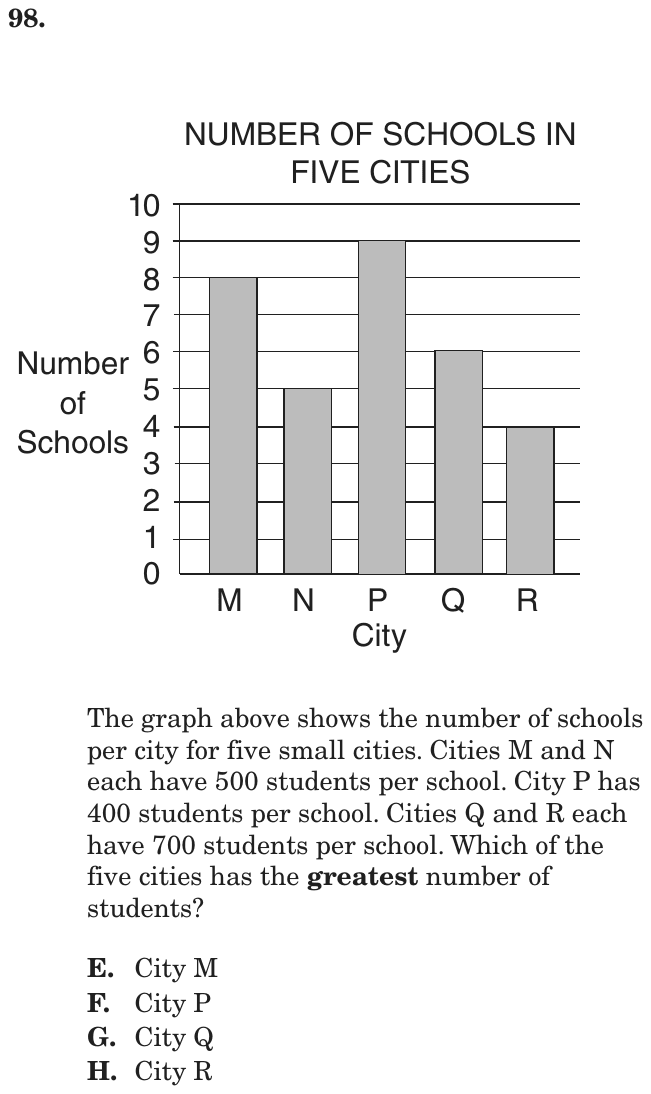
Question 99 of 120
2018 Test A Math, question 42Question
A box contains 5 strawberry candies, 3 banana candies, and 2 orange candies. If Braden selects 2 candies at random from this box, without replacement, what is the probability that both candies are not banana?
- A
- B
- C
- D
Show the answer
Correct answer: C
The total number of candies in the box is
5 + 3 + 2 = 10
The number of candies that are not banana is
5 + 2 = 7
The probability of the first candy not being banana is
Now, out of 9 candies, there are 6 candies left that are not banana. The probability of the second candy not being banana is
Multiply these two probabilities to get the solution:
Question analysis
This probability question has a box of strawberry, banana and orange candies and asks the chance that two candies drawn without replacement are both not banana. Students must count the non-banana candies, find the chance for each draw, and multiply. The second draw changes because one candy is already gone.
- NYS standards
- 7.SP.8a compound event as fraction of outcomes
- Grade level
- Grade 7 content, by NYS standard
- Compared with grade 7
- Above grade 7 Grade 7 compound probability usually uses lists or tree diagrams for independent events such as coins and number cubes. Here the draws are dependent, and students must also work with the complement, 'not banana'.
- Estimated difficulty
- Hard: combines ideas, needs a plan, and has more than one tempting wrong answer.
- Thinking it demands
- Depth of knowledge 2, skills and concepts · mainly apply
- What makes it hard
- Combines ideas moderate
- A very close wrong answer moderate
- Error-prone arithmetic minor
- Solution
- 3 steps
- Reading level
- Question and choices: about grade 9, 35 words.
- Corrected from the DOE handbook
- A stray punctuation mark in the explanation was removed.
- Students, last 30 days
- Not enough answers yet to show (it takes 10).
Why it is hard, traps and wrong answers (shows the answer)
Why it is hard
Two phrases in the stem change the calculation, "not" and "without replacement", and each has a choice for the student who misses it. The cleanest approach treats strawberry and orange together as one group of 7 and then works through the two draws in order. Students who know independent probability well are the most likely to square a fraction out of habit.
Combines ideas moderate Working it out
Two ideas meet: counting the 7 non-banana candies as the favorable group, and reducing both counts by one for the dependent second draw. (Embretson, 1998; Daniel & Embretson, 2010)
A very close wrong answer moderate Choosing the answer
The choices 49/100 and 7/15 are about 0.49 and 0.47, so estimating cannot separate them; only noticing that the second draw is 6 of 9, not 7 of 10, does. (Embretson & Wetzel, 1987; Gorin & Embretson, 2006; Ascalon et al., 2007)
Error-prone arithmetic minor Working it out
The product 7/10 × 6/9 = 42/90 must be simplified to 7/15 to match a choice, a reduction by 6 that is easy to stall on. (Brown & Burton, 1978; Junker & Sijtsma, 2001)
Strategy: Count the candies that are not banana, find the chance the first draw is one of them, reduce both counts by one for the second draw, and multiply.
Traps
- Without replacement: In a second pick there is one fewer item, which changes the probability.
- Misreads the question: Misses or misreads a condition or a word in the question: "at least", "each", "remaining", "not".
The wrong answers, classified
A Misreads the question (Hegarty, Mayer & Monk, 1995)
Misses the bold "not" and finds the chance that both candies are banana, 3/10 × 2/9 = 6/90 = 1/15.
B Without replacement (Fischbein & Schnarch, 1997)
Squares 3/10, finding two bananas as if the first candy were put back, which misses both "not" and "without replacement".
D Without replacement (Fischbein & Schnarch, 1997)
Squares 7/10 as if the first candy were returned, keeping 7 of 10 for the second draw instead of 6 of 9.
What was corrected from the DOE handbook, and why
- Explanation: The handbook reads “The probability of the second candy not being banana is. 6/9.” The period after “is” was removed.
Worked solution, step by step
Formulas used
- Probability
- P is the probability, the chance that something happens. f is the number of favorable outcomes, the ones you want. t is the total number of outcomes. It works when every outcome is equally likely, like picking one item at random.
- Two picks in a row
- To find the chance that two things both happen, multiply their chances. For the second chance, use what is left after the first pick. You multiply because you want a fraction of a fraction: the second pick must work in the share of times the first one did.
Sort out what you know
The box has 5 strawberry, 3 banana and 2 orange candies. Braden takes 2 candies. “Without replacement” means he keeps the first candy out. He does not put it back.
You need the chance that neither candy is banana. Watch out: the bold “not” matters. The chance that both are banana is , choice A.
Count the candies
There are 10 candies. The ones that are not banana are the strawberry and orange ones:
Find the chance for the first candy
7 of the 10 candies are not banana. Use the probability formula:
So the first candy is not banana 7 times out of 10.
Find the chance for the second candy
Say the first candy was not banana. Now 9 candies are left, and 6 of them are not banana:
Watch out: the first candy is not put back. Using again gives , choice D.
Multiply the two chances
Simplify by dividing the top and bottom by 6:
So the answer is C, .
Check your answer
Count pairs instead. From 10 candies there are 10 × 9 ÷ 2 = 45 different pairs. Pairs with no banana come from the 7 others: 7 × 6 ÷ 2 = 21. And 21 out of 45 is 7/15. It matches.
More questions like this
The original DOE question
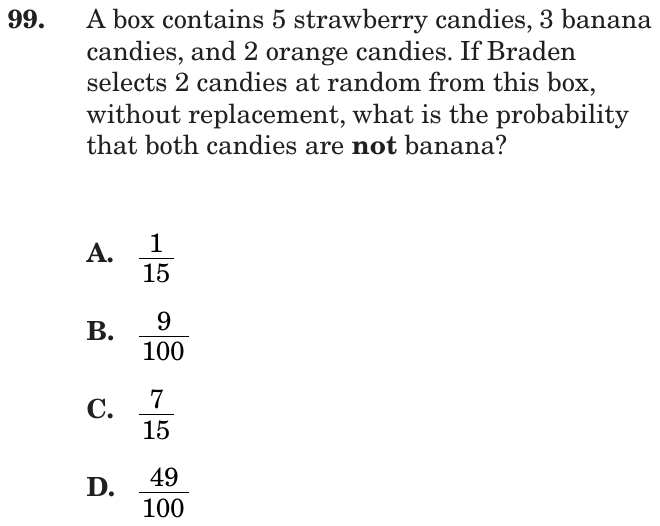
Question 100 of 120
2018 Test A Math, question 43Question
In the equation above, , and are positive numbers. Which of these is equal to ?
- A
- B
- C
- D
Show the answer
Correct answer: D
Solve the equation for :
Question analysis
This algebra question gives the proportion w/x = y/z, with all four letters positive, and asks which expression equals z. Students must solve the equation for one letter in terms of the others. With only letters on the page, it is easy to multiply when you should divide or to stop one step early.
- Grade level
- Grade 8 content, by NYS standard
- Compared with grade 7
- Above grade 7 Grade 7 students cross-multiply numeric proportions such as 3/4 = 9/x. Solving a proportion made only of letters for one of them is a literal equation, a grade 8 algebra skill, though it takes just two steps.
- Estimated difficulty
- Straightforward: two steps or one careful reading.
- Thinking it demands
- Depth of knowledge 1, recall and reproduction · mainly apply
- What makes it hard
- Variables instead of numbers moderate
- A very close wrong answer moderate
- Solution
- 2 steps
- Reading level
- Question and choices: about grade 10, 22 words.
- Students, last 30 days
- Not enough answers yet to show (it takes 10).
Why it is hard, traps and wrong answers (shows the answer)
Why it is hard
The method, cross-multiply and divide, is the same one students use on numeric proportions, but letters hide whether each step went the right way. The two most attractive wrong choices are both one step from the answer: one never divides, and the other divides upside down. A quick check with 2/3 = 4/6, where z = 6, settles it.
Variables instead of numbers moderate Understanding the question
The proportion has only letters, so cross-multiplying to wz = xy and dividing by w must be done without numbers to show whether w goes on top or bottom. (Koedinger & Nathan, 2004; Enright, Morley & Sheehan, 2002)
A very close wrong answer moderate Choosing the answer
The choices w/(xy) and xy/w use the same three letters with the fraction turned over, so only dividing in the right direction after wz = xy separates them. (Embretson & Wetzel, 1987; Gorin & Embretson, 2006; Ascalon et al., 2007)
Strategy: Cross-multiply to clear both fractions, then divide both sides by whatever multiplies z; check with a true proportion such as 2/3 = 4/6.
Traps
- Wrong operation: Adds instead of multiplying, divides the wrong way round, turns a ratio or rate upside down, or undoes a step in the wrong direction (subtracts what should be added back).
- Stops one step early: A choice is a number from partway through the solution.
The wrong answers, classified
A Numbers taken from the question (Hegarty, Mayer & Monk, 1995)
Matches z with x because both sit in a denominator, picking a letter from the equation without solving for z.
B Stops one step early (King et al., 2004; Gierl et al., 2017)
Cross-multiplies to wz = xy but stops there, giving xy without dividing both sides by w.
C Wrong operation (Hegarty, Mayer & Monk, 1995; King et al., 2004)
Cross-multiplies correctly but divides the wrong way round, putting w over xy instead of xy over w.
Worked solution, step by step
Formulas used
- Cross-multiplying
- a, b, c and d are numbers that are not 0. When two fractions are equal, each top times the other bottom gives the same answer. It works because you multiply both sides by both bottoms, which clears the fractions.
Sort out what you need
The equation says w over x equals y over z. All four letters are positive numbers. You need to get z alone on one side. Then the other side shows what z equals.
Cross-multiply the fractions
Multiply each top by the other fraction’s bottom:
So wz = xy, and z is no longer on the bottom. Watch out: stopping here and picking xy gives choice B. z is not alone yet.
Get z alone
z is being multiplied by w. To undo that, divide both sides by w. Doing the same to both sides keeps them equal:
Watch out: dividing the wrong way round gives w over xy, choice C. So the answer is D, .
Check your answer
Use a true pair of equal fractions: 2/3 = 4/6. So w = 2, x = 3, y = 4 and z = 6. Choice D gives 3 × 4 ÷ 2 = 6, which is z. Choice C gives 2 ÷ 12, which is not 6.
More questions like this
The original DOE question
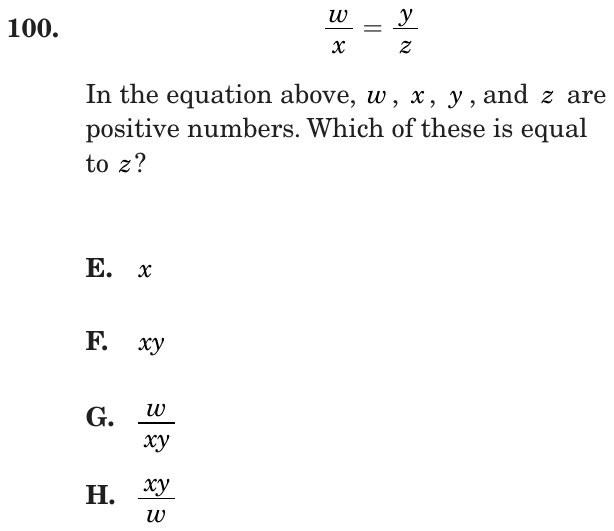
Question 101 of 120
2018 Test A Math, question 44Question

On the number line above, points , , , and are integers, and . What is the value of ?
- A8
- B11
- C12
- D18
Show the answer
Correct answer: C
Convert the ratios into fractions of . Use the sum of the ratios for the denominator.
The part of that is is the sum of those fractions:
Find the length of :
The value of is .
Question analysis
This number line question places integer points W, X, Y and Z on a line and gives the ratio of the segments WX, XY and YZ as 4 to 2 to 3. Students find the whole length from W to Z, split it by the ratio, and add the parts that make up WY. Mixing up a part with the whole is the main risk.
- Grade level
- Grade 7 content, by NYS standard
- Compared with grade 7
- Above grade 7 Grade 7 students find distances on a number line and use part-to-whole ratios, usually separately. This item joins them: a negative endpoint, a three-term ratio and a choice of which segments to combine.
- Estimated difficulty
- Hard: combines ideas, needs a plan, and has more than one tempting wrong answer.
- Thinking it demands
- Depth of knowledge 2, skills and concepts · mainly apply
- What makes it hard
- Combines ideas moderate
- Reading a figure, table or graph moderate
- Many steps minor
- Solution
- 3 steps
- Reading level
- Question and choices: about grade 10, 21 words.
- Corrected from the DOE handbook
- Equations in the explanation that mixed up a fraction of a length with the length itself were corrected.
- Students, last 30 days
- Not enough answers yet to show (it takes 10).
Why it is hard, traps and wrong answers (shows the answer)
Why it is hard
Each step is routine, but the question keeps asking for a different piece of the line: the whole WZ, the part WX, and finally WY, which is two parts added together. Two of the wrong choices are exactly those other pieces. Students who mark the actual positions, X at −2 and Y at 2, can check the ratio before answering.
Combines ideas moderate Working it out
A three-part ratio, 4:2:3, must be applied to a length found from a negative endpoint, 8 − (−10) = 18, joining ratio and number-line distance. (Embretson, 1998; Daniel & Embretson, 2010)
Reading a figure, table or graph moderate Understanding the question
Only W at −10 and Z at 8 are labeled, and the drawing is not to scale: Y is drawn nearer 5 than 2, so reading WY from the picture fails. (Lesh, Post & Behr, 1987; Kirsch & Mosenthal, 1990)
Many steps minor Working it out
Find WZ, split it into 9 equal parts of 2, then add the 4 parts of WX and the 2 parts of XY. (Daniel & Embretson, 2010; Enright, Morley & Sheehan, 2002)
Strategy: Find the length WZ from the endpoints on the number line, divide it by the total number of ratio parts, and multiply by the parts from W to Y.
Traps
- Stops one step early: A choice is a number from partway through the solution.
- Answers a different question: A choice is right for another quantity: the other unknown, the rest instead of the part, the part instead of the whole.
- Counting the ends: Inclusive or exclusive ends, fence posts, consecutive numbers: an answer that is one too many or too few, or an endpoint drawn open where it belongs closed (or the reverse).
The wrong answers, classified
A Stops one step early (King et al., 2004; Gierl et al., 2017)
Finds WX, 4/9 of 18 = 8, and stops without adding XY's 4 to reach Y; 8 also matches Z's label.
B Counting the ends (Brown & Burton, 1978)
Places Y at 2 but counts the integers strictly between −10 and 2, which are −9 through 1, getting 11 instead of the distance 12.
D Answers a different question (King et al., 2004; Hegarty, Mayer & Monk, 1995)
Gives the whole length WZ, 8 − (−10) = 18, instead of the part from W to Y.
What was corrected from the DOE handbook, and why
- Explanation: The handbook writes WX = 4/9, XY = 2/9 and WY = 2/3, and then says “The value of WY is 2/3(18) = 12”. Those fractions are parts of WZ, not the lengths themselves (WX is 8 and WY is 12), so WY cannot be both 2/3 and 12. The lines now read WX = 4/9 WZ, XY = 2/9 WZ and WY = 2/3 WZ. The method and the answer are unchanged.
Worked solution, step by step
Formulas used
- Distance on a number line
- d is the distance between two points. b is the point on the right and a is the point on the left. Subtracting left from right always gives a positive distance. It works even when a is negative.
- Size of one part of a ratio
- u is the size of one part. L is the whole length being shared. p is the total number of parts, found by adding the numbers in the ratio. Every part is the same size, so you share the length equally.
Sort out what you know
W is at −10 and Z is at 8. X and Y are between them. The ratio 4:2:3 means WX is 4 parts, XY is 2 parts and YZ is 3 parts. All the parts are the same size.
You need the length WY, from W to Y. The drawing is not exact, so use the numbers, not the picture.
Find the whole length WZ
WZ is 18 units long. Subtracting a negative number is the same as adding.
Find the size of one part
Add the ratio numbers to get the number of parts:
Share the 18 units equally among 9 parts:
Each part is 2 units long.
Find WY
WY is WX and XY together, so it has 4 + 2 = 6 parts:
Watch out: WX alone is 4 × 2 = 8, which is choice A. And 18 is the whole line, choice D. So the answer is C, 12.
Check your answer
Place the points. W is at −10. X is 8 units to the right, at −2. Y is 4 more, at 2. Z is 6 more, at 8, which matches its label. And the distance from −10 to 2 is 2 − (−10) = 12.
More questions like this
The original DOE question
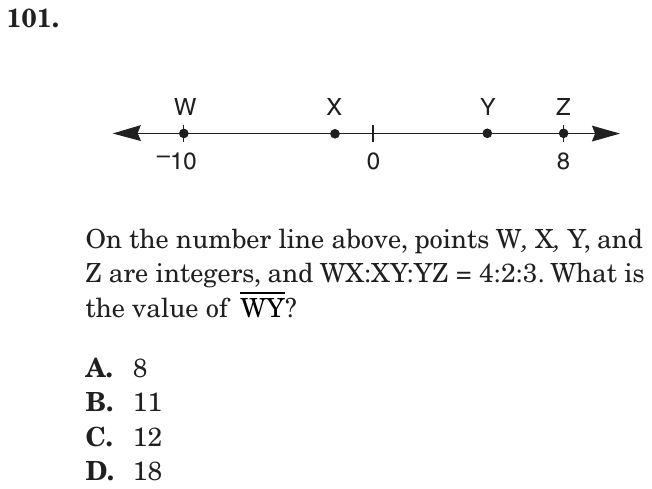
Question 102 of 120
2018 Test A Math, question 45Question
A metal square used in an electronic device must have a thickness of 0.02 inch, with an allowable error of 1 percent. What is the greatest allowable thickness of the metal square?
- A0.0002 in.
- B0.02 in.
- C0.0202 in.
- D0.03 in.
Show the answer
Correct answer: C
Find 1% of 0.02:
The greatest allowable thickness would be
inch.
Question analysis
This percent question says a metal square must be 0.02 inch thick with an allowable error of 1 percent, and asks for the greatest allowable thickness. Students must find 1 percent of a small decimal and add it to the target thickness. Keeping track of decimal places is what makes it tricky.
- Grade level
- Grade 7 content, by NYS standard
- Compared with grade 7
- At grade 7 Percent error and tolerance problems appear in grade 7, so the idea is on level. The demand comes from taking a percent of a tiny decimal and adding the result, where a slipped decimal place is easy to miss.
- Estimated difficulty
- Moderate: several steps, or a close reading with one strong distractor.
- Thinking it demands
- Depth of knowledge 2, skills and concepts · mainly apply
- What makes it hard
- Error-prone arithmetic moderate
- Turning words into math moderate
- A very close wrong answer minor
- Solution
- 2 steps
- Reading level
- Question and choices: about grade 4, 34 words.
- Students, last 30 days
- Not enough answers yet to show (it takes 10).
Why it is hard, traps and wrong answers (shows the answer)
Why it is hard
The idea of tolerance is simple, but the numbers are tiny, and the question turns on what the 1 percent is a percent of. Students who read it as 0.01 inch land on a choice that looks sensible, and those who find the error correctly may stop before adding it. Writing 0.02 × 1.01 in one step avoids both.
Error-prone arithmetic moderate Working it out
One percent of 0.02 is 0.0002, two more decimal places, and adding it to 0.02 needs the places lined up to get 0.0202. (Brown & Burton, 1978; Junker & Sijtsma, 2001)
Turning words into math moderate Understanding the question
The phrase "allowable error of 1 percent" must be read as 1 percent of 0.02 inch, added for the greatest thickness, not 1 percent as a fixed 0.01 inch. (Hegarty, Mayer & Monk, 1995; Koedinger & Nathan, 2004)
A very close wrong answer minor Choosing the answer
The choices 0.0202, 0.02 and 0.0002 are built from the same digits, and the first two differ by only 1 percent, so only careful counting of decimal places tells them apart. (Embretson & Wetzel, 1987; Gorin & Embretson, 2006; Ascalon et al., 2007)
Strategy: Find 1 percent of 0.02 by dividing by 100, counting decimal places carefully, then add that error to 0.02 to get the upper limit.
Traps
- Stops one step early: A choice is a number from partway through the solution.
- Misunderstands the concept: A wrong belief about a concept: that percents can be added, that area grows like length, that averages can be averaged, that a bigger denominator means a bigger fraction.
The wrong answers, classified
A Stops one step early (King et al., 2004; Gierl et al., 2017)
Finds the allowable error, 1 percent of 0.02 = 0.0002 inch, and stops without adding it to the target thickness.
B Numbers taken from the question (Hegarty, Mayer & Monk, 1995)
Gives the target thickness from the stem, 0.02 inch, ignoring that the allowed error permits a slightly thicker square.
D Misunderstands the concept (Smith, diSessa & Roschelle, 1993; De Bock et al., 1998; Ni & Zhou, 2005)
Treats 1 percent as 0.01 inch, a percent of 1 inch rather than of 0.02 inch, and adds it to get 0.03.
Worked solution, step by step
Formulas used
- Percent of a number
- x is the part you want. p is the percent. n is the whole amount. Percent means out of 100, so p percent of a number is p hundredths of it.
Sort out what you know
The square should be 0.02 inch thick. An allowable error of 1 percent means it may be off by up to 1 percent of 0.02 inch. It may be that much thinner or thicker.
You need the greatest allowed thickness, so look at the thicker side.
Find 1 percent of 0.02
Dividing by 100 moves the decimal point two places to the left. So the error is 0.0002 inch.
Watch out: 1 percent here is not 0.01 inch. It is 1 percent of 0.02 inch. Adding 0.01 gives 0.03, which is choice D.
Add the error to the thickness
The thickest square is the right size plus the error. Line up the decimal points:
Watch out: 0.0002 is only the error, choice A. You must add it to 0.02. So the answer is C, 0.0202 in.
Check your answer
0.0202 is just a tiny bit more than 0.02, which makes sense for a small error. Check it: 0.0202 − 0.02 = 0.0002. And 0.0002 ÷ 0.02 = 0.01, which is 1 percent.
More questions like this
The original DOE question
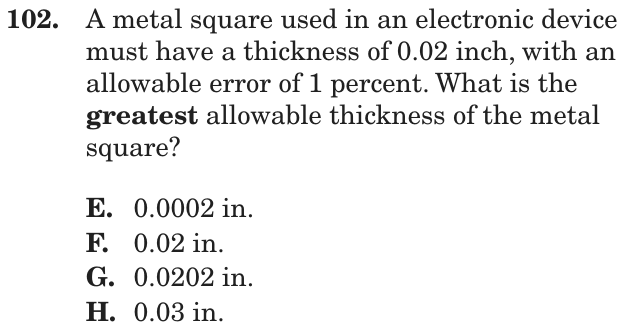
Question 103 of 120
2018 Test A Math, question 46Question
SCORES ON BIOLOGY TEST
| Section | Lowest Score | Range |
| I | 65 | 28 |
| II | 62 | 25 |
| III | 67 | 22 |
Mr. Blake’s biology class is divided into three sections. The same test was given to each section. The table above shows both the lowest score and the range of scores on this test for each section. What is the overall range of all scores in all three sections?
- A25
- B27
- C28
- D31
Show the answer
Correct answer: D
First, calculate the highest score for each section by adding the lowest score to the range:
Section I: 65 + 28 = 93
Section II: 62 + 25 = 87
Section III: 67 + 22 = 89
The overall highest score is 93, and the overall lowest score is 62. Thus the overall range is 93 − 62 = 31.
Question analysis
This statistics question uses a table of the lowest score and the range for three sections of a biology class and asks for the range of all the scores combined. Students must rebuild each section's highest score from its lowest score and range, then compare across sections. Reversing the usual range calculation is the tricky part.
- Grade level
- Grade 6 content, by NYS standard
- Compared with grade 7
- At grade 7 Grade 7 students compute a range from a list of data. Here they must work backward from range to the highest score in each section and then combine three groups, one step beyond routine.
- Estimated difficulty
- Moderate: several steps, or a close reading with one strong distractor.
- Thinking it demands
- Depth of knowledge 2, skills and concepts · mainly apply
- What makes it hard
- No obvious method moderate
- A very close wrong answer moderate
- Much to keep track of minor
- Solution
- 3 steps
- Reading level
- Question and choices: about grade 2, 59 words.
- Students, last 30 days
- Not enough answers yet to show (it takes 10).
Why it is hard, traps and wrong answers (shows the answer)
Why it is hard
Range is usually computed from a list, so working backward from it is the unfamiliar part. The key fact, that the overall lowest and highest scores come from different sections, is invisible until all three highest scores are written down. Every wrong choice comes from skipping that step and reasoning with the ranges as given.
No obvious method moderate Working it out
The table gives each section's lowest score and range but no highest score, so students must reverse the range formula, high = low + range, before comparing sections. (Schoenfeld, 1985)
A very close wrong answer moderate Choosing the answer
The choices 28 and 27 sit within 4 of 31, so a sense of the spread cannot separate them; only rebuilding the highest scores, which puts the top at 93, does. (Embretson & Wetzel, 1987; Gorin & Embretson, 2006; Ascalon et al., 2007)
Much to keep track of minor Working it out
The overall lowest, 62, comes from Section II and the overall highest, 93, from Section I, so values from two rows must be combined. (Sweller, 1988; Carpenter, Just & Shell, 1990)
Strategy: Add each section's range to its lowest score to get its highest score, then subtract the lowest of all scores from the highest of all scores.
Traps
- Answers a different question: A choice is right for another quantity: the other unknown, the rest instead of the part, the part instead of the whole.
The wrong answers, classified
A Misunderstands the concept (Smith, diSessa & Roschelle, 1993; De Bock et al., 1998; Ni & Zhou, 2005)
Averages the three section ranges, (28 + 25 + 22) ÷ 3 = 25, as if the overall range were a typical section's range.
B Answers a different question (King et al., 2004; Hegarty, Mayer & Monk, 1995)
Leaves Section I out, taking the top score as Section III's 67 + 22 = 89, which gives the range of Sections II and III only.
C Answers a different question (King et al., 2004; Hegarty, Mayer & Monk, 1995)
Takes Section I's range, 28, the largest in the table, giving one section's spread instead of the spread across all three.
Worked solution, step by step
Formulas used
- Range
- R is the range, the spread of the scores. H is the highest score and L is the lowest score. The range tells how far apart the top and bottom scores are. If you know L and R, then H = L + R.
Sort out what you know
The table gives each section’s lowest score and its range. The range is the highest score minus the lowest score.
The bold overall means one range for all three sections together. For that you need the highest and lowest scores of all.
Find each section’s highest score
Turn the range formula around: highest = lowest + range.
Section Lowest Range Highest I 65 28 65 + 28 = 93 II 62 25 62 + 25 = 87 III 67 22 67 + 22 = 89 Pick the overall highest and lowest
The highest score of all is 93, from Section I. The lowest score of all is 62, from Section II. They come from different sections, and that is fine.
Subtract to find the range
Watch out: 28 is just Section I’s range, choice C. Averaging the three ranges gives 25, choice A. Neither covers all the scores at once.
So the answer is D, 31.
Check your answer
The overall range must be at least as big as each section’s range, because it covers all their scores. 31 is bigger than 28, 25 and 22, so it is reasonable. Also, 62 + 31 = 93, the top score.
More questions like this
The original DOE question
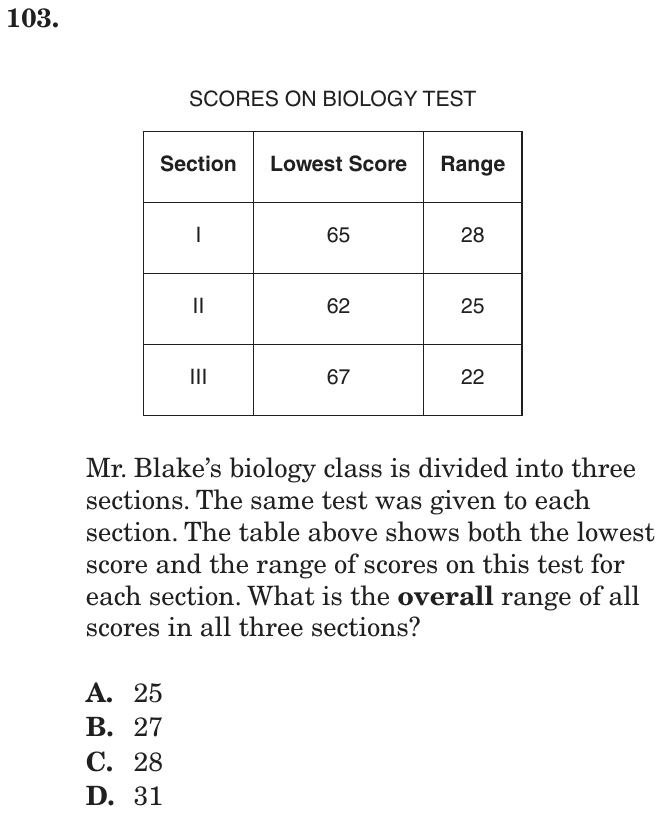
Question 104 of 120
2018 Test A Math, question 47Question
If is a positive even number, how many odd numbers are in the range from up to and including ?
- A2
- B3
- C4
- D5
Show the answer
Correct answer: B
Since is even, then must be odd.
Thus and are also odd.
So there are a total of 3 numbers in this range that are odd.
Question analysis
This number properties question says 3n is a positive even number and asks how many odd numbers lie from 3n up to and including 3n + 5. Students must decide which integers in that span are odd. The coefficient in 3n is a distraction; only the fact that 3n is even matters.
- Grade level
- Grade 6 content, by NYS standard
- Compared with grade 7
- At grade 7 Grade 7 students work with expressions like 3n + 5 but rarely reason about whether they are even or odd. The idea is simple once the integers are written out, so the demand is about typical for grade 7.
- Estimated difficulty
- Straightforward: two steps or one careful reading.
- Thinking it demands
- Depth of knowledge 2, skills and concepts · mainly apply
- What makes it hard
- Variables instead of numbers moderate
- Something you must already know minor
- A very close wrong answer minor
- Solution
- 2 steps
- Reading level
- Question and choices: about grade 12, 22 words.
- Students, last 30 days
- Not enough answers yet to show (it takes 10).
Why it is hard, traps and wrong answers (shows the answer)
Why it is hard
Writing the six integers from 3n to 3n + 5 and marking them even, odd, even, odd, even, odd answers the question in seconds. The traps come from not writing them: dropping the last one, which "up to and including" keeps in, or reading the 5 in 3n + 5 as a count. Picking any even value for 3n, such as 6, makes the check concrete.
Variables instead of numbers moderate Understanding the question
No value of n is given, so students must reason about parity: since 3n is even, 3n + 1, 3n + 3 and 3n + 5 are the odd ones. (Koedinger & Nathan, 2004; Enright, Morley & Sheehan, 2002)
Something you must already know minor Working it out
The parity rules, even plus odd is odd and even plus even is even, are assumed; the coefficient 3 is a distraction once 3n is said to be even. (Anderson & Krathwohl, 2001)
A very close wrong answer minor Choosing the answer
The choices 2, 3, 4 and 5 are consecutive counts, so 2 and 3 cannot be told apart by sizing up; only checking whether 3n + 5 is inside the range separates them. (Embretson & Wetzel, 1987; Gorin & Embretson, 2006; Ascalon et al., 2007)
Strategy: Write out every integer from 3n to 3n + 5, mark 3n as even, alternate even and odd from there, and count the odd ones.
Traps
- Counting the ends: Inclusive or exclusive ends, fence posts, consecutive numbers: an answer that is one too many or too few, or an endpoint drawn open where it belongs closed (or the reverse).
The wrong answers, classified
A Counting the ends (Brown & Burton, 1978)
Leaves out 3n + 5, stopping before the last number although "up to and including" keeps it, and counts only 3n + 1 and 3n + 3.
C Misunderstands the concept (Smith, diSessa & Roschelle, 1993; De Bock et al., 1998; Ni & Zhou, 2005)
Counts 3n itself as odd because its coefficient 3 is odd, ignoring the stem's statement that 3n is even, and adds it to the three.
D Numbers taken from the question (Hegarty, Mayer & Monk, 1995)
Takes the 5 in 3n + 5 as the count, subtracting the ends instead of listing the six integers and picking out the odd ones.
Worked solution, step by step
Formulas used
- Even plus odd
- An even number splits into pairs. An odd number has one left over. Adding them keeps that one left over, so the sum is odd. So adding 1, 3 or 5 to an even number gives an odd number.
- Even plus even
- Two numbers that each split into pairs still split into pairs when you add them. So adding 2 or 4 to an even number gives an even number.
Sort out what you know
You are told that 3n is even. You do not need to know n itself. You need to count the odd numbers from 3n to 3n + 5.
“Up to and including” means 3n + 5 counts too.
List all the numbers
Go up by 1 each time, from 3n to 3n + 5. That gives six numbers:
Mark each as even or odd
3n is even. Adding 1, 3 or 5 makes it odd. Adding 2 or 4 keeps it even.
Number Even or odd even odd even odd even odd Watch out: 3n is even because the question says so. The 3 being odd does not matter. Counting 3n as odd gives choice C, 4.
Count the odd numbers
The odd ones are 3n + 1, 3n + 3 and 3n + 5. That is 3 numbers.
Watch out: leaving out 3n + 5 gives 2, choice A. It is the last number, and it is included. So the answer is B, 3.
Check your answer
Try a real number. If n = 2, then 3n = 6, which is even. The numbers from 6 to 11 are 6, 7, 8, 9, 10 and 11. The odd ones are 7, 9 and 11. That is 3.
More questions like this
The original DOE question
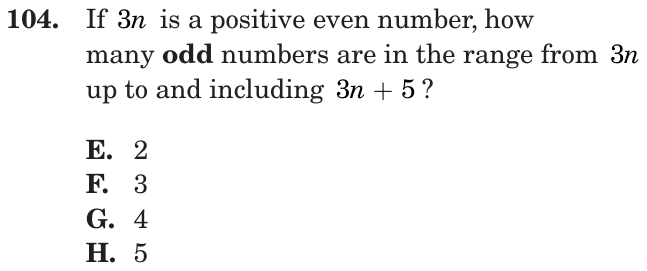
Question 105 of 120
2018 Test A Math, question 48Question
In the infinitely repeating decimal above, 7 is the first digit in the repeating pattern. What is the 391st digit?
- A0
- B3
- C6
- D7
Show the answer
Correct answer: D
There are 6 digits in the repeating decimal (769230), so 7 would be the first, seventh, thirteenth digit and so on.
To find the 391st digit, divide 391 by 6.
391 ÷ 6 = 65 R1
Since the remainder is 1, that means the 391st digit is the same as the 1st digit, which is 7.
Question analysis
This repeating decimal question shows the six-digit repeating pattern of 10/13 and asks for the 391st digit after the decimal point. Students must use the length of the repeating block and division with a remainder to find the position within the cycle. Matching the remainder to the right digit is where students slip.
- Grade level
- Grade 7 content, by NYS standard
- Compared with grade 7
- Above grade 7 Seventh graders learn that fractions have repeating decimals. Using the length of the repeating block and a remainder to find a digit hundreds of places away is a pattern-reasoning step beyond typical seventh-grade classwork.
- Estimated difficulty
- Hard: combines ideas, needs a plan, and has more than one tempting wrong answer.
- Thinking it demands
- Depth of knowledge 2, skills and concepts · mainly apply
- What makes it hard
- No obvious method moderate
- Solution
- 2 steps
- Reading level
- Question and choices: about grade 8, 20 words.
- Students, last 30 days
- Not enough answers yet to show (it takes 10).
Why it is hard, traps and wrong answers (shows the answer)
Why it is hard
Once the cycle length is used, the arithmetic is a single division, 391 ÷ 6 = 65 remainder 1. The difficulty is turning the remainder into a position: remainder 1 is the first digit of a new block, not the last digit of the previous one or the second of the new one. Checking the rule on small positions, the 1st and 7th digits are both 7, removes the doubt.
No obvious method moderate Working it out
Nothing in the stem mentions division; students must see that the six-digit block 769230 repeats, so position 391 depends only on the remainder of 391 divided by 6. (Schoenfeld, 1985)
Strategy: Divide 391 by the length of the repeating block and look only at the remainder; a remainder of r points to the r-th digit of the block.
Traps
- Counting the ends: Inclusive or exclusive ends, fence posts, consecutive numbers: an answer that is one too many or too few, or an endpoint drawn open where it belongs closed (or the reverse).
The wrong answers, classified
A Counting the ends (Brown & Burton, 1978)
Sees that 65 blocks fill 390 places and lands on the 390th digit, the 0 that ends a block, one place short.
B A faulty procedure (Brown & Burton, 1978; Tatsuoka, 1983)
Uses the quotient 65 instead of the remainder, takes its last digit 5, and reads the fifth digit of 769230, which is 3.
C Counting the ends (Brown & Burton, 1978)
Treats the remainder 1 as one step past the block's first digit, moving from 7 to the second digit, 6.
Worked solution, step by step
Formulas used
- Division with a remainder
- n is the number you divide. d is what you divide by. q is the quotient, the number of whole groups. r is the remainder, what is left over. Here it tells how many full blocks of digits fit, and where you land after them.
Sort out what you know
The bar over 769230 means those six digits repeat forever: 769230769230 and so on. The 7 is digit number 1. You need digit number 391.
Spot the pattern
The block 769230 has 6 digits, so the pattern starts over every 6 digits. Digit 1 is 7, and so are digits 7, 13, 19 and so on. Each full block ends with a 0, at digits 6, 12, 18 and so on.
Divide 391 by 6
Find how many full blocks fit into 391 digits, and what is left:
So 65 full blocks use up 6 × 65 = 390 digits. The remainder is 1. That means digit 391 is the 1st digit of the next block.
Read the digit
The 1st digit of the block is 7. Watch out: digit 390 is the last digit of a full block, which is 0. That is choice A. Digit 391 is one step past it, so it starts a new block.
So the answer is D, 7.
Check your answer
Test the idea on a small number. Digit 7: 7 = 6 × 1 + 1, so the remainder is 1 and the digit should be 7. Write it out: 7692307. The 7th digit is indeed 7. The rule works.
More questions like this
The original DOE question
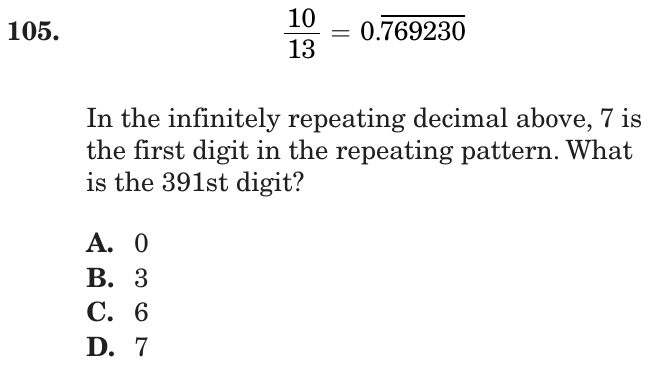
Question 106 of 120
2018 Test A Math, question 49Question
A car travels at 4,400 feet per minute. The radius of each tire on the car is 1 foot. How many revolutions does one of these tires make in 1 minute? (Use the approximation for .)
- A700
- B1,925
- C13,828
- D15,400
Show the answer
Correct answer: A
One revolution is equal to the circumference of the tire:
ft
The car travels at 4,400 ft per minute. To calculate the number of revolutions, divide the speed by the circumference:
700 revolutions.
Question analysis
This circle word problem says a car travels 4,400 feet per minute on tires with a radius of 1 foot and asks how many revolutions each tire makes in a minute, using 22/7 for pi. Students must see that one revolution covers the tire's circumference, then divide. Dividing by a fraction is the step to check.
- Grade level
- Grade 7 content, by NYS standard
- Compared with grade 7
- At grade 7 Circumference is grade 7 content. This item adds the idea that each revolution rolls the tire one circumference forward and requires dividing by a fraction, which is typical of a solid grade 7 application problem.
- Estimated difficulty
- Moderate: several steps, or a close reading with one strong distractor.
- Thinking it demands
- Depth of knowledge 2, skills and concepts · mainly apply
- What makes it hard
- Turning words into math moderate
- Something you must already know moderate
- Error-prone arithmetic minor
- Solution
- 2 steps
- Reading level
- Question and choices: about grade 5, 34 words.
- Students, last 30 days
- Not enough answers yet to show (it takes 10).
Why it is hard, traps and wrong answers (shows the answer)
Why it is hard
The question tests whether students connect distance traveled to turns of a wheel, a link the stem leaves unstated. Every wrong choice is larger than the answer, and two exceed 4,400, which is impossible when each turn covers more than 6 feet. A sense check on size rules those out before any fraction work, leaving only the division by 44/7 to do carefully.
Turning words into math moderate Understanding the question
The stem never says that one revolution rolls the car forward one circumference; students must supply that link to turn 4,400 feet into a count of turns. (Hegarty, Mayer & Monk, 1995; Koedinger & Nathan, 2004)
Something you must already know moderate Working it out
The circumference formula, C = 2πr, is not given; with r = 1 and 22/7 for π it gives 44/7 feet per turn. (Anderson & Krathwohl, 2001)
Error-prone arithmetic minor Working it out
Dividing 4,400 by 44/7 means multiplying by 7/44, which is clean only if students see that 4,400 ÷ 44 = 100 before multiplying by 7. (Brown & Burton, 1978; Junker & Sijtsma, 2001)
Strategy: Find the distance covered in one turn with the circumference formula, 2πr, then divide the distance traveled in a minute by that circumference.
Traps
- A formula you must know: Needs a formula the test does not give: area, circumference, volume, probability rules.
The wrong answers, classified
B Little reason to choose it (Haladyna & Downing, 1993; Rodriguez, 2005)
No standard path gives 1,925, which equals 4,400 × 7 ÷ 16, so it mostly draws students guessing a mid-sized count.
C Wrong operation (Hegarty, Mayer & Monk, 1995; King et al., 2004)
Multiplies 4,400 by π, 22/7, instead of dividing by the circumference, and truncates 13,828.57 to 13,828.
D An arithmetic slip (Junker & Sijtsma, 2001)
Divides 4,400 by 2/7 instead of 44/7, dropping the 22 of π while flipping 2 × 22/7, which gives 4,400 × 7 ÷ 2.
Worked solution, step by step
Formulas used
- Circumference of a circle
- C is the circumference, the distance around a circle. r is the radius, from the center to the edge. π (pi) is about 22/7. The distance around is a bit more than 3 times the distance across, which is 2 × r.
- Number of turns
- n is the number of turns. d is the distance the car travels. C is the circumference. Each full turn rolls the car forward one circumference, so you divide the distance by it.
Sort out what you know
The car goes 4,400 feet in 1 minute. Each tire has a radius of 1 foot. A revolution is one full turn of the tire. You need how many turns a tire makes in 1 minute.
Find how far one turn goes
When a tire turns once, the car rolls forward the distance around the tire. That distance is the circumference. Use for π:
One turn moves the car feet, about 6.3 feet.
Divide the distance by one turn
To divide by a fraction, multiply by its reciprocal (the fraction flipped upside down):
Notice that 4,400 ÷ 44 = 100. That makes it easy.
Give the answer
The tire makes 700 turns. Watch out: multiplying 4,400 by π instead of dividing by the circumference gives about 13,828, choice C. So the answer is A, 700.
Check your answer
Estimate. One turn is about 6 feet. 4,400 ÷ 6 is about 730, close to 700. There should be fewer turns than feet, since each turn covers several feet. Choices C and D are bigger than 4,400, so they cannot be right.
More questions like this
The original DOE question
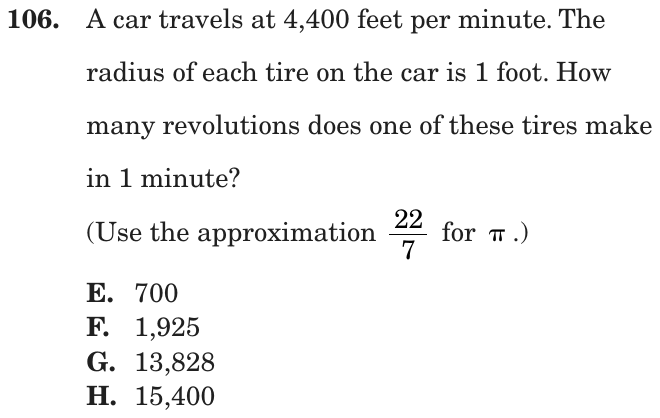
Question 107 of 120
2018 Test A Math, question 50Question
- A101
- B200
- C301
- D341
Show the answer
Correct answer: D
Question analysis
This order of operations question asks students to evaluate 100(2 + 0.1)² − 100, an expression with a decimal, a square and a subtraction. Students must add inside the parentheses first, square the result, multiply by 100, and then subtract. Squaring the two parts of the sum separately is the trap.
- Grade level
- Grade 6 content, by NYS standard
- Compared with grade 7
- Below grade 7 Evaluating an expression with an exponent and decimals in the correct order is grade 6 content. This is a short routine calculation, so it asks less than typical grade 7 work with negative numbers and multi-step equations.
- Estimated difficulty
- Straightforward: two steps or one careful reading.
- Thinking it demands
- Depth of knowledge 1, recall and reproduction · mainly apply
- What makes it hard
- A very close wrong answer moderate
- Error-prone arithmetic minor
- Solution
- 3 steps
- Reading level
- Question and choices: about grade 16+, 1 words.
- Students, last 30 days
- Not enough answers yet to show (it takes 10).
Why it is hard, traps and wrong answers (shows the answer)
Why it is hard
This is a direct order-of-operations calculation with no word problem around it, so the only real risk is the square of a sum. Students who apply the exponent to each part, or only to the 0.1, find a listed answer waiting. Adding inside the parentheses before squaring, and then squaring 2.1 exactly, is the whole task.
A very close wrong answer moderate Choosing the answer
The choices 301 and 341 differ by 40, and squaring 2.1 roughly as 4 lands nearer 301; only the exact square, 4.41, separates them. (Embretson & Wetzel, 1987; Gorin & Embretson, 2006; Ascalon et al., 2007)
Error-prone arithmetic minor Working it out
Squaring 2.1 by hand to get 4.41 puts two decimal places in the product, an easy place to misplace the point. (Brown & Burton, 1978; Junker & Sijtsma, 2001)
Strategy: Add inside the parentheses to get a single decimal, square it carefully, then multiply by 100 and subtract 100, following the order of operations.
Traps
- A faulty procedure: A systematic but wrong procedure: adding fractions straight across, applying an exponent to each term of a sum, dropping a sign when moving a term.
- Order of operations: Working left to right, or distributing a minus sign wrongly, gives a choice.
The wrong answers, classified
A Order of operations (Brown & Burton, 1978)
Squares only the 0.1, as if the parentheses were not there, so 100 × 2.01 − 100 gives 101.
B Little reason to choose it (Haladyna & Downing, 1993; Rodriguez, 2005)
No single slip gives 200; it requires (2 + 0.1)² to come out as 3, so it mostly catches guesses.
C A faulty procedure (Brown & Burton, 1978; Tatsuoka, 1983)
Squares each term of the sum separately, 4 + 0.01 = 4.01, instead of squaring 2.1, so 100 × 4.01 − 100 gives 301.
Worked solution, step by step
Formulas used
- Order of operations
- This is the agreed order for doing math steps. Work inside parentheses first, then exponents, then multiply and divide, then add and subtract. Everyone follows it, so a problem has only one answer.
- Squaring a number
- a is any number. The small 2, called an exponent, means multiply the number by itself. So 2.1 squared means 2.1 times 2.1.
Sort out the problem
You need to work out . The 100 right next to the parentheses means 100 times. Follow the order of operations, one step at a time.
Add inside the parentheses
Parentheses come first in the order of operations. So add the numbers inside them:
Now the problem is:
Square 2.1
Work out 21 × 21 = 441, then put in two decimal places, one for each 2.1.
Watch out: do not square the 2 and the 0.1 one at a time. That gives 4 + 0.01 = 4.01, which is wrong. It leads to 301, choice C.
Multiply, then subtract
The exponent is done, so multiply next. Multiplying by 100 moves the decimal point two places to the right. Subtracting comes last:
So the answer is D, 341.
Check your answer
Estimate. 2.1 is a bit more than 2, so its square is a bit more than 4. 100 times that is a bit more than 400. Take away 100 and you get a bit more than 300. 341 fits. Choices A and B are too small.
More questions like this
The original DOE question
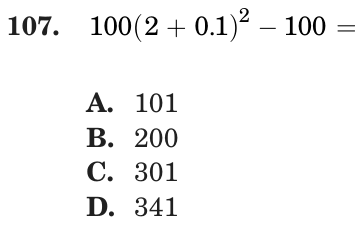
Question 108 of 120
2018 Test A Math, question 51Question
A sports store has a container of handballs: 4 blue, 5 red, 8 yellow, 9 white, and 11 green. If one ball is picked from the container at random, what is the probability that it will be yellow?
- A
- B
- C
- D
Show the answer
Correct answer: C
The total number of handballs in the container is
Since there are 8 yellow handballs, the probability of selecting a yellow handball is
Question analysis
This probability question describes a container of handballs in five colors and asks the chance that one ball picked at random is yellow. Students must add all the balls to get the total and compare the yellow count to it. Using the wrong total, such as only the balls that are not yellow, is the easy mistake.
- NYS standards
- 6.SP.8a uniform probability models
- Grade level
- Grade 6 content, by NYS standard
- Compared with grade 7
- Below grade 7 Finding the probability of a single event as favorable outcomes over total outcomes is grade 6 content. This item takes one addition and one fraction, so it is easier than typical grade 7 compound probability work.
- Estimated difficulty
- Routine: one familiar step, little to misread.
- Thinking it demands
- Depth of knowledge 2, skills and concepts · mainly apply
- What makes it hard
- Solution
- 2 steps
- Reading level
- Question and choices: about grade 5, 37 words.
- Students, last 30 days
- Not enough answers yet to show (it takes 10).
Why it is hard, traps and wrong answers (shows the answer)
Why it is hard
This is a one-event probability: add the five colors to get 37 balls and put the 8 yellow ones over that total. The only real decision is the denominator, and the wrong choices offer the non-yellow count, the yellow count, and a numerator of 1. Students who say "favorable over total" to themselves avoid all three.
A very close wrong answer minor Choosing the answer
The choices 8/37 and 8/29 share the numerator 8 and differ only in the denominator, all 37 balls against the 29 that are not yellow. (Embretson & Wetzel, 1987; Gorin & Embretson, 2006; Ascalon et al., 2007)
Strategy: Add up every ball in the container to get the total number of outcomes, then put the number of yellow balls over that total.
Traps
- Misunderstands the concept: A wrong belief about a concept: that percents can be added, that area grows like length, that averages can be averaged, that a bigger denominator means a bigger fraction.
- Answers a different question: A choice is right for another quantity: the other unknown, the rest instead of the part, the part instead of the whole.
The wrong answers, classified
A Answers a different question (King et al., 2004; Hegarty, Mayer & Monk, 1995)
Finds the 37 balls correctly but puts 1 on top, giving the chance of picking one particular ball rather than any yellow one.
B Numbers taken from the question (Hegarty, Mayer & Monk, 1995)
Puts 1 over the 8 yellow balls, a fraction built from the yellow count alone that ignores the other 29 balls.
D Misunderstands the concept (Smith, diSessa & Roschelle, 1993; De Bock et al., 1998; Ni & Zhou, 2005)
Compares the 8 yellow balls with the 29 that are not yellow, a part-to-part ratio, instead of with all 37 balls.
Worked solution, step by step
Formulas used
- Probability
- P is the probability, the chance that something happens. f is the number of favorable outcomes, the ones you want. t is the total number of outcomes. It works when every outcome is equally likely, like picking one item at random.
Sort out what you know
The container has 4 blue, 5 red, 8 yellow, 9 white and 11 green balls. One ball is picked at random, so every ball has the same chance. You need the chance it is yellow.
Count all the balls
Add up every color, because any ball could be picked:
There are 37 balls in all. That is the total number of outcomes.
Put yellow over the total
8 of the balls are yellow. Those are the favorable outcomes:
Watch out: compares yellow with the 29 balls that are not yellow. Probability compares the part with all the balls, so choice D is wrong. So the answer is C, .
Check your answer
8 out of 37 is about 0.22, a little more than 1 in 5. That makes sense, since yellow is a fair share of the balls. Choice A, 1/37, is the chance of picking one certain ball, not any yellow one.
More questions like this
The original DOE question
Question 109 of 120
2018 Test A Math, question 52Question
Each week, Leon has fixed expenses of $1,250 at his furniture shop. It costs him $150 to make a chair in his shop, and he sells each chair for $275. What is Leon’s profit if he makes and sells 25 chairs in 1 week?
- A$1,875
- B$2,500
- C$3,125
- D$4,375
Show the answer
Correct answer: A
Each chair costs Leon $150 to make, and he sells the chair for $275.
His profit is found by subtracting the cost from the price:
$275 − $150 = $125 per chair
If Leon makes and sells 25 chairs in a week, his initial profit is
25 × $125 = $3,125
However, Leon has additional fixed expenses of $1,250 per week, so this cost must also be subtracted to arrive at the profit. His final profit is
$3,125 − $1,250 = $1,875
Question analysis
This profit word problem gives Leon's weekly fixed expenses at his furniture shop, the cost to make each chair and its selling price, then asks his profit for 25 chairs in one week. Students must find the profit on each chair, multiply, and account for the fixed expenses. Forgetting the fixed expenses, or adding them, are the main slips.
- NYS standards
- Grade level
- Grade 7 content, by NYS standard
- Compared with grade 7
- At grade 7 Multi-step money problems are standard grade 7 work. This one has three whole-number steps and a familiar profit idea, so it matches typical grade 7 demand, with the fixed cost as the detail to remember.
- Estimated difficulty
- Moderate: several steps, or a close reading with one strong distractor.
- Thinking it demands
- Depth of knowledge 2, skills and concepts · mainly apply
- What makes it hard
- Much to keep track of moderate
- Something you must already know minor
- Solution
- 3 steps
- Reading level
- Question and choices: about grade 3, 39 words.
- Students, last 30 days
- Not enough answers yet to show (it takes 10).
Why it is hard, traps and wrong answers (shows the answer)
Why it is hard
The arithmetic is whole-number and friendly, so the question is about bookkeeping: which amounts are income, which are costs, and which happen once a week. The fixed expenses are named first in the stem and are easy to forget by the time the per-chair profit is multiplied. A final check that revenue minus all costs, 6,875 − 3,750 − 1,250, gives the same result confirms it.
Much to keep track of moderate Working it out
Three dollar amounts play different roles, a weekly fixed expense, a cost per chair and a price per chair, and each must enter the profit with the right sign. (Sweller, 1988; Carpenter, Just & Shell, 1990)
Something you must already know minor Working it out
The bold "profit" is not defined; students must know it means money taken in minus every cost, including costs that do not depend on the number of chairs. (Anderson & Krathwohl, 2001)
Strategy: Subtract the cost from the price to get the profit per chair, multiply by the number of chairs, then subtract the week's fixed expenses.
Traps
- Stops one step early: A choice is a number from partway through the solution.
- Wrong operation: Adds instead of multiplying, divides the wrong way round, turns a ratio or rate upside down, or undoes a step in the wrong direction (subtracts what should be added back).
The wrong answers, classified
B Numbers taken from the question (Hegarty, Mayer & Monk, 1995)
Multiplies the $150 cost by 25 chairs and subtracts the $1,250, treating the cost of making a chair as money earned.
C Stops one step early (King et al., 2004; Gierl et al., 2017)
Finds the profit on 25 chairs at $125 each, $3,125, and stops before subtracting the $1,250 fixed expenses.
D Wrong operation (Hegarty, Mayer & Monk, 1995; King et al., 2004)
Adds the $1,250 fixed expenses to the $3,125 chair profit instead of subtracting them, treating an expense as income.
Worked solution, step by step
Formulas used
- Profit
- P is the profit, the money Leon keeps. I is the income, the money he takes in from sales. C is the total cost: every dollar he spends, including fixed expenses. Profit is what is left after all costs are paid.
Sort out what you know
Leon pays $1,250 each week no matter what. These are fixed expenses, like rent. Each chair costs $150 to make, and he sells each one for $275.
He makes and sells 25 chairs. Profit is the money left after paying all the costs.
Find the profit on one chair
Each chair sells for $275 but costs $150 to make. Subtract to see what he keeps:
He keeps $125 on each chair he sells.
Find the profit on 25 chairs
The chairs bring in $3,125 more than they cost to make. Watch out: $3,125 is choice C, but it is not the final profit. The fixed expenses still have to be paid.
Subtract the fixed expenses
Watch out: the $1,250 is money spent, so subtract it. Adding it gives $4,375, choice D. So the answer is A, $1,875.
Check your answer
Work it the long way. Sales: 25 × $275 = $6,875. Costs: 25 × $150 = $3,750, plus $1,250, which makes $5,000. Profit: $6,875 − $5,000 = $1,875. Same answer.
More questions like this
The original DOE question
Question 110 of 120
2018 Test A Math, question 53Question
Using the approximation 2.54 centimeters = 1 inch, how many centimeters are in 4 feet 7 inches?
- A21.65
- B119.38
- C121.92
- D139.70
Show the answer
Correct answer: D
Convert 4 ft 7 in. to inches. Since 12 in. = 1 ft :
4(12) + 7 = 55 inches
Multiply that by the conversion
2.54 cm = 1 in.
55 × 2.54 = 139.70 cm
Question analysis
This unit conversion question uses 2.54 centimeters per inch and asks how many centimeters are in 4 feet 7 inches. Students must first turn feet and inches into inches alone, then multiply by the conversion factor. Mixing feet and inches into a single number is the easy slip.
- Grade level
- Grade 6 content, by NYS standard
- Compared with grade 7
- Below grade 7 Converting measurement units with a given factor is grade 6 content. This item takes two short steps and one decimal multiplication, so it asks a little less than typical grade 7 work, though the mixed units need care.
- Estimated difficulty
- Straightforward: two steps or one careful reading.
- Thinking it demands
- Depth of knowledge 1, recall and reproduction · mainly apply
- What makes it hard
- Solution
- 2 steps
- Reading level
- Question and choices: about grade 13, 12 words.
- Corrected from the DOE handbook
- A missing decimal point in the explanation was restored.
- Students, last 30 days
- Not enough answers yet to show (it takes 10).
Why it is hard, traps and wrong answers (shows the answer)
Why it is hard
The conversion factor is given and the multiplication is mechanical, so the question rests on the mixed measurement. Feet and inches are not a decimal system, and treating 4 feet 7 inches as 47, or dropping the 7, both lead to listed answers. A rough estimate, 55 inches × 2.5 ≈ 137, points straight to the right choice.
Something you must already know minor Working it out
The stem gives centimeters per inch but not inches per foot; students must supply 12 to turn 4 feet into 48 inches. (Anderson & Krathwohl, 2001)
Strategy: Change 4 feet to inches using 12 inches per foot, add the extra 7 inches, then multiply the total number of inches by 2.54.
Traps
- Units or scale: The answer is wanted in other units, or a rate or scale must be converted first.
- Answers a different question: A choice is right for another quantity: the other unknown, the rest instead of the part, the part instead of the whole.
The wrong answers, classified
A Wrong operation (Hegarty, Mayer & Monk, 1995; King et al., 2004)
Divides 55 inches by 2.54 instead of multiplying, converting in the wrong direction and getting fewer centimeters than inches.
B Units or scale (King et al., 2004)
Reads 4 feet 7 inches as 47 inches, as if feet were tens of inches, then multiplies 47 × 2.54 = 119.38.
C Answers a different question (King et al., 2004; Hegarty, Mayer & Monk, 1995)
Converts the 4 feet to 48 inches and multiplies by 2.54, getting 121.92, but leaves out the extra 7 inches.
What was corrected from the DOE handbook, and why
- Explanation: The handbook writes the conversion as “254 cm = 1 in.”, dropping the decimal point. The question gives 2.54 centimeters = 1 inch and the handbook’s next line multiplies by 2.54, so it now reads 2.54 cm = 1 in.
Worked solution, step by step
Formulas used
- Feet to inches
- i is the number of inches and f is the number of feet. Each foot has 12 inches, so you multiply the feet by 12.
- Inches to centimeters
- c is the number of centimeters and i is the number of inches. Each inch is about 2.54 centimeters, so you multiply. A centimeter is smaller than an inch, so you get a bigger number.
Sort out what you know
The length is 4 feet 7 inches. That means 4 feet plus 7 more inches. You know 1 inch is about 2.54 centimeters.
So change everything to inches first, then to centimeters. The question does not say that 1 foot is 12 inches. You have to know it.
Change the length to inches
4 feet is 48 inches. Now add the extra 7 inches:
The length is 55 inches. Watch out: 4 feet 7 inches is not 47 inches. Using 47 gives choice B. Leaving out the 7 inches gives 121.92, choice C.
Change inches to centimeters
To multiply in your head, split 55 into 50 and 5: 127 + 12.7 = 139.7.
Watch out: multiply, do not divide. Dividing 55 by 2.54 gives 21.65, choice A. So the answer is D, 139.70.
Check your answer
A centimeter is smaller than an inch. So the number of centimeters must be bigger than 55. About 2.5 × 55 is 137.5, close to 139.70. Choice A, 21.65, is smaller than 55, so it cannot be right.
More questions like this
The original DOE question
Question 111 of 120
2018 Test A Math, question 54Question
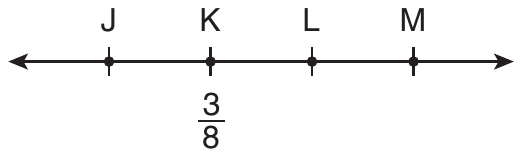
On the number line above, , , and . What is the position of point ?
- A
- B
- C
- D
Show the answer
Correct answer: C
First, use to find the location of :
Now, use to find the location of :
Finally, use to find the location of :
Question analysis
This number line question gives the lengths JK, JM and LM as mixed numbers and asks for the position of point L. Students must chain three distance steps, moving left from K to J, right to M and back to L, with fractions in eighths and a negative position. Losing track of where K sits is the main danger.
- Grade level
- Grade 7 content, by NYS standard
- Compared with grade 7
- Above grade 7 Grade 7 students add and subtract rational numbers and find distances on a number line one at a time. This item chains three such steps with mixed numbers and a negative position, more than typical grade 7 work demands.
- Estimated difficulty
- Among the hardest on the SHSAT: a non-obvious approach, heavy reading, or a well-hidden trap.
- Thinking it demands
- Depth of knowledge 2, skills and concepts · mainly apply
- What makes it hard
- A very close wrong answer major
- Error-prone arithmetic moderate
- Reading a figure, table or graph moderate
- Many steps minor
- Solution
- 4 steps
- Reading level
- Question and choices: about grade 9, 20 words.
- Students, last 30 days
- Not enough answers yet to show (it takes 10).
Why it is hard, traps and wrong answers (shows the answer)
Why it is hard
Every number is a mixed fraction, one position is negative, and the figure's even spacing hides how long KL really is. The distance route, KL = 9 3/4 − 3 1/2 − 1 1/8, avoids the negative entirely but ends one step short of a position unless K's 3/8 is added back. That last step is the one most students skip, which is why the question sits at the top of the scale.
A very close wrong answer major Choosing the answer
The choices 5 1/8, 5 1/4 and 5 1/2 lie within 3/8 of one another, so no estimate separates them; only exact eighths and adding K's 3/8 pick out the right one. (Embretson & Wetzel, 1987; Gorin & Embretson, 2006; Ascalon et al., 2007)
Error-prone arithmetic moderate Working it out
Every step mixes halves, quarters and eighths, and placing J means 3/8 − 3 1/2 = −3 1/8, a subtraction that crosses zero. (Brown & Burton, 1978; Junker & Sijtsma, 2001)
Reading a figure, table or graph moderate Understanding the question
Only K is labeled, and the points are drawn evenly spaced although KL is over four times LM, so the picture gives no help with sizes. (Lesh, Post & Behr, 1987; Kirsch & Mosenthal, 1990)
Many steps minor Working it out
Three linked moves, K to J, J to M and M back to L, each depend on the last, so an early slip carries through. (Daniel & Embretson, 2010; Enright, Morley & Sheehan, 2002)
Strategy: Start from K's labeled position, subtract JK to place J, add JM to place M, then subtract LM, keeping every fraction in eighths.
Traps
- Answers a different question: A choice is right for another quantity: the other unknown, the rest instead of the part, the part instead of the whole.
- Stops one step early: A choice is a number from partway through the solution.
The wrong answers, classified
A Stops one step early (King et al., 2004; Gierl et al., 2017)
Finds KL = 9 3/4 − 3 1/2 − 1 1/8 = 5 1/8 and stops one step short, never adding K's position of 3/8.
B An arithmetic slip (Junker & Sijtsma, 2001)
Rewrites 9 3/4 as 9 4/8 instead of 9 6/8, so M lands at 6 3/8 and L at 6 3/8 − 1 1/8 = 5 1/4.
D Answers a different question (King et al., 2004; Hegarty, Mayer & Monk, 1995)
Finds KM = 9 3/4 − 3 1/2 = 6 1/4, the distance from K to M, and gives it without moving back 1 1/8 to L.
Worked solution, step by step
Formulas used
- Distance on a number line
- d is the distance between two points. b is the point on the right and a is the point on the left. Subtracting left from right always gives a positive distance. It works even when a is negative.
- Equal fractions
- a is the top number (numerator) and b is the bottom number (denominator). Multiplying both by the same number k gives an equal fraction. It is like cutting each piece into k smaller pieces. Use it to give fractions the same bottom before you add or subtract.
Sort out what you know
Only K has a value: . JK means the distance from J to K. You know JK = , JM = and LM = .
You need the position of L, the number where L sits. The points are drawn evenly spaced, but the distances are not equal. So use the numbers, not the picture.
Write the fractions in eighths
The fractions use halves, fourths and eighths. Give them all a bottom of 8:
Watch out: is , not . That slip leads to choice B.
Find the distance from K to M
JM is JK and KM put together. So take JK away from JM:
KM is , or . Watch out: this is a distance, not where L sits. Choice D stops here.
Find the distance from K to L
KM is KL and LM put together. So take LM away:
KL is . Watch out: this is still a distance. Choice A stops here.
Find the position of L
L is to the right of K, and K is at . Add:
So the answer is C, .
Check your answer
Place every point. J is left of K, at . M is right of J, at . L is left of M, at , which is . Same answer.
More questions like this
The original DOE question
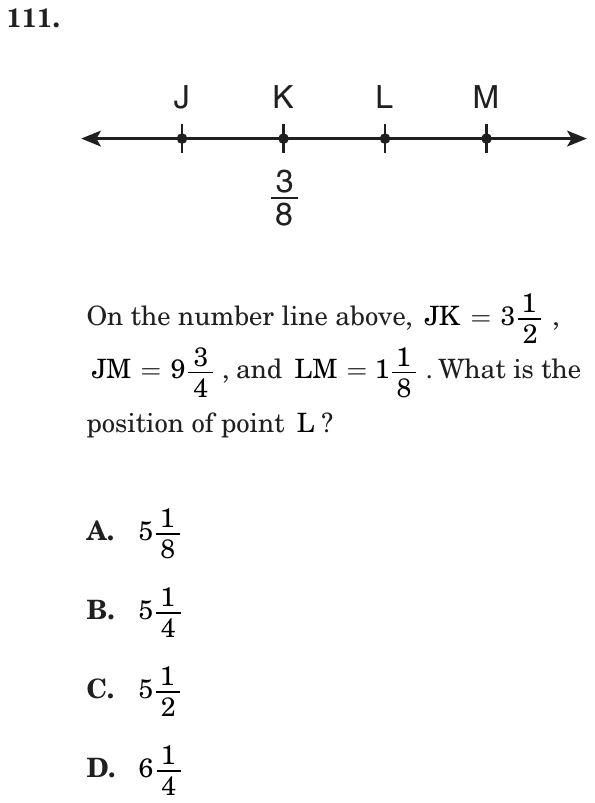
Question 112 of 120
2018 Test A Math, question 55Question
If , what is in terms of ?
- A
- B
- C
- D
Show the answer
Correct answer: C
Question analysis
This algebra question gives the linear equation 4x − 3y = 12 and asks for x in terms of y. Students must isolate the x term and then divide to solve for x. With two variables and a negative coefficient, small sign and division slips each lead to a different wrong choice.
- NYS standards
- Grade level
- Grade 8 content, by NYS standard
- Compared with grade 7
- Above grade 7 Grade 7 students solve one-variable equations like 4x − 3 = 12. Rearranging an equation with two variables to express one in terms of the other is grade 8 algebra, with sign and division slips to avoid.
- Estimated difficulty
- Moderate: several steps, or a close reading with one strong distractor.
- Thinking it demands
- Depth of knowledge 1, recall and reproduction · mainly apply
- What makes it hard
- Variables instead of numbers moderate
- A very close wrong answer moderate
- Error-prone arithmetic minor
- Solution
- 2 steps
- Reading level
- Question and choices: about grade 10, 13 words.
- Students, last 30 days
- Not enough answers yet to show (it takes 10).
Why it is hard, traps and wrong answers (shows the answer)
Why it is hard
The solution is two moves, add 3y to both sides and divide everything by 4, yet each move has a classic slip attached. The four choices are the four combinations of getting the sign right or wrong and dividing the 12 or not, so every partial mistake has a home. Checking one point that satisfies the original equation catches any of them.
Variables instead of numbers moderate Understanding the question
With two variables there is no number to check against unless students invent one; the point x = 6, y = 4 satisfies the equation and separates the choices. (Koedinger & Nathan, 2004; Enright, Morley & Sheehan, 2002)
A very close wrong answer moderate Choosing the answer
The choices x = 3/4 y + 3 and x = −3/4 y + 3 are identical except for the sign of the y term, which only correctly moving −3y across the equals sign settles. (Embretson & Wetzel, 1987; Gorin & Embretson, 2006; Ascalon et al., 2007)
Error-prone arithmetic minor Working it out
Dividing 12 + 3y by 4 must reach both terms, and the negative coefficient −3 has to change sign when it moves, two slips in a short line. (Brown & Burton, 1978; Junker & Sijtsma, 2001)
Strategy: Move the y term to the right side, watching its sign, so only the x term remains on the left, then divide the entire right side, term by term, by 4.
Traps
- A faulty procedure: A systematic but wrong procedure: adding fractions straight across, applying an exponent to each term of a sum, dropping a sign when moving a term.
The wrong answers, classified
A A faulty procedure (Brown & Burton, 1978; Tatsuoka, 1983)
Moves 3y correctly but divides only the y term by 4, leaving the constant 12 undivided.
B A faulty procedure (Brown & Burton, 1978; Tatsuoka, 1983)
Keeps the minus sign on the 3y term when moving it and also leaves the 12 undivided, two errors at once.
D A faulty procedure (Brown & Burton, 1978; Tatsuoka, 1983)
Divides every term by 4 correctly but keeps the minus on 3y, as if a term kept its sign when moved across.
Worked solution, step by step
Formulas used
- Keeping an equation balanced
- a and b are the two sides of an equation, and c is any number. An equation is like a balance. If you do the same thing to both sides, such as adding 3y or dividing by 4, they stay equal.
- Dividing a sum
- a and b are the two parts of the top, and c is the number you divide by. To divide a sum, divide each part. It works because sharing a + b into c groups shares a and b each into c groups.
Sort out what you need
The question asks for x in terms of y. That means get x alone on one side. The other side may have y and numbers, but no x. Start with .
Move the y term
The 3y is being subtracted on the left. Add 3y to both sides to clear it:
Watch out: the term was minus 3y. Adding 3y to both sides makes it plus 3y on the right. Keeping the minus sign leads to choice D.
Divide both sides by 4
x is being multiplied by 4. Divide both sides by 4 to undo it:
Split the fraction
Divide each part of the top by 4:
Watch out: the 12 must be divided by 4 too. Leaving it as 12 gives choice A. The choices put the y term first. So the answer is C, .
Check your answer
Pick y = 4. Choice C gives x = 3 + 3 = 6. Put x = 6 and y = 4 into the start: 4 × 6 − 3 × 4 = 24 − 12 = 12. It works. Choice D gives x = 0, and 4 × 0 − 12 = −12, not 12.
More questions like this
The original DOE question
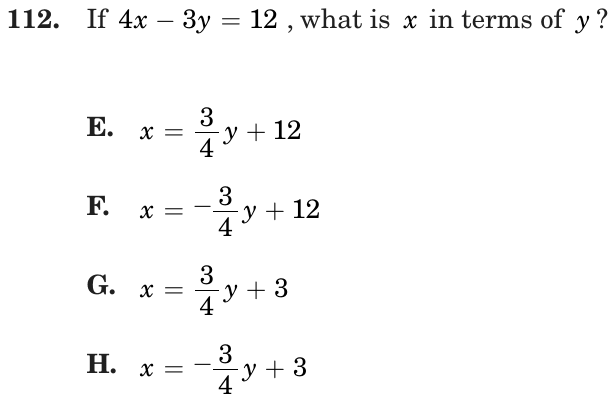
Question 113 of 120
2018 Test A Math, question 56Question
SERVINGS OF FRUITS AND VEGETABLES
| Number of Servings of Fruits and Vegetables | Number of Students |
| 0 | 5 |
| 1 | 7 |
| 2 | 3 |
| 3 | 4 |
| 4 | 0 |
| 5 | 1 |
There are 20 students in a class. The frequency table above shows the number of students in this class who ate 0, 1, 2, 3, 4, or 5 servings of fruits and vegetables yesterday. What is the mean number of servings of fruits and vegetables eaten yesterday per student in this class?
- A
- B
- C
- D
Show the answer
Correct answer: A
First, determine the total number of servings of fruits and vegetables that the students ate by multiplying the number of servings by the number of students in each row of the table.
Then add that column to get the total number of servings:
| Number of Servings of Fruits and Vegetables | Number of Students | Number of Servings × Number of Students |
| 0 | 5 | 0 |
| 1 | 7 | 7 |
| 2 | 3 | 6 |
| 3 | 4 | 12 |
| 4 | 0 | 0 |
| 5 | 1 | 5 |
Total: 30
Calculate the mean by dividing the total number of servings of fruits and vegetables by the total number of students:
Question analysis
This statistics question uses a frequency table showing how many of 20 students ate 0, 1, 2, 3, 4 or 5 servings of fruits and vegetables, and asks for the mean servings per student. Students must weight each serving amount by its number of students, add, and divide. Averaging the wrong column of the table is the common mistake.
- NYS standards
- 6.SP.5c range, center, and overall pattern
- Grade level
- Grade 6 content, by NYS standard
- Compared with grade 7
- At grade 7 Finding a mean is grade 6 content; doing it from a frequency table, where each value must be weighted by its count, is the multi-step version grade 7 students meet regularly.
- Estimated difficulty
- Moderate: several steps, or a close reading with one strong distractor.
- Thinking it demands
- Depth of knowledge 2, skills and concepts · mainly apply
- What makes it hard
- Reading a figure, table or graph moderate
- Many steps minor
- Solution
- 3 steps
- Reading level
- Question and choices: about grade 7, 64 words.
- Students, last 30 days
- Not enough answers yet to show (it takes 10).
Why it is hard, traps and wrong answers (shows the answer)
Why it is hard
The answer is smaller than every wrong choice, which surprises students who average the table's columns directly. The question rewards seeing that each row stands for several students, so the total servings come from weighting each value by its count. The stem's reminder that there are 20 students points to the right divisor.
Reading a figure, table or graph moderate Understanding the question
The frequency table has a value column and a count column; the mean needs each value multiplied by its count, so the two columns play different roles. (Lesh, Post & Behr, 1987; Kirsch & Mosenthal, 1990)
Many steps minor Working it out
Six products, 0, 7, 6, 12, 0 and 5, must be found and added to 30 before dividing by the 20 students. (Daniel & Embretson, 2010; Enright, Morley & Sheehan, 2002)
Strategy: Multiply each serving amount by its number of students, add those products to get the total servings, then divide by the 20 students.
Traps
- Answers a different question: A choice is right for another quantity: the other unknown, the rest instead of the part, the part instead of the whole.
The wrong answers, classified
B Misunderstands the concept (Smith, diSessa & Roschelle, 1993; De Bock et al., 1998; Ni & Zhou, 2005)
Averages the serving amounts 1 through 5 listed in the table, (1 + 2 + 3 + 4 + 5) ÷ 5 = 3, without weighting by the students.
C Answers a different question (King et al., 2004; Hegarty, Mayer & Monk, 1995)
Averages the Number of Students column, 20 students over 6 rows, finding the mean count per row instead of the servings per student.
D Numbers taken from the question (Hegarty, Mayer & Monk, 1995)
Divides the 20 students by 5, the largest serving amount, combining two numbers from the page without a model of the mean.
Worked solution, step by step
Formulas used
- Mean
- m is the mean, or average. S is the sum of all the values, here the total servings eaten. n is the number of values, here the number of students. The mean shares the total equally, as if every student ate the same amount.
Sort out the table
This is a frequency table. Each row says how many students ate a certain number of servings. For example, the second row says 7 students ate 1 serving each.
There are 20 students. You need the mean, or average, number of servings per student.
Find the servings in each row
In each row, multiply the servings by the number of students:
Servings Students Servings × Students 0 5 0 1 7 7 2 3 6 3 4 12 4 0 0 5 1 5 Add up all the servings
The class ate 30 servings in all. The students add up to 20, as the question says: 5 + 7 + 3 + 4 + 0 + 1 = 20.
Divide by the number of students
Watch out: do not just average the serving numbers 1 to 5. That gives 3, choice B, and ignores how many students ate each amount. Dividing 20 students by 6 rows gives choice C.
So the answer is A, .
Check your answer
12 of the 20 students ate 0 or 1 serving. Only 5 ate 3 or more. So the mean should be small, between 1 and 2. fits. Choices B, C and D are all 3 or more, which is too big.
More questions like this
The original DOE question
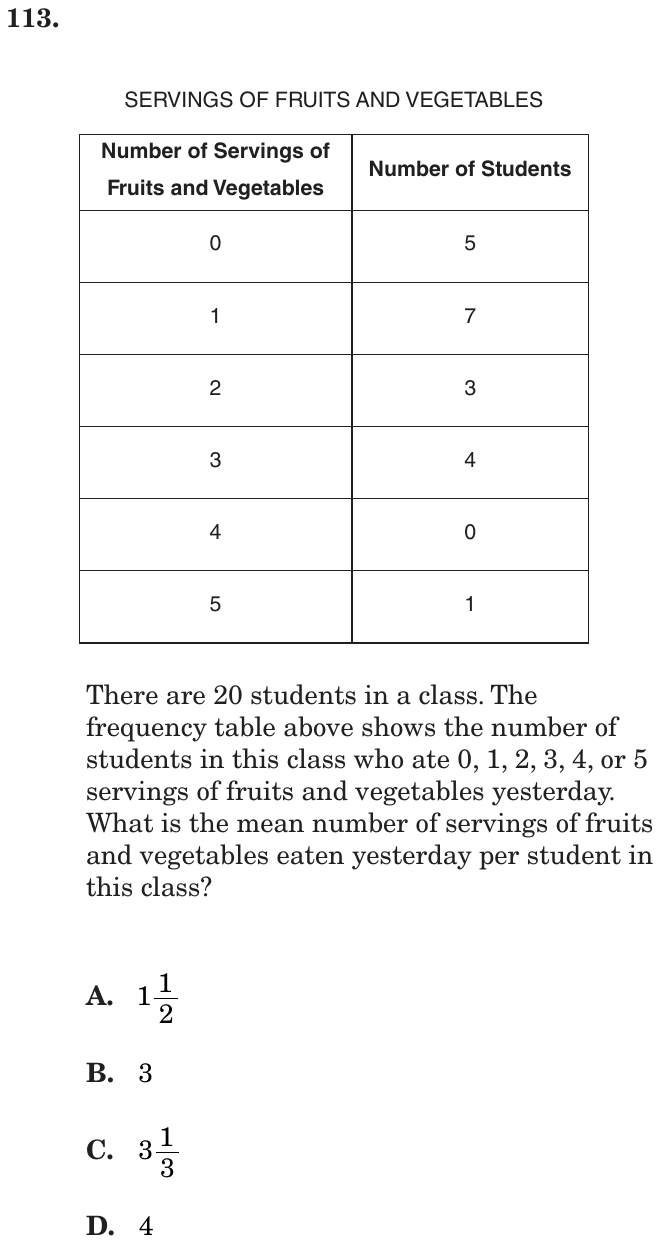
Question 114 of 120
2018 Test A Math, question 57Question
A paste used to cover a billboard is made by mixing the following ingredients by weight: 4 parts powder, 3 parts water, 2 parts resin, and 1 part hardener. To cover one billboard requires 30 pounds of this paste. How many total pounds of resin are required to cover 4 billboards?
- A6
- B8
- C24
- D48
Show the answer
Correct answer: C
The ratio is , so the total parts is 10.
Since there are two parts resin, the fraction of resin is
So the amount of resin in 30 lb of paste (for 1 billboard) is
lb.
For 4 billboards, that would be 6 × 4 = 24 lb.
Question analysis
This ratio word problem gives a billboard paste recipe of 4 parts powder, 3 parts water, 2 parts resin and 1 part hardener by weight, with 30 pounds of paste per billboard. It asks how many pounds of resin four billboards need. Students must find resin's share of the total parts and scale up to four billboards.
- Grade level
- Grade 7 content, by NYS standard
- Compared with grade 7
- At grade 7 Part-to-whole ratio problems with several ingredients are typical grade 7 work. This one adds a final scaling step for four billboards, which keeps it a routine multistep ratio problem at grade 7 level.
- Estimated difficulty
- Straightforward: two steps or one careful reading.
- Thinking it demands
- Depth of knowledge 2, skills and concepts · mainly apply
- What makes it hard
- Many steps minor
- Solution
- 3 steps
- Reading level
- Question and choices: about grade 8, 45 words.
- Students, last 30 days
- Not enough answers yet to show (it takes 10).
Why it is hard, traps and wrong answers (shows the answer)
Why it is hard
The recipe lists four ingredients but only resin's share matters, so the work is part over whole and then scaling. The question asks for four billboards only in the last sentence, after the per-billboard amount has been set up, which is why stopping early is the main risk. Finding the total paste first, 120 pounds, and taking a fifth of it reaches the answer in one step.
Many steps minor Working it out
Add the parts to 10, take resin's 2/10 of 30 pounds, then multiply by 4 billboards: three short steps. (Daniel & Embretson, 2010; Enright, Morley & Sheehan, 2002)
Strategy: Add the ratio parts to get the total, find resin's fraction of one batch of paste, take that fraction of 30 pounds, and multiply by the number of billboards.
Traps
- Stops one step early: A choice is a number from partway through the solution.
- Answers a different question: A choice is right for another quantity: the other unknown, the rest instead of the part, the part instead of the whole.
The wrong answers, classified
A Stops one step early (King et al., 2004; Gierl et al., 2017)
Finds the resin for one billboard, 2/10 of 30 = 6 pounds, and stops without multiplying by four billboards.
B Numbers taken from the question (Hegarty, Mayer & Monk, 1995)
Treats resin's 2 parts as 2 pounds and multiplies by 4 billboards, ignoring the 30 pounds of paste each one needs.
D Answers a different question (King et al., 2004; Hegarty, Mayer & Monk, 1995)
Uses powder's 4 parts instead of resin's 2, finding 4/10 of 120 pounds, which is the powder needed for four billboards.
Worked solution, step by step
Formulas used
- Fraction from a ratio
- f is the fraction of the mix that is one ingredient. p is that ingredient’s number of parts. T is the total number of parts, found by adding all the ratio numbers. Use it to turn a ratio into a fraction of the whole.
Sort out what you know
The paste is 4 parts powder, 3 parts water, 2 parts resin and 1 part hardener, by weight. A part is just an equal share of the mix.
One billboard needs 30 pounds of paste. You need the pounds of resin for 4 billboards.
Find resin’s fraction of the paste
The mix has 10 parts in all, and resin is 2 of them:
So resin is one fifth of the paste. Watch out: 2 parts is not 2 pounds. Treating it that way gives 2 × 4 = 8, choice B.
Find the resin for one billboard
One billboard needs 6 pounds of resin. Watch out: 6 is choice A, but that covers only one billboard.
Multiply by four billboards
Each billboard needs the same 6 pounds of resin, so multiply by 4:
Four billboards need 24 pounds of resin. So the answer is C, 24.
Check your answer
Work it another way. Four billboards need 4 × 30 = 120 pounds of paste. One fifth of 120 is 24. Choice D, 48, is the powder, which has 4 parts out of 10.
More questions like this
The original DOE question
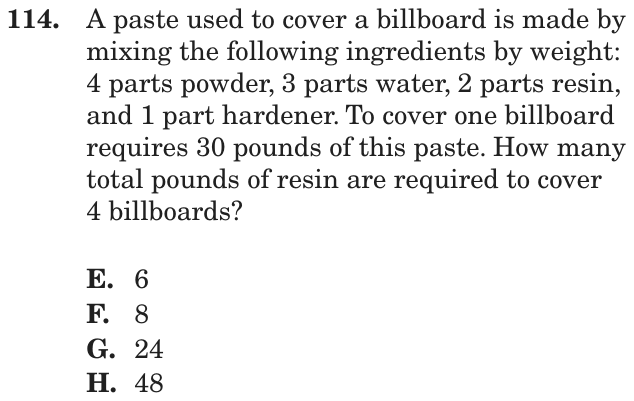
Question 115 of 120
2018 Test B English, question 1Question
Read this sentence.
The Colosseum in Rome, Italy which is considered one of the “new” Seven Wonders of the World, is the largest amphitheater ever built and could hold more than 50,000 spectators.
Which edit should be made to correct the sentence?
- ADelete the comma after Rome.
- BInsert a comma after Italy.
- CDelete the comma after World.
- DInsert a comma after built.
Show the answer
Correct answer: B
The question asks for the correction needed for an error in the sentence. The sentence needs a comma to set off the clause “which is considered one of the ‘new’ Seven Wonders of the World,” because the clause is not essential to the meaning of the sentence (nonrestrictive clause).
Option B is correct because it places a comma where it is needed, after “Italy,” to set off the nonrestrictive clause that follows.
Option A is incorrect because when a name has more than one element, a comma is used to separate the elements for clarity.
Option C is incorrect because it would remove the comma at the end of the nonrestrictive clause, which should be set off by commas at the beginning and the end.
Option D is incorrect because a comma after “built” would separate the phrase “could hold more than 50,000 spectators,” which is part of a compound predicate that uses the subject from the main clause and so needs to stay connected to the rest of the sentence.
Question analysis
This punctuation question gives one long sentence about the Colosseum in Rome and asks which single comma edit makes it correct. Students apply the comma rules for place names and for nonessential clauses. The long subject makes it tricky, because every comma has to be weighed: added, removed or left alone.
- NYS standards
- 7L2 capitalization, punctuation, and spelling
- Grade level
- Grade 6 reading and task
- Compared with grade 7
- Below grade 7 Comma rules for place names and for extra information in mid-sentence are grade 6 punctuation, tested here in one short sentence with a single edit. Grade 7 editing usually moves on to clauses, modifiers and sentence combining.
- Estimated difficulty
- Straightforward: two steps or one careful reading.
- Thinking it demands
- Depth of knowledge 1, recall and reproduction · mainly apply
- What makes it hard
- A rule that doesn't sound wrong moderate
- Complex sentences minor
- Evidence
- Answered from one sentence or line
- Reading level
- Question and choices: about grade 6, 61 words.
- Corrected from the DOE handbook
- A grammar term in the explanation was corrected.
- Students, last 30 days
- Not enough answers yet to show (it takes 10).
Why it is hard, traps and wrong answers (shows the answer)
Why it is hard
Most students who miss this question can find the which-clause but treat its two edges differently: they see the closing comma after “World” as an error and never notice that the opening comma is missing. The question rewards marking where the extra description begins and ends before judging any single comma. Knowing that a city and its country are always separated settles the rest quickly.
A rule that doesn't sound wrong moderate Working it out
The missing comma after “Italy” does two jobs at once, closing the city–country pair and opening the which-clause, and “Rome, Italy which is considered” reads smoothly enough that few students hear the gap. (Connors & Lunsford, 1988)
Complex sentences minor Understanding the question
The sentence packs a place name, a nonessential which-clause and a compound predicate (“is the largest amphitheater ever built and could hold”) into 30 words, so every comma has to be placed within that structure. (Abedi & Lord, 2001; Freedle & Kostin, 1993; Messick, 1989)
Strategy: Mark where the extra description of the Colosseum begins and ends, then ask of each comma whether it separates a city from its country, sets off that description, or splits subject from verb.
The wrong answers, classified
A Punctuation (Connors & Lunsford, 1988)
Treats Rome and Italy as one name that needs no comma between them, not knowing that a comma always separates a city from its state or country.
C Punctuation (Connors & Lunsford, 1988)
Applies the real rule against a comma between subject and verb to the comma after “World,” missing that it closes the which-clause and must stay.
D Punctuation (Connors & Lunsford, 1988)
Adds a comma wherever the long sentence seems to pause, before “and could hold,” though that second verb shares the subject and takes no comma.
What was corrected from the DOE handbook, and why
- Explanation: The handbook calls “could hold more than 50,000 spectators” a dependent clause. It has no subject of its own: it is the second half of a compound predicate (the Colosseum “is the largest amphitheater ever built and could hold…”), which is why no comma goes before it. The site now calls it “part of a compound predicate.”
Working it out, step by step
Figure out what the question asks
This is a punctuation question. Punctuation means marks like commas and periods. The sentence has one comma mistake. You need the one edit that fixes it. Two comma rules decide it.
Learn the rule for extra information
Some groups of words just add an extra fact. The sentence still makes sense without them. Grammar books call this a nonessential clause. Put a comma before it and a comma after it, like a pair of brackets.
Example: My dog, which is brown, likes to swim. Take out the middle part and you still have My dog likes to swim.
Find the extra part in this sentence
Here the extra part starts with “which is considered” and ends with “of the World.” It gives a fun fact about the Colosseum. Without it, the sentence still works: The Colosseum in Rome, Italy, is the largest amphitheater ever built.
There is a comma at the end of the extra part, after “World.” But there is no comma at the start, after “Italy.” That is the mistake.
Learn the rule for places
When you name a city and then its country, put a comma between them. If the sentence keeps going, put another comma after the country. Example: We flew to Paris, France, last May.
So “Rome, Italy” needs a comma after “Italy” too. Here one comma does both jobs.
Check each choice
- A is wrong. The comma between “Rome” and “Italy” must stay. It splits the city from the country.
- B is right. It adds the missing comma at the start of the extra part.
- C is wrong. The comma after “World” closes the extra part, so it must stay.
- D is wrong. “Could hold” shares its subject, “The Colosseum,” with “is.” No comma goes before a second verb like that. Example: Sam ran home and ate lunch.
Watch out: C is tempting. A comma between a subject (who or what the sentence is about) and its verb (the action word) is usually wrong. Here it is fine, because it is the second comma of the pair.
Choose the answer
With the new comma, the extra part has a comma on each side. So the answer is B: insert a comma after Italy.
Why this answer and not the closest wrong one
C is the closest wrong answer. It treats the comma after “World” as a mistake. But that comma ends the extra part. If you delete it, the extra part has no comma at either end. B adds the missing first comma, so both ends are marked.
More questions like this
The original DOE question
Question 116 of 120
2018 Test B English, question 2Question
Read this paragraph.
In September 2016 the National Museum of African American History and Culture opened as part of the Smithsonian Institution, the museum is already the Smithsonian’s third most popular site. Experts say that they expect this newest Smithsonian facility to welcome nearly 4 million visitors a year. The museum features more than 30,000 objects, including Muhammad Ali’s boxing gloves and a dress sewn by Rosa Parks. A commemorative copy of the Emancipation Proclamation, written in 1863 during the presidency of Abraham Lincoln, is also on display at the museum.
Which revision corrects the error in sentence structure in the paragraph?
- AInstitution, and the
- Byear, and the
- Cobjects, which include
- DProclamation, which was written
Show the answer
Correct answer: A
The question asks for the correction of an error in sentence structure in the paragraph.
The first sentence is a run-on sentence because both clauses—“In September 2016 the National Museum of African American History and Culture opened as part of the Smithsonian Institution” and “the museum is already the Smithsonian’s third most popular site”—are independent clauses, and independent clauses should not be combined without the use of a conjunction and a comma. The revision in Option A adds the word “and” after the comma, which corrects the run-on.
Option B, Option C, Option D are incorrect responses because the corresponding underlined portions in the paragraph are not structural errors. No edits are needed to correct those portions of the text.
Question analysis
This sentence-structure question gives a short paragraph about the opening of the National Museum of African American History and Culture. Students must find which of four spots holds a real error, such as a run-on, a fragment or a misplaced phrase, and pick the revision that fixes it. Long names stretch the sentences, and the spots that need no change can look just as suspicious.
- Grade level
- Grade 6 reading and task
- Compared with grade 7
- Below grade 7 Fixing run-ons and fragments is taught before grade 7, and here students check four short spots in one paragraph for a single structural error. Long institution names add reading load but no extra grammar.
- Estimated difficulty
- Straightforward: two steps or one careful reading.
- Thinking it demands
- Depth of knowledge 2, skills and concepts · mainly apply
- What makes it hard
- A rule that doesn't sound wrong moderate
- Complex sentences minor
- Every choice must be checked minor
- Evidence
- Answered from one paragraph or stanza
- Reading level
- Question and choices: about grade 10, 111 words.
- Corrected from the DOE handbook
- A misdescribed detail in the explanation was corrected.
- Students, last 30 days
- Not enough answers yet to show (it takes 10).
Why it is hard, traps and wrong answers (shows the answer)
Why it is hard
Students who miss this one usually look for the error in the wrong place: the phrases “including Muhammad Ali’s boxing gloves” and “written in 1863” look suspicious, while the real splice hides behind the long museum name. The question rewards checking each spot for a subject and verb on both sides of its punctuation. Two choices offer the same “, and the” fix, so knowing the fix is not enough without finding where it belongs.
A rule that doesn't sound wrong moderate Working it out
The error is a comma splice after “Institution,” where a comma alone joins two complete clauses, and a comma sounds like a natural pause when the sentence is read aloud. (Connors & Lunsford, 1988)
Complex sentences minor Understanding the question
The eight-word museum name stretches the first clause, so by the time “the museum is already” arrives, it reads like a continuation rather than a new subject and verb. (Abedi & Lord, 2001; Freedle & Kostin, 1993; Messick, 1989)
Every choice must be checked minor Choosing the answer
The four underlined spots fall in four different sentences, and each has to be tested for whether a complete sentence sits on both sides of its punctuation. (Embretson & Wetzel, 1987)
Strategy: Check each sentence for a subject and main verb and count its complete thoughts, then decide whether the spot each choice changes actually breaks a rule before picking a fix.
The wrong answers, classified
B Fixes what isn't broken (Connors & Lunsford, 1988)
Recognizes “, and the” as the usual run-on fix but applies it where a period already separates two complete, correctly punctuated sentences.
C Fixes what isn't broken (Connors & Lunsford, 1988)
Believes a phrase opening with “including” after a comma is a fragment, so turns it into a which-clause, though the phrase already attaches correctly to “objects.”
D Fixes what isn't broken (Connors & Lunsford, 1988)
Thinks “written in 1863” cannot describe the copy without “which was,” though the sentence already has its verb “is” and the phrase is correctly set off.
What was corrected from the DOE handbook, and why
- Explanation: The handbook says the correct revision “adds the word ‘and’ before the comma.” In “Institution, and the,” the word “and” comes after the comma, so the site now says “after the comma.”
Working it out, step by step
Figure out what the question asks
This question is about sentence structure, or how a sentence is built. One of the four underlined spots has a mistake. You need the change that fixes it.
Learn the run-on rule
A complete sentence has a subject (who or what it is about) and a verb (the action). It can stand alone. You cannot join two complete sentences with only a comma. That mistake is called a run-on.
Wrong: I was hungry, I ate an apple.
Fixed: I was hungry, and I ate an apple.
A period would also work: I was hungry. I ate an apple.Find the run-on
Look at the first sentence. The words before the comma can stand alone: “In September 2016 the National Museum of African American History and Culture opened as part of the Smithsonian Institution.” So can the words after it: “the museum is already the Smithsonian’s third most popular site.” Only a comma joins them. That is a run-on.
Check each choice
- A is right. “Institution, and the” adds the joining word “and” after the comma. That fixes the run-on.
- B is wrong. A period already splits those two sentences correctly.
- C is wrong. “Including Muhammad Ali’s boxing gloves” already describes the objects. It needs no change.
- D is wrong. “Written in 1863” already describes the copy. The sentence already has its verb, “is.”
Watch out: C and D are not bad sentences. But they change spots that were already correct, and the run-on stays.
Choose the answer
Now the first sentence says the museum opened, and it is already very popular. Those are two complete ideas, joined the right way. So the answer is A: Institution, and the.
Why this answer and not the closest wrong one
D is a tempting choice, because “which was written” also sounds fine. But a change that sounds fine is not a fix. The question asks you to correct the error. Only A changes the first sentence, where the run-on is.
More questions like this
The original DOE question
Question 117 of 120
2018 Test B English, question 3Question
Read this sentence.
To promote their club, a bake sale will be sponsored by members of the debate team on Wednesday.
How should the sentence be revised?
- ATo promote their club, on Wednesday a bake sale will be sponsored by members of the debate team.
- BOn Wednesday to promote their club, a bake sale will be sponsored by members of the debate team.
- CTo promote their club, members of the debate team will sponsor a bake sale on Wednesday.
- DMembers of the debate team, on Wednesday to promote their club, will sponsor a bake sale.
Show the answer
Correct answer: C
The question asks for the correct revision of the sentence in the box.
The sentence is incorrect because, as written, the phrase “to promote their club” refers to the closest noun to the phrase, which is “a bake sale,” and that does not match logically.
Option C is correct because the revision has the phrase “to promote their club” clearly modifying “members of the debate team” and adds the idea that the bake sale is on Wednesday to the end of the sentence.
Option A and Option B are incorrect because the revisions do not fix the error that “to promote their club” modifies “a bake sale.”
Option D is incorrect; while the revision clarifies that “to promote their club” relates to the “members of the debate team,” the rest of the sentence is poorly written because the insertion of “on Wednesday to promote their club” in the middle of the sentence interrupts the main clause, “Members of the debate team will sponsor a bake sale.”
Question analysis
This sentence-structure question shows a sentence about a debate team’s bake sale and asks how it should be revised. Students choose the rewrite that places each phrase where it logically belongs. The rewrites move the same phrases into different orders, so students must judge both the logic and how naturally each version reads.
- NYS standards
- 7L1 grammar and usage conventions
- Grade level
- Grade 7 reading and task
- Compared with grade 7
- At grade 7 Placing phrases so they modify the right words is named in the grade 7 language standards, and this one-sentence item is a typical classroom example. Students must also judge whether each rewrite reads smoothly, not just whether it is logical.
- Estimated difficulty
- Straightforward: two steps or one careful reading.
- Thinking it demands
- Depth of knowledge 2, skills and concepts · mainly evaluate
- What makes it hard
- A rule that doesn't sound wrong moderate
- Complex sentences minor
- Every choice must be checked minor
- A very close wrong answer minor
- Evidence
- Answered from one sentence or line
- Reading level
- Question and choices: about grade 6, 95 words.
- Students, last 30 days
- Not enough answers yet to show (it takes 10).
Why it is hard, traps and wrong answers (shows the answer)
Why it is hard
The original sentence is easy to understand, which is exactly why its dangling modifier slips past students who judge by sound. Rewrites that only move “on Wednesday” keep the passive voice and the error, so asking who is doing the promoting rules them out at once. Among the rewrites that put the team members first, the remaining decision is about smoothness: whether a phrase should sit between the subject and its verb.
A rule that doesn't sound wrong moderate Working it out
“To promote their club” has no logical doer in the original, since a bake sale cannot promote anything, but the meaning is so clear that the dangling modifier is hard to hear. (Connors & Lunsford, 1988)
Complex sentences minor Understanding the question
The passive “will be sponsored by members of the debate team” pushes the real actors to the end, which is why the opening phrase lands on “a bake sale.” (Abedi & Lord, 2001; Freedle & Kostin, 1993; Messick, 1989)
Every choice must be checked minor Choosing the answer
All four rewrites shuffle the same three phrases, so each must be read whole to see which noun follows the opening phrase and whether the main clause is interrupted. (Embretson & Wetzel, 1987)
A very close wrong answer minor Choosing the answer
The interrupted rewrite uses the same words as the right one and also makes the team members the subject; only where “on Wednesday to promote their club” sits, between subject and verb, separates them. (Embretson & Wetzel, 1987; Gorin & Embretson, 2006; Ascalon et al., 2007)
Strategy: Ask who is actually promoting the club, then read each rewrite to see which words the to-phrase attaches to and how smoothly the whole sentence reads.
Traps
- Misplaced modifier: A describing word or phrase that attaches to the wrong word, or to nothing in the sentence.
The wrong answers, classified
A Misplaced modifier (Connors & Lunsford, 1988)
Moves “on Wednesday” as if the time phrase were the problem and keeps the passive voice, so “To promote their club” still describes the bake sale.
B Misplaced modifier (Connors & Lunsford, 1988)
Shuffles both phrases to the front without a comma between them, yet “a bake sale” still follows, so the club-promoting phrase still describes the sale.
D Misplaced modifier (Connors & Lunsford, 1988)
Correctly makes “Members of the debate team” the subject but misplaces “on Wednesday to promote their club” between subject and verb, an awkward interruption the best revision avoids.
Working it out, step by step
Figure out what the question asks
This question is about a modifier. A modifier is a group of words that describes something. You need the version where the describing words go with the right noun (a person, place or thing).
Learn the rule for opening phrases
Sometimes a sentence starts with a describing phrase and a comma. That phrase describes whoever comes right after the comma. So the one doing the action must come right after the comma.
Wrong: To win the race, every day was spent training. A day can’t win a race.
Fixed: To win the race, Maya trained every day.Find the problem in the sentence
The sentence starts with “To promote their club.” To promote something means to get people interested in it. Right after the comma comes “a bake sale.” So the sentence says the bake sale is promoting the club. That makes no sense. The people promoting the club are the “members of the debate team.” They should come right after the comma.
Check each choice
- A is wrong. After the comma comes “on Wednesday a bake sale.” The bake sale is still doing the promoting.
- B is wrong. It moves “On Wednesday” to the front, but “a bake sale” still follows the comma.
- C is right. “Members of the debate team” comes right after the comma. They are the ones who “will sponsor a bake sale.”
- D is wrong. It names the members first. But it stuffs “on Wednesday to promote their club” between the subject and its verb. That breaks up the sentence.
Watch out: D also makes the members the ones promoting the club, so it is tempting. But C says the same thing in a smooth, clear order.
Choose the answer
In C, the members promote their club, and “on Wednesday” comes at the end, where it reads smoothly. So the answer is C.
Why this answer and not the closest wrong one
D is the closest wrong answer. Like C, it puts the members of the debate team first. But D splits the subject from its verb with a long phrase: “Members of the debate team, on Wednesday to promote their club, will sponsor.” C keeps the main idea together, so it reads clearly.
More questions like this
The original DOE question
Question 118 of 120
2018 Test B English, question 4Question
Read this paragraph.
(1) Devon spent several hours preparing for an upcoming audition for a play at the community theater. (2) First he did vocal exercises to practice his diction and projection so that his words would carry clearly throughout the large auditorium. (3) Then he studies the text of the monologue to better understand the emotions, and motivations of the character he plans to portray. (4) Finally he recited his monologue in front of a mirror many times, making slight adjustments and improvements to his performance each time.
How should the paragraph be revised?
- ASentence 1: Change spent to had spent, AND insert a comma after play.
- BSentence 2: Change did to does, AND insert a comma after projection.
- CSentence 3: Change studies to studied, AND delete the comma after emotions.
- DSentence 4: Change recited to recites, AND delete the comma after times.
Show the answer
Correct answer: C
The question asks for the necessary revisions to the paragraph. Option C is correct because the errors appear in sentence 3 of the paragraph. The word “studies” is in the present tense, but it should be changed to “studied” to match the past tense established in the paragraph (“spent,” “recited”). Additionally, the comma after the word “emotions” needs to be removed because the words “emotions and motivations” are part of a group (series) of two elements, and when there are only two elements in a series, a comma is not used.
Option A is incorrect because sentence 1 does not need to be revised. The word “spent” is correct in the past tense, and there is no need to insert a comma after the word “play.”
Option B is incorrect because sentence 2 does not need to be revised. The word “did” is correct as written in the past tense, and there is no comma needed after the word “projection” because “so” is not functioning as a conjunction but rather as part of the conjunction phrase “so that,” which does not take a comma.
Option D is incorrect because sentence 4 does not need to be revised. The word “recited” is correct as written in the past tense, and the comma after “times” is needed in order to separate the modifying phrase “making slight adjustments and improvements to his performance each time” from the main clause.
Question analysis
This grammar and punctuation question gives a four-sentence paragraph about Devon preparing for a theater audition. Each answer choice pairs a verb change with a comma change in a single sentence. Students judge verb tense and comma use together, since a choice is right only if both of its edits are needed.
- Grade level
- Grade 6 reading and task
- Compared with grade 7
- Below grade 7 Verb tense consistency and basic comma use are taught before grade 7, and this paragraph is short and plain. Each choice bundles two edits, so a student who finds one real error can confirm the answer with the other.
- Estimated difficulty
- Routine: one familiar step, little to misread.
- Thinking it demands
- Depth of knowledge 1, recall and reproduction · mainly apply
- What makes it hard
- Evidence
- Answered from one paragraph or stanza
- Reading level
- Question and choices: about grade 9, 136 words.
- Students, last 30 days
- Not enough answers yet to show (it takes 10).
Why it is hard, traps and wrong answers (shows the answer)
Why it is hard
The tense error is easy to hear: “Then he studies” breaks a past-tense story told with “spent,” “did” and “recited.” Spotting either half of the correct choice is enough to find it, which is why this is one of the easier editing questions. Students who go wrong are usually drawn by a comma rule they half remember, such as a comma before “so,” and stop checking the verb.
A rule that doesn't sound wrong minor Working it out
The comma in “emotions, and motivations” separates just two items, and many students have learned to put a comma before “and” in any list without counting the items. (Connors & Lunsford, 1988)
Every choice must be checked minor Choosing the answer
Each choice bundles a verb change and a comma change in a different sentence, so all four sentences must be checked, and a choice is right only if both of its edits are needed. (Embretson & Wetzel, 1987)
Strategy: Note the tense of the paragraph’s first verb, check every other verb against it, and only then test whether the comma half of that choice is also needed.
The wrong answers, classified
A Verb tense or form (Connors & Lunsford, 1988)
Thinks “had spent” is needed because the preparing came before the audition, and accepts a comma after “play” that would split “a play at the community theater.”
B Punctuation (Connors & Lunsford, 1988)
Follows the rule of a comma before “so” joining two clauses, missing that “so that” introduces a purpose clause and takes no comma, and accepts the present-tense “does.”
D Verb tense or form (Connors & Lunsford, 1988)
Notices that the tenses clash but takes the present-tense “studies” as the standard, shifts “recited” to match, and drops the comma that sets off “making slight adjustments.”
Working it out, step by step
Figure out what the question asks
Each choice makes two changes to one sentence: a verb change and a comma change. The right choice is the one where both changes fix real errors. If either change is not needed, the choice is wrong.
Check the verb tenses
Tense is the time a verb shows: past, present or future. A paragraph should stay in one tense. Example: Yesterday I walk to school should be Yesterday I walked to school.
This paragraph tells about the past: “spent,” “did,” “recited.” But sentence 3 says “Then he studies the text.” “Studies” is present tense. It should be “studied.”
Check the comma rule for pairs
Use commas in a list of three or more things: apples, pears, and plums. But two things joined by “and” take no comma: apples and pears.
Sentence 3 says “the emotions, and motivations.” That is only two things. So the comma after “emotions” should go.
Check each choice
- A is wrong. “Spent” is already past tense. A comma after “play” would cut off “at the community theater.”
- B is wrong. “Does” would be present tense, which is the mistake, not the fix. And “so that” takes no comma before it.
- C is right. Both changes fix real errors in sentence 3.
- D is wrong. “Recites” would be present tense. The comma after “times” is needed. It sets off the describing words “making slight adjustments.”
Watch out: D notices that the tenses don’t match, but it fixes the wrong verb. Three verbs are past and one is present, so change the present one.
Choose the answer
With both fixes, sentence 3 says he studied the text to understand the emotions and motivations of the character. So the answer is C.
Why this answer and not the closest wrong one
D is tempting because it also spots the tense problem. But it changes “recited,” which was already right, to match the one wrong verb. It also removes a comma that is needed. Both of C’s edits fix real errors, so C is the only choice that works.
More questions like this
The original DOE question
Question 119 of 120
2018 Test B English, question 5Passage The Local Library
The Local Library
(1) According to a 2015 survey, more than two-thirds of Americans own a smartphone, which means that obtaining information or communicating with people is easier than ever before. (2) With the swipe of a finger, the tap of an icon, or a verbal command, people have instant access to articles, blogs, news, and social networking websites. (3) Even with all these immediately available sources of information, one of the best resources for many members of the community also happens to be one of the oldest. (4) The public library is a great place for people to get information.
(5) The public library serves a truly critical role in promoting community. (6) With the explosion of digital media in recent years, people in different locations can now communicate almost instantaneously. (7) And yet many people complain of feeling more isolated and alone than ever before. (8) The library stands in a rare position to help community members meet this universal need for human connection and companionship.
(9) Furthermore, libraries provide certain amenities, such as access to the Internet, for free to all people. (10) A student who does not have a computer at home can research and type a paper for school. (11) Similarly, an unemployed adult without access to the Internet can make use of library resources to find job opportunities. (12) The free items that are found at the library can help people get a lot done.
(13) Public libraries also offer a variety of resources to community members. (14) One important resource is the local librarian, who does far more than check out books and collect fines. (15) Other library resources include free or low-cost tutoring and training programs. (16) Additionally, lectures, book groups, and town meetings promote critical thinking and community engagement. (17) A typical librarian holds a master’s degree and can help library patrons navigate through the flood of information available in print and on the Internet.
(18) The hallmark of a public library is that its materials and services are accessible to all. (19) The library connects people to a network of information and resources and is an important part of a community.
Question
Which sentence should replace sentence 4 to best introduce the main claim of the passage?
- AIn this age of smartphones and search engines, the public library is a valuable resource that all members of a community should use.
- BFinding information is easier than ever, but going to the public library is still a valuable learning experience.
- CThough today’s computers are highly advanced, the resources available at a public library are more useful for students.
- DDespite the proliferation of social networking sites, a public library is a great place for people who are interested in improving their community.
Show the answer
Correct answer: A
The question asks for a sentence that should replace sentence 4 to introduce the main claim of the passage.
Option A is correct because it best presents the main claim that the public library is a valuable resource and should be used by community members.
Option B is incorrect because it states that going to the library can be a learning experience. This idea is implied in sentences 17 and 18, but it is not the main claim of the passage.
Option C is incorrect because it states the idea that the library is useful for students, which would be supporting evidence rather than an introductory statement expressing the main claim.
Option D is incorrect because it states that local libraries provide services to help improve communities, which is explained in sentences 15–18, but it does not present the main claim.
Question analysis
This introduction question uses a persuasive essay about public libraries that opens with statistics on smartphone ownership. Students choose a new fourth sentence that states the passage’s main claim. Every option contrasts technology with libraries, so the challenge is telling the overall argument apart from single supporting points.
- NYS standards
- 7W1a introducing claims and counterclaims
- Grade level
- Grade 7 reading and task
- Compared with grade 7
- At grade 7 Grade 7 writers learn to state a precise claim; here students must find the claim behind a whole five-paragraph essay and test each candidate opener against all of its reasons, not just one paragraph.
- Estimated difficulty
- Moderate: several steps, or a close reading with one strong distractor.
- Thinking it demands
- Depth of knowledge 2, skills and concepts · mainly evaluate
- What makes it hard
- Evidence in several places moderate
- A very close wrong answer moderate
- How sentences fit together minor
- Evidence
- Answered from the whole text
- Reading level
- Passage: about grade 11, 341 words; question and choices: about grade 12, 96 words.
- Students, last 30 days
- Not enough answers yet to show (it takes 10).
Why it is hard, traps and wrong answers (shows the answer)
Why it is hard
The risk here is settling for a true point from the essay instead of its overall claim. Every opener sets technology against the library, so the contrast itself decides nothing; what decides is whether the library is presented as a resource for the whole community or as a benefit to one group. Students who state the claim in their own words before reading the choices avoid the near-copy that narrows it to learning.
Evidence in several places moderate Working it out
The main claim is never stated in one place: it has to be pieced together from paragraphs on human connection, free Internet access, librarians and tutoring, and access for all, ending with “an important part of a community.” (Kirsch & Mosenthal, 1990; Gorin & Embretson, 2006)
A very close wrong answer moderate Choosing the answer
The learning-experience opener has the right one’s shape, a nod to technology and then “valuable,” and differs in one part of the claim: “a valuable learning experience” instead of “a valuable resource that all members of a community should use.” (Embretson & Wetzel, 1987; Gorin & Embretson, 2006; Ascalon et al., 2007)
How sentences fit together minor Working it out
Sentence 3 builds up to an unnamed “one of the best resources,” so the new sentence 4 must name the library as that resource and say why everyone should use it. (Halliday & Hasan, 1976)
Strategy: Before reading the choices, sum up in your own words what the essay wants readers to believe about the library, drawing on every paragraph, then find the opener that matches it.
Traps
- Too narrow: A single detail offered as the central idea or a summary, or a summary that keeps minor details and leaves out an essential part.
- Too broad or too strong: A choice overstates, generalizes, or uses absolute words the text does not support.
The wrong answers, classified
B Too narrow (King et al., 2004)
Echoes sentence 1’s “easier than ever” and sounds balanced, but reduces the claim to one benefit, learning, and drops the community and the free services the essay argues for.
C Too broad or too strong (King et al., 2004)
Builds on the student in sentence 10 and the essay’s technology contrast, but claims libraries beat computers, a ranking the essay never makes, since libraries offer the Internet.
D Too narrow (King et al., 2004)
Keeps the original sentence’s vague “great place for people” and narrows the audience to those improving their community, one point from paragraphs 2 and 4 rather than the claim.
Working it out, step by step
Figure out what the question asks
You need a new sentence 4. Sentence 4 ends the first paragraph, so it should state the main claim. A claim is the big point a writer tries to prove. Here it must fit the whole essay.
Sum up what the essay argues
Look at what each paragraph says about the library.
- Paragraph 2: it helps people meet the “need for human connection and companionship.”
- Paragraph 3: it offers things like “access to the Internet, for free to all people.”
- Paragraph 4: it offers librarians, tutoring, lectures and book groups.
- Paragraph 5: it is “an important part of a community.”
So the claim is this: the library is a valuable resource that everyone in the community should use.
See how sentence 4 must fit
Sentence 1 talks about smartphones. Sentence 3 says that “one of the best resources” is also “one of the oldest.” Sentence 4 should name that old resource, the library. It should also say why everyone should use it.
Check each choice
- A is right. It links back to the smartphones. It calls the library “a valuable resource that all members of a community should use.” That is the whole claim.
- B is wrong. It shrinks the claim to learning. It leaves out the free services and the human connection.
- C is wrong. It talks only about students. It also says the library beats computers, which the essay never says. The library even offers the Internet.
- D is wrong. It talks only about people who want to improve their community. It keeps the vague words “a great place.”
Watch out: B repeats “easier than ever” from sentence 1, so it sounds like it belongs. But it covers only one benefit.
Choose the answer
A names the library, calls it valuable and tells everyone to use it. So the answer is A.
Why this answer and not the closest wrong one
B is the closest wrong answer. It also starts with how easy it is to find information today, and it calls the library valuable. But it calls the library “a valuable learning experience.” The essay argues for much more than learning: free Internet, librarians, programs and a place to meet people. A covers all of that.
More questions like this
The original DOE question
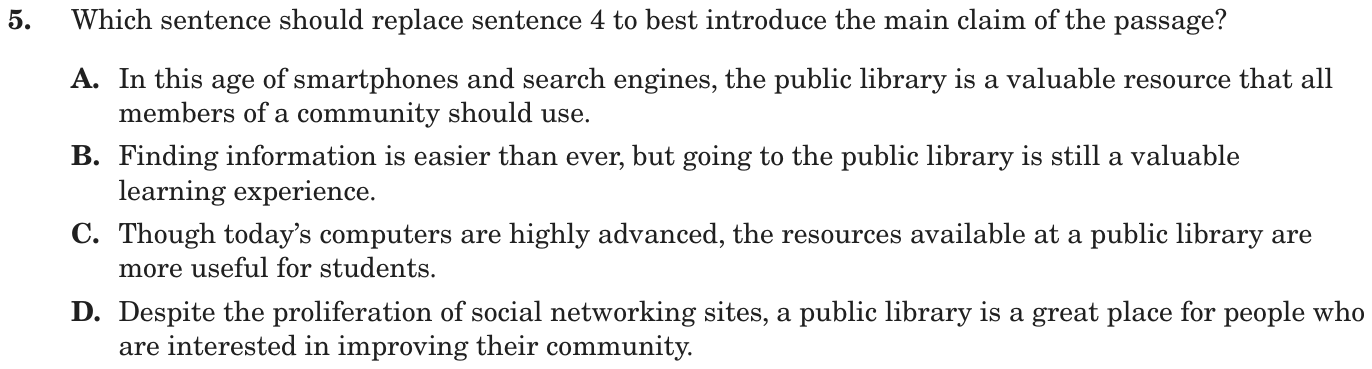
The passage “The Local Library” as printed (page 120)
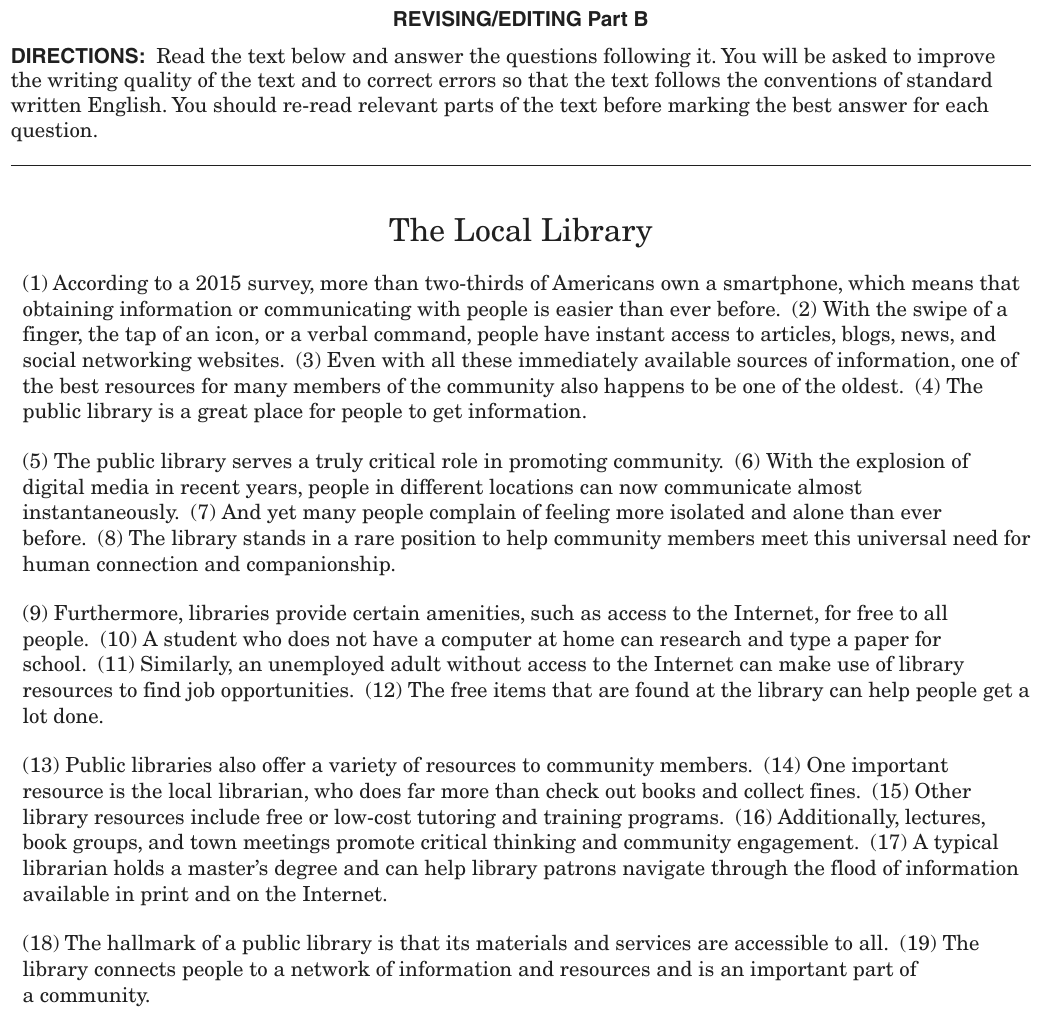
Question 120 of 120
2018 Test B English, question 6Uses the passage above: “The Local Library”.
Question
Which sentence would best follow and support sentence 8?
- ALibraries, which have been around for centuries and are found throughout the world today, help preserve the history of a community.
- BThe public library is often used as a place for community leaders and organizers to host community events, such as hearings or town halls.
- CLibraries rely on a combination of local, state, and federal dollars to provide the kinds of services and programs that community members have come to expect.
- DAt a public library, people can interact with others through a variety of programs, including teen book clubs, toddler story times, and senior-citizen exercise classes.
Show the answer
Correct answer: D
The question asks which option would provide the best support for sentence 8. Sentence 8 expresses the idea that the library helps community members meet their need for human connection and companionship.
Option D is correct because it provides support for sentence 8 and strengthens the connection between the information in sentence 8 and the main claim of the passage by listing examples of how people can connect at the library.
Option A is incorrect because it references the history of the library, which does not support the idea in sentence 8 or the main claim of the passage.
Option B is incorrect because, although it introduces the idea of community meetings, it does not support the idea in sentence 8.
Option C is incorrect because it mentions expectations by the community members and brings up a new idea that is unrelated to the main claim of the passage and that does not provide support for sentence 8.
Question analysis
This supporting-details question returns to the library essay and its point that people feel isolated in a digital world. Students pick the sentence that would best follow sentence 8 and back it up. Each option sounds like a fair statement about libraries, which is what makes the choice harder than it first looks.
- NYS standards
- 7W1b supporting claims with evidence
- Grade level
- Grade 7 reading and task
- Compared with grade 7
- At grade 7 Choosing evidence that fits a claim is standard grade 7 argument work. This item sharpens it: all four sentences are believable facts about libraries, so students must match the specific idea in sentence 8 rather than the general topic.
- Estimated difficulty
- Moderate: several steps, or a close reading with one strong distractor.
- Thinking it demands
- Depth of knowledge 2, skills and concepts · mainly evaluate
- What makes it hard
- How sentences fit together moderate
- Evidence
- Answered from one paragraph or stanza
- Reading level
- Passage: about grade 11, 341 words; question and choices: about grade 12, 104 words.
- Students, last 30 days
- Not enough answers yet to show (it takes 10).
Why it is hard, traps and wrong answers (shows the answer)
Why it is hard
Every choice says something favorable about libraries, so a student who asks only whether a sentence fits the essay will find all four acceptable. The question rewards narrowing the test to sentence 8’s own idea, the loneliness of a digital age and the need for company. The teen book clubs, toddler story times and exercise classes for seniors are what make the right sentence a support rather than a new topic.
How sentences fit together moderate Working it out
Sentence 8 ends on “human connection and companionship,” so the sentence after it must give an example of people meeting each other, not just another good thing about libraries. (Halliday & Hasan, 1976)
Strategy: Restate sentence 8 in a few words, then ask of each choice whether it gives a concrete example of that exact idea or just says something good about libraries.
Traps
- Off the point: Adds or keeps something that does not support the paragraph's or the passage's focus, or an introduction or conclusion that misses the main point.
- Wrong part of the text: A choice is true of another paragraph, stanza or speaker than the one asked about.
The wrong answers, classified
A Off the point (Halliday & Hasan, 1976)
Offers a pleasant general fact about libraries preserving community history, which matches the word “community” but says nothing about loneliness or human connection.
B Wrong part of the text (Kirsch & Mosenthal, 1990)
Describes hearings and town halls, which belong with paragraph 4’s “town meetings” and civic engagement, and concern leaders running events rather than people finding companionship.
C Off the point (Halliday & Hasan, 1976)
Brings in funding from local, state and federal dollars, a new topic that neither illustrates sentence 8’s need for connection nor advances the essay’s claim.
Working it out, step by step
Figure out what the question asks
You need the sentence that would come right after sentence 8 and back it up. To support a sentence means to give an example or a reason that proves it.
Read sentence 8 closely
Sentence 8 says: “The library stands in a rare position to help community members meet this universal need for human connection and companionship.” Just before it, sentence 7 says people feel “more isolated and alone than ever before.”
Put sentence 8 in plain words
“Isolated” means cut off from other people. “Companionship” means having friends and people around you. So sentence 8 says: people feel lonely, and the library can help them spend time with others. The next sentence should show how people meet each other at the library.
Check each choice
- A is wrong. It is about saving a community’s history, not about people meeting.
- B is wrong. Hearings and town halls are about leaders running community business. They are not about lonely people finding company.
- C is wrong. Money for libraries is a new topic. It says nothing about human connection.
- D is right. Book clubs, story times and exercise classes are real ways people “can interact with others.”
Watch out: B mentions community events, so it seems to fit. But its point is public meetings, not friendship. It fits better with the “town meetings” in sentence 16.
Choose the answer
D gives clear examples of people meeting and spending time together. So the answer is D.
Why this answer and not the closest wrong one
B is the closest wrong answer, because it also shows people gathering at the library. But hearings and town halls are public business, run by leaders. Sentence 8 is about loneliness and companionship. D shows people of every age, from toddlers to seniors, meeting and doing things together.
More questions like this
The original DOE question