Question
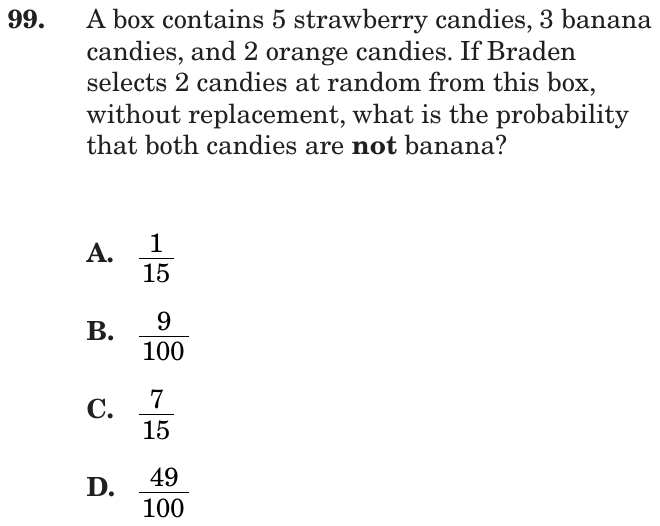
A box contains 5 strawberry candies, 3 banana candies, and 2 orange candies. If Braden selects 2 candies at random from this box, without replacement, what is the probability that both candies are not banana?
- A
- B
- C
- D
Show the answer
Correct answer: C
The total number of candies in the box is
5 + 3 + 2 = 10
The number of candies that are not banana is
5 + 2 = 7
The probability of the first candy not being banana is
Now, out of 9 candies, there are 6 candies left that are not banana. The probability of the second candy not being banana is
Multiply these two probabilities to get the solution:
Question analysis
This probability question has a box of strawberry, banana and orange candies and asks the chance that two candies drawn without replacement are both not banana. Students must count the non-banana candies, find the chance for each draw, and multiply. The second draw changes because one candy is already gone.
- NYS standards
- 7.SP.8a compound event as fraction of outcomes
- Grade level
- Grade 7 content, by NYS standard
- Compared with grade 7
- Above grade 7 Grade 7 compound probability usually uses lists or tree diagrams for independent events such as coins and number cubes. Here the draws are dependent, and students must also work with the complement, 'not banana'.
- Estimated difficulty
- Hard: combines ideas, needs a plan, and has more than one tempting wrong answer.
- Thinking it demands
- Depth of knowledge 2, skills and concepts · mainly apply
- What makes it hard
- Combines ideas moderate
- A very close wrong answer moderate
- Error-prone arithmetic minor
- Solution
- 3 steps
- Reading level
- Question and choices: about grade 9, 35 words.
- Corrected from the DOE handbook
- A stray punctuation mark in the explanation was removed.
- Students, last 30 days
- Not enough answers yet to show (it takes 10).
Why it is hard, traps and wrong answers (shows the answer)
Why it is hard
Two phrases in the stem change the calculation, "not" and "without replacement", and each has a choice for the student who misses it. The cleanest approach treats strawberry and orange together as one group of 7 and then works through the two draws in order. Students who know independent probability well are the most likely to square a fraction out of habit.
Combines ideas moderate Working it out
Two ideas meet: counting the 7 non-banana candies as the favorable group, and reducing both counts by one for the dependent second draw. (Embretson, 1998; Daniel & Embretson, 2010)
A very close wrong answer moderate Choosing the answer
The choices 49/100 and 7/15 are about 0.49 and 0.47, so estimating cannot separate them; only noticing that the second draw is 6 of 9, not 7 of 10, does. (Embretson & Wetzel, 1987; Gorin & Embretson, 2006; Ascalon et al., 2007)
Error-prone arithmetic minor Working it out
The product 7/10 × 6/9 = 42/90 must be simplified to 7/15 to match a choice, a reduction by 6 that is easy to stall on. (Brown & Burton, 1978; Junker & Sijtsma, 2001)
Strategy: Count the candies that are not banana, find the chance the first draw is one of them, reduce both counts by one for the second draw, and multiply.
Traps
- Without replacement: In a second pick there is one fewer item, which changes the probability.
- Misreads the question: Misses or misreads a condition or a word in the question: "at least", "each", "remaining", "not".
The wrong answers, classified
A Misreads the question (Hegarty, Mayer & Monk, 1995)
Misses the bold "not" and finds the chance that both candies are banana, 3/10 × 2/9 = 6/90 = 1/15.
B Without replacement (Fischbein & Schnarch, 1997)
Squares 3/10, finding two bananas as if the first candy were put back, which misses both "not" and "without replacement".
D Without replacement (Fischbein & Schnarch, 1997)
Squares 7/10 as if the first candy were returned, keeping 7 of 10 for the second draw instead of 6 of 9.
What was corrected from the DOE handbook, and why
- Explanation: The handbook reads “The probability of the second candy not being banana is. 6/9.” The period after “is” was removed.
Worked solution, step by step
Formulas used
- Probability
- P is the probability, the chance that something happens. f is the number of favorable outcomes, the ones you want. t is the total number of outcomes. It works when every outcome is equally likely, like picking one item at random.
- Two picks in a row
- To find the chance that two things both happen, multiply their chances. For the second chance, use what is left after the first pick. You multiply because you want a fraction of a fraction: the second pick must work in the share of times the first one did.
Sort out what you know
The box has 5 strawberry, 3 banana and 2 orange candies. Braden takes 2 candies. “Without replacement” means he keeps the first candy out. He does not put it back.
You need the chance that neither candy is banana. Watch out: the bold “not” matters. The chance that both are banana is , choice A.
Count the candies
There are 10 candies. The ones that are not banana are the strawberry and orange ones:
Find the chance for the first candy
7 of the 10 candies are not banana. Use the probability formula:
So the first candy is not banana 7 times out of 10.
Find the chance for the second candy
Say the first candy was not banana. Now 9 candies are left, and 6 of them are not banana:
Watch out: the first candy is not put back. Using again gives , choice D.
Multiply the two chances
Simplify by dividing the top and bottom by 6:
So the answer is C, .
Check your answer
Count pairs instead. From 10 candies there are 10 × 9 ÷ 2 = 45 different pairs. Pairs with no banana come from the 7 others: 7 × 6 ÷ 2 = 21. And 21 out of 45 is 7/15. It matches.
More questions like this
The original DOE question