Also in 2026 Practice Test A Math, question 38; 2025 Practice Test A Math, question 43.
Question
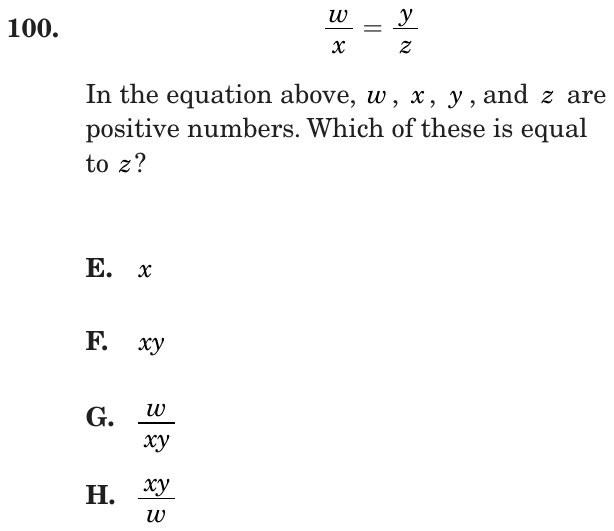
In the equation above, , and are positive numbers. Which of these is equal to ?
- A
- B
- C
- D
Show the answer
Correct answer: D
Solve the equation for :
Question analysis
This algebra question gives the proportion w/x = y/z, with all four letters positive, and asks which expression equals z. Students must solve the equation for one letter in terms of the others. With only letters on the page, it is easy to multiply when you should divide or to stop one step early.
- Grade level
- Grade 8 content, by NYS standard
- Compared with grade 7
- Above grade 7 Grade 7 students cross-multiply numeric proportions such as 3/4 = 9/x. Solving a proportion made only of letters for one of them is a literal equation, a grade 8 algebra skill, though it takes just two steps.
- Estimated difficulty
- Straightforward: two steps or one careful reading.
- Thinking it demands
- Depth of knowledge 1, recall and reproduction · mainly apply
- What makes it hard
- Variables instead of numbers moderate
- A very close wrong answer moderate
- Solution
- 2 steps
- Reading level
- Question and choices: about grade 10, 22 words.
- Students, last 30 days
- Not enough answers yet to show (it takes 10).
Why it is hard, traps and wrong answers (shows the answer)
Why it is hard
The method, cross-multiply and divide, is the same one students use on numeric proportions, but letters hide whether each step went the right way. The two most attractive wrong choices are both one step from the answer: one never divides, and the other divides upside down. A quick check with 2/3 = 4/6, where z = 6, settles it.
Variables instead of numbers moderate Understanding the question
The proportion has only letters, so cross-multiplying to wz = xy and dividing by w must be done without numbers to show whether w goes on top or bottom. (Koedinger & Nathan, 2004; Enright, Morley & Sheehan, 2002)
A very close wrong answer moderate Choosing the answer
The choices w/(xy) and xy/w use the same three letters with the fraction turned over, so only dividing in the right direction after wz = xy separates them. (Embretson & Wetzel, 1987; Gorin & Embretson, 2006; Ascalon et al., 2007)
Strategy: Cross-multiply to clear both fractions, then divide both sides by whatever multiplies z; check with a true proportion such as 2/3 = 4/6.
Traps
- Wrong operation: Adds instead of multiplying, divides the wrong way round, turns a ratio or rate upside down, or undoes a step in the wrong direction (subtracts what should be added back).
- Stops one step early: A choice is a number from partway through the solution.
The wrong answers, classified
A Numbers taken from the question (Hegarty, Mayer & Monk, 1995)
Matches z with x because both sit in a denominator, picking a letter from the equation without solving for z.
B Stops one step early (King et al., 2004; Gierl et al., 2017)
Cross-multiplies to wz = xy but stops there, giving xy without dividing both sides by w.
C Wrong operation (Hegarty, Mayer & Monk, 1995; King et al., 2004)
Cross-multiplies correctly but divides the wrong way round, putting w over xy instead of xy over w.
Worked solution, step by step
Formulas used
- Cross-multiplying
- a, b, c and d are numbers that are not 0. When two fractions are equal, each top times the other bottom gives the same answer. It works because you multiply both sides by both bottoms, which clears the fractions.
Sort out what you need
The equation says w over x equals y over z. All four letters are positive numbers. You need to get z alone on one side. Then the other side shows what z equals.
Cross-multiply the fractions
Multiply each top by the other fraction’s bottom:
So wz = xy, and z is no longer on the bottom. Watch out: stopping here and picking xy gives choice B. z is not alone yet.
Get z alone
z is being multiplied by w. To undo that, divide both sides by w. Doing the same to both sides keeps them equal:
Watch out: dividing the wrong way round gives w over xy, choice C. So the answer is D, .
Check your answer
Use a true pair of equal fractions: 2/3 = 4/6. So w = 2, x = 3, y = 4 and z = 6. Choice D gives 3 × 4 ÷ 2 = 6, which is z. Choice C gives 2 ÷ 12, which is not 6.
More questions like this
The original DOE question