Passage The Year without a Summer
The Year without a Summer
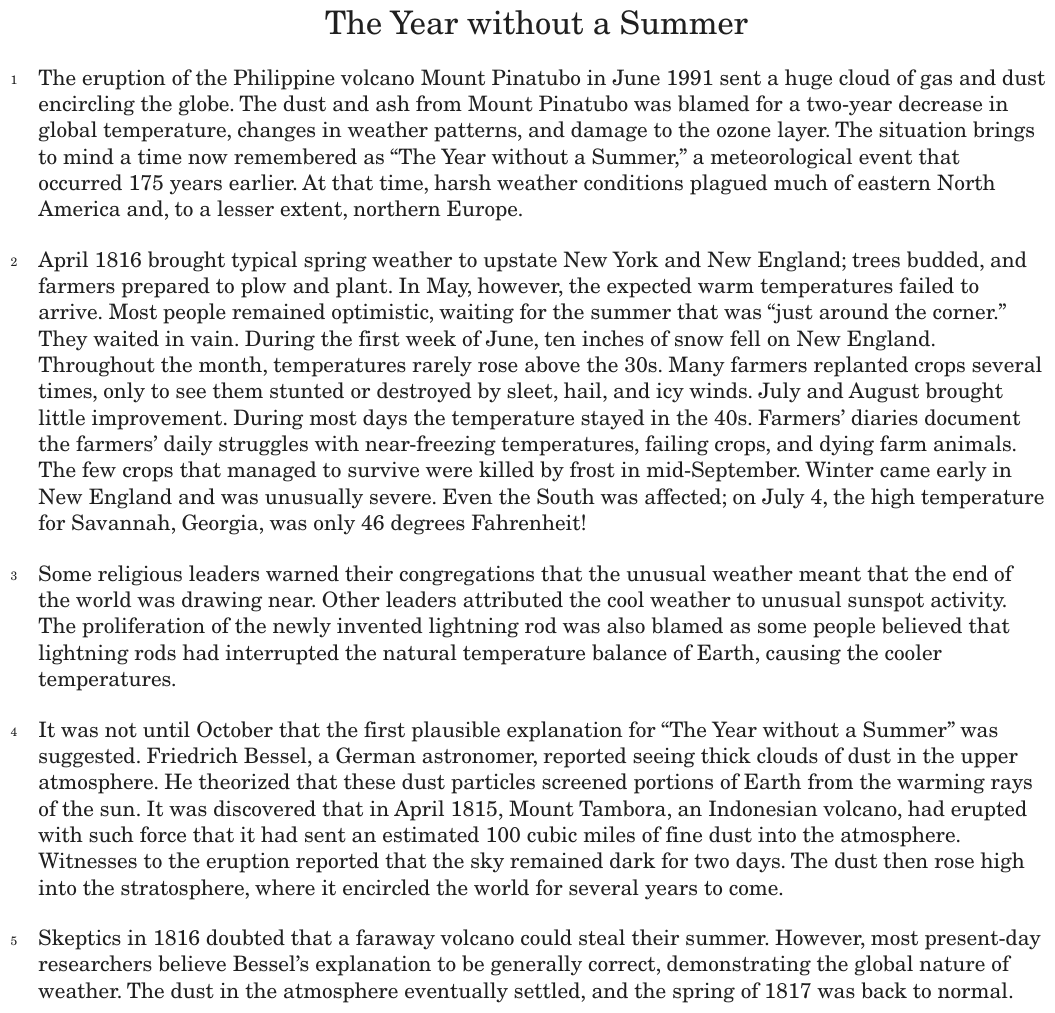
The eruption of the Philippine volcano Mount Pinatubo in June 1991 sent a huge cloud of gas and dust encircling the globe. The dust and ash from Mount Pinatubo was blamed for a two-year decrease in global temperature, changes in weather patterns, and damage to the ozone layer. The situation brings to mind a time now remembered as “The Year without a Summer,” a meteorological event that occurred 175 years earlier. At that time, harsh weather conditions plagued much of eastern North America and, to a lesser extent, northern Europe.
April 1816 brought typical spring weather to upstate New York and New England; trees budded, and farmers prepared to plow and plant. In May, however, the expected warm temperatures failed to arrive. Most people remained optimistic, waiting for the summer that was “just around the corner.” They waited in vain. During the first week of June, ten inches of snow fell on New England. Throughout the month, temperatures rarely rose above the 30s. Many farmers replanted crops several times, only to see them stunted or destroyed by sleet, hail, and icy winds. July and August brought little improvement. During most days the temperature stayed in the 40s. Farmers’ diaries document the farmers’ daily struggles with near-freezing temperatures, failing crops, and dying farm animals. The few crops that managed to survive were killed by frost in mid-September. Winter came early in New England and was unusually severe. Even the South was affected; on July 4, the high temperature for Savannah, Georgia, was only 46 degrees Fahrenheit!
Some religious leaders warned their congregations that the unusual weather meant that the end of the world was drawing near. Other leaders attributed the cool weather to unusual sunspot activity. The proliferation of the newly invented lightning rod was also blamed as some people believed that lightning rods had interrupted the natural temperature balance of Earth, causing the cooler temperatures.
It was not until October that the first plausible explanation for “The Year without a Summer” was suggested. Friedrich Bessel, a German astronomer, reported seeing thick clouds of dust in the upper atmosphere. He theorized that these dust particles screened portions of Earth from the warming rays of the sun. It was discovered that in April 1815, Mount Tambora, an Indonesian volcano, had erupted with such force that it had sent an estimated 100 cubic miles of fine dust into the atmosphere. Witnesses to the eruption reported that the sky remained dark for two days. The dust then rose high into the stratosphere, where it encircled the world for several years to come.
Skeptics in 1816 doubted that a faraway volcano could steal their summer. However, most present-day researchers believe Bessel’s explanation to be generally correct, demonstrating the global nature of weather. The dust in the atmosphere eventually settled, and the spring of 1817 was back to normal.
Question
In the winter that followed the summer of 1816, New Englanders most likely experienced
- Anew weather events that they had not encountered before.
- Btemperatures that were warmer than usual for that time of year.
- Cshortages of fruits, vegetables, and other essential crops.
- Ddifficulty adjusting to a different timeline for planting crops.
Show the answer
Correct answer: C
The answer is (C)
The question asks for the outcome that is best implied by the situation the New Englanders faced in 1816.
Option C is the correct answer because, with many crops “stunted or destroyed” (paragraph 2) in the summer of 1816, one would expect food shortages the following winter.
Option A is incorrect because cold weather was familiar to the population in New England, just not for such an extended period of time.
Option B is incorrect because there is no evidence in the passage that people experienced warmer temperatures.
Option D is incorrect because, although some farmers did replant their crops, there is no evidence in the passage that they struggled to adjust to a different timeline for farming.
Question analysis
Students must predict what New Englanders most likely faced in the winter after the cold summer of 1816, an inference question on an informational passage about a historic cold spell. The passage says little about daily life that winter, so students must reason one step beyond the text from what it reports about the summer.
- Grade level
- Grade 7 reading and task
- Compared with grade 7
- At grade 7 Drawing a likely consequence from stated facts is typical grade 7 inference work. The needed step goes just beyond what the passage reports, and the text is short and clear, so the demand matches grade 7.
- Estimated difficulty
- Moderate: several steps, or a close reading with one strong distractor.
- Thinking it demands
- Depth of knowledge 2, skills and concepts · mainly understand
- What makes it hard
- Reading between the lines moderate
- Something you must already know minor
- Evidence
- Answered from one paragraph or stanza
- Reading level
- Passage: about grade 9, 469 words; question and choices: about grade 9, 50 words.
- Corrected from the DOE handbook
- A spelling error in the explanation was corrected.
- Students, last 30 days
- Not enough answers yet to show (it takes 10).
Why it is hard, traps and wrong answers (shows the answer)
Why it is hard
This inference goes one step past the text, from destroyed crops to a hungry winter, and the passage never makes that step for the reader. Meanwhile the one sentence about the winter, early and unusually severe, tempts students toward an answer about unheard-of weather. Students who ask what the summer's losses would mean for daily life months later find the key; those who look only for the word “winter” do not.
Reading between the lines moderate Working it out
The passage says nothing about food that winter; students must reason from “The few crops that managed to survive were killed by frost in mid-September” to empty stores months later. (Graesser, Singer & Trabasso, 1994; Kintsch, 1998)
Something you must already know minor Working it out
The inference needs the everyday fact that a farm family's winter food comes from the autumn harvest, which the passage leaves unsaid. (Anderson & Krathwohl, 2001)
Strategy: List the consequences of the cold summer that paragraph 2 reports, then ask which would still affect people months later, in winter.
Traps
- Too broad or too strong: A choice overstates, generalizes, or uses absolute words the text does not support.
- Wrong part of the text: A choice is true of another paragraph, stanza or speaker than the one asked about.
The wrong answers, classified
A Too broad or too strong (King et al., 2004)
Stretches “unusually severe” into weather never encountered before, but New Englanders knew cold winters well; this one was harsher, not new.
B Twists what the text says (King et al., 2004)
Reverses the passage's statement that winter “came early” and “was unusually severe,” which rules out warmer temperatures.
D Wrong part of the text (Kirsch & Mosenthal, 1990)
Carries the summer's repeated replanting into winter, though planting is not a winter task and the passage never mentions a changed planting timeline.
What was corrected from the DOE handbook, and why
- Explanation: The handbook’s “some famers did replant their crops” now reads “some farmers”.
Working it out, step by step
Figure out what the question asks
This is an inference question. The passage never says what life was like that winter. You must reason from what it does say.
Find what happened to the crops
Paragraph 2 tells the story. Crops were “stunted or destroyed by sleet, hail, and icy winds.” Then: “The few crops that managed to survive were killed by frost in mid-September.” Finally, “Winter came early in New England and was unusually severe.”
Work out the result
Stunted means stopped from growing to full size. In 1816, families ate food they grew in summer and saved for winter. But almost all the crops died. So there was very little food to save. That means the winter would bring shortages: not enough food to go around.
Check each choice
- A New Englanders knew cold winters well. This one was harsher, not a new kind of weather.
- B The passage says the winter was severe, so it was not warmer.
- C fits. With the crops gone, food would run short.
- D Nobody plants crops in winter. The passage says nothing about a new planting schedule.
Choose the answer
With the crops destroyed, people likely ran short of food that winter. So the answer is C.
Why this answer and not the closest wrong one
A is the closest trap, because the winter was “unusually severe.” But severe means harsh, not new. Cold winters were normal in New England. C follows from the clearest facts in paragraph 2: the crops died, so there would be little food.
More questions like this
The original DOE question

The passage “The Year without a Summer” as printed (page 76)