Passage The Year without a Summer
The Year without a Summer
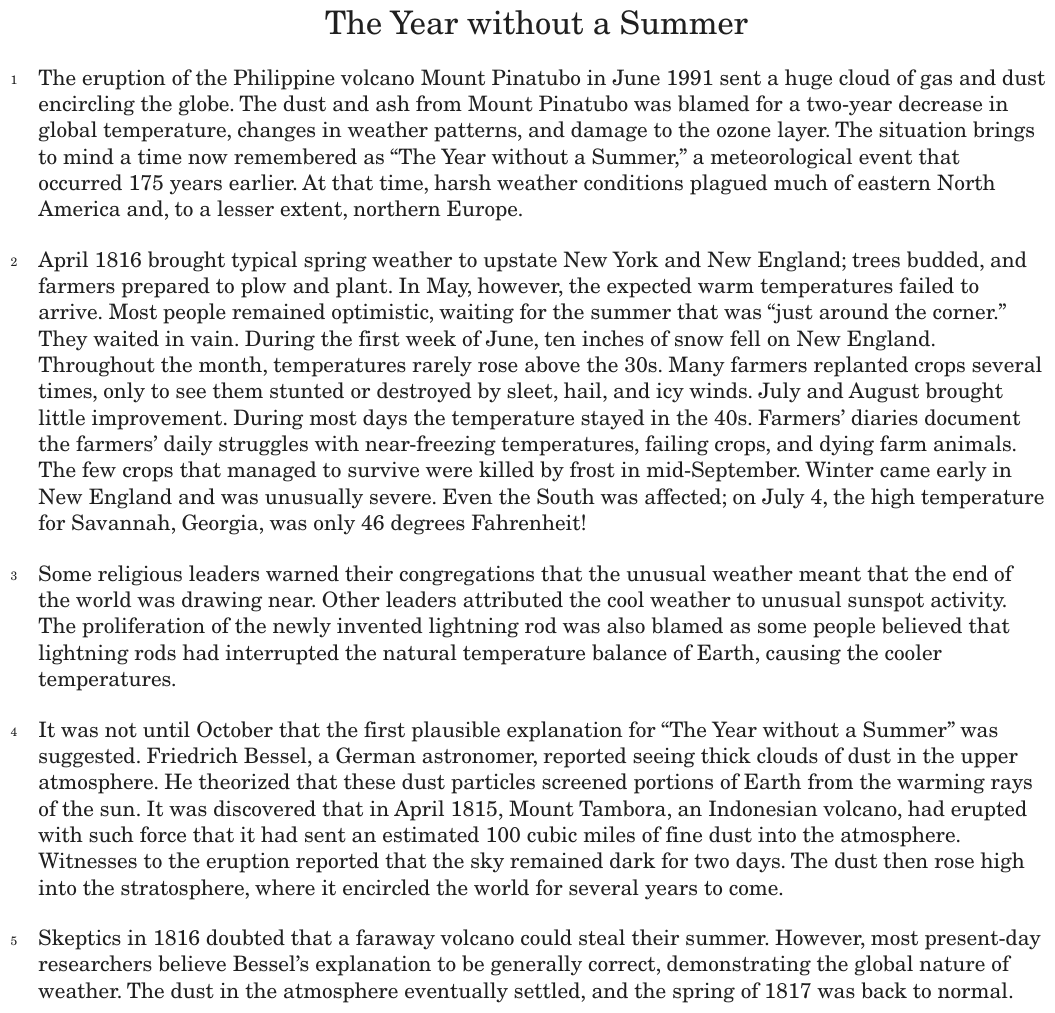
The eruption of the Philippine volcano Mount Pinatubo in June 1991 sent a huge cloud of gas and dust encircling the globe. The dust and ash from Mount Pinatubo was blamed for a two-year decrease in global temperature, changes in weather patterns, and damage to the ozone layer. The situation brings to mind a time now remembered as “The Year without a Summer,” a meteorological event that occurred 175 years earlier. At that time, harsh weather conditions plagued much of eastern North America and, to a lesser extent, northern Europe.
April 1816 brought typical spring weather to upstate New York and New England; trees budded, and farmers prepared to plow and plant. In May, however, the expected warm temperatures failed to arrive. Most people remained optimistic, waiting for the summer that was “just around the corner.” They waited in vain. During the first week of June, ten inches of snow fell on New England. Throughout the month, temperatures rarely rose above the 30s. Many farmers replanted crops several times, only to see them stunted or destroyed by sleet, hail, and icy winds. July and August brought little improvement. During most days the temperature stayed in the 40s. Farmers’ diaries document the farmers’ daily struggles with near-freezing temperatures, failing crops, and dying farm animals. The few crops that managed to survive were killed by frost in mid-September. Winter came early in New England and was unusually severe. Even the South was affected; on July 4, the high temperature for Savannah, Georgia, was only 46 degrees Fahrenheit!
Some religious leaders warned their congregations that the unusual weather meant that the end of the world was drawing near. Other leaders attributed the cool weather to unusual sunspot activity. The proliferation of the newly invented lightning rod was also blamed as some people believed that lightning rods had interrupted the natural temperature balance of Earth, causing the cooler temperatures.
It was not until October that the first plausible explanation for “The Year without a Summer” was suggested. Friedrich Bessel, a German astronomer, reported seeing thick clouds of dust in the upper atmosphere. He theorized that these dust particles screened portions of Earth from the warming rays of the sun. It was discovered that in April 1815, Mount Tambora, an Indonesian volcano, had erupted with such force that it had sent an estimated 100 cubic miles of fine dust into the atmosphere. Witnesses to the eruption reported that the sky remained dark for two days. The dust then rose high into the stratosphere, where it encircled the world for several years to come.
Skeptics in 1816 doubted that a faraway volcano could steal their summer. However, most present-day researchers believe Bessel’s explanation to be generally correct, demonstrating the global nature of weather. The dust in the atmosphere eventually settled, and the spring of 1817 was back to normal.
Question
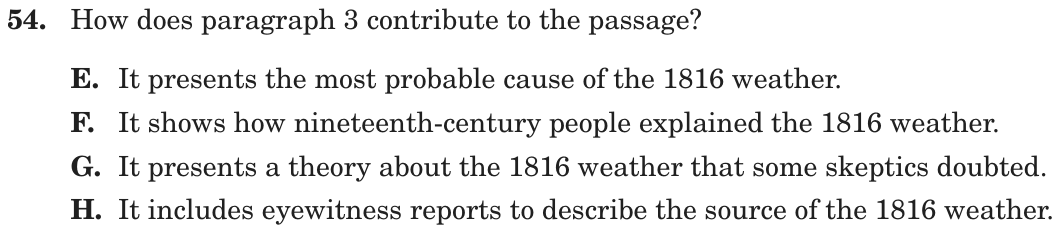
How does paragraph 3 contribute to the passage?
- AIt presents the most probable cause of the 1816 weather.
- BIt shows how nineteenth-century people explained the 1816 weather.
- CIt presents a theory about the 1816 weather that some skeptics doubted.
- DIt includes eyewitness reports to describe the source of the 1816 weather.
Show the answer
Correct answer: B
The answer is (B)
The question asks for the purpose and importance of paragraph 3 to the passage. Paragraph 3 describes how nineteenth-century religious and other leaders tried to account for the cooler weather in 1816. Some leaders thought it was “the end of the world,” “sunspot activity,” or the proliferation of a new invention. How this information contributed to the passage is stated in Option B.
Option A is incorrect because the causes described in paragraph 3 were not the most probable cause, as “the first plausible explanation”—Bessel’s—is described later in the passage.
Option C is incorrect because more than one theory is presented in paragraph 3.
Option D is incorrect because the ideas described are not included in paragraph 3.
Question analysis
This text structure question asks what paragraph 3 of “The Year without a Summer” contributes to the passage. Students must place the paragraph within the passage's account of the cold summer, which means knowing what the paragraphs before and after it do.
- NYS standards
- 7R5 structure and genre features
- Grade level
- Grade 7 reading and task
- Compared with grade 7
- At grade 7 Explaining a paragraph's role is standard grade 7 structure work. The paragraph is short, but nearby paragraphs also discuss causes of the cold, so students must keep them apart; overall the demand is typical.
- Estimated difficulty
- Straightforward: two steps or one careful reading.
- Thinking it demands
- Depth of knowledge 2, skills and concepts · mainly analyze
- What makes it hard
- Much to keep track of moderate
- How, not what minor
- A very close wrong answer minor
- Evidence
- Answered from several paragraphs or stanzas
- Reading level
- Passage: about grade 9, 469 words; question and choices: about grade 7, 46 words.
- Students, last 30 days
- Not enough answers yet to show (it takes 10).
Why it is hard, traps and wrong answers (shows the answer)
Why it is hard
Paragraph 3 is short and clear on its own, but the paragraphs around it also deal with causes, and the wrong choices are built from those neighbors: the plausible explanation and eyewitnesses from paragraph 4, the skeptics from paragraph 5. A student who summarizes paragraph 3 before reading the choices, as three guesses made at the time, has little trouble; one who checks choices against a general memory of the passage can be caught.
Much to keep track of moderate Working it out
Paragraphs 3, 4 and 5 all deal with explanations, the guesses of 1816, Bessel's dust theory, the skeptics, and each wrong choice borrows from one of them. (Sweller, 1988; Carpenter, Just & Shell, 1990)
How, not what minor Working it out
The stem asks what paragraph 3 contributes, so students must name its role, a record of how people at the time accounted for the cold, not just list its theories. (Anderson & Krathwohl, 2001)
A very close wrong answer minor Choosing the answer
A and B both say paragraph 3 explains the 1816 weather; they differ in one phrase, since A calls it “the most probable cause,” a label the passage gives only to Bessel's dust theory in paragraph 4. (Embretson & Wetzel, 1987; Gorin & Embretson, 2006; Ascalon et al., 2007)
Strategy: Summarize paragraph 3 in a few words, do the same for the paragraphs around it, and pick the choice that matches paragraph 3's own job.
Traps
- Wrong part of the text: A choice is true of another paragraph, stanza or speaker than the one asked about.
The wrong answers, classified
A Wrong part of the text (Kirsch & Mosenthal, 1990)
Credits paragraph 3 with Bessel's dust theory from paragraph 4, which the passage calls “the first plausible explanation.”
C Wrong part of the text (Kirsch & Mosenthal, 1990)
Borrows the skeptics from paragraph 5, who doubted the volcano theory, and overlooks that paragraph 3 offers several guesses, not one doubted theory.
D Wrong part of the text (Kirsch & Mosenthal, 1990)
Brings in the witnesses to the Tambora eruption from paragraph 4; paragraph 3 contains no eyewitness reports.
Working it out, step by step
Figure out what the question asks
This is a structure question. It asks what job paragraph 3 does in the passage. Sum it up first, then compare it with the paragraphs around it.
Read paragraph 3
Paragraph 3 lists three guesses from 1816. Some religious leaders said “the end of the world was drawing near.” Others blamed “unusual sunspot activity.” Some people blamed the new lightning rod.
Work out its job
All three ideas come from people living at the time, in the nineteenth century (the 1800s). None of them turned out to be right. So the paragraph shows how people back then tried to explain the cold.
The real cause comes next. Paragraph 4 calls Bessel’s idea “the first plausible explanation.” Plausible means believable.
Check each choice
- A The most probable cause, Bessel’s dust, is in paragraph 4, not 3.
- B fits. It shows how people of the 1800s explained the weather.
- C Paragraph 3 gives several guesses, not one theory. The skeptics (doubters) come in paragraph 5.
- D The eyewitness reports, about Mount Tambora, are in paragraph 4.
Choose the answer
Paragraph 3 shows how people at the time explained the strange weather. So the answer is B.
Why this answer and not the closest wrong one
A is the closest trap. A and B both say paragraph 3 explains the weather. But A calls it “the most probable cause.” The passage saves that label for Bessel’s idea in paragraph 4, “the first plausible explanation.” Paragraph 3’s guesses were wrong, so B fits.
More questions like this
The original DOE question
The passage “The Year without a Summer” as printed (page 76)