Passage Ruins of a Fabled City
Ruins of a Fabled City
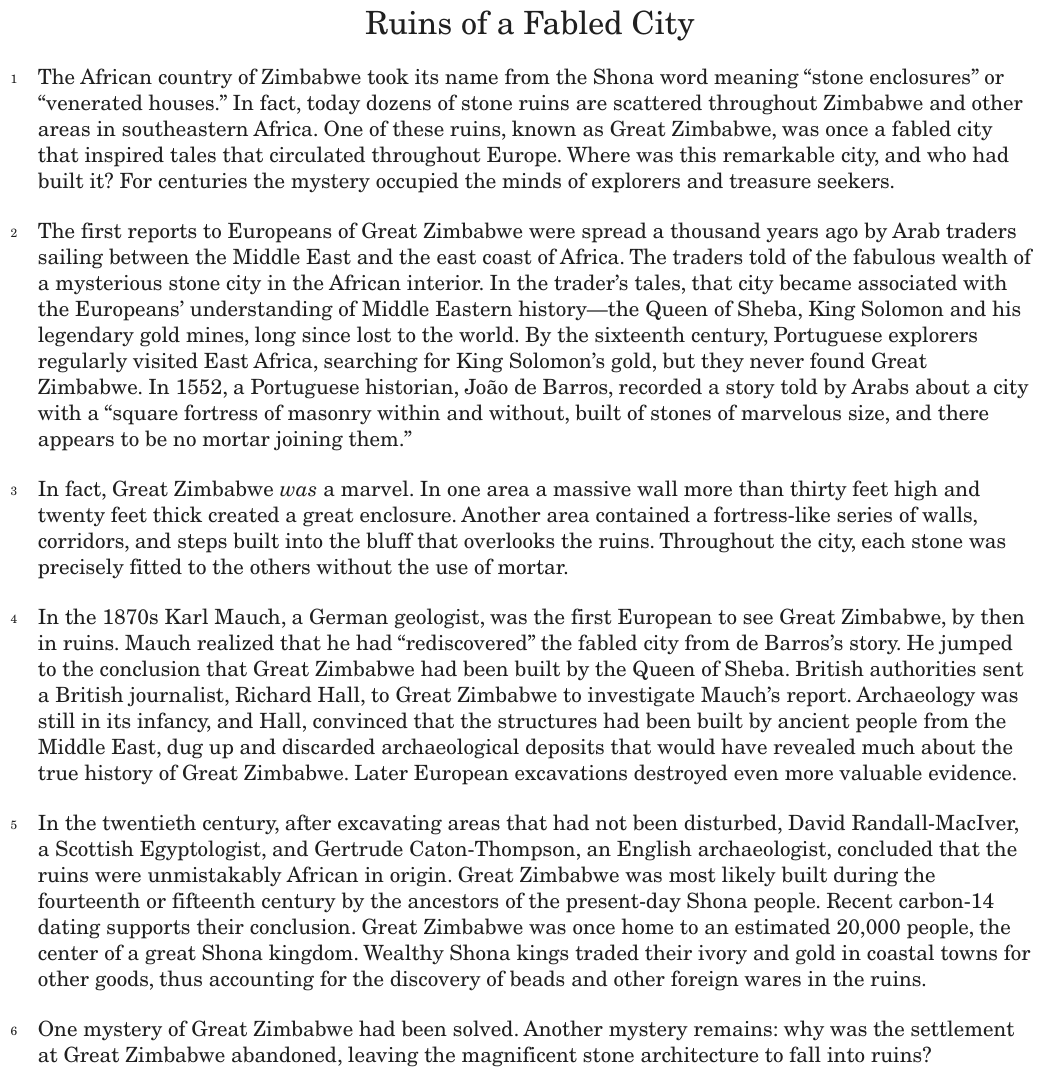
The African country of Zimbabwe took its name from the Shona word meaning “stone enclosures” or “venerated houses.” In fact, today dozens of stone ruins are scattered throughout Zimbabwe and other areas in southeastern Africa. One of these ruins, known as Great Zimbabwe, was once a fabled city that inspired tales that circulated throughout Europe. Where was this remarkable city, and who had built it? For centuries the mystery occupied the minds of explorers and treasure seekers.
The first reports to Europeans of Great Zimbabwe were spread a thousand years ago by Arab traders sailing between the Middle East and the east coast of Africa. The traders told of the fabulous wealth of a mysterious stone city in the African interior. In the trader’s tales, that city became associated with the Europeans’ understanding of Middle Eastern history—the Queen of Sheba, King Solomon and his legendary gold mines, long since lost to the world. By the sixteenth century, Portuguese explorers regularly visited East Africa, searching for King Solomon’s gold, but they never found Great Zimbabwe. In 1552, a Portuguese historian, João de Barros, recorded a story told by Arabs about a city with a “square fortress of masonry within and without, built of stones of marvelous size, and there appears to be no mortar joining them.”
In fact, Great Zimbabwe was a marvel. In one area a massive wall more than thirty feet high and twenty feet thick created a great enclosure. Another area contained a fortress-like series of walls, corridors, and steps built into the bluff that overlooks the ruins. Throughout the city, each stone was precisely fitted to the others without the use of mortar.
In the 1870s Karl Mauch, a German geologist, was the first European to see Great Zimbabwe, by then in ruins. Mauch realized that he had “rediscovered” the fabled city from de Barros’s story. He jumped to the conclusion that Great Zimbabwe had been built by the Queen of Sheba. British authorities sent a British journalist, Richard Hall, to Great Zimbabwe to investigate Mauch’s report. Archaeology was still in its infancy, and Hall, convinced that the structures had been built by ancient people from the Middle East, dug up and discarded archaeological deposits that would have revealed much about the true history of Great Zimbabwe. Later European excavations destroyed even more valuable evidence.
In the twentieth century, after excavating areas that had not been disturbed, David Randall-MacIver, a Scottish Egyptologist, and Gertrude Caton-Thompson, an English archaeologist, concluded that the ruins were unmistakably African in origin. Great Zimbabwe was most likely built during the fourteenth or fifteenth century by the ancestors of the present-day Shona people. Recent carbon-14 dating supports their conclusion. Great Zimbabwe was once home to an estimated 20,000 people, the center of a great Shona kingdom. Wealthy Shona kings traded their ivory and gold in coastal towns for other goods, thus accounting for the discovery of beads and other foreign wares in the ruins.
One mystery of Great Zimbabwe had been solved. Another mystery remains: why was the settlement at Great Zimbabwe abandoned, leaving the magnificent stone architecture to fall into ruins?
Question
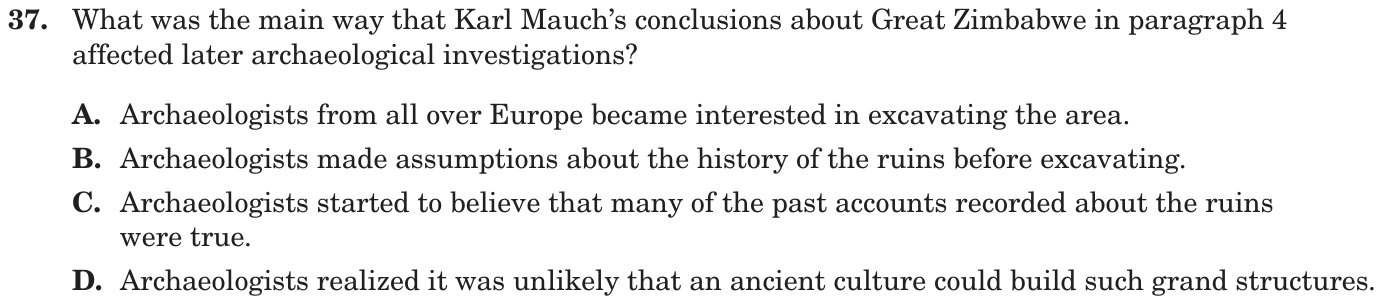
What was the main way that Karl Mauch’s conclusions about Great Zimbabwe in paragraph 4 affected later archaeological investigations?
- AArchaeologists from all over Europe became interested in excavating the area.
- BArchaeologists made assumptions about the history of the ruins before excavating.
- CArchaeologists started to believe that many of the past accounts recorded about the ruins were true.
- DArchaeologists realized it was unlikely that an ancient culture could build such grand structures.
Show the answer
Correct answer: B
The answer is (B)
The question asks for an explanation of how Mauch’s conclusions influenced later investigations.
Option B is the best option because Mauch’s conclusion that Great Zimbabwe “had been built by the Queen of Sheba” (paragraph 4) affected later investigations of the ruins by causing archaeologists to destroy evidence without examining it, as they assumed that Mauch’s conclusions were accurate (paragraph 4).
Option A is incorrect because, while archaeologists were interested in the area, this was not the main effect of Mauch’s conclusions, as described in the passage.
Option C is incorrect because people searched for Great Zimbabwe because they already believed the stories told by Arab traders and historians like de Barros (paragraph 2), not because of Mauch’s conclusions.
Option D is incorrect because, although the city was considered impressive (paragraph 3), Mauch’s conclusions did not influence whether people believed an ancient culture could have built the city.
Question analysis
This cause-and-effect question asks how Karl Mauch's 1870s conclusions about Great Zimbabwe shaped the investigations that came after him. Students must trace the effect through paragraph 4, where later visitors dug at the site, while keeping the older traders' tales and Portuguese searches in their proper order.
- Grade level
- Grade 7 reading and task
- Compared with grade 7
- At grade 7 Grade 7 informational reading asks how events and ideas influence one another, which is exactly this task. The effect is implied rather than stated, but it sits in one paragraph, keeping the demand typical for grade 7.
- Estimated difficulty
- Moderate: several steps, or a close reading with one strong distractor.
- Thinking it demands
- Depth of knowledge 2, skills and concepts · mainly analyze
- What makes it hard
- Reading between the lines moderate
- A very close wrong answer moderate
- Much to keep track of minor
- Evidence
- Answered from one paragraph or stanza
- Reading level
- Passage: about grade 11, 524 words; question and choices: about grade 11, 70 words.
- Students, last 30 days
- Not enough answers yet to show (it takes 10).
Why it is hard, traps and wrong answers (shows the answer)
Why it is hard
The cause and effect is implied across two sentences of paragraph 4, so students must connect Mauch's leap to the Queen of Sheba with Hall's conviction and the evidence he threw away. The passage's long run of legends makes the older accounts feel like a consequence of Mauch, when they came first. The key rewards reading for what investigators did differently because of him, not what anyone believed at some point.
Reading between the lines moderate Working it out
The passage never says Mauch's conclusion caused anything; the link comes from Hall being sent “to investigate Mauch's report” and arriving “convinced” of Middle Eastern builders. (Graesser, Singer & Trabasso, 1994; Kintsch, 1998)
A very close wrong answer moderate Choosing the answer
B and C both say later investigators took beliefs about the ruins' history for granted; C differs in one detail, since trust in the old accounts began centuries before Mauch rather than because of him. (Embretson & Wetzel, 1987; Gorin & Embretson, 2006; Ascalon et al., 2007)
Much to keep track of minor Working it out
Students must keep the order of believers straight: Arab traders, Portuguese explorers, de Barros in 1552, Mauch in the 1870s, then Hall and later European diggers. (Sweller, 1988; Carpenter, Just & Shell, 1990)
Strategy: Find what Mauch concluded, then read the sentences about the next people to dig at the site and ask how his conclusion shows up in what they did.
Traps
- Reversed relationship: Cause and effect, or the order of events, turned around.
- Too broad or too strong: A choice overstates, generalizes, or uses absolute words the text does not support.
- Outside knowledge: A choice is plausible in the real world but not supported by this text.
The wrong answers, classified
A Too broad or too strong (King et al., 2004)
Inflates the British inquiry and the “later European excavations” into archaeologists from all over Europe, and treats their interest as Mauch's main effect.
C Reversed relationship (King et al., 2004)
Flips the order: trust in the traders' tales and de Barros's account came long before Mauch and shaped his conclusion, not the other way round.
D Outside knowledge (King et al., 2004; Recht & Leslie, 1988)
Echoes the real colonial-era doubt that Africans built the city, but in the passage Hall credits ancient Middle Eastern builders, so investigators did think an ancient culture built it.
Working it out, step by step
Figure out what the question asks
This is a cause-and-effect question. It asks how Karl Mauch’s ideas changed what later people did at the ruins.
Find the evidence in paragraph 4
Mauch “jumped to the conclusion that Great Zimbabwe had been built by the Queen of Sheba.” Then Richard Hall was sent “to investigate Mauch’s report.”
Hall arrived “convinced that the structures had been built by ancient people from the Middle East.” So he “dug up and discarded archaeological deposits.” Later digs “destroyed even more valuable evidence.”
Work out the effect
To jump to a conclusion is to decide something before you have proof. Mauch did that. Hall came to check Mauch’s report, already sure of a story like Mauch’s. He decided the answer before he dug. So he threw away clues. “Deposits” here means layers of old things in the ground. They could have shown the true history.
Check each choice
- A The passage never says people from all over Europe became interested.
- B fits. The diggers made assumptions (beliefs taken as true without proof) before they dug.
- C People trusted the old tales centuries before Mauch, so he did not cause that.
- D Hall still thought an ancient people built the city, just not Africans.
Choose the answer
Mauch’s guess led later diggers to decide the city’s history before they dug. So the answer is B.
Why this answer and not the closest wrong one
C is the closest trap. It also says people trusted ideas about the ruins. But trust in the old tales began with Arab traders, and de Barros wrote his story down in 1552. Mauch came in the 1870s. C gets the order backward. B names what changed after Mauch.
More questions like this
The original DOE question
The passage “Ruins of a Fabled City” as printed (page 68)