Passage Ruins of a Fabled City
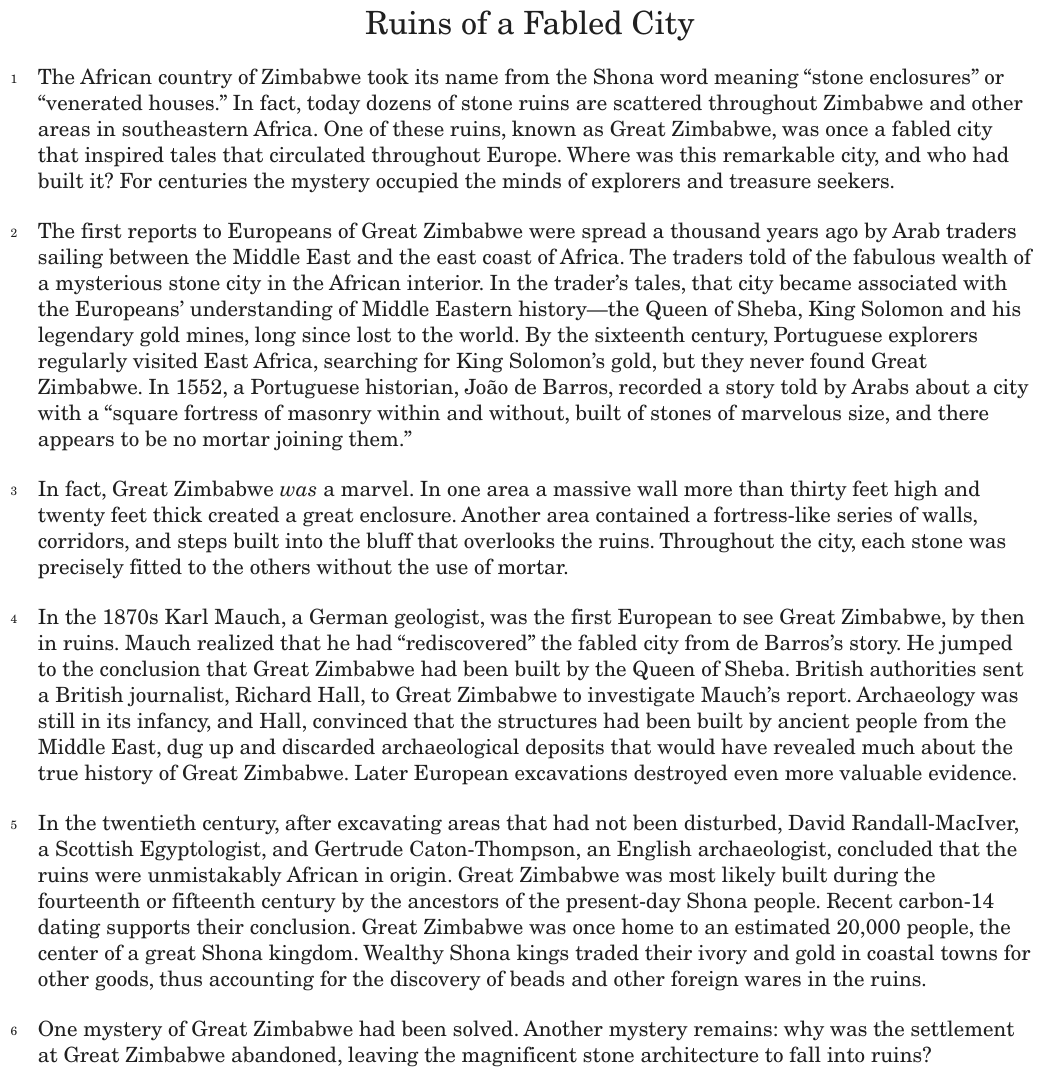
Ruins of a Fabled City
The African country of Zimbabwe took its name from the Shona word meaning “stone enclosures” or “venerated houses.” In fact, today dozens of stone ruins are scattered throughout Zimbabwe and other areas in southeastern Africa. One of these ruins, known as Great Zimbabwe, was once a fabled city that inspired tales that circulated throughout Europe. Where was this remarkable city, and who had built it? For centuries the mystery occupied the minds of explorers and treasure seekers.
The first reports to Europeans of Great Zimbabwe were spread a thousand years ago by Arab traders sailing between the Middle East and the east coast of Africa. The traders told of the fabulous wealth of a mysterious stone city in the African interior. In the trader’s tales, that city became associated with the Europeans’ understanding of Middle Eastern history—the Queen of Sheba, King Solomon and his legendary gold mines, long since lost to the world. By the sixteenth century, Portuguese explorers regularly visited East Africa, searching for King Solomon’s gold, but they never found Great Zimbabwe. In 1552, a Portuguese historian, João de Barros, recorded a story told by Arabs about a city with a “square fortress of masonry within and without, built of stones of marvelous size, and there appears to be no mortar joining them.”
In fact, Great Zimbabwe was a marvel. In one area a massive wall more than thirty feet high and twenty feet thick created a great enclosure. Another area contained a fortress-like series of walls, corridors, and steps built into the bluff that overlooks the ruins. Throughout the city, each stone was precisely fitted to the others without the use of mortar.
In the 1870s Karl Mauch, a German geologist, was the first European to see Great Zimbabwe, by then in ruins. Mauch realized that he had “rediscovered” the fabled city from de Barros’s story. He jumped to the conclusion that Great Zimbabwe had been built by the Queen of Sheba. British authorities sent a British journalist, Richard Hall, to Great Zimbabwe to investigate Mauch’s report. Archaeology was still in its infancy, and Hall, convinced that the structures had been built by ancient people from the Middle East, dug up and discarded archaeological deposits that would have revealed much about the true history of Great Zimbabwe. Later European excavations destroyed even more valuable evidence.
In the twentieth century, after excavating areas that had not been disturbed, David Randall-MacIver, a Scottish Egyptologist, and Gertrude Caton-Thompson, an English archaeologist, concluded that the ruins were unmistakably African in origin. Great Zimbabwe was most likely built during the fourteenth or fifteenth century by the ancestors of the present-day Shona people. Recent carbon-14 dating supports their conclusion. Great Zimbabwe was once home to an estimated 20,000 people, the center of a great Shona kingdom. Wealthy Shona kings traded their ivory and gold in coastal towns for other goods, thus accounting for the discovery of beads and other foreign wares in the ruins.
One mystery of Great Zimbabwe had been solved. Another mystery remains: why was the settlement at Great Zimbabwe abandoned, leaving the magnificent stone architecture to fall into ruins?
Question
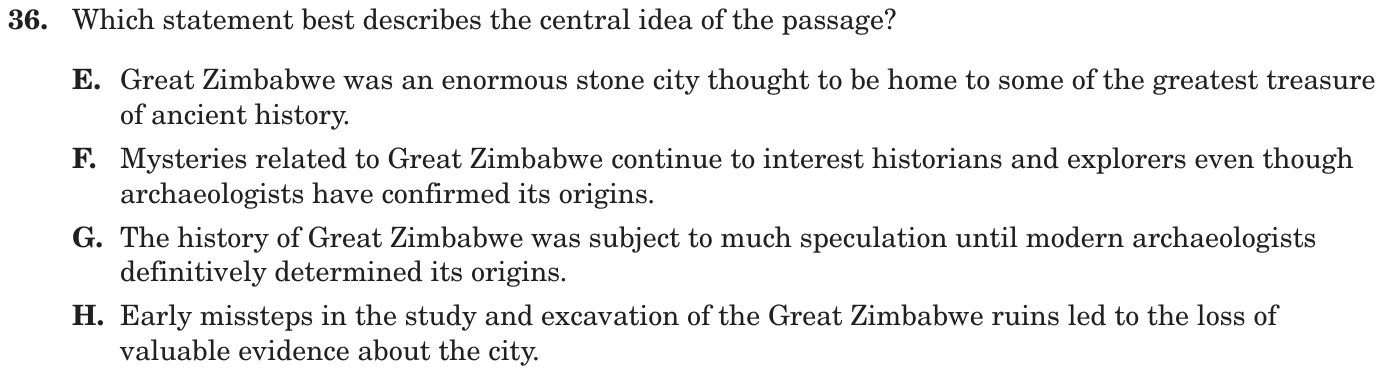
Which statement best describes the central idea of the passage?
- AGreat Zimbabwe was an enormous stone city thought to be home to some of the greatest treasure of ancient history.
- BMysteries related to Great Zimbabwe continue to interest historians and explorers even though archaeologists have confirmed its origins.
- CThe history of Great Zimbabwe was subject to much speculation until modern archaeologists definitively determined its origins.
- DEarly missteps in the study and excavation of the Great Zimbabwe ruins led to the loss of valuable evidence about the city.
Show the answer
Correct answer: C
The answer is (C)
The question asks for the sentence that best summarizes the central idea of the passage. The idea that there was much speculation about Great Zimbabwe is explained at the end of paragraph 1 and in paragraph 2, and the details about how modern archaeologists determined its origins are explained in paragraph 5.
Option C best represents the central idea that is developed and supported throughout the passage.
Option A is incorrect because it does not fully express the central idea of the passage: it includes facts from only the beginning of the passage and does not take into account the discoveries revealed about Great Zimbabwe in paragraph 5.
Option B is incorrect because it focuses mainly on the idea that archaeologists are still interested in the mysteries of Great Zimbabwe (paragraph 6) and does not fully explain the central idea.
Option D is incorrect because the fact that early excavations of Great Zimbabwe caused the destruction of valuable evidence is a detail from paragraph 4, and the option does not fully convey the central idea of the passage.
Question analysis
This central idea question asks which statement best sums up “Ruins of a Fabled City,” an informational passage about Great Zimbabwe, the stone ruins in southeastern Africa. Students must weigh the whole passage, from traders' legends to later excavations and a final unsolved question, and decide which choice best covers it.
- NYS standards
- 7R2 theme or central idea
- Grade level
- Grade 7 reading and task
- Compared with grade 7
- At grade 7 Finding the central idea of a six-paragraph informational text is core grade 7 work. The passage is dense with names, dates and theories, which adds reading load, but the task matches what grade 7 state tests routinely ask.
- Estimated difficulty
- Moderate: several steps, or a close reading with one strong distractor.
- Thinking it demands
- Depth of knowledge 2, skills and concepts · mainly understand
- What makes it hard
- A lot to read moderate
- A very close wrong answer moderate
- Every choice must be checked minor
- Evidence
- Answered from the whole text
- Reading level
- Passage: about grade 11, 524 words; question and choices: about grade 12, 87 words.
- Students, last 30 days
- Not enough answers yet to show (it takes 10).
Why it is hard, traps and wrong answers (shows the answer)
Why it is hard
Every choice is drawn from the passage, so the work is judging scope. Two choices summarize one stage of the story well, and one blends the solved question with the unsolved one in a way that sounds like a full summary. The key is the only one that runs from the early speculation to the twentieth-century finding, and students who sketch the passage's arc before reading the choices spot it fastest.
A lot to read moderate Understanding the question
Six paragraphs span a thousand years and a crowd of names, from Arab traders and de Barros to Mauch, Hall, Randall-MacIver and Caton-Thompson, and the summary must hold them together. (Kintsch, 1998; Gorin & Embretson, 2006; Freedle & Kostin, 1993)
A very close wrong answer moderate Choosing the answer
B and C both say archaeologists settled the city's origins; they differ in the other half, where C traces the speculation before that finding and B claims historians and explorers are still chasing mysteries. (Embretson & Wetzel, 1987; Gorin & Embretson, 2006; Ascalon et al., 2007)
Every choice must be checked minor Choosing the answer
The treasure-city and destroyed-evidence choices are each accurate for a paragraph or two, so each must be measured against the whole passage rather than checked for truth. (Embretson & Wetzel, 1987)
Strategy: Jot a few words for what each of the six paragraphs does, then pick the statement that accounts for most of them; one true of only a paragraph or two is too narrow.
Traps
- Too narrow: A single detail offered as the central idea or a summary, or a summary that keeps minor details and leaves out an essential part.
- Half right: One half of a two-part choice is right and the other is not.
The wrong answers, classified
A Too narrow (King et al., 2004)
Sums up only the opening legends of a treasure city and stops before the passage settles who built it.
B Half right (King et al., 2004; Thissen, Steinberg & Fitzpatrick, 1989)
Rightly says archaeologists settled the city's origins, but the claim that mysteries keep drawing historians and explorers inflates the final paragraph's one open question.
D Too narrow (King et al., 2004)
Promotes paragraph 4's account of careless digging that destroyed evidence to the main point, though it is one stage in a longer story.
Working it out, step by step
Figure out what the question asks
This question asks for the central idea. That is the main point of the whole passage, not of one paragraph. The right choice must cover most of the passage.
Note what each paragraph does
- Paragraph 1: Great Zimbabwe was a “fabled city,” a city from legends. Who built it was a mystery.
- Paragraph 2: Traders told tales and linked it to King Solomon’s gold.
- Paragraph 3: Its stone walls were amazing.
- Paragraph 4: Mauch and Hall guessed wrong and destroyed evidence.
- Paragraph 5: Scientists showed that Africans built it.
- Paragraph 6: Why people left is still unknown.
See the shape of the passage
Most of the passage is about guesses: tales, legends and wrong ideas about who built the city. Speculation means guessing without proof.
Then, in paragraph 5, archaeologists (scientists who dig up and study old things) found that the ruins were “unmistakably African in origin.” So the passage moves from guessing to an answer.
Check each choice
- A covers only the early legends. It stops before the answer.
- B blows up the one open question in paragraph 6. The passage never says explorers are still chasing mysteries.
- C fits. It runs from the guessing to the answer.
- D is true, but it covers only paragraph 4.
Choose the answer
The passage is about guesses that lasted until archaeologists found the truth. So the answer is C.
Why this answer and not the closest wrong one
B is the closest choice. Like C, it says archaeologists found the city’s origins. But B adds that mysteries “continue to interest historians and explorers.” The passage names only one open question and never says that. C covers paragraphs 1 through 5, so it fits better.
More questions like this
The original DOE question
The passage “Ruins of a Fabled City” as printed (page 68)