Passage Ruins of a Fabled City
Ruins of a Fabled City
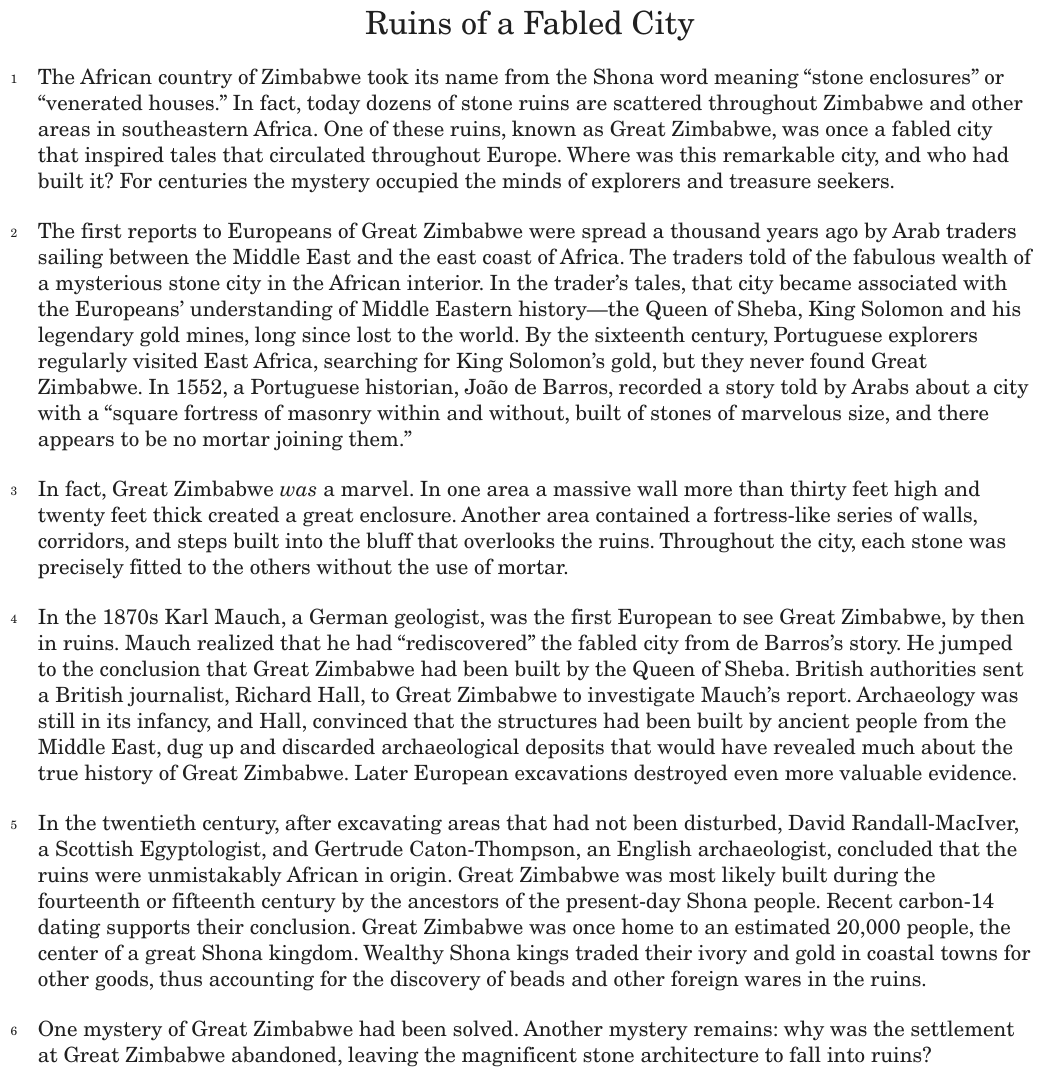
The African country of Zimbabwe took its name from the Shona word meaning “stone enclosures” or “venerated houses.” In fact, today dozens of stone ruins are scattered throughout Zimbabwe and other areas in southeastern Africa. One of these ruins, known as Great Zimbabwe, was once a fabled city that inspired tales that circulated throughout Europe. Where was this remarkable city, and who had built it? For centuries the mystery occupied the minds of explorers and treasure seekers.
The first reports to Europeans of Great Zimbabwe were spread a thousand years ago by Arab traders sailing between the Middle East and the east coast of Africa. The traders told of the fabulous wealth of a mysterious stone city in the African interior. In the trader’s tales, that city became associated with the Europeans’ understanding of Middle Eastern history—the Queen of Sheba, King Solomon and his legendary gold mines, long since lost to the world. By the sixteenth century, Portuguese explorers regularly visited East Africa, searching for King Solomon’s gold, but they never found Great Zimbabwe. In 1552, a Portuguese historian, João de Barros, recorded a story told by Arabs about a city with a “square fortress of masonry within and without, built of stones of marvelous size, and there appears to be no mortar joining them.”
In fact, Great Zimbabwe was a marvel. In one area a massive wall more than thirty feet high and twenty feet thick created a great enclosure. Another area contained a fortress-like series of walls, corridors, and steps built into the bluff that overlooks the ruins. Throughout the city, each stone was precisely fitted to the others without the use of mortar.
In the 1870s Karl Mauch, a German geologist, was the first European to see Great Zimbabwe, by then in ruins. Mauch realized that he had “rediscovered” the fabled city from de Barros’s story. He jumped to the conclusion that Great Zimbabwe had been built by the Queen of Sheba. British authorities sent a British journalist, Richard Hall, to Great Zimbabwe to investigate Mauch’s report. Archaeology was still in its infancy, and Hall, convinced that the structures had been built by ancient people from the Middle East, dug up and discarded archaeological deposits that would have revealed much about the true history of Great Zimbabwe. Later European excavations destroyed even more valuable evidence.
In the twentieth century, after excavating areas that had not been disturbed, David Randall-MacIver, a Scottish Egyptologist, and Gertrude Caton-Thompson, an English archaeologist, concluded that the ruins were unmistakably African in origin. Great Zimbabwe was most likely built during the fourteenth or fifteenth century by the ancestors of the present-day Shona people. Recent carbon-14 dating supports their conclusion. Great Zimbabwe was once home to an estimated 20,000 people, the center of a great Shona kingdom. Wealthy Shona kings traded their ivory and gold in coastal towns for other goods, thus accounting for the discovery of beads and other foreign wares in the ruins.
One mystery of Great Zimbabwe had been solved. Another mystery remains: why was the settlement at Great Zimbabwe abandoned, leaving the magnificent stone architecture to fall into ruins?
Question
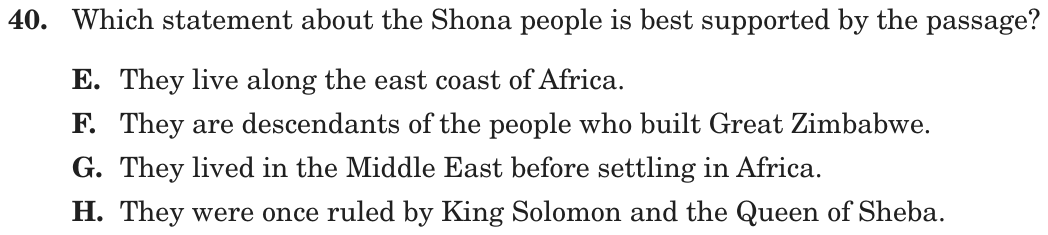
Which statement about the Shona people is best supported by the passage?
- AThey live along the east coast of Africa.
- BThey are descendants of the people who built Great Zimbabwe.
- CThey lived in the Middle East before settling in Africa.
- DThey were once ruled by King Solomon and the Queen of Sheba.
Show the answer
Correct answer: B
The answer is (B)
The question asks for the best supported evidence the passage provides about the Shona people. The Shona people are discussed in paragraph 5, where it is explained that Great Zimbabwe was discovered to have been built by the ancient ancestors of the Shona people, making Option B correct.
Option A is incorrect because the ancient Shona people lived in the African interior, not on the coast, and the passage does not give specific details about where the Shona people live presently.
Option C is incorrect because the passage does not give a detailed history about the origins and locations of the Shona people in Africa.
Option D is incorrect because, while early explorers were looking for King Solomon’s gold and evidence of the Queen of Sheba in Africa, the Shona people were not found to be linked to these people.
Question analysis
Students must decide which statement about the Shona people is best supported by the passage on Great Zimbabwe. The Shona appear in only a few sentences of a text crowded with explorers, legends and rival theories, so each choice must be checked against exactly what those sentences say.
- NYS standards
- 7R1 textual evidence and inferences
- Grade level
- Grade 6 reading and task
- Compared with grade 7
- Below grade 7 Locating what a passage says about one group and restating it is a grade 6 skill. The supporting sentence is short and clear, so this falls below typical grade 7 demand despite the passage's crowded content.
- Estimated difficulty
- Routine: one familiar step, little to misread.
- Thinking it demands
- Depth of knowledge 1, recall and reproduction · mainly understand
- What makes it hard
- Evidence
- Answered from one sentence or line
- Reading level
- Passage: about grade 11, 524 words; question and choices: about grade 5, 52 words.
- Students, last 30 days
- Not enough answers yet to show (it takes 10).
Why it is hard, traps and wrong answers (shows the answer)
Why it is hard
The Shona are named only in paragraph 5, and the sentence that matters says the city was built by their ancestors. The one real hurdle is the reversal of that relation in the key, which a student who mixes up ancestors and descendants may reject. Every wrong choice borrows a place or name tied to someone else in the passage: the traders' coast, Hall's Middle East, the European legends.
The right answer is reworded minor Choosing the answer
The key flips the passage's “ancestors of the present-day Shona people” into “descendants of the people who built,” while wrong choices reuse “east coast,” “Middle East” and “King Solomon.” (Freedle & Kostin, 1993; Kirsch & Mosenthal, 1990)
Strategy: Search the passage for every mention of the Shona and read those sentences closely; choose the statement they directly support, not one that merely sounds historical.
Traps
- Wrong part of the text: A choice is true of another paragraph, stanza or speaker than the one asked about.
- Word match: Repeats striking words or phrases from the text, so it looks supported, but its meaning does not fit the question.
The wrong answers, classified
A Wrong part of the text (Kirsch & Mosenthal, 1990)
Moves the Shona to the coast because Shona kings traded “in coastal towns” and Arab traders sailed the “east coast,” though the city stood in the interior.
C Twists what the text says (King et al., 2004)
Attaches Hall's discredited theory of Middle Eastern builders to the Shona, giving them an origin the passage never mentions.
D Word match (Freedle & Kostin, 1993)
Repeats the striking names King Solomon and the Queen of Sheba, which belong to the legends Europeans told, not to Shona history.
Working it out, step by step
Figure out what the question asks
This asks which statement about the Shona people the passage supports. Trust only what the passage says, not what sounds right.
Find every mention of the Shona
The Shona appear only in paragraph 5. Great Zimbabwe “was most likely built during the fourteenth or fifteenth century by the ancestors of the present-day Shona people.” Later: “Wealthy Shona kings traded their ivory and gold in coastal towns.”
Turn the sentence around
Your ancestors are family members who lived long before you, like your great-great-grandparents. Your descendants are the people who come after you, like your grandchildren.
So if the builders were the ancestors of the Shona, then the Shona today are the descendants of the builders. Choice B flips the words, but it says the same thing.
Check each choice
- A The kings traded in coastal towns. But the city was in the African interior, away from the coast.
- B fits. It restates paragraph 5.
- C Builders from the Middle East was Hall’s wrong idea. It is not Shona history.
- D King Solomon and the Queen of Sheba come from European legends, not Shona history.
Choose the answer
The passage supports the idea that the Shona today are descendants of the city’s builders. So the answer is B.
Why this answer and not the closest wrong one
A is tempting because Shona kings traded “in coastal towns.” But trading in a place is not living there. The passage never says where the Shona live now. B is the only choice the passage states, just turned around from “ancestors” to “descendants.”
More questions like this
The original DOE question
The passage “Ruins of a Fabled City” as printed (page 68)