Also in 2025 Practice Test A Math, question 45.
Question
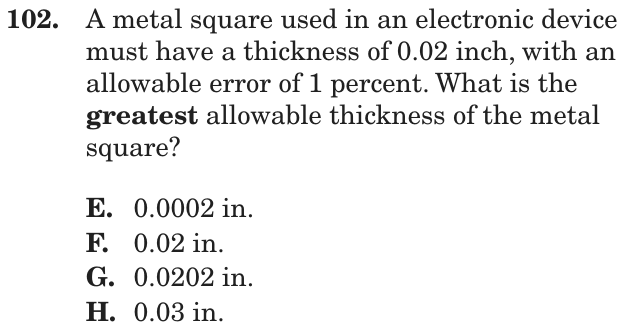
A metal square used in an electronic device must have a thickness of 0.02 inch, with an allowable error of 1 percent. What is the greatest allowable thickness of the metal square?
- A0.0002 in.
- B0.02 in.
- C0.0202 in.
- D0.03 in.
Show the answer
Correct answer: C
Find 1% of 0.02:
The greatest allowable thickness would be
inch.
Question analysis
This percent question says a metal square must be 0.02 inch thick with an allowable error of 1 percent, and asks for the greatest allowable thickness. Students must find 1 percent of a small decimal and add it to the target thickness. Keeping track of decimal places is what makes it tricky.
- Grade level
- Grade 7 content, by NYS standard
- Compared with grade 7
- At grade 7 Percent error and tolerance problems appear in grade 7, so the idea is on level. The demand comes from taking a percent of a tiny decimal and adding the result, where a slipped decimal place is easy to miss.
- Estimated difficulty
- Moderate: several steps, or a close reading with one strong distractor.
- Thinking it demands
- Depth of knowledge 2, skills and concepts · mainly apply
- What makes it hard
- Error-prone arithmetic moderate
- Turning words into math moderate
- A very close wrong answer minor
- Solution
- 2 steps
- Reading level
- Question and choices: about grade 4, 34 words.
- Students, last 30 days
- Not enough answers yet to show (it takes 10).
Why it is hard, traps and wrong answers (shows the answer)
Why it is hard
The idea of tolerance is simple, but the numbers are tiny, and the question turns on what the 1 percent is a percent of. Students who read it as 0.01 inch land on a choice that looks sensible, and those who find the error correctly may stop before adding it. Writing 0.02 × 1.01 in one step avoids both.
Error-prone arithmetic moderate Working it out
One percent of 0.02 is 0.0002, two more decimal places, and adding it to 0.02 needs the places lined up to get 0.0202. (Brown & Burton, 1978; Junker & Sijtsma, 2001)
Turning words into math moderate Understanding the question
The phrase "allowable error of 1 percent" must be read as 1 percent of 0.02 inch, added for the greatest thickness, not 1 percent as a fixed 0.01 inch. (Hegarty, Mayer & Monk, 1995; Koedinger & Nathan, 2004)
A very close wrong answer minor Choosing the answer
The choices 0.0202, 0.02 and 0.0002 are built from the same digits, and the first two differ by only 1 percent, so only careful counting of decimal places tells them apart. (Embretson & Wetzel, 1987; Gorin & Embretson, 2006; Ascalon et al., 2007)
Strategy: Find 1 percent of 0.02 by dividing by 100, counting decimal places carefully, then add that error to 0.02 to get the upper limit.
Traps
- Stops one step early: A choice is a number from partway through the solution.
- Misunderstands the concept: A wrong belief about a concept: that percents can be added, that area grows like length, that averages can be averaged, that a bigger denominator means a bigger fraction.
The wrong answers, classified
A Stops one step early (King et al., 2004; Gierl et al., 2017)
Finds the allowable error, 1 percent of 0.02 = 0.0002 inch, and stops without adding it to the target thickness.
B Numbers taken from the question (Hegarty, Mayer & Monk, 1995)
Gives the target thickness from the stem, 0.02 inch, ignoring that the allowed error permits a slightly thicker square.
D Misunderstands the concept (Smith, diSessa & Roschelle, 1993; De Bock et al., 1998; Ni & Zhou, 2005)
Treats 1 percent as 0.01 inch, a percent of 1 inch rather than of 0.02 inch, and adds it to get 0.03.
Worked solution, step by step
Formulas used
- Percent of a number
- x is the part you want. p is the percent. n is the whole amount. Percent means out of 100, so p percent of a number is p hundredths of it.
Sort out what you know
The square should be 0.02 inch thick. An allowable error of 1 percent means it may be off by up to 1 percent of 0.02 inch. It may be that much thinner or thicker.
You need the greatest allowed thickness, so look at the thicker side.
Find 1 percent of 0.02
Dividing by 100 moves the decimal point two places to the left. So the error is 0.0002 inch.
Watch out: 1 percent here is not 0.01 inch. It is 1 percent of 0.02 inch. Adding 0.01 gives 0.03, which is choice D.
Add the error to the thickness
The thickest square is the right size plus the error. Line up the decimal points:
Watch out: 0.0002 is only the error, choice A. You must add it to 0.02. So the answer is C, 0.0202 in.
Check your answer
0.0202 is just a tiny bit more than 0.02, which makes sense for a small error. Check it: 0.0202 − 0.02 = 0.0002. And 0.0002 ÷ 0.02 = 0.01, which is 1 percent.
More questions like this
The original DOE question