Also in 2026 Practice Test A Math, question 40; 2025 Practice Test A Math, question 46.
Question
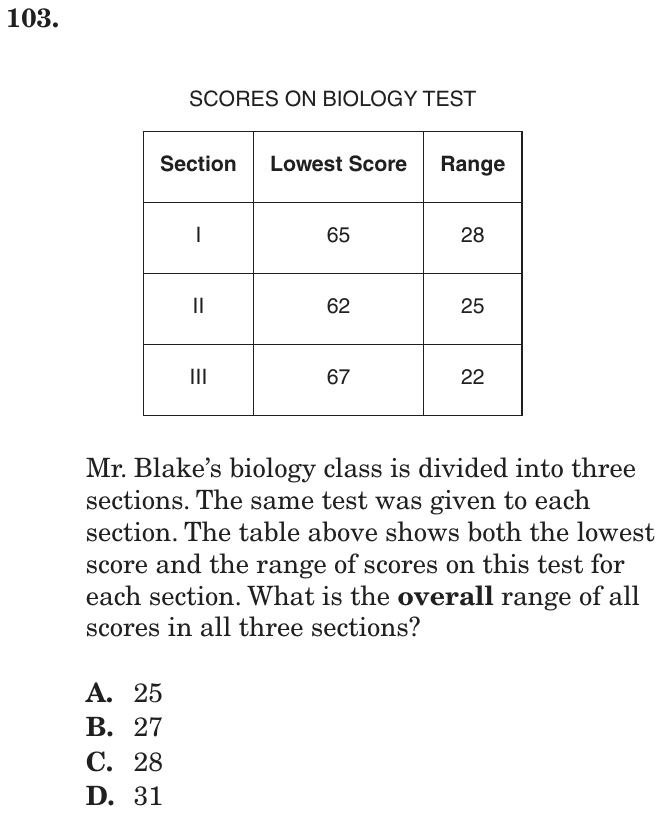
SCORES ON BIOLOGY TEST
| Section | Lowest Score | Range |
| I | 65 | 28 |
| II | 62 | 25 |
| III | 67 | 22 |
Mr. Blake’s biology class is divided into three sections. The same test was given to each section. The table above shows both the lowest score and the range of scores on this test for each section. What is the overall range of all scores in all three sections?
- A25
- B27
- C28
- D31
Show the answer
Correct answer: D
First, calculate the highest score for each section by adding the lowest score to the range:
Section I: 65 + 28 = 93
Section II: 62 + 25 = 87
Section III: 67 + 22 = 89
The overall highest score is 93, and the overall lowest score is 62. Thus the overall range is 93 − 62 = 31.
Question analysis
This statistics question uses a table of the lowest score and the range for three sections of a biology class and asks for the range of all the scores combined. Students must rebuild each section's highest score from its lowest score and range, then compare across sections. Reversing the usual range calculation is the tricky part.
- Grade level
- Grade 6 content, by NYS standard
- Compared with grade 7
- At grade 7 Grade 7 students compute a range from a list of data. Here they must work backward from range to the highest score in each section and then combine three groups, one step beyond routine.
- Estimated difficulty
- Moderate: several steps, or a close reading with one strong distractor.
- Thinking it demands
- Depth of knowledge 2, skills and concepts · mainly apply
- What makes it hard
- No obvious method moderate
- A very close wrong answer moderate
- Much to keep track of minor
- Solution
- 3 steps
- Reading level
- Question and choices: about grade 2, 59 words.
- Students, last 30 days
- Not enough answers yet to show (it takes 10).
Why it is hard, traps and wrong answers (shows the answer)
Why it is hard
Range is usually computed from a list, so working backward from it is the unfamiliar part. The key fact, that the overall lowest and highest scores come from different sections, is invisible until all three highest scores are written down. Every wrong choice comes from skipping that step and reasoning with the ranges as given.
No obvious method moderate Working it out
The table gives each section's lowest score and range but no highest score, so students must reverse the range formula, high = low + range, before comparing sections. (Schoenfeld, 1985)
A very close wrong answer moderate Choosing the answer
The choices 28 and 27 sit within 4 of 31, so a sense of the spread cannot separate them; only rebuilding the highest scores, which puts the top at 93, does. (Embretson & Wetzel, 1987; Gorin & Embretson, 2006; Ascalon et al., 2007)
Much to keep track of minor Working it out
The overall lowest, 62, comes from Section II and the overall highest, 93, from Section I, so values from two rows must be combined. (Sweller, 1988; Carpenter, Just & Shell, 1990)
Strategy: Add each section's range to its lowest score to get its highest score, then subtract the lowest of all scores from the highest of all scores.
Traps
- Answers a different question: A choice is right for another quantity: the other unknown, the rest instead of the part, the part instead of the whole.
The wrong answers, classified
A Misunderstands the concept (Smith, diSessa & Roschelle, 1993; De Bock et al., 1998; Ni & Zhou, 2005)
Averages the three section ranges, (28 + 25 + 22) ÷ 3 = 25, as if the overall range were a typical section's range.
B Answers a different question (King et al., 2004; Hegarty, Mayer & Monk, 1995)
Leaves Section I out, taking the top score as Section III's 67 + 22 = 89, which gives the range of Sections II and III only.
C Answers a different question (King et al., 2004; Hegarty, Mayer & Monk, 1995)
Takes Section I's range, 28, the largest in the table, giving one section's spread instead of the spread across all three.
Worked solution, step by step
Formulas used
- Range
- R is the range, the spread of the scores. H is the highest score and L is the lowest score. The range tells how far apart the top and bottom scores are. If you know L and R, then H = L + R.
Sort out what you know
The table gives each section’s lowest score and its range. The range is the highest score minus the lowest score.
The bold overall means one range for all three sections together. For that you need the highest and lowest scores of all.
Find each section’s highest score
Turn the range formula around: highest = lowest + range.
Section Lowest Range Highest I 65 28 65 + 28 = 93 II 62 25 62 + 25 = 87 III 67 22 67 + 22 = 89 Pick the overall highest and lowest
The highest score of all is 93, from Section I. The lowest score of all is 62, from Section II. They come from different sections, and that is fine.
Subtract to find the range
Watch out: 28 is just Section I’s range, choice C. Averaging the three ranges gives 25, choice A. Neither covers all the scores at once.
So the answer is D, 31.
Check your answer
The overall range must be at least as big as each section’s range, because it covers all their scores. 31 is bigger than 28, 25 and 22, so it is reasonable. Also, 62 + 31 = 93, the top score.
More questions like this
The original DOE question