Also in 2026 Practice Test A Math, question 36; 2025 Practice Test A Math, question 41.
Question
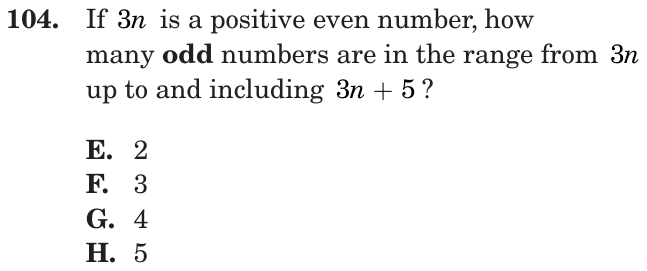
If is a positive even number, how many odd numbers are in the range from up to and including ?
- A2
- B3
- C4
- D5
Show the answer
Correct answer: B
Since is even, then must be odd.
Thus and are also odd.
So there are a total of 3 numbers in this range that are odd.
Question analysis
This number properties question says 3n is a positive even number and asks how many odd numbers lie from 3n up to and including 3n + 5. Students must decide which integers in that span are odd. The coefficient in 3n is a distraction; only the fact that 3n is even matters.
- Grade level
- Grade 6 content, by NYS standard
- Compared with grade 7
- At grade 7 Grade 7 students work with expressions like 3n + 5 but rarely reason about whether they are even or odd. The idea is simple once the integers are written out, so the demand is about typical for grade 7.
- Estimated difficulty
- Straightforward: two steps or one careful reading.
- Thinking it demands
- Depth of knowledge 2, skills and concepts · mainly apply
- What makes it hard
- Variables instead of numbers moderate
- Something you must already know minor
- A very close wrong answer minor
- Solution
- 2 steps
- Reading level
- Question and choices: about grade 12, 22 words.
- Students, last 30 days
- Not enough answers yet to show (it takes 10).
Why it is hard, traps and wrong answers (shows the answer)
Why it is hard
Writing the six integers from 3n to 3n + 5 and marking them even, odd, even, odd, even, odd answers the question in seconds. The traps come from not writing them: dropping the last one, which "up to and including" keeps in, or reading the 5 in 3n + 5 as a count. Picking any even value for 3n, such as 6, makes the check concrete.
Variables instead of numbers moderate Understanding the question
No value of n is given, so students must reason about parity: since 3n is even, 3n + 1, 3n + 3 and 3n + 5 are the odd ones. (Koedinger & Nathan, 2004; Enright, Morley & Sheehan, 2002)
Something you must already know minor Working it out
The parity rules, even plus odd is odd and even plus even is even, are assumed; the coefficient 3 is a distraction once 3n is said to be even. (Anderson & Krathwohl, 2001)
A very close wrong answer minor Choosing the answer
The choices 2, 3, 4 and 5 are consecutive counts, so 2 and 3 cannot be told apart by sizing up; only checking whether 3n + 5 is inside the range separates them. (Embretson & Wetzel, 1987; Gorin & Embretson, 2006; Ascalon et al., 2007)
Strategy: Write out every integer from 3n to 3n + 5, mark 3n as even, alternate even and odd from there, and count the odd ones.
Traps
- Counting the ends: Inclusive or exclusive ends, fence posts, consecutive numbers: an answer that is one too many or too few, or an endpoint drawn open where it belongs closed (or the reverse).
The wrong answers, classified
A Counting the ends (Brown & Burton, 1978)
Leaves out 3n + 5, stopping before the last number although "up to and including" keeps it, and counts only 3n + 1 and 3n + 3.
C Misunderstands the concept (Smith, diSessa & Roschelle, 1993; De Bock et al., 1998; Ni & Zhou, 2005)
Counts 3n itself as odd because its coefficient 3 is odd, ignoring the stem's statement that 3n is even, and adds it to the three.
D Numbers taken from the question (Hegarty, Mayer & Monk, 1995)
Takes the 5 in 3n + 5 as the count, subtracting the ends instead of listing the six integers and picking out the odd ones.
Worked solution, step by step
Formulas used
- Even plus odd
- An even number splits into pairs. An odd number has one left over. Adding them keeps that one left over, so the sum is odd. So adding 1, 3 or 5 to an even number gives an odd number.
- Even plus even
- Two numbers that each split into pairs still split into pairs when you add them. So adding 2 or 4 to an even number gives an even number.
Sort out what you know
You are told that 3n is even. You do not need to know n itself. You need to count the odd numbers from 3n to 3n + 5.
“Up to and including” means 3n + 5 counts too.
List all the numbers
Go up by 1 each time, from 3n to 3n + 5. That gives six numbers:
Mark each as even or odd
3n is even. Adding 1, 3 or 5 makes it odd. Adding 2 or 4 keeps it even.
Number Even or odd even odd even odd even odd Watch out: 3n is even because the question says so. The 3 being odd does not matter. Counting 3n as odd gives choice C, 4.
Count the odd numbers
The odd ones are 3n + 1, 3n + 3 and 3n + 5. That is 3 numbers.
Watch out: leaving out 3n + 5 gives 2, choice A. It is the last number, and it is included. So the answer is B, 3.
Check your answer
Try a real number. If n = 2, then 3n = 6, which is even. The numbers from 6 to 11 are 6, 7, 8, 9, 10 and 11. The odd ones are 7, 9 and 11. That is 3.
More questions like this
The original DOE question