Also in 2026 Practice Test A Math, question 42; 2025 Practice Test A Math, question 48.
Question
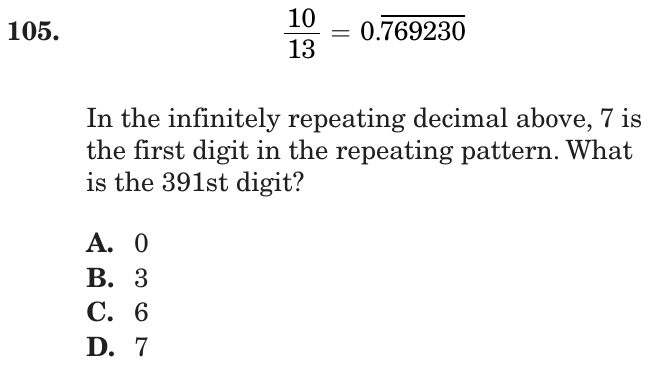
In the infinitely repeating decimal above, 7 is the first digit in the repeating pattern. What is the 391st digit?
- A0
- B3
- C6
- D7
Show the answer
Correct answer: D
There are 6 digits in the repeating decimal (769230), so 7 would be the first, seventh, thirteenth digit and so on.
To find the 391st digit, divide 391 by 6.
391 ÷ 6 = 65 R1
Since the remainder is 1, that means the 391st digit is the same as the 1st digit, which is 7.
Question analysis
This repeating decimal question shows the six-digit repeating pattern of 10/13 and asks for the 391st digit after the decimal point. Students must use the length of the repeating block and division with a remainder to find the position within the cycle. Matching the remainder to the right digit is where students slip.
- Grade level
- Grade 7 content, by NYS standard
- Compared with grade 7
- Above grade 7 Seventh graders learn that fractions have repeating decimals. Using the length of the repeating block and a remainder to find a digit hundreds of places away is a pattern-reasoning step beyond typical seventh-grade classwork.
- Estimated difficulty
- Hard: combines ideas, needs a plan, and has more than one tempting wrong answer.
- Thinking it demands
- Depth of knowledge 2, skills and concepts · mainly apply
- What makes it hard
- No obvious method moderate
- Solution
- 2 steps
- Reading level
- Question and choices: about grade 8, 20 words.
- Students, last 30 days
- Not enough answers yet to show (it takes 10).
Why it is hard, traps and wrong answers (shows the answer)
Why it is hard
Once the cycle length is used, the arithmetic is a single division, 391 ÷ 6 = 65 remainder 1. The difficulty is turning the remainder into a position: remainder 1 is the first digit of a new block, not the last digit of the previous one or the second of the new one. Checking the rule on small positions, the 1st and 7th digits are both 7, removes the doubt.
No obvious method moderate Working it out
Nothing in the stem mentions division; students must see that the six-digit block 769230 repeats, so position 391 depends only on the remainder of 391 divided by 6. (Schoenfeld, 1985)
Strategy: Divide 391 by the length of the repeating block and look only at the remainder; a remainder of r points to the r-th digit of the block.
Traps
- Counting the ends: Inclusive or exclusive ends, fence posts, consecutive numbers: an answer that is one too many or too few, or an endpoint drawn open where it belongs closed (or the reverse).
The wrong answers, classified
A Counting the ends (Brown & Burton, 1978)
Sees that 65 blocks fill 390 places and lands on the 390th digit, the 0 that ends a block, one place short.
B A faulty procedure (Brown & Burton, 1978; Tatsuoka, 1983)
Uses the quotient 65 instead of the remainder, takes its last digit 5, and reads the fifth digit of 769230, which is 3.
C Counting the ends (Brown & Burton, 1978)
Treats the remainder 1 as one step past the block's first digit, moving from 7 to the second digit, 6.
Worked solution, step by step
Formulas used
- Division with a remainder
- n is the number you divide. d is what you divide by. q is the quotient, the number of whole groups. r is the remainder, what is left over. Here it tells how many full blocks of digits fit, and where you land after them.
Sort out what you know
The bar over 769230 means those six digits repeat forever: 769230769230 and so on. The 7 is digit number 1. You need digit number 391.
Spot the pattern
The block 769230 has 6 digits, so the pattern starts over every 6 digits. Digit 1 is 7, and so are digits 7, 13, 19 and so on. Each full block ends with a 0, at digits 6, 12, 18 and so on.
Divide 391 by 6
Find how many full blocks fit into 391 digits, and what is left:
So 65 full blocks use up 6 × 65 = 390 digits. The remainder is 1. That means digit 391 is the 1st digit of the next block.
Read the digit
The 1st digit of the block is 7. Watch out: digit 390 is the last digit of a full block, which is 0. That is choice A. Digit 391 is one step past it, so it starts a new block.
So the answer is D, 7.
Check your answer
Test the idea on a small number. Digit 7: 7 = 6 × 1 + 1, so the remainder is 1 and the digit should be 7. Write it out: 7692307. The 7th digit is indeed 7. The rule works.
More questions like this
The original DOE question