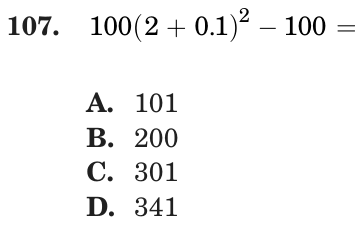
Also in 2025 Practice Test A Math, question 50.
Question
- A101
- B200
- C301
- D341
Show the answer
Correct answer: D
Question analysis
This order of operations question asks students to evaluate 100(2 + 0.1)² − 100, an expression with a decimal, a square and a subtraction. Students must add inside the parentheses first, square the result, multiply by 100, and then subtract. Squaring the two parts of the sum separately is the trap.
- Grade level
- Grade 6 content, by NYS standard
- Compared with grade 7
- Below grade 7 Evaluating an expression with an exponent and decimals in the correct order is grade 6 content. This is a short routine calculation, so it asks less than typical grade 7 work with negative numbers and multi-step equations.
- Estimated difficulty
- Straightforward: two steps or one careful reading.
- Thinking it demands
- Depth of knowledge 1, recall and reproduction · mainly apply
- What makes it hard
- A very close wrong answer moderate
- Error-prone arithmetic minor
- Solution
- 3 steps
- Reading level
- Question and choices: about grade 16+, 1 words.
- Students, last 30 days
- Not enough answers yet to show (it takes 10).
Why it is hard, traps and wrong answers (shows the answer)
Why it is hard
This is a direct order-of-operations calculation with no word problem around it, so the only real risk is the square of a sum. Students who apply the exponent to each part, or only to the 0.1, find a listed answer waiting. Adding inside the parentheses before squaring, and then squaring 2.1 exactly, is the whole task.
A very close wrong answer moderate Choosing the answer
The choices 301 and 341 differ by 40, and squaring 2.1 roughly as 4 lands nearer 301; only the exact square, 4.41, separates them. (Embretson & Wetzel, 1987; Gorin & Embretson, 2006; Ascalon et al., 2007)
Error-prone arithmetic minor Working it out
Squaring 2.1 by hand to get 4.41 puts two decimal places in the product, an easy place to misplace the point. (Brown & Burton, 1978; Junker & Sijtsma, 2001)
Strategy: Add inside the parentheses to get a single decimal, square it carefully, then multiply by 100 and subtract 100, following the order of operations.
Traps
- A faulty procedure: A systematic but wrong procedure: adding fractions straight across, applying an exponent to each term of a sum, dropping a sign when moving a term.
- Order of operations: Working left to right, or distributing a minus sign wrongly, gives a choice.
The wrong answers, classified
A Order of operations (Brown & Burton, 1978)
Squares only the 0.1, as if the parentheses were not there, so 100 × 2.01 − 100 gives 101.
B Little reason to choose it (Haladyna & Downing, 1993; Rodriguez, 2005)
No single slip gives 200; it requires (2 + 0.1)² to come out as 3, so it mostly catches guesses.
C A faulty procedure (Brown & Burton, 1978; Tatsuoka, 1983)
Squares each term of the sum separately, 4 + 0.01 = 4.01, instead of squaring 2.1, so 100 × 4.01 − 100 gives 301.
Worked solution, step by step
Formulas used
- Order of operations
- This is the agreed order for doing math steps. Work inside parentheses first, then exponents, then multiply and divide, then add and subtract. Everyone follows it, so a problem has only one answer.
- Squaring a number
- a is any number. The small 2, called an exponent, means multiply the number by itself. So 2.1 squared means 2.1 times 2.1.
Sort out the problem
You need to work out . The 100 right next to the parentheses means 100 times. Follow the order of operations, one step at a time.
Add inside the parentheses
Parentheses come first in the order of operations. So add the numbers inside them:
Now the problem is:
Square 2.1
Work out 21 × 21 = 441, then put in two decimal places, one for each 2.1.
Watch out: do not square the 2 and the 0.1 one at a time. That gives 4 + 0.01 = 4.01, which is wrong. It leads to 301, choice C.
Multiply, then subtract
The exponent is done, so multiply next. Multiplying by 100 moves the decimal point two places to the right. Subtracting comes last:
So the answer is D, 341.
Check your answer
Estimate. 2.1 is a bit more than 2, so its square is a bit more than 4. 100 times that is a bit more than 400. Take away 100 and you get a bit more than 300. 341 fits. Choices A and B are too small.
More questions like this
The original DOE question