Also in 2026 Practice Test A Math, question 44; 2025 Practice Test A Math, question 51.
Question
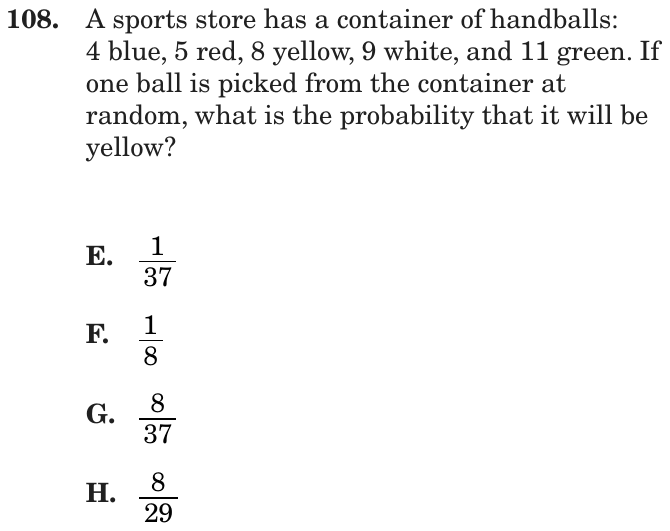
A sports store has a container of handballs: 4 blue, 5 red, 8 yellow, 9 white, and 11 green. If one ball is picked from the container at random, what is the probability that it will be yellow?
- A
- B
- C
- D
Show the answer
Correct answer: C
The total number of handballs in the container is
Since there are 8 yellow handballs, the probability of selecting a yellow handball is
Question analysis
This probability question describes a container of handballs in five colors and asks the chance that one ball picked at random is yellow. Students must add all the balls to get the total and compare the yellow count to it. Using the wrong total, such as only the balls that are not yellow, is the easy mistake.
- NYS standards
- 6.SP.8a uniform probability models
- Grade level
- Grade 6 content, by NYS standard
- Compared with grade 7
- Below grade 7 Finding the probability of a single event as favorable outcomes over total outcomes is grade 6 content. This item takes one addition and one fraction, so it is easier than typical grade 7 compound probability work.
- Estimated difficulty
- Routine: one familiar step, little to misread.
- Thinking it demands
- Depth of knowledge 2, skills and concepts · mainly apply
- What makes it hard
- Solution
- 2 steps
- Reading level
- Question and choices: about grade 5, 37 words.
- Students, last 30 days
- Not enough answers yet to show (it takes 10).
Why it is hard, traps and wrong answers (shows the answer)
Why it is hard
This is a one-event probability: add the five colors to get 37 balls and put the 8 yellow ones over that total. The only real decision is the denominator, and the wrong choices offer the non-yellow count, the yellow count, and a numerator of 1. Students who say "favorable over total" to themselves avoid all three.
A very close wrong answer minor Choosing the answer
The choices 8/37 and 8/29 share the numerator 8 and differ only in the denominator, all 37 balls against the 29 that are not yellow. (Embretson & Wetzel, 1987; Gorin & Embretson, 2006; Ascalon et al., 2007)
Strategy: Add up every ball in the container to get the total number of outcomes, then put the number of yellow balls over that total.
Traps
- Misunderstands the concept: A wrong belief about a concept: that percents can be added, that area grows like length, that averages can be averaged, that a bigger denominator means a bigger fraction.
- Answers a different question: A choice is right for another quantity: the other unknown, the rest instead of the part, the part instead of the whole.
The wrong answers, classified
A Answers a different question (King et al., 2004; Hegarty, Mayer & Monk, 1995)
Finds the 37 balls correctly but puts 1 on top, giving the chance of picking one particular ball rather than any yellow one.
B Numbers taken from the question (Hegarty, Mayer & Monk, 1995)
Puts 1 over the 8 yellow balls, a fraction built from the yellow count alone that ignores the other 29 balls.
D Misunderstands the concept (Smith, diSessa & Roschelle, 1993; De Bock et al., 1998; Ni & Zhou, 2005)
Compares the 8 yellow balls with the 29 that are not yellow, a part-to-part ratio, instead of with all 37 balls.
Worked solution, step by step
Formulas used
- Probability
- P is the probability, the chance that something happens. f is the number of favorable outcomes, the ones you want. t is the total number of outcomes. It works when every outcome is equally likely, like picking one item at random.
Sort out what you know
The container has 4 blue, 5 red, 8 yellow, 9 white and 11 green balls. One ball is picked at random, so every ball has the same chance. You need the chance it is yellow.
Count all the balls
Add up every color, because any ball could be picked:
There are 37 balls in all. That is the total number of outcomes.
Put yellow over the total
8 of the balls are yellow. Those are the favorable outcomes:
Watch out: compares yellow with the 29 balls that are not yellow. Probability compares the part with all the balls, so choice D is wrong. So the answer is C, .
Check your answer
8 out of 37 is about 0.22, a little more than 1 in 5. That makes sense, since yellow is a fair share of the balls. Choice A, 1/37, is the chance of picking one certain ball, not any yellow one.
More questions like this
The original DOE question