Also in 2026 Practice Test A Math, question 45; 2025 Practice Test A Math, question 52.
Question
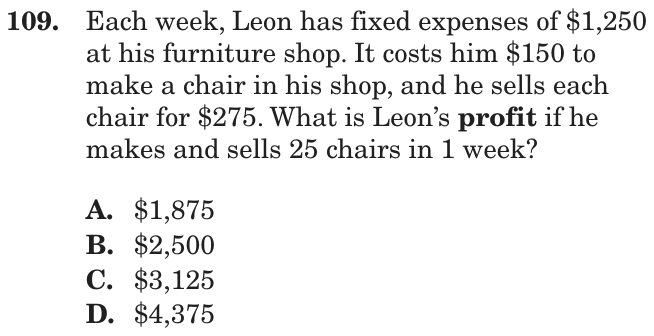
Each week, Leon has fixed expenses of $1,250 at his furniture shop. It costs him $150 to make a chair in his shop, and he sells each chair for $275. What is Leon’s profit if he makes and sells 25 chairs in 1 week?
- A$1,875
- B$2,500
- C$3,125
- D$4,375
Show the answer
Correct answer: A
Each chair costs Leon $150 to make, and he sells the chair for $275.
His profit is found by subtracting the cost from the price:
$275 − $150 = $125 per chair
If Leon makes and sells 25 chairs in a week, his initial profit is
25 × $125 = $3,125
However, Leon has additional fixed expenses of $1,250 per week, so this cost must also be subtracted to arrive at the profit. His final profit is
$3,125 − $1,250 = $1,875
Question analysis
This profit word problem gives Leon's weekly fixed expenses at his furniture shop, the cost to make each chair and its selling price, then asks his profit for 25 chairs in one week. Students must find the profit on each chair, multiply, and account for the fixed expenses. Forgetting the fixed expenses, or adding them, are the main slips.
- NYS standards
- Grade level
- Grade 7 content, by NYS standard
- Compared with grade 7
- At grade 7 Multi-step money problems are standard grade 7 work. This one has three whole-number steps and a familiar profit idea, so it matches typical grade 7 demand, with the fixed cost as the detail to remember.
- Estimated difficulty
- Moderate: several steps, or a close reading with one strong distractor.
- Thinking it demands
- Depth of knowledge 2, skills and concepts · mainly apply
- What makes it hard
- Much to keep track of moderate
- Something you must already know minor
- Solution
- 3 steps
- Reading level
- Question and choices: about grade 3, 39 words.
- Students, last 30 days
- Not enough answers yet to show (it takes 10).
Why it is hard, traps and wrong answers (shows the answer)
Why it is hard
The arithmetic is whole-number and friendly, so the question is about bookkeeping: which amounts are income, which are costs, and which happen once a week. The fixed expenses are named first in the stem and are easy to forget by the time the per-chair profit is multiplied. A final check that revenue minus all costs, 6,875 − 3,750 − 1,250, gives the same result confirms it.
Much to keep track of moderate Working it out
Three dollar amounts play different roles, a weekly fixed expense, a cost per chair and a price per chair, and each must enter the profit with the right sign. (Sweller, 1988; Carpenter, Just & Shell, 1990)
Something you must already know minor Working it out
The bold "profit" is not defined; students must know it means money taken in minus every cost, including costs that do not depend on the number of chairs. (Anderson & Krathwohl, 2001)
Strategy: Subtract the cost from the price to get the profit per chair, multiply by the number of chairs, then subtract the week's fixed expenses.
Traps
- Stops one step early: A choice is a number from partway through the solution.
- Wrong operation: Adds instead of multiplying, divides the wrong way round, turns a ratio or rate upside down, or undoes a step in the wrong direction (subtracts what should be added back).
The wrong answers, classified
B Numbers taken from the question (Hegarty, Mayer & Monk, 1995)
Multiplies the $150 cost by 25 chairs and subtracts the $1,250, treating the cost of making a chair as money earned.
C Stops one step early (King et al., 2004; Gierl et al., 2017)
Finds the profit on 25 chairs at $125 each, $3,125, and stops before subtracting the $1,250 fixed expenses.
D Wrong operation (Hegarty, Mayer & Monk, 1995; King et al., 2004)
Adds the $1,250 fixed expenses to the $3,125 chair profit instead of subtracting them, treating an expense as income.
Worked solution, step by step
Formulas used
- Profit
- P is the profit, the money Leon keeps. I is the income, the money he takes in from sales. C is the total cost: every dollar he spends, including fixed expenses. Profit is what is left after all costs are paid.
Sort out what you know
Leon pays $1,250 each week no matter what. These are fixed expenses, like rent. Each chair costs $150 to make, and he sells each one for $275.
He makes and sells 25 chairs. Profit is the money left after paying all the costs.
Find the profit on one chair
Each chair sells for $275 but costs $150 to make. Subtract to see what he keeps:
He keeps $125 on each chair he sells.
Find the profit on 25 chairs
The chairs bring in $3,125 more than they cost to make. Watch out: $3,125 is choice C, but it is not the final profit. The fixed expenses still have to be paid.
Subtract the fixed expenses
Watch out: the $1,250 is money spent, so subtract it. Adding it gives $4,375, choice D. So the answer is A, $1,875.
Check your answer
Work it the long way. Sales: 25 × $275 = $6,875. Costs: 25 × $150 = $3,750, plus $1,250, which makes $5,000. Profit: $6,875 − $5,000 = $1,875. Same answer.
More questions like this
The original DOE question