Question
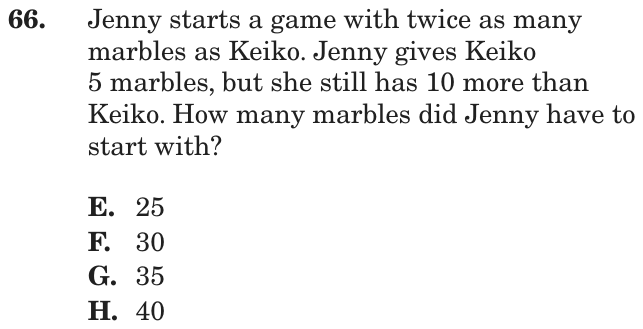
Jenny starts a game with twice as many marbles as Keiko. Jenny gives Keiko 5 marbles, but she still has 10 more than Keiko. How many marbles did Jenny have to start with?
- A25
- B30
- C35
- D40
Show the answer
Correct answer: D
Set up some equations. Jenny (J) has twice as many marbles as Keiko (K):
Jenny gives Keiko 5 marbles, so now they each have: J − 5 and K + 5 marbles. Jenny still has 10 more than Keiko:
To find how many marbles Jenny had to start with, solve J = 2K for K and substitute that into the second equation:
In equation J = 2K, solve for K:
Substitute in for K.
marbles
Question analysis
A two-variable word problem about marbles: Jenny starts with twice as many as Keiko, gives Keiko 5, and still has 10 more. Students set up equations for before and after the trade and solve for Jenny's starting number. The trade changes both players' counts, and the question asks about the start, not the end.
- Grade level
- Grade 8 content, by NYS standard
- Compared with grade 7
- Above grade 7 Grade 7 students solve one equation in one unknown. This needs two related unknowns and a before-and-after change, which leads to a system of equations or a variable on both sides, both grade 8 skills.
- Estimated difficulty
- Hard: combines ideas, needs a plan, and has more than one tempting wrong answer.
- Thinking it demands
- Depth of knowledge 2, skills and concepts · mainly apply
- What makes it hard
- Turning words into math major
- Much to keep track of moderate
- Solution
- 4 steps
- Reading level
- Question and choices: about grade 4, 31 words.
- Students, last 30 days
- Not enough answers yet to show (it takes 10).
Why it is hard, traps and wrong answers (shows the answer)
Why it is hard
Most of the difficulty is in setting up the equations, not solving them. The gift of 5 marbles changes both counts, so the gap between the girls shrinks by 10, not 5, and students who take the marbles from Jenny without giving them to Keiko reach a consistent but wrong answer. Two other choices are true counts from after the trade, so finishing the algebra is not the same as answering the question. Testing the choices backward is a fast, safe alternative.
Turning words into math major Understanding the question
Three relations hide in two sentences: "twice as many", the gift of 5 that lowers Jenny's count and raises Keiko's, and "still has 10 more", which compares the counts after the gift. (Hegarty, Mayer & Monk, 1995; Koedinger & Nathan, 2004)
Much to keep track of moderate Working it out
Each girl has a count before and after the trade, four quantities in all, and the question asks for only one of them, Jenny's at the start. (Sweller, 1988; Carpenter, Just & Shell, 1990)
Strategy: Work backward from the choices: halve each one for Keiko's start, move 5 marbles from Jenny to Keiko, and check whether Jenny ends with exactly 10 more.
Traps
- Misreads the question: Misses or misreads a condition or a word in the question: "at least", "each", "remaining", "not".
- Answers a different question: A choice is right for another quantity: the other unknown, the rest instead of the part, the part instead of the whole.
The wrong answers, classified
A Answers a different question (King et al., 2004; Hegarty, Mayer & Monk, 1995)
Solves correctly for Keiko's start, 20, then reports her count after receiving the 5 marbles, 25, instead of Jenny's starting count.
B Misreads the question (Hegarty, Mayer & Monk, 1995)
Subtracts the 5 marbles from Jenny but forgets that Keiko gains them, solving 2K − 5 = K + 10 to get K = 15 and J = 30.
C Answers a different question (King et al., 2004; Hegarty, Mayer & Monk, 1995)
Gives Jenny's count after she hands over 5 marbles, 40 − 5 = 35, instead of the number she had at the start.
Worked solution, step by step
Formulas used
- Twice as many
- J is the number of marbles Jenny starts with, and K is the number Keiko starts with. Twice as many means 2 times as many, so J equals 2 times K. Because J and 2K are equal, you can write 2K anywhere you see J.
- Keeping an equation balanced
- a and b are the two sides of an equation, and c is any number or term. An equation is like a balanced scale. If you subtract the same thing from both sides, it stays balanced. The same is true if you add the same thing, or divide both sides by the same number that is not zero.
Sort out the question
Let K be Keiko’s marbles at the start. Jenny starts with twice as many, so she has 2K. Then Jenny gives Keiko 5 marbles. After that, “she still has 10 more than Keiko”. You need Jenny’s count at the start, before the gift.
Write the counts after the gift
The gift changes both counts. Jenny loses 5, and Keiko gains 5.
- Jenny now has .
- Keiko now has .
Jenny has 10 more than Keiko. So Jenny’s count equals Keiko’s count plus 10.
Watch out: Keiko gains the 5 marbles too. Taking 5 from Jenny but not adding 5 to Keiko leads to 30, choice B.
Solve for K
Add the numbers on the right side first.
Subtract K from both sides. Then add 5 to both sides. Each move keeps the equation balanced.
Keiko started with 20 marbles.
Find Jenny’s starting count
Jenny started with twice as many as Keiko.
Watch out: 25 is Keiko’s count after the gift, choice A. 35 is Jenny’s count after the gift, choice C. The question asks about the start. So the answer is D, 40.
Check your answer
Start: Jenny has 40 and Keiko has 20, and 40 is twice 20. After the gift, Jenny has 35 and Keiko has 25. , so Jenny still has 10 more. Every fact fits.
More questions like this
The original DOE question