Also in 2026 Practice Test A Math, question 12; 2025 Practice Test A Math, question 13.
Question
The perimeter of a rectangle is 510 centimeters. The ratio of the length to the width is 3:2. What are the dimensions of this rectangle?
- A150 cm by 105 cm
- B153 cm by 102 cm
- C158 cm by 97 cm
- D165 cm by 90 cm
Show the answer
Correct answer: B
Let = the width and = the length.
Draw the rectangle to help visualize.
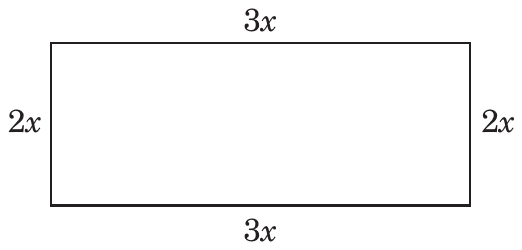
Since 2 times width + 2 times length = perimeter, we get
cm and cm
Question analysis
A rectangle word problem that combines perimeter with a ratio: the perimeter is 510 centimeters and the length and width are in the ratio 3 to 2. Students find the rectangle's dimensions. Every choice has the correct perimeter, so only the ratio separates them.
- Grade level
- Grade 7 content, by NYS standard
- Compared with grade 7
- At grade 7 Perimeter and ratio are each familiar from grades 6 and 7, and combining them with a five-part split is a typical grade 7 multistep ratio problem. It asks about the same as classroom work.
- Estimated difficulty
- Moderate: several steps, or a close reading with one strong distractor.
- Thinking it demands
- Depth of knowledge 2, skills and concepts · mainly apply
- What makes it hard
- A very close wrong answer moderate
- Turning words into math minor
- Solution
- 3 steps
- Reading level
- Question and choices: about grade 3, 35 words.
- Students, last 30 days
- Not enough answers yet to show (it takes 10).
Why it is hard, traps and wrong answers (shows the answer)
Why it is hard
The question is built so that the perimeter, the easier condition, rules nothing out: every choice adds to 255. A student who tests the choices against 510 alone will accept whichever comes first, and the first is 150 by 105. Solving with ratio parts, or checking each pair's ratio, avoids that; 3:2 means the length is exactly one and a half times the width.
A very close wrong answer moderate Choosing the answer
153 by 102 and 150 by 105 differ by just 3 cm in each side and give the same 510 cm perimeter; only the ratio, exactly 3:2 against 10:7, separates them. (Embretson & Wetzel, 1987; Gorin & Embretson, 2006; Ascalon et al., 2007)
Turning words into math minor Understanding the question
"The ratio of the length to the width is 3:2" has to become 3 parts and 2 parts of the half-perimeter, 255, not of the full 510. (Hegarty, Mayer & Monk, 1995; Koedinger & Nathan, 2004)
Strategy: Halve the perimeter to get length plus width, split that sum into 5 equal parts, and give the length 3 parts and the width 2.
Traps
- Misreads the question: Misses or misreads a condition or a word in the question: "at least", "each", "remaining", "not".
The wrong answers, classified
A Misreads the question (Hegarty, Mayer & Monk, 1995)
Checks only the perimeter, 2 × (150 + 105) = 510, and accepts the first pair that fits; 150 to 105 is 10:7, not 3:2.
C Misreads the question (Hegarty, Mayer & Monk, 1995)
Confirms that 158 + 97 = 255, half the perimeter, but never tests the ratio; 1.5 × 97 is 145.5, not 158.
D Misreads the question (Hegarty, Mayer & Monk, 1995)
Matches the perimeter, since 165 + 90 = 255, but a 3:2 rectangle 90 cm wide would be 135 cm long, not 165.
Worked solution, step by step
Formulas used
- Perimeter of a rectangle
- P is the perimeter, the distance all the way around the shape. l is the length and w is the width. A rectangle has two lengths and two widths. So you add one length and one width, then double it.
- Sharing a total in a ratio
- In a ratio like 3:2, the amounts are made of equal-sized parts. Add the numbers in the ratio to count the parts. Divide the total by that count to get the size of one part. Then multiply by how many parts each amount has.
Sort out the question
The perimeter of the rectangle is 510 cm. The perimeter is the distance all the way around. The ratio of length to width is 3:2. That means the length is 3 equal parts, and the width is 2 of the same parts. You need the length and the width.
Find length plus width
The perimeter counts each side twice, once for each matching side. So halve it to get one length plus one width.
Length plus width is 255 cm.
Find the size of one part
Length and width together are parts. Share the 255 cm equally among them.
Each part is 51 cm.
Find the length and width
The length is 3 parts and the width is 2 parts.
The length is 153 cm and the width is 102 cm.
Check the ratio, then answer
Watch out: every choice has a perimeter of 510 cm. For example, too. So checking only the perimeter can trick you into choice A. The ratio decides it. 153 is exactly 1.5 times 102, but 150 is not 1.5 times 105. So the answer is B, 153 cm by 102 cm.
Check your answer
Check both facts. Perimeter: . Ratio: and , so 153 to 102 is 3:2.
More questions like this
The original DOE question