Also in 2026 Practice Test A Math, question 11; 2025 Practice Test A Math, question 12.
Question
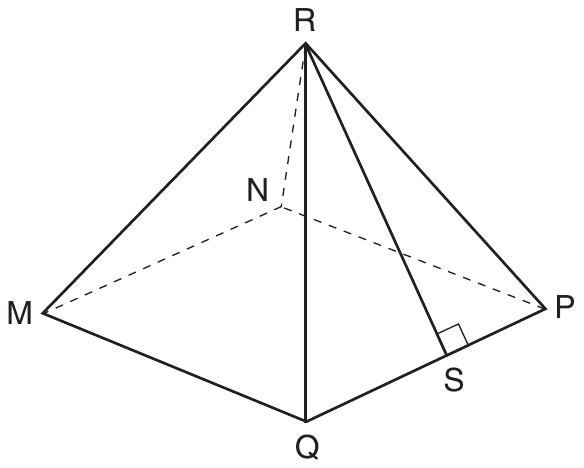
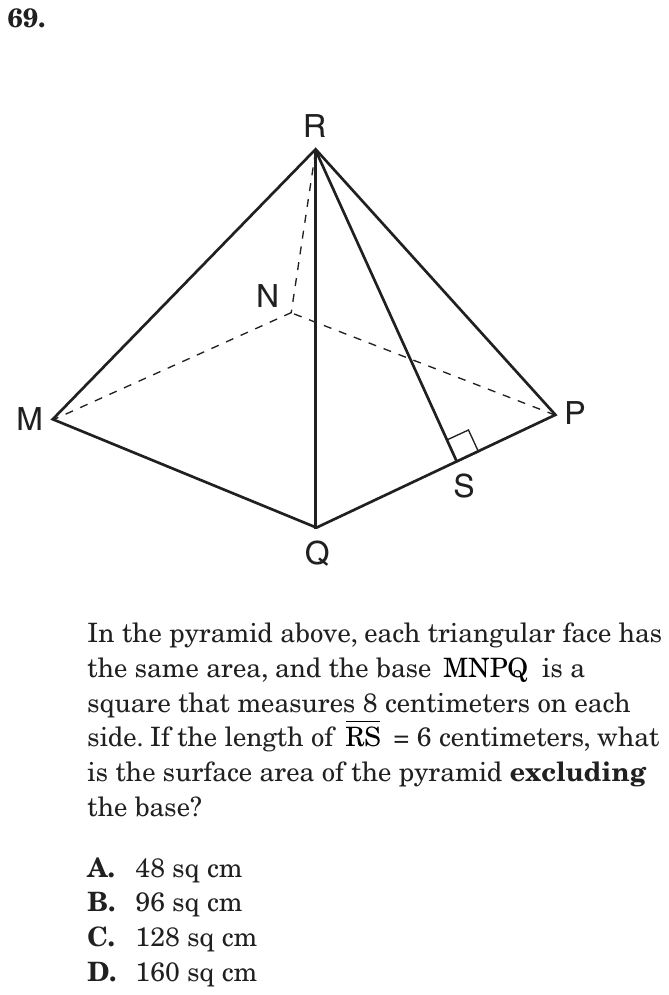
In the pyramid above, each triangular face has the same area, and the base MNPQ is a square that measures 8 centimeters on each side. If the length of = 6 centimeters, what is the surface area of the pyramid excluding the base?
- A48 sq cm
- B96 sq cm
- C128 sq cm
- D160 sq cm
Show the answer
Correct answer: B
Line segment is the altitude, or height, of triangle QRP. The length of is 8 cm. Use that information to find the area of triangle QRP:
sq cm.
There are 4 congruent triangles in the pyramid, so the surface area is
4 × 24 = 96 sq cm
Question analysis
A geometry question about the surface area of a square pyramid, leaving out its base. The base edges are 8 cm and segment RS, the height of one triangular face drawn from the top to a base edge, is 6 cm. Students find one face's area and multiply by the number of faces, reading excluding the base carefully.
- Grade level
- Grade 7 content, by NYS standard
- Compared with grade 7
- At grade 7 Surface area of a right pyramid from its faces is named in the grade 7 standards, and this is a direct two-step case. It matches typical grade 7 work, though the drawing's slant height must be read correctly.
- Estimated difficulty
- Moderate: several steps, or a close reading with one strong distractor.
- Thinking it demands
- Depth of knowledge 2, skills and concepts · mainly apply
- What makes it hard
- Solution
- 2 steps
- Reading level
- Question and choices: about grade 5, 49 words.
- Students, last 30 days
- Not enough answers yet to show (it takes 10).
Why it is hard, traps and wrong answers (shows the answer)
Why it is hard
Once RS is read as the height of a face, the computation is short: one triangle, then four of them. Points go to the figure and to one word. Students who count only the faces drawn in front, or who include the square base, reach listed choices, and the bold "excluding" is all that separates the lateral area from the total. The statement that every face has the same area is what makes multiplying by four valid.
Reading a figure, table or graph moderate Understanding the question
The drawing shows two lateral faces in front and two behind dashed edges, and RS, with its right-angle mark at S, is the height of face QRP, not of the pyramid. (Lesh, Post & Behr, 1987; Kirsch & Mosenthal, 1990)
Something you must already know minor Working it out
The triangle area formula, one half times base times height, and the fact that a square pyramid has four lateral faces are both assumed, not given. (Anderson & Krathwohl, 2001)
Strategy: Find the area of one triangular face with one half times base times height, using RS as the height, then multiply by the four congruent faces.
Traps
- Misreads the question: Misses or misreads a condition or a word in the question: "at least", "each", "remaining", "not".
- A formula you must know: Needs a formula the test does not give: area, circumference, volume, probability rules.
The wrong answers, classified
A Misreads the figure (Lesh, Post & Behr, 1987; Kirsch & Mosenthal, 1990)
Finds one face as ½ × 8 × 6 = 24 but counts only the two faces drawn in front, 2 × 24 = 48, missing the two hidden ones.
C Numbers taken from the question (Hegarty, Mayer & Monk, 1995)
Uses only the 8 cm edge, as both base and height of each face, 4 × ½ × 8 × 8 = 128, and never uses RS.
D Misreads the question (Hegarty, Mayer & Monk, 1995)
Finds the four faces, 96 sq cm, then adds the 8 × 8 = 64 sq cm base that the question says to exclude.
Worked solution, step by step
Formulas used
- Area of a triangle
- A is the area. b is the base, the side the triangle sits on. h is the height: the straight-up distance from the base to the top corner, at a right angle to the base. You take half because a triangle is half of a rectangle with the same base and height.
Sort out the pyramid
The pyramid sits on a square base, MNPQ. Each side of the square is 8 cm. Four triangle faces rise from the base and meet at the top point, R. Every face has the same area. Segment RS is 6 cm. You need the area of the four faces, “excluding the base”. Excluding means leaving it out.
See what RS measures
RS runs from R down face QRP to point S on edge QP. The small square at S marks a right angle. So RS is the height of triangle QRP. The base of that triangle is QP, one side of the square, so it is 8 cm.
Find the area of one face
Use the triangle formula with base 8 cm and height 6 cm.
One face has an area of 24 sq cm.
Add the four faces
All four faces are the same, so multiply by 4.
Watch out: only two faces are drawn in front. The other two hide behind the dashed lines. Counting just two faces gives 48, choice A. Watch out: don’t add the base, . That gives 160, choice D. So the answer is B, 96 sq cm.
Check your answer
Each face fits inside an 8 by 6 rectangle, with an area of 48 sq cm. The triangle is half of that, 24 sq cm, and four faces make 96 sq cm. That is less than 160, which would include the base.
More questions like this
The original DOE question