Also in 2026 Practice Test A Math, question 13; 2025 Practice Test A Math, question 14.
Question
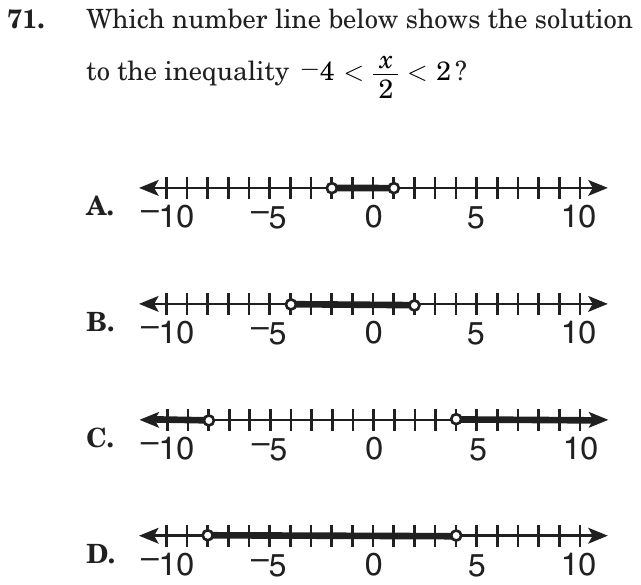
Which number line below shows the solution to the inequality ?
- A

- B

- C

- D

Show the answer
Correct answer: D
Multiply each term by 2 to eliminate the fraction, and isolate :
Therefore, must be between −8 and 4.
Question analysis
An inequality question: choose the number line that shows the solution of a compound inequality in which x divided by 2 lies between −4 and 2. Students undo the division in every part and match the graph's endpoints and shading. The four number lines differ in their endpoints and in which part of the line is shaded.
- Grade level
- Grade 7 content, by NYS standard
- Compared with grade 7
- At grade 7 Grade 7 students solve two-step inequalities and graph them on a number line. This compound inequality needs only one operation applied to all three parts at once, so it matches typical grade 7 work.
- Estimated difficulty
- Straightforward: two steps or one careful reading.
- Thinking it demands
- Depth of knowledge 1, recall and reproduction · mainly apply
- What makes it hard
- Reading a figure, table or graph moderate
- Error-prone arithmetic minor
- Solution
- 2 steps
- Reading level
- Question and choices: about grade 11, 11 words.
- Students, last 30 days
- Not enough answers yet to show (it takes 10).
Why it is hard, traps and wrong answers (shows the answer)
Why it is hard
Solving takes one step, multiplying through by 2, so most of the work is matching the result to a picture. The choices pair each common slip with a graph: the bounds left as written, the bounds halved, and the right bounds shaded on the wrong side. Reading the open circles against the labeled ticks at −5 and 5 settles it.
Reading a figure, table or graph moderate Understanding the question
The four number lines are labeled only at −10, −5, 0, 5 and 10, so open circles at −8 and 4, or at −4 and 2, have to be located by counting ticks. (Lesh, Post & Behr, 1987; Kirsch & Mosenthal, 1990)
Error-prone arithmetic minor Working it out
All three parts of −4 < x/2 < 2 must be multiplied by 2, and the negative bound −4 becomes −8; halving instead gives −2. (Brown & Burton, 1978; Junker & Sijtsma, 2001)
Strategy: Multiply all three parts of the inequality by 2 to isolate x, then pick the graph whose open circles and shading match the new bounds.
Traps
- Stops one step early: A choice is a number from partway through the solution.
- Negatives and direction: Arithmetic with negative numbers, the order of a subtraction, or direction on a number line. (Moving a term across the equals sign without changing its sign is a faulty procedure.)
The wrong answers, classified
A Wrong operation (Hegarty, Mayer & Monk, 1995; King et al., 2004)
Divides each part of the inequality by 2 instead of multiplying, getting −2 < x < 1, so the open circles land at −2 and 1.
B Stops one step early (King et al., 2004; Gierl et al., 2017)
Graphs −4 and 2 as the bounds of x, stopping before the step of multiplying through by 2 to clear the fraction x/2.
C Negatives and direction (Brown & Burton, 1978)
Finds −8 and 4 correctly but shades the two rays outside them, as if x had to be less than −8 or greater than 4.
Worked solution, step by step
Formulas used
- Multiplying an inequality by a positive number
- a and b are numbers, and the less-than sign means the left side is smaller. If you multiply both sides by the same positive number, like 2, the smaller side stays smaller. So the sign keeps pointing the same way. A negative number would flip it, but 2 is positive.
Sort out the inequality
An inequality compares two amounts that may not be equal. The sign means less than. Here means x divided by 2. The inequality says x divided by 2 is between −4 and 2. You need the values of x itself. Then you pick the number line that shows them.
Multiply all three parts by 2
To undo dividing by 2, multiply by 2. Multiply all three parts, so the whole statement stays true.
Watch out: multiply, don’t divide. Dividing gives −2 and 1, choice A. Leaving the ends at −4 and 2 is choice B.
Read what the answer means
x is greater than −8 and less than 4. So x is any number between −8 and 4. x cannot equal −8 or 4 exactly. On a number line, that means open circles at −8 and 4, with the part between them shaded.
Find the matching number line
The number lines are labeled only at −10, −5, 0, 5 and 10. Count the tick marks. −8 is 3 ticks left of −5, and 4 is 1 tick left of 5. Watch out: choice C has circles at −8 and 4 but shades the parts outside them. So the answer is D.
Check your answer
Test a number from the shaded part, like 0. , and 0 is between −4 and 2. Now test 6, which is outside. , and 3 is not less than 2. So only the part between −8 and 4 works.
More questions like this
The original DOE question