Also in 2026 Practice Test A Math, question 48; 2025 Practice Test A Math, question 55.
Question
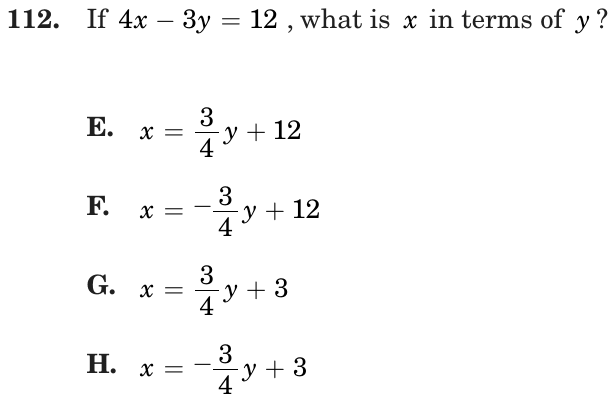
If , what is in terms of ?
- A
- B
- C
- D
Show the answer
Correct answer: C
Question analysis
This algebra question gives the linear equation 4x − 3y = 12 and asks for x in terms of y. Students must isolate the x term and then divide to solve for x. With two variables and a negative coefficient, small sign and division slips each lead to a different wrong choice.
- NYS standards
- Grade level
- Grade 8 content, by NYS standard
- Compared with grade 7
- Above grade 7 Grade 7 students solve one-variable equations like 4x − 3 = 12. Rearranging an equation with two variables to express one in terms of the other is grade 8 algebra, with sign and division slips to avoid.
- Estimated difficulty
- Moderate: several steps, or a close reading with one strong distractor.
- Thinking it demands
- Depth of knowledge 1, recall and reproduction · mainly apply
- What makes it hard
- Variables instead of numbers moderate
- A very close wrong answer moderate
- Error-prone arithmetic minor
- Solution
- 2 steps
- Reading level
- Question and choices: about grade 10, 13 words.
- Students, last 30 days
- Not enough answers yet to show (it takes 10).
Why it is hard, traps and wrong answers (shows the answer)
Why it is hard
The solution is two moves, add 3y to both sides and divide everything by 4, yet each move has a classic slip attached. The four choices are the four combinations of getting the sign right or wrong and dividing the 12 or not, so every partial mistake has a home. Checking one point that satisfies the original equation catches any of them.
Variables instead of numbers moderate Understanding the question
With two variables there is no number to check against unless students invent one; the point x = 6, y = 4 satisfies the equation and separates the choices. (Koedinger & Nathan, 2004; Enright, Morley & Sheehan, 2002)
A very close wrong answer moderate Choosing the answer
The choices x = 3/4 y + 3 and x = −3/4 y + 3 are identical except for the sign of the y term, which only correctly moving −3y across the equals sign settles. (Embretson & Wetzel, 1987; Gorin & Embretson, 2006; Ascalon et al., 2007)
Error-prone arithmetic minor Working it out
Dividing 12 + 3y by 4 must reach both terms, and the negative coefficient −3 has to change sign when it moves, two slips in a short line. (Brown & Burton, 1978; Junker & Sijtsma, 2001)
Strategy: Move the y term to the right side, watching its sign, so only the x term remains on the left, then divide the entire right side, term by term, by 4.
Traps
- A faulty procedure: A systematic but wrong procedure: adding fractions straight across, applying an exponent to each term of a sum, dropping a sign when moving a term.
The wrong answers, classified
A A faulty procedure (Brown & Burton, 1978; Tatsuoka, 1983)
Moves 3y correctly but divides only the y term by 4, leaving the constant 12 undivided.
B A faulty procedure (Brown & Burton, 1978; Tatsuoka, 1983)
Keeps the minus sign on the 3y term when moving it and also leaves the 12 undivided, two errors at once.
D A faulty procedure (Brown & Burton, 1978; Tatsuoka, 1983)
Divides every term by 4 correctly but keeps the minus on 3y, as if a term kept its sign when moved across.
Worked solution, step by step
Formulas used
- Keeping an equation balanced
- a and b are the two sides of an equation, and c is any number. An equation is like a balance. If you do the same thing to both sides, such as adding 3y or dividing by 4, they stay equal.
- Dividing a sum
- a and b are the two parts of the top, and c is the number you divide by. To divide a sum, divide each part. It works because sharing a + b into c groups shares a and b each into c groups.
Sort out what you need
The question asks for x in terms of y. That means get x alone on one side. The other side may have y and numbers, but no x. Start with .
Move the y term
The 3y is being subtracted on the left. Add 3y to both sides to clear it:
Watch out: the term was minus 3y. Adding 3y to both sides makes it plus 3y on the right. Keeping the minus sign leads to choice D.
Divide both sides by 4
x is being multiplied by 4. Divide both sides by 4 to undo it:
Split the fraction
Divide each part of the top by 4:
Watch out: the 12 must be divided by 4 too. Leaving it as 12 gives choice A. The choices put the y term first. So the answer is C, .
Check your answer
Pick y = 4. Choice C gives x = 3 + 3 = 6. Put x = 6 and y = 4 into the start: 4 × 6 − 3 × 4 = 24 − 12 = 12. It works. Choice D gives x = 0, and 4 × 0 − 12 = −12, not 12.
More questions like this
The original DOE question