Also in 2026 Practice Test A Math, question 35; 2025 Practice Test A Math, question 40.
Question
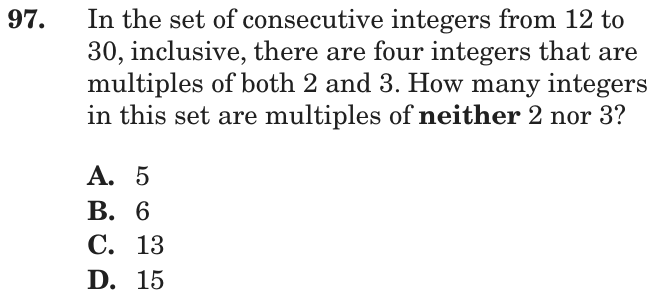
In the set of consecutive integers from 12 to 30, inclusive, there are four integers that are multiples of both 2 and 3. How many integers in this set are multiples of neither 2 nor 3?
- A5
- B6
- C13
- D15
Show the answer
Correct answer: B
The question asks for integers from 12 to 30 that are not divisible by 2 or 3. The set of consecutive integers is
{12, 13, 14, 15, 16, 17, 18, 19, 20, 21, 22, 23, 24, 25, 26, 27, 28, 29, 30}
Since all even numbers are divisible by 2, eliminate all even numbers, leaving the odd numbers in the set:
{13, 15, 17, 19, 21, 23, 25, 27, 29}
Eliminate those integers that are multiples of 3 (15, 21, and 27). The remaining integers are:
{13, 17, 19, 23, 25, 29}
Therefore, there are 6 numbers in the set that are multiples of neither 2 nor 3.
Question analysis
This number properties question takes the integers from 12 to 30, inclusive, and asks how many are multiples of neither 2 nor 3. Students must count the whole set, remove multiples of 2 and of 3 without removing any number twice, and count what remains. Inclusive endpoints and the overlap make it easy to miscount.
- NYS standards
- 6.NS.4 common factors and multiples
- Grade level
- Grade 6 content, by NYS standard
- Compared with grade 7
- Above grade 7 Multiples are sixth-grade content, but grade 7 problems rarely ask students to count a set under two overlapping conditions. The inclusive range and the numbers that are multiples of both make this longer and trickier than usual.
- Estimated difficulty
- Hard: combines ideas, needs a plan, and has more than one tempting wrong answer.
- Thinking it demands
- Depth of knowledge 2, skills and concepts · mainly apply
- What makes it hard
- Much to keep track of moderate
- A very close wrong answer moderate
- Solution
- 3 steps
- Reading level
- Question and choices: about grade 9, 30 words.
- Students, last 30 days
- Not enough answers yet to show (it takes 10).
Why it is hard, traps and wrong answers (shows the answer)
Why it is hard
The question gives the overlap, four multiples of both 2 and 3, which invites a subtraction method with three places to go wrong: the count of the set, the overlap, and the final complement. Each of those errors has its own choice. Listing the 19 numbers and crossing out evens and then odd multiples of 3 is slower to describe but faster and safer to do.
Much to keep track of moderate Working it out
Each of the 19 integers must be checked against two conditions, and the four multiples of 6 meet both, so they must be removed once, not twice. (Sweller, 1988; Carpenter, Just & Shell, 1990)
A very close wrong answer moderate Choosing the answer
The choices 5 and 6 differ by one, the result of counting 30 − 12 = 18 integers instead of 19, so only counting the inclusive set exactly separates them. (Embretson & Wetzel, 1987; Gorin & Embretson, 2006; Ascalon et al., 2007)
Strategy: Cross out every even number first, then cross out the odd multiples of 3 that remain, and count the survivors; listing all nineteen numbers is quick enough.
Traps
- Answers a different question: A choice is right for another quantity: the other unknown, the rest instead of the part, the part instead of the whole.
- Counting the ends: Inclusive or exclusive ends, fence posts, consecutive numbers: an answer that is one too many or too few, or an endpoint drawn open where it belongs closed (or the reverse).
The wrong answers, classified
A Counting the ends (Brown & Burton, 1978)
Counts 30 − 12 = 18 integers instead of 19, then subtracts the 13 multiples of 2 or 3 and gets 5.
C Answers a different question (King et al., 2004; Hegarty, Mayer & Monk, 1995)
Counts the integers that are multiples of 2 or 3, the 13 to be crossed out, and gives that count instead of the 6 left over.
D Misreads the question (Hegarty, Mayer & Monk, 1995)
Subtracts only the four multiples of both 2 and 3 from the 19 integers, reading "neither 2 nor 3" as "not both 2 and 3".
Worked solution, step by step
Formulas used
- Counting whole numbers in a list
- a is the first number and b is the last. n is how many whole numbers there are, counting both ends. You add 1 because subtracting counts the gaps, and there is one more number than gaps.
Sort out the question
The set is every integer (whole number) from 12 to 30. “Inclusive” means 12 and 30 are both in.
A multiple of 2 is an even number. A multiple of 3 is a number in the 3 times table. You need the numbers that are neither: not even, and not in the 3 times table.
Count the numbers in the set
There are 19 integers. Watch out: 30 − 12 = 18 forgets one end. That slip leads to choice A, 5.
Cross out the even numbers
Every even number is a multiple of 2, so remove them all. The odd numbers are left:
13, 15, 17, 19, 21, 23, 25, 27, 29
That is 9 numbers.
Cross out the multiples of 3
Check each odd number for 3. A quick test: add its digits. If the sum is in the 3 times table, so is the number. That removes 15, 21 and 27. These are left:
13, 17, 19, 23, 25, 29
Watch out: only 12, 18, 24 and 30 are multiples of both. Removing just those gives 19 − 4 = 15, choice D. “Neither” means you remove every multiple of 2 and every multiple of 3.
Count what is left
Six numbers are left. Watch out: 13 is how many you crossed out, choice C. The question asks for the ones left. So the answer is B, 6.
Check your answer
Count another way. Of the 19 numbers, 10 are even. Of the 9 odd ones, 3 are multiples of 3. So 10 + 3 = 13 are crossed out, and 19 − 13 = 6 are left. Same answer.
More questions like this
The original DOE question