Also in 2026 Practice Test A Math, question 34; 2025 Practice Test A Math, question 39.
Question
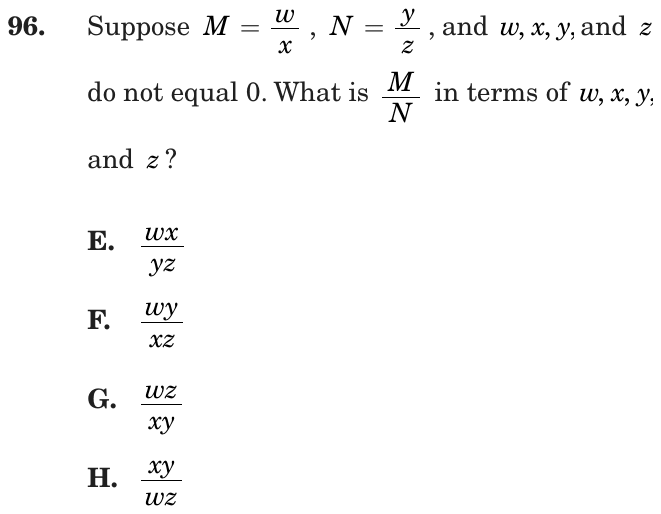
Suppose , , and , and do not equal 0. What is in terms of , and ?
- A
- B
- C
- D
Show the answer
Correct answer: C
It is easier to rewrite
as
since they are both fractions.
Question analysis
This algebra question defines M and N as fractions built from the letters w, x, y and z, and asks for M divided by N in terms of those letters. Students must divide one fraction by another using only variables. Without numbers to check against, it is easy to multiply instead of divide or flip the wrong fraction.
- Grade level
- Grade 7 content, by NYS standard
- Compared with grade 7
- At grade 7 Grade 7 students divide numeric fractions such as 2/3 ÷ 4/5. This item applies the same rule with four letters instead of numbers, which adds abstraction but no new steps.
- Estimated difficulty
- Straightforward: two steps or one careful reading.
- Thinking it demands
- Depth of knowledge 1, recall and reproduction · mainly apply
- What makes it hard
- Variables instead of numbers moderate
- A very close wrong answer moderate
- Solution
- 2 steps
- Reading level
- Question and choices: about grade 10, 23 words.
- Students, last 30 days
- Not enough answers yet to show (it takes 10).
Why it is hard, traps and wrong answers (shows the answer)
Why it is hard
This is fraction division in disguise, and students who recognize M/N as M ÷ N need one rule. The difficulty is that every choice is built from the same four letters, so a wrong rule still produces something that looks like a reasonable answer. Substituting small numbers, such as w = 1, x = 2, y = 3 and z = 4, checks the result in seconds.
Variables instead of numbers moderate Understanding the question
All four letters stand for unknown nonzero numbers, so dividing w/x by y/z must be done symbolically, with no value to check the result against. (Koedinger & Nathan, 2004; Enright, Morley & Sheehan, 2002)
A very close wrong answer moderate Choosing the answer
All four choices arrange w, x, y and z as one fraction, and xy/wz is wz/xy turned over, so only carrying out the division in the right order tells them apart. (Embretson & Wetzel, 1987; Gorin & Embretson, 2006; Ascalon et al., 2007)
Strategy: Rewrite M/N as M ÷ N, then multiply by the reciprocal of the second fraction; substituting small numbers for the letters checks the result.
Traps
- A faulty procedure: A systematic but wrong procedure: adding fractions straight across, applying an exponent to each term of a sum, dropping a sign when moving a term.
- Wrong operation: Adds instead of multiplying, divides the wrong way round, turns a ratio or rate upside down, or undoes a step in the wrong direction (subtracts what should be added back).
The wrong answers, classified
A Numbers taken from the question (Hegarty, Mayer & Monk, 1995)
Stacks M's letters over N's letters, writing wx over yz, without carrying out any fraction division.
B Wrong operation (Hegarty, Mayer & Monk, 1995; King et al., 2004)
Multiplies M by N straight across, top times top and bottom times bottom, instead of dividing.
D A faulty procedure (Brown & Burton, 1978; Tatsuoka, 1983)
Flips the first fraction instead of the second, computing x/w × y/z, which gives N divided by M.
Worked solution, step by step
Formulas used
- Dividing fractions
- a, b, c and d are numbers that are not 0. To divide by a fraction, multiply by its reciprocal (the fraction flipped upside down). It works because dividing by a number is the same as multiplying by 1 over that number.
- Multiplying fractions
- a and c are the tops and b and d are the bottoms. Multiply the tops together and the bottoms together. Use it after you flip the second fraction.
Sort out what you know
M is the fraction w over x. N is the fraction y over z. The letters stand for numbers that are not 0.
The fraction bar in means M divided by N. So you must divide one fraction by another.
Write it as a division
Rewrite the big fraction as a division. Then put in the fractions for M and N. This lets you use the rule for dividing fractions:
Flip the second fraction
Use the rule for dividing fractions. Keep the first fraction. Flip only the second one, and change divide to multiply:
Watch out: flipping the first fraction instead gives choice D, which is N ÷ M. Multiplying without flipping at all gives choice B.
Multiply across
Multiply the tops and the bottoms:
Here wz means w times z. So the answer is C, .
Check your answer
Try small numbers. Let w = 1, x = 2, y = 3 and z = 4. Then M = 1/2 and N = 3/4. So M ÷ N = 1/2 × 4/3 = 4/6. Choice C gives (1 × 4) ÷ (2 × 3) = 4/6 too. They match.
More questions like this
The original DOE question