Also in 2026 Practice Test A Math, question 5; 2025 Practice Test A Math, question 5.
Question
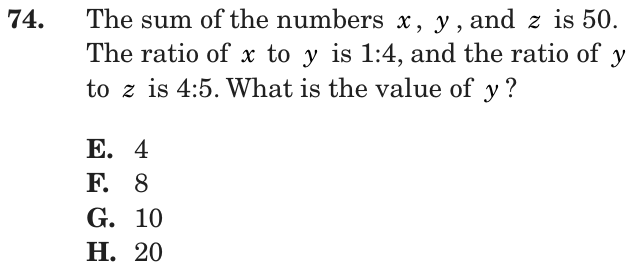
The sum of the numbers x, y, and z is 50. The ratio of x to y is 1:4, and the ratio of y to z is 4:5. What is the value of y ?
- A4
- B8
- C10
- D20
Show the answer
Correct answer: D
Since both ratios have in common, solve for and in terms of in both equations. Using , solve for in terms of .
Using the ratio , solve for in terms of :
The question states . Substitute from the two equations above and solve for .
Question analysis
A ratio problem with three unknowns: x, y and z add to 50, x to y is 1 to 4, and y to z is 4 to 5. Students merge the two ratios into one three-part ratio and use the sum to find y. The step that is easy to skip is turning ratio parts into actual values.
- Grade level
- Grade 7 content, by NYS standard
- Compared with grade 7
- At grade 7 Grade 7 ratio problems usually involve one ratio. Here two ratios share a term and must be merged before the total is used, though the shared term already matches, which keeps it near typical grade 7 work.
- Estimated difficulty
- Moderate: several steps, or a close reading with one strong distractor.
- Thinking it demands
- Depth of knowledge 2, skills and concepts · mainly apply
- What makes it hard
- No obvious method moderate
- Variables instead of numbers minor
- Many steps minor
- Solution
- 3 steps
- Reading level
- Question and choices: about grade 2, 31 words.
- Students, last 30 days
- Not enough answers yet to show (it takes 10).
Why it is hard, traps and wrong answers (shows the answer)
Why it is hard
The question rewards noticing that y has the same term in both ratios, which turns two ratios into one three-part ratio in a single move. Students who miss this often write x and z in terms of y, as the explanation does, which works but is slower. The wrong choices are numbers taken from the ratios themselves, so a student who never scales up to the total of 50 finds an answer waiting.
No obvious method moderate Working it out
The two ratios have to be merged into one, x : y : z = 1 : 4 : 5, which works only because y is 4 in both; nothing in the wording says to combine them. (Schoenfeld, 1985)
Variables instead of numbers minor Understanding the question
x, y and z are given only through two ratios and their sum of 50, so there is no actual count to anchor the work until the parts are scaled. (Koedinger & Nathan, 2004; Enright, Morley & Sheehan, 2002)
Many steps minor Working it out
Adding the parts, dividing 50 by their total and scaling y's 4 parts are three steps, and the count of parts after the first step is itself a listed choice. (Daniel & Embretson, 2010; Enright, Morley & Sheehan, 2002)
Strategy: Since y is 4 in both ratios, write x : y : z as one combined ratio, find the value of one part from the total of 50, and scale up.
Traps
- Numbers taken from the question: Combines the numbers in the question without a model of the situation, or is simply a number that appears in the question.
- Answers a different question: A choice is right for another quantity: the other unknown, the rest instead of the part, the part instead of the whole.
The wrong answers, classified
A Numbers taken from the question (Hegarty, Mayer & Monk, 1995)
Takes y's term in the ratios, 4, as y's actual value, never using the sum of 50.
B Numbers taken from the question (Hegarty, Mayer & Monk, 1995)
Adds the two 4s that stand for y in the two ratios, 4 + 4 = 8, treating ratio terms as amounts.
C Answers a different question (King et al., 2004; Hegarty, Mayer & Monk, 1995)
Combines the ratios into 1 : 4 : 5 and gives the total number of parts, 1 + 4 + 5 = 10, instead of y's share of the 50.
Worked solution, step by step
Formulas used
- Sharing a total in a ratio
- In a ratio like 3:2, the amounts are made of equal-sized parts. Add the numbers in the ratio to count the parts. Divide the total by that count to get the size of one part. Then multiply by how many parts each amount has.
Sort out the question
The three numbers x, y and z add up to 50. The ratio of x to y is 1:4. The ratio of y to z is 4:5. A ratio compares sizes. You need the actual value of y.
Join the two ratios
y is 4 in both ratios. So the two ratios use the same size parts, and you can join them into one.
This means x is 1 part, y is 4 parts, and z is 5 parts.
Count the parts
There are 10 parts in all. Watch out: 10 is the number of parts, not the value of y. Picking it is choice C.
Find the size of one part
Use the sharing formula. The 10 parts share the total of 50.
Each part is worth 5.
Find y
y is 4 parts.
Watch out: the 4 in the ratio counts parts. It is not the value of y. Picking 4 is choice A. So the answer is D, 20.
Check your answer
Find all three: x = 5, y = 20, z = 25. They add up: . x to y is 5 to 20, which is 1:4. y to z is 20 to 25, which is 4:5. Everything fits.
More questions like this
The original DOE question