Also in 2026 Practice Test A Math, question 15; 2025 Practice Test A Math, question 16.
Question
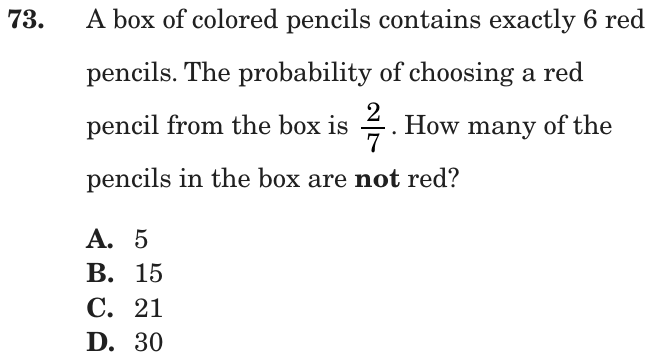
A box of colored pencils contains exactly 6 red pencils. The probability of choosing a red pencil from the box is . How many of the pencils in the box are not red?
- A5
- B15
- C21
- D30
Show the answer
Correct answer: B
Let be the total number of colored pencils in the box. Set up a proportion to find :
If there are 6 red pencils, then the number of pencils that are not red is
21 − 6 = 15.
Question analysis
A probability word problem: a box holds exactly 6 red pencils, and the chance of drawing a red one is 2/7. Students work backward from the probability to the number of pencils in the box, then answer the question actually asked, which is about the pencils that are not red.
- Grade level
- Grade 6 content, by NYS standard
- Compared with grade 7
- At grade 7 Simple probability is grade 6 content in New York. Reversing it to find a total is a step beyond plugging counts into a fraction, which puts this at about the level of typical grade 7 work.
- Estimated difficulty
- Straightforward: two steps or one careful reading.
- Thinking it demands
- Depth of knowledge 2, skills and concepts · mainly apply
- What makes it hard
- Turning words into math moderate
- Something you must already know minor
- Solution
- 2 steps
- Reading level
- Question and choices: about grade 6, 32 words.
- Corrected from the DOE handbook
- A spelling mistake in the explanation was corrected.
- Students, last 30 days
- Not enough answers yet to show (it takes 10).
Why it is hard, traps and wrong answers (shows the answer)
Why it is hard
Students have to treat a probability as a ratio and scale it up: 6 red pencils is three times the 2 in 2/7. The common loss is choosing the total number of pencils, which appears naturally halfway through the work and is a listed choice. Reading the 7 as a pencil count, or scaling by 6 instead of 3, leads to the other wrong answers.
Turning words into math moderate Understanding the question
"The probability of choosing a red pencil from the box is 2/7" has to become a part-to-whole ratio: 2 of every 7 pencils are red, so the 6 red pencils are 2 parts. (Hegarty, Mayer & Monk, 1995; Koedinger & Nathan, 2004)
Something you must already know minor Working it out
The question assumes students know that a probability is favorable outcomes over all outcomes, here used in reverse to find the total from the red count. (Anderson & Krathwohl, 2001)
Strategy: Since 2 parts out of 7 are red, find how many pencils one part stands for, then count the parts that are not red.
Traps
- Stops one step early: A choice is a number from partway through the solution.
The wrong answers, classified
A Numbers taken from the question (Hegarty, Mayer & Monk, 1995)
Reads 2/7 as 2 red pencils among exactly 7 and takes 7 − 2 = 5, ignoring the stated 6 red pencils.
C Stops one step early (King et al., 2004; Gierl et al., 2017)
Solves 2/7 = 6/x to get 21 pencils in all and stops before subtracting the 6 red ones that the bold not excludes.
D A faulty procedure (Brown & Burton, 1978; Tatsuoka, 1983)
Treats the 6 red pencils as one share of the 7 instead of two, so each share is 6 and the 5 non-red shares make 30.
What was corrected from the DOE handbook, and why
- Explanation: The handbook says “the number of pencils that are not read is 21 − 6 = 15”. “read” now reads “red”.
Worked solution, step by step
Formulas used
- Probability
- P is the probability, the chance that something happens. Favorable is the number of ways to get what you want, here a red pencil. Total is the number of all possible picks, here every pencil in the box. It works when every pick is equally likely.
Sort out the question
A probability is a number that tells how likely something is. The box has exactly 6 red pencils. The chance of picking a red one is . You need the number of pencils that are not red.
Read the probability as parts
means 2 out of every 7 pencils are red. Picture the box split into 7 equal parts. Red pencils fill 2 of the parts. The other 5 parts are not red. Watch out: the box does not hold just 7 pencils. It has 6 red ones alone. Taking is choice A.
Find the size of one part
The 6 red pencils fill 2 parts. Divide to find one part.
Each part is 3 pencils. So the whole box has pencils.
Check with the probability formula
Put the counts into the formula to make sure.
Divide the top and bottom of 6/21 by 3 to get 2/7. It matches.
Count the pencils that are not red
That is the same as 5 parts of 3 pencils each. Watch out: 21 is all the pencils, choice C. The question asks only for the ones that are not red. So the answer is B, 15.
Check your answer
Red and not red should make the whole box: . Red is less likely than not red, since 2/7 is less than half. 6 red against 15 not red fits that.
More questions like this
The original DOE question