Question
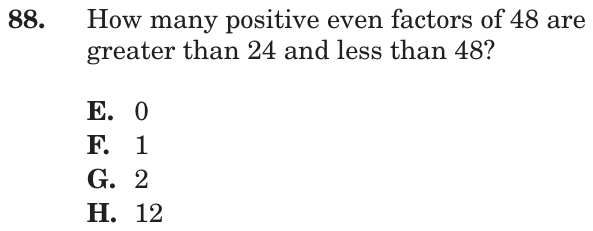
How many positive even factors of 48 are greater than 24 and less than 48?
- A0
- B1
- C2
- D12
Show the answer
Correct answer: A
List the factors of 48:
1 and 48, 2 and 24, 3 and 16, 4 and 12, 6 and 8
There are no factors greater than 24 and less than 48.
Question analysis
This number properties question asks how many positive even factors of 48 are greater than 24 and less than 48. Students list the factors of 48 and test which ones fall strictly inside that range. Reading both conditions precisely, and listing every factor without skipping any, is what matters.
- NYS standards
- 6.NS.4 common factors and multiples
- Grade level
- Grade 6 content, by NYS standard
- Compared with grade 7
- Below grade 7 Listing the factors of a two-digit number is grade 6 work, and here it takes one short list. The only demand beyond routine is reading both conditions exactly, which grade 7 students already do regularly.
- Estimated difficulty
- Straightforward: two steps or one careful reading.
- Thinking it demands
- Depth of knowledge 1, recall and reproduction · mainly apply
- What makes it hard
- A very close wrong answer moderate
- Much to keep track of minor
- Solution
- 2 steps
- Reading level
- Question and choices: about grade 7, 12 words.
- Students, last 30 days
- Not enough answers yet to show (it takes 10).
Why it is hard, traps and wrong answers (shows the answer)
Why it is hard
The factor list is short, so the question is decided by the conditions. The pairs 2 and 24 and 1 and 48 put the only candidates exactly on the boundaries, and the strict words "greater than" and "less than" exclude them. Students also tend to distrust an answer of zero, which nudges them toward counting an endpoint.
A very close wrong answer moderate Choosing the answer
The choices 0 and 1 differ by a single factor, so the count cannot be sized up; only checking whether 48 itself, or 24, falls strictly inside the range separates them. (Embretson & Wetzel, 1987; Gorin & Embretson, 2006; Ascalon et al., 2007)
Much to keep track of minor Working it out
Each factor must pass three tests at once, even, greater than 24 and less than 48, and the factor list itself must be complete. (Sweller, 1988; Carpenter, Just & Shell, 1990)
Strategy: List the factors of 48 in pairs, starting from 1 × 48, then check each one against both conditions: it must be even and lie strictly between 24 and 48.
Traps
- Counting the ends: Inclusive or exclusive ends, fence posts, consecutive numbers: an answer that is one too many or too few, or an endpoint drawn open where it belongs closed (or the reverse).
- Misreads the question: Misses or misreads a condition or a word in the question: "at least", "each", "remaining", "not".
The wrong answers, classified
B Counting the ends (Brown & Burton, 1978)
Counts one boundary factor, usually 48 itself, as inside the range, reading "less than 48" as "48 or less".
C Counting the ends (Brown & Burton, 1978)
Counts both 24 and 48, treating "greater than 24 and less than 48" as if the range included both of its ends.
D Misreads the question (Hegarty, Mayer & Monk, 1995)
Drops the condition that the numbers be factors of 48 and counts the even numbers from 26 up to and including 48, which makes 12.
Worked solution, step by step
Formulas used
- Factor pairs
- n is the number you start with, here 48. If two whole numbers a and b multiply to make n, both are factors of n. A factor divides n with nothing left over. Listing factors in pairs makes sure you skip none.
Sort out what the question asks
A factor of 48 is a whole number that divides 48 with nothing left over. You need factors that pass three tests. They must be even. They must be greater than 24. They must be less than 48.
“Less than 48” means 48 itself does not count. “Greater than 24” means 24 does not count either.
List the factors of 48 in pairs
Start with 1 and work up. Each pair multiplies to 48:
The next number, 7, does not divide 48. After 6 and 8 the pairs repeat. So the factors are 1, 2, 3, 4, 6, 8, 12, 16, 24 and 48.
Look between 24 and 48
In the list, the factor right after 24 is 48. Nothing falls between them.
Here is why. A factor bigger than 24 must pair with a number smaller than 2. The only such number is 1, and it pairs with 48. So no factor of 48 is between 24 and 48, even or odd.
Give the answer
Watch out: 24 and 48 are both factors, but they sit on the edges. Counting 48 gives 1, which is choice B. Counting both gives 2, which is choice C.
So the answer is A, 0.
Check your answer
Try the even numbers 26, 28, and so on up to 46. Dividing 48 by any of them gives more than 1 but less than 2. That is never a whole number, so none of them is a factor. Choice D, 12, counts even numbers without checking that they are factors.
More questions like this
The original DOE question