Question
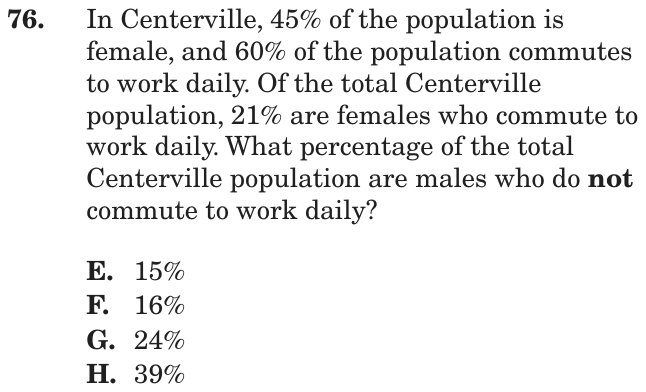
In Centerville, 45% of the population is female, and 60% of the population commutes to work daily. Of the total Centerville population, 21% are females who commute to work daily. What percentage of the total Centerville population are males who do not commute to work daily?
- A15%
- B16%
- C24%
- D39%
Show the answer
Correct answer: B
Create a table with the information provided in the problem and use subtraction to fill in the rest of the table:
| Female | Male | TOTAL | |
| Commutes to work | 21% | 39% (60 − 21) |
60% |
| Does not commute to work | 24% (45 − 21) |
16% (40 − 24) |
40% (100 − 60) |
| TOTAL | 45% | 100% |
16% of the population is male and does not commute to work.
Question analysis
A percent problem about overlapping groups in a town's population: the percents who are female, who commute daily, and who are female commuters are given. Students find the percent who are male and do not commute. A two-way table helps, since several of its cells are easy to confuse with the one asked for.
- Grade level
- Grade 7 content, by NYS standard
- Compared with grade 7
- Above grade 7 Grade 7 percent problems usually take a percent of one quantity. This needs two overlapping categories organized in a two-way table, which is not in New York's grade 7 standards, with three subtractions and two tempting cells.
- Estimated difficulty
- Hard: combines ideas, needs a plan, and has more than one tempting wrong answer.
- Thinking it demands
- Depth of knowledge 2, skills and concepts · mainly analyze
- What makes it hard
- No obvious method moderate
- Much to keep track of moderate
- Turning words into math moderate
- Solution
- 3 steps
- Reading level
- Question and choices: about grade 12, 43 words.
- Students, last 30 days
- Not enough answers yet to show (it takes 10).
Why it is hard, traps and wrong answers (shows the answer)
Why it is hard
The question gives three overlapping percents and asks for the one group none of them describes directly. Without a table, students tend to subtract the given numbers in some order, and several orders yield a listed choice. The last trap is the word "not", since the males who do commute are one cell away. Filling every cell of a two-by-two table before answering takes under a minute and leaves nothing to guess.
No obvious method moderate Working it out
Nothing in the wording points to a two-way table, yet the four groups, female or male by commuting or not, fall into place only once one is drawn. (Schoenfeld, 1985)
Much to keep track of moderate Working it out
Three given percents, 45, 60 and 21, plus their complements, 55 and 40, have to be kept straight while the cells are filled in by subtraction. (Sweller, 1988; Carpenter, Just & Shell, 1990)
Turning words into math moderate Understanding the question
"Of the total Centerville population, 21% are females who commute" is a share of everyone, not of the females, and belongs in a single cell of the table. (Hegarty, Mayer & Monk, 1995; Koedinger & Nathan, 2004)
Strategy: Make a two-by-two table of female and male against commutes and does not commute, fill in the totals, and complete each cell by subtraction.
Traps
- Misreads the question: Misses or misreads a condition or a word in the question: "at least", "each", "remaining", "not".
- Stops one step early: A choice is a number from partway through the solution.
The wrong answers, classified
A Numbers taken from the question (Hegarty, Mayer & Monk, 1995)
Subtracts one given percent from another, 60 − 45 = 15, without placing the 21% of female commuters anywhere.
C Stops one step early (King et al., 2004; Gierl et al., 2017)
Fills in the first empty cell, females who do not commute, 45 − 21 = 24, and stops before using it to reach the males' cell.
D Misreads the question (Hegarty, Mayer & Monk, 1995)
Finds the males who commute, 60 − 21 = 39, missing the word not in the question.
Worked solution, step by step
Formulas used
- Parts add up to the whole
- In a two-way table, every row and every column splits a group into two parts. a and b are the two parts, and W is the whole group. If you know the whole and one part, subtract to find the other part.
Sort out the question
Every number is a percent of the whole town. 45% of people are female. 60% commute, which means they travel to work every day. 21% are females who commute. You need the percent who are “males who do not commute to work daily”.
Make a two-way table
A two-way table sorts people two ways at once: female or male, and commutes or not. Put in what you know. The whole town is 100%.
Female Male Total Commute 21% ? 60% Do not commute ? ? ? Total 45% ? 100% Fill in the two totals
Everyone is female or male, so the males are what is left.
Everyone either commutes or does not.
So 55% are male, and 40% do not commute.
Find the males who commute
Use the commute row. All commuters are 60%, and the female commuters are 21%.
So 39% are males who commute. Watch out: the question says do not commute. Picking 39% is choice D.
Find the males who do not commute
Use the male column. All males are 55%, and the males who commute are 39%.
Watch out: 24% is the females who do not commute, . That is choice C. So the answer is B, 16%.
Check your answer
Find the same cell another way. Females who do not commute: . All who do not commute: 40%. So males who do not commute: . The answers match.
More questions like this
The original DOE question