Also in 2026 Practice Test A Math, question 28; 2025 Practice Test A Math, question 32.
Question
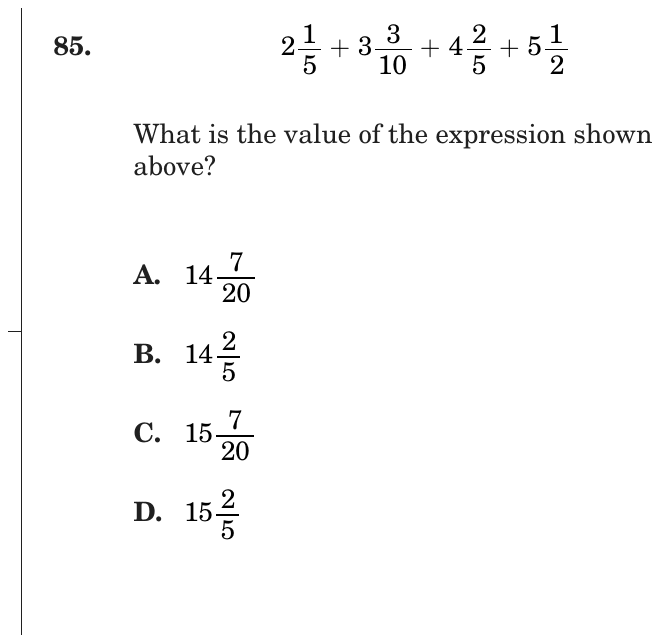
What is the value of the expression shown above?
- A
- B
- C
- D
Show the answer
Correct answer: D
Convert all the fractions to a common denominator (10):
Question analysis
A fractions question: add four mixed numbers whose fractions have denominators of 5, 10, 5 and 2. Students rewrite the fractions over a common denominator, add the whole numbers and the fractions, regroup any extra whole, and simplify. Regrouping and lowest terms both matter, since the choices differ in exactly those places.
- NYS standards
- Grade level
- Grade 7 content, by NYS standard
- Compared with grade 7
- Below grade 7 Adding mixed numbers with unlike denominators is grade 5 content. With four terms and a regrouping step it takes care, but it asks less than typical grade 7 work with negative rational numbers.
- Estimated difficulty
- Straightforward: two steps or one careful reading.
- Thinking it demands
- Depth of knowledge 1, recall and reproduction · mainly apply
- What makes it hard
- Error-prone arithmetic moderate
- A very close wrong answer moderate
- An answer in an unexpected form minor
- Solution
- 3 steps
- Reading level
- Question and choices: about grade 9, 14 words.
- Students, last 30 days
- Not enough answers yet to show (it takes 10).
Why it is hard, traps and wrong answers (shows the answer)
Why it is hard
The numbers are friendly: every fraction converts to tenths, and the whole parts add to 14. The risk is in the bookkeeping, either forgetting to carry the extra whole from the fractions or adding numerators over a made-up denominator. Converting to decimals, 2.2 + 3.3 + 4.4 + 5.5, is a fast check that avoids both.
Error-prone arithmetic moderate Working it out
Four mixed numbers with denominators 5, 10, 5 and 2 must be rewritten as tenths, 2 + 3 + 4 + 5 tenths, and the 14/10 regrouped into a whole and a fraction. (Brown & Burton, 1978; Junker & Sijtsma, 2001)
A very close wrong answer moderate Choosing the answer
15 2/5 and 14 2/5 are written alike and share the fraction 2/5; only the whole carried from 14/10 separates them, so a missed carry is invisible at a glance. (Embretson & Wetzel, 1987; Gorin & Embretson, 2006; Ascalon et al., 2007)
An answer in an unexpected form minor Choosing the answer
The fractions total 1 4/10, but every choice is in lowest terms, so the 4/10 has to be reduced to 2/5 before it matches. (Enright, Morley & Sheehan, 2002)
Strategy: Convert each mixed number to a decimal, since these fractions all convert exactly, add them, and turn the decimal part back into a fraction in lowest terms.
Traps
- Answer in another form: The right answer is written differently from the way you worked it out.
The wrong answers, classified
A A faulty procedure (Brown & Burton, 1978; Tatsuoka, 1983)
Adds the numerators straight across, 1 + 3 + 2 + 1 = 7, and puts them over 20, a common denominator (10 × 2), without rescaling them, so nothing carries.
B An arithmetic slip (Junker & Sijtsma, 2001)
Adds the fractions to 14/10 but keeps only the 4/10 = 2/5 left over, forgetting to carry the whole 1 into 14.
C Little reason to choose it (Haladyna & Downing, 1993; Rodriguez, 2005)
Pairs a correct carry into 15 with the 7/20 from adding numerators, two steps no single line of working combines; it mostly catches guesses.
Worked solution, step by step
Formulas used
- Equal fractions
- a is the top number, called the numerator. b is the bottom number, called the denominator. n is any whole number except zero. Multiplying the top and bottom by the same n gives an equal fraction. Use it to give fractions the same denominator so you can add them.
Sort out the question
You need to add four mixed numbers. A mixed number is a whole number plus a fraction, like . The fractions have different denominators, or bottom numbers: 5, 10, 5 and 2. To add fractions, they need the same denominator.
Add the whole numbers
Add the whole numbers first. You will add the fractions on their own after that.
The whole numbers make 14.
Rewrite each fraction in tenths
Use 10 as the denominator, since 5 and 2 both go into 10.
is already in tenths. Watch out: when you change a bottom number, change the top too. Adding the old tops, 1 + 3 + 2 + 1 = 7, and putting them over 20 gives 7/20. That is in choices A and C.
Add the fractions
14 tenths is more than 1 whole. Ten tenths make 1, so 14 tenths is 1 whole and 4 tenths.
To simplify 4/10, divide the top and bottom by 2.
Put it all together
Add the 14 wholes to the sum of the fractions.
Watch out: carry the extra whole into the 14. Missing it gives , choice B. So the answer is D, .
Check your answer
Change each mixed number to a decimal: . The 0.4 is 4 tenths, which is 2/5. So the sum is .
More questions like this
The original DOE question