Also in 2025 Practice Test A Math, question 25.
Question
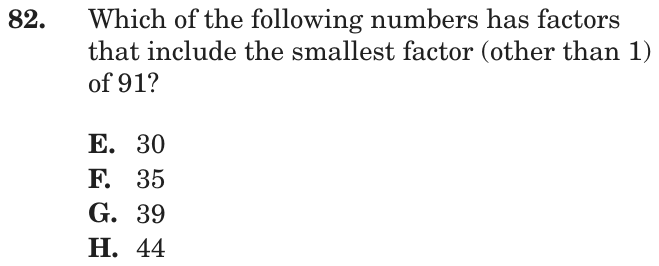
Which of the following numbers has factors that include the smallest factor (other than 1) of 91?
- A30
- B35
- C39
- D44
Show the answer
Correct answer: B
To find the smallest factor of 91, list the factors:
1, 7, 13, and 91
The smallest factor (other than 1) is 7.
Of the options listed (30, 35, 39, and 44), only 35 is a multiple of 7.
Question analysis
A number properties question about factors: students find the smallest factor of 91 other than 1, then pick the number that shares it. Because 91 looks like a prime number, many students skip the factoring, and the choices include numbers built from factors that 91 might seem to have.
- NYS standards
- 6.NS.4 common factors and multiples
- Grade level
- Grade 6 content, by NYS standard
- Compared with grade 7
- Below grade 7 Factors and divisibility are grade 4 to 6 skills, and this takes two quick checks. It is easier than typical grade 7 work, though recognizing that 91 is not prime catches many students.
- Estimated difficulty
- Moderate: several steps, or a close reading with one strong distractor.
- Thinking it demands
- Depth of knowledge 2, skills and concepts · mainly apply
- What makes it hard
- Complex sentences moderate
- Something you must already know moderate
- Solution
- 2 steps
- Reading level
- Question and choices: about grade 8, 15 words.
- Students, last 30 days
- Not enough answers yet to show (it takes 10).
Why it is hard, traps and wrong answers (shows the answer)
Why it is hard
The question tests a grade 6 skill inside a hard-to-parse sentence. Once the stem is unpacked, the work is finding the smallest prime factor of 91 and checking the choices for it. Students lose points in two ways: 91 looks prime or divisible by 3, so they guess at its factors, or they find 13 before 7 and accept the choice that shares it.
Complex sentences moderate Understanding the question
The stem nests three ideas, "has factors that include the smallest factor (other than 1) of 91", so it has to be unpacked before any math; this is reading difficulty, not number difficulty. (Abedi & Lord, 2001; Freedle & Kostin, 1993; Messick, 1989)
Something you must already know moderate Working it out
Students must find that 91 = 7 × 13, and 91 is a number many students wrongly take to be prime or a multiple of 3. (Anderson & Krathwohl, 2001)
Strategy: Test 91 against the small primes in order, starting with 2, until one divides it evenly, then check which choice is a multiple of that prime.
Traps
- Misreads the question: Misses or misreads a condition or a word in the question: "at least", "each", "remaining", "not".
The wrong answers, classified
A An arithmetic slip (Junker & Sijtsma, 2001)
Wrongly takes 91 as a multiple of 3, as 90 is, and picks 30, which 3 divides; in fact 91 ÷ 3 is not a whole number.
C Misreads the question (Hegarty, Mayer & Monk, 1995)
Factors 91 as 7 × 13 but matches 39 = 3 × 13, which shares the larger factor, overlooking the word smallest.
D Little reason to choose it (Haladyna & Downing, 1993; Rodriguez, 2005)
Neither of its prime factors, 2 and 11, divides 91, an odd number, so no common working leads to 44; it mostly draws guesses.
Worked solution, step by step
Formulas used
- What a factor is
- a, b and c are whole numbers. If b = a × c, then a and c are factors of b. That means a divides b evenly, with no remainder. Every whole number has 1 and itself as factors.
Unpack the long sentence
A factor of a number divides it evenly, with nothing left over. For example, 3 is a factor of 12, because . The question has two steps. First, find “the smallest factor (other than 1) of 91”. Then find the choice that also has that factor.
Test small numbers on 91
Try dividing 91 by 2, 3, 5 and so on, until one works.
- 2: no. 91 is odd. That also rules out 4 and 6, which are even.
- 3: no. A number is a multiple of 3 only if its digits add to a multiple of 3. Here 9 + 1 = 10, which is not.
- 5: no. 91 does not end in 0 or 5.
- 7: yes!
So 7 is the smallest factor of 91 other than 1.
Avoid the 3 trap
Watch out: 91 is close to 90, and 3 goes into 90. But is 30 with 1 left over. So 3 is not a factor of 91. That trap leads to 30, choice A.
Check each choice for 7
Now look for a multiple of 7 among the choices.
- 30: no. and .
- 35: yes. .
- 39: no. .
- 44: no. .
Watch out: 39 shares 13 with 91, but 13 is the larger factor, not the smallest. That is choice C. So the answer is B, 35.
Check your answer
Multiply to be sure: and . So 7 goes into both numbers evenly. No number from 2 to 6 goes into 91, so 7 really is the smallest.
More questions like this
The original DOE question