Also in 2026 Practice Test A Math, question 22; 2025 Practice Test A Math, question 24.
Question
How many more people in Center City walk to work than ride their bicycle to work?
- A2,500
- B2,700
- C2,800
- D3,000
Show the answer
Correct answer: B
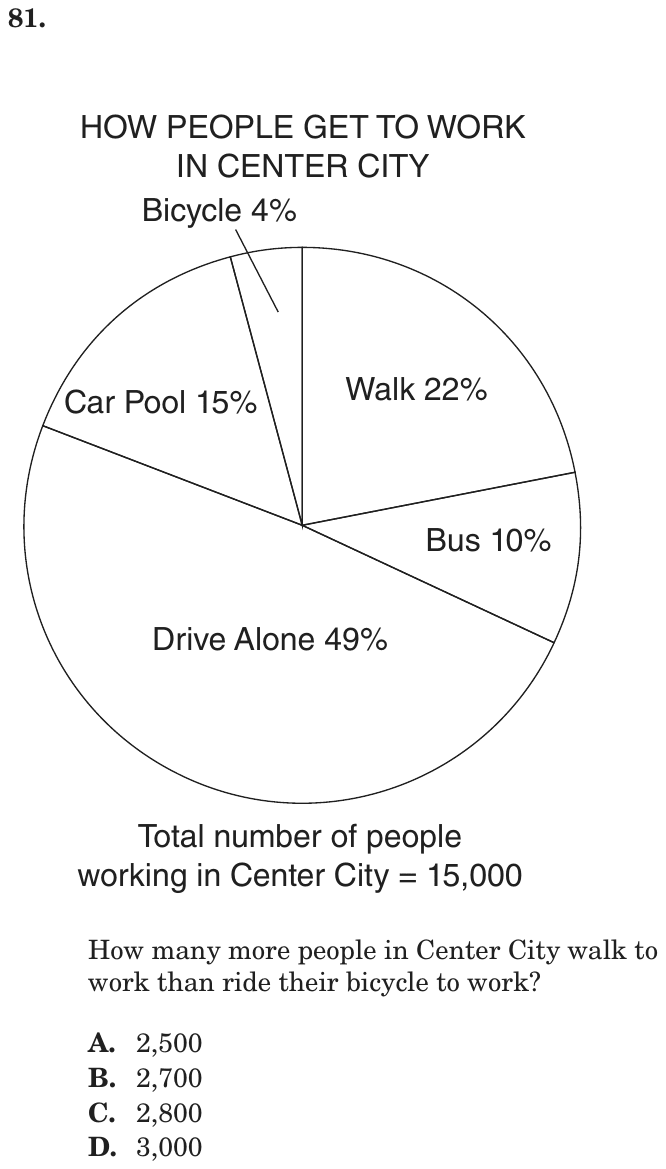
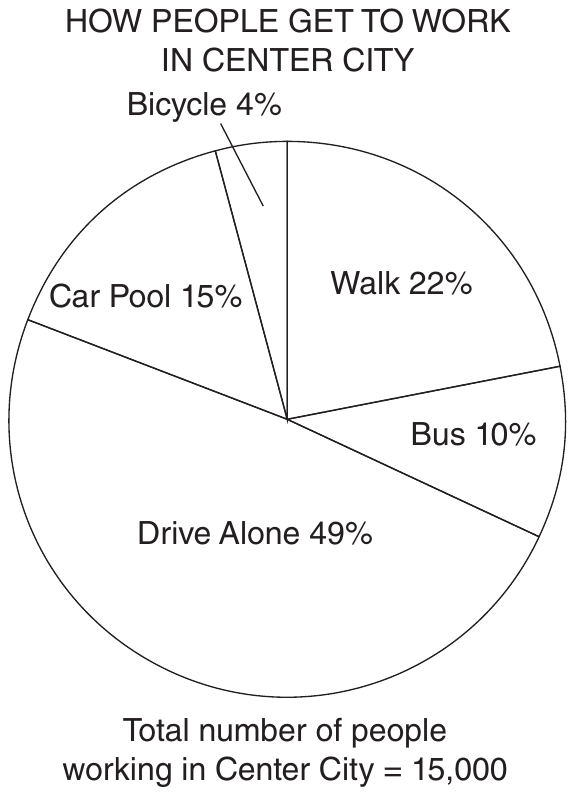
According to the chart, 22% of people walk to work and 4% ride a bicycle. Subtract to find the percentage of how many more people walk than bicycle:
22% − 4% = 18%
To find the exact number of people, multiply 18% (0.18) by the number of people working in Center City (15,000):
Question analysis
This circle graph question shows how the 15,000 people working in Center City get to work, with 22% walking and 4% riding a bicycle. Students find how many more people walk than bike by combining a percent difference with a percent of a total. The choices are close together, so estimating is risky.
- Grade level
- Grade 6 content, by NYS standard
- Compared with grade 7
- Below grade 7 Reading a circle graph and taking a percent of a total are grade 6 skills. With only two short steps and friendly numbers, this is easier than typical grade 7 multistep percent work.
- Estimated difficulty
- Straightforward: two steps or one careful reading.
- Thinking it demands
- Depth of knowledge 2, skills and concepts · mainly apply
- What makes it hard
- A very close wrong answer moderate
- Reading a figure, table or graph minor
- Error-prone arithmetic minor
- Solution
- 2 steps
- Reading level
- Question and choices: about grade 7, 16 words.
- Students, last 30 days
- Not enough answers yet to show (it takes 10).
Why it is hard, traps and wrong answers (shows the answer)
Why it is hard
The method is short: subtract the percents first, or find both groups and subtract, and both reach the same number. What makes the question less safe than it looks is the tight spread of choices, all within 500 of each other, so rounding 18% or slipping on one product lands on a wrong answer. Subtracting the percents first leaves one multiplication to get right instead of two.
A very close wrong answer moderate Choosing the answer
2,700 sits only 100 from 2,800 and 300 from 3,000, so estimating 18% of 15,000 as about a fifth cannot pick it; only the exact product does. (Embretson & Wetzel, 1987; Gorin & Embretson, 2006; Ascalon et al., 2007)
Reading a figure, table or graph minor Understanding the question
The Walk 22% and Bicycle 4% labels must be picked out of five sectors, and the 15,000 total sits in a caption below the circle graph. (Lesh, Post & Behr, 1987; Kirsch & Mosenthal, 1990)
Error-prone arithmetic minor Working it out
The percent gap has to become a count, 0.18 × 15,000, a decimal times a five-digit number worked by hand without a calculator. (Brown & Burton, 1978; Junker & Sijtsma, 2001)
Strategy: Subtract the two percents first, then take that single percent of 15,000, instead of finding each group and subtracting.
The wrong answers, classified
A Little reason to choose it (Haladyna & Downing, 1993; Rodriguez, 2005)
No common working gives 2,500, which is 1/6 of 15,000 and matches no sector or difference of sectors; it mostly catches estimates.
C An arithmetic slip (Junker & Sijtsma, 2001)
Takes 4% of 15,000 as 500 instead of 600 and subtracts it from the 3,300 walkers, getting 2,800.
D Rounds too early (King et al., 2004)
Rounds the 18-point gap up to 20% to make the multiplication easy and takes 20% of 15,000, which is 3,000.
Worked solution, step by step
Formulas used
- Percent of a number
- W is the whole amount. p is the percent, and x is the part you want. Percent means out of 100, so p percent is the fraction p over 100. Multiplying the whole by that fraction gives the part.
Sort out the circle graph
A circle graph shows how a whole splits into parts. This one shows how 15,000 workers get to work. Walk is 22%. Bicycle is 4%. You need how many more people walk than ride a bicycle.
Subtract the percents first
Both percents are parts of the same 15,000 people. So you can subtract the percents first. Then you only need one multiplication.
The difference is 18% of all the workers.
Find 18% of 15,000
First find 1% by dividing by 100. Then multiply by 18.
That is 2,700 people.
Avoid rounding and answer
Watch out: don’t round 18% up to 20% to make it easy. 20% of 15,000 is 3,000, choice D. The choices are close together, so you need the exact number. So the answer is B, 2,700.
Check your answer
Find each group, then subtract. Walkers: 22% of 15,000 is 3,300. Bike riders: 4% of 15,000 is 600. . You get the same answer.
More questions like this
The original DOE question