Question
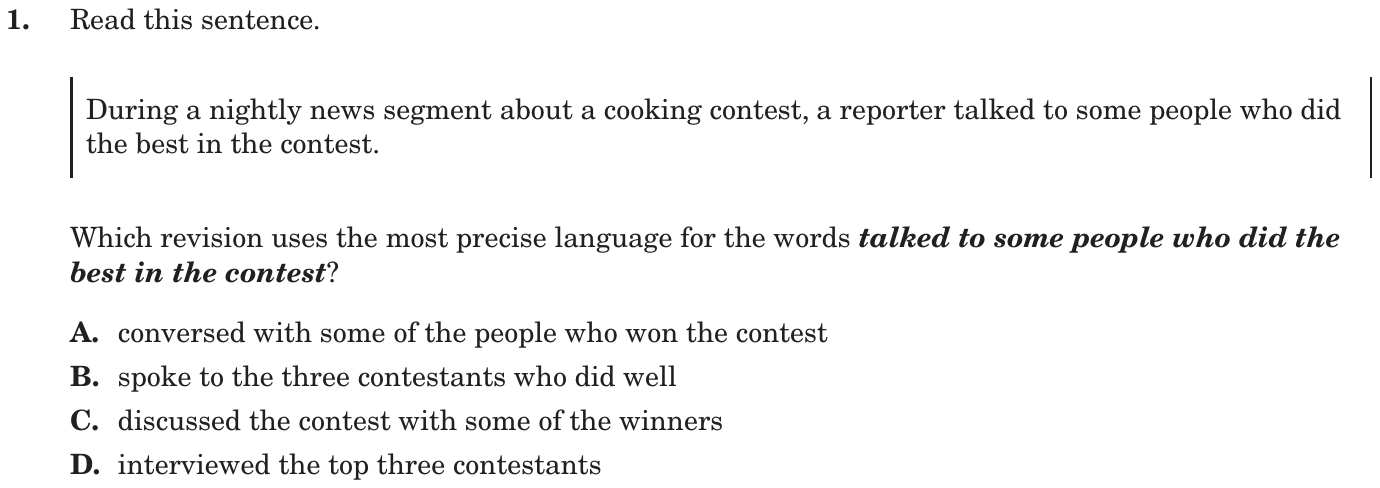
Read this sentence.
During a nightly news segment about a cooking contest, a reporter talked to some people who did the best in the contest.
Which revision uses the most precise language for the words talked to some people who did the best in the contest?
- Aconversed with some of the people who won the contest
- Bspoke to the three contestants who did well
- Cdiscussed the contest with some of the winners
- Dinterviewed the top three contestants
Show the answer
Correct answer: D
This is the answer.(D)
The question asks for the most precise revision for the words “talked to some people who did the best in the contest.”
Option D is the correct response because the revision precisely states both the reporter’s action (“interviewed”) and whom the reporter interviewed (“the top three contestants”).
Option A is an incorrect response because the revision does not provide precise information about the number of people interviewed.
Option B is an incorrect response because the revision uses the imprecise phrase “who did well.”
Option C is an incorrect response because the revision does not provide precise information about the number of people interviewed.
Question analysis
This revising question gives one sentence about a news report on a cooking contest and asks which rewrite of a vague phrase uses the most precise language. The tricky part is that several choices sound more formal or add one specific detail while staying vague about something else.
- NYS standards
- 7L3a precise and concise language
- Grade level
- Grade 7 reading and task
- Compared with grade 7
- Below grade 7 Choosing precise wording is a grade 7 language skill, but this item is one short sentence with everyday words and a single comparison to make. Typical grade 7 revision work asks for the same judgment inside a longer paragraph.
- Estimated difficulty
- Routine: one familiar step, little to misread.
- Thinking it demands
- Depth of knowledge 1, recall and reproduction · mainly evaluate
- What makes it hard
- Evidence
- Answered from one sentence or line
- Reading level
- Question and choices: about grade 5, 77 words.
- Students, last 30 days
- Not enough answers yet to show (it takes 10).
Why it is hard, traps and wrong answers (shows the answer)
Why it is hard
This is a quick item once a student tests two things in every rewrite: what the reporter did and exactly who was involved. Points are lost by stopping at the first concrete detail, such as the number three, or by mistaking a formal verb like “conversed” for a precise one. It rewards checking each rewrite all the way through.
Every choice must be checked minor Choosing the answer
Each rewrite repairs a different piece of “talked to some people who did the best”, so all four have to be checked for both the action and the people. (Embretson & Wetzel, 1987)
Strategy: Ask two things of each revision: does it say exactly what the reporter did, and exactly whom the reporter spoke with? Keep a revision only if it is specific on both counts.
Traps
- Wordy, vague or informal: A revision is grammatical but wordy, imprecise or too casual for the passage.
- Half right: One half of a two-part choice is right and the other is not.
The wrong answers, classified
A Wordy, vague or informal (Connors & Lunsford, 1988)
Treats the formal verb “conversed” as more precise than “talked”, but it is only a fancier synonym, and “some of the people” leaves the number as vague as before.
B Half right (King et al., 2004; Thissen, Steinberg & Fitzpatrick, 1989)
Spots the exact number in “the three contestants” and stops checking, though “spoke to” and “who did well” are as loose as the original wording.
C Wordy, vague or informal (Connors & Lunsford, 1988)
Takes “winners” as sharper than “people who did the best”, missing that “some of the winners” still gives no count and “discussed the contest with” is wordier.
Working it out, step by step
Figure out what the question asks
This question asks you to make a phrase more precise. Precise language is exact. It tells the reader exactly what happened and exactly who was there. For example, a big dog is vague, but a 90-pound sheepdog is precise. You need to fix the words “talked to some people who did the best in the contest.”
Find what is vague now
The words are vague in two ways. First, “talked to” is a plain verb. On the news, a reporter who asks people questions is doing an interview. Second, “some people who did the best” does not say who or how many. So a good fix must sharpen both parts: the action and the people.
Test each choice on both parts
- A uses “conversed with,” which is just a fancy word for “talked.” And “some of the people” is still vague.
- B gives a number, “the three contestants.” But “spoke to” and “who did well” are still loose.
- C says “some of the winners,” which still gives no number. “Discussed the contest with” is wordier, not clearer.
- D says “interviewed,” the exact action. “The top three contestants” says exactly who.
Watch out: Choice B is tempting because it has a number. Many students stop there. But it fixes only one part.
Pick the answer
Only one choice is exact about both the action and the people. The new sentence reads: During a nightly news segment about a cooking contest, a reporter interviewed the top three contestants. So the answer is D, “interviewed the top three contestants.”
Why this answer and not the closest wrong one
Choice B is the closest wrong answer. Like D, it names three contestants. But “spoke to” is as plain as “talked to,” and “who did well” is vaguer than “top.” D is exact about what the reporter did and about whom, so it is the most precise.
More questions like this
The original DOE question