Passage Champion of the Channel
Champion of the Channel
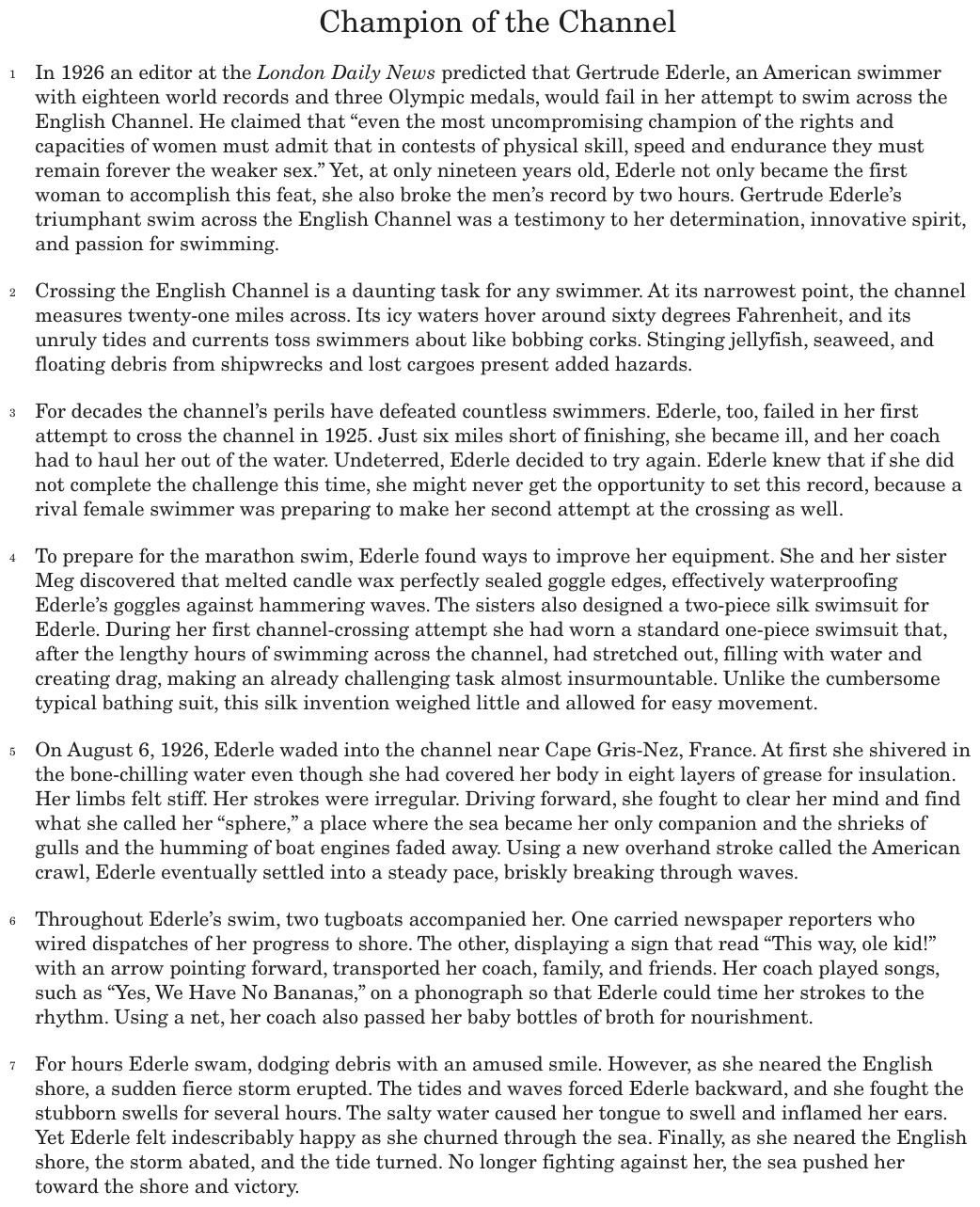
In 1926 an editor at the London Daily News predicted that Gertrude Ederle, an American swimmer with eighteen world records and three Olympic medals, would fail in her attempt to swim across the English Channel. He claimed that “even the most uncompromising champion of the rights and capacities of women must admit that in contests of physical skill, speed and endurance they must remain forever the weaker sex.” Yet, at only nineteen years old, Ederle not only became the first woman to accomplish this feat, she also broke the men’s record by two hours. Gertrude Ederle’s triumphant swim across the English Channel was a testimony to her determination, innovative spirit, and passion for swimming.
Crossing the English Channel is a daunting task for any swimmer. At its narrowest point, the channel measures twenty-one miles across. Its icy waters hover around sixty degrees Fahrenheit, and its unruly tides and currents toss swimmers about like bobbing corks. Stinging jellyfish, seaweed, and floating debris from shipwrecks and lost cargoes present added hazards.
For decades the channel’s perils have defeated countless swimmers. Ederle, too, failed in her first attempt to cross the channel in 1925. Just six miles short of finishing, she became ill, and her coach had to haul her out of the water. Undeterred, Ederle decided to try again. Ederle knew that if she did not complete the challenge this time, she might never get the opportunity to set this record, because a rival female swimmer was preparing to make her second attempt at the crossing as well.
To prepare for the marathon swim, Ederle found ways to improve her equipment. She and her sister Meg discovered that melted candle wax perfectly sealed goggle edges, effectively waterproofing Ederle’s goggles against hammering waves. The sisters also designed a two-piece silk swimsuit for Ederle. During her first channel-crossing attempt she had worn a standard one-piece swimsuit that, after the lengthy hours of swimming across the channel, had stretched out, filling with water and creating drag, making an already challenging task almost insurmountable. Unlike the cumbersome typical bathing suit, this silk invention weighed little and allowed for easy movement.
On August 6, 1926, Ederle waded into the channel near Cape Gris-Nez, France. At first she shivered in the bone-chilling water even though she had covered her body in eight layers of grease for insulation. Her limbs felt stiff. Her strokes were irregular. Driving forward, she fought to clear her mind and find what she called her “sphere,” a place where the sea became her only companion and the shrieks of gulls and the humming of boat engines faded away. Using a new overhand stroke called the American crawl, Ederle eventually settled into a steady pace, briskly breaking through waves.
Throughout Ederle’s swim, two tugboats accompanied her. One carried newspaper reporters who wired dispatches of her progress to shore. The other, displaying a sign that read “This way, ole kid!” with an arrow pointing forward, transported her coach, family, and friends. Her coach played songs, such as “Yes, We Have No Bananas,” on a phonograph so that Ederle could time her strokes to the rhythm. Using a net, her coach also passed her baby bottles of broth for nourishment.
For hours Ederle swam, dodging debris with an amused smile. However, as she neared the English shore, a sudden fierce storm erupted. The tides and waves forced Ederle backward, and she fought the stubborn swells for several hours. The salty water caused her tongue to swell and inflamed her ears. Yet Ederle felt indescribably happy as she churned through the sea. Finally, as she neared the English shore, the storm abated, and the tide turned. No longer fighting against her, the sea pushed her toward the shore and victory.
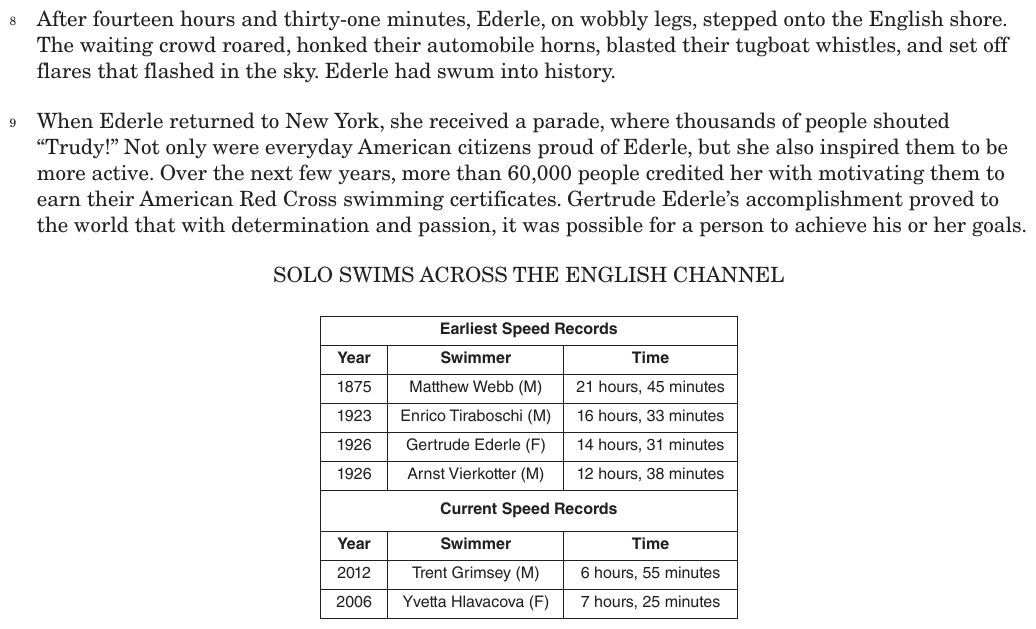
After fourteen hours and thirty-one minutes, Ederle, on wobbly legs, stepped onto the English shore. The waiting crowd roared, honked their automobile horns, blasted their tugboat whistles, and set off flares that flashed in the sky. Ederle had swum into history.
When Ederle returned to New York, she received a parade, where thousands of people shouted “Trudy!” Not only were everyday American citizens proud of Ederle, but she also inspired them to be more active. Over the next few years, more than 60,000 people credited her with motivating them to earn their American Red Cross swimming certificates. Gertrude Ederle’s accomplishment proved to the world that with determination and passion, it was possible for a person to achieve his or her goals.
SOLO SWIMS ACROSS THE ENGLISH CHANNEL
|
Earliest Speed Records |
||
| Year | Swimmer | Time |
| 1875 | Matthew Webb (M) | 21 hours, 45 minutes |
| 1923 | Enrico Tiraboschi (M) | 16 hours, 33 minutes |
| 1926 | Gertrude Ederle (F) | 14 hours, 31 minutes |
| 1926 | Arnst Vierkotter (M) | 12 hours, 38 minutes |
| Current Speed Records | ||
| Year | Swimmer | Time |
| 2012 | Trent Grimsey (M) | 6 hours, 55 minutes |
| 2006 | Yvetta Hlavacova (F) | 7 hours, 25 minutes |
Question
Which sentence from the passage best conveys the author’s perspective regarding the impact of Ederle’s accomplishment?
- A“Gertrude Ederle’s triumphant swim across the English Channel was a testimony to her determination, innovative spirit, and passion for swimming.” (paragraph 1)
- B“For hours Ederle swam, dodging debris with an amused smile.” (paragraph 7)
- C“Yet Ederle felt indescribably happy as she churned through the sea.” (paragraph 7)
- D“Ederle had swum into history.” (paragraph 8)
Show the answer
Correct answer: D
The answer is (D)
The question asks for the sentence from the passage that best conveys the author’s perspective about the impact of Ederle’s swim.
Option D is correct because, throughout the passage, the author emphasizes that Ederle’s accomplishment was memorable and great, which is best stated in the sentence from paragraph 8.
The sentence presented in Option A is incorrect because it focuses on Ederle’s personal attributes that allowed her to successfully complete her swim, not the author’s perspective about the impact of her achievement.
The sentence presented in Option B is incorrect because the details in the sentence relate to Ederle’s state of mind as she came closer to achieving her goal and do not provide details about the author’s opinion of the impact of Ederle’s accomplishment.
The sentence presented in Option C is incorrect because it simply presents Ederle’s emotional state as she nears her goal and does not provide information about the author’s perspective.
Question analysis
This reading question asks which quoted sentence best conveys the author's own perspective on the impact of Gertrude Ederle's English Channel swim. Every quotation shows the swim in a positive light, so students must tell the author's judgment apart from description and keep the question's focus on impact in mind.
- Grade level
- Grade 7 reading and task
- Compared with grade 7
- At grade 7 Identifying an author's own perspective is typical grade 7 point-of-view work. The quotations are short and labeled, and the main demand is attending to the word impact in the question.
- Estimated difficulty
- Moderate: several steps, or a close reading with one strong distractor.
- Thinking it demands
- Depth of knowledge 2, skills and concepts · mainly analyze
- What makes it hard
- How, not what moderate
- Figurative or literary language minor
- Evidence
- Answered from several paragraphs or stanzas
- Reading level
- Passage: about grade 9, 790 words; question and choices: about grade 12, 66 words.
- Corrected from the DOE handbook
- A grammar slip in the explanation was corrected.
- Students, last 30 days
- Not enough answers yet to show (it takes 10).
Why it is hard, traps and wrong answers (shows the answer)
Why it is hard
Two tests apply at once: whose view a sentence gives and whether that view concerns impact. The thesis sentence passes the first and fails the second, which makes it the main trap, while the two sentences from paragraph 7 report Ederle's feelings, not the author's judgment. The short sentence in paragraph 8 is easy to skim past because it states impact in five words and a figure of speech.
How, not what moderate Working it out
The question asks for the author's perspective, so narration of Ederle's own feelings, her “amused smile” and being “indescribably happy”, has to be set apart from the author's judgment. (Anderson & Krathwohl, 2001)
Figurative or literary language minor Understanding the question
“Ederle had swum into history” states the impact through a figure of speech, so the student must read it as a claim that the swim earned a lasting place. (Graesser, Singer & Trabasso, 1994; Kintsch, 1998)
Strategy: Ask two questions of each quotation: whose view does it express, and is it about the swim's impact or about something else? Only one quotation passes both tests.
Traps
- True but not the answer: A choice says something accurate about the text that does not answer this question.
- Wrong tone or attitude: Misjudges the tone, attitude or point of view, such as reading admiration as criticism, or taking a character's or subject's feelings for the author's.
The wrong answers, classified
A True but not the answer (King et al., 2004; Embretson & Wetzel, 1987)
Picks the passage's thesis, a real statement of the author's view, but it praises her determination and passion rather than saying what the swim meant or changed.
B Wrong tone or attitude (Graesser, Singer & Trabasso, 1994)
Takes Ederle's “amused smile” while dodging debris as the author's opinion, but it describes her mood mid-swim, not any judgment about the swim's impact.
C Wrong tone or attitude (Graesser, Singer & Trabasso, 1994)
Reads “indescribably happy” as the author's enthusiasm, but the sentence reports how Ederle felt during the storm, not how the author sees her achievement's impact.
What was corrected from the DOE handbook, and why
- Explanation: In the reason for rejecting F (B on this site), the handbook reads “the details in the sentence relate to … and does not provide details”. It now reads “do not provide”, to agree with “details”.
Working it out, step by step
Figure out what the question asks
A perspective is a point of view. Impact means the effect something has. So you need a sentence that shows the author’s opinion about what Ederle’s swim meant. A sentence about how Ederle felt does not count.
Ask two questions of each quote
For each choice, ask: Whose view is this, the author’s or Ederle’s? Then ask: Is it about the effect of the swim, or about something else? Only one choice will pass both tests.
Check each choice
- A: the swim was “a testimony to her determination, innovative spirit, and passion for swimming.” This is the author’s view, but it is about her qualities, not the swim’s effect.
- B: “dodging debris with an amused smile” describes Ederle’s mood during the swim.
- C: “Ederle felt indescribably happy” describes her feelings, not the author’s judgment.
- D: “Ederle had swum into history” (paragraph 8). This is the author speaking about what the swim meant.
Explain the key phrase
“Swum into history” is a figure of speech, words that mean more than their exact sense. She didn’t really swim into a history book. It means her swim was so important that people will remember it for a long time. That is a judgment about its impact.
Pick the answer
Watch out: A is the author’s main claim, so it is tempting. But it explains what made her succeed, not what her success meant. So the answer is D.
Why this answer and not the closest wrong one
A is the closest wrong answer, because it is also the author’s own opinion. But it tells what the swim showed about Ederle: her determination and passion. D tells what the swim meant: it made history. Only D is about impact.
More questions like this
The original DOE question
The passage “Champion of the Channel” as printed (pages 56–57)