Also in 2024 Test A English, question 2; 2026 Practice Test D English, question 47.
Question
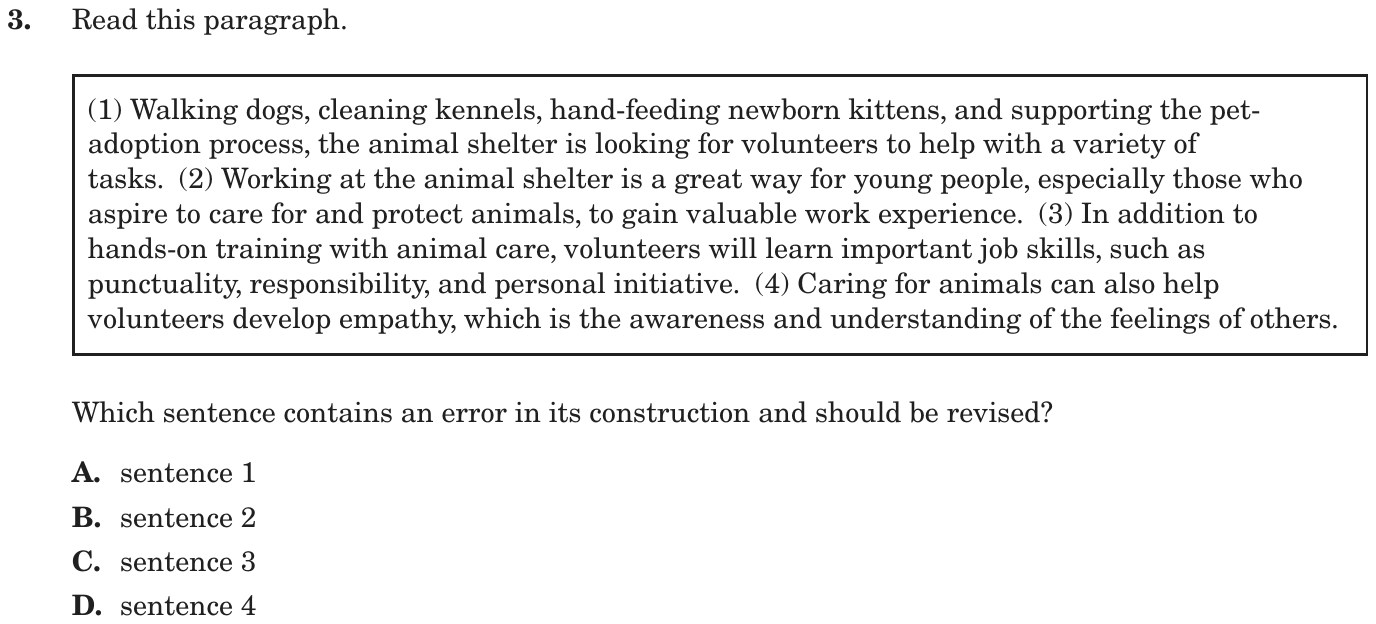
Read this paragraph.
(1) Walking dogs, cleaning kennels, hand-feeding newborn kittens, and supporting the pet-adoption process, the animal shelter is looking for volunteers to help with a variety of tasks. (2) Working at the animal shelter is a great way for young people, especially those who aspire to care for and protect animals, to gain valuable work experience. (3) In addition to hands-on training with animal care, volunteers will learn important job skills, such as punctuality, responsibility, and personal initiative. (4) Caring for animals can also help volunteers develop empathy, which is the awareness and understanding of the feelings of others.
Which sentence contains an error in its construction and should be revised?
- Asentence 1
- Bsentence 2
- Csentence 3
- Dsentence 4
Show the answer
Correct answer: A
The answer is (A)
The question asks for the identification of the sentence in the paragraph that has an error in its construction and should be revised.
Option A (sentence 1) is the correct response because sentence 1 contains a structural error. The sentence begins with a list of modifying phrases: “Walking dogs, cleaning kennels, hand-feeding newborn kittens, and supporting the pet-adoption process.” As written, this list modifies the closest noun phrase, “the animal shelter,” which is illogical because the list describes tasks at the animal shelter, not the shelter itself. The list should follow the word “tasks” at the end of the sentence, so that it is closer to the word that it modifies.
Option B, Option C, and Option D are incorrect responses because sentence 2, sentence 3, and sentence 4 do not contain structural errors.
For Option B, the phrase “especially those who aspire to care for and protect animals” in sentence 2 correctly modifies “young people.”
For Option C, the structure of sentence 3 allows the words “In addition to hands-on training with animal care” to correctly modify “volunteers will learn.”
For Option D, the phrase “which is the awareness and understanding of the feelings of others” in sentence 4 correctly modifies the word “empathy.”
Question analysis
This editing question gives a paragraph inviting young people to volunteer at an animal shelter and asks which sentence is built incorrectly and should be revised. The error is in sentence structure, not spelling or punctuation, and every sentence contains long descriptive phrases, so students must check what each phrase actually describes.
- NYS standards
- 7L1 grammar and usage conventions
- Grade level
- Grade 7 reading and task
- Compared with grade 7
- At grade 7 Spotting a misplaced or dangling modifier is the grade 7 grammar skill tested here. The faulty sentence reads smoothly and the correct sentences also hold long modifying phrases, so it matches a careful grade 7 editing task.
- Estimated difficulty
- Moderate: several steps, or a close reading with one strong distractor.
- Thinking it demands
- Depth of knowledge 2, skills and concepts · mainly analyze
- What makes it hard
- A rule that doesn't sound wrong major
- Every choice must be checked moderate
- Complex sentences minor
- Evidence
- Answered from one paragraph or stanza
- Reading level
- Question and choices: about grade 10, 113 words.
- Students, last 30 days
- Not enough answers yet to show (it takes 10).
Why it is hard, traps and wrong answers (shows the answer)
Why it is hard
The faulty sentence is the first one and the smoothest-sounding, because the mind supplies the missing volunteers who walk the dogs. Students who judge by ear pass over it and then flag a correct sentence that merely sounds busy. The question rewards asking, for every opening phrase, which noun it actually attaches to.
A rule that doesn't sound wrong major Working it out
Sentence 1's opening list, “Walking dogs, cleaning kennels, hand-feeding newborn kittens”, grammatically describes “the animal shelter”, an error that sounds natural because readers know volunteers will do those tasks. (Connors & Lunsford, 1988)
Every choice must be checked moderate Choosing the answer
The stem names no kind of error, so all four sentences must be checked, and sentences 2, 3 and 4 each contain a long phrase that could look misplaced. (Embretson & Wetzel, 1987)
Complex sentences minor Understanding the question
Every sentence carries a lengthy modifier, from the interrupting “especially those who aspire to care for and protect animals” to the closing definition of empathy, so the faulty one does not stand out. (Abedi & Lord, 2001; Freedle & Kostin, 1993; Messick, 1989)
Strategy: In each sentence, find every descriptive phrase and ask which noun sits next to it. Any phrase placed beside a noun it cannot logically describe marks the sentence to revise.
The wrong answers, classified
B Fixes what isn't broken (Connors & Lunsford, 1988)
Flags the interruption “especially those who aspire to care for and protect animals” as an error, though it correctly describes “young people” and the sentence is complete.
C Fixes what isn't broken (Connors & Lunsford, 1988)
Suspects the opening phrase “In addition to hands-on training with animal care” dangles like sentence 1's, but it leads straight into “volunteers”, who receive the training.
D Fixes what isn't broken (Connors & Lunsford, 1988)
Picks the “which is the awareness and understanding of the feelings of others” clause as misplaced, though it sits right after “empathy”, the word it defines.
Working it out, step by step
Figure out what the question asks
This asks which sentence is built wrong. The words may be fine, but the parts are in the wrong order or don’t fit together. The question doesn’t say what kind of error to look for. So you need to check all four sentences.
Learn the rule about describing phrases
A modifier is a word or phrase that describes something. It must sit right next to the thing it describes. If it sits next to the wrong word, the sentence says something silly. Example: Barking loudly, the mail carrier ran from the dog. This says the mail carrier was barking! Fix: The mail carrier ran from the dog, which was barking loudly.
Test sentence 1
Sentence 1 begins with a list: “Walking dogs, cleaning kennels, hand-feeding newborn kittens, and supporting the pet-adoption process.” Right after the comma comes “the animal shelter.” So the sentence says the shelter is walking dogs and feeding kittens. A shelter is a place. It can’t do those things. The list really describes the “tasks” at the end of the sentence. One fix moves the list after that word: …volunteers to help with a variety of tasks, such as walking dogs, cleaning kennels…
Test sentences 2, 3, and 4
- Sentence 2: “especially those who aspire to care for and protect animals” comes right after “young people.” It describes them, so it is in the right place. (To aspire means to hope or aim.)
- Sentence 3: “In addition to hands-on training with animal care” leads straight into “volunteers.” The volunteers get the training, so it fits.
- Sentence 4: “which is the awareness and understanding of the feelings of others” comes right after “empathy.” It explains that word, so it fits.
Watch out: Sentence 3 also starts with a phrase and a comma, so choice C can look like sentence 1. Ask who gets the training. The volunteers do.
Pick the answer
Only sentence 1 puts a describing phrase next to the wrong noun. So the answer is A, sentence 1.
Why this answer and not the closest wrong one
Sentence 3 is the closest trap, because it also opens with a phrase and a comma. But the word after its comma is “volunteers,” and the volunteers really do get the training. In sentence 1, the words after the comma are “the animal shelter,” and a shelter can’t walk dogs.
More questions like this
The original DOE question