Passage The Local Library
The Local Library
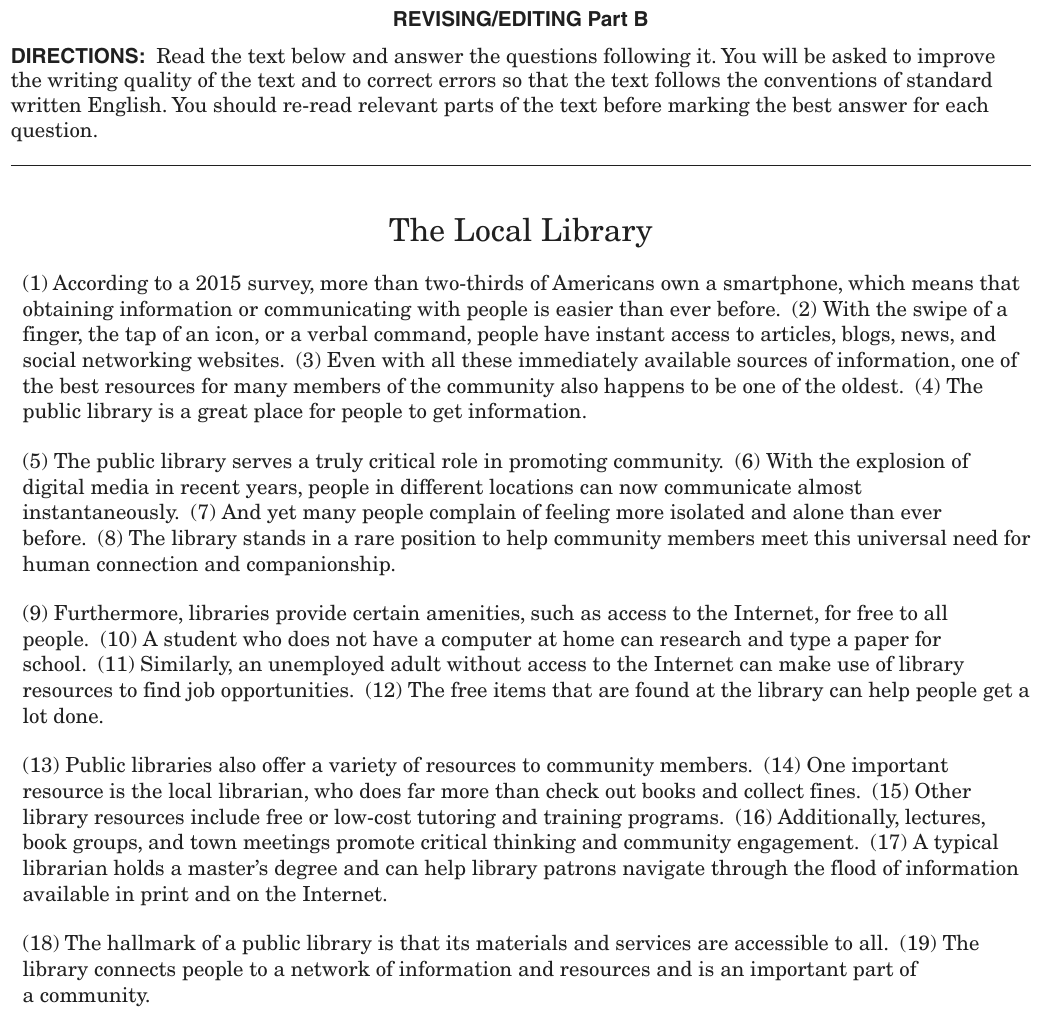
(1) According to a 2015 survey, more than two-thirds of Americans own a smartphone, which means that obtaining information or communicating with people is easier than ever before. (2) With the swipe of a finger, the tap of an icon, or a verbal command, people have instant access to articles, blogs, news, and social networking websites. (3) Even with all these immediately available sources of information, one of the best resources for many members of the community also happens to be one of the oldest. (4) The public library is a great place for people to get information.
(5) The public library serves a truly critical role in promoting community. (6) With the explosion of digital media in recent years, people in different locations can now communicate almost instantaneously. (7) And yet many people complain of feeling more isolated and alone than ever before. (8) The library stands in a rare position to help community members meet this universal need for human connection and companionship.
(9) Furthermore, libraries provide certain amenities, such as access to the Internet, for free to all people. (10) A student who does not have a computer at home can research and type a paper for school. (11) Similarly, an unemployed adult without access to the Internet can make use of library resources to find job opportunities. (12) The free items that are found at the library can help people get a lot done.
(13) Public libraries also offer a variety of resources to community members. (14) One important resource is the local librarian, who does far more than check out books and collect fines. (15) Other library resources include free or low-cost tutoring and training programs. (16) Additionally, lectures, book groups, and town meetings promote critical thinking and community engagement. (17) A typical librarian holds a master’s degree and can help library patrons navigate through the flood of information available in print and on the Internet.
(18) The hallmark of a public library is that its materials and services are accessible to all. (19) The library connects people to a network of information and resources and is an important part of a community.
Question
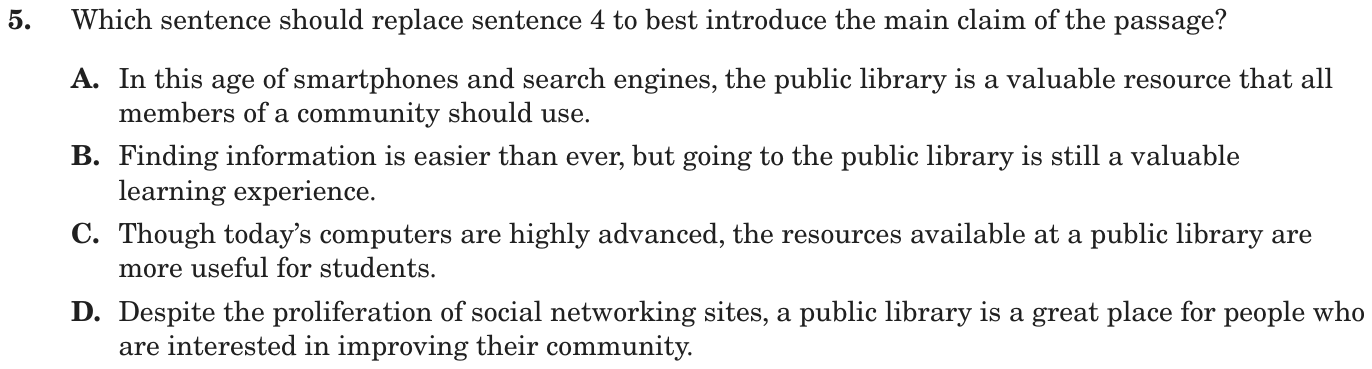
Which sentence should replace sentence 4 to best introduce the main claim of the passage?
- AIn this age of smartphones and search engines, the public library is a valuable resource that all members of a community should use.
- BFinding information is easier than ever, but going to the public library is still a valuable learning experience.
- CThough today’s computers are highly advanced, the resources available at a public library are more useful for students.
- DDespite the proliferation of social networking sites, a public library is a great place for people who are interested in improving their community.
Show the answer
Correct answer: A
The question asks for a sentence that should replace sentence 4 to introduce the main claim of the passage.
Option A is correct because it best presents the main claim that the public library is a valuable resource and should be used by community members.
Option B is incorrect because it states that going to the library can be a learning experience. This idea is implied in sentences 17 and 18, but it is not the main claim of the passage.
Option C is incorrect because it states the idea that the library is useful for students, which would be supporting evidence rather than an introductory statement expressing the main claim.
Option D is incorrect because it states that local libraries provide services to help improve communities, which is explained in sentences 15–18, but it does not present the main claim.
Question analysis
This introduction question uses a persuasive essay about public libraries that opens with statistics on smartphone ownership. Students choose a new fourth sentence that states the passage’s main claim. Every option contrasts technology with libraries, so the challenge is telling the overall argument apart from single supporting points.
- NYS standards
- 7W1a introducing claims and counterclaims
- Grade level
- Grade 7 reading and task
- Compared with grade 7
- At grade 7 Grade 7 writers learn to state a precise claim; here students must find the claim behind a whole five-paragraph essay and test each candidate opener against all of its reasons, not just one paragraph.
- Estimated difficulty
- Moderate: several steps, or a close reading with one strong distractor.
- Thinking it demands
- Depth of knowledge 2, skills and concepts · mainly evaluate
- What makes it hard
- Evidence in several places moderate
- A very close wrong answer moderate
- How sentences fit together minor
- Evidence
- Answered from the whole text
- Reading level
- Passage: about grade 11, 341 words; question and choices: about grade 12, 96 words.
- Students, last 30 days
- Not enough answers yet to show (it takes 10).
Why it is hard, traps and wrong answers (shows the answer)
Why it is hard
The risk here is settling for a true point from the essay instead of its overall claim. Every opener sets technology against the library, so the contrast itself decides nothing; what decides is whether the library is presented as a resource for the whole community or as a benefit to one group. Students who state the claim in their own words before reading the choices avoid the near-copy that narrows it to learning.
Evidence in several places moderate Working it out
The main claim is never stated in one place: it has to be pieced together from paragraphs on human connection, free Internet access, librarians and tutoring, and access for all, ending with “an important part of a community.” (Kirsch & Mosenthal, 1990; Gorin & Embretson, 2006)
A very close wrong answer moderate Choosing the answer
The learning-experience opener has the right one’s shape, a nod to technology and then “valuable,” and differs in one part of the claim: “a valuable learning experience” instead of “a valuable resource that all members of a community should use.” (Embretson & Wetzel, 1987; Gorin & Embretson, 2006; Ascalon et al., 2007)
How sentences fit together minor Working it out
Sentence 3 builds up to an unnamed “one of the best resources,” so the new sentence 4 must name the library as that resource and say why everyone should use it. (Halliday & Hasan, 1976)
Strategy: Before reading the choices, sum up in your own words what the essay wants readers to believe about the library, drawing on every paragraph, then find the opener that matches it.
Traps
- Too narrow: A single detail offered as the central idea or a summary, or a summary that keeps minor details and leaves out an essential part.
- Too broad or too strong: A choice overstates, generalizes, or uses absolute words the text does not support.
The wrong answers, classified
B Too narrow (King et al., 2004)
Echoes sentence 1’s “easier than ever” and sounds balanced, but reduces the claim to one benefit, learning, and drops the community and the free services the essay argues for.
C Too broad or too strong (King et al., 2004)
Builds on the student in sentence 10 and the essay’s technology contrast, but claims libraries beat computers, a ranking the essay never makes, since libraries offer the Internet.
D Too narrow (King et al., 2004)
Keeps the original sentence’s vague “great place for people” and narrows the audience to those improving their community, one point from paragraphs 2 and 4 rather than the claim.
Working it out, step by step
Figure out what the question asks
You need a new sentence 4. Sentence 4 ends the first paragraph, so it should state the main claim. A claim is the big point a writer tries to prove. Here it must fit the whole essay.
Sum up what the essay argues
Look at what each paragraph says about the library.
- Paragraph 2: it helps people meet the “need for human connection and companionship.”
- Paragraph 3: it offers things like “access to the Internet, for free to all people.”
- Paragraph 4: it offers librarians, tutoring, lectures and book groups.
- Paragraph 5: it is “an important part of a community.”
So the claim is this: the library is a valuable resource that everyone in the community should use.
See how sentence 4 must fit
Sentence 1 talks about smartphones. Sentence 3 says that “one of the best resources” is also “one of the oldest.” Sentence 4 should name that old resource, the library. It should also say why everyone should use it.
Check each choice
- A is right. It links back to the smartphones. It calls the library “a valuable resource that all members of a community should use.” That is the whole claim.
- B is wrong. It shrinks the claim to learning. It leaves out the free services and the human connection.
- C is wrong. It talks only about students. It also says the library beats computers, which the essay never says. The library even offers the Internet.
- D is wrong. It talks only about people who want to improve their community. It keeps the vague words “a great place.”
Watch out: B repeats “easier than ever” from sentence 1, so it sounds like it belongs. But it covers only one benefit.
Choose the answer
A names the library, calls it valuable and tells everyone to use it. So the answer is A.
Why this answer and not the closest wrong one
B is the closest wrong answer. It also starts with how easy it is to find information today, and it calls the library valuable. But it calls the library “a valuable learning experience.” The essay argues for much more than learning: free Internet, librarians, programs and a place to meet people. A covers all of that.
More questions like this
The original DOE question
The passage “The Local Library” as printed (page 120)