Also in 2024 Test B English, question 15; 2026 Practice Test D English, question 46.
Passage Moving through Mountains
Moving through Mountains
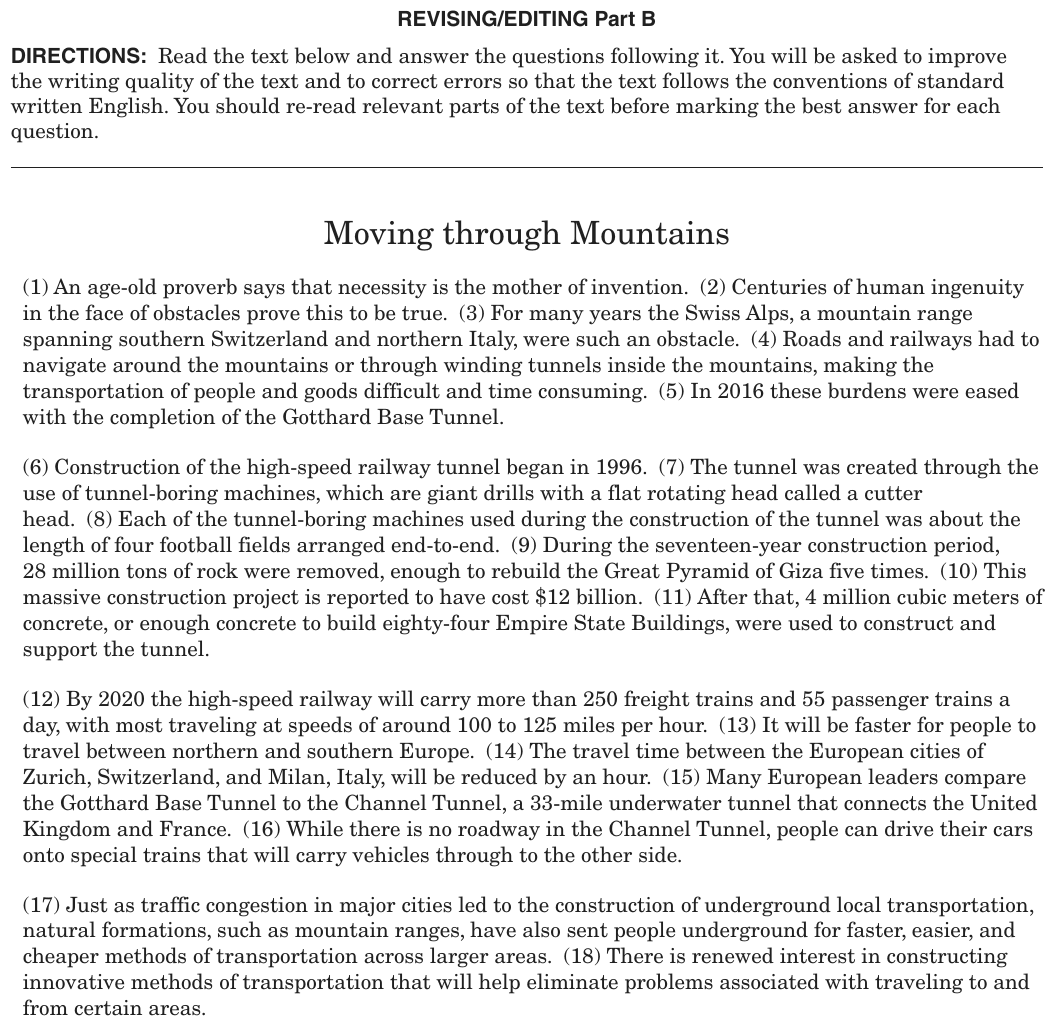
(1) An age-old proverb says that necessity is the mother of invention. (2) Centuries of human ingenuity in the face of obstacles prove this to be true. (3) For many years the Swiss Alps, a mountain range spanning southern Switzerland and northern Italy, were such an obstacle. (4) Roads and railways had to navigate around the mountains or through winding tunnels inside the mountains, making the transportation of people and goods difficult and time consuming. (5) In 2016 these burdens were eased with the completion of the Gotthard Base Tunnel.
(6) Construction of the high-speed railway tunnel began in 1996. (7) The tunnel was created through the use of tunnel-boring machines, which are giant drills with a flat rotating head called a cutter head. (8) Each of the tunnel-boring machines used during the construction of the tunnel was about the length of four football fields arranged end-to-end. (9) During the seventeen-year construction period, 28 million tons of rock were removed, enough to rebuild the Great Pyramid of Giza five times. (10) This massive construction project is reported to have cost $12 billion. (11) After that, 4 million cubic meters of concrete, or enough concrete to build eighty-four Empire State Buildings, were used to construct and support the tunnel.
(12) By 2020 the high-speed railway will carry more than 250 freight trains and 55 passenger trains a day, with most traveling at speeds of around 100 to 125 miles per hour. (13) It will be faster for people to travel between northern and southern Europe. (14) The travel time between the European cities of Zurich, Switzerland, and Milan, Italy, will be reduced by an hour. (15) Many European leaders compare the Gotthard Base Tunnel to the Channel Tunnel, a 33-mile underwater tunnel that connects the United Kingdom and France. (16) While there is no roadway in the Channel Tunnel, people can drive their cars onto special trains that will carry vehicles through to the other side.
(17) Just as traffic congestion in major cities led to the construction of underground local transportation, natural formations, such as mountain ranges, have also sent people underground for faster, easier, and cheaper methods of transportation across larger areas. (18) There is renewed interest in constructing innovative methods of transportation that will help eliminate problems associated with traveling to and from certain areas.
Question
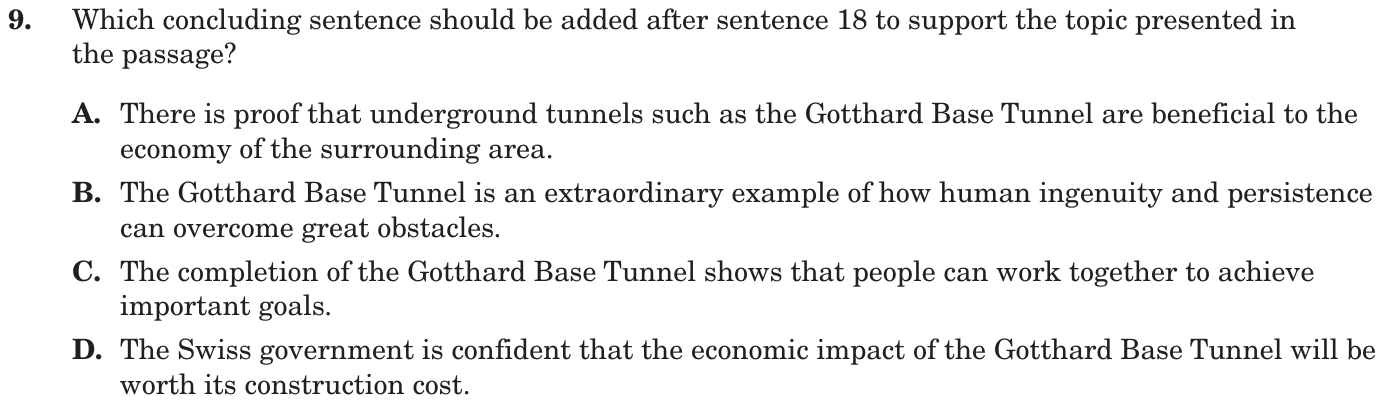
Which concluding sentence should be added after sentence 18 to support the topic presented in the passage?
- AThere is proof that underground tunnels such as the Gotthard Base Tunnel are beneficial to the economy of the surrounding area.
- BThe Gotthard Base Tunnel is an extraordinary example of how human ingenuity and persistence can overcome great obstacles.
- CThe completion of the Gotthard Base Tunnel shows that people can work together to achieve important goals.
- DThe Swiss government is confident that the economic impact of the Gotthard Base Tunnel will be worth its construction cost.
Show the answer
Correct answer: B
The answer is (B)
The question asks for a concluding sentence that supports key ideas about the topic developed earlier in the passage.
Option B is correct because it supports the points made in the introductory paragraph by affirming the idea that the Gotthard Base Tunnel is an example of a way people have improved life by overcoming obstacles.
Option A is incorrect because the economies of surrounding areas were never mentioned in the passage.
Option C is incorrect because, although the construction of the Gotthard Base Tunnel appears to have required many people to work together, the passage does not explicitly mention people or groups working together.
Option D is incorrect because it focuses on the cost of the Gotthard Base Tunnel, which is referred to only in sentence 10 of the passage.
Question analysis
This revising question asks which concluding sentence should end the passage about building the Gotthard Base Tunnel. Students must recognize the passage's overall point and choose a conclusion that sums it up, avoiding sentences that sound reasonable but add claims the passage never supports.
- NYS standards
- 7W2e concluding informative writing
- Grade level
- Grade 7 reading and task
- Compared with grade 7
- At grade 7 Picking a concluding sentence that reflects a passage's central idea is standard grade 7 writing work. Students must keep the whole short passage in mind and reject conclusions that bring in claims it never makes.
- Estimated difficulty
- Moderate: several steps, or a close reading with one strong distractor.
- Thinking it demands
- Depth of knowledge 2, skills and concepts · mainly evaluate
- What makes it hard
- Evidence in several places moderate
- A very close wrong answer moderate
- Evidence
- Answered from the whole text
- Reading level
- Passage: about grade 11, 362 words; question and choices: about grade 12, 92 words.
- Students, last 30 days
- Not enough answers yet to show (it takes 10).
Why it is hard, traps and wrong answers (shows the answer)
Why it is hard
The conclusion has to return to the idea the passage opened with, which sits at the far end of the text from where the new sentence goes. Students who have forgotten the proverb about necessity tend to choose by tone, and three choices sound like fitting final lessons or benefits. What the question rewards is matching the conclusion to the opening's own words, ingenuity and obstacles.
Evidence in several places moderate Working it out
The passage's point is set out in sentences 1 to 3, the proverb about necessity and “human ingenuity in the face of obstacles”, about fifteen sentences before the spot where the conclusion goes. (Kirsch & Mosenthal, 1990; Gorin & Embretson, 2006)
A very close wrong answer moderate Choosing the answer
The right conclusion and the teamwork one share a frame, the tunnel as proof of what people can do, and differ only in the lesson: ingenuity against obstacles, from sentences 1 to 3, or teamwork, which the passage never mentions. (Embretson & Wetzel, 1987; Gorin & Embretson, 2006; Ascalon et al., 2007)
Strategy: Say in one sentence what the whole passage is about, then choose the conclusion that restates that idea without adding claims the passage never makes.
Traps
- Off the point: Adds or keeps something that does not support the paragraph's or the passage's focus, or an introduction or conclusion that misses the main point.
- Too narrow: A single detail offered as the central idea or a summary, or a summary that keeps minor details and leaves out an essential part.
The wrong answers, classified
A Off the point (Halliday & Hasan, 1976)
Ends on a claim of “proof” that tunnels help local economies, a benefit that sounds right for a conclusion but that the passage never discusses.
C Off the point (Halliday & Hasan, 1976)
Sees that the ending should state a broad human lesson but picks teamwork, which the passage never raises, instead of the ingenuity against obstacles it opened with.
D Too narrow (King et al., 2004)
Seizes on the $12 billion cost, mentioned once in sentence 10, and adds a government opinion the passage never reports, narrowing the ending to one detail.
Working it out, step by step
Figure out what the question asks
You need a last sentence for the passage. A good conclusion sums up the main idea. It often goes back to the point made at the start. It should not add new claims that the passage never made.
Find the main idea at the start
Sentence 1 says: “An age-old proverb says that necessity is the mother of invention.” Sentence 2 says: “Centuries of human ingenuity in the face of obstacles prove this to be true.” Sentence 3 says the Swiss Alps “were such an obstacle.”
Put the main idea in plain words
A proverb is an old saying. Necessity is the mother of invention means that when people really need something, they find a clever way to get it. Ingenuity means cleverness. An obstacle is something in the way. So the passage says people use cleverness to get past what blocks them. The tunnel is the example.
Check each choice
- B says the tunnel shows “how human ingenuity and persistence can overcome great obstacles.” This repeats the opening idea. Persistence means not giving up.
- A is about the economy, meaning money and jobs, of nearby areas. The passage never discusses that.
- C is about people working together. The passage never mentions teamwork.
- D is about the cost and the government’s opinion. The cost comes up only once, in sentence 10.
Watch out: C sounds like a fine life lesson for an ending. But a conclusion must match this passage, and teamwork is not its point.
Pick the answer
Choice B restates the passage’s main idea without adding anything new. It ties the ending back to the beginning. So the answer is B.
Why this answer and not the closest wrong one
C is the closest wrong answer, because it also uses the tunnel to teach a lesson. But teamwork never comes up in the passage. B uses the passage’s own words, “human ingenuity” against “obstacles,” so it closes the passage the way it opened.
More questions like this
The original DOE question
The passage “Moving through Mountains” as printed (page 48)