Also in 2026 Practice Test A Math, question 20; 2025 Practice Test A Math, question 22.
Question
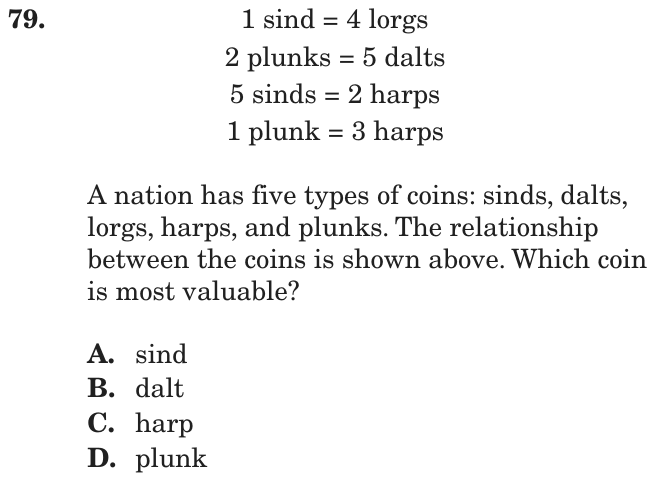
1 sind = 4 lorgs
2 plunks = 5 dalts
5 sinds = 2 harps
1 plunk = 3 harps
A nation has five types of coins: sinds, dalts, lorgs, harps, and plunks. The relationship between the coins is shown above. Which coin is most valuable?
- Asind
- Bdalt
- Charp
- Dplunk
Show the answer
Correct answer: D
1 sind = 4 lorgs,
so 1 sind > 1 lorg.
2 harps = 5 sinds,
so 1 harp > 1 sind.
1 plunk = 3 harps,
so 1 plunk > 1 harp,
meaning that 1 plunk > 1 sind and 1 lorg.
2 plunks = 5 dalts,
so 1 plunk > 1 dalt.
Therefore, the plunk is the most valuable.
Question analysis
This reasoning question invents a money system: four exchange rates link five made-up coins. Students compare the coins step by step to find which one is worth the most. The rates run in different directions, so it is easy to misjudge which side of an equation holds the more valuable coin.
- Grade level
- Grade 6 content, by NYS standard
- Compared with grade 7
- At grade 7 Grade 6 and 7 ratio work converts between two units at a time. Chaining four invented rates and comparing values with no common unit given is less familiar, though the arithmetic stays simple.
- Estimated difficulty
- Moderate: several steps, or a close reading with one strong distractor.
- Thinking it demands
- Depth of knowledge 2, skills and concepts · mainly analyze
- What makes it hard
- Turning words into math moderate
- Much to keep track of moderate
- No obvious method minor
- Solution
- 3 steps
- Reading level
- Question and choices: about grade 1, 38 words.
- Students, last 30 days
- Not enough answers yet to show (it takes 10).
Why it is hard, traps and wrong answers (shows the answer)
Why it is hard
There is little arithmetic, but the relationships have to be read the right way round and chained. Students who think a larger count means a more valuable coin rank the coins backward, and students who stop after one or two links pick a coin that beats only its neighbor. Writing each coin's worth in lorgs, 4 for a sind, 10 for a harp, 12 for a dalt and 30 for a plunk, makes the ranking plain.
Turning words into math moderate Understanding the question
In "2 plunks = 5 dalts" the coin with the larger count is worth less, the reverse of what the bigger number suggests, and the same holds in all four equations. (Hegarty, Mayer & Monk, 1995; Koedinger & Nathan, 2004)
Much to keep track of moderate Working it out
Five coins and four exchange rates have to be linked into one ranking; dalts connect only through plunks, and lorgs only through sinds. (Sweller, 1988; Carpenter, Just & Shell, 1990)
No obvious method minor Working it out
Nothing says how to compare coins that never appear in the same equation; converting every coin to lorgs, or chaining inequalities, has to be chosen. (Schoenfeld, 1985)
Strategy: Rewrite every coin in terms of lorgs, which only ever appear as the smaller unit, following the rates one link at a time, then compare.
Traps
- Equation written backwards: Writes a comparison the wrong way round, word for word: "six times as many students as professors" as 6S = P. The bigger quantity gets the bigger number.
- Stops one step early: A choice is a number from partway through the solution.
The wrong answers, classified
A Equation written backwards (Clement, Lochhead & Monk, 1981)
Reads every equation backward, giving more value to the coin with the larger count, so 5 sinds = 2 harps puts sinds above harps and 1 plunk = 3 harps puts harps above plunks.
B Equation written backwards (Clement, Lochhead & Monk, 1981)
Reads 2 plunks = 5 dalts backward, giving the bigger value to the coin with the bigger count, so the dalt seems to outrank the plunk.
C Stops one step early (King et al., 2004; Gierl et al., 2017)
Sees from 5 sinds = 2 harps that a harp beats a sind and stops, missing the last line, 1 plunk = 3 harps.
Worked solution, step by step
Formulas used
- Value of a group of coins
- V is what a group of coins is worth. n is the number of coins, and v is what one coin is worth. Here every value is counted in lorgs, the smallest coin. Using one unit for all the coins lets you compare them.
Sort out the question
There are five coins and four trading rules. You need the coin that is worth the most. Read each rule carefully. In 2 plunks = 5 dalts, it takes more dalts to match. So each dalt is worth less than a plunk. More coins on one side means each of those coins is worth less.
Pick one coin to measure with
Measure every coin in lorgs, the way you might measure every length in inches. The first rule says 1 sind = 4 lorgs. So one sind is worth 4 lorgs.
Find a harp’s value in lorgs
The rule 5 sinds = 2 harps links harps to sinds. First find what 5 sinds are worth.
So 2 harps are worth 20 lorgs, and 1 harp is worth half of that.
One harp is worth 10 lorgs.
Find a plunk’s value in lorgs
The rule 1 plunk = 3 harps says a plunk is worth 3 harps.
One plunk is worth 30 lorgs.
Find a dalt’s value in lorgs
The rule 2 plunks = 5 dalts links dalts to plunks. Two plunks are worth lorgs. So 5 dalts are worth 60 lorgs too.
One dalt is worth 12 lorgs.
Compare all five coins
Coin Value in lorgs lorg 1 sind 4 harp 10 dalt 12 plunk 30 Watch out: 5 dalts trade for only 2 plunks, so a dalt is worth less. Reading that rule backward leads to choice B. Watch out: the harp beats the sind, but the plunk beats the harp. Stopping early gives choice C. So the answer is D, plunk.
Check your answer
Test each rule with the lorg values. 2 plunks = 60 lorgs, and 5 dalts = 60 lorgs. 5 sinds = 20 lorgs, and 2 harps = 20 lorgs. 1 plunk = 30 lorgs, and 3 harps = 30 lorgs. Every rule balances.
More questions like this
The original DOE question