Also in 2025 Practice Test A Math, question 6.
Question
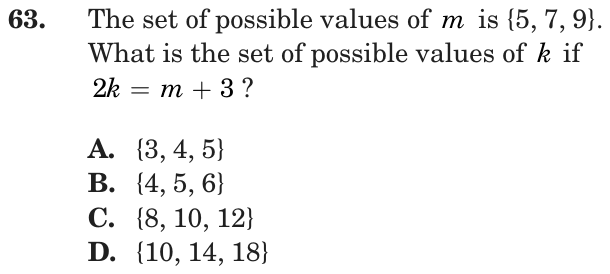
The set of possible values of is . What is the set of possible values of if ?
- A
- B
- C
- D
Show the answer
Correct answer: B
so
Substitute each value of m to find the values of k:
The set k is { 4, 5, 6}.
Question analysis
An algebra question about substitution: m can be 5, 7 or 9, and an equation links k to m. Students find every possible value of k by substituting each value of m and solving. The curly-brace set notation can look unfamiliar, and each value has to be carried all the way through the solve.
- Grade level
- Grade 6 content, by NYS standard
- Compared with grade 7
- At grade 7 Each substitution leads to a one-step grade 6 equation, easier than a typical grade 7 two-step problem. What adds demand is doing it three times and reading the answer as a set of values, which grade 7 rarely uses.
- Estimated difficulty
- Straightforward: two steps or one careful reading.
- Thinking it demands
- Depth of knowledge 1, recall and reproduction · mainly apply
- What makes it hard
- Solution
- 2 steps
- Reading level
- Question and choices: about grade 9, 24 words.
- Students, last 30 days
- Not enough answers yet to show (it takes 10).
Why it is hard, traps and wrong answers (shows the answer)
Why it is hard
The equation is simple, and the main hazard is stopping one step short: m + 3 gives 8, 10 and 12, a listed choice even though those are values of 2k. Checking a single value of m is the other risk, since k = 4 and k = 5 both appear in the first two sets. Students who substitute all three values and halve each result finish quickly.
Variables instead of numbers minor Understanding the question
There is no single unknown: m stands for the set {5, 7, 9}, and the answer is the matching set for k, so the equation has to be applied to three values. (Koedinger & Nathan, 2004; Enright, Morley & Sheehan, 2002)
Strategy: Rewrite the equation so k equals m plus 3, all divided by 2, then evaluate it for each of the three values of m.
Traps
- Stops one step early: A choice is a number from partway through the solution.
The wrong answers, classified
A Checks only one number (Schoenfeld, 1985)
Checks only m = 5, gets k = 4, and takes the first set containing 4; m = 9, giving k = 6, would rule it out.
C Stops one step early (King et al., 2004; Gierl et al., 2017)
Adds 3 to each value of m to get 8, 10 and 12, which are the values of 2k, and forgets to divide by 2.
D Wrong operation (Hegarty, Mayer & Monk, 1995; King et al., 2004)
Doubles each value of m to get 10, 14 and 18, moving the 2 onto m instead of dividing by it, and drops the + 3.
Worked solution, step by step
Formulas used
- Getting k by itself
- k and m are the letters from the equation 2k = m + 3. The fraction bar means divide. If 2 times k equals m + 3, then k is half of m + 3. You get this by dividing both sides of the equation by 2.
Sort out the question
The letter m can be 5, 7 or 9. The curly braces { } show a set, which is a list of numbers. The equation links k to m. You need every value k can have, one for each value of m.
Get k by itself
2k means 2 times k. To undo times 2, divide both sides by 2. Doing the same thing to both sides keeps the equation true.
Try each value of m
Put each value of m into the formula. Add 3 first, then divide by 2.
Watch out: 8, 10 and 12 are the values of m + 3, which equal 2k, not k. Stopping before you divide by 2 gives choice C.
Pick the matching set
The values of k are 4, 5 and 6. Watch out: try all three values of m. If you only try m = 5, you get k = 4, and choice A has a 4 too. So the answer is B, {4, 5, 6}.
Check your answer
Put each k back into the equation. . . . All three work, so the set is right.
More questions like this
The original DOE question