Also in 2026 Practice Test A Math, question 14; 2025 Practice Test A Math, question 15.
Question
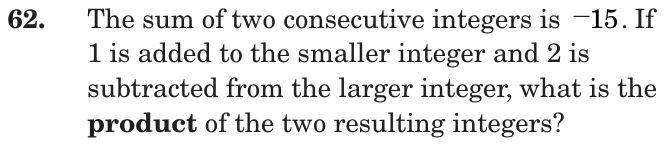
The sum of two consecutive integers is −15. If 1 is added to the smaller integer and 2 is subtracted from the larger integer, what is the product of the two resulting integers?
Grid-in question: work out the answer and enter it as a number.
Show the answer
Correct answer: 63
If x is the smaller consecutive integer, then
is the larger consecutive integer. Use their sum (−15) to find x:
The two consecutive integers are −8 and −7. One is added to the smaller integer:
and 2 is subtracted from the larger integer:
Find the product:
Question analysis
A grid-in problem about two consecutive integers whose sum is −15. Students find the two integers, add 1 to the smaller and subtract 2 from the larger, then multiply the results. Deciding which negative integer is the smaller one, and keeping signs straight through every step, are what make it tricky.
- Grade level
- Grade 7 content, by NYS standard
- Compared with grade 7
- Above grade 7 A typical grade 7 task solves one two-step equation or multiplies signed numbers. This links both: set up a consecutive-integer equation, solve it with negatives, adjust each integer, and multiply, with no choices to check against.
- Estimated difficulty
- Hard: combines ideas, needs a plan, and has more than one tempting wrong answer.
- Thinking it demands
- Depth of knowledge 2, skills and concepts · mainly apply
- What makes it hard
- Error-prone arithmetic moderate
- Turning words into math moderate
- Many steps moderate
- Solution
- 4 steps
- Reading level
- Question and choices: about grade 9, 30 words.
- Students, last 30 days
- Not enough answers yet to show (it takes 10).
Why it is hard, traps and wrong answers (shows the answer)
Why it is hard
Every step is routine, yet the question collects most of the ways students lose points with negatives. The crucial judgment is which of −8 and −7 is the smaller; a student who picks −7 still produces a tidy, wrong product. Gridding the product of the original pair, or giving a negative product, are the other usual losses. Writing each intermediate pair down, rather than holding them in mind, protects against all three.
Error-prone arithmetic moderate Working it out
Every number in play is negative: −8 and −7, then −7 and −9, and a product of two negatives that must come out positive. (Brown & Burton, 1978; Junker & Sijtsma, 2001)
Turning words into math moderate Understanding the question
"1 is added to the smaller integer and 2 is subtracted from the larger" depends on knowing that −8, not −7, is the smaller, since it lies farther below zero. (Hegarty, Mayer & Monk, 1995; Koedinger & Nathan, 2004)
Many steps moderate Working it out
Four linked steps: set up x + (x + 1) = −15, solve for x, adjust each integer, then multiply; an error early in the chain carries through to the product. (Daniel & Embretson, 2010; Enright, Morley & Sheehan, 2002)
Strategy: Halve the sum to see which two integers sit on either side of it, remember that the smaller negative is farther from zero, then adjust each and multiply.
Traps
- Negatives and direction: Arithmetic with negative numbers, the order of a subtraction, or direction on a number line. (Moving a term across the equals sign without changing its sign is a faulty procedure.)
- Misreads the question: Misses or misreads a condition or a word in the question: "at least", "each", "remaining", "not".
The wrong answers, classified
60 Negatives and direction (Brown & Burton, 1978)
Takes −7 as the smaller integer because 7 is less than 8, so adjusts to −7 + 1 = −6 and −8 − 2 = −10, and multiplies to 60.
56 Misreads the question (Hegarty, Mayer & Monk, 1995)
Finds −8 and −7 and multiplies them to get 56, skipping the sentence that adds 1 to one integer and subtracts 2 from the other.
-63 Negatives and direction (Brown & Burton, 1978)
Finds the adjusted integers −7 and −9 correctly but gives their product a negative sign, gridding −63.
Worked solution, step by step
Formulas used
- Consecutive integers
- Integers are whole numbers and their opposites, like −2, −1, 0, 1 and 2. Consecutive integers come one right after another. If n is the smaller one, the next one is n + 1, because each step up the number line adds 1.
- Multiplying two negative numbers
- a and b are positive numbers, so −a and −b are negative. When you multiply two negative numbers, the answer is positive. The two minus signs cancel out.
Sort out the question
Two consecutive integers add up to −15. Integers are whole numbers and their negatives. Consecutive means one comes right after the other, like 4 and 5. You need to do three things:
- Find the two integers.
- Add 1 to the smaller one. Subtract 2 from the larger one.
- Find the product of the two new numbers. The product is the answer when you multiply.
Find the two integers
Call the smaller integer n. Then the larger one is n + 1. Their sum is −15.
Subtract 1 from both sides. Then divide both sides by 2.
So the integers are −8 and −7.
Decide which one is smaller
On a number line, −8 is to the left of −7. Numbers to the left are smaller. So −8 is the smaller integer, and −7 is the larger one. Watch out: 8 is bigger than 7, but −8 is smaller than −7. Mixing them up gives −6 and −10, and the wrong answer 60.
Change each integer
Add 1 to the smaller integer.
Subtract 2 from the larger integer.
The two new numbers are −7 and −9.
Multiply the new numbers
Both numbers are negative, so their product is positive.
Watch out: the answer is not −63, because two negatives make a positive. Also, don’t multiply the first pair, −8 and −7. That gives 56 and skips the changes. So you would grid 63.
Check your answer
Check the pair: , and they are one apart. Half of −15 is −7.5, and −8 and −7 sit on either side of it. Then , and the sign is positive.
More questions like this
The original DOE question