Question
Read this paragraph.
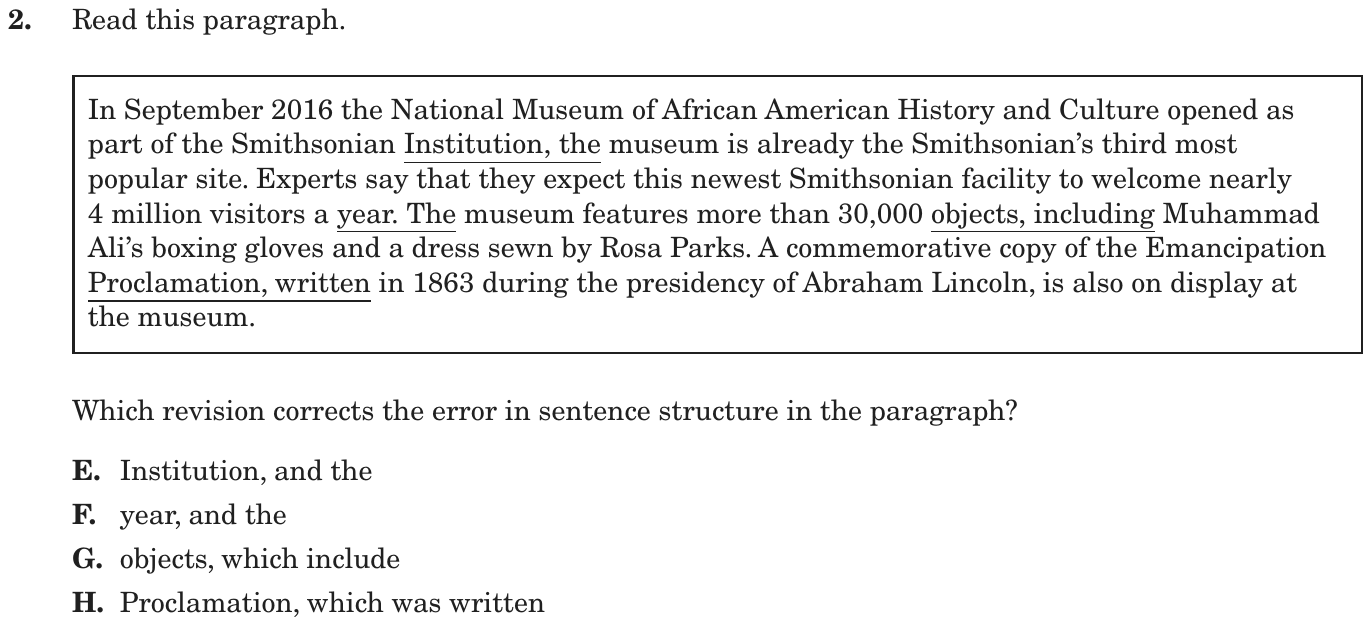
In September 2016 the National Museum of African American History and Culture opened as part of the Smithsonian Institution, the museum is already the Smithsonian’s third most popular site. Experts say that they expect this newest Smithsonian facility to welcome nearly 4 million visitors a year. The museum features more than 30,000 objects, including Muhammad Ali’s boxing gloves and a dress sewn by Rosa Parks. A commemorative copy of the Emancipation Proclamation, written in 1863 during the presidency of Abraham Lincoln, is also on display at the museum.
Which revision corrects the error in sentence structure in the paragraph?
- AInstitution, and the
- Byear, and the
- Cobjects, which include
- DProclamation, which was written
Show the answer
Correct answer: A
The question asks for the correction of an error in sentence structure in the paragraph.
The first sentence is a run-on sentence because both clauses—“In September 2016 the National Museum of African American History and Culture opened as part of the Smithsonian Institution” and “the museum is already the Smithsonian’s third most popular site”—are independent clauses, and independent clauses should not be combined without the use of a conjunction and a comma. The revision in Option A adds the word “and” after the comma, which corrects the run-on.
Option B, Option C, Option D are incorrect responses because the corresponding underlined portions in the paragraph are not structural errors. No edits are needed to correct those portions of the text.
Question analysis
This sentence-structure question gives a short paragraph about the opening of the National Museum of African American History and Culture. Students must find which of four spots holds a real error, such as a run-on, a fragment or a misplaced phrase, and pick the revision that fixes it. Long names stretch the sentences, and the spots that need no change can look just as suspicious.
- Grade level
- Grade 6 reading and task
- Compared with grade 7
- Below grade 7 Fixing run-ons and fragments is taught before grade 7, and here students check four short spots in one paragraph for a single structural error. Long institution names add reading load but no extra grammar.
- Estimated difficulty
- Straightforward: two steps or one careful reading.
- Thinking it demands
- Depth of knowledge 2, skills and concepts · mainly apply
- What makes it hard
- A rule that doesn't sound wrong moderate
- Complex sentences minor
- Every choice must be checked minor
- Evidence
- Answered from one paragraph or stanza
- Reading level
- Question and choices: about grade 10, 111 words.
- Corrected from the DOE handbook
- A misdescribed detail in the explanation was corrected.
- Students, last 30 days
- Not enough answers yet to show (it takes 10).
Why it is hard, traps and wrong answers (shows the answer)
Why it is hard
Students who miss this one usually look for the error in the wrong place: the phrases “including Muhammad Ali’s boxing gloves” and “written in 1863” look suspicious, while the real splice hides behind the long museum name. The question rewards checking each spot for a subject and verb on both sides of its punctuation. Two choices offer the same “, and the” fix, so knowing the fix is not enough without finding where it belongs.
A rule that doesn't sound wrong moderate Working it out
The error is a comma splice after “Institution,” where a comma alone joins two complete clauses, and a comma sounds like a natural pause when the sentence is read aloud. (Connors & Lunsford, 1988)
Complex sentences minor Understanding the question
The eight-word museum name stretches the first clause, so by the time “the museum is already” arrives, it reads like a continuation rather than a new subject and verb. (Abedi & Lord, 2001; Freedle & Kostin, 1993; Messick, 1989)
Every choice must be checked minor Choosing the answer
The four underlined spots fall in four different sentences, and each has to be tested for whether a complete sentence sits on both sides of its punctuation. (Embretson & Wetzel, 1987)
Strategy: Check each sentence for a subject and main verb and count its complete thoughts, then decide whether the spot each choice changes actually breaks a rule before picking a fix.
The wrong answers, classified
B Fixes what isn't broken (Connors & Lunsford, 1988)
Recognizes “, and the” as the usual run-on fix but applies it where a period already separates two complete, correctly punctuated sentences.
C Fixes what isn't broken (Connors & Lunsford, 1988)
Believes a phrase opening with “including” after a comma is a fragment, so turns it into a which-clause, though the phrase already attaches correctly to “objects.”
D Fixes what isn't broken (Connors & Lunsford, 1988)
Thinks “written in 1863” cannot describe the copy without “which was,” though the sentence already has its verb “is” and the phrase is correctly set off.
What was corrected from the DOE handbook, and why
- Explanation: The handbook says the correct revision “adds the word ‘and’ before the comma.” In “Institution, and the,” the word “and” comes after the comma, so the site now says “after the comma.”
Working it out, step by step
Figure out what the question asks
This question is about sentence structure, or how a sentence is built. One of the four underlined spots has a mistake. You need the change that fixes it.
Learn the run-on rule
A complete sentence has a subject (who or what it is about) and a verb (the action). It can stand alone. You cannot join two complete sentences with only a comma. That mistake is called a run-on.
Wrong: I was hungry, I ate an apple.
Fixed: I was hungry, and I ate an apple.
A period would also work: I was hungry. I ate an apple.Find the run-on
Look at the first sentence. The words before the comma can stand alone: “In September 2016 the National Museum of African American History and Culture opened as part of the Smithsonian Institution.” So can the words after it: “the museum is already the Smithsonian’s third most popular site.” Only a comma joins them. That is a run-on.
Check each choice
- A is right. “Institution, and the” adds the joining word “and” after the comma. That fixes the run-on.
- B is wrong. A period already splits those two sentences correctly.
- C is wrong. “Including Muhammad Ali’s boxing gloves” already describes the objects. It needs no change.
- D is wrong. “Written in 1863” already describes the copy. The sentence already has its verb, “is.”
Watch out: C and D are not bad sentences. But they change spots that were already correct, and the run-on stays.
Choose the answer
Now the first sentence says the museum opened, and it is already very popular. Those are two complete ideas, joined the right way. So the answer is A: Institution, and the.
Why this answer and not the closest wrong one
D is a tempting choice, because “which was written” also sounds fine. But a change that sounds fine is not a fix. The question asks you to correct the error. Only A changes the first sentence, where the run-on is.
More questions like this
The original DOE question