Passage An Early Warning
An Early Warning
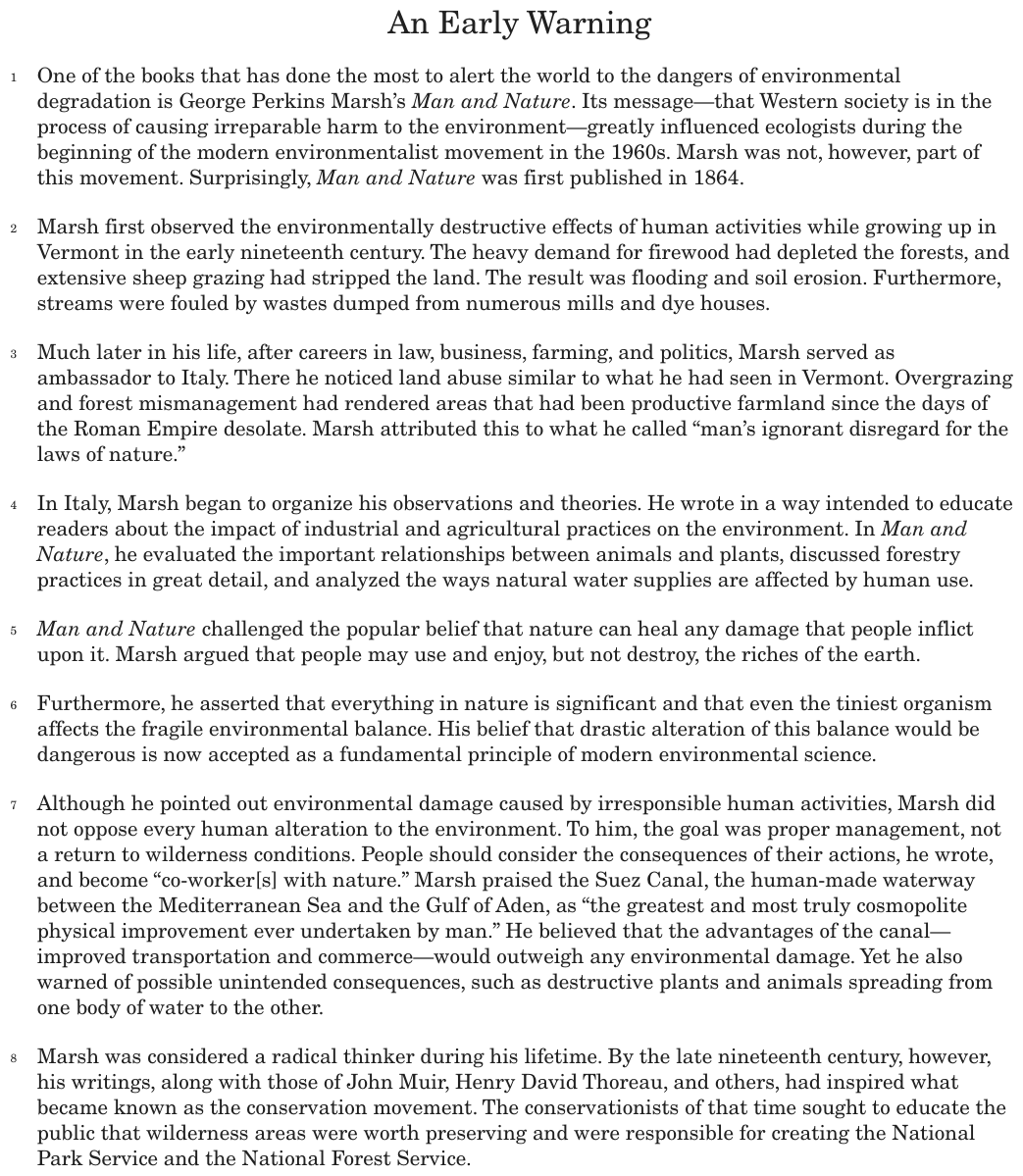
One of the books that has done the most to alert the world to the dangers of environmental degradation is George Perkins Marsh’s Man and Nature. Its message—that Western society is in the process of causing irreparable harm to the environment—greatly influenced ecologists during the beginning of the modern environmentalist movement in the 1960s. Marsh was not, however, part of this movement. Surprisingly, Man and Nature was first published in 1864.
Marsh first observed the environmentally destructive effects of human activities while growing up in Vermont in the early nineteenth century. The heavy demand for firewood had depleted the forests, and extensive sheep grazing had stripped the land. The result was flooding and soil erosion. Furthermore, streams were fouled by wastes dumped from numerous mills and dye houses.
Much later in his life, after careers in law, business, farming, and politics, Marsh served as ambassador to Italy. There he noticed land abuse similar to what he had seen in Vermont. Overgrazing and forest mismanagement had rendered areas that had been productive farmland since the days of the Roman Empire desolate. Marsh attributed this to what he called “man’s ignorant disregard for the laws of nature.”
In Italy, Marsh began to organize his observations and theories. He wrote in a way intended to educate readers about the impact of industrial and agricultural practices on the environment. In Man and Nature, he evaluated the important relationships between animals and plants, discussed forestry practices in great detail, and analyzed the ways natural water supplies are affected by human use.
Man and Nature challenged the popular belief that nature can heal any damage that people inflict upon it. Marsh argued that people may use and enjoy, but not destroy, the riches of the earth.
Furthermore, he asserted that everything in nature is significant and that even the tiniest organism affects the fragile environmental balance. His belief that drastic alteration of this balance would be dangerous is now accepted as a fundamental principle of modern environmental science.
Although he pointed out environmental damage caused by irresponsible human activities, Marsh did not oppose every human alteration to the environment. To him, the goal was proper management, not a return to wilderness conditions. People should consider the consequences of their actions, he wrote, and become “co-worker[s] with nature.” Marsh praised the Suez Canal, the human-made waterway between the Mediterranean Sea and the Gulf of Aden, as “the greatest and most truly cosmopolite physical improvement ever undertaken by man.” He believed that the advantages of the canal— improved transportation and commerce—would outweigh any environmental damage. Yet he also warned of possible unintended consequences, such as destructive plants and animals spreading from one body of water to the other.
Marsh was considered a radical thinker during his lifetime. By the late nineteenth century, however, his writings, along with those of John Muir, Henry David Thoreau, and others, had inspired what became known as the conservation movement. The conservationists of that time sought to educate the public that wilderness areas were worth preserving and were responsible for creating the National Park Service and the National Forest Service.
Question
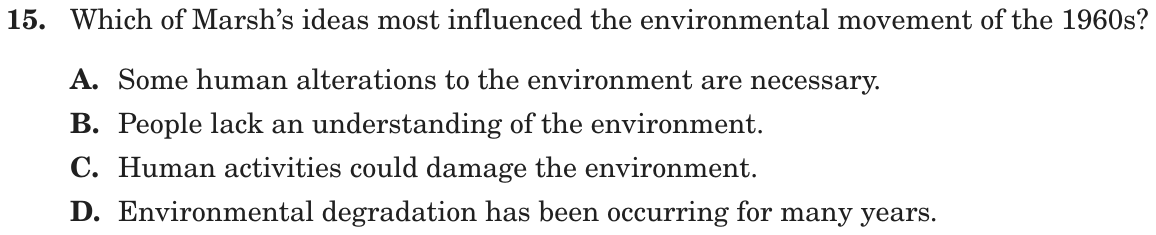
Which of Marsh’s ideas most influenced the environmental movement of the 1960s?
- ASome human alterations to the environment are necessary.
- BPeople lack an understanding of the environment.
- CHuman activities could damage the environment.
- DEnvironmental degradation has been occurring for many years.
Show the answer
Correct answer: C
The answer is (C)
The question asks for the idea Marsh had that was the most influential on the movement in the 1960s. Marsh’s main contribution to the modern environmental movement—the idea that Western society is causing irreversible harm to the environment—is given in paragraph 1, making Option C correct.
Option A is incorrect because, while Marsh did believe that some human alterations to the environment are necessary (paragraph 7), the negative impact of human activity was his most influential idea.
Option B is incorrect because, while Marsh believed that people lacked an understanding of nature (paragraph 3), this belief is a detail in support of his overall claim.
Option D is incorrect because, while Marsh observed firsthand that environmental degradation had been occurring for many years (paragraph 3), that was not the focus of his most influential idea.
Question analysis
This reading question asks which of George Perkins Marsh's ideas most influenced the environmental movement of the 1960s, according to a passage about his book Man and Nature. All four choices are ideas the passage connects to Marsh, so students must find the one the text links to that later movement.
- Grade level
- Grade 7 reading and task
- Compared with grade 7
- At grade 7 Identifying an idea that a text says shaped later events is routine grade 7 reading. Each choice is one of Marsh's real ideas, so the demand is matching the question to the passage's exact statement, not interpretation.
- Estimated difficulty
- Straightforward: two steps or one careful reading.
- Thinking it demands
- Depth of knowledge 1, recall and reproduction · mainly understand
- What makes it hard
- The right answer is reworded moderate
- Every choice must be checked minor
- Evidence
- Answered from one paragraph or stanza
- Reading level
- Passage: about grade 12, 523 words; question and choices: about grade 12, 41 words.
- Students, last 30 days
- Not enough answers yet to show (it takes 10).
Why it is hard, traps and wrong answers (shows the answer)
Why it is hard
The link to the 1960s is stated outright in the second sentence of the passage, so a student who goes back to it can answer quickly. Points are lost by answering from memory, since every choice is a genuine Marsh idea, including his view that people misunderstand nature. Matching the paraphrase rather than the familiar wording is the whole task.
The right answer is reworded moderate Choosing the answer
The right choice restates paragraph 1's message, “causing irreparable harm to the environment”, in plain words, while wrong ones echo “environmental degradation” and “human alteration to the environment”. (Freedle & Kostin, 1993; Kirsch & Mosenthal, 1990)
Every choice must be checked minor Choosing the answer
All four choices are ideas the passage connects to Marsh, so recognizing one as his is not enough; each must be checked for a link to the 1960s. (Embretson & Wetzel, 1987)
Strategy: Find where the passage mentions the movement of the 1960s and read exactly what it says influenced it, then match that wording to a choice.
Traps
- True but not the answer: A choice says something accurate about the text that does not answer this question.
- Word match: Repeats striking words or phrases from the text, so it looks supported, but its meaning does not fit the question.
The wrong answers, classified
A True but not the answer (King et al., 2004; Embretson & Wetzel, 1987)
Recalls paragraph 7's point that Marsh accepted some changes to nature, such as the Suez Canal, a real view of his but not the message credited with shaping the 1960s.
B True but not the answer (King et al., 2004; Embretson & Wetzel, 1987)
Remembers Marsh blaming “man's ignorant disregard for the laws of nature”, a real belief, but the passage ties the 1960s to his warning about harm, not to ignorance.
D Word match (Freedle & Kostin, 1993)
Repeats “environmental degradation” from the passage's first sentence, so it looks anchored in paragraph 1, but long-standing damage is an observation, not the message that influenced ecologists.
Working it out, step by step
Figure out what the question asks
All four choices are ideas linked to Marsh. You need the one the passage says shaped the environmental movement of the 1960s. So find where the passage talks about the 1960s.
Find the 1960s in the passage
Paragraph 1 says: “Its message—that Western society is in the process of causing irreparable harm to the environment—greatly influenced ecologists during the beginning of the modern environmentalist movement in the 1960s.”
Put the sentence in plain words
“Its message” means the book’s main point. Irreparable means it can’t be repaired. Western society means the countries of Europe and North America. So the message was: people are doing damage to nature that can’t be undone. That message is what influenced the 1960s ecologists.
Check each choice
- C: “Human activities could damage the environment.” This says the same thing in simpler words.
- A: Marsh did accept some changes, like the Suez Canal (paragraph 7). But the passage doesn’t link that to the 1960s.
- B: Marsh did blame “man’s ignorant disregard for the laws of nature” (paragraph 3). But that is a reason for the harm, not the message that shaped the 1960s.
- D: “environmental degradation,” or damage, appears in paragraph 1. But saying damage has gone on for years is only an observation.
Watch out: B is a real belief of Marsh’s, so it feels right. Make sure a choice answers this question, about the 1960s.
Pick the answer
The passage directly says the message about harm influenced the 1960s. So the answer is C.
Why this answer and not the closest wrong one
B is the closest wrong answer, because Marsh really did think people didn’t understand nature. But paragraph 1 says the message that influenced the 1960s was about harm: people were “causing irreparable harm to the environment.” C states that idea.
More questions like this
The original DOE question
The passage “An Early Warning” as printed (page 52)