Passage Excerpt from A Tramp Abroad
Excerpt from A Tramp Abroad
by Mark Twain
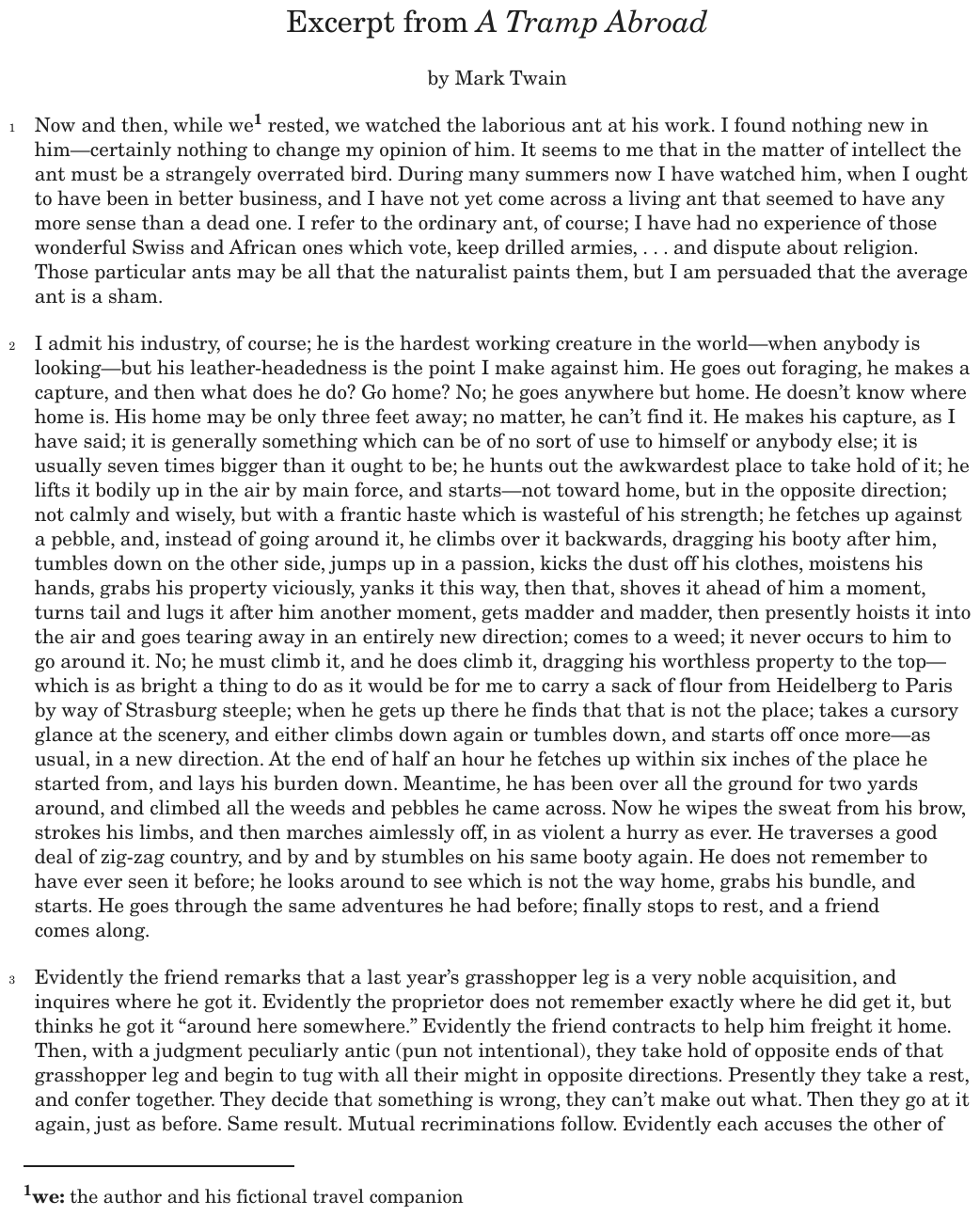
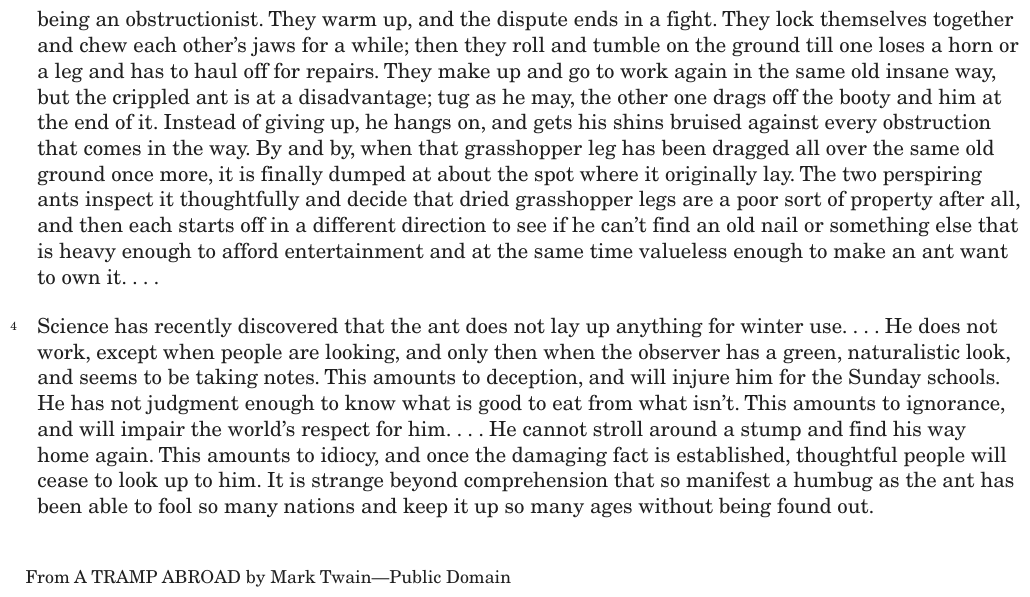
Now and then, while we rested, we watched the laborious ant at his work. I found nothing new in him—certainly nothing to change my opinion of him. It seems to me that in the matter of intellect the ant must be a strangely overrated bird. During many summers now I have watched him, when I ought to have been in better business, and I have not yet come across a living ant that seemed to have any more sense than a dead one. I refer to the ordinary ant, of course; I have had no experience of those wonderful Swiss and African ones which vote, keep drilled armies, . . . and dispute about religion. Those particular ants may be all that the naturalist paints them, but I am persuaded that the average ant is a sham.
I admit his industry, of course; he is the hardest working creature in the world—when anybody is looking—but his leather-headedness is the point I make against him. He goes out foraging, he makes a capture, and then what does he do? Go home? No; he goes anywhere but home. He doesn’t know where home is. His home may be only three feet away; no matter, he can’t find it. He makes his capture, as I have said; it is generally something which can be of no sort of use to himself or anybody else; it is usually seven times bigger than it ought to be; he hunts out the awkwardest place to take hold of it; he lifts it bodily up in the air by main force, and starts—not toward home, but in the opposite direction; not calmly and wisely, but with a frantic haste which is wasteful of his strength; he fetches up against a pebble, and, instead of going around it, he climbs over it backwards, dragging his booty after him, tumbles down on the other side, jumps up in a passion, kicks the dust off his clothes, moistens his hands, grabs his property viciously, yanks it this way, then that, shoves it ahead of him a moment, turns tail and lugs it after him another moment, gets madder and madder, then presently hoists it into the air and goes tearing away in an entirely new direction; comes to a weed; it never occurs to him to go around it. No; he must climb it, and he does climb it, dragging his worthless property to the top—which is as bright a thing to do as it would be for me to carry a sack of flour from Heidelberg to Paris by way of Strasburg steeple; when he gets up there he finds that that is not the place; takes a cursory glance at the scenery, and either climbs down again or tumbles down, and starts off once more—as usual, in a new direction. At the end of half an hour he fetches up within six inches of the place he started from, and lays his burden down. Meantime, he has been over all the ground for two yards around, and climbed all the weeds and pebbles he came across. Now he wipes the sweat from his brow, strokes his limbs, and then marches aimlessly off, in as violent a hurry as ever. He traverses a good deal of zig-zag country, and by and by stumbles on his same booty again. He does not remember to have ever seen it before; he looks around to see which is not the way home, grabs his bundle, and starts. He goes through the same adventures he had before; finally stops to rest, and a friend comes along.
Evidently the friend remarks that a last year’s grasshopper leg is a very noble acquisition, and inquires where he got it. Evidently the proprietor does not remember exactly where he did get it, but thinks he got it “around here somewhere.” Evidently the friend contracts to help him freight it home. Then, with a judgment peculiarly antic (pun not intentional), they take hold of opposite ends of that grasshopper leg and begin to tug with all their might in opposite directions. Presently they take a rest, and confer together. They decide that something is wrong, they can’t make out what. Then they go at it again, just as before. Same result. Mutual recriminations follow. Evidently each accuses the other of being an obstructionist. They warm up, and the dispute ends in a fight. They lock themselves together and chew each other’s jaws for a while; then they roll and tumble on the ground till one loses a horn or a leg and has to haul off for repairs. They make up and go to work again in the same old insane way, but the crippled ant is at a disadvantage; tug as he may, the other one drags off the booty and him at the end of it. Instead of giving up, he hangs on, and gets his shins bruised against every obstruction that comes in the way. By and by, when that grasshopper leg has been dragged all over the same old ground once more, it is finally dumped at about the spot where it originally lay. The two perspiring ants inspect it thoughtfully and decide that dried grasshopper legs are a poor sort of property after all, and then each starts off in a different direction to see if he can’t find an old nail or something else that is heavy enough to afford entertainment and at the same time valueless enough to make an ant want to own it. . . .
Science has recently discovered that the ant does not lay up anything for winter use. . . . He does not work, except when people are looking, and only then when the observer has a green, naturalistic look, and seems to be taking notes. This amounts to deception, and will injure him for the Sunday schools. He has not judgment enough to know what is good to eat from what isn’t. This amounts to ignorance, and will impair the world’s respect for him. . . . He cannot stroll around a stump and find his way home again. This amounts to idiocy, and once the damaging fact is established, thoughtful people will cease to look up to him. It is strange beyond comprehension that so manifest a humbug as the ant has been able to fool so many nations and keep it up so many ages without being found out.
we: the author and his fictional travel companion
From A TRAMP ABROAD by Mark Twain—Public Domain
Question
Read this sentence from paragraph 3.
The two perspiring ants inspect it thoughtfully and decide that dried grasshopper legs are a poor sort of property after all, and then each starts off in a different direction to see if he can’t find an old nail or something else that is heavy enough to afford entertainment and at the same time valueless enough to make an ant want to own it.
How does the word choice in the sentence contribute to the overall meaning of the excerpt?
- AIt creates a humorous critique of the ants’ intense attitude toward their pointless work.
- BIt illustrates the ants’ confusion over their lack of positive results compared with their level of effort.
- CIt highlights the ants’ frustration as they repeatedly chose a difficult task over one that could be accomplished more easily.
- DIt illustrates the ants’ stubborn determination to hold on to the worthless object.
Show the answer
Correct answer: A
The answer is (A)
The question asks for an explanation of how the word choice in the sentence adds to the meaning of the excerpt. The image the author creates of two sweating ants abandoning the grasshopper leg to look for “an old nail,” which an ant would want because it is “valueless,” is comical, as suggested in Option A.
Option B is incorrect because it is a misinterpretation of the excerpt, as the ants are not confused but are acting decisively (paragraph 3: “Then they go at it again, just as before”).
Option C is incorrect because the ants find moving heavy objects to be an amusing way to spend their time and are not aware enough to feel frustrated (paragraph 3: “something else that is heavy enough to afford entertainment and at the same time valueless enough to make an ant want to own it”).
Option D is incorrect because the ants are willingly giving up on their object (paragraph 3: “decide that dried grasshopper legs are a poor sort of property after all”).
Question analysis
This question asks how Mark Twain's word choice in one long sentence, where two sweating ants give up on a grasshopper leg and go looking for something else to carry, shapes the excerpt's meaning. Students must judge the tone of words such as “thoughtfully,” “entertainment” and “valueless” and relate it to the excerpt as a whole.
- Grade level
- Grade 7 reading and task
- Compared with grade 7
- At grade 7 Grade 7 students regularly judge how word choice shapes tone, so the skill is familiar. What adds demand is one very long sentence whose effect depends on reading its adjectives against the situation they describe.
- Estimated difficulty
- Moderate: several steps, or a close reading with one strong distractor.
- Thinking it demands
- Depth of knowledge 2, skills and concepts · mainly analyze
- What makes it hard
- Figurative or literary language major
- Complex sentences moderate
- Evidence
- Answered from one sentence or line
- Reading level
- Passage: about grade 9, 1099 words; question and choices: about grade 11, 149 words.
- Students, last 30 days
- Not enough answers yet to show (it takes 10).
Why it is hard, traps and wrong answers (shows the answer)
Why it is hard
The sentence comes after a brawl, so readers expect frustration or confusion, and two wrong choices supply exactly those moods from earlier in paragraph 3. Here, though, the ants are calm and deliberate, and the joke is that their calm reasoning picks the heaviest, most worthless thing to haul. Students who judge the words of this sentence, not the paragraph's general mood, see that it mocks the ants' earnest attitude toward pointless work.
Figurative or literary language major Understanding the question
The humor is ironic logic: the ants inspect “thoughtfully,” then seek something “heavy enough to afford entertainment” and “valueless enough” to own, praising the very qualities that make their work pointless. (Graesser, Singer & Trabasso, 1994; Kintsch, 1998)
Complex sentences moderate Understanding the question
The effect builds across one 67-word sentence whose key phrases come at the very end, after a chain of clauses about inspecting, deciding and setting off. (Abedi & Lord, 2001; Freedle & Kostin, 1993; Messick, 1989)
Strategy: Underline the words that describe the ants' thinking and goals, decide what effect they have in this sentence, and then compare that effect with each choice.
Traps
- Half right: One half of a two-part choice is right and the other is not.
- Wrong part of the text: A choice is true of another paragraph, stanza or speaker than the one asked about.
The wrong answers, classified
B Wrong part of the text (Kirsch & Mosenthal, 1990)
Carries over “they can't make out what” from earlier in the paragraph, but in this sentence the ants inspect the leg thoughtfully and decide calmly.
C Half right (King et al., 2004; Thissen, Steinberg & Fitzpatrick, 1989)
Correctly sees the ants choosing heavy loads, but the frustration belongs to the earlier fight; here they want heavy things “to afford entertainment,” not out of anger.
D Wrong part of the text (Kirsch & Mosenthal, 1990)
Recalls the crippled ant who “hangs on” earlier in the paragraph, missing that here both ants drop the leg as “a poor sort of property.”
Working it out, step by step
Figure out what the question asks
This is a word-choice question. It asks how the words in one sentence add to the meaning of the excerpt. Pay attention to the tone, which is the feeling the words give.
Find the key words
The sentence ends paragraph 3. First the ants “inspect it thoughtfully.” Then each one looks for “an old nail or something else that is heavy enough to afford entertainment and at the same time valueless enough to make an ant want to own it.”
Work out the joke
“Afford entertainment” means give them fun. “Valueless” means worth nothing. Twain makes the ants sound careful and wise. Then they decide to look for something heavy and worthless.
That is the joke. The very things that make their work pointless are what they want most. Twain is making fun of how seriously the ants take their silly work.
Check each choice
- A fits. The words make a funny critique (a judgment) of the ants’ serious attitude toward pointless work.
- B In this sentence the ants are not confused. They think it over and decide calmly.
- C They do pick heavy things, but for fun, not out of frustration.
- D They give the leg up. They decide it is “a poor sort of property after all.”
Choose the answer
The sentence pokes fun at how hard the ants work at nothing. So the answer is A.
Why this answer and not the closest wrong one
C is the closest trap, since the ants really do choose heavy loads. But the anger came earlier in the paragraph, during the fight. In this sentence the ants are calm. They want something heavy to have fun with. Fun, not frustration, is the point, and Twain makes it funny. That matches A.
More questions like this
The original DOE question
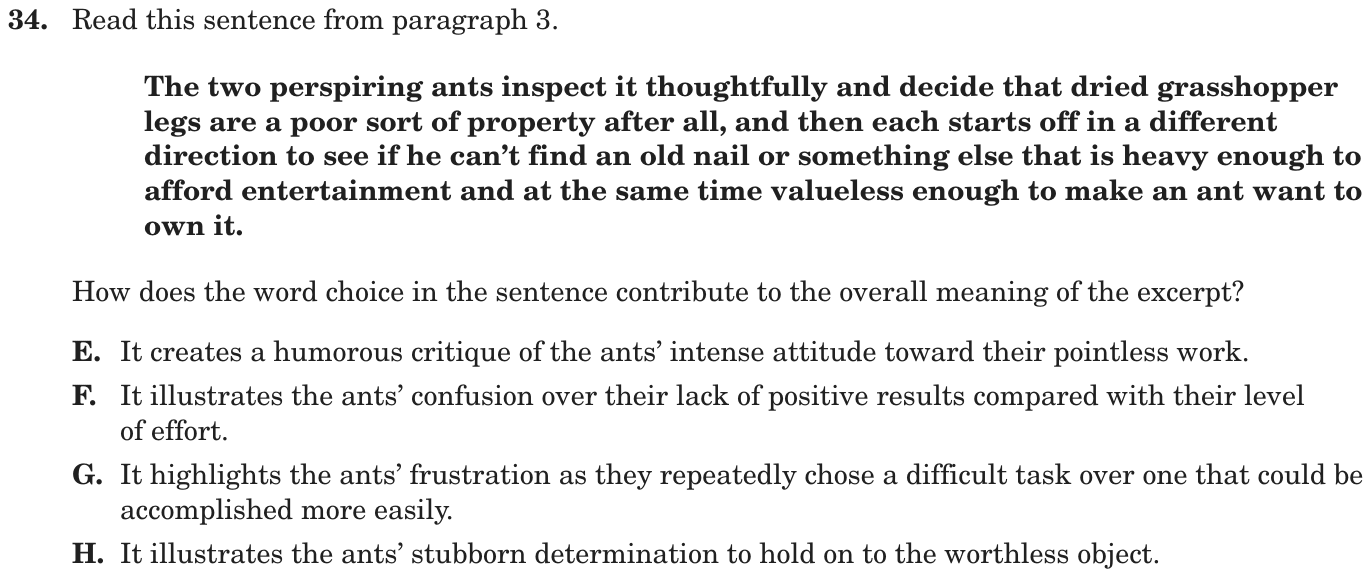
The passage “Excerpt from A Tramp Abroad” as printed (pages 62–63)