7.EE expressions, equations, and inequalities
Question 1 of 107
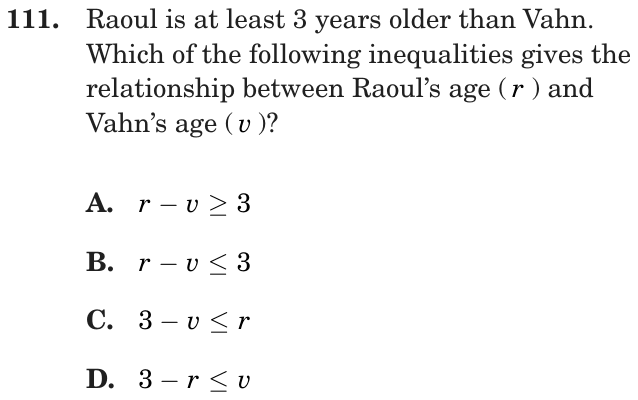
2026 Practice Test A Math, question 8Question
Liam and Kevin each collect stamps. Liam has twice as many stamps as Kevin. Liam gives 8 of his stamps to Kevin. Liam now has 12 more stamps than Kevin.
How many stamps did Liam start with?
Select the correct answer from each drop-down to complete the sentences.
An equation that relates the number of stamps originally in Liam’s and Kevin’s collections is .
After Liam gives 8 stamps to Kevin, the equation becomes .
By solving the equation, it can be determined that Liam started with stamps.
Choose an answer from each menu, then check. The DOE has not published how answers with several parts are scored; this site counts one right only when every part is right.
Show the answer
Correct answer: blank 1: 2; blank 2: K + 20; blank 3: 56
Liam originally has twice as many stamps as Kevin, so the equation is .
After Liam gives 8 stamps to Kevin, the equation becomes , which simplifies to .
Substitute into the equation: .
Solve for K:
Substitute to find L: .
So, Liam started with 56 stamps.
Question analysis
This word problem about two stamp collections is answered with three drop-down menus: an equation for the starting counts, an equation for after Liam gives Kevin 8 stamps, and the number Liam started with. Students turn "twice as many" and "12 more" into algebra and solve. Tracking both boys' counts before and after the gift is the tricky part, and every menu must be right.
- Grade level
- Grade 8 content, by NYS standard
- Compared with grade 7
- Above grade 7 Grade 7 students solve one equation in one unknown. The menus lay out the equations, but the problem still ties two unknowns together before and after a gift, a grade 8 system, and all three menus must be right.
- Estimated difficulty
- Moderate: several steps, or a close reading with one strong distractor.
- Thinking it demands
- Depth of knowledge 2, skills and concepts · mainly apply
- What makes it hard
- Turning words into math moderate
- Much to keep track of moderate
- Solution
- 4 steps
- Reading level
- Question and choices: about grade 5, 86 words.
- Students, last 30 days
- Not enough answers yet to show (it takes 10).
Why it is hard, traps and wrong answers (shows the answer)
Why it is hard
The menus do much of the setting up, since each sentence already shows the shape of its equation. The second menu is the hard one: the 8 stamps leave Liam and join Kevin before the gap of 12 is measured. Solving gives Kevin's 28 first, and K + 20 then equals 48, Liam's count after the gift, which waits on the last menu beside his starting 56. Testing each starting count against the story is a quick check on the last menu.
Turning words into math moderate Understanding the question
The gift changes both counts, so "Liam now has 12 more stamps than Kevin" compares Liam's L − 8 with Kevin's K + 8, and the second menu's K + 20 holds a 20 that appears nowhere in the stem. (Hegarty, Mayer & Monk, 1995; Koedinger & Nathan, 2004)
Much to keep track of moderate Working it out
Each boy has a count before and after the gift, four numbers in all, and all three menus must be right; the last asks for Liam's start, not the 48 he has after giving 8 away. (Sweller, 1988; Carpenter, Just & Shell, 1990)
Strategy: Let K be Kevin's starting count, write each boy's count after the gift in terms of K, and set Liam's 12 above Kevin's; testing each number in the last menu is a fast check.
Traps
- Answers a different question: A choice is right for another quantity: the other unknown, the rest instead of the part, the part instead of the whole.
- Follows a key word: Picks the operation from a single word rather than the situation: "removed" so subtract, "of" so multiply, "more" so add, when the situation needs something else.
- Equation written backwards: Writes a comparison the wrong way round, word for word: "six times as many students as professors" as 6S = P. The bigger quantity gets the bigger number.
The wrong answers, classified
BCB Answers a different question (King et al., 2004; Hegarty, Mayer & Monk, 1995)
Sets up both equations and solves for Kevin's 28, then takes the value of K + 20, 48, which is Liam's count after the gift, not at the start.
BBC Follows a key word (Hegarty, Mayer & Monk, 1995)
Follows the words "12 more" to L + 12, adding 12 to Liam's own count instead of Kevin's, then finds 56 by testing the three counts against the story.
ACC Equation written backwards (Clement, Lochhead & Monk, 1981)
Writes "twice as many stamps as Kevin" backwards, as 2L = K, and picks 0.5, giving Liam half of Kevin's stamps, while the other two menus are right.
Worked solution, step by step
Formulas used
- Twice as many as
- L is the number of stamps Liam starts with, and K is the number Kevin starts with. Twice as many means 2 times as many, so Liam’s count is 2 times Kevin’s. Because L and 2K are equal, you can put 2K in place of L in any equation.
- Doing the same to both sides
- a and b are the two sides of an equation, and c is any number or term. An equation is like a balanced scale. Add the same thing to both sides, or take the same thing away from both, and the scale stays level. This is how you move a term to the other side.
Sort out the question
Let L be Liam’s stamps at the start and K be Kevin’s. You know three facts:
- Liam has twice as many stamps as Kevin.
- Liam gives 8 of his stamps to Kevin.
- After that, Liam has 12 more stamps than Kevin.
The first menu finishes the starting equation. The second finishes the equation after the gift. The third is Liam’s count at the start.
Fill in the first menu
Twice as many means 2 times as many. Liam has twice as many as Kevin, so:
Pick 2 in the first menu.
Watch out: the 0.5 in the menu turns the fact around. would give Liam half as many as Kevin. Liam has more, so his count must be the bigger one.
Write both counts after the gift
The gift changes both counts. Liam loses 8 stamps, and Kevin gains those same 8.
- Liam now has stamps.
- Kevin now has stamps.
Liam has 12 more than Kevin. So Liam’s count equals Kevin’s count plus 12:
Pick K + 20 in the second menu.
Watch out: the 12 goes on Kevin’s count, not Liam’s. Picking L + 12 adds it to the wrong boy.
Solve for K
Now use the first equation. Since , put 2K in place of L:
Subtract K from both sides. Then add 8 to both sides. Each move keeps the scale level.
Kevin started with 28 stamps.
Find Liam’s starting count
Liam started with twice as many as Kevin:
Liam started with 56 stamps.
Watch out: is Liam’s count after the gift. The menu offers 48, but the question asks about the start.
So the menus read 2, K + 20 and 56.
Check your answer
At the start, Liam has 56 stamps and Kevin has 28, and 56 is twice 28. After the gift, Liam has 48 and Kevin has 36. , so Liam has 12 more. Every fact fits.
More questions like this
The original DOE question
Question 2 of 107
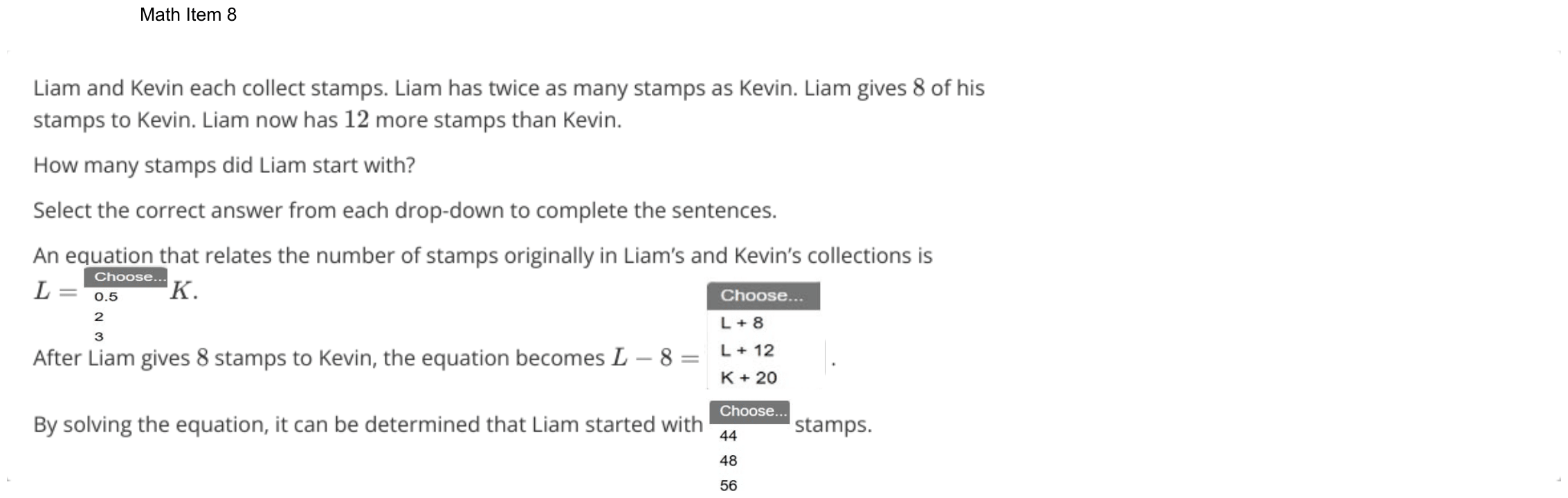
2026 Practice Test A Math, question 10Question
Three expressions are given:
Which of these are equivalent to the sum of these three expressions?
Select the two correct answers.
Choose every answer that is correct, then check. The DOE has not published how answers with several parts are scored; this site counts one right only when every part is right.
- A
- B
- C
- D
- E18
- F34
Show the answer
Correct answer: A and E
Add the three expressions: .
Distribute 3 and −2: .
Combine the variable terms and combine the constants: .
Question analysis
This algebra question gives three expressions, one with a decimal coefficient and a negative factor, and asks which two of six choices are equivalent to their sum. It tests distributing, combining like terms and recognizing equivalent expressions. Signs from the negative factor are easy to lose, and several choices are built from exactly those slips.
- NYS standards
- Grade level
- Grade 7 content, by NYS standard
- Compared with grade 7
- At grade 7 Expanding and combining linear expressions with a negative factor and a decimal coefficient is standard grade 7 work. Choosing the two equivalent ones out of six, where each common slip appears as a choice, takes more care than one simplification.
- Estimated difficulty
- Moderate: several steps, or a close reading with one strong distractor.
- Thinking it demands
- Depth of knowledge 1, recall and reproduction · mainly apply
- What makes it hard
- Error-prone arithmetic moderate
- A very close wrong answer moderate
- Many steps minor
- An answer in an unexpected form minor
- Solution
- 4 steps
- Reading level
- Question and choices: about grade 8, 28 words.
- Students, last 30 days
- Not enough answers yet to show (it takes 10).
Why it is hard, traps and wrong answers (shows the answer)
Why it is hard
The six choices form three consistent pairs, each an expansion with its simplified total: the right pair, a pair built on a sign slip with −2 × 4 that totals 34, and a pair built on 3 × 2n read as 5n that totals 18 − n. A student who makes either slip finds two choices that agree with each other and seem to confirm the work. The question rewards one careful simplification and the confidence to accept a sum with no n left.
Error-prone arithmetic moderate Working it out
The first expression puts a negative factor in front of a decimal term: −2 times 2.5n is −5n, and the −2 must reach the 4 as well, giving −8, not +8. (Brown & Burton, 1978; Junker & Sijtsma, 2001)
A very close wrong answer moderate Choosing the answer
The first two expansions are identical except for their last sign, − 8 against + 8, and the third differs from the first only in 5n for 6n, so only a term-by-term check separates them. (Embretson & Wetzel, 1987; Gorin & Embretson, 2006; Ascalon et al., 2007)
Many steps minor Working it out
Two distributions come first, then the n terms and the constants are collected separately, and six choices are compared with the result; both right ones must be picked to score. (Daniel & Embretson, 2010; Enright, Morley & Sheehan, 2002)
An answer in an unexpected form minor Choosing the answer
One right answer is the expansion before any terms are combined and the other is the plain number 18, which has to be accepted as equal to a sum in which every expression held n. (Enright, Morley & Sheehan, 2002)
Strategy: Distribute each factor across its parentheses, keeping the sign with every product, then combine the n terms and the constants separately and test each of the six choices against the result.
Traps
- Order of operations: Working left to right, or distributing a minus sign wrongly, gives a choice.
- Misunderstands the concept: A wrong belief about a concept: that percents can be added, that area grows like length, that averages can be averaged, that a bigger denominator means a bigger fraction.
- Answer in another form: The right answer is written differently from the way you worked it out.
The wrong answers, classified
B Order of operations (Brown & Burton, 1978)
Gives the minus of −2 to 2.5n but not to 4, expanding −2(2.5n + 4) as −5n + 8 instead of −5n − 8, so this expansion totals 34.
C Wrong operation (Hegarty, Mayer & Monk, 1995; King et al., 2004)
Expands 3(2n + 7) as 5n + 21, adding 3 and 2 instead of multiplying them, so the n terms no longer cancel and leave −n.
D Misunderstands the concept (Smith, diSessa & Roschelle, 1993; De Bock et al., 1998; Ni & Zhou, 2005)
Expects a sum of expressions in n to keep an n term, so it doubts the plain 18 and takes 18 − n, which the 5n expansion also simplifies to.
F Order of operations (Brown & Burton, 1978)
Takes −2 × 4 as +8, so the constants add to 5 + 21 + 8 = 34 while −n + 6n − 5n still cancels, leaving no n term.
Worked solution, step by step
Formulas used
- The distributive property
- a is the number in front of the parentheses, and b and c are the terms inside. You multiply a by every term inside, not only the first one. If a is negative, its minus sign goes into every product. It works because a groups of b + c is a groups of b plus a groups of c.
- Multiplying signed numbers
- a and b are positive numbers, so −a is negative. A negative number times a positive number is negative. Use it whenever a minus sign sits in front of the parentheses: −2 times 4 is −8, not 8.
- Combining like terms
- Like terms have the same letter part, such as 6n and −5n. a and b are their coefficients, the numbers in front of n. Add the coefficients and keep the n. Constants, the plain numbers, combine only with other constants.
Sort out the question
An expression is a math phrase made of numbers, letters and signs, with no equal sign. The sum of the three expressions means you add all of them:
You need the two choices that are equivalent to this sum. Equivalent means equal for every value of n. Some choices show the sum before it is simplified. Others show the result.
Distribute the 3
To distribute means to multiply the number outside the parentheses by each term inside.
Watch out: 3 times 2n is 6n. Adding 3 and 2 instead gives 5n. That slip leads to choice C, and then to 18 − n, choice D.
Distribute the −2
Now multiply −2 by both terms. A negative times a positive is negative, so both products are negative.
Watch out: the −2 multiplies the 4 too. Writing +8 instead of −8 leads to choice B. That sum works out to 34, choice F.
Write the whole sum
Put the three pieces together, starting with 5 − n:
This matches choice A exactly, term by term. So A is one of the answers.
Combine like terms
Gather the n terms first. Remember that −n means −1 times n.
Then gather the constants:
The n terms cancel out, so the whole sum is just 18.
Watch out: a sum with no n left is fine. Keeping an extra −n leads to choice D.
Pick the two answers
Choice A is the sum before you combine like terms. Choice E, 18, is the sum after you combine them. Both equal the sum for every value of n. So the answers are A and E.
Check your answer
Try a value, such as n = 2, in each expression. . . . The sum is , which matches E. Choice D would give 18 − 2 = 16 instead.
More questions like this
The original DOE question
Question 3 of 107
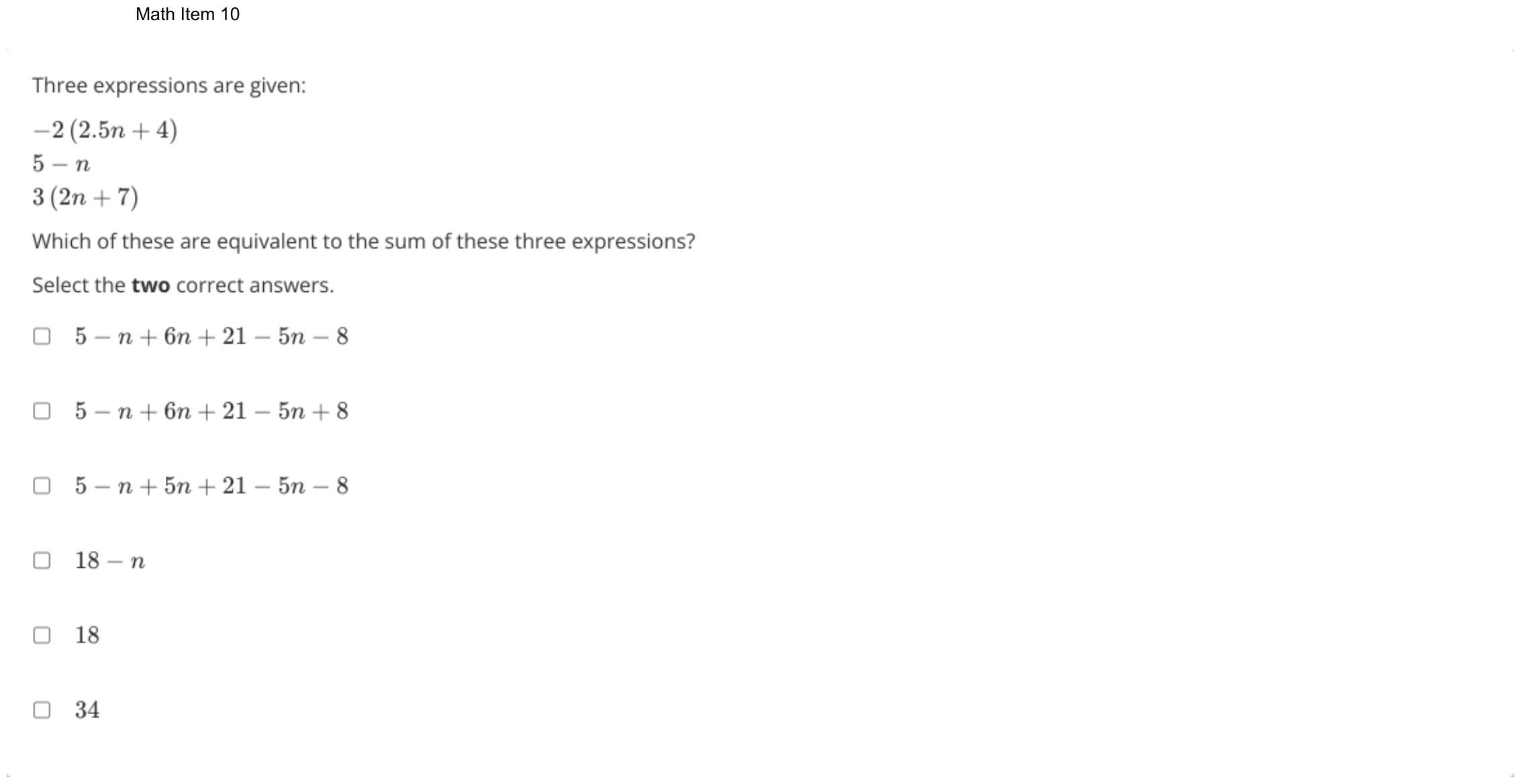
2026 Practice Test A Math, question 27Question
Complete the steps to show one way to solve the equation for x.
Move the correct answer to each box. Each answer may be used more than once. Not all answers will be used.
On the test you drag tiles into the boxes; here, choose each box’s tile from its menu. A tile can be used more than once. The DOE has not published how answers with several parts are scored; this site counts one right only when every part is right.
Show the answer
Correct answer: blank 1: −4; blank 2: 28; blank 3: −56
Solution:
Answer for second equation: −4
Answer for third equation: 28
Answer for fourth equation: −56
Distribute the −0.5 on the right side of the equation: .
Add 4 to both sides of the equation to eliminate the −4 on the right side: .
Divide both sides by −0.5: .
Question analysis
Students complete a step-by-step solution of the equation 24 = −0.5(x + 8) by dragging number tiles into three boxes: one after distributing, one after collecting the constants, and one for x. It tests solving a two-step linear equation with a negative decimal. Tiles may be reused, and many come in positive and negative pairs, so every sign counts.
- Grade level
- Grade 7 content, by NYS standard
- Compared with grade 7
- At grade 7 Solving equations of the form p(x + q) = r with rational numbers is named in the grade 7 standards. Here the steps are laid out, but the negative decimal factor forces a sign decision at every one of the three boxes.
- Estimated difficulty
- Moderate: several steps, or a close reading with one strong distractor.
- Thinking it demands
- Depth of knowledge 1, recall and reproduction · mainly apply
- What makes it hard
- Error-prone arithmetic moderate
- A very close wrong answer minor
- Many steps minor
- An answer in an unexpected form minor
- Solution
- 3 steps
- Reading level
- Question and choices: about grade 3, 39 words.
- Students, last 30 days
- Not enough answers yet to show (it takes 10).
Why it is hard, traps and wrong answers (shows the answer)
Why it is hard
The layout settles the method, so the question comes down to one sign at each box. The printed plus before the first box nudges students toward the positive 4, and the pool then supplies every number that follows from it, down to −40. Students who distribute correctly can still lose the item at the last box by dividing 28 by 0.5. Substituting −56 back, −0.5 × (−48) = 24, confirms the final box.
Error-prone arithmetic moderate Working it out
Two of the three boxes turn on a negative decimal: −0.5 times 8 must give −4, and dividing 28 by −0.5 means multiplying by −2, which doubles the size and makes it negative. (Brown & Burton, 1978; Junker & Sijtsma, 2001)
A very close wrong answer minor Choosing the answer
The pool pairs −4 with 4, −40 with 40 and −56 with 56, so a box filled with the right size and the wrong sign looks just as finished; estimating cannot separate −56 from 56. (Embretson & Wetzel, 1987; Gorin & Embretson, 2006; Ascalon et al., 2007)
Many steps minor Working it out
The three boxes form a chain and all three must be right, so a slip in the first carries through; the pool even holds the whole wrong chain 4, 20 and −40. (Daniel & Embretson, 2010; Enright, Morley & Sheehan, 2002)
An answer in an unexpected form minor Choosing the answer
The second line prints a plus sign before its box, so the distributed −0.5x − 4 must be written as −0.5x + (−4), with the negative tile in the box. (Enright, Morley & Sheehan, 2002)
Strategy: Multiply −0.5 by both x and 8, undo the constant term by doing the opposite operation to both sides, then divide by −0.5, which is the same as multiplying by −2.
Traps
- Order of operations: Working left to right, or distributing a minus sign wrongly, gives a choice.
- Negatives and direction: Arithmetic with negative numbers, the order of a subtraction, or direction on a number line. (Moving a term across the equals sign without changing its sign is a faulty procedure.)
- A faulty procedure: A systematic but wrong procedure: adding fractions straight across, applying an exponent to each term of a sum, dropping a sign when moving a term.
The wrong answers, classified
DEB Order of operations (Brown & Burton, 1978)
Gives the minus of −0.5 to x but not to 8, writing −0.5x + 4, then correctly reaches 20 = −0.5x and x = −40 from that wrong start.
CFH Negatives and direction (Brown & Burton, 1978)
Distributes and adds 4 correctly to reach 28 = −0.5x, then divides 28 by 0.5 instead of −0.5, dropping the negative and entering 56.
CEB A faulty procedure (Brown & Burton, 1978; Tatsuoka, 1983)
Distributes correctly to −4 but moves it to the left side without changing its sign, so 24 − 4 = 20, and 20 ÷ (−0.5) = −40.
Worked solution, step by step
Formulas used
- The distributive property
- a is the number in front of the parentheses, and b and c are the terms inside. Multiply a by each term inside. If a is negative, the minus sign goes into every product. It works because a groups of b + c is the same as a groups of b plus a groups of c.
- Signs when you multiply or divide
- A negative number times a positive number gives a negative result. A negative times a negative gives a positive result. The same rules hold when you divide. Use them at every step where a negative number appears.
- Doing the same to both sides
- a and b are the two sides of an equation, and c is any number (not zero when you divide). An equation is like a balanced scale. Doing the same thing to both sides keeps it level. That is how you get x by itself.
Sort out the question
You solve by filling three boxes:
- Box 1 comes after , once the parentheses are gone.
- Box 2 is the number equal to .
- Box 3 is the value of x.
A tile can be used more than once, and some tiles are not used.
Distribute the −0.5
Multiply −0.5 by each term inside the parentheses. A negative times a positive is negative:
So . The line already shows a plus sign, so box 1 gets −4.
Watch out: the −0.5 multiplies the 8 too. Writing 4 instead starts a wrong chain: 4, then 20, then −40. Every number in that chain is a tile.
Add 4 to both sides
You want −0.5x alone on one side, and the −4 is in the way. Adding 4 undoes subtracting 4, so add 4 to both sides:
Box 2 gets 28.
Watch out: taking 4 away from 24 instead gives 20, another tile.
Divide both sides by −0.5
Now x is multiplied by −0.5. Dividing undoes multiplying, so divide both sides by −0.5:
Dividing by 0.5 is the same as multiplying by 2, since every whole holds two halves. A positive divided by a negative is negative. So .
Watch out: dropping the minus sign gives 56, which is also a tile.
Name the three tiles
From top to bottom, the finished steps read:
So the boxes get −4, 28 and −56, in that order. On the test, you drag each tile into its box. On this site, you choose it from the box’s menu.
Check your answer
Put back into the first equation. . Then , since a negative times a negative is positive. That gives 24, the left side, so −56 is right.
More questions like this
The original DOE question
Question 4 of 107
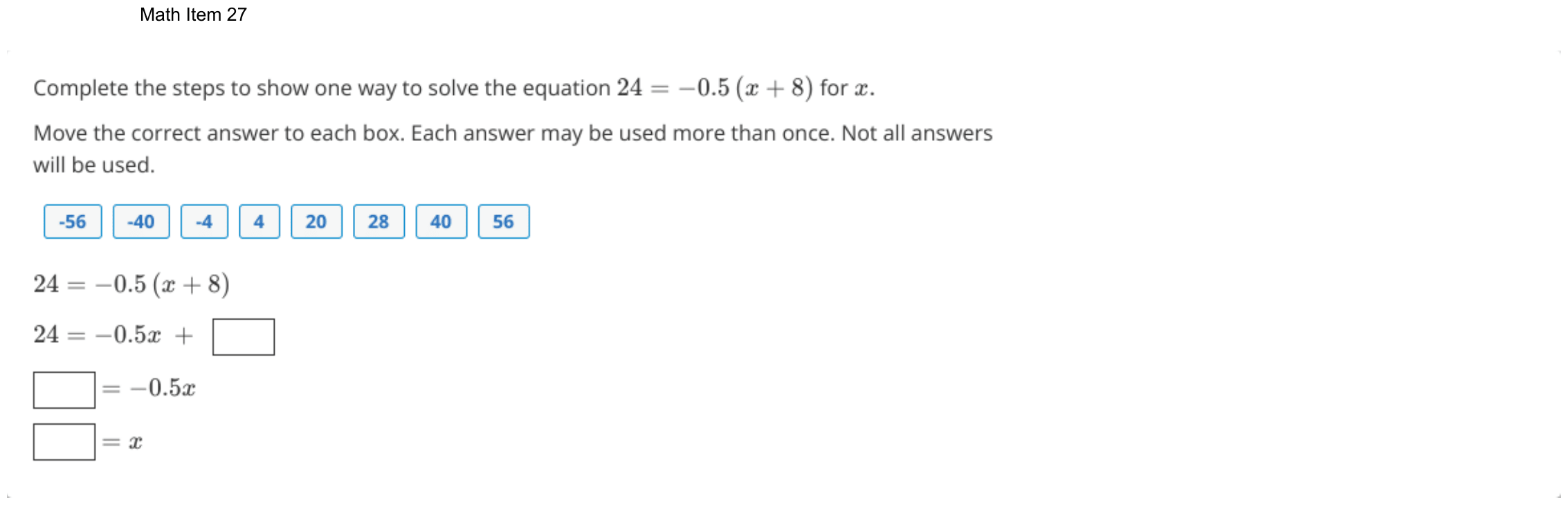
2026 Practice Test A Math, question 43Question
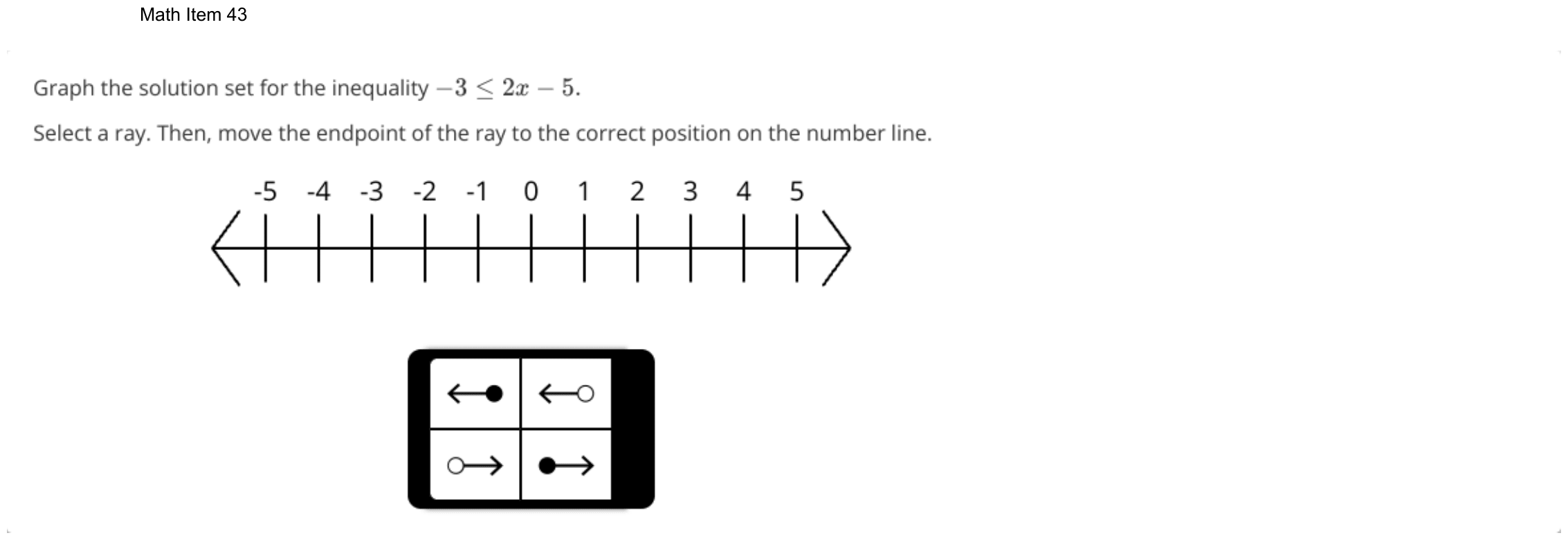
Graph the solution set for the inequality .
Select a ray. Then, move the endpoint of the ray to the correct position on the number line.
On the test you draw the ray on the number line; here, choose its endpoint, whether the endpoint is closed or open, and its direction. The DOE has not published how answers with several parts are scored; this site counts one right only when every part is right.
Show the answer
Correct answer: a ray with a closed endpoint at 1, pointing right
Solution:

Solve the inequality for x, then graph the solution on the number line:
Add 5 to both sides of the inequality:
Divide both sides by 2:
Rewrite the inequality with x on the left side:
The graph of is a closed ray (solid point) beginning at 1 and extending to the right on the number line.
Question analysis
Students graph the solution set of a two-step inequality on a number line by choosing a ray: where it starts, whether its endpoint is open or closed, and which way it points. It tests solving a linear inequality and reading its solution. The variable sits on the right of the inequality symbol, so reading the result the right way round is part of the challenge.
- Grade level
- Grade 7 content, by NYS standard
- Compared with grade 7
- At grade 7 Solving a two-step inequality and graphing its solution set is a named grade 7 skill. This one puts the variable on the right of the symbol and asks students to build the graph themselves rather than pick it from four.
- Estimated difficulty
- Moderate: several steps, or a close reading with one strong distractor.
- Thinking it demands
- Depth of knowledge 1, recall and reproduction · mainly apply
- What makes it hard
- Reading a figure, table or graph moderate
- Many steps minor
- An answer in an unexpected form minor
- Solution
- 3 steps
- Reading level
- Question and choices: about grade 6, 26 words.
- Students, last 30 days
- Not enough answers yet to show (it takes 10).
Why it is hard, traps and wrong answers (shows the answer)
Why it is hard
Solving takes two routine moves; the points are lost in turning 1 ≤ x into a picture. Because x sits on the right, the symbol seems to point left, and a student who shades the way it points draws the values below 1, which all fail. The dot must also be solid, since x = 1 makes both sides −3. Testing x = 2, where 2x − 5 = −1 and −3 ≤ −1 holds, confirms the direction.
Reading a figure, table or graph moderate Understanding the question
The solution comes out as 1 ≤ x, with x on the right, so the ≤ sign points away from the shaded side; it has to be read as x ≥ 1 before the ray is drawn. (Lesh, Post & Behr, 1987; Kirsch & Mosenthal, 1990)
Many steps minor Working it out
Two solving moves, adding 5 and then halving, come before three graph choices, the endpoint, a solid dot and a direction, and a mistake in any of the five loses the item. (Daniel & Embretson, 2010; Enright, Morley & Sheehan, 2002)
An answer in an unexpected form minor Choosing the answer
The ray is built, by picking one of four ray shapes and dragging its endpoint, rather than chosen from four finished graphs, so nothing on screen flags a ray that starts at the right number but points the wrong way. (Enright, Morley & Sheehan, 2002)
Strategy: Undo the subtraction and then the multiplication on both sides, rewrite the result with x first, decide whether the endpoint is included, and test one value on your ray in the original inequality.
Traps
- Negatives and direction: Arithmetic with negative numbers, the order of a subtraction, or direction on a number line. (Moving a term across the equals sign without changing its sign is a faulty procedure.)
- Counting the ends: Inclusive or exclusive ends, fence posts, consecutive numbers: an answer that is one too many or too few, or an endpoint drawn open where it belongs closed (or the reverse).
- A faulty procedure: A systematic but wrong procedure: adding fractions straight across, applying an exponent to each term of a sum, dropping a sign when moving a term.
The wrong answers, classified
1|closed|left Negatives and direction (Brown & Burton, 1978)
Solves to 1 ≤ x but shades the way the ≤ symbol points, a rule that holds only with x on the left, so the ray covers x ≤ 1.
1|open|right Counting the ends (Brown & Burton, 1978)
Finds the right endpoint and direction but draws an open dot, leaving out 1 itself, though the "or equal to" in ≤ includes it.
-4|closed|right A faulty procedure (Brown & Burton, 1978; Tatsuoka, 1983)
Moves the −5 to the left side without changing its sign, writing −3 − 5 = −8 ≤ 2x, so the ray starts at −4.
Worked solution, step by step
Formulas used
- Doing the same to both sides
- a and b are the two sides of an inequality, and c is any number. Adding the same number to both sides keeps the inequality true. So does dividing both sides by the same positive number. Dividing by a negative number would flip the symbol, but that does not happen here.
- Turning an inequality around
- a and b are any two numbers or terms. You may swap the two sides if you also turn the symbol around. The pointed end of the symbol always faces the smaller side. So 1 ≤ x and x ≥ 1 say the same thing.
Sort out the question
The symbol ≤ means is less than or equal to. The solution set is every value of x that makes true. You show it as a ray. A ray is a dot, called the endpoint, with an arrow going one way forever. You need three things: where the dot goes, whether it is closed or open, and which way the ray points.
Add 5 to both sides
The right side is 2x − 5. Adding 5 undoes subtracting 5, so add 5 to both sides:
Watch out: taking 5 away from −3 instead gives −8 ≤ 2x. That wrong move puts the dot at −4.
Divide both sides by 2
Now x is multiplied by 2, so divide both sides by 2. You divide by a positive number, so the symbol stays the same:
Read it with x first
says 1 is less than or equal to x. So x is 1 or any number bigger than 1. With x first, that is:
Bigger numbers are to the right on a number line, so the ray points right.
Watch out: in 1 ≤ x, the symbol seems to point left. Do not follow it. A ray pointing left from 1 shows numbers that do not work.
Choose a closed dot
The words or equal to mean 1 itself is a solution. Check it: , and −3 ≤ −3 is true. So the dot at 1 is closed, which means filled in. An open dot, an empty circle, leaves the endpoint out. Use it only for < or >.
Watch out: an open dot at 1 would leave out a number that works.
Draw the ray
On the test, choose the ray with a filled dot and an arrow pointing right. Then drag its dot to 1. On this site, choose 1 for the endpoint, then closed (filled dot) and pointing right.
So the answer is a closed dot at 1, with the ray pointing right.
Check your answer
Test a number on your ray, such as 3. , and −3 ≤ 1 is true. Now test a number off the ray, such as 0. , and −3 ≤ −5 is false. So the ray points the right way.
More questions like this
The original DOE question
Question 5 of 107
2026 Practice Test B Math, question 17Question
How many positive integers satisfy the inequality ?
Enter your answer in the space.
Fill-in question: work out the answer and type it as a number.
Show the answer
Correct answer: 15
Solve the inequality for x.
There are 15 positive integers that are less than 16.
Question analysis
This inequality question asks how many positive integers make x + 7 < 23 true, and the count is typed into a box. Students solve a one-step inequality, then count its whole-number solutions. The strict less-than sign and the word positive decide where the count starts and stops, so both ends need checking.
- Grade level
- Grade 7 content, by NYS standard
- Compared with grade 7
- Below grade 7 Grade 7 inequality problems usually take two steps, such as 2x − 5 > 9. This one needs a single subtraction; the care goes into counting the whole-number solutions and deciding whether the boundary itself counts.
- Estimated difficulty
- Straightforward: two steps or one careful reading.
- Thinking it demands
- Depth of knowledge 1, recall and reproduction · mainly apply
- What makes it hard
- Solution
- 2 steps
- Reading level
- Question and choices: about grade 12, 14 words.
- Students, last 30 days
- Not enough answers yet to show (it takes 10).
Why it is hard, traps and wrong answers (shows the answer)
Why it is hard
One subtraction solves the inequality, so the points are lost in the count that follows. The boundary 16 is the last number the solving produces and is easy to type in, or to count up to; checking that 16 + 7 is 23, which is not less than 23, rules it out. Listing 1 through 15, the positive integers below the boundary, settles the count.
An answer in an unexpected form minor Choosing the answer
Solving gives x < 16, but the box asks how many positive integers make the inequality true, a count that still has to be made after the solving is done. (Enright, Morley & Sheehan, 2002)
Much to keep track of minor Working it out
Two conditions set the ends of the count at once: the word positive starts it at 1 rather than 0, and the strict < stops it below 16. (Sweller, 1988; Carpenter, Just & Shell, 1990)
Strategy: Undo the addition to find the boundary for x, then count the positive whole numbers below it, checking the largest one and the boundary in the original inequality.
Traps
- Counting the ends: Inclusive or exclusive ends, fence posts, consecutive numbers: an answer that is one too many or too few, or an endpoint drawn open where it belongs closed (or the reverse).
- A faulty procedure: A systematic but wrong procedure: adding fractions straight across, applying an exponent to each term of a sum, dropping a sign when moving a term.
The wrong answers, classified
16 Counting the ends (Brown & Burton, 1978)
Solves to x < 16 and then enters 16, either the boundary itself or a count of 1 through 16, though x = 16 makes x + 7 equal 23, not less than it.
29 A faulty procedure (Brown & Burton, 1978; Tatsuoka, 1983)
Moves the 7 to the right side without changing its sign, 23 + 7 = 30, and counts the 29 positive integers below 30.
Worked solution, step by step
Formulas used
- Doing the same to both sides
- a and b are the two sides of an inequality, and c is any number. Taking the same number away from both sides keeps the inequality true. Think of two people who each walk down the same number of stairs: the lower one stays lower. Use it to get x by itself.
Sort out the question
An inequality compares two amounts. The sign < means is less than. A positive integer is a whole number bigger than 0: 1, 2, 3, and so on. You need to count how many of them make true. The answer is a count, not a value of x.
Get x by itself
The 7 is added to x. Subtracting 7 undoes adding 7, so subtract 7 from both sides:
So x must be less than 16.
Watch out: adding 7 to 23 instead gives x < 30, and a count of 29.
Check the boundary number
The number 16 is the boundary, where the solutions stop. Does 16 itself work? Try it:
But 23 is not less than 23. It is equal. So 16 does not count. The largest number that works is 15, since , and 22 is less than 23.
Watch out: entering 16 counts the boundary, which fails.
Count the positive integers
The numbers that work start at 1, the smallest positive integer. Zero is not positive. They stop at 15:
Counting from 1 up to 15 gives 15 numbers.
Enter the count
There are 15 positive integers that make the inequality true. Type the count in the box as a plain whole number. So you would enter 15.
Check your answer
Test both ends. For 1: , and 8 is less than 23, so 1 works. For 15: 22 is less than 23, so 15 works. For 16: 23 is not less than 23, so 16 fails. That leaves exactly the numbers 1 through 15.
More questions like this
The original DOE question

Question 6 of 107
2026 Practice Test B Math, question 46Question
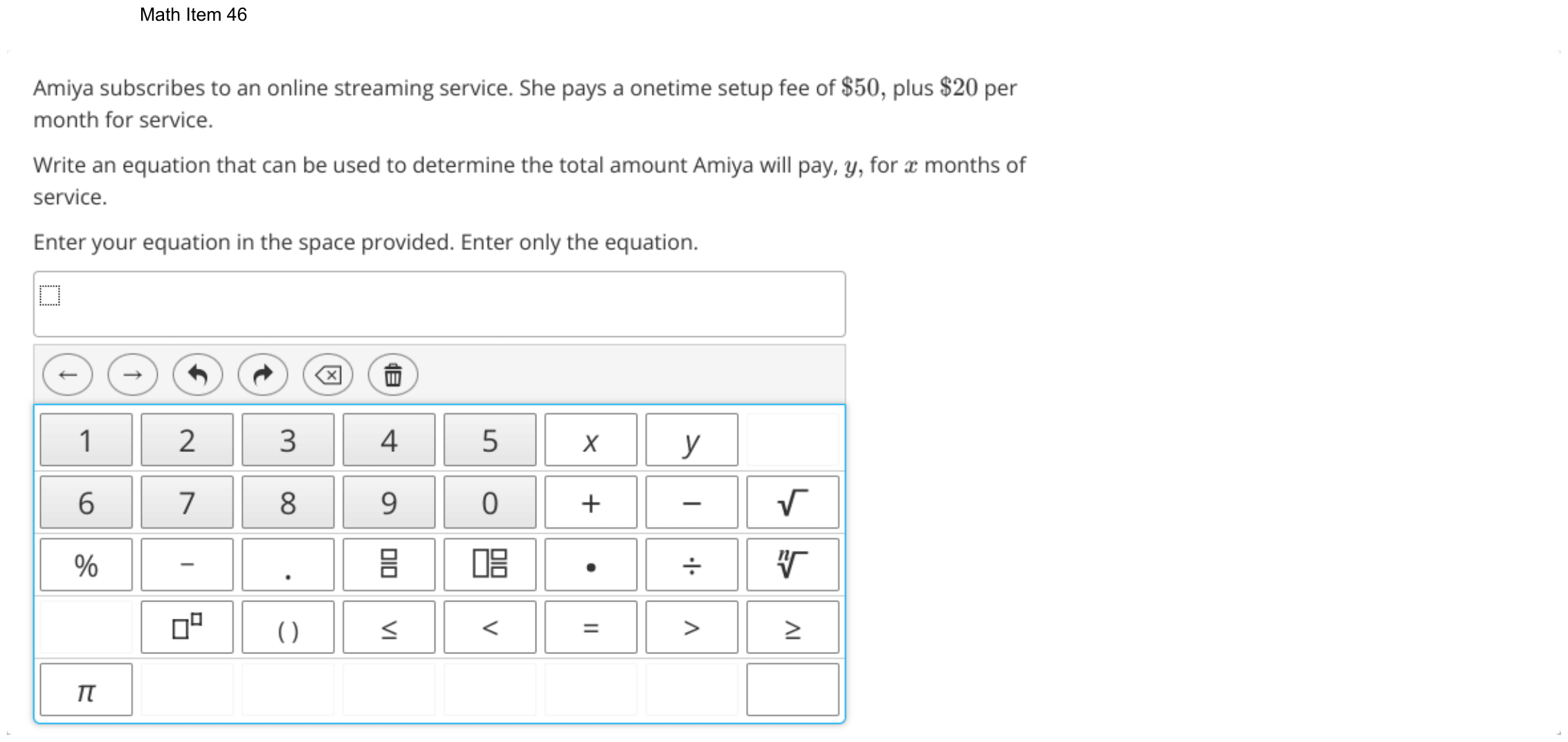
Amiya subscribes to an online streaming service. She pays a onetime setup fee of $50, plus $20 per month for service.
Write an equation that can be used to determine the total amount Amiya will pay, y, for x months of service.
Enter your equation in the space provided. Enter only the equation.
On the test you build the answer on an on-screen keypad; here, type it. Use ^ for a power, sqrt( ) or √ for a root, pi for π, and <= or >= for ≤ and ≥.
Show the answer
Correct answer: y = 20x + 50
Solution:
An equation of the form can be used to represent the total amount Amiya will pay.
Using the information from the scenario, the onetime setup fee of $50 is the constant term (q), and the $20 per month of service is the coefficient (p) of the number of months (x).
So, the equation that can be used to determine the total amount Amiya will pay, y, for x months of service is .
Question analysis
Amiya pays a one-time setup fee plus a monthly charge for a streaming service, and students type an equation for her total cost y after x months. It tests writing a linear equation from a word problem with a starting amount and a rate. The two dollar amounts play different roles, so which one goes with x has to be thought through.
- NYS standards
- Grade level
- Grade 7 content, by NYS standard
- Compared with grade 7
- At grade 7 Writing an equation for a fixed fee plus a steady monthly charge is a familiar grade 7 task, and the numbers are whole. Typing the full equation, with both variables and no choices to compare, makes it less forgiving.
- Estimated difficulty
- Straightforward: two steps or one careful reading.
- Thinking it demands
- Depth of knowledge 2, skills and concepts · mainly apply
- What makes it hard
- Turning words into math moderate
- An answer in an unexpected form minor
- Solution
- 2 steps
- Reading level
- Question and choices: about grade 6, 51 words.
- Students, last 30 days
- Not enough answers yet to show (it takes 10).
Why it is hard, traps and wrong answers (shows the answer)
Why it is hard
The numbers are small and whole, so the work is in the roles. The $50 is paid once and the $20 every month, and a student who places them in the order they appear writes the fee as the monthly rate; others leave the fee out entirely. Checking the equation at x = 1 and x = 2, where Amiya has paid $70 and then $90, shows at once whether each amount is in the right place.
Turning words into math moderate Understanding the question
Only the words “onetime setup fee” and “per month” tell which amount is multiplied by x and which is added once, and the $50 comes first in the sentence. (Hegarty, Mayer & Monk, 1995; Koedinger & Nathan, 2004)
An answer in an unexpected form minor Choosing the answer
The whole equation, with y, an equals sign and x, is built on a keypad with no choices, so a reversed or incomplete equation looks as finished as the right one. (Enright, Morley & Sheehan, 2002)
Strategy: Work out Amiya's total for 1 month and for 2 months by hand, see which amount is added again each month, and build an equation that gives both totals.
Traps
- Misunderstands the concept: A wrong belief about a concept: that percents can be added, that area grows like length, that averages can be averaged, that a bigger denominator means a bigger fraction.
- Stops one step early: A choice is a number from partway through the solution.
- Numbers taken from the question: Combines the numbers in the question without a model of the situation, or is simply a number that appears in the question.
The wrong answers, classified
y = 20x Stops one step early (King et al., 2004; Gierl et al., 2017)
Multiplies the $20 monthly charge by x months but never adds the one-time $50 setup fee, so the equation gives only the cost of service.
y = 50x + 20 Misunderstands the concept (Smith, diSessa & Roschelle, 1993; De Bock et al., 1998; Ni & Zhou, 2005)
Attaches x to the $50 fee and adds the $20 once, putting the numbers into y = mx + b in the order they appear rather than by which one repeats.
y = 70x Numbers taken from the question (Hegarty, Mayer & Monk, 1995)
Adds the $50 fee and the $20 charge into $70 and multiplies by the months, which would charge the setup fee again every month.
Worked solution, step by step
Formulas used
- Total cost with a fee and a rate
- y is the total cost in dollars, and x is the number of months. The rate is the amount paid every month. You multiply it by x because it is paid once for each month. The fee is paid only once, so you add it once, no matter how many months.
Sort out the question
Amiya pays two kinds of charges:
- a setup fee of $50, paid one time only;
- a charge of $20 for every month of service.
y is her total cost in dollars, and x is the number of months. You need an equation that links them. The answer is an equation, not a number.
Work out a few totals
Find the total for a few months by hand. Each month adds one more $20:
Months Monthly charges ($) Total ($) 1 2 3 The $50 shows up once in every total. The $20 shows up once for each month.
Match each number to its job
Use the fee-and-rate model, . The rate is the amount that repeats each month, $20. It multiplies the months, so it becomes 20x. The fee, $50, is paid once, so it is added once.
Watch out: the $50 comes first in the question, but it is not the rate. charges $50 a month. charges the fee every month. forgets the fee.
Write the equation
Put the rate and the fee into the model:
Here 20x means 20 times x. An equal form is fine too, such as , because you can add in either order.
Enter it on the keypad
Type the whole equation, including y =. Without it, you have an expression, not an equation. On the test, the keypad has x, y and = keys. Press y, =, 2, 0, x, +, 5, 0. You do not need a times sign or dollar signs. On this site, type it the same way.
So you would enter y = 20x + 50.
Check your answer
Test the equation with the totals you found. For 1 month, , and Amiya pays $50 + $20 = $70. For 2 months, . Both match. For 0 months, y = 50, just the setup fee.
More questions like this
The original DOE question
Question 7 of 107
2026 Practice Test C Math, question 2Question
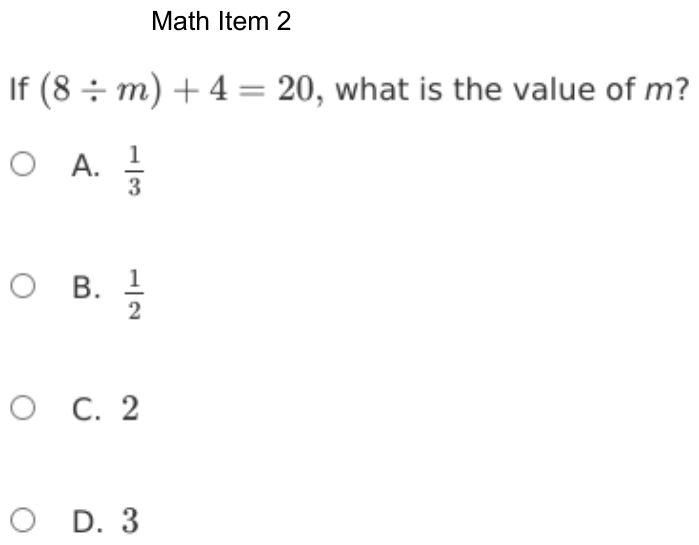
If , what is the value of m?
- A
- B
- C2
- D3
Show the answer
Correct answer: B
The quantity means the same as , so the equation can be rewritten:
Subtract 4 from both sides:
Multiply both sides of the equation by m:
Solve for m:
Simplify:
Question analysis
This equation question asks for the value of m when 8 divided by m, plus 4, equals 20. Students undo the addition, then work out what m must be for 8 divided by it to give the value left. Because m is the divisor rather than the number being divided, the last step needs care.
- Grade level
- Grade 7 content, by NYS standard
- Compared with grade 7
- At grade 7 Undoing an addition and then a division is typical two-step grade 7 equation work. The unknown sitting in a denominator is less common than px + q = r, which makes the last step easier to get backward.
- Estimated difficulty
- Straightforward: two steps or one careful reading.
- Thinking it demands
- Depth of knowledge 1, recall and reproduction · mainly apply
- What makes it hard
- Error-prone arithmetic moderate
- Something you must already know minor
- Solution
- 3 steps
- Reading level
- Question and choices: about grade 6, 10 words.
- Students, last 30 days
- Not enough answers yet to show (it takes 10).
Why it is hard, traps and wrong answers (shows the answer)
Why it is hard
Undoing the + 4 is routine, so nearly all the risk sits in the last step, where m divides 8 rather than being divided by it. Students who read 8 ÷ m = 16 as asking how many 8s make 16 answer 2, and substituting it back, 8 ÷ 2 + 4 = 8, shows at once that it fails. The right value makes 8 ÷ 1/2 = 16, a division that gives a larger number, which feels wrong but is correct.
Error-prone arithmetic moderate Working it out
The unknown is the divisor, so 8 ÷ m = 16 ends in m = 8 ÷ 16, a quotient less than 1; the familiar order, 16 ÷ 8, gives a whole number instead. (Brown & Burton, 1978; Junker & Sijtsma, 2001)
Something you must already know minor Working it out
Students must see that (8 ÷ m) is the fraction 8/m and that freeing m from a denominator means multiplying both sides by it, a move grade 7 equations rarely need. (Anderson & Krathwohl, 2001)
Strategy: Subtract 4 from both sides, multiply both sides by m so the unknown is no longer in a denominator, then divide; check by substituting your value back into the equation.
Traps
- Wrong operation: Adds instead of multiplying, divides the wrong way round, turns a ratio or rate upside down, or undoes a step in the wrong direction (subtracts what should be added back).
The wrong answers, classified
A Wrong operation (Hegarty, Mayer & Monk, 1995; King et al., 2004)
Adds 4 to 20 instead of subtracting it, so 8 ÷ m = 24 and m = 8/24, which simplifies to 1/3.
C Wrong operation (Hegarty, Mayer & Monk, 1995; King et al., 2004)
Gets 8 ÷ m = 16 correctly but then divides 16 by 8, putting the divisor and the dividend the wrong way round, so m comes out as 2.
D Wrong operation (Hegarty, Mayer & Monk, 1995; King et al., 2004)
Makes both mistakes, adding 4 to get 8 ÷ m = 24 and then dividing 24 by 8 instead of 8 by 24.
Worked solution, step by step
Formulas used
- Keeping an equation balanced
- a and b are the two sides of an equation, and c is any number. An equation is like a balanced scale. Subtract the same number from both sides, or multiply both sides by the same number, and it stays balanced. That is how you get the unknown by itself.
Sort out the question
The equation is . You need the value of m. Here m is the number you divide 8 by. In words: 8 divided by some number, plus 4, makes 20.
Undo the plus 4
A fraction bar means divide, so is the same as . Subtract 4 from both sides to undo the plus 4:
Now 8 divided by m equals 16.
Watch out: adding 4 instead gives 24 on the right. That leads to choice A, 1/3, or to D, 3.
Get m out of the bottom
m is on the bottom of the fraction. Multiply both sides by m to free it:
Now divide both sides by 16:
8 goes into both 8 and 16, so 8/16 simplifies to 1/2.
Choose the answer
Watch out: it is tempting to divide 16 by 8 and get 2, choice C. But ask yourself: 8 divided by what number makes 16? To get an answer bigger than 8, you must divide by a number less than 1.
So the answer is B, 1/2.
Check your answer
Put 1/2 back into the equation. How many halves are in 8? There are 16, so . Then . That matches the equation, so m = 1/2 is right.
More questions like this
The original DOE question
Question 8 of 107
2026 Practice Test C Math, question 7Question
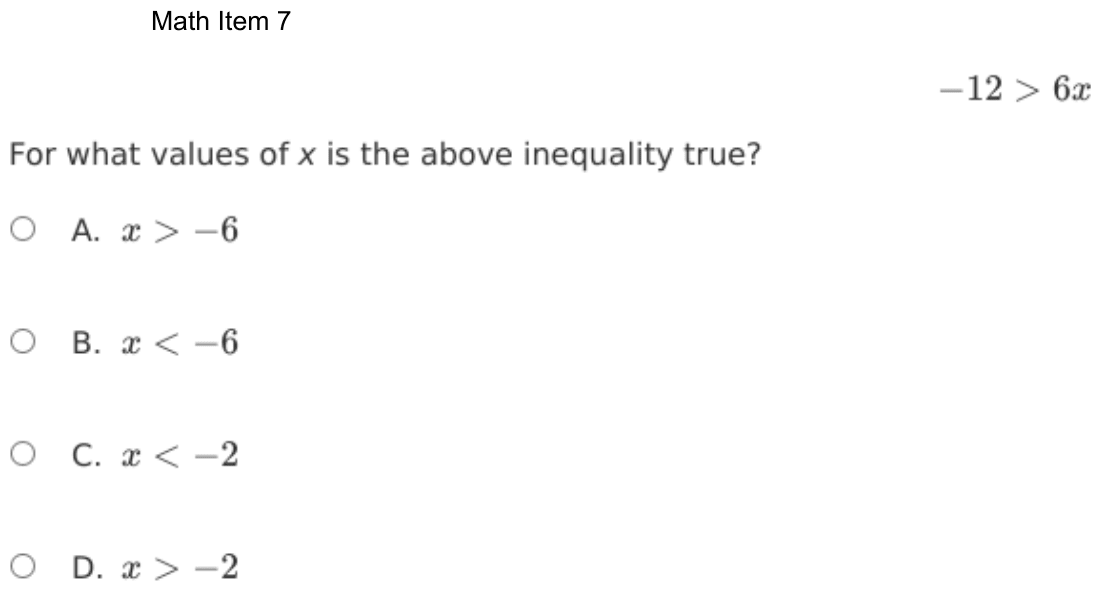
For what values of x is the above inequality true?
- A
- B
- C
- D
Show the answer
Correct answer: C
Divide to solve for x:
Rewriting with the x term first requires reversing the inequality symbol in order to keep the meaning “x is less than ”.
Question analysis
This inequality question asks which values of x make −12 > 6x true. Students solve a one-step inequality by dividing and then state the solution with x written first. A negative number on one side and the variable on the other make the direction of the symbol the main thing to get right.
- Grade level
- Grade 7 content, by NYS standard
- Compared with grade 7
- Below grade 7 Grade 7 inequalities usually take two steps, such as 3x + 4 > 19. This one needs a single division, and the care goes into reading the result correctly when the variable ends up on the right of the symbol.
- Estimated difficulty
- Straightforward: two steps or one careful reading.
- Thinking it demands
- Depth of knowledge 1, recall and reproduction · mainly apply
- What makes it hard
- A very close wrong answer moderate
- Something you must already know minor
- Solution
- 2 steps
- Reading level
- Question and choices: about grade 10, 15 words.
- Students, last 30 days
- Not enough answers yet to show (it takes 10).
Why it is hard, traps and wrong answers (shows the answer)
Why it is hard
One division finds the boundary, so the question is really about direction. Two things pull students the wrong way: the −12 on the left makes the inequality look like one that must be flipped, and the result −2 > x has x on the right, where it is easy to read backward. Testing x = −3, which gives −12 > −18, shows that values below −2 work.
A very close wrong answer moderate Choosing the answer
x < −2 and x > −2 share the boundary −2 and differ only in direction, so finding the right number settles nothing until the direction is read correctly. (Embretson & Wetzel, 1987; Gorin & Embretson, 2006; Ascalon et al., 2007)
Something you must already know minor Working it out
Students must know that the symbol flips only when both sides are multiplied or divided by a negative number, and that −2 > x says the same as x < −2. (Anderson & Krathwohl, 2001)
Strategy: Divide both sides by 6, asking whether you divided by a negative number, then rewrite the result with x on the left so that the symbol still opens toward the larger side.
Traps
- Negatives and direction: Arithmetic with negative numbers, the order of a subtraction, or direction on a number line. (Moving a term across the equals sign without changing its sign is a faulty procedure.)
- Wrong operation: Adds instead of multiplying, divides the wrong way round, turns a ratio or rate upside down, or undoes a step in the wrong direction (subtracts what should be added back).
The wrong answers, classified
A Wrong operation (Hegarty, Mayer & Monk, 1995; King et al., 2004)
Adds 6 to −12 instead of dividing by 6, getting −6, and also reverses the direction, so both the boundary and the symbol are wrong.
B Wrong operation (Hegarty, Mayer & Monk, 1995; King et al., 2004)
Undoes the 6 by adding it to −12 rather than dividing, as if 6x meant x − 6, getting −6 > x and so x < −6.
D Negatives and direction (Brown & Burton, 1978)
Finds −2 > x but flips the symbol because −12 is negative, or reads −2 > x as x > −2, though dividing by a positive 6 keeps the direction.
Worked solution, step by step
Formulas used
- Dividing both sides of an inequality
- a and b are the two sides of an inequality, and c is the number you divide by. If c is positive, the symbol stays the same. It flips only when you multiply or divide both sides by a negative number. Here c is 6, which is positive.
- Reading an inequality the other way
- a and b are any two numbers. Saying a is greater than b is the same as saying b is less than a. When you swap the two sides, turn the symbol around. Its point still aims at the smaller number.
Sort out the question
The inequality is . The symbol > means is greater than. So it says −12 is greater than 6 times x. You need every value of x that makes this true.
Divide both sides by 6
To get x alone, divide both sides by 6:
You divided by 6, which is positive. So the symbol does not flip.
Watch out: −12 is negative, but that does not matter. Only dividing by a negative number flips the symbol.
Put x first
says −2 is greater than x. That means x is less than −2. Swap the sides and turn the symbol around:
Watch out: keeping > when you swap the sides gives choice D, . That is the opposite meaning.
Choose the answer
Choices A and B use −6. That comes from adding 6 to −12 instead of dividing by 6. The right boundary is −2, and x is below it.
So the answer is C, .
Check your answer
Test a number below −2, such as −3. Then , and is true. Now test 0, which is above −2. Then , and is false. So only numbers below −2 work.
More questions like this
The original DOE question
Question 9 of 107
2026 Practice Test C Math, question 11Question
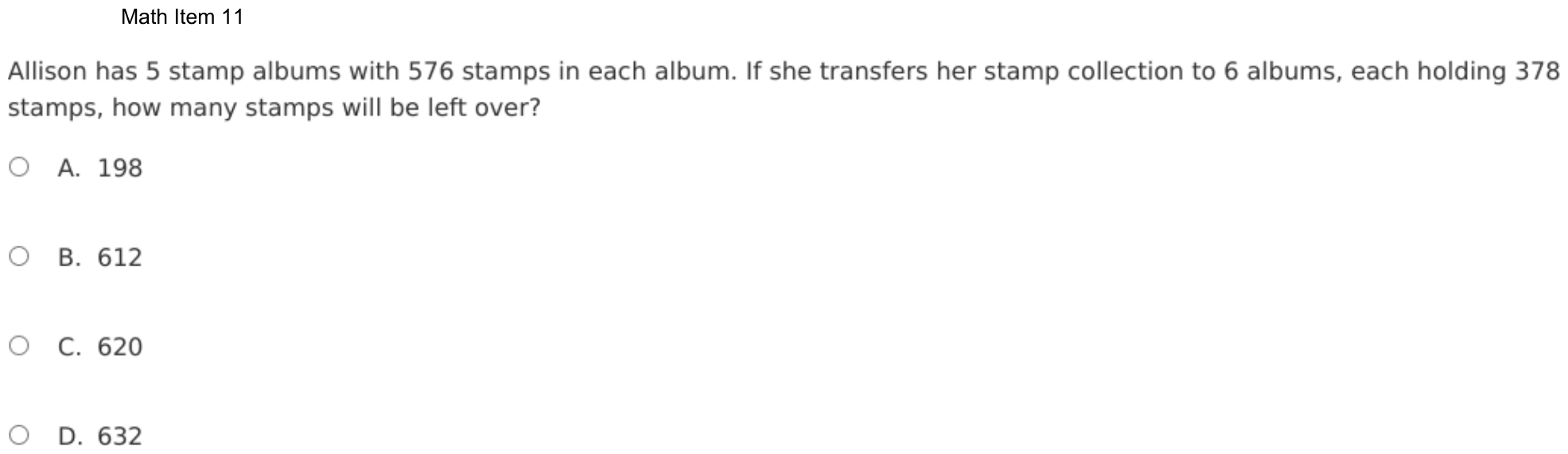
Allison has 5 stamp albums with 576 stamps in each album. If she transfers her stamp collection to 6 albums, each holding 378 stamps, how many stamps will be left over?
- A198
- B612
- C620
- D632
Show the answer
Correct answer: B
Determine the total number of stamps in 5 albums holding 576 stamps:
Determine the total number of stamps in 6 albums holding 378 stamps:
Subtract 2,268 from 2,880 to find the number of stamps that will be left over:
Question analysis
Allison moves a stamp collection from 5 albums of 576 stamps into 6 albums that hold 378 each, and students find how many stamps are left over. It tests multiplying and subtracting large whole numbers in a word problem. The question gives no total, so the collection has to be counted before the new albums' capacity is taken away.
- Grade level
- Grade 7 content, by NYS standard
- Compared with grade 7
- Below grade 7 Whole-number multiplication and subtraction in a three-step word problem is easier than grade 7 work with fractions, decimals or negatives. Because the products are large, a slip or a rounded estimate easily gives another choice.
- Estimated difficulty
- Straightforward: two steps or one careful reading.
- Thinking it demands
- Depth of knowledge 2, skills and concepts · mainly apply
- What makes it hard
- A very close wrong answer moderate
- Error-prone arithmetic minor
- Solution
- 3 steps
- Reading level
- Question and choices: about grade 6, 27 words.
- Students, last 30 days
- Not enough answers yet to show (it takes 10).
Why it is hard, traps and wrong answers (shows the answer)
Why it is hard
The plan is clear from the stem: count the stamps, then take away what the six new albums hold, so the question tests careful arithmetic. Its choices punish the estimating that saves time elsewhere, since rounding either factor shifts the result by only a few tens, onto another listed number. Students who skip the album counts altogether and compare one album with one album find 198 waiting.
A very close wrong answer moderate Choosing the answer
612, 620 and 632 lie within 20 of one another, so rounding 576 and 378 to friendly numbers before multiplying lands on a wrong choice; only exact products separate them. (Embretson & Wetzel, 1987; Gorin & Embretson, 2006; Ascalon et al., 2007)
Error-prone arithmetic minor Working it out
Two products of three-digit numbers, 5 × 576 = 2,880 and 6 × 378 = 2,268, must be done by hand and then subtracted with regrouping. (Brown & Burton, 1978; Junker & Sijtsma, 2001)
Strategy: Multiply to find the total number of stamps, multiply again to find how many the six new albums hold, subtract, and check the last digit of each product.
Traps
- Rounds too early: Rounds a value partway through, or rounds the wrong way, so the final answer drifts from the exact one.
- Numbers taken from the question: Combines the numbers in the question without a model of the situation, or is simply a number that appears in the question.
The wrong answers, classified
A Numbers taken from the question (Hegarty, Mayer & Monk, 1995)
Subtracts 378 from 576, comparing one old album with one new album, and ignores that there are 5 old albums and 6 new ones.
C Rounds too early (King et al., 2004)
Rounds 576 to 580 and 378 to 380 before multiplying, so 2,900 − 2,280 = 620, an estimate rather than the exact number left over.
D Rounds too early (King et al., 2004)
Rounds only 576 up to 580, getting 2,900 stamps, then subtracts the exact 2,268, so the count comes out 20 too high.
Worked solution, step by step
Formulas used
- Total in equal groups
- Here the groups are albums. The amount in each group is how many stamps one album holds. When every group is the same size, multiplying is a fast way to add them all up.
Sort out the question
Allison has 5 albums with 576 stamps in each. She moves all her stamps into 6 new albums. Each new album holds 378 stamps. Some stamps will not fit. You need the number left over.
Count all her stamps
Use the equal-groups formula. Split 576 into 500 + 76 to make it easy:
Allison has 2,880 stamps.
Count what the new albums hold
Do the same for the 6 new albums. Split 378 into 300 + 78:
The new albums hold 2,268 stamps in all.
Subtract to find the leftovers
The stamps left over are the ones she has minus the ones that fit:
Watch out: , choice A, compares just one old album with one new one. Rounding to 580 and 380 first gives 620, choice C. Rounding only 576 gives 632, choice D. Use the exact numbers.
So the answer is B, 612.
Check your answer
Add the leftovers to the stamps that fit: . That is exactly the number Allison started with. So no stamps were lost or counted twice.
More questions like this
The original DOE question
Question 10 of 107
2026 Practice Test C Math, question 28Question
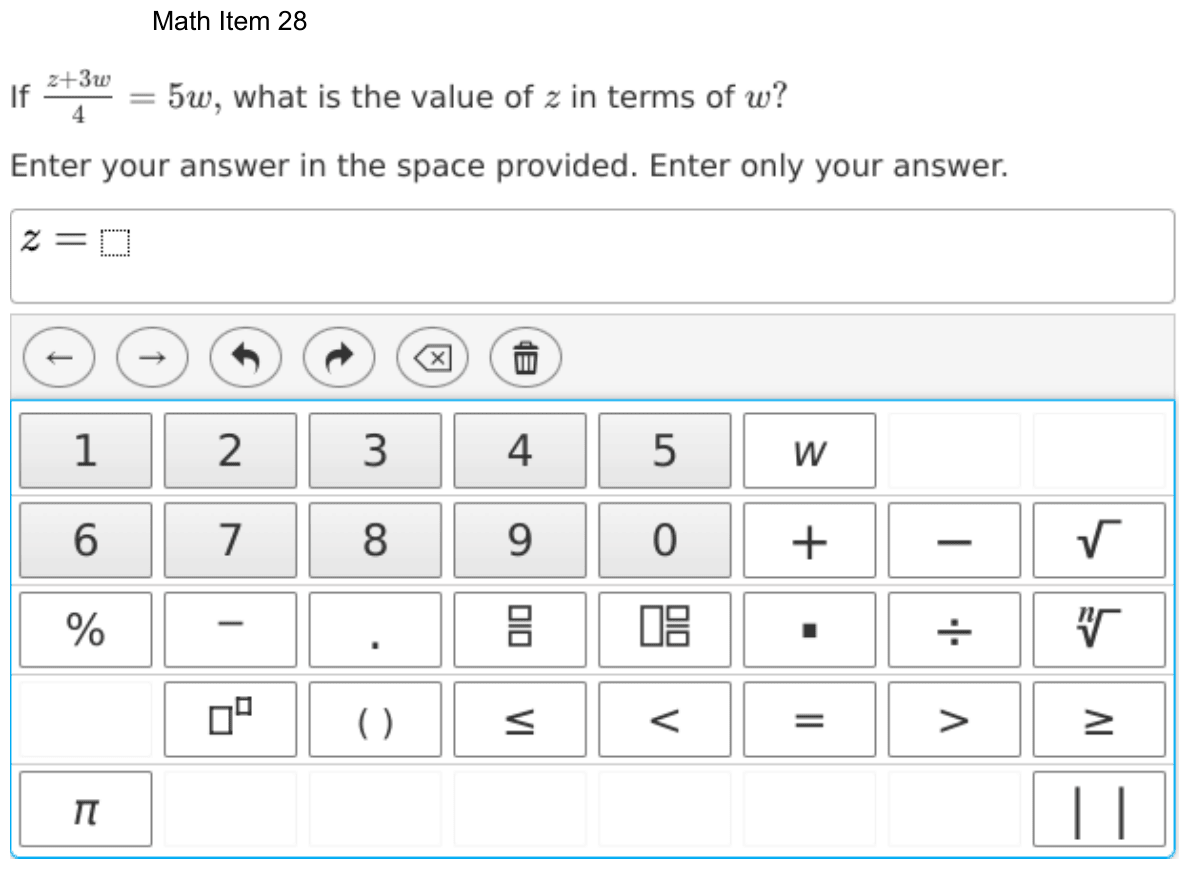
If , what is the value of z in terms of w?
Enter your answer in the space provided. Enter only your answer.
On the test you build the answer on an on-screen keypad; here, type it. Use ^ for a power, sqrt( ) or √ for a root, pi for π, and <= or >= for ≤ and ≥.
Show the answer
Correct answer: z = 17w
The goal is to isolate the variable z by using inverse operations.
First, multiply both sides by 4:
Then subtract from both sides:
Question analysis
This algebra question gives an equation in which z plus 3w, all divided by 4, equals 5w, and students type z in terms of w after a printed "z =". It tests solving a literal equation with inverse operations. The 4 divides the whole sum, so undoing the steps in the right order, with the right signs, is the tricky part.
- Grade level
- Grade 8 content, by NYS standard
- Compared with grade 7
- Above grade 7 Grade 7 students solve two-step equations with numbers, such as (x + 3)/4 = 5. Solving for one letter in terms of another is grade 8 work, and the typed answer gives no choices to check against.
- Estimated difficulty
- Moderate: several steps, or a close reading with one strong distractor.
- Thinking it demands
- Depth of knowledge 1, recall and reproduction · mainly apply
- What makes it hard
- Variables instead of numbers moderate
- An answer in an unexpected form minor
- Solution
- 2 steps
- Reading level
- Question and choices: about grade 4, 23 words.
- Students, last 30 days
- Not enough answers yet to show (it takes 10).
Why it is hard, traps and wrong answers (shows the answer)
Why it is hard
The equation takes only two inverse operations, but their order is the trap: the 4 divides the whole sum z + 3w, so it has to be cleared first. Students who subtract 3w from 5w straight away, or who move 3w to the right without changing its sign, reach a tidy multiple of w that looks as finished as the right one. Substituting w = 1, which needs z = 17 to make (z + 3)/4 equal 5, checks any entry.
Variables instead of numbers moderate Understanding the question
With w on both sides and no numbers to substitute, the result has to stay a multiple of w, and a slip such as 23w gives no sign that it is wrong. (Koedinger & Nathan, 2004; Enright, Morley & Sheehan, 2002)
An answer in an unexpected form minor Choosing the answer
The answer is typed after a printed “z =”, with no choices to compare, so the entry must be a single term in w, not an equation or a number. (Enright, Morley & Sheehan, 2002)
Strategy: Treat w like a known number: undo the division by 4 first, multiplying the whole of each side, then undo the added 3w, keeping the terms in w together.
Traps
- A faulty procedure: A systematic but wrong procedure: adding fractions straight across, applying an exponent to each term of a sum, dropping a sign when moving a term.
- Order of operations: Working left to right, or distributing a minus sign wrongly, gives a choice.
- Wrong operation: Adds instead of multiplying, divides the wrong way round, turns a ratio or rate upside down, or undoes a step in the wrong direction (subtracts what should be added back).
The wrong answers, classified
8w Order of operations (Brown & Burton, 1978)
Undoes the + 3w before the ÷ 4, subtracting 3w from 5w as if only z were divided by 4, so z/4 = 2w and z = 8w.
23w A faulty procedure (Brown & Burton, 1978; Tatsuoka, 1983)
Multiplies correctly to get z + 3w = 20w, then moves 3w to the right side without changing its sign, so z = 20w + 3w = 23w.
-1.75w Wrong operation (Hegarty, Mayer & Monk, 1995; King et al., 2004)
Divides 5w by 4 instead of multiplying, undoing a division with another division, so z + 3w = 1.25w and z = 1.25w − 3w = −1.75w.
Worked solution, step by step
Formulas used
- Doing the same thing to both sides
- A and B are the two sides of an equation, so they are equal. C is any amount. An equation is like a balanced scale. If you multiply both sides by the same number, or take the same amount from both, it stays balanced. That is how you get one letter alone.
Sort out the question
The equation is . You need z in terms of w. That means getting z alone on one side. The other side will use only w and numbers.
Treat w like a number you do not know yet. The answer box already shows z =, so you type only what comes after it.
Undo the division first
The fraction bar means the whole top, z + 3w, is divided by 4. So undo that first. Multiply both sides by 4, because multiplying undoes dividing:
Watch out: do not subtract 3w first. The 3w sits inside the fraction, so it is divided by 4 too. Subtracting it from 5w first leads to the wrong answer 8w.
Undo the adding
Now 3w is added to z. Subtract 3w from both sides:
Think of w as a thing, like apples. 20 apples take away 3 apples leaves 17 apples.
Watch out: moving 3w to the other side without changing its sign gives . That is wrong.
Enter it after the printed z =
On the test, the box already shows z =. Press 1, then 7, then the w key. You do not need a times sign between 17 and w. Do not type z = again. On this site, type 17w in the box.
So you would enter 17w, which makes z = 17w.
Check your answer
Pick a number for w, such as w = 1. Then z = 17. Put both into the first equation. The left side is . The right side is . The two sides match, so 17w works.
More questions like this
The original DOE question
Question 11 of 107
2026 Practice Test C Math, question 35Question
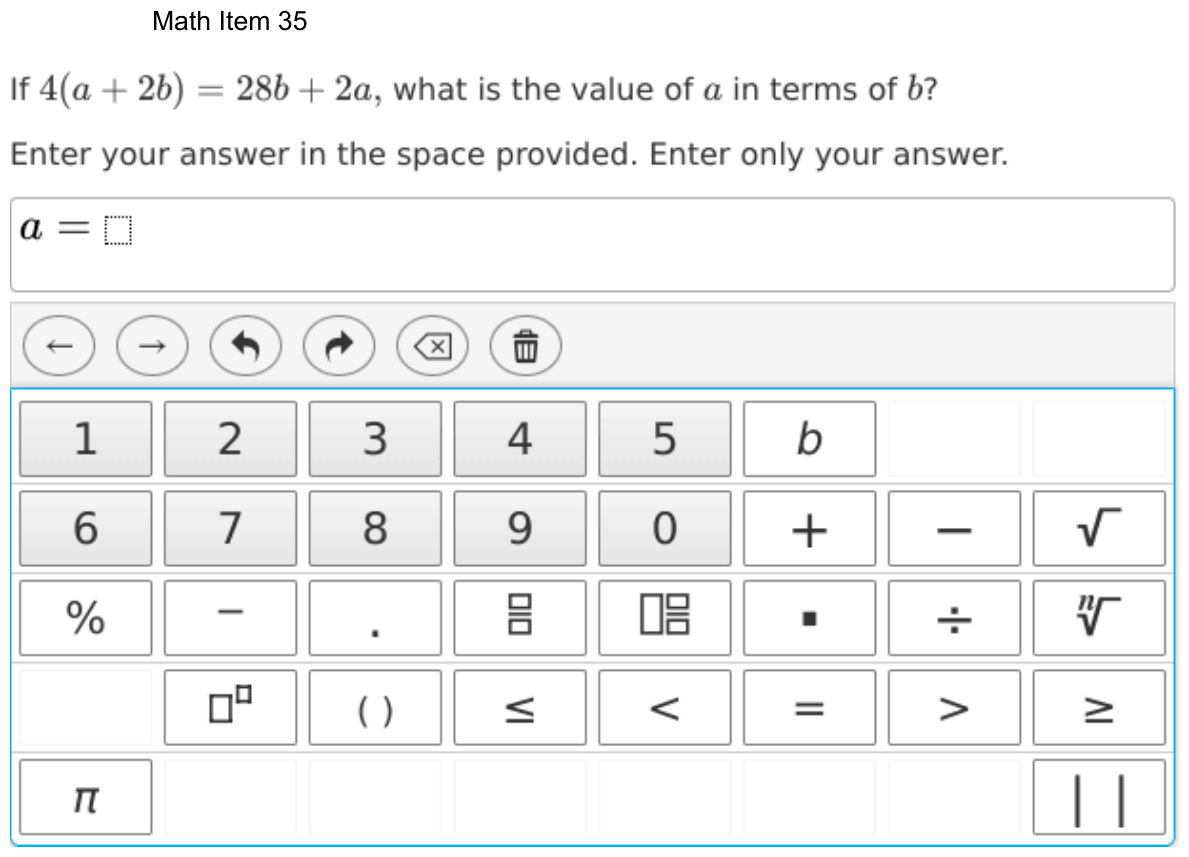
If , what is the value of a in terms of b?
Enter your answer in the space provided. Enter only your answer.
On the test you build the answer on an on-screen keypad; here, type it. Use ^ for a power, sqrt( ) or √ for a root, pi for π, and <= or >= for ≤ and ≥.
Show the answer
Correct answer: a = 10b
To find the value of a in terms of b, solve for a. Begin by distributing 4 on the left side of the equation:
Then, get the a terms on one side and the b terms on the other:
Solve for the value of a in terms of b by combining like terms and then dividing each side by 2:
Question analysis
An algebra question gives an equation with a and b on both sides, one side written as 4 times a sum in parentheses, and students type a in terms of b after a printed "a =". It tests the distributive property and solving linear equations. The answer is typed, so a slip in distributing or moving terms is not caught by any choices.
- NYS standards
- Grade level
- Grade 8 content, by NYS standard
- Compared with grade 7
- Above grade 7 Grade 7 students solve equations like 4(x + 2) = 28 with numbers. This one has letters on both sides, needs the distributive property and like terms, and asks for a in terms of b, which is grade 8 algebra.
- Estimated difficulty
- Hard: combines ideas, needs a plan, and has more than one tempting wrong answer.
- Thinking it demands
- Depth of knowledge 1, recall and reproduction · mainly apply
- What makes it hard
- Variables instead of numbers moderate
- Many steps moderate
- An answer in an unexpected form minor
- Solution
- 3 steps
- Reading level
- Question and choices: about grade 4, 23 words.
- Students, last 30 days
- Not enough answers yet to show (it takes 10).
Why it is hard, traps and wrong answers (shows the answer)
Why it is hard
Every step is routine, yet there are four of them, each with a classic slip, and the typed answer catches none. Multiplying the 4 into only the a, or carrying 8b across without changing its sign, gives another whole multiple of b that looks finished. Testing b = 1, where 4(a + 2) and 28 + 2a must come out equal, confirms an entry quickly.
Variables instead of numbers moderate Understanding the question
Both letters appear on both sides, and the answer must stay a multiple of b, so there is no number to check an entry against unless students invent one. (Koedinger & Nathan, 2004; Enright, Morley & Sheehan, 2002)
Many steps moderate Working it out
Four moves run in a chain, distributing the 4, gathering the a terms, gathering the b terms and dividing by 2, and an error at any one carries into the typed result. (Daniel & Embretson, 2010; Enright, Morley & Sheehan, 2002)
An answer in an unexpected form minor Choosing the answer
The answer is typed after a printed “a =”, with no choices, so 20b, the line before dividing by 2, can be entered without anything on screen questioning it. (Enright, Morley & Sheehan, 2002)
Strategy: Distribute the 4 to both terms in the parentheses, gather the a terms on one side and the b terms on the other, then divide by the coefficient of a.
Traps
- A faulty procedure: A systematic but wrong procedure: adding fractions straight across, applying an exponent to each term of a sum, dropping a sign when moving a term.
- Stops one step early: A choice is a number from partway through the solution.
The wrong answers, classified
13b A faulty procedure (Brown & Burton, 1978; Tatsuoka, 1983)
Multiplies only the a by 4, writing 4a + 2b = 28b + 2a, so 2a = 26b and a = 13b.
18b A faulty procedure (Brown & Burton, 1978; Tatsuoka, 1983)
Distributes correctly but moves 8b to the right without changing its sign, so 2a = 28b + 8b = 36b and a = 18b.
20b Stops one step early (King et al., 2004; Gierl et al., 2017)
Reaches 2a = 20b correctly and enters 20b, stopping before dividing both sides by 2 to get a alone.
Worked solution, step by step
Formulas used
- Distributive property
- k is the number outside the parentheses. x and y are the terms inside. The number outside multiplies every term inside, not just the first one. It works because 4 groups of (x + y) hold 4 x’s and 4 y’s.
- Doing the same thing to both sides
- A and B are the two equal sides of an equation. C is any amount. Taking the same amount from both sides, or dividing both by the same number, keeps them equal, like a balanced scale.
Sort out the question
The equation is . You need a in terms of b. That means a alone on one side, with only b and numbers on the other.
The answer box already shows a =, so you type only what comes after it.
Multiply out the parentheses
Use the distributive property. The 4 multiplies both terms inside:
Watch out: multiplying only the a by 4 gives 4a + 2b. That leads to the wrong answer 13b.
Gather the a terms
Like terms are terms with the same letter, such as 4a and 2a. Put the a terms on the left. Subtract 2a from both sides:
Gather the b terms
Now subtract 8b from both sides:
Watch out: moving 8b without changing its sign gives . That leads to 18b, which is wrong.
Divide both sides by 2
2a means 2 times a. Divide both sides by 2 to get a alone:
Watch out: 20b is equal to 2a, not a. Do not stop there.
Enter it after the printed a =
On the test, the box already shows a =. Press 1, then 0, then the b key. You do not need a times sign. Do not type a = again. On this site, type 10b in the box.
So you would enter 10b, which makes a = 10b.
Check your answer
Pick b = 1, so a = 10. The left side is . The right side is . The sides match, so 10b works.
More questions like this
The original DOE question
Question 12 of 107
2026 Practice Test C Math, question 38Question
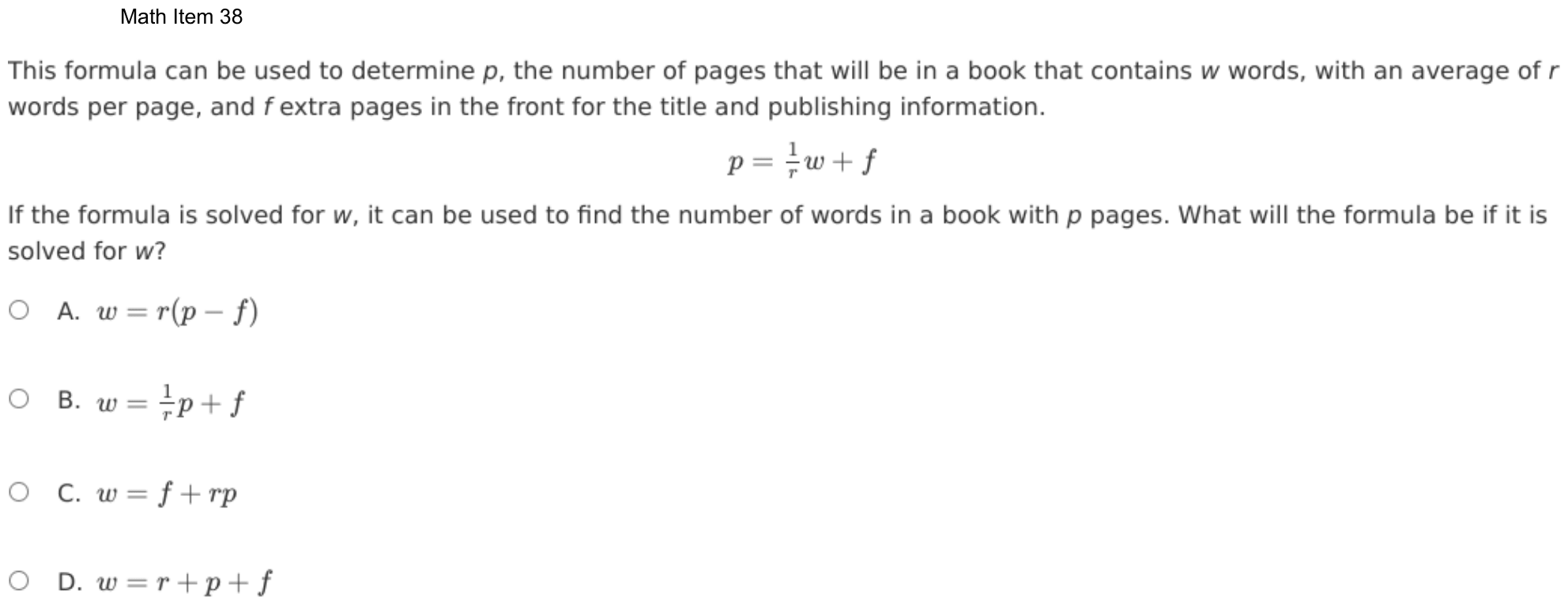
This formula can be used to determine p, the number of pages that will be in a book that contains w words, with an average of r words per page, and f extra pages in the front for the title and publishing information.
If the formula is solved for w, it can be used to find the number of words in a book with p pages. What will the formula be if it is solved for w?
- A
- B
- C
- D
Show the answer
Correct answer: A
Apply the properties of equality to solve for w.
Subtract f from both sides of the equation.
Multiply both sides by r.
Question analysis
A formula gives the number of pages p in a book from its number of words w, the average words per page r, and the extra front pages f. Students choose the formula solved for w. It tests rearranging a formula with inverse operations, and with only letters there are no numbers to check, so the order of the steps matters.
- Grade level
- Grade 8 content, by NYS standard
- Compared with grade 7
- Above grade 7 Grade 7 students solve two-step equations such as 5 = x/4 + 2 with numbers. Rearranging a formula with four letters to solve for a different one is grade 8 work, with no numbers to check against.
- Estimated difficulty
- Moderate: several steps, or a close reading with one strong distractor.
- Thinking it demands
- Depth of knowledge 1, recall and reproduction · mainly apply
- What makes it hard
- Variables instead of numbers moderate
- Many steps minor
- Solution
- 2 steps
- Reading level
- Question and choices: about grade 5, 82 words.
- Students, last 30 days
- Not enough answers yet to show (it takes 10).
Why it is hard, traps and wrong answers (shows the answer)
Why it is hard
The formula is short, but solving it for w means undoing two operations in reverse order, with letters only. The tempting shortcut multiplies p by r and leaves the f untouched, which yields a formula that looks as finished as the right one. Swapping p and w without undoing anything is the other quick trap. Substituting a small book, 5,000 words at 250 a page with 4 front pages, shows which formula gives back 5,000.
Variables instead of numbers moderate Understanding the question
Four letters and no numbers mean each choice has to be judged by its structure, unless students pick values such as r = 250, w = 5,000 and f = 4 to test it. (Koedinger & Nathan, 2004; Enright, Morley & Sheehan, 2002)
Many steps minor Working it out
Two inverse operations must come in order, subtracting f before multiplying by r; multiplying first means the f would have to be multiplied by r as well. (Daniel & Embretson, 2010; Enright, Morley & Sheehan, 2002)
Strategy: Treat it like a two-step equation with numbers: undo what was done to w last, then the step before, applying each operation to the whole of the other side.
Traps
- A faulty procedure: A systematic but wrong procedure: adding fractions straight across, applying an exponent to each term of a sum, dropping a sign when moving a term.
- Misunderstands the concept: A wrong belief about a concept: that percents can be added, that area grows like length, that averages can be averaged, that a bigger denominator means a bigger fraction.
- Numbers taken from the question: Combines the numbers in the question without a model of the situation, or is simply a number that appears in the question.
The wrong answers, classified
B Misunderstands the concept (Smith, diSessa & Roschelle, 1993; De Bock et al., 1998; Ni & Zhou, 2005)
Treats solving for w as trading the places of p and w, keeping the 1/r and the + f exactly where they were.
C A faulty procedure (Brown & Burton, 1978; Tatsuoka, 1983)
Multiplies p by r to undo the 1/r but leaves the + f alone, neither subtracting it first nor multiplying it by r too.
D Numbers taken from the question (Hegarty, Mayer & Monk, 1995)
Adds the other three letters, r + p + f, keeping the formula’s letters but none of its multiplication or division.
Worked solution, step by step
Formulas used
- Multiplying by the reciprocal
- r is any number except 0. The reciprocal of r is 1/r, the number flipped upside down. A number times its reciprocal is always 1. So multiplying by r undoes the 1/r in front of w and leaves w by itself.
Sort out the question
The formula is . Here p is the number of pages, w the number of words, r the words on each page, and f the extra front pages.
You need the formula solved for w. That means w alone on one side of the equal sign.
See what happens to w
Read the formula like a recipe. Start with w. First it is multiplied by , which is the same as dividing by r. Then f is added.
To get w back, undo the steps in reverse order. Take away f first. Then undo the .
Subtract f from both sides
Taking f from both sides keeps them equal:
Now the only thing left to undo is the .
Multiply both sides by r
Use the reciprocal rule. Multiply both whole sides by r:
So .
Watch out: , choice C, multiplies only p by r. The f must be taken away before you multiply. Or, if you multiply first, every term gets multiplied by r.
Give the answer
Choice B only trades the places of p and w, and it undoes nothing. Choice D just adds the letters.
So the answer is A, .
Check your answer
Try a book with 5,000 words, 250 words a page and 4 front pages. The first formula gives pages. Choice A gives back the words: . Choice C gives , which is wrong.
More questions like this
The original DOE question
Question 13 of 107
2026 Practice Test C Math, question 40Question
In basketball, a player can earn 1 point for making a free throw and 2 points for making another basket. Marcus makes a mean of 8 free throws per game, and he scores a total of at least 25 points per game. The inequality below shows this relationship, where b represents the number of 2-point baskets Marcus makes.
What is the number of 2-point baskets Marcus needs to make if he wants to score at least his minimum total points for a game and make his mean number of free throws?
- A
- B
- C
- D
Show the answer
Correct answer: B
Solve the inequality .
Since the number of baskets made must be a whole number, the fewest 2-point baskets, b, he must make is 9.
Question analysis
In basketball, Marcus makes a mean of 8 one-point free throws a game and wants at least 25 points, shown by the inequality 2b + 8 ≥ 25. Students find how many 2-point baskets he needs. It tests solving a two-step inequality and interpreting the solution in context, since a player cannot make part of a basket.
- NYS standards
- 7.EE.4b two-step inequalities
- Grade level
- Grade 7 content, by NYS standard
- Compared with grade 7
- At grade 7 Solving a two-step inequality from a word problem is a grade 7 standard. Here the inequality is already written, so the extra demand is interpreting its solution as a count of baskets, typical of grade 7 tasks.
- Estimated difficulty
- Straightforward: two steps or one careful reading.
- Thinking it demands
- Depth of knowledge 2, skills and concepts · mainly apply
- What makes it hard
- An answer in an unexpected form minor
- Complex sentences minor
- Solution
- 3 steps
- Reading level
- Question and choices: about grade 5, 92 words.
- Students, last 30 days
- Not enough answers yet to show (it takes 10).
Why it is hard, traps and wrong answers (shows the answer)
Why it is hard
The inequality is handed over, so the solving is two routine moves; the judgment comes after. Dividing 17 by 2 leaves a half, and since a basket cannot be split, the boundary has to move up to 9: eight baskets give 2(8) + 8 = 24 points, one short of 25. Students who flip the symbol while dividing, or who move the 8 without changing its sign, still find a choice to match.
An answer in an unexpected form minor Choosing the answer
Solving gives b ≥ 8.5, which no choice shows; it has to be recognized as b ≥ 9, because Marcus cannot make half a basket. (Enright, Morley & Sheehan, 2002)
Complex sentences minor Understanding the question
The 33-word question restates the given inequality as “at least his minimum total points” and “make his mean number of free throws”, wording harder than the math it describes. (Abedi & Lord, 2001; Freedle & Kostin, 1993; Messick, 1989)
Strategy: Undo the added 8 and then the 2 to solve for b, then ask which whole numbers of baskets actually reach 25 points, testing the boundary value in the original inequality.
Traps
- Negatives and direction: Arithmetic with negative numbers, the order of a subtraction, or direction on a number line. (Moving a term across the equals sign without changing its sign is a faulty procedure.)
- A faulty procedure: A systematic but wrong procedure: adding fractions straight across, applying an exponent to each term of a sum, dropping a sign when moving a term.
- Numbers taken from the question: Combines the numbers in the question without a model of the situation, or is simply a number that appears in the question.
The wrong answers, classified
A Negatives and direction (Brown & Burton, 1978)
Reverses the inequality when dividing by 2, as if dividing always flipped it, so b ≤ 8.5, and whole baskets give b ≤ 8.
C A faulty procedure (Brown & Burton, 1978; Tatsuoka, 1983)
Moves the 8 to the right without changing its sign, so 2b ≥ 33 and b ≥ 16.5, then drops the half to match b ≥ 16.
D Numbers taken from the question (Hegarty, Mayer & Monk, 1995)
Takes the 25-point total from the inequality as a limit on baskets and writes at most, a number copied from the question rather than solved for.
Worked solution, step by step
Formulas used
- Solving an inequality
- A and B are the two sides. The sign ≥ means greater than or equal to. Taking the same amount C from both sides keeps the sign the same. Dividing both sides by a positive number, like 2, also keeps it the same. Only a negative number flips it.
Sort out the question
A free throw is worth 1 point, and each other basket is worth 2 points. Marcus makes 8 free throws, which give 8 points. The letter b is the number of 2-point baskets, so they give 2b points.
He wants at least 25 points in all. That is the inequality . An inequality compares two amounts. The sign ≥ means greater than or equal to. You need the values of b that work.
Subtract 8 from both sides
Undo the added 8 first:
Watch out: adding 8 instead gives . That leads to choice C, which is wrong.
Divide both sides by 2
2b means 2 times b. Divide both sides by 2. Since 2 is positive, the sign stays the same:
Watch out: do not flip the sign here. Flipping it gives , which leads to choice A.
Think about whole baskets
Marcus cannot make half a basket. So test the whole numbers near 8.5:
Eight baskets give 24 points, one short of 25. Nine baskets give 26 points, which is enough. So he needs 9 or more baskets.
Give the answer
The number of baskets is 9 or more, written . Choice D, , just copies the 25 from the points.
So the answer is B, .
Check your answer
Try a bigger number, such as b = 12. Then points, which is at least 25. Any number of baskets above 9 also works, and that is what ≥ says. Below 9, the total stays at 24 points or fewer.
More questions like this
The original DOE question
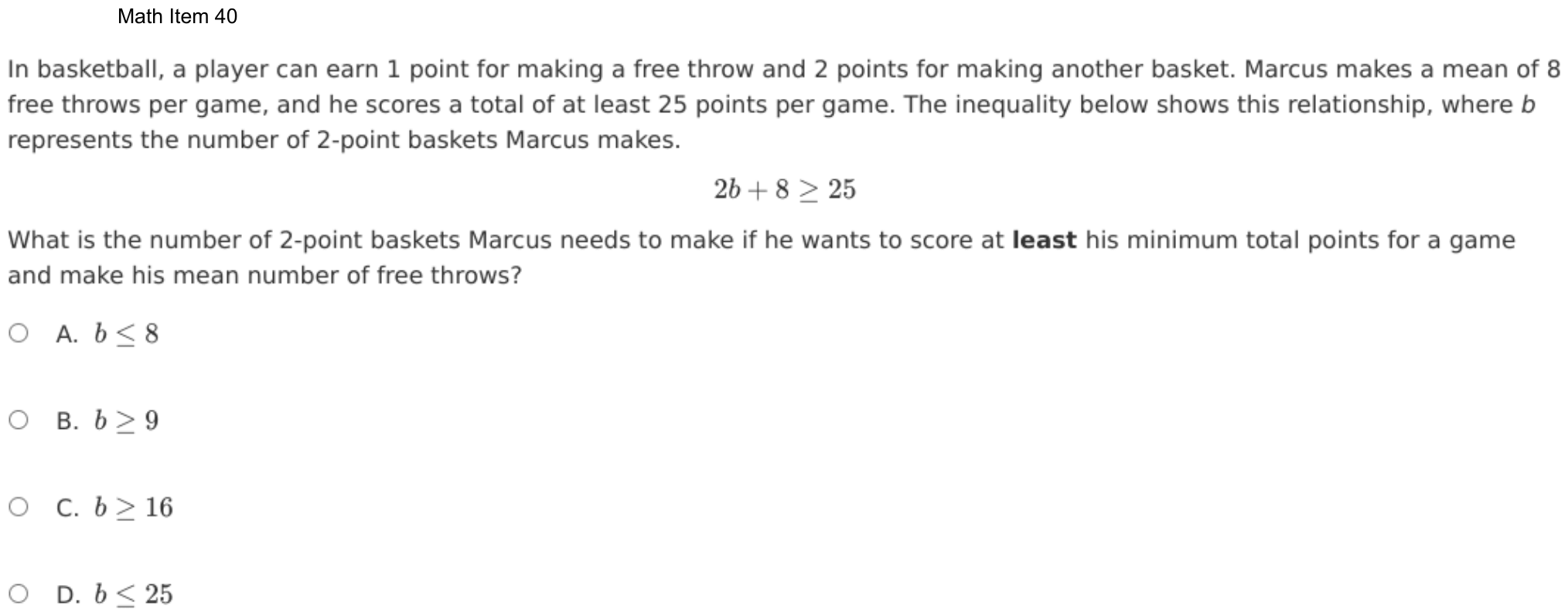
Question 14 of 107
2026 Practice Test C Math, question 41Question
Elijah is at the school bookstore. He wants to buy a water bottle for $12.50 and some notebooks that cost $4.75 each. He has at most $35.00 to spend. Write an inequality that represents the number of notebooks, n, Elijah can purchase.
Enter your answer in the space provided. Enter only your answer.
On the test you build the answer on an on-screen keypad; here, type it. Use ^ for a power, sqrt( ) or √ for a root, pi for π, and <= or >= for ≤ and ≥.
Show the answer
Correct answer: 12.50 + 4.75n ≤ 35.00
The question uses the phrase “at most,” which means “less than or equal to” (≤).
Since notebooks cost $4.75 each and Elijah will buy n notebooks, the total cost just for the notebooks is found by multiplying $4.75 by n, or .
Combining the cost of a water bottle ($12.50) with the cost of n notebooks, the inequality is .
This may also be written as .
Question analysis
Elijah has at most $35.00 to buy one water bottle and some notebooks at the school bookstore, with a price given for each. Students type an inequality for the number of notebooks, n, he can buy. It tests writing an inequality from a word problem. The two prices play different roles, and the phrase "at most" decides the inequality symbol.
- Grade level
- Grade 7 content, by NYS standard
- Compared with grade 7
- At grade 7 Writing an inequality for a budget with a one-time cost and a cost per item is typical grade 7 work. The answer is typed, so both the symbol for "at most" and the role of each price must be right.
- Estimated difficulty
- Straightforward: two steps or one careful reading.
- Thinking it demands
- Depth of knowledge 2, skills and concepts · mainly apply
- What makes it hard
- Turning words into math moderate
- An answer in an unexpected form minor
- Solution
- 2 steps
- Reading level
- Question and choices: about grade 5, 50 words.
- Students, last 30 days
- Not enough answers yet to show (it takes 10).
Why it is hard, traps and wrong answers (shows the answer)
Why it is hard
The prices are given in the order they are used, so the expression for the total is the easier half. The points are lost on the symbol: “at most” has to be heard as no more than, with equality allowed, and the keypad offers all four inequality signs side by side. Pricing one and two notebooks with the bottle, $17.25 and $22.00, shows which amount repeats and confirms the total.
Turning words into math moderate Understanding the question
The $12.50 bottle is bought once and the $4.75 is paid for each of n notebooks, and “at most $35.00” has to become ≤, which allows a total of exactly $35.00. (Hegarty, Mayer & Monk, 1995; Koedinger & Nathan, 2004)
An answer in an unexpected form minor Choosing the answer
The whole inequality, with n, its symbol and both prices, is built on a keypad offering ≤, <, ≥ and >, so a wrong symbol looks as complete as the right one. (Enright, Morley & Sheehan, 2002)
Strategy: Price a few cases by hand, such as 1 and 2 notebooks with the water bottle, to see which amount repeats, then decide whether a total of exactly $35.00 is allowed.
Traps
- Misreads the question: Misses or misreads a condition or a word in the question: "at least", "each", "remaining", "not".
- Counting the ends: Inclusive or exclusive ends, fence posts, consecutive numbers: an answer that is one too many or too few, or an endpoint drawn open where it belongs closed (or the reverse).
- Numbers taken from the question: Combines the numbers in the question without a model of the situation, or is simply a number that appears in the question.
The wrong answers, classified
12.50 + 4.75n ≥ 35.00 Misreads the question (Hegarty, Mayer & Monk, 1995)
Builds the total correctly but reads “at most” as at least, writing ≥, which would mean Elijah must spend $35.00 or more.
12.50 + 4.75n < 35.00 Counting the ends (Brown & Burton, 1978)
Builds the total correctly but uses a strict less-than sign, leaving out a total of exactly $35.00, which “at most” allows.
17.25n ≤ 35.00 Numbers taken from the question (Hegarty, Mayer & Monk, 1995)
Adds the bottle’s price to each notebook’s, $12.50 + $4.75 = $17.25, and multiplies by n, as if a bottle came with every notebook.
Worked solution, step by step
Formulas used
- Total cost with a one-time cost
- The one-time cost is paid once, no matter what. The price each is paid once for every item. n is the number of items. You multiply the price each by n because you pay it n times.
- At most
- The sign ≤ means less than or equal to. The total can be under the limit or exactly equal to it, but never over it. Use it for words like at most and no more than.
Sort out the question
Elijah buys one water bottle for $12.50. He also buys n notebooks at $4.75 each. He can spend at most $35.00.
You need an inequality for n. An inequality compares two amounts with a sign such as ≤ instead of =.
Price a few cases
Work out the cost for a few numbers of notebooks:
Notebooks Total ($) 1 2 3 The $12.50 shows up once. The $4.75 shows up once for each notebook.
Write the total cost
Use the total cost formula. The bottle is the one-time cost, and each notebook costs $4.75:
Here 4.75n means 4.75 times n.
Watch out: do not add the two prices first. charges for a new bottle with every notebook.
Choose the sign
At most $35.00 means the total can be less than $35.00 or exactly $35.00. It cannot be more. So use ≤:
Watch out: ≥ means at least, the opposite. And < leaves out a total of exactly $35.00, which Elijah is allowed to spend.
Enter it on the keypad
Type the whole inequality. Nothing is printed before the box. On the test, press 1, 2, ., 5, 0, +, 4, ., 7, 5, the n key, the ≤ key, then 3, 5, ., 0, 0. The ≤ key is in the fourth row. Skip the dollar signs. On this site, type <= for ≤.
So you would enter 12.50 + 4.75n ≤ 35.00. An equal form, such as 4.75n + 12.50 ≤ 35.00, counts too.
Check your answer
Test some numbers. For 4 notebooks, , which is not over 35.00. For 5 notebooks, , which is too much. So Elijah can buy up to 4 notebooks. That makes sense for a budget of $35.00.
More questions like this
The original DOE question
Question 15 of 107
2026 Practice Test D Math, question 2Question
What is the value of z in ?
- A1
- B5
- C
- D
Show the answer
Correct answer: D
First, multiply both sides of the equation by 10 to eliminate the fractions. In other words, multiply each term by 10.
Then, distribute and combine like terms to find the value for z.
Question analysis
This algebra question gives an equation with three letters and fractions, x over 10 plus (y − x) over 5 equals z over 10, and asks for the value of z. Students clear the denominators, distribute and combine like terms. The two fractions on the left have different denominators, which is where the usual slip happens.
- NYS standards
- Grade level
- Grade 7 content, by NYS standard
- Compared with grade 7
- At grade 7 Grade 7 students add and expand linear expressions with fraction coefficients, usually in one letter. Here three letters appear, one numerator is a difference, and the result is an expression rather than a number, which adds abstraction but no new skill.
- Estimated difficulty
- Moderate: several steps, or a close reading with one strong distractor.
- Thinking it demands
- Depth of knowledge 1, recall and reproduction · mainly apply
- What makes it hard
- Variables instead of numbers moderate
- Error-prone arithmetic moderate
- Solution
- 3 steps
- Reading level
- Question and choices: about grade 6, 10 words.
- Students, last 30 days
- Not enough answers yet to show (it takes 10).
Why it is hard, traps and wrong answers (shows the answer)
Why it is hard
The equation has three fractions and three letters, and the work is three routine moves: multiply through by 10, distribute, collect the x terms. Most errors come from the middle term, whose denominator 5 differs from the other two; treating it as tenths makes z simply y. Students who test values should avoid x = y, since that pair makes y and 2y − x agree, and x = y = 1 even makes the number 1 fit.
Variables instead of numbers moderate Understanding the question
The answer is z in terms of x and y, not a number, yet two choices are plain numbers, 1 and 5, which tempt students who expect the equation to give z a single value. (Koedinger & Nathan, 2004; Enright, Morley & Sheehan, 2002)
Error-prone arithmetic moderate Working it out
Clearing the denominators turns (y − x)/5 into 2(y − x), and the −2x from distributing must then combine with the lone x to leave −x, two places where a factor or a sign slips. (Brown & Burton, 1978; Junker & Sijtsma, 2001)
Strategy: Multiply every term on both sides by 10 so no fractions remain, distribute across the parentheses, and combine the x terms; substituting small numbers for x and y checks the result.
Traps
- A faulty procedure: A systematic but wrong procedure: adding fractions straight across, applying an exponent to each term of a sum, dropping a sign when moving a term.
- Numbers taken from the question: Combines the numbers in the question without a model of the situation, or is simply a number that appears in the question.
The wrong answers, classified
A Checks only one number (Schoenfeld, 1985)
Tests x = 1 and y = 1, gets 1/10 + 0 = z/10, so z = 1, and takes the choice that reads 1; any pair with x ≠ y rules it out.
B Numbers taken from the question (Hegarty, Mayer & Monk, 1995)
Expects z to be a number and takes the 5 from the middle denominator, a number copied from the equation rather than the result of any step.
C A faulty procedure (Brown & Burton, 1978; Tatsuoka, 1983)
Adds the numerators x and y − x over 10 as if (y − x)/5 were already in tenths, so the left side becomes y/10 and z = y.
Worked solution, step by step
Formulas used
- Doing the same to both sides
- a and b are the two sides of an equation. Multiplying both sides by the same number keeps them equal, like adding the same weight to both pans of a balance. Here 10 is a good choice, because it clears away every fraction.
- The distributive property
- a is the number outside the parentheses, and b and c are the terms inside. Multiply a by each term inside, and keep the minus sign between them. It works because a groups of (b − c) is a groups of b minus a groups of c.
Sort out the question
The equation has three letters, x, y and z. You need z written using x and y. The answer will not be one number, because x and y can be anything. The fractions make the work messy, so clear them first.
Multiply every term by 10
The bottoms are 10, 5 and 10, and each one divides into 10. So multiply every term by 10:
10 times x/10 is x. Since 10 ÷ 5 = 2, 10 times (y − x)/5 is 2(y − x). And 10 times z/10 is z.
Distribute the 2
Use the distributive property. Multiply the 2 by both y and x:
So the equation becomes:
Combine like terms
Like terms have the same letter. Here x and −2x are like terms. Since 1 − 2 = −1, they combine to −x:
That leaves:
Watch out: do not add the tops of x/10 and (y − x)/5 straight away. Their bottoms are different. Doing it anyway gives z = y, choice C. Choices A and B are plain numbers, but z changes when x and y do.
So the answer is D, .
Check your answer
Pick numbers. Let x = 2 and y = 7. The left side is 2/10 + 5/5 = 0.2 + 1 = 1.2. Choice D gives z = 2 × 7 − 2 = 12, and 12/10 = 1.2. Both sides match.
More questions like this
The original DOE question
Question 16 of 107
2026 Practice Test D Math, question 3Question
Two sets, R and S, are described below. The sum of the elements in set R equals the sum of the elements in set S.
What is the value of ?
- A−7
- B−5
- C5
- D7
Show the answer
Correct answer: B
First, find the sum for each set by adding the terms in each set separately.
The sum for set R is , which is .
The sum for set S is , which is .
The question states that these two sums are equal to each other, so write the equation and then rearrange using inverse operations.
If the rearranging to obtain the target value is unclear, use the equation and find a few possible values for x and y.
For example, if , then because . If , then because . Then find the value of . No matter which values are chosen, will always be .
Question analysis
Two sets of four numbers, R and S, each contain one unknown, x and y, and the sums of the two sets are equal. Students find the value of x − y without being able to find x or y alone. It tests writing and rearranging an equation, and deciding which way round the difference goes is the tricky part.
- Grade level
- Grade 7 content, by NYS standard
- Compared with grade 7
- At grade 7 Grade 7 students write and solve equations with one unknown. This one has two unknowns that are never found separately; students must rearrange to get their difference, a less familiar goal, though the arithmetic is light.
- Estimated difficulty
- Moderate: several steps, or a close reading with one strong distractor.
- Thinking it demands
- Depth of knowledge 2, skills and concepts · mainly apply
- What makes it hard
- A very close wrong answer moderate
- Variables instead of numbers minor
- Solution
- 3 steps
- Reading level
- Question and choices: about grade 4, 33 words.
- Students, last 30 days
- Not enough answers yet to show (it takes 10).
Why it is hard, traps and wrong answers (shows the answer)
Why it is hard
The sums take seconds; the point is lost on the sign. Because set R's known numbers add to more than set S's, x has to be the smaller unknown, so x − y is negative, but subtracting the two known sums in the order they appear gives a positive 5. Choosing one pair of values that balances the sets, such as x = 1 and y = 6, settles the sign at once.
A very close wrong answer moderate Choosing the answer
The choices pair −5 with 5 and −7 with 7, so the size 5 is easy to reach and only the order of subtraction, x − y rather than y − x, separates the right choice from its opposite. (Embretson & Wetzel, 1987; Gorin & Embretson, 2006; Ascalon et al., 2007)
Variables instead of numbers minor Understanding the question
Neither x nor y can be found, only the gap between them, so students who look for a value of each letter stall; the question rewards rearranging x + 16 = y + 11. (Koedinger & Nathan, 2004; Enright, Morley & Sheehan, 2002)
Strategy: Add the known numbers in each set, set the two sums equal, then move both letters to one side so it reads x − y; testing one pair of values confirms the sign.
Traps
- Negatives and direction: Arithmetic with negative numbers, the order of a subtraction, or direction on a number line. (Moving a term across the equals sign without changing its sign is a faulty procedure.)
The wrong answers, classified
A Little reason to choose it (Haladyna & Downing, 1993; Rodriguez, 2005)
No common working gives −7; it needs a slip in a sum, such as 18 for 5 + 3 + 8, so it mostly draws guesses near −5.
C Negatives and direction (Brown & Burton, 1978)
Subtracts the known sums in the order the sets appear, 16 − 11 = 5, which is y − x, missing that R's larger known sum makes x the smaller unknown.
D Little reason to choose it (Haladyna & Downing, 1993; Rodriguez, 2005)
Needs two unrelated errors, a slip in a sum and the subtraction reversed, so no single line of working reaches 7 and it mostly catches guesses.
Worked solution, step by step
Formulas used
- Doing the same to both sides
- a and b are two equal amounts, and c is any number or letter. Taking the same thing away from both sides keeps them equal. You use it to move terms around until the equation shows what you want.
Sort out the question
Set R holds 5, x, 3 and 8. Set S holds 6, y, 4 and 1. The elements (the members) of R add up to the same total as the elements of S. You cannot find x or y alone. But you can find , the gap between them.
Add up each set
Add the known numbers in each set, and keep the letter:
The two sums are equal, so:
Rearrange to get x − y
You want on one side. Subtract y from both sides:
Then subtract 16 from both sides:
Make sense of the sign
Set R already has 16 from its numbers, but set S has only 11. So y must be 5 more than x to make the sums match. That makes negative.
Watch out: 16 − 11 = 5 is , not . Using it leads to choice C.
So the answer is B, −5.
Check your answer
Try real values. If x = 1, then R adds to 17. So y + 11 = 17, and y = 6. Then . Try x = 10: then y = 15, and 10 − 15 = −5 again.
More questions like this
The original DOE question
Question 17 of 107
2026 Practice Test D Math, question 10Question
For what values of x is the above inequality true?
- A
- B
- C
- D
Show the answer
Correct answer: A
Use inverse operations to isolate the variable x by first getting the x variable on one side.
Now, when dividing by , the direction of the inequality sign changes.
Another way to solve is to keep the coefficient of x positive and then recognize that is the same as .
Question analysis
This algebra question asks which values of x make the inequality 2x + 11 > 3x + 9 true, choosing from four solution sets. It tests solving a linear inequality with the variable on both sides. Collecting the x terms can leave a negative coefficient, and handling the inequality sign at that point is where most mistakes happen.
- Grade level
- Grade 8 content, by NYS standard
- Compared with grade 7
- At grade 7 Two-step inequalities are grade 7 work, and having x on both sides, a grade 8 idea, takes only one extra subtraction here. The demand matches a careful grade 7 problem, with one sign decision that is easy to get wrong.
- Estimated difficulty
- Moderate: several steps, or a close reading with one strong distractor.
- Thinking it demands
- Depth of knowledge 1, recall and reproduction · mainly apply
- What makes it hard
- Error-prone arithmetic moderate
- A very close wrong answer moderate
- Solution
- 2 steps
- Reading level
- Question and choices: about grade 10, 15 words.
- Corrected from the DOE handbook
- A grammatical error in the explanation was corrected.
- Students, last 30 days
- Not enough answers yet to show (it takes 10).
Why it is hard, traps and wrong answers (shows the answer)
Why it is hard
The boundary 2 comes out of two routine moves; the direction is where points are lost. Whichever side the x terms are collected on, the last step either divides by a negative or leaves x on the right, and both moments invite a reversed answer. A second risk is moving the 9 without changing its sign, which yields 20. Substituting x = 0, which makes 11 > 9 true, confirms the direction.
Error-prone arithmetic moderate Working it out
Subtracting 3x from both sides leaves −x > −2, and dividing by −1 must reverse the sign; subtracting 2x instead leaves 2 > x, which still has to be read from the x side. (Brown & Burton, 1978; Junker & Sijtsma, 2001)
A very close wrong answer moderate Choosing the answer
x < 2 and x > 2 share the boundary and differ only in direction, so finding the 2 settles nothing; only the sign rule or a test value such as x = 0 decides. (Embretson & Wetzel, 1987; Gorin & Embretson, 2006; Ascalon et al., 2007)
Strategy: Subtract 2x from both sides so the x term stays positive, undo the + 9, then rewrite the result with x first; testing a value in the original inequality checks the direction.
Traps
- Negatives and direction: Arithmetic with negative numbers, the order of a subtraction, or direction on a number line. (Moving a term across the equals sign without changing its sign is a faulty procedure.)
- A faulty procedure: A systematic but wrong procedure: adding fractions straight across, applying an exponent to each term of a sum, dropping a sign when moving a term.
The wrong answers, classified
B Negatives and direction (Brown & Burton, 1978)
Reaches −x > −2 but divides by −1 without reversing the inequality, or reads 2 > x as x > 2, so the direction comes out backwards.
C A faulty procedure (Brown & Burton, 1978; Tatsuoka, 1983)
Moves the 9 across the inequality without changing its sign, 11 + 9 = 20 instead of 11 − 9 = 2, and keeps the direction right.
D A faulty procedure (Brown & Burton, 1978; Tatsuoka, 1983)
Moves the 9 without changing its sign to get 20 > x, then also rewrites that statement backwards as x > 20, two errors at once.
What was corrected from the DOE handbook, and why
- Explanation: The DOE’s explanation says “Another way to solve is to keep the coefficient of x positive and then recognizing that 2 > x is the same as x < 2.” The two verbs joined by “and then” should have the same form, so the site now says “and then recognize that”.
Worked solution, step by step
Formulas used
- Doing the same to both sides of an inequality
- a and b are the two sides, and c is any number or term. Subtracting (or adding) the same amount on both sides keeps the inequality true and its sign the same. That is how you move terms from one side to the other.
- Dividing by a negative number
- a and b are any numbers. Multiplying or dividing both sides by a negative number flips the sign, so > becomes <. For example, 3 > 2, but −3 < −2. Use it whenever you divide by a negative number.
Sort out the question
The sign > means is greater than. You need every value of x that makes 2x + 11 greater than 3x + 9. The answer is a range of values, not one number. Solve it like an equation, but keep an eye on the direction of the sign.
Gather the x terms on one side
The right side has more x’s, 3x, than the left side, 2x. So subtract 2x from both sides. That keeps the x term positive:
Get x by itself
Subtract 9 from both sides:
Watch out: to move the 9, subtract it from both sides. Adding it instead gives 20 > x, which leads to choice C or D.
Read it from the x side
says 2 is greater than x. That is the same as saying x is less than 2:
Watch out: when you swap the sides, the sign must point the other way. Writing gives choice B. If you subtract 3x instead, you get . Dividing by −1 then flips the sign, and you get again.
So the answer is A, .
Check your answer
Test x = 0, which is less than 2. The left side is 11 and the right side is 9, and 11 > 9 is true. Test x = 5, which is more than 2. The left side is 21 and the right side is 24, and 21 > 24 is false. So only values below 2 work.
More questions like this
The original DOE question
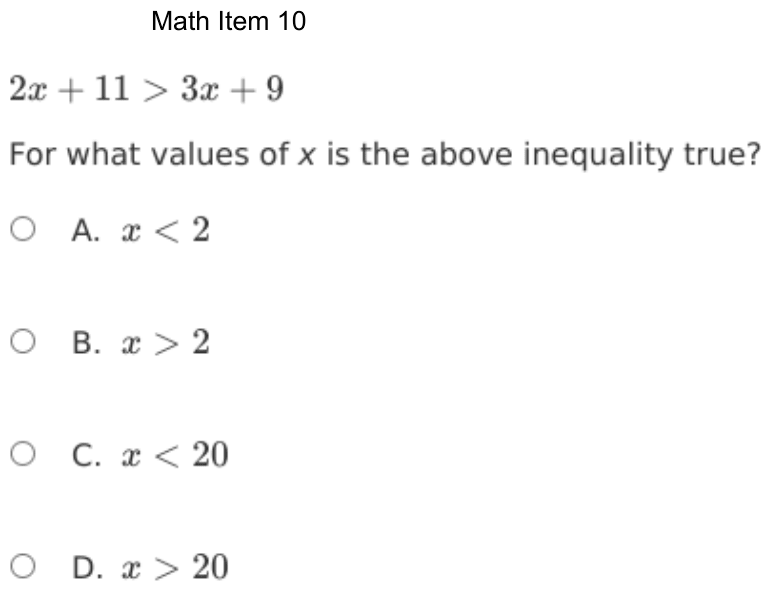
Question 18 of 107
2026 Practice Test D Math, question 13Question
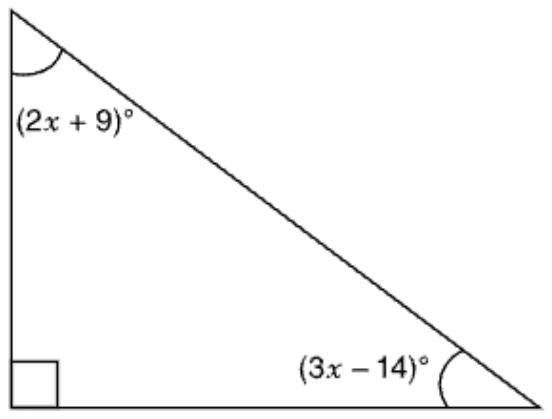
In the right triangle shown above, what is the measure of the smallest angle?
- A43°
- B44°
- C46°
- D47°
Show the answer
Correct answer: A
Since the three angles of a triangle have a sum of 180°, and since one angle is a right angle, the other two angles have a sum of 90°. By writing an equation and using inverse operations, the value of x can be found.
Now, use substitution to find the measure of the two angles to determine the smallest angle of the triangle.
The smallest angle is 43°.
Question analysis
A right triangle has its two other angles labeled (2x + 9)° and (3x − 14)°, and students find the measure of the smallest angle. It tests the angle sum of a triangle and solving a linear equation. Finding x is not the end: both angles must be worked out and compared to see which one is smallest.
- NYS standards
- Grade level
- Grade 8 content, by NYS standard
- Compared with grade 7
- Above grade 7 Grade 7 students write equations for unknown angles using complementary and supplementary angles. This also needs the angle sum of a triangle, which New York places in grade 8, plus substituting back and comparing, though each step is short.
- Estimated difficulty
- Moderate: several steps, or a close reading with one strong distractor.
- Thinking it demands
- Depth of knowledge 2, skills and concepts · mainly apply
- What makes it hard
- Combines ideas moderate
- Many steps minor
- Something you must already know minor
- Solution
- 4 steps
- Reading level
- Question and choices: about grade 6, 14 words.
- Students, last 30 days
- Not enough answers yet to show (it takes 10).
Why it is hard, traps and wrong answers (shows the answer)
Why it is hard
Setting the sum of the two labeled angles to 90° is the decision; the algebra after it is routine. The trap waits at the end: x = 19 is not an angle, and the expression at the top vertex, 2x + 9, gives the larger acute angle, 47°. Evaluating both expressions and checking that they add to 90° takes seconds and shows which one is smaller.
Combines ideas moderate Working it out
The angle facts and the algebra meet in one equation: the right angle means the two labeled angles add to 90°, and only that sum makes (2x + 9) + (3x − 14) solvable. (Embretson, 1998; Daniel & Embretson, 2010)
Many steps minor Working it out
After solving 5x − 5 = 90, both angle expressions must be evaluated and compared, because the question wants an angle, not x, and not the first angle found. (Daniel & Embretson, 2010; Enright, Morley & Sheehan, 2002)
Something you must already know minor Working it out
The 180° angle sum of a triangle is not printed, and only the small square at the bottom left shows that one angle is 90°. (Anderson & Krathwohl, 2001)
Strategy: Use the right angle to see that the other two angles add to 90°, solve that equation for x, then substitute into both expressions and compare them.
Traps
- Answers a different question: A choice is right for another quantity: the other unknown, the rest instead of the part, the part instead of the whole.
- A formula you must know: Needs a formula the test does not give: area, circumference, volume, probability rules.
The wrong answers, classified
B Little reason to choose it (Haladyna & Downing, 1993; Rodriguez, 2005)
No common working gives 44°; it sits one degree from the right measure and fits no consistent value of x, so it mostly draws estimates and guesses.
C Little reason to choose it (Haladyna & Downing, 1993; Rodriguez, 2005)
No common working gives 46°, which would need x = 20 and two angles adding to 95°, so it mostly catches guesses near 45°.
D Answers a different question (King et al., 2004; Hegarty, Mayer & Monk, 1995)
Solves x = 19 correctly but answers with 2x + 9 = 47°, the larger acute angle, instead of evaluating both expressions to find the smaller.
Worked solution, step by step
Formulas used
- Angles in a triangle
- a, b and c are the three angles of any triangle, in degrees. They always add up to 180 degrees. If you tear off the three corners and set them side by side, they make a straight line.
- The two other angles of a right triangle
- a and b are the two angles that are not the right angle. A right angle is 90 degrees, so the other two share what is left of the 180: 180 − 90 = 90.
Sort out the question
The small square at the bottom left corner marks a right angle, which is 90°. The top angle is (2x + 9)°, and the bottom right angle is (3x − 14)°. You need the smallest of the three angles. First find x, then find each angle.
Write an equation
The three angles add to 180°. The right angle uses 90° of that, so the other two angles add to 90°:
Solve for x
Combine the x terms, 2x + 3x = 5x. Combine the numbers, 9 − 14 = −5:
Add 5 to both sides, then divide both sides by 5:
Find both angles
Put x = 19 into each expression:
The three angles are 47°, 43° and 90°.
Watch out: x = 19 is not an angle. And the first angle you find, 47°, is not the smallest one. Stopping there gives choice D.
Pick the smallest angle
Compare 47°, 43° and 90°. The smallest is 43°. The figure is not drawn to scale, so do not judge the angles by how they look. Use the numbers.
So the answer is A, 43°.
Check your answer
Add the three angles: 47 + 43 + 90 = 180. That is the right total for a triangle. Also, 47 + 43 = 90, so the two smaller angles fill exactly what the right angle leaves.
More questions like this
The original DOE question
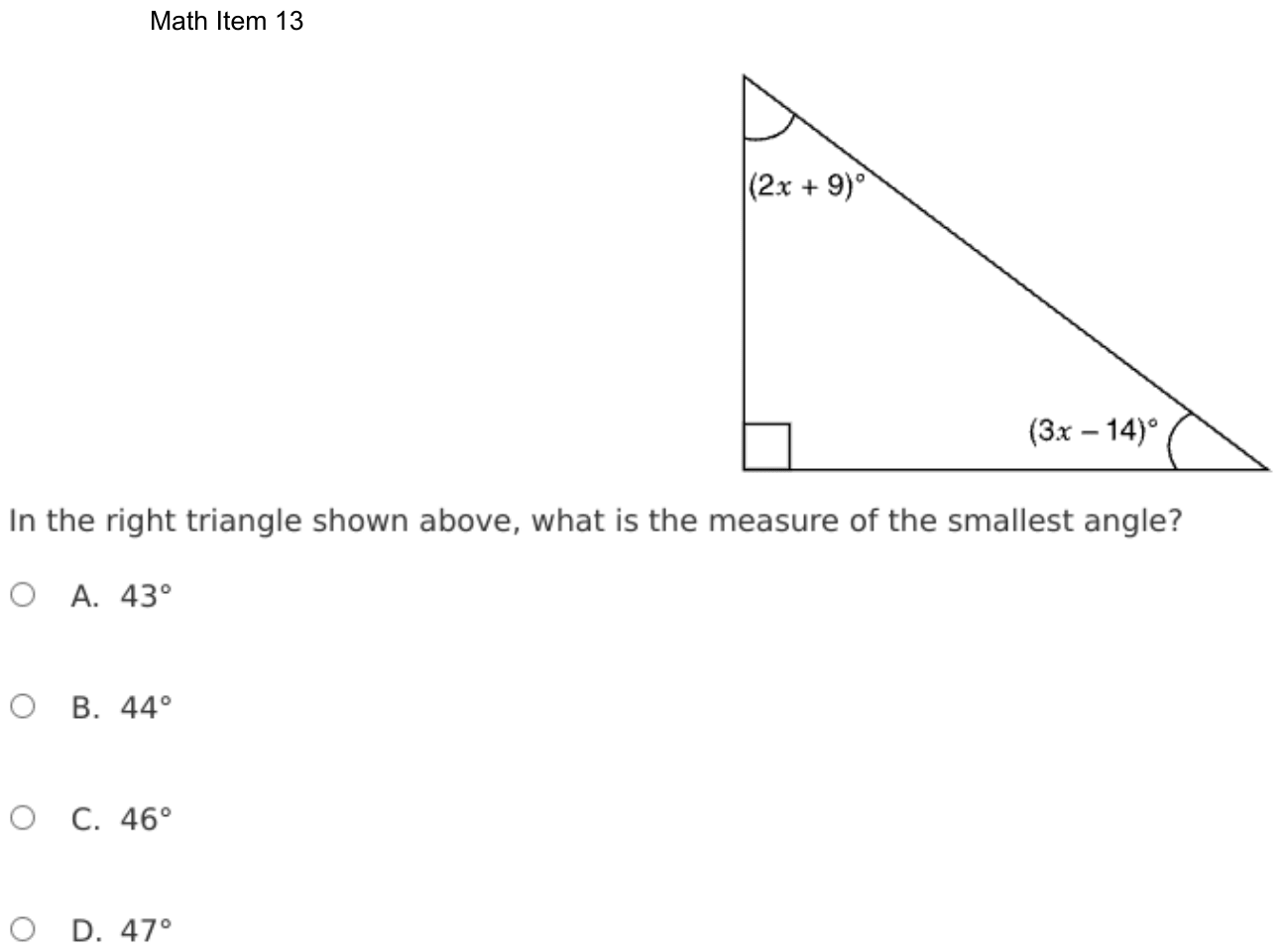
Question 19 of 107
2026 Practice Test D Math, question 14Question
James must read 84 pages of a book for a class assignment. If he reads of the pages in the morning and of the remaining pages in the afternoon, how many pages will he still need to read?
- A35
- B42
- C45
- D56
Show the answer
Correct answer: B
Pages read in the morning:
Pages remaining after the morning:
Pages read in the afternoon:
Pages he still needs to read:
Question analysis
James must read 84 pages for a class assignment: 1/4 of them in the morning, then 1/3 of the remaining pages in the afternoon. Students find how many pages he still has left to read. It tests finding a fraction of a quantity in stages, and the bold word remaining decides which amount the second fraction is taken of.
- Grade level
- Grade 7 content, by NYS standard
- Compared with grade 7
- At grade 7 Taking fractions of a quantity in stages is typical grade 7 work. The numbers divide evenly and the bold word flags the trap, so the four short steps match routine grade 7 demand.
- Estimated difficulty
- Straightforward: two steps or one careful reading.
- Thinking it demands
- Depth of knowledge 2, skills and concepts · mainly apply
- What makes it hard
- Many steps moderate
- Turning words into math minor
- Solution
- 4 steps
- Reading level
- Question and choices: about grade 7, 39 words.
- Students, last 30 days
- Not enough answers yet to show (it takes 10).
Why it is hard, traps and wrong answers (shows the answer)
Why it is hard
Each step is simple, but the second fraction has a different whole from the first. Students who take 1/3 of the full 84 pages get a tidy 28 and a listed answer, despite the bold word that warns against it. Here the pages read and the pages left both come to 42, so confusing those two quantities costs nothing, and checking that 21 + 21 + 42 = 84 confirms the work.
Many steps moderate Working it out
Four operations in order, a quarter of 84, a subtraction, a third of the 63 left, and a second subtraction, each feed the next, so a slip early carries through. (Daniel & Embretson, 2010; Enright, Morley & Sheehan, 2002)
Turning words into math minor Understanding the question
The bold “remaining” moves the base of the second fraction from all 84 pages to the 63 left after the morning, and “still need to read” asks for what is left, not what was read. (Hegarty, Mayer & Monk, 1995; Koedinger & Nathan, 2004)
Strategy: Work in order: find the morning's pages, subtract to get what remains, take 1/3 of that remainder, and subtract again; a quick bar sketch of the 84 pages helps.
Traps
- Misreads the question: Misses or misreads a condition or a word in the question: "at least", "each", "remaining", "not".
The wrong answers, classified
A Misreads the question (Hegarty, Mayer & Monk, 1995)
Takes 1/3 of all 84 pages for the afternoon, 28, instead of 1/3 of the 63 remaining, so 84 − 21 − 28 = 35.
C Little reason to choose it (Haladyna & Downing, 1993; Rodriguez, 2005)
No common working gives 45; it is not a fraction or a difference of any page count in the problem, so it mostly draws guesses near 42.
D Misreads the question (Hegarty, Mayer & Monk, 1995)
Takes the afternoon's third from all 84 pages and subtracts only that, 84 − 28 = 56, overlooking the 21 pages already read in the morning.
Worked solution, step by step
Formulas used
- A fraction of a number
- n is the whole amount, and a/b is the fraction you take. The word of means multiply. When the top, a, is 1, this is just n divided by b. For example, 1/4 of 84 is 84 ÷ 4.
Sort out the question
James has 84 pages to read. In the morning he reads 1/4 of all the pages. In the afternoon he reads 1/3 of the remaining pages, the ones still left after the morning. You need the number of pages he still has to read after that.
Find the morning pages
Take 1/4 of 84:
He reads 21 pages in the morning. That leaves:
63 pages are left after the morning.
Find the afternoon pages
The afternoon fraction is 1/3 of the 63 pages left, not of all 84:
He reads 21 pages in the afternoon.
Watch out: taking 1/3 of all 84 pages gives 28. Then 84 − 21 − 28 = 35, choice A. The bold word remaining tells you to use 63.
Find the pages still to read
Take the afternoon pages away from the 63 pages left after the morning:
He still needs to read 42 pages.
Watch out: subtract both readings, morning and afternoon. Taking only 28 from 84 gives 56, choice D.
So the answer is B, 42.
Check your answer
Add up all the parts: 21 pages in the morning, 21 in the afternoon and 42 still to read. 21 + 21 + 42 = 84, the whole assignment. Another way: after he reads 1/3 of the 63 pages, 2/3 of them are left, and 2/3 of 63 is 42.
More questions like this
The original DOE question
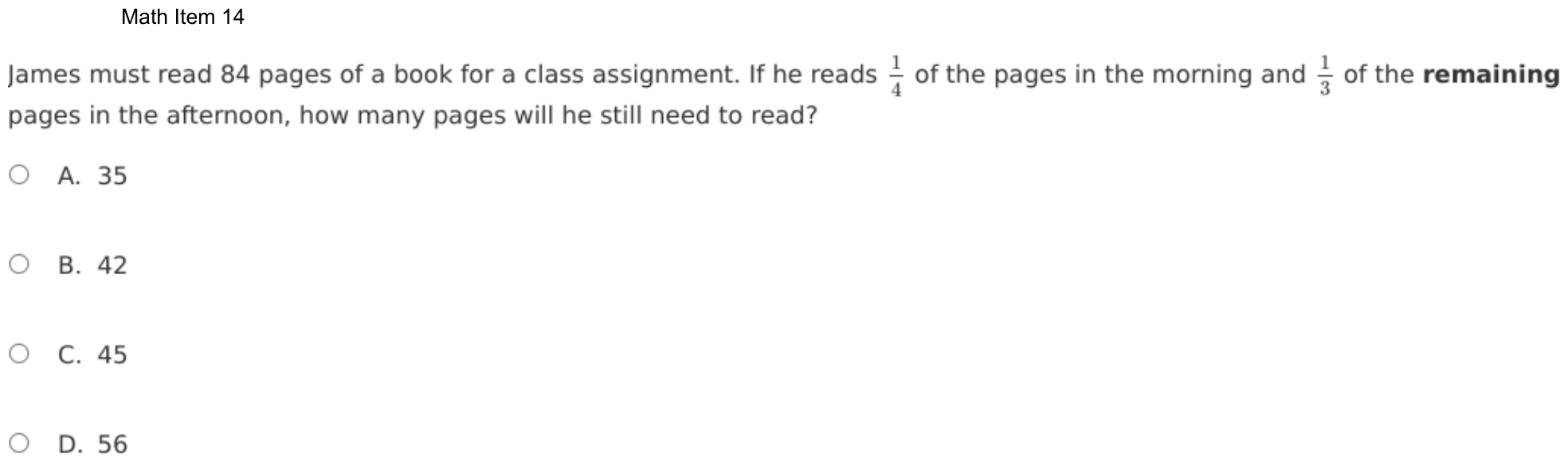
Question 20 of 107
2026 Practice Test D Math, question 22Question
Seth grows strawberries in his garden.
- He picked cups of strawberries on Monday.
- He picked 4 cups of strawberries on Tuesday.
- He ate cup of strawberries for breakfast each day on Wednesday, Thursday, and Friday.
How many cups of strawberries did Seth have left?
- A
- B
- C6
- D9
Show the answer
Correct answer: B
When Seth picks strawberries, the value represents a positive number, and when he eats the strawberries, the value represents a negative number. Write an expression and then evaluate the expression, where the negative value is multiplied by 3 because he ate the same amount on 3 different days.
If the multiplication is confusing, evaluate the expression below which represents the sum for the 5 days with each day listed separately.
Question analysis
Seth picked strawberries on Monday and Tuesday, in amounts given as a mixed number and a whole number, then ate the same fraction of a cup at breakfast on three days. Students find how many cups he has left. It tests adding, multiplying and subtracting fractions in a short word problem, and the eaten amount repeats each day.
- Grade level
- Grade 7 content, by NYS standard
- Compared with grade 7
- Below grade 7 Adding mixed numbers and multiplying a fraction by a whole number are skills from before grade 7. The three steps are short and the numbers friendly, so the demand is below typical grade 7 work with signed rational numbers.
- Estimated difficulty
- Straightforward: two steps or one careful reading.
- Thinking it demands
- Depth of knowledge 2, skills and concepts · mainly apply
- What makes it hard
- Error-prone arithmetic moderate
- Turning words into math minor
- Solution
- 3 steps
- Reading level
- Question and choices: about grade 6, 47 words.
- Students, last 30 days
- Not enough answers yet to show (it takes 10).
Why it is hard, traps and wrong answers (shows the answer)
Why it is hard
The bulleted list lays out the story day by day, so setting up the problem is easy; the points are lost in the fractions. The number of breakfast days, 3, sits right beside the 3/4 cup, and subtracting 3 cups instead of three quarters of a cup each day is the tempting shortcut. Writing every amount in fourths, 26/4 picked and 9/4 eaten, makes the last step a whole-number subtraction.
Error-prone arithmetic moderate Working it out
Three breakfasts of 3/4 cup make 9/4 = 2 1/4 cups, and taking that from 6 1/2 means renaming the half as 2/4, two fraction steps where a slip is easy. (Brown & Burton, 1978; Junker & Sijtsma, 2001)
Turning words into math minor Understanding the question
Picking adds and eating subtracts, and “each day on Wednesday, Thursday, and Friday” means the 3/4 cup counts three times, not once. (Hegarty, Mayer & Monk, 1995; Koedinger & Nathan, 2004)
Strategy: Add the two amounts picked, multiply the breakfast amount by the number of days, and subtract that from the total; writing every amount in fourths keeps the arithmetic simple.
Traps
- Numbers taken from the question: Combines the numbers in the question without a model of the situation, or is simply a number that appears in the question.
- Wrong operation: Adds instead of multiplying, divides the wrong way round, turns a ratio or rate upside down, or undoes a step in the wrong direction (subtracts what should be added back).
The wrong answers, classified
A Numbers taken from the question (Hegarty, Mayer & Monk, 1995)
Subtracts 3 cups, the number of breakfast days, instead of 3 × 3/4 = 2 1/4 cups, so 6 1/2 − 3 = 3 1/2.
C Little reason to choose it (Haladyna & Downing, 1993; Rodriguez, 2005)
No common working gives exactly 6; it is near the 6 1/2 cups picked and mostly catches students who drop the fractions or guess.
D Wrong operation (Hegarty, Mayer & Monk, 1995; King et al., 2004)
Adds the 2 1/4 cups eaten to the 6 1/2 cups picked instead of subtracting, 8 3/4 cups, and takes the nearest choice, 9.
Worked solution, step by step
Formulas used
- Total of a repeated amount
- Use it when the same amount happens again and again. Here Seth eats 3/4 cup on each of 3 days, so the number of times is 3 and the amount each time is 3/4 cup.
- A whole number times a fraction
- n is a whole number, and a/b is a fraction. Multiply the whole number by the top only, and keep the bottom. It works because n groups of a pieces make n × a pieces, and each piece is still size 1/b.
Sort out the question
Seth picked 2 1/2 cups on Monday and 4 cups on Tuesday. Then he ate 3/4 cup each day on Wednesday, Thursday and Friday. That is 3 days of eating. Picking adds strawberries, and eating takes them away. You need the number of cups he has left.
Add what he picked
Add the two days of picking:
He picked 6 1/2 cups in all, before he ate any.
Find how much he ate
He ate 3/4 cup on each of 3 days. Multiply:
To change 9/4 to a mixed number, note that 4 fits into 9 twice, with 1 left over. He ate 2 1/4 cups.
Watch out: he ate 3/4 cup three times, not 3 cups. Subtracting 3 gives 3 1/2, choice A.
Take away what he ate
Write the half as fourths, so both fractions have the same bottom: 1/2 = 2/4. Then subtract the wholes and the fourths:
Watch out: eating takes away. Adding the 2 1/4 cups gives 8 3/4, and the nearest choice is 9, choice D.
So the answer is B, cups.
Check your answer
Use decimals. 2.5 + 4 = 6.5 cups picked. 3 × 0.75 = 2.25 cups eaten. Then 6.5 − 2.25 = 4.25 cups, which is 4 1/4.
More questions like this
The original DOE question
Question 21 of 107
2026 Practice Test D Math, question 26Question
Jordan has a budget of $120 to rent a food truck. The rental company charges $18 per hour to rent the truck, plus a one-time cleaning fee of $30.
Write an inequality that represents this situation, in which x is the number of hours Jordan can rent the truck.
Enter your answer in the space provided. Enter only your answer.
On the test you build the answer on an on-screen keypad; here, type it. Use ^ for a power, sqrt( ) or √ for a root, pi for π, and <= or >= for ≤ and ≥.
Show the answer
Correct answer: 30 + 18x ≤ 120
Let x represent the number of hours Jordan can rent the truck.
The hourly rental cost can be represented as , written as .
The one-time cleaning fee of $30 is added to the hourly cost to obtain the total cost.
The sum of the cleaning fee and the hourly rental cost is represented as .
As Jordan has $120 to spend, the total cost must be less than or equal to $120.
This is represented as or .
Question analysis
Jordan has $120 to rent a food truck that costs $18 an hour plus a one-time $30 cleaning fee, and students type an inequality for x, the number of hours. It tests writing a two-step inequality from a word problem. Matching each dollar amount to its role and choosing the symbol that fits a spending limit are the tricky parts.
- Grade level
- Grade 7 content, by NYS standard
- Compared with grade 7
- At grade 7 Writing a two-step inequality from a word problem is the grade 7 standard itself. Nothing is offered to choose from: students type the whole inequality, so the numbers, the variable term and the symbol are all theirs to get right.
- Estimated difficulty
- Moderate: several steps, or a close reading with one strong distractor.
- Thinking it demands
- Depth of knowledge 2, skills and concepts · mainly apply
- What makes it hard
- Turning words into math moderate
- An answer in an unexpected form minor
- Solution
- 3 steps
- Reading level
- Question and choices: about grade 6, 57 words.
- Corrected from the DOE handbook
- A spelling error in the explanation was corrected.
- Students, last 30 days
- Not enough answers yet to show (it takes 10).
Why it is hard, traps and wrong answers (shows the answer)
Why it is hard
The arithmetic is small, so the points ride on two decisions the keypad leaves open: which symbol, and whether to stop before solving. A budget means Jordan may spend all $120 but no more, so the total cost must stay at or under it, and a strict < leaves out the five-hour rental that costs exactly $120. Testing x = 5 and x = 6 in the typed inequality confirms both the symbol and the setup.
Turning words into math moderate Understanding the question
The stem never says “at most”: the limit comes only from “a budget of $120”, while “$18 per hour” must multiply x and the “one-time cleaning fee of $30” is added just once. (Hegarty, Mayer & Monk, 1995; Koedinger & Nathan, 2004)
An answer in an unexpected form minor Choosing the answer
The whole inequality is typed on a keypad that offers <, ≤, > and ≥ side by side, with no choices to compare, and the solved form x ≤ 5 is not accepted. (Enright, Morley & Sheehan, 2002)
Strategy: Work out what 1 hour and 2 hours would cost Jordan in all, see which amount repeats each hour, build the total for x hours, then compare it with the budget and test a few values.
Traps
- Counting the ends: Inclusive or exclusive ends, fence posts, consecutive numbers: an answer that is one too many or too few, or an endpoint drawn open where it belongs closed (or the reverse).
- Misreads the question: Misses or misreads a condition or a word in the question: "at least", "each", "remaining", "not".
The wrong answers, classified
30 + 18x < 120 Counting the ends (Brown & Burton, 1978)
Builds the cost 30 + 18x correctly but uses a strict less-than sign, which shuts out a five-hour rental costing exactly the $120 Jordan has.
30 + 18x ≥ 120 Misreads the question (Hegarty, Mayer & Monk, 1995)
Builds the cost correctly but points the symbol the wrong way, treating the $120 budget as an amount Jordan must spend at least instead of a limit.
x ≤ 5 Misreads the question (Hegarty, Mayer & Monk, 1995)
Writes and solves the inequality correctly, then enters its solution, x ≤ 5, though the item asks for the inequality showing the fee, the hourly charge and the budget.
What was corrected from the DOE handbook, and why
- Explanation: The DOE’s explanation says “The onetime cleaning fee of $30 is added to the hourly cost …”. “Onetime” means “former”; a fee charged once is a “one-time” fee, as the question itself spells it. The site now says “one-time”.
Worked solution, step by step
Formulas used
- Total cost with a fee and a rate
- The fee is a charge paid only once, so you add it once. The rate is the charge for each hour. x is the number of hours. You multiply the rate by x because it is paid again for every hour.
- Staying within a budget
- The sign ≤ means is less than or equal to. A budget is the most money you can spend. You may spend all of it, or less, but never more. So the total cost must be less than or equal to the budget.
Sort out the question
You know three facts:
- Jordan can spend at most $120. That is the budget.
- The truck costs $18 for each hour.
- A cleaning fee of $30 is paid one time only.
x is the number of hours. You need an inequality. That is a math sentence that compares two amounts with a sign such as < or ≤. It must show all three facts.
Work out a few totals
Find the total cost for a few hours. Each hour adds one more $18:
Hours Hourly charges ($) Total cost ($) 1 2 x The $30 shows up once in every total. The $18 shows up once for each hour. So x hours cost 30 + 18x dollars. Here 18x means 18 times x.
Choose the right sign
The total cost must fit inside the budget. Jordan may spend exactly $120, or less, but not more. That is less than or equal to, the sign ≤. So:
Watch out: the sign < means less than, but not equal. leaves out spending exactly $120. The sign ≥ is backward too. It says Jordan must spend at least $120. Also keep each number in its place. charges $30 an hour.
Stop before you solve
You could solve the inequality. Subtract 30 from both sides to get . Then divide both sides by 18 to get . So Jordan can rent the truck for at most 5 hours.
Watch out: the question asks for an inequality that models the situation. To model means to show the facts of the story in math. The solved form, x ≤ 5, is true, but it hides the $18, the $30 and the $120. So x ≤ 5 is not accepted. Enter the inequality before you solve it.
Enter it on the keypad
On the test, build the inequality on the keypad. Press 3, 0, +, 1, 8 and the x key. Then press the ≤ key, in the fourth row of keys. Then press 1, 2, 0. You need no dollar signs and no times sign. On this site, type it, with <= for ≤: 30 + 18x <= 120.
So you would enter 30 + 18x ≤ 120. The same inequality written the other way round, 120 ≥ 30 + 18x, is also right. The solved form, x ≤ 5, is not accepted, because it does not model the situation.
Check your answer
Test two numbers of hours. For 5 hours, . Is 120 ≤ 120? Yes, so 5 hours fit the budget. For 6 hours, . Is 138 ≤ 120? No, and $138 is over budget. The inequality gets both right.
More questions like this
The original DOE question
Question 22 of 107
2026 Practice Test D Math, question 40Question
A team is participating in a contest to collect canned goods for a food drive. The team has 53 points and must have a total of at least 100 points to win a prize. The team earns 5 points for each can of food a member collects. Which inequality can be used to find x, the number of cans of food the team needs to collect to win a prize?
- A
- B
- C
- D
Show the answer
Correct answer: D
Since each can is worth 5 points, the total number of points earned from all the cans, x, is 5x. The team started with 53 points. That is a constant value and doesn’t change. So the total number of points the team will earn is . The team wants to earn at least (≥) 100 points, so they need total points.
Question analysis
A team has 53 points in a canned-food drive, earns 5 points for each can, and needs at least 100 points to win a prize. Students choose the inequality for x, the number of cans the team must collect. It tests writing an inequality from words, where the starting points and the points per can must each take the right place.
- Grade level
- Grade 7 content, by NYS standard
- Compared with grade 7
- At grade 7 Writing an inequality for a word problem with a starting amount and a rate is grade 7 work. The four choices pair two expressions with two symbols, so students make one decision about the terms and one about the phrase "at least".
- Estimated difficulty
- Straightforward: two steps or one careful reading.
- Thinking it demands
- Depth of knowledge 2, skills and concepts · mainly apply
- What makes it hard
- Turning words into math moderate
- A very close wrong answer minor
- Solution
- 2 steps
- Reading level
- Question and choices: about grade 4, 71 words.
- Students, last 30 days
- Not enough answers yet to show (it takes 10).
Why it is hard, traps and wrong answers (shows the answer)
Why it is hard
The choices form a two-by-two grid: which number goes with x, and which way the symbol points. Each decision can be made separately, so a student who settles both gets the item, while one mistake lands on a listed choice. Testing two numbers of cans, 5, which leaves the team at 78 points, and 10, which lifts it to 103, rules out every wrong inequality.
Turning words into math moderate Understanding the question
The 53 points the team “has” are a fixed start, the “5 points for each can” go with x, and “at least 100” calls for ≥, though “least” can sound like less. (Hegarty, Mayer & Monk, 1995; Koedinger & Nathan, 2004)
A very close wrong answer minor Choosing the answer
The four choices are two expressions, 5 + 53x and 53 + 5x, each with ≤ and with ≥, so the right one and the strongest wrong one differ only in the symbol. (Embretson & Wetzel, 1987; Gorin & Embretson, 2006; Ascalon et al., 2007)
Strategy: Work out the team's total points after 2 cans and then after x cans, translate "at least 100" into a symbol, and compare the result with each choice.
Traps
- Misreads the question: Misses or misreads a condition or a word in the question: "at least", "each", "remaining", "not".
- Misunderstands the concept: A wrong belief about a concept: that percents can be added, that area grows like length, that averages can be averaged, that a bigger denominator means a bigger fraction.
The wrong answers, classified
A Misunderstands the concept (Smith, diSessa & Roschelle, 1993; De Bock et al., 1998; Ni & Zhou, 2005)
Attaches x to the 53 points the team already has and also reverses “at least”, combining the mistakes behind the other two wrong choices.
B Misunderstands the concept (Smith, diSessa & Roschelle, 1993; De Bock et al., 1998; Ni & Zhou, 2005)
Keeps the right symbol but multiplies the number of cans by 53 and adds 5, putting the starting points where the points per can belong.
C Misreads the question (Hegarty, Mayer & Monk, 1995)
Writes the points correctly as 53 + 5x but reads “at least 100” as at most 100, reversing the inequality.
Worked solution, step by step
Formulas used
- Total with a start and a rate
- The start is the amount you have now, here 53 points. The rate is what each item adds, here 5 points for each can. x is the number of items. The start is added once, and the rate is multiplied by x.
- At least
- The sign ≥ means is greater than or equal to. At least 100 means 100 or more. So the total must be greater than or equal to 100.
Sort out the question
You know:
- The team already has 53 points.
- It earns 5 points for each can.
- It needs at least 100 points to win.
x is the number of cans. You need the inequality that shows this.
Write the total points
Try 2 cans first. The team gets 5 points for each, so points. For x cans, the total is:
Watch out: the 53 points do not repeat for each can. gives 53 points for each can, as in choices A and B.
Choose the sign
At least 100 means 100 or more, so use ≥:
Watch out: “least” sounds like “less,” but at least means the total can be 100 or higher. Using ≤ gives choice C.
So the answer is D, .
Check your answer
Test two numbers of cans. With 10 cans, , and 103 ≥ 100 is true. The team wins. With 9 cans, , and 98 ≥ 100 is false. The team is short. Choice D gets both right.
More questions like this
The original DOE question
Question 23 of 107
2026 Practice Test D Math, question 44Question
A bakery charges $1.25 for each cupcake and $2.50 for a serving tray. The equation describes p, the price of c cupcakes and a serving tray, not including tax.
If Samantha bought some cupcakes and a serving tray for a total of $22.50, not including tax, how many cupcakes did she buy?
- A4
- B9
- C16
- D18
Show the answer
Correct answer: C
Using the specified equation , determine the number of cupcakes Samantha bought by substituting the total paid ($22.50) for p, and solve the equation for the value of c, the number of cupcakes bought.
Question analysis
A bakery's price for c cupcakes and a serving tray is given by the equation p = 2.50 + 1.25c, and Samantha paid $22.50 before tax. This equation question asks how many cupcakes she bought. Students substitute the total and solve a two-step equation with decimal money amounts, undoing the steps in the right order.
- Grade level
- Grade 7 content, by NYS standard
- Compared with grade 7
- At grade 7 Solving a two-step equation of the form px + q = r in a money context is core grade 7 algebra. The equation is given, so the work is substituting the total and dividing by a decimal, a routine example.
- Estimated difficulty
- Straightforward: two steps or one careful reading.
- Thinking it demands
- Depth of knowledge 1, recall and reproduction · mainly apply
- What makes it hard
- Error-prone arithmetic minor
- Solution
- 2 steps
- Reading level
- Question and choices: about grade 6, 50 words.
- Students, last 30 days
- Not enough answers yet to show (it takes 10).
Why it is hard, traps and wrong answers (shows the answer)
Why it is hard
The equation is supplied, so the question is a two-step solve with money. The tray’s $2.50 has to come off the total before dividing, and students who divide the whole $22.50 by $1.25 get a whole number that matches a choice, so nothing warns them. Substituting the chosen number back into p = 2.50 + 1.25c is a quick, decisive check.
Error-prone arithmetic minor Working it out
After subtracting the tray, $20 must be divided by $1.25, a decimal divisor that is easiest handled as 2,000 ÷ 125 or by noting that 4 cupcakes cost $5. (Brown & Burton, 1978; Junker & Sijtsma, 2001)
Strategy: Substitute the total for p, subtract the tray's cost from both sides, then divide by the price of one cupcake; check by putting your number back into the equation.
Traps
- Misreads the question: Misses or misreads a condition or a word in the question: "at least", "each", "remaining", "not".
- Numbers taken from the question: Combines the numbers in the question without a model of the situation, or is simply a number that appears in the question.
The wrong answers, classified
A Stops one step early (King et al., 2004; Gierl et al., 2017)
Notes that 4 cupcakes cost $5.00 and that the $20 left after the tray holds four such amounts, then gives the 4 groups instead of 16 cupcakes.
B Numbers taken from the question (Hegarty, Mayer & Monk, 1995)
Divides the $22.50 total by the $2.50 tray price, combining two numbers from the question without using the equation.
D Misreads the question (Hegarty, Mayer & Monk, 1995)
Divides the whole $22.50 by $1.25 a cupcake, forgetting that $2.50 of the total paid for the serving tray.
Worked solution, step by step
Formulas used
- Doing the same to both sides
- a and b are the two sides of an equation, and n is any number (not zero when you divide). An equation is like a balanced scale. Doing the same thing to both sides keeps it level. That is how you get c, the number of cupcakes, by itself.
Sort out the question
The equation gives the price. p is the price in dollars, and c is the number of cupcakes. The 2.50 is the tray, and 1.25 is the price of one cupcake. Samantha paid $22.50. You need c.
Put in the total
Samantha paid $22.50 in all, so put 22.50 in place of p. Now the equation has only one unknown, c:
Subtract the tray
Take 2.50 away from both sides. That removes the cost of the tray:
So $20.00 went to cupcakes alone.
Watch out: dividing all of $22.50 by $1.25 gives 18, choice D. That forgets the tray.
Divide by the price of one cupcake
Divide both sides by 1.25:
An easy way: 4 cupcakes cost dollars. $20 is 4 groups of $5. So Samantha bought cupcakes.
Watch out: 4 is the number of $5 groups, not cupcakes. That is choice A.
So the answer is C, 16.
Check your answer
Put 16 back into the equation. , and . That is what Samantha paid, so 16 is right.
More questions like this
The original DOE question
Question 24 of 107
2026 Practice Test D Math, question 45Question
Marcus and Isla are saving money to buy concert tickets.
- They decide to save the same amount each week.
- They already have $8 saved.
- After 3 weeks, the two have $26 saved in total.
How much money, in dollars, is being saved by Marcus and Isla each week?
Enter your answer in the space.
Fill-in question: work out the answer and type it as a number.
Show the answer
Correct answer: 6
Define the variable:
Let w represent the amount of money Marcus and Isla save per week.
Construct an equation:
Start with $8.
Marcus and Isla save w each week for 3 weeks, which can be expressed as or .
The total amount saved can be represented by the expression .
After 3 weeks, Marcus and Isla have $26. This can be represented by the equation .
Solve the equation:
(subtracting 8 from both sides)
(dividing both sides by 3)
Marcus and Isla are saving $6 per week.
Question analysis
Marcus and Isla already have $8 toward concert tickets, save the same amount each week, and have $26 in all after 3 weeks. Students type how many dollars the two of them save each week. It tests writing and solving a two-step equation, keeping the money saved beforehand apart from the weekly savings.
- NYS standards
- 7.EE.4a two-step equations
- Grade level
- Grade 7 content, by NYS standard
- Compared with grade 7
- At grade 7 Writing and solving an equation of the form px + q = r from a word problem is the grade 7 standard. This one uses small whole numbers and two steps, a typical classroom example, with no choices to compare.
- Estimated difficulty
- Straightforward: two steps or one careful reading.
- Thinking it demands
- Depth of knowledge 2, skills and concepts · mainly apply
- What makes it hard
- Solution
- 2 steps
- Reading level
- Question and choices: about grade 4, 51 words.
- Students, last 30 days
- Not enough answers yet to show (it takes 10).
Why it is hard, traps and wrong answers (shows the answer)
Why it is hard
Two inverse steps solve it, subtracting the starting $8 and dividing by the 3 weeks, and most mistakes drop one of them. The $18 saved over three weeks is the natural stopping place, and dividing $26 by 3 without removing the $8 gives an awkward value that should prompt a second look. Adding three weeks of the answer to $8 and getting $26 confirms it.
Turning words into math minor Understanding the question
The bullet points hold a start amount, “already have $8 saved”, and a total after three weeks, “$26 saved in total”, which must become 8 + 3w = 26. (Hegarty, Mayer & Monk, 1995; Koedinger & Nathan, 2004)
An answer in an unexpected form minor Choosing the answer
The amount is typed with no choices, so stopping at the 3-week total of $18 leaves a whole number that nothing on screen questions. (Enright, Morley & Sheehan, 2002)
Strategy: Take away the amount saved before the weeks began, then share what is left equally among the weeks; check by adding three weeks of savings to the starting amount.
Traps
- Stops one step early: A choice is a number from partway through the solution.
- Answers a different question: A choice is right for another quantity: the other unknown, the rest instead of the part, the part instead of the whole.
- Misreads the question: Misses or misreads a condition or a word in the question: "at least", "each", "remaining", "not".
The wrong answers, classified
18 Stops one step early (King et al., 2004; Gierl et al., 2017)
Subtracts the $8 already saved from the $26 total and stops, giving the amount saved over all 3 weeks rather than in each week.
26/3 Misreads the question (Hegarty, Mayer & Monk, 1995)
Divides the $26 total by the 3 weeks, 26 ÷ 3 = 8 2/3, about $8.67, forgetting that $8 of it was saved before the weekly saving began.
3 Answers a different question (King et al., 2004; Hegarty, Mayer & Monk, 1995)
Finds the weekly amount and then halves it for each person, though the question asks what Marcus and Isla save together each week.
Worked solution, step by step
Formulas used
- Total savings
- The start is the money saved before the weeks begin. The amount each week is added once for every week, so you multiply it by the number of weeks. The total is all the money together.
- Doing the same to both sides
- a and b are the two sides of an equation, and c is any number (not zero when you divide). Doing the same thing to both sides keeps them equal. That is how you get the unknown by itself.
Sort out the question
You know:
- Marcus and Isla already have $8.
- They save the same amount each week.
- After 3 weeks they have $26 in all.
You need the amount the two of them save together each week.
Write an equation
Let w be the dollars saved each week. Three weeks add 3w dollars to the $8 they started with:
Subtract the starting money
Take 8 away from both sides:
They saved $18 over the 3 weeks.
Watch out: 18 is the amount for all 3 weeks, not for each week. Do not stop here.
Divide by the number of weeks
Divide both sides by 3:
They save $6 each week.
Watch out: dividing all $26 by 3 gives about 8.67. That forgets the $8 saved before. Halving 6 to get 3 is wrong too: the question asks what the two save together.
Enter the answer
Type only the number in the box, with no dollar sign and no units. So you would enter 6.
Check your answer
Count up week by week. Start at $8. After week 1: . After week 2: . After week 3: . That is the $26 in the question.
More questions like this
The original DOE question
Question 25 of 107
2026 Practice Test D Math, question 46Question
A company charges $3.00 to ship a 4-pound package. The cost includes a base fee of $1.50 plus $0.50 for each pound over the first pound. The table below illustrates how the cost depends on the total weight of the package. Complete the table by matching each total weight to its correct total shipping cost.
Move the correct answer to each box. Not all answers will be used.
SHIPPING COSTS
| Total Weight (pounds) | Total Cost to Ship (dollars) |
|---|---|
| 2 | |
| 2.50 | |
| 6 | |
| 5.50 |
On the test you drag tiles into the boxes; here, choose each box’s tile from its menu. Each tile can be used once. The DOE has not published how answers with several parts are scored; this site counts one right only when every part is right.
Show the answer
Correct answer: blank 1: 2; blank 2: 3; blank 3: 4; blank 4: 9
| Total Weight (pounds) | Total Cost to Ship (dollars) |
|---|---|
| 2 | 2 |
| 3 | 2.50 |
| 6 | 4 |
| 9 | 5.50 |
Let x represent the weight of the package in pounds. The first pound is included in the base fee of $1.50, so represents the number of pounds that cost $0.50 each.
The cost equation can be written as
- The cost for a 2-pound package is
- The cost for a 6-pound package is
-
The weight of a package that costs $2.50 to ship can be found by solving
-
The weight of a package that costs $5.50 to ship can be found by solving
To check:
Given that the total cost is $3.00 for the initial package
pounds fits the linear pattern of the table
Question analysis
A shipping company charges a base fee plus 50 cents for each pound over the first, and a 4-pound package costs $3.00. Students drag number tiles into a table to complete two costs and two weights, with some tiles left unused. It tests building and using a linear rule, and the wording about the first pound must be applied in every row.
- Grade level
- Grade 7 content, by NYS standard
- Compared with grade 7
- At grade 7 Grade 7 students solve word problems with equations like p(x + q) = r. This table needs that rule four times, twice run backward from a cost to a weight, and the phrase about the first pound must be applied every time.
- Estimated difficulty
- Moderate: several steps, or a close reading with one strong distractor.
- Thinking it demands
- Depth of knowledge 2, skills and concepts · mainly apply
- What makes it hard
- Turning words into math moderate
- Many steps minor
- Solution
- 4 steps
- Reading level
- Question and choices: about grade 4, 75 words.
- Students, last 30 days
- Not enough answers yet to show (it takes 10).
Why it is hard, traps and wrong answers (shows the answer)
Why it is hard
The rule is stated in words and confirmed by the 4-pound example, so the work is applying it consistently in both directions. Charging every pound breaks the $3.00 example at once, since 4 pounds would cost $3.50, and models that ignore the wording leave costs or weights with no matching tile. A shortcut helps: each extra pound adds $0.50 to the $3.00, so the table can be filled by counting up or down from 4 pounds.
Turning words into math moderate Understanding the question
The phrase “$0.50 for each pound over the first pound” means the first pound is covered by the $1.50 fee, so a package of x pounds pays for only x − 1 of them. (Hegarty, Mayer & Monk, 1995; Koedinger & Nathan, 2004)
Many steps minor Working it out
Four boxes must all be right, two found forward from a weight and two backward from a cost, and the backward rows need the first pound added back. (Daniel & Embretson, 2010; Enright, Morley & Sheehan, 2002)
Strategy: Write the rule as the base fee plus $0.50 times the pounds after the first, check it against the 4-pound example, then use it forward for the costs and backward for the weights.
Traps
- Misreads the question: Misses or misreads a condition or a word in the question: "at least", "each", "remaining", "not".
- Misunderstands the concept: A wrong belief about a concept: that percents can be added, that area grows like length, that averages can be averaged, that a bigger denominator means a bigger fraction.
- Stops one step early: A choice is a number from partway through the solution.
The wrong answers, classified
BAEH Misreads the question (Hegarty, Mayer & Monk, 1995)
Charges $0.50 for every pound, first included, so 2 pounds cost $2.50 and $2.50 ships 2 pounds; no tile fits its $4.50 or 8, so it settles for 4 and 9.
ACFH Misunderstands the concept (Smith, diSessa & Roschelle, 1993; De Bock et al., 1998; Ni & Zhou, 2005)
Triples the 2-pound cost for the 6-pound package, $2 × 3 = $6, treating the cost as proportional to weight though the base fee is paid only once.
ACBH Stops one step early (King et al., 2004; Gierl et al., 2017)
Charges $0.50 for each of the 5 pounds over the first for the 6-pound package but stops there, leaving out the $1.50 base fee and entering 2.5.
Worked solution, step by step
Formulas used
- Shipping cost
- C is the total cost in dollars, and w is the weight in pounds. The $1.50 base fee is paid once, and it covers the first pound. Each pound after the first costs $0.50. There are w − 1 of those pounds.
Sort out the question
The base fee of $1.50 covers the first pound. Each pound over the first adds $0.50. A 4-pound package costs $3.00.
You fill four boxes: the costs for 2 and 6 pounds, and the weights that cost $2.50 and $5.50. Each tile is used once at most, and four tiles are not used.
Test the rule on 4 pounds
Check the rule with the example. A 4-pound package has 3 pounds over the first:
That is $3.00, so the rule fits.
Watch out: charging $0.50 for every pound, the first one too, gives $3.50 for 4 pounds. That does not match.
Find the two costs
For 2 pounds, 1 pound is over the first:
For 6 pounds, 5 pounds are over the first:
The costs are the tiles 2 and 4.
Watch out: 6 pounds is 3 times 2 pounds, but the cost is not 3 times $2. The base fee is paid once. Tripling gives the tile 6. Leaving out the base fee gives the tile 2.5.
Work back to the two weights
For $2.50, take off the base fee: . At $0.50 a pound, $1.00 pays for 2 extra pounds. Add the first pound: pounds.
For $5.50: . $4.00 pays for 8 extra pounds. Add the first pound: pounds.
Watch out: forgetting to add back the first pound gives 2 and 8.
Fill in the four boxes
From top to bottom, the boxes get 2, 3, 4 and 9. The tiles 2.5, 3.5, 6 and 7 are not used. On the test, you drag each tile into its box. On this site, you choose it from the box’s menu.
Check your answer
Each extra pound adds $0.50, so count from 4 pounds at $3.00. Going down: 3 pounds cost $2.50 and 2 pounds cost $2.00. Going up: 5 pounds $3.50, 6 pounds $4.00, 7 pounds $4.50, 8 pounds $5.00 and 9 pounds $5.50. All four boxes match.
More questions like this
The original DOE question
Question 26 of 107
2026 Practice Test D Math, question 48Question
The perimeter of square W is twice the perimeter of equilateral triangle X. What is the ratio of the length of one side of square W to the length of one side of equilateral triangle X?
- A3:8
- B2:3
- C3:2
- D2:1
Show the answer
Correct answer: C
First, set up the ratio of the perimeter of the square to the triangle as 2:1 because the question states that the perimeter of the square is twice the perimeter of the triangle.
Recognizing that the square has 4 equal sides and that an equilateral triangle has 3 sides, use division to find the ratio of the sides.
Perimeter:
Sides:
Question analysis
The perimeter of square W is twice the perimeter of equilateral triangle X, and students find the ratio of a side of the square to a side of the triangle. This ratio question uses perimeters of regular shapes with no lengths given. Turning a comparison of perimeters into one of sides, and keeping the ratio in the order asked, are the tricky parts.
- NYS standards
- Grade level
- Grade 7 content, by NYS standard
- Compared with grade 7
- Above grade 7 Grade 7 ratio problems usually supply numbers to work with. This one gives only a relationship between two perimeters, so students must bring in the number of sides of each shape themselves and keep the ratio in the order asked.
- Estimated difficulty
- Hard: combines ideas, needs a plan, and has more than one tempting wrong answer.
- Thinking it demands
- Depth of knowledge 2, skills and concepts · mainly apply
- What makes it hard
- Turning words into math moderate
- Variables instead of numbers moderate
- A very close wrong answer minor
- Solution
- 3 steps
- Reading level
- Question and choices: about grade 9, 36 words.
- Students, last 30 days
- Not enough answers yet to show (it takes 10).
Why it is hard, traps and wrong answers (shows the answer)
Why it is hard
The question turns a statement about perimeters into a ratio of sides, and the natural guess, that the sides keep the perimeters’ 2 to 1, ignores that the square shares its perimeter among 4 sides and the triangle among 3. Choosing a triangle perimeter such as 12 makes the comparison concrete. The order of the ratio still has to be checked at the end, because its reverse is listed too.
Turning words into math moderate Understanding the question
“The perimeter of square W is twice the perimeter of equilateral triangle X” must become 4s = 2 × 3t, with the 2 on the triangle’s side; written backward, it gives the triangle the larger perimeter. (Hegarty, Mayer & Monk, 1995; Koedinger & Nathan, 2004)
Variables instead of numbers moderate Understanding the question
No side length is given, so students must either work with letters for the two sides or choose a convenient perimeter themselves, such as 12 for the triangle. (Koedinger & Nathan, 2004; Enright, Morley & Sheehan, 2002)
A very close wrong answer minor Choosing the answer
The ratios 3:2 and 2:3 use the same two numbers, so only keeping the square’s side first, as the question orders it, separates the answer from its reverse. (Embretson & Wetzel, 1987; Gorin & Embretson, 2006; Ascalon et al., 2007)
Strategy: Pick an easy side length for the triangle, find its perimeter, double that for the square, divide by the square's number of sides, and write square to triangle.
Traps
- Misunderstands the concept: A wrong belief about a concept: that percents can be added, that area grows like length, that averages can be averaged, that a bigger denominator means a bigger fraction.
- Wrong operation: Adds instead of multiplying, divides the wrong way round, turns a ratio or rate upside down, or undoes a step in the wrong direction (subtracts what should be added back).
- Equation written backwards: Writes a comparison the wrong way round, word for word: "six times as many students as professors" as 6S = P. The bigger quantity gets the bigger number.
The wrong answers, classified
A Equation written backwards (Clement, Lochhead & Monk, 1981)
Writes the comparison backward, 2 × 4s = 3t, giving the triangle the larger perimeter, so the ratio of the sides comes out 3:8.
B Wrong operation (Hegarty, Mayer & Monk, 1995; King et al., 2004)
Finds the right relationship but turns the ratio upside down, giving the triangle’s side to the square’s instead of the square’s side first.
D Misunderstands the concept (Smith, diSessa & Roschelle, 1993; De Bock et al., 1998; Ni & Zhou, 2005)
Assumes the sides are in the same ratio as the perimeters, 2:1, ignoring that the square has 4 sides and the triangle only 3.
Worked solution, step by step
Formulas used
- Perimeter of a square
- P is the perimeter, the distance around the shape. s is the length of one side. A square has 4 equal sides, so its perimeter is 4 times one side.
- Perimeter of an equilateral triangle
- An equilateral triangle has 3 equal sides. t is the length of one side. So its perimeter is 3 times one side.
- Ratio
- A ratio compares two amounts in order. a : b means a compared with b. The order matters, so write the amounts in the order the question names them.
Sort out the question
Square W has a perimeter twice as long as the perimeter of triangle X. Equilateral means all 3 sides of X are equal.
You need the ratio of one side of the square to one side of the triangle, in that order. No lengths are given, so you can pick a size to try.
Pick a size for the triangle
Choose an easy side length for the triangle, such as 2 units. All 3 sides are 2, so its perimeter is:
Find the square’s side
The square’s perimeter is twice the triangle’s:
The square has 4 equal sides, so divide by 4:
Each side of the square is 3 units.
Write the ratio in order
The square comes first, then the triangle. Their sides are 3 and 2, so the ratio is 3 : 2.
Watch out: 2 : 1, choice D, compares the perimeters, not the sides. The square splits its perimeter into 4 sides, the triangle into only 3. Choice B, 2 : 3, puts the triangle first. Choice A, 3 : 8, comes from giving the triangle the bigger perimeter.
So the answer is C, 3:2.
Check your answer
Try a different size. Give the triangle sides of 4. Its perimeter is 12, so the square’s is 24. Each side of the square is . The ratio 6 : 4 simplifies to 3 : 2. The size does not change the ratio.
More questions like this
The original DOE question
Question 27 of 107
2024 Test A Math, question 2Question
Angle M and angle R are supplementary. The measure of angle R is 5 times the measure of angle M. What is the measure of angle R, in degrees?
Grid-in question: work out the answer and enter it as a number.
Show the answer
Correct answer: 150
Angle M and angle R are supplementary, so the sum of the angles is 180°.
Let m equal the measure of angle M, and let r equal the measure of angle R.
The measure of angle R is 5 times the measure of angle M.
Therefore, the measure of angle R is 150°.
Question analysis
A geometry grid-in about two supplementary angles, where one angle is five times the size of the other. Students must recall what supplementary means, write an equation linking the two angles, and solve it. The question asks for the larger angle, so stopping at the smaller one is the usual slip.
- Grade level
- Grade 7 content, by NYS standard
- Compared with grade 7
- At grade 7 Grade 7 students regularly write and solve simple equations for unknown angles using supplementary and complementary facts. This is a two-step version of exactly that task, with whole numbers and no figure to read.
- Estimated difficulty
- Straightforward: two steps or one careful reading.
- Thinking it demands
- Depth of knowledge 2, skills and concepts · mainly apply
- What makes it hard
- Solution
- 3 steps
- Reading level
- Question and choices: about grade 5, 28 words.
- Students, last 30 days
- Not enough answers yet to show (it takes 10).
Why it is hard, traps and wrong answers (shows the answer)
Why it is hard
Once supplementary is read as a 180° total, the problem is a one-variable equation with whole numbers. Students lose the point in two ways: by stopping at the smaller angle, which the equation produces first, or by using 90° for the total. Checking that the gridded angle is the larger of the pair, and that the two angles add to 180°, catches both.
Something you must already know moderate Working it out
The stem never says what supplementary means; the 180° total has to be recalled, and a student who confuses it with complementary's 90° halves every angle. (Anderson & Krathwohl, 2001)
Turning words into math minor Understanding the question
The sentence "The measure of angle R is 5 times the measure of angle M" has to become R = 5M, so the 180° splits into six equal parts, not five. (Hegarty, Mayer & Monk, 1995; Koedinger & Nathan, 2004)
An answer in an unexpected form minor Choosing the answer
As a grid-in there is nothing to compare against, so gridding angle M's 30°, the first value the equation gives, looks just as finished as angle R. (Enright, Morley & Sheehan, 2002)
Strategy: Call angle M one part and angle R five parts; together the six parts make the supplementary total, so find one part and then multiply for angle R.
Traps
- Answers a different question: A choice is right for another quantity: the other unknown, the rest instead of the part, the part instead of the whole.
- Wrong formula: Uses a related but wrong formula: perimeter for area, diameter for radius, area for volume, or a misremembered one.
The wrong answers, classified
30 Answers a different question (King et al., 2004; Hegarty, Mayer & Monk, 1995)
Solves 6m = 180 correctly for angle M, 30°, and grids it instead of multiplying by 5 to get angle R, the angle the question asks for.
75 Wrong formula (King et al., 2004)
Uses 90° for supplementary, the complementary total, so 6m = 90 gives m = 15 and angle R = 75, half its real size.
36 Numbers taken from the question (Hegarty, Mayer & Monk, 1995)
Divides 180 by the 5 in the stem, combining the two numbers without an equation that gives angle M its own share of the 180°.
Worked solution, step by step
Formulas used
- Supplementary angles
- M and R are the sizes of two angles, in degrees. Supplementary means the two angles add up to 180 degrees. Put side by side, they make a straight line. Do not mix this up with complementary, which means a total of 90 degrees.
Sort out the question
Two angles, M and R, are supplementary. Angle R is 5 times as big as angle M. You need the measure of angle R, in degrees. Measure means its size. Notice that the question asks for R, not M.
Write the facts as equations
Supplementary angles add up to 180°.
The sentence “The measure of angle R is 5 times the measure of angle M” becomes this:
Watch out: supplementary means 180°, not 90°. Using 90° gives R = 75, which is wrong.
Find angle M
Put in place of R. Then the equation has only one unknown, M.
Think of 6 equal parts. M is 1 part and R is 5 parts. So angle M is 30°.
Find angle R
Angle R is 5 times angle M.
Angle R is 150°. Watch out: do not stop at M. Gridding 30 gives the wrong angle. So you would grid 150.
Check your answer
Add the two angles: . So they are supplementary. Also, , so R really is 5 times M. Both facts in the question check out.
More questions like this
The original DOE question
Question 28 of 107
2024 Test A Math, question 4Question
Mr. Chan’s lawn grows inches every 2 weeks. He mows his lawn every 2 weeks and cuts off the top inches of lawn. If Mr. Chan’s lawn was 4 inches tall at the beginning of the season, how many inches tall, in decimal form, is Mr. Chan’s lawn after 8 weeks?
Grid-in question: work out the answer and enter it as a number.
Show the answer
Correct answer: 5.5
The lawn grows inches every 2 weeks. Find the total number of inches it grows in 8 weeks.
The lawn was 4 inches tall at the beginning of the season.
Mr. Chan mows his lawn every 2 weeks and cuts off the top inches. Find the total number of inches that are cut off in 8 weeks.
The height after 8 weeks is the total number of inches grown minus the total number of inches cut off.
Question analysis
This multistep word problem follows Mr. Chan's lawn over 8 weeks: it grows a mixed number of inches every 2 weeks, and he mows a mixed number of inches off on the same schedule. Students combine the growth, the cuts and the starting height and give the final height as a decimal. Leaving out one of those three pieces is the usual error.
- Grade level
- Grade 7 content, by NYS standard
- Compared with grade 7
- At grade 7 Grade 7 students solve multi-step problems with mixed numbers and convert between fractions and decimals. This one strings four such steps together, including counting the 2-week periods, which is typical grade 7 work done carefully.
- Estimated difficulty
- Moderate: several steps, or a close reading with one strong distractor.
- Thinking it demands
- Depth of knowledge 2, skills and concepts · mainly apply
- What makes it hard
- Many steps moderate
- Error-prone arithmetic moderate
- Turning words into math minor
- An answer in an unexpected form minor
- Solution
- 4 steps
- Reading level
- Question and choices: about grade 3, 49 words.
- Corrected from the DOE handbook
- A misspelled name in the explanation was corrected.
- Students, last 30 days
- Not enough answers yet to show (it takes 10).
Why it is hard, traps and wrong answers (shows the answer)
Why it is hard
No single step is hard, but three parts must all reach the final height: the starting 4 inches, four rounds of growth and four rounds of mowing. Leaving out any one of them gives a clean decimal that can be gridded without a second thought. Working one 2-week period at a time, in which the lawn gains 3/8 inch net, keeps the bookkeeping short.
Many steps moderate Working it out
Four pieces have to be combined: count the four 2-week periods in 8 weeks, total the growth, total the mowing, and start from the lawn's first 4 inches. (Daniel & Embretson, 2010; Enright, Morley & Sheehan, 2002)
Error-prone arithmetic moderate Working it out
The amounts are mixed numbers with unlike denominators, 2 1/8 and 1 3/4, which must be multiplied by 4 or subtracted and then gridded as a decimal. (Brown & Burton, 1978; Junker & Sijtsma, 2001)
Turning words into math minor Understanding the question
The phrase "every 2 weeks" governs both the growing and the mowing, so 8 weeks means four rounds of each, not eight. (Hegarty, Mayer & Monk, 1995; Koedinger & Nathan, 2004)
An answer in an unexpected form minor Choosing the answer
As a grid-in it gives no choices, so a height that leaves out the starting 4 inches, or leaves out the mowing, looks as finished as the right one. (Enright, Morley & Sheehan, 2002)
Strategy: Find the net change for one 2-week period by subtracting the cut from the growth, multiply by the number of such periods in 8 weeks, and add the starting height.
Traps
- Stops one step early: A choice is a number from partway through the solution.
- Misreads the question: Misses or misreads a condition or a word in the question: "at least", "each", "remaining", "not".
The wrong answers, classified
1.5 Stops one step early (King et al., 2004; Gierl et al., 2017)
Finds the net gain of 3/8 inch per period and multiplies by the 4 periods, 1.5 inches, but stops before adding the lawn's starting height of 4 inches.
12.5 Stops one step early (King et al., 2004; Gierl et al., 2017)
Adds four periods of growth, 8.5 inches, to the starting 4 inches and stops there, never subtracting the 1 3/4 inches cut at each of the four mowings.
7 Misreads the question (Hegarty, Mayer & Monk, 1995)
Applies the net gain of 3/8 inch to each of the 8 weeks instead of each 2-week period, 8 × 3/8 = 3, then adds the starting 4.
What was corrected from the DOE handbook, and why
- Explanation: The handbook’s explanation says “Mr. Chen mows his lawn every 2 weeks.” The question calls him Mr. Chan throughout, so the site now reads “Mr. Chan.”
Worked solution, step by step
Formulas used
- Mixed number to decimal
- A mixed number has a whole part, a, and a fraction part, b over c. To write it as a decimal, divide b by c to get the fraction part as a decimal. Then add the whole part. For example, one and a half is 1 + 0.5 = 1.5.
- Repeated amount
- n is how many times something happens. a is the amount each time. Adding the same amount n times is the same as multiplying it by n.
Sort out the question
The lawn starts at 4 inches tall. Every 2 weeks it grows inches. Every 2 weeks Mr. Chan also cuts off inches. You need the height after 8 weeks, as a decimal. Three things matter: the start, the growing and the cutting.
Count the 2-week periods
Both the growing and the cutting happen every 2 weeks. So count how many 2-week periods fit in 8 weeks.
There are 4 periods. The lawn grows 4 times and is cut 4 times. Watch out: do not count 8 rounds, one for each week. That leads to the wrong answer 7.
Change the mixed numbers to decimals
The answer must be a decimal, so change both amounts now.
Each period, the lawn grows 2.125 inches and loses 1.75 inches.
Add up the growing
The lawn grows 2.125 inches, 4 times.
It grows 8.5 inches in all. Add the starting height of 4 inches.
Without mowing, the lawn would be 12.5 inches tall. Watch out: do not forget the starting 4 inches. Leaving them out leads to 1.5.
Add up the cutting
Mr. Chan cuts off 1.75 inches, 4 times.
He cuts off 7 inches in all.
Subtract the cutting
The lawn is 5.5 inches tall after 8 weeks. Watch out: 12.5 is not the answer. It leaves out the mowing. So you would grid 5.5.
Check your answer
Work one period at a time. Each period the lawn gains inch. In 4 periods that is inches. Add the starting 4 inches: . Same answer.
More questions like this
The original DOE question
Question 29 of 107
2024 Test A Math, question 7Question
If and , what expression is represented by ?
- A
- B
- C
- D
Show the answer
Correct answer: C
Use properties of equations to determine the missing expression:
The missing expression is .
Question analysis
An algebra question with fractions: two fractions with x and 2x in their denominators are subtracted, and students find the numerator that makes the difference equal a fraction over 2x. It tests rewriting a fraction over a common denominator when the denominators contain a variable. Adjusting only part of a fraction is the common mistake.
- NYS standards
- Grade level
- Grade 7 content, by NYS standard
- Compared with grade 7
- At grade 7 Grade 7 students subtract fractions with unlike denominators and combine like terms, but rarely see a variable in a denominator. The steps are the same two as with numbers, so the demand is typical once the form is familiar.
- Estimated difficulty
- Straightforward: two steps or one careful reading.
- Thinking it demands
- Depth of knowledge 1, recall and reproduction · mainly apply
- What makes it hard
- Variables instead of numbers moderate
- Error-prone arithmetic minor
- Solution
- 2 steps
- Reading level
- Question and choices: about grade 13, 14 words.
- Students, last 30 days
- Not enough answers yet to show (it takes 10).
Why it is hard, traps and wrong answers (shows the answer)
Why it is hard
This is subtraction of fractions with unlike denominators, written with letters. The box over 2x shows the target denominator, which helps, but each wrong choice matches a familiar fraction error: subtracting the tops before matching the bottoms, or rewriting the first fraction and stopping. Students who rewrite 2y/x as 4y/2x and then subtract y from the new numerator finish in seconds.
Variables instead of numbers moderate Understanding the question
The denominators are x and 2x, so the common denominator is built with a letter, and there is no number to check unless students substitute values such as x = 1 and y = 2. (Koedinger & Nathan, 2004; Enright, Morley & Sheehan, 2002)
Error-prone arithmetic minor Working it out
Only the first fraction changes: 2y/x becomes 4y/2x with top and bottom both doubled, while y/2x already has the denominator the box sits over. (Brown & Burton, 1978; Junker & Sijtsma, 2001)
Strategy: Rewrite the first fraction over 2x by multiplying its top and bottom by 2, then subtract the numerators, which now share a denominator.
Traps
- A faulty procedure: A systematic but wrong procedure: adding fractions straight across, applying an exponent to each term of a sum, dropping a sign when moving a term.
- Stops one step early: A choice is a number from partway through the solution.
The wrong answers, classified
A A faulty procedure (Brown & Burton, 1978; Tatsuoka, 1983)
Subtracts the numerators straight away, 2y − y = y, and puts the result over 2x as if the two fractions already shared a denominator.
B A faulty procedure (Brown & Burton, 1978; Tatsuoka, 1983)
Subtracts the numerators over x, (2y − y)/x = y/x, then doubles top and bottom to reach the denominator 2x, giving 2y/2x.
D Stops one step early (King et al., 2004; Gierl et al., 2017)
Rewrites 2y/x as 4y/2x correctly to match the box's denominator, then stops before subtracting the y of the second fraction.
Worked solution, step by step
Formulas used
- Equivalent fractions
- a is the top of the fraction, b is the bottom, and k is any number except zero. Multiplying the top and bottom by the same number does not change the value. It is like multiplying by k over k, which is 1.
- Subtracting fractions with the same bottom
- a and b are the tops, and d is the shared bottom, called the denominator. When two fractions have the same bottom, their pieces are the same size. So subtract the tops and keep the bottom.
Sort out the question
The box, , stands for a missing expression. An expression is a math phrase made of numbers and letters, like 5y. You need what goes in the box to make the two sides equal. means x is not zero, so no fraction divides by zero.
Pick a shared bottom
You can only subtract fractions when their bottoms match. The bottoms here are x and 2x. The box sits over 2x, so use 2x for both. The second fraction, , already has it.
Rewrite the first fraction over 2x
To turn x into 2x, multiply by 2. Multiply the top by 2 as well, so the value stays the same.
Watch out: this is only the first fraction. Stopping here and choosing 4y gives choice D.
Subtract the tops
4y take away y is like 4 apples take away 1 apple. That leaves 3y. Watch out: do not subtract the tops, 2y − y, before the bottoms match. That gives y, choice A.
Match the box
The left side equals . The right side is . The bottoms are the same, so the tops must be equal. The box is 3y. So the answer is C, .
Check your answer
Try numbers. Let x = 1 and y = 2. The left side is . With 3y in the box, the right side is . Both sides are 3, so 3y works.
More questions like this
The original DOE question
Question 30 of 107
2024 Test A Math, question 10Question
Simplify:
- A
- B
- C
- D
Show the answer
Correct answer: A
Divide the first 39 by 3.
Distribute 13 through .
In the numerator, the terms −39 and 39 cancel out.
Finally, divide the numerator and denominator by 13 to get x.
Question analysis
An algebra question that asks students to simplify a stacked fraction: 39 times (x − 3) over 3, plus 39, all divided by 13. It tests dividing, distributing and combining like terms in the right order. The nested fraction bars make it easy to divide only some of the terms or to distribute to only one.
- NYS standards
- Grade level
- Grade 7 content, by NYS standard
- Compared with grade 7
- At grade 7 Grade 7 students expand and simplify linear expressions such as 13(x − 3) + 39. This wraps that work inside two fraction bars, which adds reading load and chances to misstep but no new mathematics.
- Estimated difficulty
- Straightforward: two steps or one careful reading.
- Thinking it demands
- Depth of knowledge 1, recall and reproduction · mainly apply
- What makes it hard
- Error-prone arithmetic moderate
- Many steps minor
- Solution
- 3 steps
- Reading level
- Question and choices: about grade 16+, 6 words.
- Students, last 30 days
- Not enough answers yet to show (it takes 10).
Why it is hard, traps and wrong answers (shows the answer)
Why it is hard
The expression looks heavier than it is: every number is a multiple of 13, and the constants cancel to leave a single term. What makes it risky is scope, knowing which terms each fraction bar and each multiplier covers. Each wrong choice comes from stretching or shrinking that scope by one term, so working outward from the innermost parentheses, one line per step, is the safe way.
Error-prone arithmetic moderate Working it out
Two fraction bars are nested: 39 ÷ 3 applies only to the first term, the 13 must reach both x and −3, and only then does the whole numerator divide by 13. (Brown & Burton, 1978; Junker & Sijtsma, 2001)
Many steps minor Working it out
Four moves come in a fixed order, divide 39 by 3, distribute 13, cancel −39 with +39, divide by 13, and each is a chance to apply a step to the wrong terms. (Daniel & Embretson, 2010; Enright, Morley & Sheehan, 2002)
Strategy: Work from the inside out: divide 39 by 3, distribute through the parentheses, combine the constants in the numerator, and only then divide everything by 13.
Traps
- A faulty procedure: A systematic but wrong procedure: adding fractions straight across, applying an exponent to each term of a sum, dropping a sign when moving a term.
- Order of operations: Working left to right, or distributing a minus sign wrongly, gives a choice.
The wrong answers, classified
B Order of operations (Brown & Burton, 1978)
Reads the inner fraction bar as covering the added 39 too, so the numerator becomes 13(x − 3) + 13 = 13x − 26, and dividing by 13 gives x − 2.
C Order of operations (Brown & Burton, 1978)
Divides only the last 39 by 13, leaving 13(x − 3) + 3 = 13x − 36, as if the outer fraction bar covered a single term.
D A faulty procedure (Brown & Burton, 1978; Tatsuoka, 1983)
Distributes the 13 to x but not to −3, so the numerator becomes 13x − 3 + 39 = 13x + 36, and dividing by 13 leaves a fraction.
Worked solution, step by step
Formulas used
- Distributive property
- a is the number outside the parentheses. b and c are the terms inside. Multiply a by each term inside, and keep the minus sign between them. It works because a groups of (b − c) are a groups of b, take away a groups of c.
Sort out the expression
You need to simplify the big fraction, which means write it in its shortest form. It has a small fraction inside its top. The top is , and the bottom is 13. Work from the inside out, one step at a time.
Divide the first 39 by 3
The small fraction bar is only under . So divide just that 39 by 3.
Now the top is . Watch out: the small bar does not reach the added 39. Dividing that 39 by 3 as well leads to , choice B.
Multiply out the parentheses
Watch out: multiply the 3 by 13 too, not just the x. Leaving −3 as it is leads to choice D.
Combine the plain numbers on top
−39 and 39 add up to 0, so they cancel. The top is now just 13x, which means 13 times x.
Divide by the bottom
Now divide the whole top by 13. Dividing by 13 undoes times 13.
Watch out: the long bar is under the whole top. Dividing only the last 39 by 13 gives , choice C. So the answer is A, .
Check your answer
Try x = 5. Then and . Next, and . Last, . You get back 5, the same as x. So x is right.
More questions like this
The original DOE question
Question 31 of 107
2024 Test A Math, question 16Question
A truck rental company charges a one-time fee of $40 plus $1 per mile driven. Dalia rented a truck and used a coupon for 20% off the total rental cost. After the coupon was applied, she spent a total of $60. How many miles did she drive?
- A8
- B20
- C32
- D35
Show the answer
Correct answer: D
Let m equal the miles driven during Dalia’s rental. The total cost, c, can be expressed as an equation.
Dalia spent a total of $60, which included a 20% off coupon. Find the cost before the coupon by dividing the final cost ($60) by the percentage paid (80%):
Use $75 as the total cost to find m.
Dalia drove 35 miles.
Question analysis
A multistep word problem about a truck rental that costs a $40 fee plus $1 per mile, with a 20% off coupon applied to the total. Given that Dalia paid $60 after the coupon, students find how many miles she drove. Undoing the discount correctly before removing the fixed fee is the hard part.
- Grade level
- Grade 7 content, by NYS standard
- Compared with grade 7
- Above grade 7 Grade 7 students solve two-step equations and work with discounts, usually separately. This combines them and makes students undo a 20% discount starting from the price paid, a reversal many grade 7 students have not practised.
- Estimated difficulty
- Hard: combines ideas, needs a plan, and has more than one tempting wrong answer.
- Thinking it demands
- Depth of knowledge 2, skills and concepts · mainly apply
- What makes it hard
- Turning words into math moderate
- Combines ideas moderate
- A very close wrong answer moderate
- Solution
- 3 steps
- Reading level
- Question and choices: about grade 5, 43 words.
- Students, last 30 days
- Not enough answers yet to show (it takes 10).
Why it is hard, traps and wrong answers (shows the answer)
Why it is hard
Two ordinary skills, undoing a discount and solving a two-step equation, are stacked, and the first runs in reverse. The natural way to undo 20% off is to add 20% back, which gives $72 instead of $75 and a choice three miles from the answer. Students who check by applying the coupon to the full cost of 40 + 35 = 75 dollars see at once that 80% of it is 60.
Turning words into math moderate Understanding the question
The sentence "After the coupon was applied, she spent a total of $60" makes 60 the price after 20% off, so it is 80% of the full cost, 40 + m. (Hegarty, Mayer & Monk, 1995; Koedinger & Nathan, 2004)
Combines ideas moderate Working it out
A percent discount has to be undone before the fee-plus-mileage equation can be solved: 60 ÷ 0.8 = 75, then 75 − 40 = 35 miles. (Embretson, 1998; Daniel & Embretson, 2010)
A very close wrong answer moderate Choosing the answer
The choices 32 and 35 are three miles apart, too close to tell apart by estimate; only dividing 60 by 0.8, rather than adding 20% of 60, separates them. (Embretson & Wetzel, 1987; Gorin & Embretson, 2006; Ascalon et al., 2007)
Strategy: Since $60 is 80% of the full cost, divide 60 by 0.80 to find the cost before the coupon, then subtract the $40 fee to get the miles.
Traps
- Percent of the wrong amount: Finding the whole from a part, or a percent change measured from the wrong starting amount.
- Misreads the question: Misses or misreads a condition or a word in the question: "at least", "each", "remaining", "not".
The wrong answers, classified
A Wrong operation (Hegarty, Mayer & Monk, 1995; King et al., 2004)
Takes 20% off the $60 again, 60 × 0.8 = 48, instead of undoing the discount, then subtracts the $40 fee to get 8 miles.
B Misreads the question (Hegarty, Mayer & Monk, 1995)
Ignores the coupon and treats the $60 as the full cost, so it subtracts the $40 fee and gets 20 miles.
C Percent of the wrong amount (Parker & Leinhardt, 1995)
Undoes the coupon by adding 20% of $60 to get $72, though the 20% was taken of the larger pre-coupon cost, then subtracts the $40 fee.
Worked solution, step by step
Formulas used
- Rental cost
- c is the full cost in dollars, before any coupon. 40 is the one-time fee, paid once no matter how far you drive. m is the number of miles, and each mile costs 1 dollar.
- Price after a discount
- The full cost is the price before the discount. p is the percent taken off. You pay what is left: 100% minus p%. For 20% off you pay 80%, so you multiply by 0.80.
Sort out the question
The truck costs a $40 fee, plus $1 for each mile. Dalia’s coupon took 20% off the total. After the coupon, she paid $60. You need how many miles she drove. The $60 is the price after the discount, not the full cost.
Write what she paid
20% off means she paid what was left of the full cost.
As a decimal, 80% is 0.80.
Undo the discount
To undo times 0.80, divide by 0.80. Move the decimal point one place in both numbers to make it easier.
The full cost was $75. Watch out: the 20% was taken off the full cost, not off $60. Adding 20% of $60 gives $72 and leads to 32 miles, choice C. Taking 20% off $60 again leads to 8 miles, choice A.
Find the miles
She drove 35 miles. Watch out: do not skip the coupon. Using $60 as the full cost gives 20 miles, choice B. So the answer is D, 35.
Check your answer
Go forward. 35 miles cost $35. Add the $40 fee to get $75. The coupon takes off 20% of $75, which is dollars. Then . That is exactly what she paid.
More questions like this
The original DOE question
Question 32 of 107
2024 Test A Math, question 18Question
Each number in a sequence is formed by doubling the previous number and then adding 1. If the 9th number in the sequence is 63, what is the 10th number minus the 7th number?
- A96
- B111
- C112
- D127
Show the answer
Correct answer: C
First, write an equation based on the rule described in the item. Let x be the previous number in the sequence and y be the number in the sequence. The ninth number in the sequence is 63.
Determine the 10th number in the sequence, y, by making and solving:
Determine the 8th number in the sequence, x, by making and solving:
Subtract one from both sides of the equation.
Determine the 7th number in the sequence, x, by making and solving:
Subtract the 7th number in the sequence from the 10th number:
The difference is 112.
Question analysis
A sequence question: each number is found by doubling the one before it and adding 1, and the 9th number is 63. Students find the 10th number minus the 7th. That means running the rule forward once and backward twice, while keeping track of which position each number holds.
- Grade level
- Grade 7 content, by NYS standard
- Compared with grade 7
- Above grade 7 Grade 7 students solve two-step equations but rarely have to run a rule backward through a sequence. This mixes forward and backward steps with position counting, so it asks for more planning than a typical grade 7 task.
- Estimated difficulty
- Hard: combines ideas, needs a plan, and has more than one tempting wrong answer.
- Thinking it demands
- Depth of knowledge 2, skills and concepts · mainly apply
- What makes it hard
- No obvious method moderate
- Many steps moderate
- Much to keep track of minor
- Solution
- 4 steps
- Reading level
- Question and choices: about grade 7, 32 words.
- Corrected from the DOE handbook
- A misplaced parenthesis in the explanation’s working was corrected.
- Students, last 30 days
- Not enough answers yet to show (it takes 10).
Why it is hard, traps and wrong answers (shows the answer)
Why it is hard
Applying the rule forward is routine; running it backward is not, and the question needs both. Students must also count positions carefully, since the 9th number is given and the 7th is two steps back, not one. Each listed wrong answer stops or slips at a different stage, so writing the four numbers in a row, 15, 31, 63 and 127, before subtracting is the reliable way.
No obvious method moderate Working it out
The rule is stated only forward, double and add 1, but the 7th and 8th numbers come before the given 9th, so the rule must be undone: subtract 1, then halve. (Schoenfeld, 1985)
Many steps moderate Working it out
One forward step reaches the 10th number, 127, two backward steps reach the 8th and 7th, 31 and 15, and a final subtraction finishes. (Daniel & Embretson, 2010; Enright, Morley & Sheehan, 2002)
Much to keep track of minor Working it out
Four positions and their values, 7th to 10th, have to be kept straight, and the 8th number is easy to mistake for the 7th. (Sweller, 1988; Carpenter, Just & Shell, 1990)
Strategy: Apply the rule to 63 to get the 10th number; to go back a position, subtract 1 and halve, doing it twice to reach the 7th; then subtract.
Traps
- Counting the ends: Inclusive or exclusive ends, fence posts, consecutive numbers: an answer that is one too many or too few, or an endpoint drawn open where it belongs closed (or the reverse).
- Stops one step early: A choice is a number from partway through the solution.
The wrong answers, classified
A Counting the ends (Brown & Burton, 1978)
Steps back only once from the 9th number and subtracts the 8th, 127 − 31 = 96, one position short of the 7th.
B Misreads the question (Hegarty, Mayer & Monk, 1995)
Doubles 63 to 126 but forgets to add 1 on that step, then subtracts the correct 7th number: 126 − 15 = 111.
D Stops one step early (King et al., 2004; Gierl et al., 2017)
Finds the 10th number, 2 × 63 + 1 = 127, and stops without subtracting the 7th number from it.
What was corrected from the DOE handbook, and why
- Explanation: Finding the 7th number, the handbook writes “2x + (1 − 1 = 31 − 1)”, with the closing parenthesis after the whole equation, so the line reads as an equation inside an expression (and 1 − 1 = 31 − 1 is false). The site now reads 2x + (1 − 1) = 31 − 1, the same step the handbook writes correctly for the 8th number (2x + (1 − 1) = 63 − 1). It leads to 2x = 30 and x = 15 as before.
Worked solution, step by step
Formulas used
- The sequence rule
- A sequence is a list of numbers that follows a rule. x is a number in the list, and y is the next number. To get the next number, double x and then add 1.
- Going back one number
- y is a number in the list, and x is the one just before it. To go back, undo the rule in reverse order. The rule doubles and then adds 1. So first subtract 1, then divide by 2.
Sort out the question
Each number is “formed by doubling the previous number and then adding 1”. Previous means the one just before. The 9th number is 63. You need the 10th number minus the 7th number. So you go forward one number and back two numbers.
Find the 10th number
Use the rule with x = 63.
The 10th number is 127. Watch out: remember to add 1. Doubling only gives 126 and leads to 111, choice B.
Plan how to go back
The 7th number comes before the 9th, so you must undo the rule. The rule doubled, then added 1. Undo the last step first: subtract 1. Then undo the doubling: divide by 2.
Find the 8th number
The 8th number is 31. Watch out: 31 is the 8th number, not the 7th. Using it gives , choice A.
Find the 7th number
Step back once more, from the 8th number. Use the same rule with y = 31.
The 7th number is 15.
Subtract the 7th from the 10th
Watch out: 127 alone is choice D. You still have to subtract the 7th number. So the answer is C, 112.
Check your answer
Go forward from 15 using the rule. , then , then . You land on 63 as the 9th number, so the list is right. And .
More questions like this
The original DOE question
Question 33 of 107
2024 Test A Math, question 20Question
A piece of wood that is feet long is cut into 2 pieces of different lengths. The shorter piece has a length of x feet. Which inequality expresses all possible values of x?
- A
- B
- C
- D
Show the answer
Correct answer: A
The original piece of wood is feet long.
The shorter piece is x feet long, and it must be less than half the length of the original piece of wood.
Since half of is , it follows that .
The shorter piece of wood cannot be 0 feet long, so it follows that .
This gives the compound inequality .
Question analysis
An inequality question: a piece of wood 4½ feet long is cut into two pieces of different lengths, and the shorter piece is x feet long. Students choose the inequality that gives every possible value of x. They must turn each condition in the words into a boundary and decide whether each end of the range is included.
- Grade level
- Grade 7 content, by NYS standard
- Compared with grade 7
- Above grade 7 Grade 7 students solve and graph simple inequalities. Writing a compound inequality from a description, where the words decide whether each end is strict, is less familiar and calls for careful reading of every condition.
- Estimated difficulty
- Moderate: several steps, or a close reading with one strong distractor.
- Thinking it demands
- Depth of knowledge 2, skills and concepts · mainly analyze
- What makes it hard
- Turning words into math moderate
- A very close wrong answer moderate
- Variables instead of numbers minor
- Solution
- 2 steps
- Reading level
- Question and choices: about grade 5, 37 words.
- Students, last 30 days
- Not enough answers yet to show (it takes 10).
Why it is hard, traps and wrong answers (shows the answer)
Why it is hard
Halving 4 1/2 feet is the only computation; the rest is deciding whether each end of the range can actually happen. A shorter piece of 2 1/4 feet would make the two pieces equal, and a piece of 0 feet is no piece at all, so both ends are excluded. Students who find the right bounds but never test the ends are drawn to the version with the inclusive symbols.
Turning words into math moderate Understanding the question
Two phrases set the two ends: "cut into 2 pieces" means x is more than 0, and "of different lengths" with "the shorter piece" means x is less than half of 4 1/2. (Hegarty, Mayer & Monk, 1995; Koedinger & Nathan, 2004)
A very close wrong answer moderate Choosing the answer
The inequalities 0 < x < 2 1/4 and 0 ≤ x ≤ 2 1/4 share both bounds and differ only in their symbols; only checking whether each end can happen separates them. (Embretson & Wetzel, 1987; Gorin & Embretson, 2006; Ascalon et al., 2007)
Variables instead of numbers minor Understanding the question
The question asks for every possible length of the shorter piece, a range rather than one length, so students must picture the cut moving along the board. (Koedinger & Nathan, 2004; Enright, Morley & Sheehan, 2002)
Strategy: Picture cutting the board in different places, find the largest and smallest values the shorter piece could take, and check whether each boundary value is actually possible.
Traps
- Counting the ends: Inclusive or exclusive ends, fence posts, consecutive numbers: an answer that is one too many or too few, or an endpoint drawn open where it belongs closed (or the reverse).
- Misreads the question: Misses or misreads a condition or a word in the question: "at least", "each", "remaining", "not".
- Answers a different question: A choice is right for another quantity: the other unknown, the rest instead of the part, the part instead of the whole.
The wrong answers, classified
B Counting the ends (Brown & Burton, 1978)
Finds the right bounds but includes both ends, allowing a piece of 0 feet or two equal halves, though the stem says 2 pieces of different lengths.
C Misreads the question (Hegarty, Mayer & Monk, 1995)
Ignores that x is the shorter piece and allows any length up to the whole 4 1/2-foot board.
D Answers a different question (King et al., 2004; Hegarty, Mayer & Monk, 1995)
Describes the longer piece, whose length lies between half the board and the whole board, instead of the shorter piece the stem calls x.
Worked solution, step by step
Formulas used
- Two pieces make the whole board
- x is the length of the shorter piece, and L is the length of the longer piece, both in feet. Together they make the whole board. Since x is smaller than L, x must be less than half of the board.
- Inequality signs
- a < b says a is less than b. a ≤ b says a is less than or equal to b, so a can also equal b. A chain like 0 < x < 5 means x is more than 0 and less than 5.
Sort out the question
A board is feet long. It is cut into 2 pieces of different lengths. The shorter piece is x feet long. You need an inequality for every possible value of x. An inequality uses signs like <, less than, to show a range of numbers.
Find the top end for x
If you cut exactly in the middle, each piece is half the board.
But the pieces have different lengths, so the cut is not in the middle. The shorter piece must be less than half.
Find the bottom end for x
The shorter piece can be very small, like 0.1 foot. But it can’t be 0 feet. Then nothing would be cut off, and there would not be 2 pieces.
Put the two ends together
This says x is more than 0 and less than . Watch out: choice B uses ≤, which allows x = 0 or . Neither can happen. Choice C lets x be more than half, so it would not be the shorter piece. Choice D describes the longer piece. So the answer is A, .
Check your answer
Test values. Cut off 1 foot: the pieces are 1 foot and feet. The shorter one is 1, and 1 is between 0 and . If x were 3, the other piece would be feet, so x would not be the shorter one. Choice A leaves 3 out, as it should.
More questions like this
The original DOE question
Question 34 of 107
2024 Test A Math, question 22Question
Yesterday in Centerville, the highest Fahrenheit temperature, F, was 86°, and the lowest was 68°. What was the difference between these temperatures, in degrees Celsius, C?
- A10.0° C
- B15.0° C
- C20.0° C
- D32.4° C
Show the answer
Correct answer: A
The highest temperature was 86° F.
Subtract 32 from both sides of the equation:
Multiply both sides of the equation by :
The lowest temperature was 68° F.
The difference, in degrees Celsius, is 30 minus 20.
Question analysis
A formula question: given F = 9/5 C + 32 and a day's high and low of 86 and 68 degrees Fahrenheit, students find the difference between the two temperatures in degrees Celsius. It tests solving a two-step equation with a fraction coefficient. Answering with the difference, in the right scale, is what to watch.
- Grade level
- Grade 7 content, by NYS standard
- Compared with grade 7
- At grade 7 Solving equations of the form px + q = r with fraction coefficients is grade 7 work. Doing it twice and comparing the results is a typical multistep grade 7 task, with extra care over which scale the answer is in.
- Estimated difficulty
- Moderate: several steps, or a close reading with one strong distractor.
- Thinking it demands
- Depth of knowledge 2, skills and concepts · mainly apply
- What makes it hard
- Many steps moderate
- Error-prone arithmetic minor
- Solution
- 4 steps
- Reading level
- Question and choices: about grade 7, 29 words.
- Corrected from the DOE handbook
- A stray term in the explanation’s working was removed.
- Students, last 30 days
- Not enough answers yet to show (it takes 10).
Why it is hard, traps and wrong answers (shows the answer)
Why it is hard
The formula is written to give Fahrenheit from Celsius, and the question runs it the other way, twice. Plugging 86 and 68 straight into the right-hand side is the tempting misuse, and it produces a listed choice. A shortcut avoids most of the work: the 18-degree Fahrenheit gap times 5/9 is the Celsius gap, because the 32 cancels when two readings are subtracted.
Many steps moderate Working it out
Each Fahrenheit reading needs its own two-step solve, subtracting 32 and multiplying by 5/9, and then the two Celsius values must be subtracted. (Daniel & Embretson, 2010; Enright, Morley & Sheehan, 2002)
Error-prone arithmetic minor Working it out
Multiplying 54 and 36 by 5/9 is easy only if the division by 9 comes first; multiplying by 5 first leaves 270/9 and 180/9 to reduce. (Brown & Burton, 1978; Junker & Sijtsma, 2001)
Strategy: Solve the formula for C at 86° and at 68° by subtracting 32 and multiplying by 5/9, then subtract; or convert the 18-degree gap directly with 5/9.
Traps
- Wrong operation: Adds instead of multiplying, divides the wrong way round, turns a ratio or rate upside down, or undoes a step in the wrong direction (subtracts what should be added back).
- Answers a different question: A choice is right for another quantity: the other unknown, the rest instead of the part, the part instead of the whole.
The wrong answers, classified
B Little reason to choose it (Haladyna & Downing, 1993; Rodriguez, 2005)
No conversion route gives 15; the gap is 18 × 5/9 by any method, so 15 needs a slip such as 54 ÷ 9 = 7, and it mostly draws guesses.
C Answers a different question (King et al., 2004; Hegarty, Mayer & Monk, 1995)
Converts the low reading, 68°F, to 20°C and gives that temperature instead of the difference between the two readings.
D Wrong operation (Hegarty, Mayer & Monk, 1995; King et al., 2004)
Converts in the wrong direction, multiplying the 18-degree gap by 9/5 instead of 5/9, the same as putting 86 and 68 in for C.
What was corrected from the DOE handbook, and why
- Explanation: After “Subtract 32 from both sides of the equation,” the handbook writes “86 − 32 = (9/5)C = 32”. The extra “= 32” would mean (9/5)C = 32, which is false: 86 − 32 = 54, and the next line is 54 = (9/5)C. The site now reads 86 − 32 = (9/5)C, as the handbook writes the same step for 68°.
Worked solution, step by step
Formulas used
- Changing Celsius to Fahrenheit
- F is a temperature in degrees Fahrenheit. C is the same temperature in degrees Celsius. Multiply the Celsius number by 9 fifths, then add 32. To go the other way, undo each step: subtract 32, then multiply by 5 ninths.
Sort out the question
Fahrenheit and Celsius are two ways to measure temperature. The formula changes Celsius, C, into Fahrenheit, F. Yesterday’s high was 86° F and the low was 68° F. You need the difference between them in degrees Celsius. So change each one to Celsius, then subtract.
Undo the + 32 for the high
Put 86 in for F. Then subtract 32 from both sides. That keeps the equation balanced.
Solve for the high in Celsius
To undo times , multiply both sides by . That is its reciprocal, the fraction flipped upside down.
Dividing 54 by 9 first gives 6, which keeps the numbers small. The high was 30° C.
Change the low to Celsius
Do the same with 68.
The low was 20° C. Watch out: 20° C is the low, not the difference. That is choice C.
Subtract to find the difference
The difference is 10 degrees Celsius. Watch out: do not multiply the 18-degree Fahrenheit gap by . That goes the wrong way and gives 32.4, choice D. So the answer is A, 10.0° C.
Check your answer
A shortcut: the gap in Fahrenheit is degrees. The + 32 moves both temperatures the same, so it does not change the gap. Multiply the gap by : . Same answer.
More questions like this
The original DOE question
Question 35 of 107
2024 Test A Math, question 23Question
Let x be an odd number. In terms of x, what is the sum of the two even numbers closest to x?
- A
- B
- C
- D
Show the answer
Correct answer: B
If x is odd, then the two even numbers closest to x are and . Find the sum of these two expressions:
Question analysis
An algebra question about odd and even numbers: x is odd, and students write the sum of the two even numbers closest to x in terms of x. It tests representing neighboring integers with expressions and adding them. Deciding exactly which even numbers are closest to an odd number is where errors start.
- NYS standards
- Grade level
- Grade 7 content, by NYS standard
- Compared with grade 7
- At grade 7 Grade 7 students write and combine linear expressions; here the expressions describe neighboring integers, a familiar idea from consecutive-integer problems. Two short steps and a quick number check put it at typical grade 7 demand.
- Estimated difficulty
- Straightforward: two steps or one careful reading.
- Thinking it demands
- Depth of knowledge 2, skills and concepts · mainly apply
- What makes it hard
- Variables instead of numbers moderate
- Turning words into math minor
- Solution
- 2 steps
- Reading level
- Question and choices: about grade 3, 26 words.
- Students, last 30 days
- Not enough answers yet to show (it takes 10).
Why it is hard, traps and wrong answers (shows the answer)
Why it is hard
The algebra is a single addition, so the work is in naming the right two numbers. An odd x sits between two even numbers, one step away on each side, and the minus one and plus one cancel. Wrong choices come from picking both neighbors below x, from treating x as even, or from giving the middle of the pair; a test value catches each of them.
Variables instead of numbers moderate Understanding the question
Here x stands for any odd number, so the two even neighbors must be written as x − 1 and x + 1; trying x = 7, with neighbors 6 and 8, makes it concrete. (Koedinger & Nathan, 2004; Enright, Morley & Sheehan, 2002)
Turning words into math minor Understanding the question
The phrase "the two even numbers closest to x" means one just below and one just above x, not two in a row on the same side. (Hegarty, Mayer & Monk, 1995; Koedinger & Nathan, 2004)
Strategy: Substitute a real odd number such as 7 for x, find its two closest even numbers and their sum, then see which expression gives that sum.
Traps
- Misreads the question: Misses or misreads a condition or a word in the question: "at least", "each", "remaining", "not".
- Answers a different question: A choice is right for another quantity: the other unknown, the rest instead of the part, the part instead of the whole.
The wrong answers, classified
A Answers a different question (King et al., 2004; Hegarty, Mayer & Monk, 1995)
Finds the number midway between the two even neighbors, x itself, which is their mean rather than their sum.
C Misreads the question (Hegarty, Mayer & Monk, 1995)
Treats x as if it were even and adds it to the even number below it, x + (x − 2), ignoring that x is odd.
D Misreads the question (Hegarty, Mayer & Monk, 1995)
Takes the two even numbers just below x, x − 1 and x − 3, instead of the closest one on each side.
Worked solution, step by step
Formulas used
- Neighbors of a number
- x is any whole number. The number just below it is x − 1, and the number just above it is x + 1. Whole numbers take turns being odd and even. So if x is odd, both of its neighbors are even.
- Combining like terms
- Like terms have the same letter, such as x and 2x. To add them, add the numbers in front. x by itself means 1x, so x + x is 2x, which is two x’s.
Sort out the question
x is an odd number. You need the sum of the two even numbers closest to x. Sum means the result of adding. In terms of x means write the answer using the letter x.
Try a real number first
Pick an odd number, like 7. The even numbers closest to 7 are 6 and 8, one on each side.
Notice that 14 is .
Write the neighbors with x
Odd and even numbers take turns. So both numbers right next to an odd x are even.
For x = 7, these are 6 and 8. Watch out: take one even number below x and one above. Using two even numbers below x, and , gives , choice D.
Add the two neighbors
The −1 and the +1 cancel, and . Watch out: x is the number in the middle, not the sum, so choice A is wrong. So the answer is B, .
Check your answer
Try another odd number, 11. Its even neighbors are 10 and 12, and . The answer 2x gives . They match.
More questions like this
The original DOE question
Question 36 of 107
2024 Test A Math, question 25Question
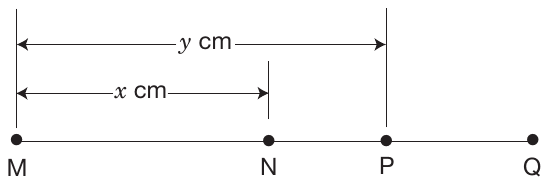
In the figure above, N is the midpoint of . Which segment has length centimeters?
- A
- B
- C
- D
Show the answer
Correct answer: A
These facts are given:
- N is the midpoint of .
- has a length of x centimeters.
- has a length of y centimeters.
Use the first two facts to determine that has a length of centimeters. So can be represented by , which is .
Question analysis
A geometry and algebra question with a labeled figure: points M, N, P and Q lie on a line, MN is x cm, MP is y cm, and N is the midpoint of MQ. Students find which segment has length 2x − y. They must turn the midpoint fact into an expression and read a difference of lengths on the figure.
- NYS standards
- Grade level
- Grade 7 content, by NYS standard
- Compared with grade 7
- Above grade 7 Grade 7 students evaluate and rewrite expressions but rarely read one as a length on a figure. Combining the midpoint idea from geometry with a difference of expressions, and no numbers, makes this more abstract than typical grade 7 work.
- Estimated difficulty
- Moderate: several steps, or a close reading with one strong distractor.
- Thinking it demands
- Depth of knowledge 2, skills and concepts · mainly analyze
- What makes it hard
- Variables instead of numbers moderate
- Reading a figure, table or graph moderate
- Solution
- 2 steps
- Reading level
- Question and choices: about grade 9, 20 words.
- Students, last 30 days
- Not enough answers yet to show (it takes 10).
Why it is hard, traps and wrong answers (shows the answer)
Why it is hard
The question reverses the usual task: instead of finding a length, students match an expression to a segment. The midpoint fact turns into MQ = 2x, and taking away the y of MP leaves the piece from P to Q. The wrong choices reward stopping at 2x, reading only the labeled arrows, or matching the letter y; picking x = 5 and y = 7 lets students check with numbers.
Variables instead of numbers moderate Understanding the question
Every length is a letter: MN is x, MP is y, and the target is the expression 2x − y, so the matching segment cannot be found by measuring. (Koedinger & Nathan, 2004; Enright, Morley & Sheehan, 2002)
Reading a figure, table or graph moderate Understanding the question
The figure marks only MN and MP with arrows; the length of MQ comes from the stem's midpoint fact, not from the drawing, and has to be written as 2x. (Lesh, Post & Behr, 1987; Kirsch & Mosenthal, 1990)
Strategy: Use the midpoint to write the length of the whole segment in terms of x, or pick sample values for x and y, then see which segment's length matches 2x − y.
Traps
- Stops one step early: A choice is a number from partway through the solution.
- Misreads the question: Misses or misreads a condition or a word in the question: "at least", "each", "remaining", "not".
The wrong answers, classified
B Misreads the question (Hegarty, Mayer & Monk, 1995)
Leaves out the midpoint fact, so the only difference it can read from the arrows is NP = y − x, which it takes for 2x − y.
C Stops one step early (King et al., 2004; Gierl et al., 2017)
Uses the midpoint to find that MQ is 2x centimeters and picks that segment, stopping before subtracting the y of MP.
D Numbers taken from the question (Hegarty, Mayer & Monk, 1995)
Sees y in the expression and picks MP, the segment labeled y, without working out the rest of 2x − y.
Worked solution, step by step
Formulas used
- Midpoint
- N is the midpoint of segment MQ, the point exactly in the middle. MN is the half from M to N, and MQ is the whole segment. The whole is two equal halves, so it is 2 times MN.
- Adding segments
- When points lie in order on a line, the short segments add up to the long one. MP runs from M to P, and PQ runs from P to Q. Put end to end, they make MQ.
Sort out the figure
Points M, N, P and Q lie in that order on a line. Segment MN is x cm long, and segment MP is y cm long. N is the midpoint of , the point exactly halfway from M to Q. You need the segment that is cm long.
Find the length of MQ
MN is half of MQ, so MQ is twice as long.
MQ is 2x cm long. Watch out: 2x is only part of the expression. Stopping here gives MQ, choice C.
Take MP away from MQ
Subtracting y from 2x means taking MP away from MQ. MP covers the part from M to P. What is left of MQ is the piece from P to Q.
So PQ is cm long. Watch out: do not pick MP just because y appears. MP is y, choice D. NP is , choice B. So the answer is A, .
Check your answer
Try numbers. Say x = 5, so MN = 5 and MQ = 10. Say y = 7, so MP = 7. Then PQ is . And . They match. NP would be , which does not.
More questions like this
The original DOE question
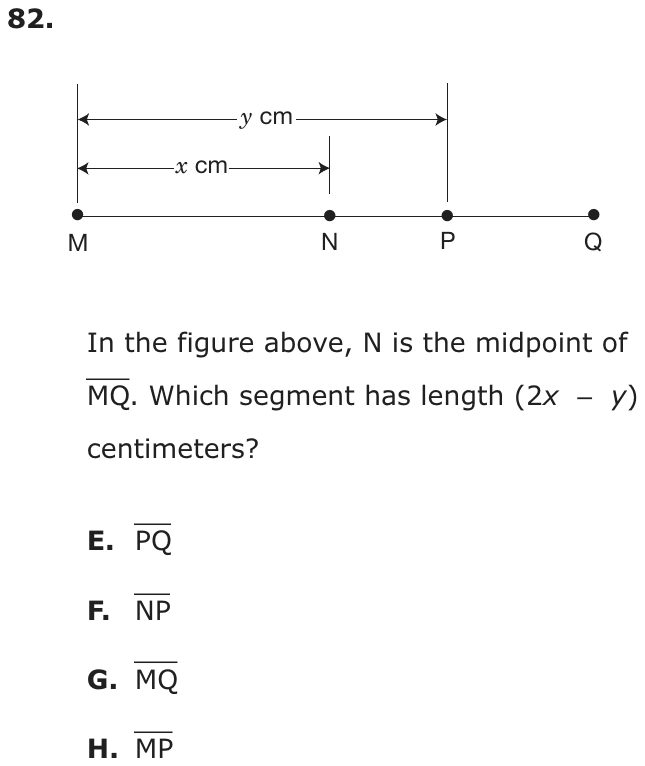
Question 37 of 107
2024 Test A Math, question 27Question
On Wednesday, a baker produced 100 more loaves of bread than were produced on Tuesday. On Thursday, the baker produced 50 fewer loaves than were produced on Tuesday. If the total number of loaves produced on all three days was 230, how many loaves were produced on Wednesday?
- A60
- B80
- C120
- D160
Show the answer
Correct answer: D
Let t represent the number of loaves of bread produced on Tuesday.
First, determine the number of loaves of bread produced on Tuesday, t, using the number of loaves produced on Wednesday, , the number produced on Thursday, , and the total number produced on these three days, 230:
Next, determine the number of loaves of bread produced on Wednesday, , when :
The number of loaves of bread produced on Wednesday is 160.
Question analysis
A word problem about a baker's bread over three days: Wednesday's output is 100 loaves more than Tuesday's, Thursday's is 50 fewer than Tuesday's, and the total is 230. Students find the number of loaves made on Wednesday. Writing every day in terms of Tuesday, and answering for the right day, are the keys.
- Grade level
- Grade 7 content, by NYS standard
- Compared with grade 7
- At grade 7 Writing and solving an equation of the form px + q = r from a word problem is a core grade 7 standard. This is a typical three-step version, with one negative adjustment and an extra step after solving.
- Estimated difficulty
- Straightforward: two steps or one careful reading.
- Thinking it demands
- Depth of knowledge 2, skills and concepts · mainly apply
- What makes it hard
- Turning words into math moderate
- Much to keep track of minor
- Solution
- 3 steps
- Reading level
- Question and choices: about grade 7, 45 words.
- Corrected from the DOE handbook
- A misplaced parenthesis in the explanation’s working was corrected.
- Students, last 30 days
- Not enough answers yet to show (it takes 10).
Why it is hard, traps and wrong answers (shows the answer)
Why it is hard
Writing all three days in terms of Tuesday turns the story into 3t + 50 = 230, a routine equation. The trap comes after it is solved: the value found is Tuesday's, and it is a listed choice. Students who label t as Tuesday from the start, and reread the question before choosing, add the 100 loaves and are done.
Turning words into math moderate Understanding the question
Both comparisons are made with Tuesday, 100 more loaves on Wednesday and 50 fewer on Thursday, so the three days become t, t + 100 and t − 50. (Hegarty, Mayer & Monk, 1995; Koedinger & Nathan, 2004)
Much to keep track of minor Working it out
The equation's unknown is Tuesday's count, while the question asks for Wednesday's, so one more step remains after the equation is solved. (Sweller, 1988; Carpenter, Just & Shell, 1990)
Strategy: Let t be Tuesday's loaves, write Wednesday and Thursday in terms of t, set the sum equal to 230, solve for t, and add 100.
Traps
- Answers a different question: A choice is right for another quantity: the other unknown, the rest instead of the part, the part instead of the whole.
- Numbers taken from the question: Combines the numbers in the question without a model of the situation, or is simply a number that appears in the question.
The wrong answers, classified
A Answers a different question (King et al., 2004; Hegarty, Mayer & Monk, 1995)
Solves 3t + 50 = 230 for Tuesday's loaves, t = 60, and gives that instead of Wednesday's t + 100.
B Numbers taken from the question (Hegarty, Mayer & Monk, 1995)
Subtracts both 100 and 50 from the total, 230 − 100 − 50 = 80, combining the numbers without writing each day in terms of Tuesday.
C Misreads the question (Hegarty, Mayer & Monk, 1995)
Finds Tuesday's 60, then gets Wednesday by subtraction, 230 − 60 − 50, taking Thursday as 50 loaves instead of 60 − 50 = 10.
What was corrected from the DOE handbook, and why
- Explanation: The handbook writes “3t + (50 − 50 = 230 − 50)”, with the closing parenthesis after the whole equation, so the line reads as an equation inside an expression (and 50 − 50 = 230 − 50 is false). The site now reads 3t + (50 − 50) = 230 − 50: subtract 50 from both sides, giving 3t = 180 as before.
Worked solution, step by step
Formulas used
- Keeping an equation balanced
- a and b are the two sides of an equation, and c is any number. An equation is like a balanced scale. If you subtract the same thing from both sides, it stays balanced. The same is true if you divide both sides by the same number that is not zero.
Sort out the question
The baker made bread on Tuesday, Wednesday and Thursday. Wednesday had 100 more loaves than Tuesday. Thursday had 50 fewer loaves than Tuesday. All three days add up to 230 loaves. You need the number of loaves made on Wednesday.
Write each day using Tuesday
Both other days are compared with Tuesday. So call Tuesday’s loaves t.
Day Loaves Tuesday Wednesday Thursday 100 more means add 100. 50 fewer means subtract 50.
Write the equation and combine
Group the t’s together and the plain numbers together. Three t’s make 3t, and .
Watch out: do not just subtract 100 and 50 from 230. That gives 80, choice B, and skips writing each day with t.
Solve for Tuesday
Subtract 50 from both sides. Then divide both sides by 3.
Tuesday had 60 loaves. Watch out: 60 is Tuesday, choice A. The question asks about Wednesday.
Find Wednesday’s loaves
Wednesday had 100 more loaves than Tuesday, so add 100 to t.
Wednesday had 160 loaves. So the answer is D, 160.
Check your answer
Find all three days. Tuesday is 60, Wednesday is 160, and Thursday is . Add them: . That is the total in the question, so 160 is right.
More questions like this
The original DOE question
Question 38 of 107
2024 Test A Math, question 29Question
Which graph represents the solution to the inequality ?
- A

- B

- C

- D

Show the answer
Correct answer: A
Use the properties of equations to solve the inequality for x.
Subtract 4 from both sides of the inequality.
The graph of will have a point at −1 and will include all values that are greater than, or to the right of, −1. The greater than or equal sign is used, which indicates that the solution includes −1. So the point at −1 will be solid. Option A is the correct answer.
Question analysis
This inequality question asks which number line graph shows the solution set of x + 4 ≥ 3. Students solve a one-step inequality by undoing the addition, then match the result to a graph. All four graphs use a solid dot and an arrow pointing right, so the whole question rests on where the shaded ray begins.
- Grade level
- Grade 7 content, by NYS standard
- Compared with grade 7
- Below grade 7 Grade 7 inequality work is usually two-step, such as 3x − 5 ≥ 10, and asks students to choose an open or closed dot and a direction. This one needs a single subtraction, and all four graphs share a closed dot and a rightward arrow.
- Estimated difficulty
- Routine: one familiar step, little to misread.
- Thinking it demands
- Depth of knowledge 1, recall and reproduction · mainly apply
- What makes it hard
- Solution
- 2 steps
- Reading level
- Question and choices: about grade 13, 9 words.
- Students, last 30 days
- Not enough answers yet to show (it takes 10).
Why it is hard, traps and wrong answers (shows the answer)
Why it is hard
Solving takes a single subtraction, and the graphs differ only in where the solid dot sits, so the question comes down to 3 − 4. Students who lose the negative sign land on the graph that starts at 1, while those who never isolate x pick a graph that starts at a number printed in the inequality. Testing 0, which satisfies 0 + 4 ≥ 3, shows that the shading must include 0.
Reading a figure, table or graph minor Understanding the question
All four graphs share a closed dot and a rightward arrow, so the only thing to read is where the dot sits, against tick labels printed with raised minus signs. (Lesh, Post & Behr, 1987; Kirsch & Mosenthal, 1990)
Error-prone arithmetic minor Working it out
Undoing the + 4 means computing 3 − 4, the one step that crosses zero; a dropped minus sign moves the dot from −1 to 1. (Brown & Burton, 1978; Junker & Sijtsma, 2001)
Strategy: Subtract 4 from both sides to get x alone, then find the graph whose solid dot sits at that number; test one shaded value in the original inequality to confirm.
Traps
- Negatives and direction: Arithmetic with negative numbers, the order of a subtraction, or direction on a number line. (Moving a term across the equals sign without changing its sign is a faulty procedure.)
- Numbers taken from the question: Combines the numbers in the question without a model of the situation, or is simply a number that appears in the question.
The wrong answers, classified
B Negatives and direction (Brown & Burton, 1978)
Computes 4 − 3 instead of 3 − 4, or drops the minus sign of −1, and starts the shaded ray at positive 1.
C Numbers taken from the question (Hegarty, Mayer & Monk, 1995)
Starts the ray at 3, the number on the right side of the inequality, as if x ≥ 3, without subtracting the 4.
D Numbers taken from the question (Hegarty, Mayer & Monk, 1995)
Starts the ray at 4, the number added to x, reading it off the inequality instead of solving for x.
Worked solution, step by step
Formulas used
- Keeping an inequality balanced
- a and b are the two sides of an inequality, and c is any number. The sign ≥ stands for greater than or equal to. Taking the same number away from both sides keeps the comparison true, like taking the same weight off both pans of a scale. Use it to get x by itself.
Sort out the question
An inequality is a math sentence that compares two amounts. The sign means is greater than or equal to. So says that x plus 4 is 3 or more.
You need the graph that shows every number x that makes this true. All four graphs have a solid dot and an arrow to the right. Only the place where the dot sits is different.
Get x by itself
Right now 4 is added to x. To undo adding 4, subtract 4 from both sides.
So x is −1 or any number greater than −1. Watch out: 3 − 4 is −1, not 1. Dropping the minus sign puts the dot at 1, choice B. Putting the dot at 3 or 4 means you read a number off the inequality without solving. That leads to C or D.
Match the solution to a graph
On a number line, greater numbers are to the right. So the shading starts at −1 and goes right. The arrow shows that it keeps going.
The dot is solid, or filled in, because of the or equal to part. A solid dot means −1 itself is a solution, a number that makes the inequality true.
Graph A has a solid dot at −1 and is shaded to the right. So the answer is A, the graph with a solid dot at −1.
Check your answer
Test a number from the shaded part, such as 0. , and 4 is more than 3. Now test the dot: , and 3 is equal to 3, so −1 works. A number left of the dot, −2, gives . That is less than 3, so −2 should not be shaded, and it isn’t.
More questions like this
The original DOE question
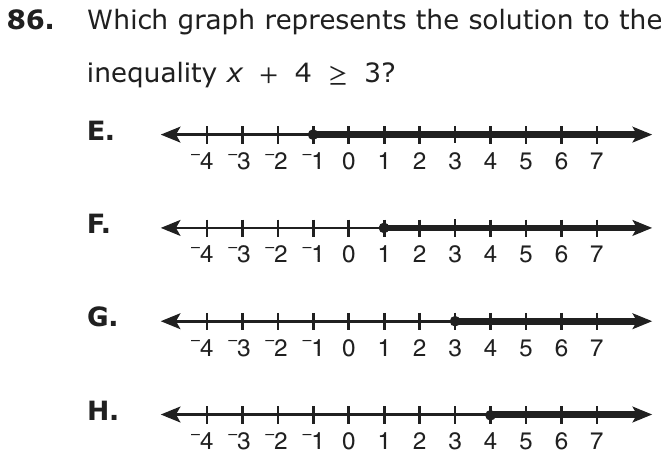
Question 39 of 107
2024 Test A Math, question 33Question
If , what is the value of x?
- A
- B
- C
- D
Show the answer
Correct answer: D
Rewrite with equivalent fractions that have like denominators.
Multiply both sides of the equation by 10.
Question analysis
This equation has fractions on both sides: the coefficient of x is 3/5 minus 1/2, and the right side is 1/4 plus 2/3. Students simplify each side using common denominators, then solve for x. Each step is routine, but four fraction operations in a row leave many places to slip, especially when undoing the coefficient.
- Grade level
- Grade 7 content, by NYS standard
- Compared with grade 7
- At grade 7 Grade 7 students solve equations such as (2/3)x = 4/5 with fractional coefficients. Here both sides must first be simplified over unlike denominators, so four fraction operations come before x is found: on level, but long.
- Estimated difficulty
- Moderate: several steps, or a close reading with one strong distractor.
- Thinking it demands
- Depth of knowledge 1, recall and reproduction · mainly apply
- What makes it hard
- Error-prone arithmetic moderate
- Many steps moderate
- Solution
- 4 steps
- Reading level
- Question and choices: about grade 8, 12 words.
- Corrected from the DOE handbook
- A minus sign printed in place of an equals sign in the explanation was corrected.
- Students, last 30 days
- Not enough answers yet to show (it takes 10).
Why it is hard, traps and wrong answers (shows the answer)
Why it is hard
Nothing here is new, but the question strings together four fraction operations, and the last one runs against habit. Having found that one tenth of x is 11/12, students must multiply by 10; multiplying by 1/10 instead gives a tiny listed value. The size of the answer is a useful check: if a tenth of x is almost 1, then x must be almost 10.
Error-prone arithmetic moderate Working it out
Both sides need common denominators, tenths on the left and twelfths on the right, and the coefficient comes out as 1/10, a fraction to divide by. (Brown & Burton, 1978; Junker & Sijtsma, 2001)
Many steps moderate Working it out
Four operations come before x appears: 3/5 − 1/2, then 1/4 + 2/3, then 11/12 divided by 1/10, then reducing 110/12 to 55/6. (Daniel & Embretson, 2010; Enright, Morley & Sheehan, 2002)
Strategy: Simplify the parentheses on the left and the sum on the right over common denominators, then undo the coefficient by multiplying both sides by its reciprocal.
Traps
- Wrong operation: Adds instead of multiplying, divides the wrong way round, turns a ratio or rate upside down, or undoes a step in the wrong direction (subtracts what should be added back).
- A faulty procedure: A systematic but wrong procedure: adding fractions straight across, applying an exponent to each term of a sum, dropping a sign when moving a term.
The wrong answers, classified
A Wrong operation (Hegarty, Mayer & Monk, 1995; King et al., 2004)
Simplifies both sides correctly but multiplies 11/12 by 1/10 instead of dividing by it, getting 11/120.
B A faulty procedure (Brown & Burton, 1978; Tatsuoka, 1983)
Combines each pair straight across, 3/5 − 1/2 as 2/3 and 1/4 + 2/3 as 3/7, then multiplies them: 2/3 × 3/7 = 2/7.
C Wrong operation (Hegarty, Mayer & Monk, 1995; King et al., 2004)
Adds 3/5 and 1/2 instead of subtracting, so the coefficient is 11/10 and x = 11/12 ÷ 11/10 = 5/6.
What was corrected from the DOE handbook, and why
- Explanation: The handbook writes “(1/10)x − 11/12”, an expression, where the working needs the equation (1/10)x = 11/12: the line before is (6/10 − 5/10)x = 3/12 + 8/12, and the next step multiplies both sides of the equation by 10. The site now reads (1/10)x = 11/12, which gives x = 110/12 = 55/6.
Worked solution, step by step
Formulas used
- Equivalent fractions
- a is the top of a fraction and b is the bottom. n is any number except 0. Multiplying the top and bottom by the same number gives an equal fraction, cut into smaller pieces. Use it to give two fractions the same bottom before you add or subtract.
- Keeping an equation balanced
- a and b are the two sides of an equation, and n is any number. An equation is like a balanced scale. If you multiply both sides by the same number, it stays balanced. Use it to undo a number that multiplies x.
Sort out the equation
An equation says two things are equal. On the left, the subtraction in the parentheses multiplies x. On the right is a sum. You need the value of x. First make each side as simple as you can. Then get x by itself.
Simplify the left side
To subtract, the fractions need the same bottom. Both 5 and 2 go into 10, so use tenths.
Watch out: this is a minus sign. Adding instead gives , and that leads to , choice C.Simplify the right side
Both 4 and 3 go into 12, so use twelfths.
Now the equation is much simpler:
Get x by itself
x is multiplied by . To undo that, multiply both sides by 10. That is the reciprocal of , the fraction flipped upside down.
Watch out: multiplying by does not undo anything. It gives , choice A.Simplify the fraction
Both 110 and 12 are even, so divide the top and the bottom by 2.
So the answer is D, .
Check your answer
Put back in for x. . That matches the right side. Also estimate. A tenth of x is almost 1, so x should be almost 10. is about 9.2.
More questions like this
The original DOE question
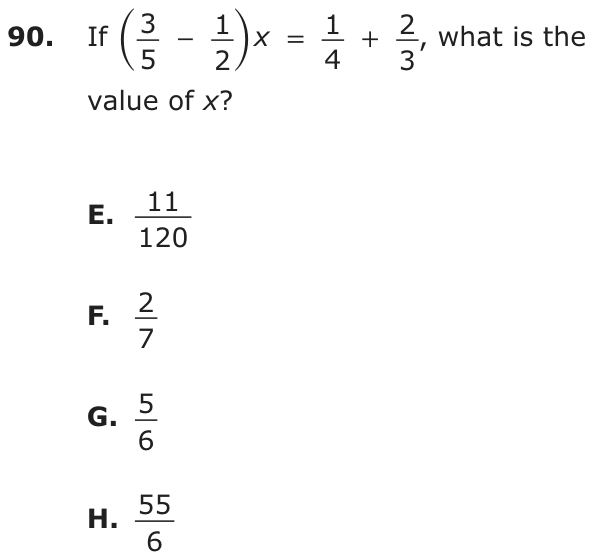
Question 40 of 107
2024 Test A Math, question 36Question
CELL PHONE SALES BY COLOR
| Color | Percentage of Cell Phones Sold |
|---|---|
| White | |
| Black | 30 |
| Blue | |
| Red | |
| Total | 100 |
The table above shows cell phone sales by color. What percentage of the cell phones sold were blue?
- A18%
- B20%
- C22%
- D28%
Show the answer
Correct answer: B
First, use the information given in the table and properties of equations to determine the value of k:
Then, determine the percentage of cell phones sold that were blue by finding the value of the expression (given in the table), when :
The percentage of cell phones sold that were blue is 20%.
Question analysis
A table of cell phone sales by color gives each color's percentage as an expression in k, such as 8k for white and 30 − 2k for blue, with a total of 100. Students write and solve an equation for k, then find the percentage for blue. Combining terms with a negative coefficient, and remembering that k itself is not the answer, both need care.
- Grade level
- Grade 7 content, by NYS standard
- Compared with grade 7
- At grade 7 Grade 7 students solve two-step equations that are written out for them. Here the equation must be built from a table whose percentages total 100, with like terms to combine, and the value found must then be substituted back.
- Estimated difficulty
- Moderate: several steps, or a close reading with one strong distractor.
- Thinking it demands
- Depth of knowledge 2, skills and concepts · mainly apply
- What makes it hard
- Many steps moderate
- Reading a figure, table or graph minor
- Error-prone arithmetic minor
- Solution
- 4 steps
- Reading level
- Question and choices: about grade 4, 36 words.
- Students, last 30 days
- Not enough answers yet to show (it takes 10).
Why it is hard, traps and wrong answers (shows the answer)
Why it is hard
The question hides an equation in a table, and the key insight is that the four percentages must add to 100. After that the algebra is routine, and no listed choice rewards stopping early, since neither k nor any other color's percentage appears. The wrong choices sit near the answer or use the blue expression with k ignored, so students who cannot set up the equation are left guessing.
Many steps moderate Working it out
The answer needs a chain: add the four expressions, set the sum to 100, collect 8k − 2k + k into 7k, solve for k, then substitute into 30 − 2k. (Daniel & Embretson, 2010; Enright, Morley & Sheehan, 2002)
Reading a figure, table or graph minor Understanding the question
No equation is printed; the table's Total row of 100 is what turns the four percentages written in k into one equation to solve. (Lesh, Post & Behr, 1987; Kirsch & Mosenthal, 1990)
Error-prone arithmetic minor Working it out
Collecting like terms includes the negative coefficient in the blue row, −2k, and the constants 30, 30 and 5 have to be gathered too. (Brown & Burton, 1978; Junker & Sijtsma, 2001)
Strategy: Add the four color expressions and set the sum equal to 100, combine like terms to solve for k, then substitute k into the blue row's expression.
Traps
- Numbers taken from the question: Combines the numbers in the question without a model of the situation, or is simply a number that appears in the question.
The wrong answers, classified
A Little reason to choose it (Haladyna & Downing, 1993; Rodriguez, 2005)
No common slip gives k = 6 from 7k + 65 = 100, the value 18% would need; it sits 2 points below the answer and mostly draws guesses.
C Little reason to choose it (Haladyna & Downing, 1993; Rodriguez, 2005)
No usual error in collecting terms or solving yields k = 4, which 22% requires, so this near neighbor of the answer mostly attracts guessers.
D Numbers taken from the question (Hegarty, Mayer & Monk, 1995)
Never solves for k and reads the blue entry 30 − 2k as 30 − 2, as if k were 1, giving 28.
Worked solution, step by step
Formulas used
- Combining like terms
- k is the unknown number. a and b are the numbers in front of k, called coefficients. Terms with the same letter are called like terms. You can add their coefficients, because a groups of k plus b groups of k make a + b groups of k.
- Keeping an equation balanced
- a and b are the two sides of an equation, and c is any number (not 0 when you divide). An equation is like a balanced scale. Doing the same thing to both sides keeps it balanced. Use it to undo each step and get k alone.
Sort out the table
The table gives the percent of phones sold in each color. Some entries use k, a letter that stands for an unknown number. 8k means 8 times k. You need the percent that were blue, . To find it, you first need k.
Write an equation for the total
Every phone sold is one of the four colors. So the four percents add up to the total, 100, as the last row of the table shows.
Combine like terms
Terms with k in them are called like terms, so they can be combined. Group the k terms together and the plain numbers together. A k on its own means 1k.
So the equation becomes . Watch out: the blue row takes away 2k. Keep its minus sign, or the k terms will be wrong.
Solve for k
Undo the adding first, then the multiplying.
So k is 5. But k is not the answer. You still need the blue row.
Find the blue percent
Put 5 in for k in the blue row.
So 20% of the phones sold were blue. Watch out: 2k means 2 times k, not 2. Reading as gives 28%, choice D.
So the answer is B, 20%.
Check your answer
Put k = 5 into every row. White: . Black: 30. Blue: 20. Red: . Now add them: . The total matches the table, so k = 5 is right.
More questions like this
The original DOE question
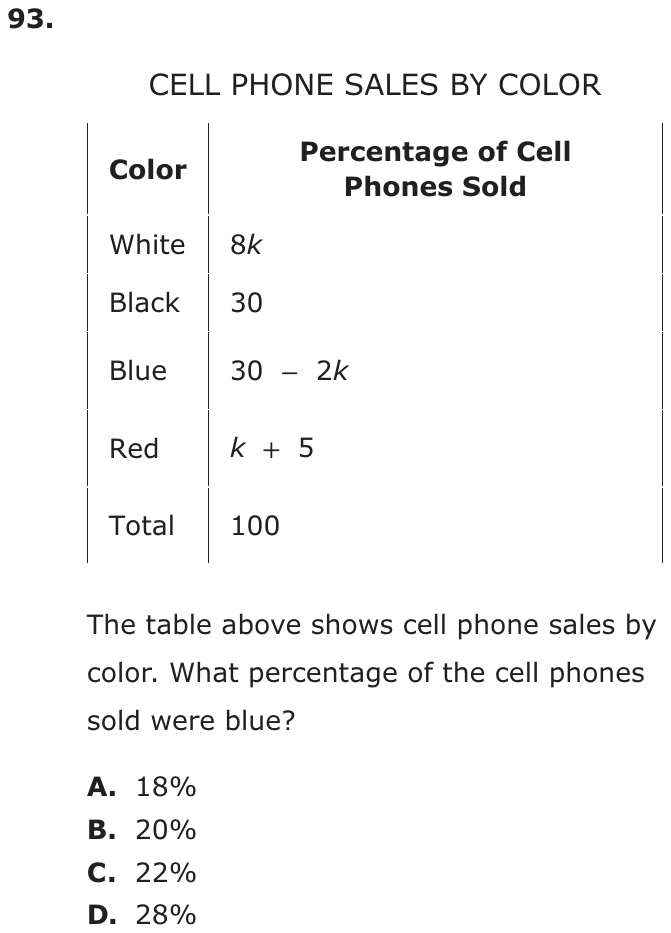
Question 41 of 107
2024 Test A Math, question 49Question
Carolyn walked 3 miles from her house to the library and then miles farther to the grocery store. Returning home by the same route, she walked miles before stopping at a friend’s house. How many miles did Carolyn have left to walk home?
- A
- B
- C
- D
Show the answer
Correct answer: A
The distance from Carolyn’s house to the grocery store is miles.
Carolyn walked miles back, so she still had miles left to walk home.
So Carolyn had miles left to walk home.
Question analysis
Carolyn walks 3 miles from home to the library and 2 1/2 miles more to the grocery store, then heads back the same way and stops at a friend's house after 1 2/3 miles. This fractions word problem asks how far she still has to walk home. Students add and subtract mixed numbers, and the subtraction needs regrouping across unlike denominators.
- Grade level
- Grade 7 content, by NYS standard
- Compared with grade 7
- At grade 7 Grade 7 students solve multi-step word problems with mixed numbers. This one has only positive numbers, but it needs a clear picture of the route and a subtraction that requires regrouping across unlike denominators.
- Estimated difficulty
- Moderate: several steps, or a close reading with one strong distractor.
- Thinking it demands
- Depth of knowledge 2, skills and concepts · mainly apply
- What makes it hard
- Error-prone arithmetic moderate
- A very close wrong answer moderate
- Turning words into math minor
- Solution
- 3 steps
- Reading level
- Question and choices: about grade 6, 48 words.
- Students, last 30 days
- Not enough answers yet to show (it takes 10).
Why it is hard, traps and wrong answers (shows the answer)
Why it is hard
The story needs a quick sketch, but the real test is one mixed-number subtraction in which the second fraction is larger than the first. Many students subtract the fractions the easy way round, which gives a choice close to the right one. Converting both numbers to sixths, 33/6 − 10/6, sidesteps the regrouping, and adding the result to 1 2/3 to get back 5 1/2 is a quick check.
Error-prone arithmetic moderate Working it out
The subtraction 5 1/2 − 1 2/3 needs sixths, 5 3/6 − 1 4/6, and the fraction on top is the smaller one, so a whole must be regrouped. (Brown & Burton, 1978; Junker & Sijtsma, 2001)
A very close wrong answer moderate Choosing the answer
Subtracting the fraction parts the wrong way round gives 4 1/6, only 1/3 away from the answer, so a rough estimate cannot tell the two apart. (Embretson & Wetzel, 1987; Gorin & Embretson, 2006; Ascalon et al., 2007)
Turning words into math minor Understanding the question
The route has to be pictured: the walk back starts at the grocery store, 5 1/2 miles from home, not at the library. (Hegarty, Mayer & Monk, 1995; Koedinger & Nathan, 2004)
Strategy: Sketch the route as a line from home to the library to the store, find the total distance out, then subtract the distance already walked back, using sixths.
Traps
- A faulty procedure: A systematic but wrong procedure: adding fractions straight across, applying an exponent to each term of a sum, dropping a sign when moving a term.
- Answers a different question: A choice is right for another quantity: the other unknown, the rest instead of the part, the part instead of the whole.
The wrong answers, classified
B A faulty procedure (Brown & Burton, 1978; Tatsuoka, 1983)
Subtracts the whole numbers, 5 − 1 = 4, then the fractions the easy way round, 2/3 − 1/2 = 1/6, giving 4 1/6.
C Answers a different question (King et al., 2004; Hegarty, Mayer & Monk, 1995)
On the store-to-library stretch, uses the 1 2/3 miles already walked instead of the 5/6 mile left, then adds the 3 miles home.
D Answers a different question (King et al., 2004; Hegarty, Mayer & Monk, 1995)
Adds all three distances, 3 + 2 1/2 + 1 2/3 = 7 1/6, which is how far she has walked so far, not how far is left.
Worked solution, step by step
Formulas used
- Mixed number to fraction
- a is the whole number part, b is the top of the fraction, and c is the bottom. Each whole holds c pieces, so a wholes hold a times c pieces. Then add the b extra pieces.
- Equivalent fractions
- a is the top of a fraction and b is the bottom. n is any number except 0. Multiplying the top and bottom by the same number gives an equal fraction, cut into smaller pieces. Use it to give two fractions the same bottom before you add or subtract.
- Subtracting fractions with the same bottom
- c is the shared bottom number. a and b are the tops. When the pieces are the same size, you just take away how many pieces you have. The size of the pieces, c, stays the same.
Picture the route
Draw a line: home, then the library, then the store. Home to the library is 3 miles. The library to the store is miles more. Carolyn walks back the same way. After miles she stops at a friend’s house. You need the miles still left to get home.
Find the distance from home to the store
The store is miles from home. She starts back from the store, so this is the full trip home. Watch out: adding all three distances gives , choice D. That is how far she has walked, not how far is left.
Change to improper fractions
The miles left are . An improper fraction has a top bigger than its bottom. Change each mixed number to one.
Use sixths for both
To subtract, the fractions need the same bottom. 2 and 3 both go into 6, so change both to sixths.
Subtract and simplify
23 sixths is 3 wholes (18 sixths) and 5 sixths more. So . Watch out: is less than . Subtracting the fraction parts the wrong way round gives , choice B.
So the answer is A, miles.
Check your answer
Add back: . That is the full distance from the store to home. Also estimate: 5.5 minus about 1.7 is about 3.8, and is about 3.83.
More questions like this
The original DOE question
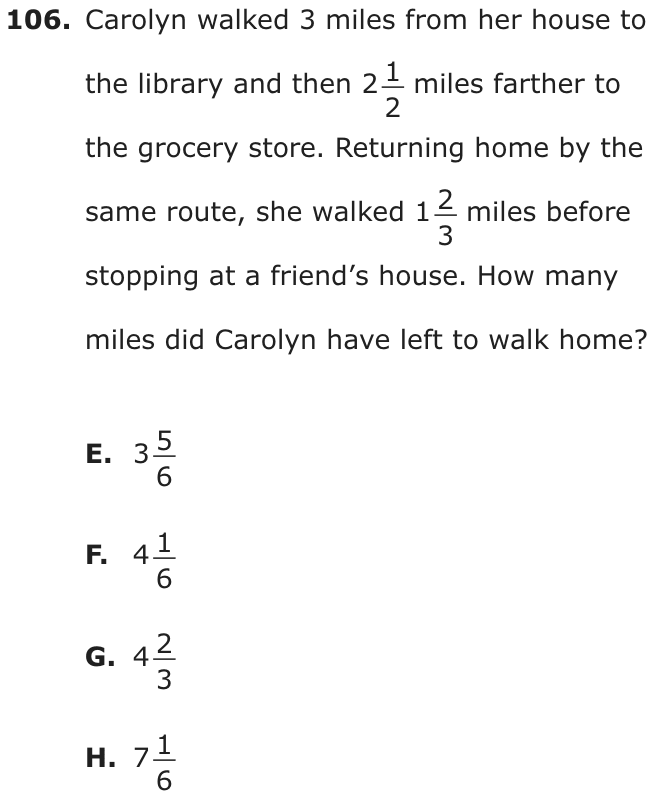
Question 42 of 107
2024 Test B Math, question 1Question
After the expression above is simplified, what is the coefficient of x, expressed as a decimal?
Grid-in question: work out the answer and enter it as a number.
Show the answer
Correct answer: -0.8
First, distribute over to get the expression .
Express as and then add like terms:
.
The coefficient of x is .
When expressed as a decimal,
.
Question analysis
An algebra grid-in on simplifying an expression: three fifths times the quantity 2x + 5, minus 2x. Students distribute a fraction, combine the x terms and report the coefficient of x as a decimal. Multiplying by a fraction, the subtraction that follows, and gridding the decimal correctly all leave room for slips.
- Grade level
- Grade 7 content, by NYS standard
- Compared with grade 7
- At grade 7 Expanding and simplifying linear expressions with fraction coefficients is a core grade 7 skill, and this is a typical short example. Writing the coefficient as a decimal in the grid adds care but no new idea.
- Estimated difficulty
- Straightforward: two steps or one careful reading.
- Thinking it demands
- Depth of knowledge 1, recall and reproduction · mainly apply
- What makes it hard
- Error-prone arithmetic moderate
- An answer in an unexpected form minor
- Solution
- 3 steps
- Reading level
- Question and choices: about grade 9, 17 words.
- Students, last 30 days
- Not enough answers yet to show (it takes 10).
Why it is hard, traps and wrong answers (shows the answer)
Why it is hard
The distribution itself is routine; points are lost after it. Students who stop at 6/5x forget the −2x outside the parentheses, and those who combine the x terms correctly can still drop the sign of a negative result. Rewriting 2x as 10/5x keeps the subtraction in fifths, and substituting x = 1 into both forms confirms the coefficient before gridding.
Error-prone arithmetic moderate Working it out
Multiplying 2x by 3/5 gives 6/5x, and taking away 2x means rewriting it as 10/5x; the result is a negative fraction that must then become a decimal with its sign. (Brown & Burton, 1978; Junker & Sijtsma, 2001)
An answer in an unexpected form minor Choosing the answer
There are no choices to check against, and the coefficient must be gridded as a decimal with its minus sign, so −4/5 has to become −0.8. (Enright, Morley & Sheehan, 2002)
Strategy: Multiply both terms inside the parentheses by 3/5, rewrite 2x in fifths so the x terms share a denominator, combine them, and convert that fraction to a decimal.
Traps
- Negatives and direction: Arithmetic with negative numbers, the order of a subtraction, or direction on a number line. (Moving a term across the equals sign without changing its sign is a faulty procedure.)
- Stops one step early: A choice is a number from partway through the solution.
- A faulty procedure: A systematic but wrong procedure: adding fractions straight across, applying an exponent to each term of a sum, dropping a sign when moving a term.
The wrong answers, classified
0.8 Negatives and direction (Brown & Burton, 1978)
Combines 6/5x and −2x to a coefficient of the right size, 4/5, but drops the minus sign, or subtracts 6/5 from 2, and grids 0.8.
1.2 Stops one step early (King et al., 2004; Gierl et al., 2017)
Distributes 3/5 to get 6/5x + 3 and grids 6/5 = 1.2, stopping before the −2x outside the parentheses is combined with it.
-1.4 A faulty procedure (Brown & Burton, 1978; Tatsuoka, 1983)
Multiplies 3/5 by 2 as 6/10, doubling the denominator along with the numerator, so the coefficient comes out 0.6 − 2 = −1.4.
Worked solution, step by step
Formulas used
- Distributive property
- a is the number outside the parentheses. b and c are the terms inside. A term is a number, a letter, or a number times a letter. To multiply out the parentheses, multiply each term inside by a. It works because a groups of b + c is a groups of b plus a groups of c.
- Multiplying a fraction by a whole number
- a over b is the fraction, and c is the whole number. Multiply only the top number, the numerator, by c. The bottom number, the denominator, stays the same. The size of each piece does not change. You just have more pieces.
Sort out the question
You start with this expression. An expression is a math phrase with numbers, letters and signs, but no equals sign.
To simplify it means to write it in its shortest form. The coefficient of x is the number multiplied by x. In 7x, the coefficient is 7. You need the coefficient of x, written as a decimal.
Multiply out the parentheses
The 3/5 multiplies everything inside the parentheses. Use the distributive property.
Multiply only the top of 3/5 by 2: . Also, . Now the whole expression is:
Watch out: do not double the bottom number too. Writing 6/10 leads to −1.4.Write 2x in fifths
There are now two x terms: and . To combine them, they need the same denominator (bottom number). One whole is 5/5, so 2 wholes are 10/5.
Watch out: the −2x is outside the parentheses, but it still counts. Stopping at 6/5 and gridding 1.2 is a common mistake.Combine the x terms
Six fifths take away ten fifths leaves negative four fifths.
The 3 has no x, so it stays as it is. The simplified expression is . So the coefficient of x is . Watch out: 6 − 10 is negative. Dropping the minus sign gives 0.8.
Change it to a decimal
A fraction means the top divided by the bottom: . Keep the minus sign.
So you would grid -0.8, with the minus sign in its own column.
Check your answer
Pick an easy value, x = 1, and put it into both forms. The first form: . The simplified form: . Both give 2.2, so the simplifying worked.
More questions like this
The original DOE question
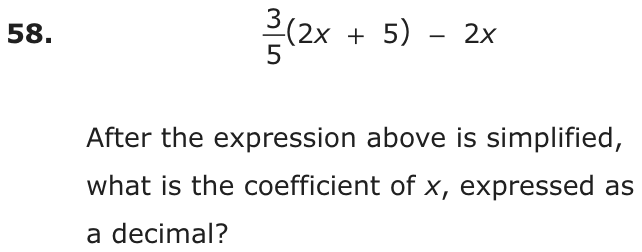
Question 43 of 107
2024 Test B Math, question 15Question
Claire is running on a circular track. She has already run 650 meters. Each lap around the track is a distance of 120 meters. Her goal is to run at least 2,500 meters in all. How many more laps does she need to complete in order to reach her goal?
- A5
- B6
- C15
- D16
Show the answer
Correct answer: D
Claire’s goal is to run at least 2,500 meters, and she has already run 650 meters.
Claire has at least 1,850 meters left to run. Divide by the distance around the track to find the number of laps she needs to complete:
Since she wants to run at least 2,500 meters, round 15.417 up to 16. Claire needs to run 16 laps to meet her goal.
Question analysis
A word problem about running laps: Claire has already run 650 meters on a 120-meter track and wants to run at least 2,500 meters in all. Students find how many more laps she must complete. Subtracting and dividing are straightforward; deciding what to do with the leftover part of a lap is the real test.
- Grade level
- Grade 7 content, by NYS standard
- Compared with grade 7
- At grade 7 Grade 7 students solve word problems that lead to inequalities like px + q ≥ r and interpret the solution in context. This is a typical three-step example, where the solution must be turned into a whole number of laps.
- Estimated difficulty
- Moderate: several steps, or a close reading with one strong distractor.
- Thinking it demands
- Depth of knowledge 2, skills and concepts · mainly apply
- What makes it hard
- Turning words into math moderate
- A very close wrong answer moderate
- Error-prone arithmetic minor
- Solution
- 3 steps
- Reading level
- Question and choices: about grade 3, 47 words.
- Students, last 30 days
- Not enough answers yet to show (it takes 10).
Why it is hard, traps and wrong answers (shows the answer)
Why it is hard
The arithmetic leads to about 15.4 laps, and the question is entirely about what to do with the fraction of a lap. Rounding to the nearest whole number is a habit that fails here, because the goal must be met or passed. Multiplying back, 15 × 120 = 1,800 and 16 × 120 = 1,920, shows which count actually covers the 1,850 meters still to run.
Turning words into math moderate Understanding the question
“At least 2,500 meters in all” means a part lap must still be run in full, so 1,850 ÷ 120 ≈ 15.4 has to be rounded up, against the usual rounding rule. (Hegarty, Mayer & Monk, 1995; Koedinger & Nathan, 2004)
A very close wrong answer moderate Choosing the answer
15 and 16 laps are one apart and both sit next to the quotient 15.4, so estimating cannot decide between them; only the condition that the goal be reached can. (Embretson & Wetzel, 1987; Gorin & Embretson, 2006; Ascalon et al., 2007)
Error-prone arithmetic minor Working it out
Dividing 1,850 by 120 by hand does not come out even, and long division by a three-digit number invites slips in placing the quotient. (Brown & Burton, 1978; Junker & Sijtsma, 2001)
Strategy: Subtract what she has run from 2,500, divide by 120, and check your whole number by multiplying it back: those laps must cover all of the remaining distance.
Traps
- Rounds too early: Rounds a value partway through, or rounds the wrong way, so the final answer drifts from the exact one.
- Answers a different question: A choice is right for another quantity: the other unknown, the rest instead of the part, the part instead of the whole.
The wrong answers, classified
A Answers a different question (King et al., 2004; Hegarty, Mayer & Monk, 1995)
Divides the 650 meters already run by 120 and rounds down to 5, counting laps finished so far instead of laps still needed.
B Answers a different question (King et al., 2004; Hegarty, Mayer & Monk, 1995)
Divides the 650 meters already run by 120, about 5.4, and rounds up as the goal requires, but for the distance done rather than the distance left.
C Rounds too early (King et al., 2004)
Finds 1,850 ÷ 120 ≈ 15.4 and rounds down to 15 by the usual rule, but 15 more laps leave her 50 meters short of the goal.
Worked solution, step by step
Formulas used
- Distance left
- Goal is the distance she wants to reach in all. Done is the distance she has already run. Subtract to find how far she still has to go.
- Number of laps
- Distance is how far she still has to run. One lap is the length of the track, 120 meters. Dividing tells how many laps fit into that distance. If it does not come out even, part of a lap is left over.
Sort out what you know
Claire has run 650 meters. One lap is 120 meters. Her goal is “at least 2,500 meters in all”. At least means 2,500 or more, so she must not fall short. You need how many more laps she must run.
Find the distance left
She still needs 1,850 meters. Watch out: divide the distance left, not the 650 meters she already ran. Dividing 650 by 120 leads to 5 or 6, choices A and B.
Divide by the length of a lap
The sign ≈ means about. Check with whole laps: . That leaves meters still to go. So 15 laps are not quite enough.
Round up to reach the goal
She needs part of one more lap. She has to complete whole laps, so she runs a 16th lap. Here you round up, even though 15.4 would usually round down. Watch out: 15 laps leave her 50 meters short, so choice C is wrong.
So the answer is D, 16.
Check your answer
Add up her total. With 15 more laps: meters, which is short of 2,500. With 16 more laps: meters. That reaches the goal.
More questions like this
The original DOE question
Question 44 of 107
2024 Test B Math, question 25Question
Which number line represents the values of x that satisfy the inequality ?
- A

- B

- C

- D

Show the answer
Correct answer: B
Split the compound inequality into two inequalities.
and
For each inequality, subtract 1 from each side.
and
For each inequality, divide both sides by −3. Note that dividing each side of an inequality by a negative number changes the direction of the inequality.
and
Combining the pieces gives the compound inequality .
The solution is that x is greater than or equal to −1 and less than or equal to 2, so choose the number line with filled circles at −1 and 2, with the filled segment between the circles.
Question analysis
An inequality question: choose the number line that shows the solutions of the compound inequality −5 ≤ 1 − 3x ≤ 4. Students solve an inequality whose x term has a negative coefficient, then match the endpoints, open or closed circles, and shading to one of four graphs.
- Grade level
- Grade 7 content, by NYS standard
- Compared with grade 7
- Above grade 7 Grade 7 students solve and graph two-step inequalities one at a time. This compound inequality needs two solved together and a division by a negative number, which reverses the signs, a step many grade 7 classes only touch on.
- Estimated difficulty
- Hard: combines ideas, needs a plan, and has more than one tempting wrong answer.
- Thinking it demands
- Depth of knowledge 1, recall and reproduction · mainly apply
- What makes it hard
- Error-prone arithmetic moderate
- A very close wrong answer moderate
- Reading a figure, table or graph minor
- Solution
- 4 steps
- Reading level
- Question and choices: about grade 12, 13 words.
- Students, last 30 days
- Not enough answers yet to show (it takes 10).
Why it is hard, traps and wrong answers (shows the answer)
Why it is hard
The question stacks two classic traps: reversing the inequality signs when dividing by −3, and matching filled or open circles to ≤. All four graphs use the endpoints −1 and 2, so finding those numbers proves little; the choice turns on the circles and the direction of the shading. Testing x = 0, x = 3 and the endpoint x = 2 in the original inequality checks both decisions in under a minute.
Error-prone arithmetic moderate Working it out
Dividing all three parts of −6 ≤ −3x ≤ 3 by −3 reverses both signs and the order, giving 2 ≥ x ≥ −1, which must be rewritten as −1 ≤ x ≤ 2. (Brown & Burton, 1978; Junker & Sijtsma, 2001)
A very close wrong answer moderate Choosing the answer
Two graphs share the endpoints −1 and 2 and the shading between them; only the circles, filled for ≤ and open for <, separate them. (Embretson & Wetzel, 1987; Gorin & Embretson, 2006; Ascalon et al., 2007)
Reading a figure, table or graph minor Understanding the question
Each graph must be read for three things at once: the endpoints, the fill of each circle, and whether the shading runs between them or outward. (Lesh, Post & Behr, 1987; Kirsch & Mosenthal, 1990)
Strategy: Subtract 1 from all three parts, divide all three by −3 while reversing both inequality signs, then rewrite the result from smallest to largest before matching circles and shading.
Traps
- Negatives and direction: Arithmetic with negative numbers, the order of a subtraction, or direction on a number line. (Moving a term across the equals sign without changing its sign is a faulty procedure.)
- Counting the ends: Inclusive or exclusive ends, fence posts, consecutive numbers: an answer that is one too many or too few, or an endpoint drawn open where it belongs closed (or the reverse).
The wrong answers, classified
A Counting the ends (Brown & Burton, 1978)
Solves for the right endpoints and shading but draws open circles, as if ≤ excluded −1 and 2 instead of including them.
C Negatives and direction (Brown & Burton, 1978)
Divides by −3 without reversing the signs, so the solutions seem to lie outside −1 and 2; with open circles, this graph shows exactly the values that fail.
D Negatives and direction (Brown & Burton, 1978)
Shades outward as if the signs had not reversed, but mixes the circles, filled at −1 and open at 2, which no single reading of ≤ gives.
Worked solution, step by step
Formulas used
- Subtracting from every part
- a and b are the two sides of an inequality, and c is any number. Subtracting the same number from every part keeps the inequality true. The sign does not change.
- Dividing by a negative number
- a and b are numbers, and c is a positive number, so −c is negative. When you divide both sides by a negative number, the inequality sign flips. For example, 2 is less than 3, but −2 is greater than −3.
Sort out the question
The inequality says that is between −5 and 4. The sign ≤ means less than or equal to. So −5 and 4 themselves are allowed. You need the number line that shows every x that works. To find them, get x alone in the middle.
Subtract 1 from every part
First take away the 1 in the middle. Subtract 1 from all three parts.
Divide by −3 and flip
Now x is multiplied by −3. Divide all three parts by −3. Dividing by a negative number flips each sign.
Watch out: if you forget to flip, x seems to lie outside −1 and 2. That leads to choices C and D, which are shaded outward.Read the result
Turn it around so the smaller number is on the left. It means the same thing.
So x can be any number from −1 to 2. The ends, −1 and 2, are included, because the signs are ≤.
Pick the number line
On a number line, a closed (filled-in) circle means the end number is included. An open circle means it is not. So you need closed circles at −1 and 2, with the part between them shaded. Watch out: choice A has the right shading but open circles, which leave out −1 and 2.
So the answer is B.
Check your answer
Test a few numbers in . For x = 0 you get 1, which is between −5 and 4, and 0 is shaded. For x = 2 you get −5, which is allowed, so the circle at 2 is filled in. For x = 3 you get −8, which is too small, so 3 is not shaded.
More questions like this
The original DOE question
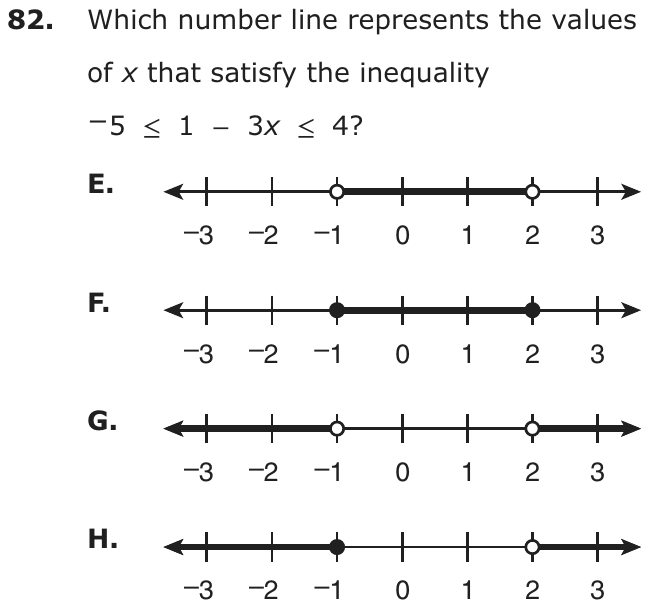
Question 45 of 107
2024 Test B Math, question 27Question
Simplify:
- A
- B
- C
- D
Show the answer
Correct answer: B
First, distribute −1 over :
Then combine the like terms:
The simplified form of the expression is .
Question analysis
An algebra question asks students to simplify 8x minus the quantity 7 + 2.5x, plus 2. They remove the parentheses and combine the x terms and the constants. Decimal coefficients and a subtraction in front of a group make sign errors likely.
- NYS standards
- 7.EE.1 linear expressions with rational coefficients
- Grade level
- Grade 7 content, by NYS standard
- Compared with grade 7
- At grade 7 Simplifying a linear expression with a subtracted group and decimal coefficients is standard grade 7 work. This is a typical two-step textbook exercise, with the usual sign trap and nothing extra.
- Estimated difficulty
- Straightforward: two steps or one careful reading.
- Thinking it demands
- Depth of knowledge 1, recall and reproduction · mainly apply
- What makes it hard
- Error-prone arithmetic moderate
- A very close wrong answer moderate
- Solution
- 2 steps
- Reading level
- Question and choices: about grade 16+, 6 words.
- Students, last 30 days
- Not enough answers yet to show (it takes 10).
Why it is hard, traps and wrong answers (shows the answer)
Why it is hard
The question checks one skill, removing parentheses that follow a minus sign, and its choices are built from the two ways to get it wrong. A student who applies the minus to too few terms gets 10.5x, and one who extends it past the parentheses gets −9. Handling the x terms and the constants as two separate small checks makes each slip easy to catch.
Error-prone arithmetic moderate Working it out
The minus sign before the parentheses must turn + 2.5x into − 2.5x and 7 into − 7, while the + 2 written after the parentheses keeps its sign. (Brown & Burton, 1978; Junker & Sijtsma, 2001)
A very close wrong answer moderate Choosing the answer
The choices pair two x terms, 5.5x and 10.5x, with two constants, −9 and −5, so each wrong one differs from the right one in a single part. (Embretson & Wetzel, 1987; Gorin & Embretson, 2006; Ascalon et al., 2007)
Strategy: Change the minus in front of the parentheses into a minus on each term inside, then combine like terms, keeping the + 2 outside the group as it is.
Traps
- Order of operations: Working left to right, or distributing a minus sign wrongly, gives a choice.
The wrong answers, classified
A Order of operations (Brown & Burton, 1978)
Carries the minus sign past the parentheses onto the + 2 as well, so the constants become −7 − 2 = −9.
C Order of operations (Brown & Burton, 1978)
Makes both slips at once, keeping + 2.5x so the x terms add to 10.5x, and subtracting the outside 2 so the constants give −9.
D Order of operations (Brown & Burton, 1978)
Applies the minus sign to the 7 but not to 2.5x, so the x terms add to 10.5x while the constants come out right.
Worked solution, step by step
Formulas used
- Subtracting a group in parentheses
- a and b are the terms inside the parentheses. A minus sign in front means take away the whole group. So each term inside is taken away, and its sign flips. Terms outside the parentheses keep their own signs.
- Combining like terms
- a and b are numbers, and x is the letter. Like terms have the same letter part. You add or subtract their numbers and keep the letter. Plain numbers combine only with plain numbers.
Sort out the problem
You need to simplify . To simplify means to write it in its shortest form. The tricky part is the minus sign in front of the parentheses. It takes away everything inside.
Remove the parentheses
Both 7 and 2.5x get a minus sign. The + 2 is outside the parentheses, so it stays + 2. Watch out: 2.5x must become −2.5x. Leaving it as + 2.5x gives 10.5x, as in choices C and D.
Combine the x terms
Like terms have the same letter part. Put the two x terms together.
Combine the plain numbers
Watch out: the + 2 is not inside the parentheses. Making it −2 gives −9, as in choice A.Put the parts together: . So the answer is B, .
Check your answer
Pick x = 2 and try both forms. The first form: . Choice B: . They match. Choice D gives , so D is wrong.
More questions like this
The original DOE question
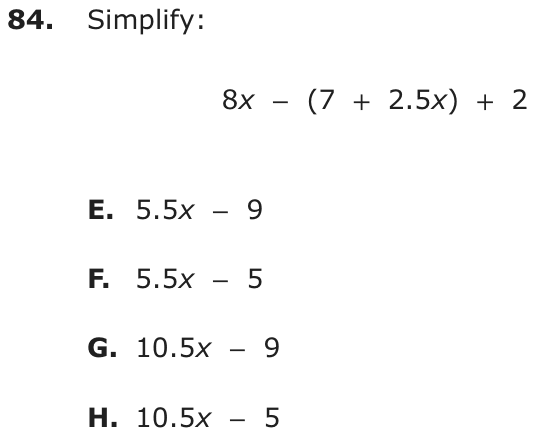
Question 46 of 107
2024 Test B Math, question 31Question
If , what is the value of in terms of x?
- A
- B
- C
- D
Show the answer
Correct answer: C
First, substitute for each y in the expression:
Then simplify the expression:
The simplified expression is .
Question analysis
Given that y equals 4x, students rewrite the expression 3y + 2(3y + 5) − x using only x. It tests substitution, the distributive property and combining like terms. Errors creep in when a term is dropped or when x terms and y terms are merged before y has been replaced.
- NYS standards
- Grade level
- Grade 7 content, by NYS standard
- Compared with grade 7
- At grade 7 Substituting an expression for a variable and simplifying with the distributive property is standard grade 7 work. Putting the substitution inside parentheses calls for care, but the steps are routine for students who combine like terms fluently.
- Estimated difficulty
- Straightforward: two steps or one careful reading.
- Thinking it demands
- Depth of knowledge 1, recall and reproduction · mainly apply
- What makes it hard
- A very close wrong answer moderate
- Error-prone arithmetic minor
- Solution
- 3 steps
- Reading level
- Question and choices: about grade 7, 16 words.
- Students, last 30 days
- Not enough answers yet to show (it takes 10).
Why it is hard, traps and wrong answers (shows the answer)
Why it is hard
Substitution and distribution are routine here, so points are lost to bookkeeping rather than method. The expression has three x pieces, 12x, 24x and a lone − x, and the last is easy to overlook after the larger terms. The other two wrong choices come from collecting 3y, 6y and x as if they were like terms, a reason to replace y with 4x before simplifying anything.
A very close wrong answer moderate Choosing the answer
Every choice ends in + 10, and 36x + 10 differs from 35x + 10 by a single x, so only remembering the last − x in the expression separates them. (Embretson & Wetzel, 1987; Gorin & Embretson, 2006; Ascalon et al., 2007)
Error-prone arithmetic minor Working it out
The substitution sits inside nested grouping, 2[3(4x) + 5], so the 2 must reach both the 12x and the 5 before the x terms are collected. (Brown & Burton, 1978; Junker & Sijtsma, 2001)
Strategy: Replace every y with 4x in parentheses before doing anything else, then distribute the 2 and collect the x terms and the constant separately.
Traps
- A faulty procedure: A systematic but wrong procedure: adding fractions straight across, applying an exponent to each term of a sum, dropping a sign when moving a term.
- Stops one step early: A choice is a number from partway through the solution.
The wrong answers, classified
A A faulty procedure (Brown & Burton, 1978; Tatsuoka, 1983)
Collects 3y + 6y − x as 8 of a single variable, treating x and y as like terms, and writes the result as 8x without substituting 4x.
B A faulty procedure (Brown & Burton, 1978; Tatsuoka, 1983)
Combines 3y + 6y − x into 8y, as if x and y were like terms, and only then substitutes 4x for y, giving 32x + 10.
D Stops one step early (King et al., 2004; Gierl et al., 2017)
Substitutes and distributes correctly to reach 12x + 24x + 10 = 36x + 10, then stops before subtracting the final x.
Worked solution, step by step
Formulas used
- Distributive property
- a is the number outside the parentheses. b and c are the terms inside. Terms are the parts joined by plus or minus signs. Multiply a by each term inside. It works because 2 groups of (12x + 5) hold 2 of the 12x and 2 of the 5.
Sort out the question
means y is always 4 times x. You need to rewrite the expression with no y in it. That is what “in terms of x” means. The answer will use only x and numbers.
Replace each y with 4x
Put 4x in parentheses everywhere you see y. The parentheses keep the multiplying clear.
3(4x) means 3 times 4x, which is 12x. It shows up twice.
Multiply out the parentheses
Use the distributive property. The 2 must multiply both the 12x and the 5.
The whole expression is now:
Combine the like terms
Like terms have the same letter part. Here the x terms are 12x, 24x and −x. The −x means take away one x.
The 10 has no x, so it stays as it is. The result is .
Watch out: Don’t forget the −x at the end. Stopping at 12x + 24x gives 36x + 10, choice D. Also, swap in 4x before you combine. Adding 3y, 6y and −x as if they were all y’s mixes unlike terms. It leads to choice B.
So the answer is C, .
Check your answer
Test a number. Let x = 1, so y = 4. The original expression gives . Your answer gives . They match. Choice D would give 46.
More questions like this
The original DOE question
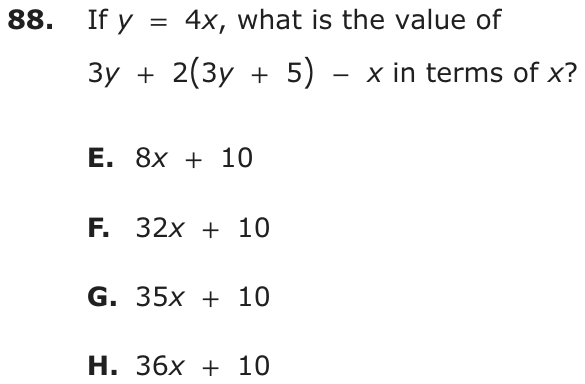
Question 47 of 107
2024 Test B Math, question 44Question
Which inequality is equivalent to ?
- A
- B
- C
- D
Show the answer
Correct answer: D
Distribute the coefficient −2 on the right-hand side:
Subtract from both sides:
Add 10 to both sides:
Divide both sides by 5:
This is equivalent to
Question analysis
Students choose the simplest equivalent form of a linear inequality that has x on both sides and a negative number multiplied into parentheses. It tests distributing, combining like terms and solving inequalities. Sign errors in the distribution, and reading the direction of the final inequality, are where most mistakes happen.
- NYS standards
- Grade level
- Grade 8 content, by NYS standard
- Compared with grade 7
- Above grade 7 Grade 7 inequalities have the form px + q < r. This one has x on both sides and a negative factor to distribute across a subtraction, steps that belong to grade 8 equation work, so it is harder than typical grade 7 practice.
- Estimated difficulty
- Hard: combines ideas, needs a plan, and has more than one tempting wrong answer.
- Thinking it demands
- Depth of knowledge 1, recall and reproduction · mainly apply
- What makes it hard
- Error-prone arithmetic moderate
- A very close wrong answer moderate
- Many steps minor
- Solution
- 4 steps
- Reading level
- Question and choices: about grade 16+, 10 words.
- Students, last 30 days
- Not enough answers yet to show (it takes 10).
Why it is hard, traps and wrong answers (shows the answer)
Why it is hard
Every move is standard algebra, but the inequality is built so that small slips change the answer completely. The −2 has to reach both terms in the parentheses, and once the boundary −2 is found its direction still has to be read correctly, since the variable ends up on the right as −2 < x. Rewriting that as x > −2, or substituting x = 0 into the original, catches the trap.
Error-prone arithmetic moderate Working it out
Distributing −2 over (5 − 3x) gives −10 + 6x, two sign decisions in one move, and the x terms then sit on both sides of the inequality. (Brown & Burton, 1978; Junker & Sijtsma, 2001)
A very close wrong answer moderate Choosing the answer
x < −2 and x > −2 share the boundary and differ only in direction, which depends on reading −2 < x correctly or flipping the sign when dividing by a negative. (Embretson & Wetzel, 1987; Gorin & Embretson, 2006; Ascalon et al., 2007)
Many steps minor Working it out
Four moves follow one another, distributing, collecting 5x + 6x, moving the x terms and dividing by 5, and a slip at any of them changes the result. (Daniel & Embretson, 2010; Enright, Morley & Sheehan, 2002)
Strategy: Distribute the −2 to both terms in the parentheses, combine the x terms on the right, then gather the x terms on the side that keeps their coefficient positive.
Traps
- Order of operations: Working left to right, or distributing a minus sign wrongly, gives a choice.
- Negatives and direction: Arithmetic with negative numbers, the order of a subtraction, or direction on a number line. (Moving a term across the equals sign without changing its sign is a faulty procedure.)
- A faulty procedure: A systematic but wrong procedure: adding fractions straight across, applying an exponent to each term of a sum, dropping a sign when moving a term.
The wrong answers, classified
A A faulty procedure (Brown & Burton, 1978; Tatsuoka, 1983)
Treats 5 − 3x as 2, combining a number with an x term, so the right side becomes 5x − 4 and the solution x < 16.
B Order of operations (Brown & Burton, 1978)
Multiplies the −2 by the 5 but not by the −3x, writing 5x − 10 − 3x, which leads to 4x < 10 and x < 5/2.
C Negatives and direction (Brown & Burton, 1978)
Finds the boundary −2 but points the inequality the wrong way, by misreading −2 < x or by not flipping the sign after dividing by −5.
Worked solution, step by step
Formulas used
- Distributive property
- a is the number outside the parentheses. b and c are the terms inside. Multiply a by each one. A minus sign inside counts as a negative term, so 5 − 3x is 5 + (−3x). A negative times a negative is positive.
- Keeping an inequality true
- a and b are the two sides, and c is any number. Adding or subtracting the same number on both sides keeps the inequality true. Dividing both sides by a positive number also keeps it true. Only multiplying or dividing by a negative number flips the sign.
Sort out the question
An inequality compares two sides with a sign like <, which means is less than. To solve it, you get x alone on one side.
You need the short inequality that has the same answers as the long one.
Distribute the −2
Multiply −2 by both terms inside the parentheses, 5 and −3x.
A negative times a negative is positive, so the second part is +6x. Watch out: If the −2 multiplies only the 5, you end up with , choice B.
Combine the x terms
The right side is now 5x − 10 + 6x. Put the x terms together: 5x + 6x = 11x.
Gather the x terms on one side
Subtract 6x from both sides. That leaves the x terms on the right, where they stay positive.
Get x by itself
Add 10 to both sides. Then divide both sides by 5.
You divided by a positive 5, so the sign does not flip.
Read it with x first
says −2 is less than x. That is the same as saying x is greater than −2, just as 3 < 5 means 5 > 3.
Watch out: , choice C, has the same number but points the wrong way.
So the answer is D, .
Check your answer
Test x = 0, which is greater than −2. The left side is . The right side is . And −20 < −10 is true. Now test x = −3. The left side is −38 and the right side is −43. That is false, as it should be.
More questions like this
The original DOE question
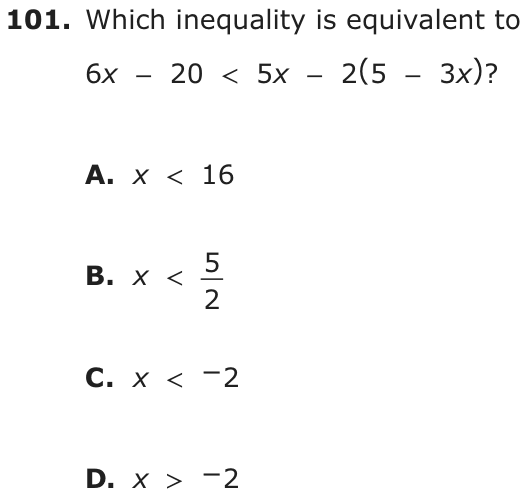
Question 48 of 107
2024 Test B Math, question 53Question
Which graph represents the solution to ?
- A

- B

- C

- D

Show the answer
Correct answer: A
Since , either or .
Solving for x gives .
Solving for x gives .
A filled circle on a number line represents “or equal to.” So the correct number line representation has filled circles at −3 and 1, with the number line filled to the left of −3 for “less than” and to the right of 1 for “greater than.”
Question analysis
Students choose the number line graph that shows every solution of an inequality in which x + 1 sits inside absolute value bars. It tests absolute value as distance and graphing inequalities. The tricky part is turning one absolute value statement into two pieces and placing each boundary point and shaded ray correctly.
- NYS standards
- Grade level
- Grade 7 content, by NYS standard
- Compared with grade 7
- Above grade 7 Grade 7 students solve and graph two-step inequalities and know absolute value as distance. An inequality with an absolute value has to be split into two cases, which is outside the grade 6 to 8 standards and well above typical grade 7 work.
- Estimated difficulty
- Hard: combines ideas, needs a plan, and has more than one tempting wrong answer.
- Thinking it demands
- Depth of knowledge 2, skills and concepts · mainly apply
- What makes it hard
- Something you must already know moderate
- A very close wrong answer moderate
- Reading a figure, table or graph minor
- Solution
- 3 steps
- Reading level
- Question and choices: about grade 9, 7 words.
- Students, last 30 days
- Not enough answers yet to show (it takes 10).
Why it is hard, traps and wrong answers (shows the answer)
Why it is hard
Reading |x + 1| as the distance from x to −1 makes this quick: the points 2 units away are −3 and 1, and greater than or equal means outside them. Students who solve only one case and mirror it across 0 land on graphs centered on 0, and students who find both endpoints may still shade between them. The graphs differ in just one dot or one shading choice, so each must be read carefully.
Something you must already know moderate Working it out
Solving |x + 1| ≥ 2 needs two cases, x + 1 ≤ −2 or x + 1 ≥ 2, joined by or; absolute value inequalities go beyond grade 7, and the stem gives no hint. (Anderson & Krathwohl, 2001)
A very close wrong answer moderate Choosing the answer
The right graph and the segment from −3 to 1 share both filled endpoints, so only deciding between outside and between the boundaries separates them. (Embretson & Wetzel, 1987; Gorin & Embretson, 2006; Ascalon et al., 2007)
Reading a figure, table or graph minor Understanding the question
Four number lines must be read for filled dots and arrow directions, and two of them differ from the right one only in where a single dot sits. (Lesh, Post & Behr, 1987; Kirsch & Mosenthal, 1990)
Strategy: Read the absolute value as distance from −1 on the number line, find the points exactly 2 units away, and decide whether the solutions lie between or outside them.
Traps
- Misunderstands the concept: A wrong belief about a concept: that percents can be added, that area grows like length, that averages can be averaged, that a bigger denominator means a bigger fraction.
- Negatives and direction: Arithmetic with negative numbers, the order of a subtraction, or direction on a number line. (Moving a term across the equals sign without changing its sign is a faulty procedure.)
The wrong answers, classified
B Misunderstands the concept (Smith, diSessa & Roschelle, 1993; De Bock et al., 1998; Ni & Zhou, 2005)
Solves x + 1 ≥ 2 to get x ≥ 1, then mirrors it across 0 to x ≤ −1, as if the solution were centered on 0 rather than on −1.
C Negatives and direction (Brown & Burton, 1978)
Finds −3 and 1 but shades between them, the solution of |x + 1| ≤ 2, reversing which side of the boundaries lies at least 2 units from −1.
D Misunderstands the concept (Smith, diSessa & Roschelle, 1993; De Bock et al., 1998; Ni & Zhou, 2005)
Solves x + 1 ≤ −2 to get x ≤ −3, then mirrors it across 0 to x ≥ 3, assuming the boundaries are symmetric about 0.
Worked solution, step by step
Formulas used
- Absolute value as distance
- x and a are points on the number line. The bars mean absolute value. |x − a| is how far apart the two points are, which is never negative. Since x + 1 = x − (−1), |x + 1| is the distance from x to −1.
Sort out the question
You need the graph of every x that makes true. The sign ≥ means greater than or equal to. The bars mean absolute value.
On a number line, a filled dot means that point counts. A thick line with an arrow means all the numbers that way count too.
Read it as a distance
Adding 1 is the same as subtracting −1, so . By the formula, is the distance from x to −1.
So the inequality says that x is at least 2 units away from −1.
Find the two boundary points
Start at −1 and go 2 units each way.
At −3 and at 1, the distance is exactly 2. The words or equal to let them count, so they get filled dots.
Decide which side to shade
Being at least 2 away means being farther out. Numbers between −3 and 1 are too close to −1. For example, 0 is only 1 unit away. So shade to the left of −3 and to the right of 1.
In algebra, that is or . These give or .
Match the graph
Choice A has filled dots at −3 and 1, with arrows going outward. That matches.
Watch out: Choice C shades between −3 and 1. Those are the points within 2 of −1, the answer to . Choices B and D are centered on 0, but the center here is −1.
So the answer is A, the graph shaded outward from −3 and 1.
Check your answer
Test a point from each part. For x = 2, , and 3 is at least 2. For x = 0, , which is less than 2. For x = −3, , which counts. Graph A agrees with all three.
More questions like this
The original DOE question
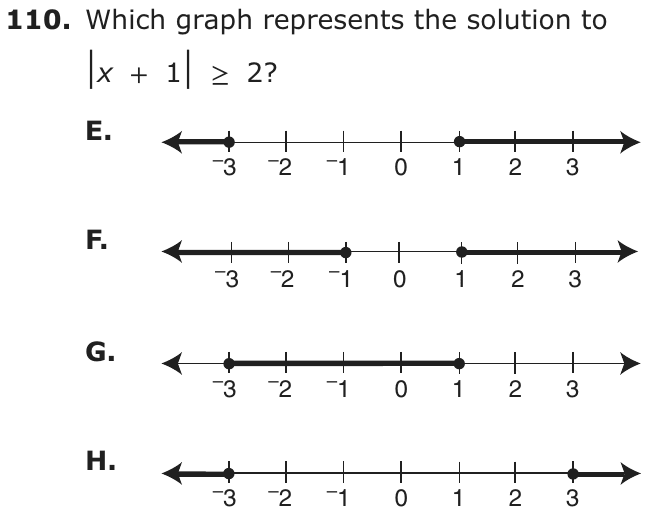
Question 49 of 107
2024 Test B Math, question 55Question
Typically, an amusement park sells 3 times as many tickets on Sunday as on any weekday, and 4 times as many tickets on Saturday as on Sunday. If the number of tickets sold on Saturday and Sunday totaled 30,000, how many tickets are expected to be sold on the following Monday?
- A2,000
- B2,500
- C3,000
- D4,285
Show the answer
Correct answer: A
First, determine the number of tickets sold on Sunday, x, using the total number of tickets sold on Saturday and Sunday, 30,000, and the number of tickets sold on Saturday, .
Then determine the number of tickets expected to be sold on Monday, y, using the number of tickets sold on Sunday, 6,000.
The number of tickets expected to be sold on Monday is 2,000.
Question analysis
An amusement park sells 3 times as many tickets on Sunday as on a weekday and 4 times as many on Saturday as on Sunday. Given the weekend total, students find the expected ticket sales for the following Monday. It tests writing an equation from multiplicative comparisons, and the trap is comparing Saturday with the wrong day.
- Grade level
- Grade 7 content, by NYS standard
- Compared with grade 7
- At grade 7 Writing and solving a one-variable equation from a word problem is grade 7 work. Two linked multiplicative comparisons, with Saturday measured against Sunday rather than a weekday, add a layer of translation, but the equation itself stays simple.
- Estimated difficulty
- Moderate: several steps, or a close reading with one strong distractor.
- Thinking it demands
- Depth of knowledge 2, skills and concepts · mainly apply
- What makes it hard
- Turning words into math moderate
- Much to keep track of minor
- Solution
- 3 steps
- Reading level
- Question and choices: about grade 12, 48 words.
- Students, last 30 days
- Not enough answers yet to show (it takes 10).
Why it is hard, traps and wrong answers (shows the answer)
Why it is hard
The question is two comparisons chained through Sunday, and most wrong answers come from linking them incorrectly. Students who read Saturday's 4 times as 4 weekdays, or who leave Sunday out of the 30,000, find listed answers, one of them from a division that does not come out even. Letting a weekday be one share, so Sunday is 3 and Saturday 12, makes the weekend 15 shares and the check easy.
Turning words into math moderate Understanding the question
"4 times as many tickets on Saturday as on Sunday" compares Saturday with Sunday, not with a weekday, so Saturday is 4 × 3 = 12 weekdays' worth. (Hegarty, Mayer & Monk, 1995; Koedinger & Nathan, 2004)
Much to keep track of minor Working it out
Three days have to be held in relation at once, a weekday, Sunday and Saturday, with the 30,000 covering only the last two. (Sweller, 1988; Carpenter, Just & Shell, 1990)
Strategy: Let Sunday's sales be the unknown, write Saturday as 4 times it, solve the weekend equation for Sunday, then divide Sunday's figure by 3 for a weekday.
Traps
- Misreads the question: Misses or misreads a condition or a word in the question: "at least", "each", "remaining", "not".
- Wrong operation: Adds instead of multiplying, divides the wrong way round, turns a ratio or rate upside down, or undoes a step in the wrong direction (subtracts what should be added back).
The wrong answers, classified
B Misreads the question (Hegarty, Mayer & Monk, 1995)
Makes Saturday 3 × 4 = 12 weekdays' worth but divides all 30,000 by 12, leaving Sunday's 3 shares out of the weekend total.
C Wrong operation (Hegarty, Mayer & Monk, 1995; King et al., 2004)
Adds the multipliers, so Saturday is 3 + 4 = 7 weekdays' worth; with Sunday's 3 the weekend is 10 shares, and 30,000 ÷ 10 = 3,000.
D Misreads the question (Hegarty, Mayer & Monk, 1995)
Reads Saturday as 4 times a weekday rather than 4 times Sunday, so splits 30,000 into 3 + 4 = 7 shares of about 4,285.7.
Worked solution, step by step
Formulas used
- Undoing multiplication
- x is the unknown number. a and b are known numbers. Division undoes multiplication. So if a times x is b, you find x by dividing b by a. This is the same as dividing both sides by a.
Sort out the question
Sunday sells 3 times as many tickets as a weekday. Saturday sells 4 times as many as Sunday. Saturday and Sunday together sell 30,000.
Monday is a weekday. You need Monday’s tickets. Notice that Saturday is compared with Sunday, not with a weekday.
Write an equation for the weekend
Let x be Sunday’s tickets. Then Saturday’s tickets are 4x. Together they make 30,000.
Solve for Sunday
Use the rule for undoing multiplication. Divide both sides by 5.
Sunday sells 6,000 tickets. Saturday sells .
Find Monday’s tickets
Sunday sells 3 times as many as a weekday. Let y be Monday’s tickets.
Watch out: If you read Saturday as 4 times a weekday, you split 30,000 into 7 shares. That gives about 4,285, choice D. Dividing 30,000 by 12 leaves out Sunday and gives 2,500, choice B.
So the answer is A, 2,000.
Check your answer
Think in shares. A weekday is 1 share. Sunday is 3 shares, and Saturday is shares. The weekend is 15 shares, and . It matches.
More questions like this
The original DOE question
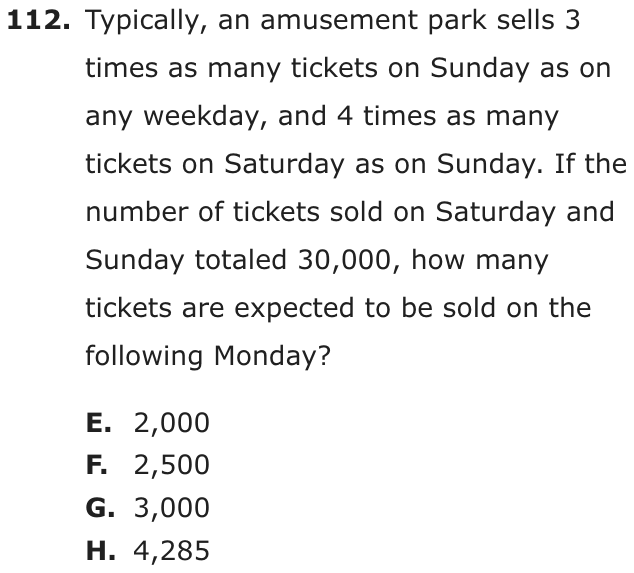
Question 50 of 107
2023 Test A Math, question 3Question
Solve for x:
Grid-in question: work out the answer and enter it as a number.
Show the answer
Correct answer: 4
| Apply the distributive property; multiply the −2 by and 1. | |
| Combine like terms. | |
| Apply the additive inverse property; subtract 1 from both sides of the equation. | |
| Apply the multiplicative inverse property; divide both sides of the equation by 3. | |
Question analysis
This grid-in gives the equation 7x + 3 − 2(2x + 1) = 13 and asks students to solve for x. It tests the distributive property with a negative factor, combining like terms and solving a two-step equation. The minus sign in front of the parentheses has to reach both terms inside, a step many students rush.
- Grade level
- Grade 7 content, by NYS standard
- Compared with grade 7
- At grade 7 Grade 7 students expand expressions with negative factors and solve equations such as p(x + q) = r. This equation needs both skills plus combining like terms, which is routine work with one negative sign that is easy to lose.
- Estimated difficulty
- Straightforward: two steps or one careful reading.
- Thinking it demands
- Depth of knowledge 1, recall and reproduction · mainly apply
- What makes it hard
- Error-prone arithmetic moderate
- An answer in an unexpected form minor
- Solution
- 4 steps
- Reading level
- Question and choices: about grade 3, 4 words.
- Students, last 30 days
- Not enough answers yet to show (it takes 10).
Why it is hard, traps and wrong answers (shows the answer)
Why it is hard
This is a standard multi-step linear equation, and the work is short once the parentheses are cleared. Everything rests on distributing −2 correctly; the later steps, combining 7x with −4x and 3 with −2, then undoing the + 1 and the × 3, are routine. Substituting 4 back into the left side, 28 + 3 − 18 = 13, is a fast check that catches a sign slip.
Error-prone arithmetic moderate Working it out
The −2 in front of (2x + 1) must reach both terms, giving −4x − 2; the second product, −2 × 1, is the one most often written as +2 or left as +1. (Brown & Burton, 1978; Junker & Sijtsma, 2001)
An answer in an unexpected form minor Choosing the answer
As a grid-in with no choices, a value such as 3 or 8/3 from a distributing slip looks just as finished as the right one; only substituting back exposes it. (Enright, Morley & Sheehan, 2002)
Strategy: Distribute −2 to both terms inside the parentheses, combine the x terms and the constants, then undo the addition and the multiplication in turn.
Traps
- A faulty procedure: A systematic but wrong procedure: adding fractions straight across, applying an exponent to each term of a sum, dropping a sign when moving a term.
- Order of operations: Working left to right, or distributing a minus sign wrongly, gives a choice.
The wrong answers, classified
3 A faulty procedure (Brown & Burton, 1978; Tatsuoka, 1983)
Multiplies only the 2x by −2 and leaves the + 1 untouched, so the equation becomes 3x + 4 = 13 and x = 3.
8/3 Order of operations (Brown & Burton, 1978)
Gives the minus sign to 4x but not to the 2, writing −4x + 2, so the equation becomes 3x + 5 = 13 and x = 8/3.
12 Stops one step early (King et al., 2004; Gierl et al., 2017)
Simplifies correctly to 3x + 1 = 13, subtracts 1 to reach 3x = 12, and grids 12 without dividing by 3.
Worked solution, step by step
Formulas used
- Distributive property
- a is the number outside the parentheses. b and c are the terms inside. A term is a number, a letter, or a number times a letter. Multiply each term inside by a. If a is negative, every product gets its sign too.
- Keeping an equation balanced
- a and b are the two equal sides. c is any number, but not 0 when you divide. Doing the same thing to both sides keeps them equal, like a balanced scale. Use it to get the unknown by itself.
Sort out the equation
You need the value of x that makes true. x is the unknown number. The tricky part is the −2 in front of the parentheses. It multiplies everything inside them.
Multiply out the parentheses
Use the distributive property with a = −2, b = 2x and c = 1.
So the equation becomes this:
Watch out: the −2 must multiply the 1 too. Leaving + 1 gives x = 3. Writing + 2 instead of − 2 gives .
Combine like terms
Like terms are terms of the same kind. Put the x terms together. Put the plain numbers together.
Get x by itself
Undo the + 1 first. Subtract 1 from both sides, so the equation stays balanced.
3x means 3 times x. So divide both sides by 3.
Watch out: don’t stop at 3x = 12. 12 is three times the answer. So you would grid 4.
Check your answer
Put x = 4 back into the first equation: . That matches the 13 on the right side, so x = 4 is right.
More questions like this
The original DOE question
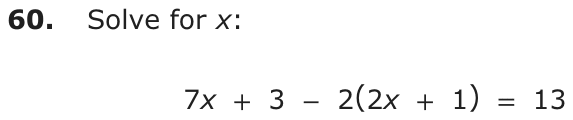
Question 51 of 107
2023 Test A Math, question 8Question
Jamel works at a computer store. He is paid an hourly rate plus a 15% commission on all computer products he sells. Last week, Jamel was paid $802.50 for working 30 hours and selling $1,250.00 worth of computer products. What is Jamel’s hourly rate?
- A$20.50/hr
- B$26.75/hr
- C$33.00/hr
- D$37.65/hr
Show the answer
Correct answer: A
First, determine the amount of Jamel’s weekly pay that is from commission:
Next, subtract Jamel’s commission amount from his weekly pay:
Last, divide the result by 30 hours to find Jamel’s hourly rate:
Question analysis
Jamel earns an hourly wage plus a 15% commission on his sales, and one week he is paid $802.50 for 30 hours of work and $1,250 in sales. Students find his hourly rate. The question mixes a percent with a rate, and the commission has to be taken out of the total pay before dividing by the hours.
- Grade level
- Grade 7 content, by NYS standard
- Compared with grade 7
- At grade 7 Commission is one of the percent applications named in the grade 7 standards, and the remaining work is a two-step equation with decimals. That matches a typical grade 7 multistep problem, with the order of the steps as the main demand.
- Estimated difficulty
- Moderate: several steps, or a close reading with one strong distractor.
- Thinking it demands
- Depth of knowledge 2, skills and concepts · mainly apply
- What makes it hard
- Turning words into math moderate
- Many steps moderate
- Error-prone arithmetic minor
- Solution
- 3 steps
- Reading level
- Question and choices: about grade 3, 44 words.
- Students, last 30 days
- Not enough answers yet to show (it takes 10).
Why it is hard, traps and wrong answers (shows the answer)
Why it is hard
Jamel's pay has two parts, and the question asks for only one of them, so the commission has to be removed before dividing by the hours. Students who divide the whole $802.50 by 30 get a believable hourly figure that still contains the commission. Checking the answer against the story, 30 × $20.50 + $187.50 = $802.50, confirms both parts.
Turning words into math moderate Understanding the question
The phrase "paid an hourly rate plus a 15% commission on all computer products he sells" makes $802.50 the sum of two parts, 30 hours of pay and 15% of $1,250. (Hegarty, Mayer & Monk, 1995; Koedinger & Nathan, 2004)
Many steps moderate Working it out
Three operations in order: 15% of $1,250 is $187.50, $802.50 − $187.50 = $615.00, and $615.00 ÷ 30 = $20.50; dividing before subtracting gives a listed choice. (Daniel & Embretson, 2010; Enright, Morley & Sheehan, 2002)
Error-prone arithmetic minor Working it out
Every amount carries cents, and 15% of $1,250 and $615 ÷ 30 are worked by hand, so a misplaced decimal point shifts the hourly rate. (Brown & Burton, 1978; Junker & Sijtsma, 2001)
Strategy: Take 15% of the $1,250 in sales to find the commission, remove that from the week's pay, and divide what is left by the 30 hours worked.
Traps
- Answers a different question: A choice is right for another quantity: the other unknown, the rest instead of the part, the part instead of the whole.
- Follows a key word: Picks the operation from a single word rather than the situation: "removed" so subtract, "of" so multiply, "more" so add, when the situation needs something else.
- Misreads the question: Misses or misreads a condition or a word in the question: "at least", "each", "remaining", "not".
The wrong answers, classified
B Answers a different question (King et al., 2004; Hegarty, Mayer & Monk, 1995)
Divides the whole $802.50 by 30 hours, which gives Jamel's average pay per hour with the commission included, not his hourly rate.
C Follows a key word (Hegarty, Mayer & Monk, 1995)
Follows the word plus and adds the $187.50 commission to the $802.50 instead of removing it, so (802.50 + 187.50) ÷ 30 = $33.00.
D Misreads the question (Hegarty, Mayer & Monk, 1995)
Swaps the two dollar amounts, taking 15% of the $802.50 pay and subtracting it from the $1,250 of sales: (1,250 − 120.38) ÷ 30 ≈ $37.65.
Worked solution, step by step
Formulas used
- Percent of a number
- p is the percent. The whole is the amount you take the percent of. The part is the result. Percent means out of 100. So 15% is 15 out of every 100, or 0.15.
- Pay with commission
- The rate is the money Jamel earns for each hour. Hours is how long he worked. The commission is extra money that is a percent of what he sells. His pay is these two amounts added together.
Sort out the question
Jamel’s pay has two parts. One part is an hourly rate, the money he earns for each hour. The other part is a commission. A commission is extra pay that is a percent of what he sells. He worked 30 hours and sold $1,250.00 of products. In all he got $802.50. You need his hourly rate.
Find the commission
His commission is 15% of what he sold. 15% means 15 out of 100, or 0.15.
His commission was $187.50. Watch out: take 15% of the $1,250 he sold, not of his $802.50 pay. Mixing them up leads to $37.65, choice D.
Take the commission out of his pay
The rest of his pay came from his hours.
He earned $615.00 for 30 hours of work. Watch out: the word plus does not mean add here. Adding the $187.50 to $802.50 counts the commission twice. That leads to $33.00, choice C.
Divide by the hours he worked
Share the $615.00 equally over the 30 hours.
Watch out: don’t divide all $802.50 by 30. That gives $26.75, choice B. That amount still includes the commission. So the answer is A, $20.50 per hour.
Check your answer
Work forward from the answer. 30 hours at $20.50 is dollars. Add the commission: . That is exactly Jamel’s pay for the week.
More questions like this
The original DOE question
Question 52 of 107
2023 Test A Math, question 12Question
If n is an integer and is an even number, which expression must also represent an even number?
- A
- B
- C
- D
Show the answer
Correct answer: A
The expression is equal to , and it is given that this is an even number. The expression must also represent an even number, because 3 is an odd number: if were odd, would be the product of two odd numbers, which is an odd number. If is an even number, then n must be an odd number. Choose an odd number to substitute for n in the answer options to find which expression represents an even number:
Let .
Option A:
Option B:
Option C:
Option D:
Since 16 is the only even number, the correct answer is option A.
Question analysis
This number properties question says that 3n + 3 is even for an integer n and asks which of four expressions must also be even. Students reason about odd and even numbers written with a variable. The hidden step is deciding what the given fact says about n itself before testing the expressions.
- Grade level
- Grade 7 content, by NYS standard
- Compared with grade 7
- Above grade 7 Grade 7 students rewrite and evaluate expressions, but rarely reason about whether an expression is odd or even for every value of a variable. Here that reasoning comes in two layers: first about n, then about each choice.
- Estimated difficulty
- Moderate: several steps, or a close reading with one strong distractor.
- Thinking it demands
- Depth of knowledge 2, skills and concepts · mainly analyze
- What makes it hard
- Solution
- 3 steps
- Reading level
- Question and choices: about grade 9, 23 words.
- Corrected from the DOE handbook
- The explanation gave the wrong reason why n + 1 must be even; the reason was corrected.
- Students, last 30 days
- Not enough answers yet to show (it takes 10).
Why it is hard, traps and wrong answers (shows the answer)
Why it is hard
The question hides its key step: 3n + 3 = 3(n + 1), and since 3 is odd, n + 1 must be even, so n is odd. A student who skips that step and tests a convenient even value never checks the condition and lands on a wrong expression. Once n is known to be odd, any odd test value, such as 1, picks out 5n + 1 at once.
Variables instead of numbers moderate Understanding the question
No value of n is given; the only fact is that 3n + 3 is even, and it has to be turned into a fact about n itself, that n is odd, before any choice is judged. (Koedinger & Nathan, 2004; Enright, Morley & Sheehan, 2002)
Something you must already know minor Working it out
The parity rules are assumed, not stated: an odd number times an odd number is odd, and an even number plus an odd number is odd. (Anderson & Krathwohl, 2001)
Every choice must be checked minor Choosing the answer
Each expression has to be tested with an odd n or by parity rules; three of the four come out odd whenever n is odd, so none can be dismissed on sight. (Embretson & Wetzel, 1987)
Strategy: First work out what 3n + 3 being even says about n, by factoring out 3 or testing small integers, then check each expression with a value of n that fits.
Traps
- Misreads the question: Misses or misreads a condition or a word in the question: "at least", "each", "remaining", "not".
- Misunderstands the concept: A wrong belief about a concept: that percents can be added, that area grows like length, that averages can be averaged, that a bigger denominator means a bigger fraction.
The wrong answers, classified
B Misunderstands the concept (Smith, diSessa & Roschelle, 1993; De Bock et al., 1998; Ni & Zhou, 2005)
Sees the even term 4n and treats the whole expression as even, overlooking that adding the odd 5 makes 4n + 5 odd for every integer n.
C Misunderstands the concept (Smith, diSessa & Roschelle, 1993; De Bock et al., 1998; Ni & Zhou, 2005)
Assumes an expression that starts with 2n must be even, though 2n + 3 is an even number plus 3 and so is always odd.
D Misreads the question (Hegarty, Mayer & Monk, 1995)
Tests n = 2 without checking the condition, though 3(2) + 3 = 9 is odd; with n = 2, only n + 2 = 4 comes out even.
What was corrected from the DOE handbook, and why
- Explanation: The DOE’s explanation said that n + 1 must be even “because 3 is an odd number and the product of an odd number and an even number is an even number.” That fact does not show that n + 1 is even; the reason is that if n + 1 were odd, 3(n + 1) would be the product of two odd numbers, which is odd, and it is given as even. The site now gives that reason. The answer, A, is unchanged.
Worked solution, step by step
Formulas used
- Pulling out a common factor
- a is a factor, a number being multiplied, that both terms share. b and c are what is left. This is the distributive property run backward. It turns a sum into a product, which is easier to reason about.
- Multiplying odd numbers
- An even number splits into pairs, like 2, 4 or 6. An odd number has one left over, like 1, 3 or 5. An odd number of odd groups always leaves one extra. So the product is odd.
- Adding odd and even numbers
- Two odd numbers each have one left over. Together the two extras make a pair, so the sum is even. An even number plus an odd number still has one left over, so the sum is odd.
Sort out the question
n is an integer, a whole number that can be positive, negative or 0. You are told that is even. You need the expression that must be even too. Must means it is even every time. First find out what the fact tells you about n.
Pull out the 3
Both terms in have a factor of 3. Pull it out.
So 3 times is an even number.
Decide whether n is odd or even
3 is odd. If were odd, would be odd times odd. That is always odd. But we are told it is even. So must be even. One less than an even number is odd. So n is odd. Watch out: don’t test n = 2. Then , which is odd. With n = 2, only comes out even, choice D.
Test each choice with an odd n
Pick an odd number, n = 3. It fits, since is even.
- A: , even
- B: , odd
- C: , odd
- D: , odd
Only A is even.
Make sure A always works
Must means every odd n, not just 3. If n is odd, 5n is odd times odd, so it is odd. Odd plus 1 is even. So is always even. Watch out: 4n is even, but adding the odd 5 makes odd, choice B. In the same way, is always odd, choice C. So the answer is A, .
Check your answer
Try another odd number, n = 1. Then , which is even, so n = 1 fits. And is even too. The other three choices give 9, 5 and 3, all odd. Choice A wins again.
More questions like this
The original DOE question
Question 53 of 107
2023 Test A Math, question 18Question
Sheila is saving money for her summer vacation. She starts the summer with a balance of $90.00 and plans to save 15% of her earnings each week. She earns the same amount each week. After 12 weeks, Sheila has saved a total of $472.59. How much money does Sheila earn each week?
- A$212.55
- B$262.55
- C$302.55
- D$312.55
Show the answer
Correct answer: A
Let x be the amount that Sheila needs to earn each week.
First, subtract 90 from both sides:
Last, divide both sides by 1.8:
Question analysis
Sheila starts the summer with $90 and saves 15% of what she earns each week, earning the same amount every week, and after 12 weeks she has $472.59. Students find her weekly earnings. They must write an equation that separates the starting balance from the savings and then work with a percent and long decimals.
- Grade level
- Grade 7 content, by NYS standard
- Compared with grade 7
- At grade 7 Writing and solving an equation of the form px + q = r from a word problem is core grade 7 work. Here the coefficient combines a percent with 12 weeks, and the decimals are long, which adds steps but no new idea.
- Estimated difficulty
- Moderate: several steps, or a close reading with one strong distractor.
- Thinking it demands
- Depth of knowledge 2, skills and concepts · mainly apply
- What makes it hard
- Turning words into math moderate
- Error-prone arithmetic moderate
- Many steps minor
- Solution
- 3 steps
- Reading level
- Question and choices: about grade 4, 48 words.
- Students, last 30 days
- Not enough answers yet to show (it takes 10).
Why it is hard, traps and wrong answers (shows the answer)
Why it is hard
The story has three layers, a starting balance, a weekly saving rate and a 12-week total, and the unknown sits under the percent. Students lose the point by forgetting the $90 was already there, or by moving it the wrong way. Testing a choice is a dependable alternative: 15% of $212.55 is about $31.88, and 12 of those plus $90 gives $472.59.
Turning words into math moderate Understanding the question
The total of $472.59 includes the $90.00 she started with, and only 15% of each week's pay is saved, so the equation is 90 + 12 × 0.15x = 472.59. (Hegarty, Mayer & Monk, 1995; Koedinger & Nathan, 2004)
Error-prone arithmetic moderate Working it out
Dividing $382.59 by 1.8 by hand means shifting the decimal point to get 3,825.9 ÷ 18, which comes out to exactly $212.55 only if every digit is placed correctly. (Brown & Burton, 1978; Junker & Sijtsma, 2001)
Many steps minor Working it out
Subtract the $90, then divide by 12 weeks and by 0.15, or by their product 1.8; doing the division before the subtraction gives a listed choice. (Daniel & Embretson, 2010; Enright, Morley & Sheehan, 2002)
Strategy: Subtract the starting $90 from the final total, then divide by 12 weeks and by 0.15, or test each choice by taking 15% of it, multiplying by 12 and adding $90.
Traps
- Misreads the question: Misses or misreads a condition or a word in the question: "at least", "each", "remaining", "not".
- Wrong operation: Adds instead of multiplying, divides the wrong way round, turns a ratio or rate upside down, or undoes a step in the wrong direction (subtracts what should be added back).
The wrong answers, classified
B Misreads the question (Hegarty, Mayer & Monk, 1995)
Overlooks the $90 she started with, treating the whole $472.59 as savings from earnings, and divides it by 1.8 to get $262.55.
C Little reason to choose it (Haladyna & Downing, 1993; Rodriguez, 2005)
No setup of the savings gives $302.55, the right weekly pay plus the $90 starting balance, a sum with no meaning here, so it mostly catches guesses.
D Wrong operation (Hegarty, Mayer & Monk, 1995; King et al., 2004)
Adds the $90 to $472.59 instead of subtracting it, so the savings from earnings look like $562.59, and dividing by 1.8 gives $312.55.
Worked solution, step by step
Formulas used
- Percent of a number
- p is the percent. The whole is the amount you take the percent of. The part is the result. Percent means out of 100. So 15% is 15 out of every 100, or 0.15.
- Savings over time
- The start is the money she had at the beginning. Weekly savings is what she adds each week. Weeks is how many weeks pass. Each week adds the same amount, so multiply. Then add what she started with.
Sort out the question
Sheila starts with $90.00. Each week she earns the same amount and saves 15% of it. After 12 weeks she has $472.59 in all. That total includes the $90 she started with. You need how much she earns each week, not how much she saves.
Write an equation
Call her weekly earnings x. She saves 15% of x each week. That is .
Take away the starting $90
Only the money added during the 12 weeks came from her pay. Subtract 90 from both sides.
She saved $382.59 from her pay. Watch out: subtract the $90, don’t add it. Adding leads to $312.55, choice D. Forgetting the $90 leads to $262.55, choice B.
Combine the numbers next to x
Each week she saves 0.15 of one week’s pay. Over 12 weeks, that adds up to 1.8 times one week’s pay.
Divide by 1.8
Divide both sides by 1.8. First move the decimal point one place right in both numbers. Then you divide by the whole number 18.
Sheila earns $212.55 each week. So the answer is A, $212.55.
Check your answer
Work forward. 12 weeks of saving 15% is 1.8 weeks of pay: . Add the $90 she started with: . That is the total in the question.
More questions like this
The original DOE question
Question 54 of 107
2023 Test A Math, question 29Question
Integer x is evenly divisible by 3. Which expression below is also evenly divisible by 3?
- A
- B
- C
- D
Show the answer
Correct answer: D
Since integer x is evenly divisible by 3, substitute 3 for x in the answer options to determine which expression is also divisible by 3:
Let .
Option A:
Option B:
Option C:
Option D:
Option D is the only value that is divisible by 3.
Question analysis
This number properties question says an integer x is divisible by 3 and asks which of four linear expressions in x is also divisible by 3, whatever multiple of 3 the integer is. Students can test a multiple of 3 in each expression or think about remainders. Testing a value that is not a multiple of 3 can make a wrong expression look right.
- Grade level
- Grade 7 content, by NYS standard
- Compared with grade 7
- At grade 7 Grade 7 students rewrite and evaluate linear expressions, but they seldom ask whether one is divisible by 3 for every allowed value. One well-chosen substitution settles it, so the demand is about typical for grade 7.
- Estimated difficulty
- Straightforward: two steps or one careful reading.
- Thinking it demands
- Depth of knowledge 2, skills and concepts · mainly analyze
- What makes it hard
- Variables instead of numbers moderate
- Every choice must be checked minor
- Solution
- 2 steps
- Reading level
- Question and choices: about grade 13, 18 words.
- Students, last 30 days
- Not enough answers yet to show (it takes 10).
Why it is hard, traps and wrong answers (shows the answer)
Why it is hard
The algebra is light; the question turns on choosing a test value that obeys the condition. The habit of trying x = 1 backfires here, because 1 is not a multiple of 3 and it makes two wrong expressions come out divisible. Students who substitute 3, or who see that 4x and 6 are both multiples of 3 whenever x is, settle it quickly, and a second multiple such as 6 confirms it.
Variables instead of numbers moderate Understanding the question
Nothing pins x down except that it is a multiple of 3, so each expression must be judged for every such x, and any test value has to be a multiple of 3 itself, such as 3 or 6. (Koedinger & Nathan, 2004; Enright, Morley & Sheehan, 2002)
Every choice must be checked minor Choosing the answer
The four expressions differ only in their coefficients and constants, from 2x + 1 to 4x + 6, so none can be dismissed at a glance; each needs a test or a look at its terms. (Embretson & Wetzel, 1987)
Strategy: Substitute a multiple of 3, such as 3 or 6, for x in every expression and keep the one whose value divides evenly by 3; a second multiple confirms it.
Traps
- Misreads the question: Misses or misreads a condition or a word in the question: "at least", "each", "remaining", "not".
- Numbers taken from the question: Combines the numbers in the question without a model of the situation, or is simply a number that appears in the question.
The wrong answers, classified
A Misreads the question (Hegarty, Mayer & Monk, 1995)
Tests x = 1, which is not a multiple of 3, finds that 2(1) + 1 = 3 divides evenly, and stops at the first choice; with x = 3 it gives 7.
B Numbers taken from the question (Hegarty, Mayer & Monk, 1995)
Sees the 3 in 3x and takes the whole expression to be a multiple of 3, overlooking that subtracting 5 spoils it: with x = 3 it gives 4.
C Misreads the question (Hegarty, Mayer & Monk, 1995)
Tries a value that is not a multiple of 3, such as x = 4, where 4x − 1 = 15 divides evenly, though x = 3 gives 11.
Worked solution, step by step
Formulas used
- Adding multiples of 3
- a and b are whole numbers, so 3a and 3b are multiples of 3. A multiple of 3 is a number that 3 divides evenly, with nothing left over. Adding two multiples of 3 always gives another multiple of 3, because you can pull the 3 out of both parts.
Sort out the question
“Evenly divisible by 3” means 3 goes into the number with nothing left over. Such a number is called a multiple of 3, like 3, 6, 9 or 12.
You know that x is a multiple of 3. You need the expression that is a multiple of 3 every time, whatever multiple of 3 x is.
Test x = 3 in every choice
Pick a number for x that follows the rule. The easiest one is 3. Put it into each expression.
Choice Work Divisible by 3? A No B No C No D Yes Watch out: your test number must be a multiple of 3. With x = 1, choice A gives 3 and looks right. That leads to the wrong choice, A.
See why D always works
One test could be lucky, so see why D works for every x. Since x is a multiple of 3, 4x is one too. For example, 4 × 3 = 12 and 4 × 6 = 24. The number 6 is also a multiple of 3, since 6 = 3 × 2.
So 4x + 6 is a multiple of 3 plus a multiple of 3. That is always a multiple of 3.
Rule out the other choices
Watch out: choice B starts with 3x, but then it subtracts 5. The 5 is not a multiple of 3, so it spoils the result, and 3(3) − 5 = 4. Choices A and C also add or take away a number that is not a multiple of 3.
So the answer is D, .
Check your answer
Try two more multiples of 3. With x = 6, choice D gives , and 30 ÷ 3 = 10. With x = 9, it gives , and 42 ÷ 3 = 14. Both divide evenly, so D keeps working.
More questions like this
The original DOE question
Question 55 of 107
2023 Test A Math, question 36Question
Josef and Mai divided some stamps between themselves. Josef got 60% of the stamps. If Josef received 500 more stamps than Mai, how many stamps did Josef receive?
- A300
- B800
- C1,500
- D2,500
Show the answer
Correct answer: C
Let j be the number of stamps Josef has. Then Mai has stamps. The total number of stamps is . Since Josef has 60% of the stamps, set up an equation to solve for j:
| Cross multiply. | |
| Apply the distributive property; multiply the 60 by and 500. | |
| Apply the additive inverse property; subtract from both sides of the equation. | |
| Apply the multiplicative inverse property; divide both sides of the equation by −20. | |
Question analysis
This percent word problem says Josef and Mai split some stamps, Josef got 60% of them, and he received 500 more than Mai; it asks how many stamps Josef received. Students must connect a difference in counts to a difference in percents. Stopping at the total, or taking a percent of 500, gives tempting wrong answers.
- Grade level
- Grade 7 content, by NYS standard
- Compared with grade 7
- Above grade 7 Grade 7 percent problems usually give the whole and ask for a part. Here neither share nor the total is known; students must link the 500-stamp gap to the gap between two percents before finding the total and then Josef's part.
- Estimated difficulty
- Hard: combines ideas, needs a plan, and has more than one tempting wrong answer.
- Thinking it demands
- Depth of knowledge 2, skills and concepts · mainly apply
- What makes it hard
- Turning words into math moderate
- No obvious method moderate
- Many steps minor
- Solution
- 3 steps
- Reading level
- Question and choices: about grade 4, 26 words.
- Students, last 30 days
- Not enough answers yet to show (it takes 10).
Why it is hard, traps and wrong answers (shows the answer)
Why it is hard
The arithmetic is easy once the 500 is seen as the gap between two percents of one total; seeing that is the hard part. The tempting move is to apply the 60% to the only number given, the 500, which treats a difference as a whole. Students who do find the total must still take Josef's share of it, since the total waits among the choices. Checking that 1,500 and 1,000 differ by 500 confirms the answer.
Turning words into math moderate Understanding the question
The stem describes one split in two ways, Josef's 60% of the total and his 500-stamp lead over Mai, and the link, that the lead is 60% − 40% = 20% of the total, is never stated. (Hegarty, Mayer & Monk, 1995; Koedinger & Nathan, 2004)
No obvious method moderate Working it out
No equation is suggested: the quick route treats the 500 as 20 percentage points and scales up to 100%, while the handbook's route, j over 2j − 500, needs cross-multiplying and a negative coefficient. (Schoenfeld, 1985)
Many steps minor Working it out
Even the short route takes three moves, the 20% gap, the 2,500 total and Josef's 60% of it, and the total is itself a listed choice. (Daniel & Embretson, 2010; Enright, Morley & Sheehan, 2002)
Strategy: If Josef has 60%, Mai has the other 40%, so the 500-stamp difference is a known percent of the total; use it to find the total, then take Josef's share.
Traps
- Stops one step early: A choice is a number from partway through the solution.
- Percent of the wrong amount: Finding the whole from a part, or a percent change measured from the wrong starting amount.
- Numbers taken from the question: Combines the numbers in the question without a model of the situation, or is simply a number that appears in the question.
The wrong answers, classified
A Percent of the wrong amount (Parker & Leinhardt, 1995)
Takes 60% of 500, applying the percent to the difference between the two shares as if the 500 stamps were the whole collection.
B Numbers taken from the question (Hegarty, Mayer & Monk, 1995)
Takes 60% of 500 to get 300 and then adds the 500 extra stamps, combining the stem's numbers without a model of the two shares.
D Stops one step early (King et al., 2004; Gierl et al., 2017)
Sees that the 500-stamp gap is 20% of the total, finds the total of 2,500, and stops before taking Josef's 60% of it.
Worked solution, step by step
Formulas used
- Percent of a number
- p is the percent. The whole is the total amount, and the part is the piece you want. Percent means “out of 100,” so 60% is 60 out of every 100. Use it to find a part, or work backward to find the whole.
Sort out the question
Josef and Mai split some stamps. Josef got 60% of them. He also got 500 more stamps than Mai. You need how many stamps Josef got. You don’t know the total yet, so find it first.
Find Mai’s percent
All the stamps make 100%. Josef has 60%, so Mai has the rest.
Mai has 40% of the stamps.
Find what the 500 stamps are
Josef’s extra 500 stamps are the gap between his share and Mai’s share.
So 500 stamps are 20% of all the stamps.
Find the total number of stamps
There are 2,500 stamps in all. Watch out: that is everyone’s stamps, choice D. Don’t stop here.
Find Josef’s share
Watch out: taking 60% of 500 gives 300, choice A. The 500 is the gap between them, not the total. So the answer is C, 1,500 stamps.
Check your answer
Mai gets 40% of 2,500, which is 1,000 stamps. Josef’s 1,500 minus Mai’s 1,000 is 500, just as the question says. And 1,500 + 1,000 = 2,500, the whole amount.
More questions like this
The original DOE question
Question 56 of 107
2023 Test A Math, question 38Question
Which graph represents the solution to ?
- A

- B

- C

- D

Show the answer
Correct answer: A
| Apply the additive inverse property; add 7 to both sides of the inequality. | |
| Apply the multiplicative inverse property; divide both sides of the inequality by −3. Note: when dividing an inequality by a negative number, the inequality sign is reversed. | |
The solution is that x is less than −1, so choose the graph that starts at −1 and continues to the left.
Question analysis
This inequality question asks which number line graph shows the solution of −3x − 7 > −4. Students solve a two-step inequality whose x term has a negative coefficient, then match the boundary point and the direction of the shading. Handling the inequality symbol at the division step is where most mistakes happen, and each slip has a matching graph.
- Grade level
- Grade 7 content, by NYS standard
- Compared with grade 7
- At grade 7 Solving and graphing a two-step inequality is a core grade 7 standard. This one has a negative coefficient on x, the classic grade 7 inequality trap, and four similar graphs test whether the sign and the direction were both handled.
- Estimated difficulty
- Moderate: several steps, or a close reading with one strong distractor.
- Thinking it demands
- Depth of knowledge 1, recall and reproduction · mainly apply
- What makes it hard
- Something you must already know moderate
- A very close wrong answer moderate
- Reading a figure, table or graph minor
- Solution
- 3 steps
- Reading level
- Question and choices: about grade 9, 7 words.
- Corrected from the DOE handbook
- A wrong term in the explanation was corrected.
- Students, last 30 days
- Not enough answers yet to show (it takes 10).
Why it is hard, traps and wrong answers (shows the answer)
Why it is hard
The solving takes two moves, but the second carries the rule the question tests: dividing an inequality by a negative number flips its direction. The four graphs cross two features, boundary at −1 or 1 and shading left or right, so forgetting the flip, dropping a sign, or both each land on a graph. Testing a shaded value such as x = −2 in the original inequality, where 6 − 7 = −1 is greater than −4, confirms the choice.
Something you must already know moderate Working it out
The step that decides the question, reversing the symbol when dividing both sides by −3, is a rule students must bring themselves; −3x > 3 becomes x < −1, not x > −1. (Anderson & Krathwohl, 2001)
A very close wrong answer moderate Choosing the answer
The graph shaded to the right from an open circle at −1 matches the right graph's boundary exactly and differs only in direction, the result of skipping the reversal. (Embretson & Wetzel, 1987; Gorin & Embretson, 2006; Ascalon et al., 2007)
Reading a figure, table or graph minor Understanding the question
Each graph must be read for two things, where its open circle sits, at −1 or 1, and which way the arrow runs, so a boundary alone does not identify the answer. (Lesh, Post & Behr, 1987; Kirsch & Mosenthal, 1990)
Strategy: Add 7 to both sides, divide by −3 and reverse the inequality symbol, then match both the boundary point and the shading direction; test one shaded value in the original.
Traps
- Negatives and direction: Arithmetic with negative numbers, the order of a subtraction, or direction on a number line. (Moving a term across the equals sign without changing its sign is a faulty procedure.)
The wrong answers, classified
B Negatives and direction (Brown & Burton, 1978)
Reverses the symbol correctly but drops the negative in 3 ÷ (−3), so the boundary lands at 1 with the shading to its left.
C Negatives and direction (Brown & Burton, 1978)
Divides both sides by −3 without reversing the symbol, solving the inequality as if it were an equation, so x > −1 and the shading runs right.
D Negatives and direction (Brown & Burton, 1978)
Treats −3x as 3x, so it solves 3x > 3 to get x > 1 with no reversal, which puts both the boundary and the direction wrong.
What was corrected from the DOE handbook, and why
- Explanation: The handbook’s steps say “add 7 to both sides of the equation” and “divide both sides of the equation by −3” (p. 142, question 95). But −3x − 7 > −4 is an inequality, not an equation, and the step’s own note is the point of the question: dividing an inequality by a negative number reverses the sign. The site now says “both sides of the inequality” in both steps, as the DOE’s later guides word this step (“Subtract 4 from both sides of the inequality” in the 2024–2025 guide). The working and the answer are unchanged.
Worked solution, step by step
Formulas used
- Adding to both sides of an inequality
- a and b are the two sides, and c is any number. Adding the same amount to both sides keeps the comparison true, like adding the same weight to both pans of a scale.
- Dividing an inequality by a negative number
- a and b are the two sides, and c is a negative number. When you divide both sides by a negative number, the greater-than sign flips to less-than. That is because negatives reverse order: 2 is more than 1, but −2 is less than −1.
Sort out the question
An inequality compares two amounts. The sign > means is greater than. You need the graph of every x that makes true. The graphs differ in two ways: where the open circle sits, at −1 or 1, and which way the shading goes.
Add 7 to both sides
Adding 7 undoes the −7, so the x term is alone on the left.
Divide by −3 and flip the sign
So x is any number less than −1. Watch out: if you forget to flip the sign, you get x > −1, and that graph is choice C. Also, 3 ÷ (−3) is −1, not 1. Dropping that minus sign leads to B or D.
Match the solution to a graph
Less than −1 means to the left of −1 on the number line. The circle at −1 is open, or empty, because −1 itself does not work. The sign means greater than, not greater than or equal to.
Graph A has an open circle at −1 and is shaded to the left. So the answer is A, the graph shaded left from an open circle at −1.
Check your answer
Test a number on each side of −1. For x = −2: , and −1 is greater than −4, so −2 works. For x = 0: , and −7 is less than −4, so 0 does not work. The shading must go left.
More questions like this
The original DOE question
Question 57 of 107
2023 Test A Math, question 40Question
Ken has k video games, and Jeff has j video games. If Ken gives 6 video games to Jeff, Ken will have twice as many video games as Jeff. Which equation shows the relationship between k and j?
- A
- B
- C
- D
Show the answer
Correct answer: A
If Ken gives 6 video games to Jeff, the number Ken has is , and the number Jeff has is . After the exchange, Ken has twice as many video games as Jeff. The equation is:
Question analysis
This algebra word problem says Ken has k video games and Jeff has j, and if Ken gives Jeff 6 games, Ken will have twice as many as Jeff. Students choose the equation that models the situation. Getting the comparison the right way round, and grouping each new total correctly, is where most errors happen.
- Grade level
- Grade 7 content, by NYS standard
- Compared with grade 7
- At grade 7 Grade 7 students write equations from word problems. This one tracks two people's counts after a transfer and states a times-as-many comparison, so both counts change and the factor of 2 must go on the right side: typical but error-prone.
- Estimated difficulty
- Moderate: several steps, or a close reading with one strong distractor.
- Thinking it demands
- Depth of knowledge 2, skills and concepts · mainly apply
- What makes it hard
- Turning words into math moderate
- A very close wrong answer moderate
- Variables instead of numbers minor
- Solution
- 2 steps
- Reading level
- Question and choices: about grade 4, 41 words.
- Students, last 30 days
- Not enough answers yet to show (it takes 10).
Why it is hard, traps and wrong answers (shows the answer)
Why it is hard
The question is all setup: no solving is needed, just an equation that says what the story says. The trade moves games out of one count and into the other, and the comparison has to be written with the 2 on the smaller side. The wrong equations reverse the comparison, forget Jeff's gain, or drop the parentheses, and all four look alike. Plugging in sample counts is the surest check.
Turning words into math moderate Understanding the question
After the gift both counts change, Ken's to k − 6 and Jeff's to j + 6, and “twice as many video games as Jeff” must double Jeff's whole new count, putting the 2 on his side. (Hegarty, Mayer & Monk, 1995; Koedinger & Nathan, 2004)
A very close wrong answer moderate Choosing the answer
All four equations share the pieces k − 6, j + 6 and a 2; the right one differs from 2(k − 6) = j + 6 only in where the 2 sits, and from k − 6 = 2j + 6 by parentheses. (Embretson & Wetzel, 1987; Gorin & Embretson, 2006; Ascalon et al., 2007)
Variables instead of numbers minor Understanding the question
There are no numbers to check against, only k and j, so testing an equation means inventing counts that fit the story, such as Jeff with 4 games and Ken with 26. (Koedinger & Nathan, 2004; Enright, Morley & Sheehan, 2002)
Strategy: Write each boy's number of games after the exchange as an expression, then translate "Ken will have twice as many as Jeff" into an equation and test it with sample numbers.
Traps
- Equation written backwards: Writes a comparison the wrong way round, word for word: "six times as many students as professors" as 6S = P. The bigger quantity gets the bigger number.
- Order of operations: Working left to right, or distributing a minus sign wrongly, gives a choice.
The wrong answers, classified
B Order of operations (Brown & Burton, 1978)
Leaves out the parentheses, doubling only Jeff's old count j and then adding 6, instead of doubling his whole new count j + 6.
C Equation written backwards (Clement, Lochhead & Monk, 1981)
Puts the 2 on Ken's side, writing the comparison backwards, and also forgets that Jeff gains the 6 games, two errors in one equation.
D Equation written backwards (Clement, Lochhead & Monk, 1981)
Writes the comparison backwards word for word, doubling Ken's new count, which would mean Jeff ends with twice as many games as Ken.
Worked solution, step by step
Formulas used
- Twice as many
- A and B are two amounts. “A has twice as many as B” means A equals 2 times B. The 2 goes with the smaller amount, because that is the one you double to match the bigger one.
- The distributive property
- a, b and c are numbers. Multiplying a by a sum means multiplying a by each part, then adding. For example, 2(4 + 6) = 8 + 12 = 20.
Sort out the question
Ken has k video games, and Jeff has j. Then Ken gives 6 of his games to Jeff. After that, Ken has twice as many games as Jeff. You need the equation that links k and j.
Write each new amount
Ken gives away 6 games, so he has k − 6 left. Jeff gets those 6 games, so he has j + 6. Both amounts change, so use both new amounts.
Write “twice as many”
After the gift, Ken has more games. So Jeff’s new amount is the one that gets doubled.
Watch out: putting the 2 on Ken’s side, as in , would mean Jeff has twice as many. That is choice D.
Keep the parentheses
Twice Jeff’s new amount is 2j + 12, not 2j + 6. Watch out: dropping the parentheses gives choice B. So the answer is A, .
Check your answer
Make up numbers that fit the story. Say Jeff has 4 games and Ken has 26. After the gift, Ken has 20 and Jeff has 10, and 20 is twice 10. Choice A gives , or 20 = 20. Choice B gives 20 = 14, which is false.
More questions like this
The original DOE question
Question 58 of 107
2023 Test A Math, question 41Question
Yesterday Sarah read 15% of her entire book. Today she read another 17% of the entire book. In lowest terms, what fraction of the book is left for her to read?
- A
- B
- C
- D
Show the answer
Correct answer: C
So far, Sarah has read of the entire book. That means she has left to read.
Question analysis
This percent word problem says Sarah read 15% of her book yesterday and 17% today, and asks what fraction of the book she still has to read, in lowest terms. Students combine percents of the same whole, find the part remaining, and convert a percent to a simplified fraction. Rounding, or giving the part already read, leads to wrong choices.
- Grade level
- Grade 7 content, by NYS standard
- Compared with grade 7
- Below grade 7 Grade 7 percent work often takes a percent of a percent or finds a percent change. Here both percents are of the same whole book, so they combine directly; the rest is a subtraction and simplifying a fraction, lighter than typical.
- Estimated difficulty
- Straightforward: two steps or one careful reading.
- Thinking it demands
- Depth of knowledge 2, skills and concepts · mainly apply
- What makes it hard
- Solution
- 3 steps
- Reading level
- Question and choices: about grade 5, 33 words.
- Corrected from the DOE handbook
- Missing percent signs in the explanation were restored.
- Students, last 30 days
- Not enough answers yet to show (it takes 10).
Why it is hard, traps and wrong answers (shows the answer)
Why it is hard
The percent work is a sum and a subtraction from 100, so the question mostly tests the last step, writing 68% as a fraction in lowest terms. Students who round to 30% read and 70% left to get a friendlier fraction land on a listed choice, as do those who give the part read. Dividing 68 and 100 by their common factor 4 keeps the answer exact.
Turning words into math minor Understanding the question
Both percents are “of the entire book,” so they simply add to 32%, and “left for her to read” asks for the rest, 100% − 32%, not the part already read. (Hegarty, Mayer & Monk, 1995; Koedinger & Nathan, 2004)
An answer in an unexpected form minor Choosing the answer
The result has to be written as a fraction in lowest terms, so 68/100 must be divided by 4 to reach a form that appears among the choices. (Enright, Morley & Sheehan, 2002)
Strategy: Add the two percents, since both are of the whole book, subtract the total from 100%, then write the result over 100 and simplify it fully.
Traps
- Rounds too early: Rounds a value partway through, or rounds the wrong way, so the final answer drifts from the exact one.
- Answers a different question: A choice is right for another quantity: the other unknown, the rest instead of the part, the part instead of the whole.
The wrong answers, classified
A Little reason to choose it (Haladyna & Downing, 1993; Rodriguez, 2005)
No sum or difference of 15% and 17% gives 28%, so 7/25 mostly draws students who match the right fraction's 25 without checking the numerator.
B Answers a different question (King et al., 2004; Hegarty, Mayer & Monk, 1995)
Gives the part already read rather than the part left, and rounds that 32% to 30% to write it as 3/10.
D Rounds too early (King et al., 2004)
Finds that 68% is left but rounds it to 70% to make an easier fraction, giving 7/10 instead of simplifying 68/100 exactly.
What was corrected from the DOE handbook, and why
- Explanation: The handbook writes “So far, Sarah has read 15 + 17 = 32 of the entire book. That means she has 100 − 32 = 68 left to read.” (p. 143, question 98), with no percent signs, so 32 and 68 read as amounts of the book (pages, say) that the question never gives. The question gives 15% and 17%, and the handbook’s next line begins “68% =”, so the site now reads 15% + 17% = 32% and 100% − 32% = 68%. The answer, 17/25, is unchanged.
Worked solution, step by step
Formulas used
- Percent as a fraction
- p is the percent. Percent means “out of 100,” so p percent is p hundredths. For example, 50% is 50 out of 100, which is one half.
- Simplifying a fraction
- a is the top number, b is the bottom, and n is a number that divides both evenly. Dividing the top and bottom by the same number keeps the value the same. A fraction is in lowest terms when no number bigger than 1 divides both.
Sort out the question
Sarah read 15% of her book yesterday and 17% today. Both are percents of the whole book. You need the part still left to read, as a fraction in lowest terms. That means a fraction that can’t be simplified any more.
Find how much she has read
Both percents are of the same whole book, so you can add them. She has read 32% of it.
Find how much is left
The whole book is 100%.
Watch out: 32% is the part she has read, not the part left. Rounding 32% to 30% gives , choice B.
Write 68% as a fraction
This fraction is not in lowest terms yet, because 68 and 100 are both even.
Write it in lowest terms
The number 4 divides both 68 and 100 evenly.
Watch out: don’t round 68% to 70%. That gives , choice D. So the answer is C, .
Check your answer
Turn the answer back into a percent: , which is 68%. Then 68% + 32% = 100%, the whole book. Also, 17 and 25 share no factor except 1, so the fraction is in lowest terms.
More questions like this
The original DOE question
Question 59 of 107
2023 Test A Math, question 44Question
For what value of x is the equation true?
- A
- B
- C
- D
Show the answer
Correct answer: B
| Apply the distributive property; multiply the 3 by 4 and . | |
| Combine like terms. | |
| Apply the additive inverse property; add and 4 to both sides of the equation. | |
| Get a common denominator. | |
| Apply the multiplicative inverse property; multiply both sides of the equation by 5. | |
| Apply the multiplicative inverse property; divide both sides of the equation by 31. | |
Question analysis
This equation question asks for the value of x that makes x/5 − 4 = 3(4 − 2x) − 1 true. Students use the distributive property, collect variable terms on one side, and clear a fraction before solving. Each wrong choice matches a common slip with the parentheses or with the fraction, so careful bookkeeping matters more than speed.
- NYS standards
- Grade level
- Grade 8 content, by NYS standard
- Compared with grade 7
- Above grade 7 Grade 7 equations have the form px + q = r. This one has x on both sides, a fractional coefficient and a product to expand, which are grade 8 equation skills, and every wrong choice matches a plausible slip along the way.
- Estimated difficulty
- Hard: combines ideas, needs a plan, and has more than one tempting wrong answer.
- Thinking it demands
- Depth of knowledge 1, recall and reproduction · mainly apply
- What makes it hard
- Error-prone arithmetic moderate
- Many steps moderate
- A very close wrong answer minor
- Solution
- 5 steps
- Reading level
- Question and choices: about grade 8, 14 words.
- Students, last 30 days
- Not enough answers yet to show (it takes 10).
Why it is hard, traps and wrong answers (shows the answer)
Why it is hard
Every step is a routine move in solving a linear equation, but there are five of them and the fraction raises the cost of each. The listed wrong answers come from distributing the 3 to only one term, clearing the fraction from one term only, and stretching the parentheses over the −1. Substituting the result back is slow with a denominator of 31, so careful step-by-step work matters more than checking.
Error-prone arithmetic moderate Working it out
The term x/5 sits beside whole-number terms and a negative −6x, so clearing the fraction means multiplying every term by 5, and the answer is the unfriendly 75/31. (Brown & Burton, 1978; Junker & Sijtsma, 2001)
Many steps moderate Working it out
Five moves in a row, distributing the 3, combining 12 and −1, collecting the x terms, clearing the fifth and dividing by 31, each give a slip a place to enter. (Daniel & Embretson, 2010; Enright, Morley & Sheehan, 2002)
A very close wrong answer minor Choosing the answer
The fraction 75/11 shares its numerator with 75/31 and differs by one digit of the denominator, so only the coefficient of x, 6 1/5 rather than 2 1/5, separates them. (Embretson & Wetzel, 1987; Gorin & Embretson, 2006; Ascalon et al., 2007)
Strategy: Distribute the 3 to both terms in the parentheses, combine constants, collect the x terms on one side, then multiply every term by 5 to clear the fraction; check by substituting.
Traps
- A faulty procedure: A systematic but wrong procedure: adding fractions straight across, applying an exponent to each term of a sum, dropping a sign when moving a term.
- Order of operations: Working left to right, or distributing a minus sign wrongly, gives a choice.
The wrong answers, classified
A A faulty procedure (Brown & Burton, 1978; Tatsuoka, 1983)
Distributes the 3 only to the 4, writing 12 − 2x, so the equation becomes x/5 + 2x = 15 and then 11x = 75.
C A faulty procedure (Brown & Burton, 1978; Tatsuoka, 1983)
Multiplies only x/5 by 5 to clear the fraction, leaving 6x and 15 unchanged, so it solves x + 6x = 15 and gets 7x = 15.
D Order of operations (Brown & Burton, 1978)
Applies the 3 to the −1 as well, as if it sat inside the parentheses, so the right side becomes 9 − 6x and the constant 13 instead of 15.
Worked solution, step by step
Formulas used
- The distributive property
- a, b and c are numbers or terms. Multiplying a by a difference means multiplying a by each part. The number outside must reach every term inside the parentheses.
- Doing the same to both sides
- a and b are the two sides of an equation, and c is any number. An equation is like a balanced scale. Adding the same amount to both sides, or multiplying both sides by the same number, keeps it balanced.
Sort out the question
You need the value of x that makes both sides of the equation equal. The plan: clear the parentheses, gather the x terms on one side, and get rid of the fraction. Then divide.
Clear the parentheses
Watch out: the 3 multiplies both 4 and 2x. Writing 12 − 2x leads to , choice A. The −1 is outside the parentheses, so the 3 does not touch it.
Gather the x terms
Add 6x to both sides to move the x terms to the left. Add 4 to both sides to move the plain numbers to the right.
Clear the fraction
Multiply both sides by 5. Every term gets multiplied, not only the fraction.
Watch out: multiplying only the fraction by 5 gives x + 6x = 15. That leads to , choice C.
Divide by 31
75 and 31 share no factor except 1, so the fraction is already simplified. So the answer is B, .
Check your answer
Put back in. Then and . Write 4 as . The left side is . On the right, , and . Both sides match.
More questions like this
The original DOE question
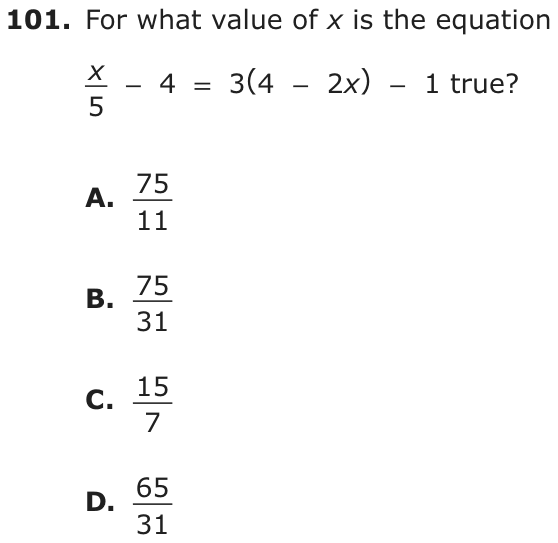
Question 60 of 107
2023 Test A Math, question 55Question
What is the least of four consecutive integers whose sum is 58?
- A1
- B2
- C12
- D13
Show the answer
Correct answer: D
Let n represent the least of the four integers. The other three integers are , , and . Write an equation to solve for n:
Question analysis
This number properties question asks for the least of four consecutive integers that add up to 58. Students write the integers in terms of one unknown and solve a two-step equation, or reason from the average of the four. Starting the list at n + 1 instead of n, which shifts every integer by one, is the main trap.
- Grade level
- Grade 7 content, by NYS standard
- Compared with grade 7
- At grade 7 Writing and solving an equation of the form px + q = r is core grade 7 work. Expressing four consecutive integers in terms of the least one is a familiar setup, so this is a routine three-step grade 7 problem.
- Estimated difficulty
- Straightforward: two steps or one careful reading.
- Thinking it demands
- Depth of knowledge 2, skills and concepts · mainly apply
- What makes it hard
- Turning words into math minor
- A very close wrong answer minor
- Solution
- 3 steps
- Reading level
- Question and choices: about grade 6, 11 words.
- Students, last 30 days
- Not enough answers yet to show (it takes 10).
Why it is hard, traps and wrong answers (shows the answer)
Why it is hard
One equation, 4n + 6 = 58, solves the question, and dividing 58 by 4 to find the middle of the four, 14.5, is quicker still. The only real risk is the count: writing the integers as n + 1 through n + 4 and reporting n gives a least integer one too small. The two smallest choices match no reasonable working, so they draw only guesses. Adding the four integers back up to 58 is a ten-second check.
Turning words into math minor Understanding the question
The phrase “four consecutive integers” has to become n, n + 1, n + 2 and n + 3, with n the least, so the sum is 4n + 6, not 4n + 10. (Hegarty, Mayer & Monk, 1995; Koedinger & Nathan, 2004)
A very close wrong answer minor Choosing the answer
The choices 12 and 13 differ by one, the size of a fence-post error, so only checking that 13 + 14 + 15 + 16 = 58 separates them. (Embretson & Wetzel, 1987; Gorin & Embretson, 2006; Ascalon et al., 2007)
Strategy: Call the least integer n, write the next three as n + 1, n + 2 and n + 3, add them and solve; or divide 58 by 4 to find the middle of the four.
Traps
- Counting the ends: Inclusive or exclusive ends, fence posts, consecutive numbers: an answer that is one too many or too few, or an endpoint drawn open where it belongs closed (or the reverse).
The wrong answers, classified
A Little reason to choose it (Haladyna & Downing, 1993; Rodriguez, 2005)
No equation for four consecutive integers gives 1; it may echo the step of 1 between them, but it mostly catches guesses.
B Little reason to choose it (Haladyna & Downing, 1993; Rodriguez, 2005)
No working with a sum of 58 leads to 2, which may echo the + 2 in n + 2, so it mostly draws guesses.
C Counting the ends (Brown & Burton, 1978)
Writes the four integers as n + 1 through n + 4, solves 4n + 10 = 58 to get n = 12, and reports n instead of the least integer, n + 1.
Worked solution, step by step
Formulas used
- Consecutive integers
- Integers are whole numbers and their negatives, like −2, 0 and 7. Consecutive integers come one right after another, like 4, 5, 6, 7. If n is the least one, each next one is 1 more than the one before.
Sort out the question
You need four consecutive integers, numbers in a row like 7, 8, 9, 10. Together they add up to 58. You need the least, or smallest, of the four.
Name the four numbers
Let n be the least number. Then the other three are 1, 2 and 3 more than n.
Write and simplify the equation
Add the four numbers and set the sum equal to 58.
To combine, count the n’s: there are four of them. The plain numbers make 1 + 2 + 3 = 6.
Solve for n
Subtract 6 from both sides. Then divide both sides by 4.
Watch out: if you call the numbers n + 1 to n + 4, you get n = 12. Then 12 is not one of the four numbers; the least one is 13. Answering 12 is choice C.
So the answer is D, 13.
Check your answer
Add them up: . It works. Another way: is their average. It falls halfway between the two middle numbers, 14 and 15. So the four numbers are 13, 14, 15 and 16.
More questions like this
The original DOE question
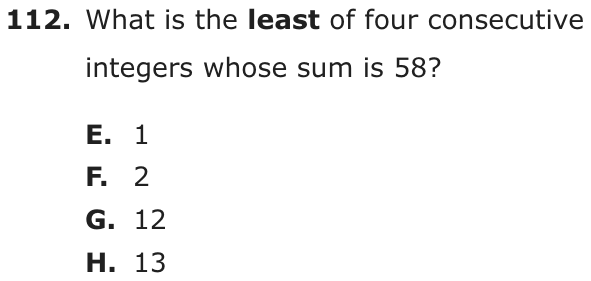
Question 61 of 107
2023 Test B Math, question 5Question
Solve the equation for x:
Grid-in question: work out the answer and enter it as a number.
Show the answer
Correct answer: 7
Question analysis
This equation puts x in a fraction with (21)(14) on top and (49)(48) below, set equal to the decimal 0.875. The grid-in asks for the value of x. Students do best to cancel common factors before multiplying anything out, and it helps to know the fraction that 0.875 equals.
- NYS standards
- Grade level
- Grade 7 content, by NYS standard
- Compared with grade 7
- At grade 7 Seventh graders solve equations like ax = b, usually with a simple coefficient. Here the coefficient is a product of four numbers that is best cancelled first, and a decimal has to be matched with a fraction.
- Estimated difficulty
- Moderate: several steps, or a close reading with one strong distractor.
- Thinking it demands
- Depth of knowledge 1, recall and reproduction · mainly apply
- What makes it hard
- Error-prone arithmetic moderate
- No obvious method minor
- An answer in an unexpected form minor
- Solution
- 3 steps
- Reading level
- Question and choices: about grade 5, 6 words.
- Students, last 30 days
- Not enough answers yet to show (it takes 10).
Why it is hard, traps and wrong answers (shows the answer)
Why it is hard
This is a one-unknown equation dressed in large numbers, and the work is in reducing them without slipping. Students who cancel early find that the whole coefficient is one eighth and that 0.875 is seven eighths, which makes the last step mental. Those who multiply out face a four-digit product and a decimal division, and with nothing to check against, an early slip goes unnoticed.
Error-prone arithmetic moderate Working it out
Multiplied out, the coefficient is 294 over 2,352 and the right side is the decimal 0.875; both invite slips unless 21/49 and 14/48 are cancelled first. (Brown & Burton, 1978; Junker & Sijtsma, 2001)
No obvious method minor Working it out
The quick route pairs 21 with 49 and 14 with 48 before multiplying, so that 3/7 × 7/24 collapses to 1/8; the layout of the fraction does not suggest that pairing. (Schoenfeld, 1985)
An answer in an unexpected form minor Choosing the answer
The result is entered with no choices, so a coefficient’s denominator or a quotient taken the wrong way looks as complete as the right value. (Enright, Morley & Sheehan, 2002)
Strategy: Cancel before multiplying: reduce 21 over 49 and 14 over 48, multiply the simplified fractions, then undo that coefficient, writing 0.875 as a fraction if it helps.
Traps
- Stops one step early: A choice is a number from partway through the solution.
- Wrong operation: Adds instead of multiplying, divides the wrong way round, turns a ratio or rate upside down, or undoes a step in the wrong direction (subtracts what should be added back).
- An arithmetic slip: The right method with a plausible arithmetic error: a digit, a place value or a times-table fact.
The wrong answers, classified
8 Stops one step early (King et al., 2004; Gierl et al., 2017)
Simplifies the coefficient correctly to 1/8 but enters the 8 from its denominator, never multiplying it by 0.875.
0.109375 Wrong operation (Hegarty, Mayer & Monk, 1995; King et al., 2004)
Divides 0.875 by 8 instead of multiplying, undoing the coefficient 1/8 the wrong way, so x comes out as 0.109375.
3.5 An arithmetic slip (Junker & Sijtsma, 2001)
Slips in reducing 14/48, taking it as 7/12 instead of 7/24, so the coefficient becomes 1/4 and x = 0.875 × 4 = 3.5.
Worked solution, step by step
Formulas used
- Multiplying fractions
- a and c are the tops, or numerators. b and d are the bottoms, or denominators. Multiply the tops together and the bottoms together. It also works backward: you can split one fraction into two smaller ones. That lets you simplify before the numbers get big.
Sort out the question
You need the value of x. On top, 21, 14 and x are multiplied. The bottom is 49 times 48. The right side is 0.875.
Multiplying 49 by 48 makes a big number. It is easier to simplify first.
Split the fraction into two
Use the rule for multiplying fractions backward. Pair 21 with 49, and 14 with 48.
Now the equation says these two fractions times x equal 0.875.
Simplify each fraction
To simplify, divide the top and bottom by the same number. Both 21 and 49 divide by 7. Both 14 and 48 divide by 2.
Watch out: 48 ÷ 2 is 24, not 12. Writing leads to 3.5.
Multiply the simple fractions
The 7 on top and the 7 on the bottom cancel, since 7 ÷ 7 = 1. Then divide 3 and 24 by 3 to get . So the equation becomes:
Solve for x
One eighth of x is 0.875. To undo dividing by 8, multiply both sides by 8.
Watch out: 8 is not the answer, and don’t divide 0.875 by 8. So you would grid 7.
Check your answer
0.875 is the same as . One eighth of 7 is , so x = 7 works. You can also multiply it all out: and . Then .
More questions like this
The original DOE question
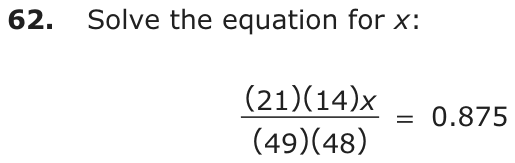
Question 62 of 107
2023 Test B Math, question 8Question
Solve for x in terms of y if .
- A
- B
- C
- D
Show the answer
Correct answer: A
| Apply the additive inverse property; subtract 4 from both sides of the equation. | |
| Apply the multiplicative inverse property; divide both sides of the equation by 2. | |
Question analysis
Given the equation 2x + 4 = y, students solve for x in terms of y. This literal-equation question offers four choices that mix multiplying and dividing by 2 with adding and subtracting 4. Undoing the two operations on x in the right order, with the right inverse each time, is what it tests.
- Grade level
- Grade 8 content, by NYS standard
- Compared with grade 7
- At grade 7 Grade 7 students solve two-step equations such as 2x + 4 = 10. Here the right side is the letter y, so the same two inverse steps leave an expression, a first taste of the grade 8 skill of rearranging.
- Estimated difficulty
- Straightforward: two steps or one careful reading.
- Thinking it demands
- Depth of knowledge 1, recall and reproduction · mainly apply
- What makes it hard
- A very close wrong answer moderate
- Variables instead of numbers minor
- Solution
- 2 steps
- Reading level
- Question and choices: about grade 6, 13 words.
- Students, last 30 days
- Not enough answers yet to show (it takes 10).
Why it is hard, traps and wrong answers (shows the answer)
Why it is hard
The two inverse steps are routine, subtract 4 and then divide by 2, but the letters hide whether they were done correctly. The main hazard is moving the 4 across the equals sign while keeping its plus sign, which produces an expression nearly identical to the right one. Substituting x = 1 and y = 6 tests every choice in seconds.
A very close wrong answer moderate Choosing the answer
(y − 4)/2 and (y + 4)/2 differ only in the sign before 4, and that sign depends on undoing the +4 by subtracting it from both sides. (Embretson & Wetzel, 1987; Gorin & Embretson, 2006; Ascalon et al., 2007)
Variables instead of numbers minor Understanding the question
With y on the right instead of a number, the answer is an expression, so there is no value to check unless the student substitutes a pair such as x = 1 and y = 6. (Koedinger & Nathan, 2004; Enright, Morley & Sheehan, 2002)
Strategy: Treat y as if it were a number and undo the operations on x in reverse order, using the inverse of each, then check by substituting a value.
Traps
- A faulty procedure: A systematic but wrong procedure: adding fractions straight across, applying an exponent to each term of a sum, dropping a sign when moving a term.
- Wrong operation: Adds instead of multiplying, divides the wrong way round, turns a ratio or rate upside down, or undoes a step in the wrong direction (subtracts what should be added back).
The wrong answers, classified
B Wrong operation (Hegarty, Mayer & Monk, 1995; King et al., 2004)
Multiplies by 2 instead of dividing and adds 4 instead of subtracting, applying the operations on x again rather than undoing them.
C A faulty procedure (Brown & Burton, 1978; Tatsuoka, 1983)
Moves the 4 across the equals sign without changing its sign, getting 2x = y + 4, then divides by 2 correctly.
D Little reason to choose it (Haladyna & Downing, 1993; Rodriguez, 2005)
Needs two unrelated errors at once, the subtraction written backward as 4 − y and a multiplication by 2 in place of division, so it mostly draws guesses.
Worked solution, step by step
Formulas used
- Keeping an equation balanced
- a and b are the two sides of an equation, and c is any number (not 0 when you divide). An equation is like a balanced scale. Doing the same thing to both sides keeps it balanced. Use this to undo, one at a time, each step that was done to x.
Sort out the question
The equation is . “Solve for x in terms of y” means get x alone on one side. The other side will have y in it. Treat y as if it were a number.
Undo the adding of 4
Right now, x is doubled and then 4 is added. Undo those steps in reverse order. First, subtract 4 from both sides.
Watch out: the 4 must be subtracted from y. Writing leads to choice C.
Undo the doubling
Next, divide both sides by 2. Divide the whole right side, not only the y.
Give the answer
Watch out: choices B and D multiply by 2. But x was multiplied by 2, so you undo that by dividing. So the answer is A, .
Check your answer
Pick a value, such as x = 1. Then . Put y = 6 into choice A: . That gives back x = 1. Choice C would give , which is wrong.
More questions like this
The original DOE question
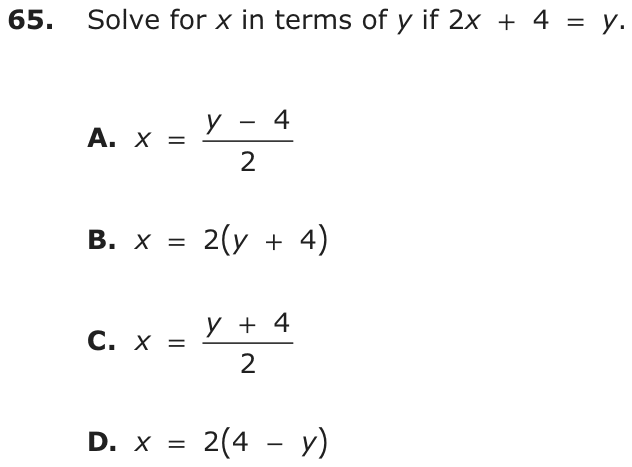
Question 63 of 107
2023 Test B Math, question 12Question
The perimeter of a 12-sided polygon is 100 centimeters. The length of one side is 25 centimeters. The length of another side is 35 centimeters. The remaining sides are equal in length to one another. What is the length of each of the remaining sides, in centimeters?
- A4
- B5
- C20
- D40
Show the answer
Correct answer: A
Let x represent the length of one of the 10 remaining sides:
Question analysis
A 12-sided polygon has a perimeter of 100 centimeters: one side is 25 cm long, another is 35 cm, and the rest are all equal to one another. Students find the length of each remaining side. This perimeter problem turns into a two-step equation, and the tricky part is counting the sides that are left.
- NYS standards
- 7.EE.4a two-step equations
- Grade level
- Grade 7 content, by NYS standard
- Compared with grade 7
- At grade 7 Writing and solving a two-step equation from a short description is standard grade 7 work. The perimeter setting is simple; the only extra care is counting the sides that remain after the two given ones.
- Estimated difficulty
- Straightforward: two steps or one careful reading.
- Thinking it demands
- Depth of knowledge 2, skills and concepts · mainly apply
- What makes it hard
- Turning words into math minor
- Many steps minor
- Solution
- 3 steps
- Reading level
- Question and choices: about grade 7, 44 words.
- Students, last 30 days
- Not enough answers yet to show (it takes 10).
Why it is hard, traps and wrong answers (shows the answer)
Why it is hard
The perimeter and the two named sides make the subtraction obvious, so the real decision comes after it: what to divide the leftover 40 centimeters by. Students who stop at the leftover length, or who lose track of how many sides remain, reach a listed choice. Writing 25 + 35 + 10x = 100 keeps the count of 10 in view.
Turning words into math minor Understanding the question
“The remaining sides are equal in length to one another” hides the count: 12 sides minus the two given ones leaves 10 equal sides to share the rest of the perimeter. (Hegarty, Mayer & Monk, 1995; Koedinger & Nathan, 2004)
Many steps minor Working it out
Subtracting 25 and 35 from 100, counting the sides left, and dividing are three steps, and the first result, 40, is itself a listed choice. (Daniel & Embretson, 2010; Enright, Morley & Sheehan, 2002)
Strategy: Subtract the two known sides from the perimeter, count how many sides are left, and share the remaining length equally among them.
Traps
- Stops one step early: A choice is a number from partway through the solution.
- Misreads the question: Misses or misreads a condition or a word in the question: "at least", "each", "remaining", "not".
The wrong answers, classified
B Little reason to choose it (Haladyna & Downing, 1993; Rodriguez, 2005)
No common working gives 5; sharing the 40 centimeters among 8 sides would, but nothing in the question suggests 8, so it mostly draws guesses.
C Misreads the question (Hegarty, Mayer & Monk, 1995)
Shares the leftover 40 centimeters between two sides, as if the figure were four-sided, overlooking that it has 12 sides.
D Stops one step early (King et al., 2004; Gierl et al., 2017)
Finds the total of the remaining sides, 100 − 25 − 35 = 40, and stops before sharing it among the 10 equal sides.
Worked solution, step by step
Formulas used
- Perimeter of a polygon
- P is the perimeter, the total distance around a shape. A polygon is a flat shape with straight sides. A sum is the answer to an addition. So add the lengths of every side to get P.
Sort out the question
The shape is a polygon with 12 sides. Its perimeter is 100 centimeters. One side is 25 centimeters, and another is 35 centimeters. The other sides all have the same length. You need that length.
Count the equal sides
Two of the 12 sides are already known. The rest are the equal sides.
So there are 10 equal sides. Call the length of each one x.
Write an equation for the perimeter
Use the perimeter formula. All 12 sides add up to 100. Ten sides of length x add up to 10x, which means 10 times x.
Solve for x
The 10 equal sides add up to 40 centimeters. Watch out: 40 is all ten sides together, not one side. Stopping here gives choice D. Now share the 40 among the 10 sides.
Give the answer
Each remaining side is 4 centimeters long. Watch out: sharing the 40 centimeters between only 2 sides gives 20, choice C. That treats the shape as if it had 4 sides, but it has 12. So the answer is A, 4.
Check your answer
Add all 12 sides: . That is the perimeter the question gives, so 4 centimeters is right.
More questions like this
The original DOE question
Question 64 of 107
2023 Test B Math, question 14Question
Each number in a sequence is 3 more than twice the number that comes just before it. If 93 is a number in the sequence, what number comes just before it?
- A92
- B90
- C48
- D45
Show the answer
Correct answer: D
Let n represent a number in the sequence, and let x represent the number that comes just before n:
Question analysis
In a sequence, each number is 3 more than twice the number just before it, and 93 is one of the numbers. Students find the number that comes just before 93. That means running the rule backward, undoing the adding and the doubling in reverse order.
- Grade level
- Grade 7 content, by NYS standard
- Compared with grade 7
- At grade 7 Grade 7 students routinely solve two-step equations. The demand here is translating the wordy sequence rule into one, or running the rule backward in the right order, rather than any harder content.
- Estimated difficulty
- Moderate: several steps, or a close reading with one strong distractor.
- Thinking it demands
- Depth of knowledge 2, skills and concepts · mainly apply
- What makes it hard
- Turning words into math moderate
- No obvious method minor
- Solution
- 2 steps
- Reading level
- Question and choices: about grade 5, 29 words.
- Students, last 30 days
- Not enough answers yet to show (it takes 10).
Why it is hard, traps and wrong answers (shows the answer)
Why it is hard
The arithmetic is two short steps, so the question rests on reading a wordy rule correctly and running it in reverse. Each wrong choice marks a different place to go wrong: ignoring the rule, stopping after the subtraction, or undoing the adding with more adding. Checking the answer forward, twice the number plus 3, confirms it reaches 93.
Turning words into math moderate Understanding the question
“Each number … is 3 more than twice the number that comes just before it” must become 2x + 3 = 93, with x the earlier number, not the later one. (Hegarty, Mayer & Monk, 1995; Koedinger & Nathan, 2004)
No obvious method minor Working it out
The rule is stated forward, from a number to the next, but the question runs backward, so each operation has to be undone in reverse order: subtract 3, then halve. (Schoenfeld, 1985)
Strategy: Call the earlier number x, write the rule as an expression in x set equal to 93, and solve it by undoing each operation in reverse order.
Traps
- Wrong operation: Adds instead of multiplying, divides the wrong way round, turns a ratio or rate upside down, or undoes a step in the wrong direction (subtracts what should be added back).
- Stops one step early: A choice is a number from partway through the solution.
- Misreads the question: Misses or misreads a condition or a word in the question: "at least", "each", "remaining", "not".
The wrong answers, classified
A Misreads the question (Hegarty, Mayer & Monk, 1995)
Reads “the number that comes just before it” as the whole number one less than 93, ignoring the sequence’s rule.
B Stops one step early (King et al., 2004; Gierl et al., 2017)
Undoes the adding of 3, 93 − 3 = 90, and stops before undoing the doubling.
C Wrong operation (Hegarty, Mayer & Monk, 1995; King et al., 2004)
Adds 3 instead of subtracting it before halving, (93 + 3) ÷ 2 = 48, undoing the rule in the wrong direction.
Worked solution, step by step
Formulas used
- The sequence rule
- x is any number in the sequence, a list that follows a rule. n is the number right after it. Twice means times 2, so twice x is 2x. Then 3 more means add 3. The same rule links every number to the one after it.
Sort out the question
A sequence is a list of numbers that follows a rule. Here, each number is “3 more than twice the number that comes just before it.” 93 is in the list. You need the number right before 93. Call it x.
Write the rule as an equation
Twice x is 2x. Three more than that is 2x + 3. The rule says this equals the next number, which is 93.
Undo the adding of 3
The rule doubles x first, then adds 3. To go backward, undo the steps in reverse order. First, subtract 3 from both sides.
Watch out: 90 is twice the number, not the number itself. Stopping here gives choice B. And don’t add 3, which leads to 48, choice C.
Undo the doubling
Now divide both sides by 2.
Watch out: “just before” means just before in this list. It does not mean one less than 93, so 92 is wrong. So the answer is D, 45.
Check your answer
Run the rule forward from 45. Twice 45 is 90, and 3 more is 93: . So 45 really does come just before 93.
More questions like this
The original DOE question
Question 65 of 107
2023 Test B Math, question 19Question
Orange juice costs $2 per gallon, and grapefruit juice costs $3 per gallon. A recent shipment of equal amounts of the two types of juice costs a total of $250. How many gallons of orange juice are in the shipment?
- A50
- B62.5
- C100
- D125
Show the answer
Correct answer: A
Let x represent the number of gallons of orange juice. Since the shipment contains equal amounts of the two types of juice, x also represents the number of gallons of grapefruit juice. Write an equation to solve for x:
Question analysis
Orange juice costs $2 a gallon and grapefruit juice costs $3 a gallon, and a shipment with equal amounts of each costs $250. Students find how many gallons of orange juice are in the shipment. The word problem leads to a simple equation; the key phrase is equal amounts of juice, not equal amounts of money.
- Grade level
- Grade 7 content, by NYS standard
- Compared with grade 7
- At grade 7 Writing and solving an equation from a short word problem is standard grade 7 work. This one has a single unknown, since both juices come in the same number of gallons, and only two short steps.
- Estimated difficulty
- Straightforward: two steps or one careful reading.
- Thinking it demands
- Depth of knowledge 2, skills and concepts · mainly apply
- What makes it hard
- Turning words into math moderate
- Solution
- 3 steps
- Reading level
- Question and choices: about grade 6, 37 words.
- Students, last 30 days
- Not enough answers yet to show (it takes 10).
Why it is hard, traps and wrong answers (shows the answer)
Why it is hard
The equation is short once the key phrase is read as equal gallons, since one gallon of each juice costs $5 together and $250 buys 50 such pairs. Read as equal spending, the same phrase leads to a listed answer that is not a whole number of gallons. The other trap is giving the gallons of both juices together when only orange juice is asked for.
Turning words into math moderate Understanding the question
“Equal amounts of the two types of juice” means the same number of gallons of each, x, so the total cost is 2x + 3x, not two equal halves of $250. (Hegarty, Mayer & Monk, 1995; Koedinger & Nathan, 2004)
Strategy: Price one gallon of each juice together, then see how many such pairs $250 buys; that is the number of gallons of each kind.
Traps
- Misreads the question: Misses or misreads a condition or a word in the question: "at least", "each", "remaining", "not".
- Answers a different question: A choice is right for another quantity: the other unknown, the rest instead of the part, the part instead of the whole.
The wrong answers, classified
B Misreads the question (Hegarty, Mayer & Monk, 1995)
Reads “equal amounts” as equal spending, $125 on each juice, and divides $125 by $2 a gallon to get 62.5.
C Answers a different question (King et al., 2004; Hegarty, Mayer & Monk, 1995)
Finds the right count for each juice but gives the whole shipment, 50 + 50 = 100 gallons, instead of the orange juice alone.
D Numbers taken from the question (Hegarty, Mayer & Monk, 1995)
Divides $250 by 2, the orange juice price or the number of juices, combining numbers from the question without equal gallons of each.
Worked solution, step by step
Formulas used
- Total cost
- The price per gallon is what one gallon costs. Multiply it by the number of gallons to get what you pay in all. For example, 3 gallons at $2 a gallon cost $6.
Sort out the question
Orange juice costs $2 a gallon. Grapefruit juice costs $3 a gallon. The shipment has equal amounts of each, so it has the same number of gallons of each juice. It costs $250 in all. You need the number of gallons of orange juice.
Write the cost of each juice
Let x be the number of gallons of each juice. Use the cost formula for each one.
Add the costs and solve
The two costs add up to $250. Two x’s plus three x’s make five x’s.
There are 50 gallons of each juice.
Give the answer
Watch out: equal amounts means equal gallons, not equal dollars. Spending $125 on each juice gives 62.5 gallons, choice B. Also, 100 gallons is both juices together, choice C. So the answer is A, 50.
Check your answer
Find each cost. 50 gallons of orange juice cost dollars. 50 gallons of grapefruit juice cost dollars. Together, dollars, the total in the question.
More questions like this
The original DOE question
Question 66 of 107
2023 Test B Math, question 20Question
Five consecutive numbers have a sum of 110. What is the least of these consecutive numbers?
- A11
- B18
- C20
- D22
Show the answer
Correct answer: C
Let n represent the least of the five numbers. Then the next four consecutive numbers are , , , . Write an equation to solve for n:
Question analysis
Five consecutive numbers add up to 110, and students find the least of them. This number-properties question can be solved with an equation in one unknown, or by noting that the middle of an odd number of consecutive numbers equals their average. The bold word least matters, because the middle number is easier to find.
- Grade level
- Grade 7 content, by NYS standard
- Compared with grade 7
- At grade 7 A sum of consecutive numbers leads to a two-step equation, standard grade 7 work. The average shortcut makes it quicker, and the only extra demand is answering for the least number rather than the middle one.
- Estimated difficulty
- Straightforward: two steps or one careful reading.
- Thinking it demands
- Depth of knowledge 2, skills and concepts · mainly apply
- What makes it hard
- Solution
- 3 steps
- Reading level
- Question and choices: about grade 5, 15 words.
- Students, last 30 days
- Not enough answers yet to show (it takes 10).
Why it is hard, traps and wrong answers (shows the answer)
Why it is hard
Dividing 110 by 5 is the natural first move, and it gives the middle number, which is a listed choice. The bold word least signals that one more step is needed, counting down two from the middle. The equation route, 5n + 10 = 110, goes straight to the least number but takes longer to set up.
Turning words into math minor Understanding the question
“Consecutive numbers” means each is 1 more than the last, and the bold “least” asks for the first of the five, not the middle one that dividing by 5 gives. (Hegarty, Mayer & Monk, 1995; Koedinger & Nathan, 2004)
Variables instead of numbers minor Understanding the question
None of the five numbers is given, so they must be written as n through n + 4, or pictured as two on each side of a middle value. (Koedinger & Nathan, 2004; Enright, Morley & Sheehan, 2002)
Strategy: Divide 110 by 5 to find the middle of the five numbers, then count down to the least of them.
Traps
- Answers a different question: A choice is right for another quantity: the other unknown, the rest instead of the part, the part instead of the whole.
- Misunderstands the concept: A wrong belief about a concept: that percents can be added, that area grows like length, that averages can be averaged, that a bigger denominator means a bigger fraction.
The wrong answers, classified
A Little reason to choose it (Haladyna & Downing, 1993; Rodriguez, 2005)
No common working gives 11, which is 110 ÷ 10; five consecutive numbers starting at 11 add to only 65, so it mostly draws guesses.
B Misunderstands the concept (Smith, diSessa & Roschelle, 1993; De Bock et al., 1998; Ni & Zhou, 2005)
Steps by 2 as if the numbers were consecutive even numbers, n through n + 8, so 5n + 20 = 110 gives 18.
D Answers a different question (King et al., 2004; Hegarty, Mayer & Monk, 1995)
Divides 110 by 5 to get 22, the middle number, and gives it without counting down to the least number.
Worked solution, step by step
Formulas used
- Consecutive numbers
- Consecutive numbers come one right after another when you count, like 7, 8, 9. Each is 1 more than the one before. If n is the least number, the next ones are n + 1, n + 2, and so on.
Sort out the question
Five consecutive numbers add up to 110. Consecutive means each number is 1 more than the one before. You need the least, or smallest, of the five.
Name the five numbers
Let n be the least number. Then the five numbers are:
Each one is 1 more than the one before it.
Write the sum as an equation
Add all five and set the sum equal to 110.
There are five n’s, which make 5n. The extra numbers add up to 1 + 2 + 3 + 4 = 10.
Solve for n
Subtract 10 from both sides. Then divide both sides by 5.
So the least number is 20.
Give the answer
Watch out: is the middle number, not the least. Picking 22 is choice D. The question asks for the least of the five. So the answer is C, 20.
Check your answer
Write out the five numbers and add them: . The sum matches. Also, the middle number, 22, is 110 ÷ 5, and the least is 2 less than the middle.
More questions like this
The original DOE question
Question 67 of 107
2023 Test B Math, question 28Question
The sum of the numbers x, y, and z is 40. The ratio of x to y is 1:2, and the ratio of y to z is 2:5. What is the value of y?
- A2
- B4
- C8
- D10
Show the answer
Correct answer: D
The ratio of x to y is 1:2, so or . Similarly, the ratio of y to z is 2:5, so . Solve for z in terms of y:
Use the given sum of x, y, and z to find the value of y:
Question analysis
This ratio question gives two ratios that share y: x to y is 1:2 and y to z is 2:5, and x, y and z total 40. Students find the value of y. The numbers in a ratio count parts, not amounts, so the work is to combine the ratios and find what one part is worth.
- Grade level
- Grade 7 content, by NYS standard
- Compared with grade 7
- At grade 7 Most grade 7 ratio tasks split a total using one ratio. Here two ratios linked through y must first become a single three-part ratio; since y's term already matches, that step is short and the problem stays at grade 7.
- Estimated difficulty
- Moderate: several steps, or a close reading with one strong distractor.
- Thinking it demands
- Depth of knowledge 2, skills and concepts · mainly apply
- What makes it hard
- No obvious method moderate
- Variables instead of numbers minor
- Many steps minor
- Solution
- 3 steps
- Reading level
- Question and choices: about grade 2, 31 words.
- Students, last 30 days
- Not enough answers yet to show (it takes 10).
Why it is hard, traps and wrong answers (shows the answer)
Why it is hard
The question rewards seeing that the two ratios share y’s term, which makes one three-part ratio. From there, one part is worth 5 and y is two parts. The wrong choices are numbers that live inside the ratios, and adding all four ratio numbers, which counts y twice, also leads to the part count, so that choice draws students along two paths.
No obvious method moderate Working it out
Nothing says to merge the ratios, but y is 2 in both, so x : y : z becomes 1 : 2 : 5 at once; the explanation’s route through fractions of y is slower. (Schoenfeld, 1985)
Variables instead of numbers minor Understanding the question
x, y and z appear only in two ratios and a sum of 40, so the ratio numbers 1, 2 and 5 are easy to mistake for the values themselves. (Koedinger & Nathan, 2004; Enright, Morley & Sheehan, 2002)
Many steps minor Working it out
Adding the 8 parts, dividing 40 by 8 to get 5 per part, and taking y’s 2 parts are three steps, and the part count is itself a listed choice. (Daniel & Embretson, 2010; Enright, Morley & Sheehan, 2002)
Strategy: Write x : y : z as one ratio using y's matching term, add the parts, divide 40 by that sum to get one part, and multiply by y's parts.
Traps
- Numbers taken from the question: Combines the numbers in the question without a model of the situation, or is simply a number that appears in the question.
- Answers a different question: A choice is right for another quantity: the other unknown, the rest instead of the part, the part instead of the whole.
The wrong answers, classified
A Numbers taken from the question (Hegarty, Mayer & Monk, 1995)
Takes y’s term in the ratios, 2, as y’s actual value, never using the sum of 40.
B Numbers taken from the question (Hegarty, Mayer & Monk, 1995)
Adds the two 2s that stand for y in the two ratios, 2 + 2 = 4, treating ratio terms as amounts.
C Answers a different question (King et al., 2004; Hegarty, Mayer & Monk, 1995)
Combines the ratios into 1 : 2 : 5 and gives the total number of parts, 1 + 2 + 5 = 8, instead of y’s share of the 40.
Worked solution, step by step
Formulas used
- Splitting a total by a ratio
- Each number in a ratio counts parts that are all the same size. Add the numbers in the ratio to find how many parts make up the total. Dividing the total by that number gives the size of one part. Each amount is its number of parts times that size.
Sort out the question
x, y and z add up to 40. A ratio compares two amounts. The ratio of x to y is 1:2, so y is twice x. The ratio of y to z is 2:5. You need the actual value of y, not its number in a ratio.
Combine the two ratios
y is 2 in both ratios. So both ratios count the same size of part, and they join into one.
So x is 1 part, y is 2 parts and z is 5 parts.
Find the total number of parts
The 40 is split into 8 equal parts. Watch out: 8 counts parts. It is not y, so choice C is wrong.
Find the size of one part
The 40 is shared equally among the 8 parts. So each part is worth 5.
Find y
y is 2 parts, so multiply the size of one part by 2.
Watch out: the 2 in the ratio counts parts, so y is not 2, choice A. Adding the two 2s to get 4 is wrong too, choice B. So the answer is D, 10.
Check your answer
Find all three: x = 5, y = 10 and z = 25. They add to . x to y is 5 to 10, which is 1:2. y to z is 10 to 25, which is 2:5.
More questions like this
The original DOE question
Question 68 of 107
2023 Test B Math, question 29Question
Which number could be the sum of 4 consecutive integers?
- A−12
- B−10
- C−8
- D−4
Show the answer
Correct answer: B
The sum of 4 consecutive integers can be expressed as:
Set that expression equal to each of the options and solve for n:
Option A:
is not an integer.
Option B:
is an integer.
Option C:
is not an integer.
Option D:
is not an integer.
The only option for which n is an integer is −10.
Question analysis
A number properties question about consecutive integers: which of four negative numbers could be the sum of 4 consecutive integers? Students write the sum with a variable, or add runs of negative integers, and test each choice. Keeping signs straight with negative numbers, and remembering that the integers must be whole numbers, is the tricky part.
- Grade level
- Grade 7 content, by NYS standard
- Compared with grade 7
- At grade 7 Grade 7 consecutive-integer problems usually give the sum and ask for the integers. This one reverses the task: students test which negative total is possible at all, using the structure of the sum rather than one equation.
- Estimated difficulty
- Moderate: several steps, or a close reading with one strong distractor.
- Thinking it demands
- Depth of knowledge 2, skills and concepts · mainly apply
- What makes it hard
- Every choice must be checked moderate
- No obvious method minor
- Error-prone arithmetic minor
- Solution
- 3 steps
- Reading level
- Question and choices: about grade 8, 9 words.
- Corrected from the DOE handbook
- A stray word in the explanation’s last sentence was removed.
- Students, last 30 days
- Not enough answers yet to show (it takes 10).
Why it is hard, traps and wrong answers (shows the answer)
Why it is hard
Three of the four choices are multiples of 4, and that is the whole trap: a student who pictures the sum as four times some integer finds three choices that seem to work. The sum of four consecutive integers is 4n + 6, so it is always even but never a multiple of 4. Trying the most natural run, −4, −3, −2 and −1, lands on −10 at once and is the fastest check.
Every choice must be checked moderate Choosing the answer
The stem asks which number “could be” the sum, so no single equation gives the answer; each of −12, −10, −8 and −4 has to be tested against the form a four-integer sum must take. (Embretson & Wetzel, 1987)
No obvious method minor Working it out
Nothing points to the shortcut that n + (n + 1) + (n + 2) + (n + 3) = 4n + 6 is always 2 more than a multiple of 4, or to simply adding a run such as −1, −2, −3 and −4. (Schoenfeld, 1985)
Error-prone arithmetic minor Working it out
Every choice is negative, so solving 4n + 6 = −12 or adding a run of integers means subtracting 6 from a negative number and dividing a negative by 4. (Brown & Burton, 1978; Junker & Sijtsma, 2001)
Strategy: Write the integers as n, n + 1, n + 2 and n + 3, add them, and set the sum equal to each choice to see which one gives a whole-number n.
Traps
- Misunderstands the concept: A wrong belief about a concept: that percents can be added, that area grows like length, that averages can be averaged, that a bigger denominator means a bigger fraction.
- A faulty procedure: A systematic but wrong procedure: adding fractions straight across, applying an exponent to each term of a sum, dropping a sign when moving a term.
- Misreads the question: Misses or misreads a condition or a word in the question: "at least", "each", "remaining", "not".
The wrong answers, classified
A Misunderstands the concept (Smith, diSessa & Roschelle, 1993; De Bock et al., 1998; Ni & Zhou, 2005)
Assumes four consecutive integers add to a multiple of 4, as if they had a whole-number middle, and takes −12 = 4 × (−3), the first such choice.
C A faulty procedure (Brown & Burton, 1978; Tatsuoka, 1983)
Writes n + (n + 1) + (n + 2) + (n + 3) as 4n, dropping the 1 + 2 + 3, so −8 = 4 × (−2) seems to give a whole-number n.
D Misreads the question (Hegarty, Mayer & Monk, 1995)
Solves 4n + 6 = −4 to get n = −2.5 and accepts it, since −2.5, −1.5, −0.5 and 0.5 add to −4, though they are not integers.
What was corrected from the DOE handbook, and why
- Explanation: The handbook ends with “The only option for which n is an integer answer is −10.” The word “answer” does not belong in that sentence; the site reads “The only option for which n is an integer is −10.” The working above it is unchanged: only 4n + 6 = −10 gives an integer, n = −4, and −4 + (−3) + (−2) + (−1) = −10.
Worked solution, step by step
Formulas used
- Sum of 4 consecutive integers
- n is the smallest of the four integers. Each next integer is 1 more than the one before, so they are n, n + 1, n + 2 and n + 3. Adding them gives four n’s, plus 1 + 2 + 3, which is 6. Use it to add any four integers in a row.
Sort out the question
Integers are whole numbers and their negatives, like −2, 0 and 5. They have no fractions or decimals. Consecutive integers come one right after another, like 7, 8, 9, 10 or −3, −2, −1, 0.
You need the choice that can be the sum of four consecutive integers. The sum is what you get when you add them.
Write the sum with a letter
You don’t know the integers yet. So call the smallest one n. Each next one is 1 more: n + 1, n + 2 and n + 3. Use the formula. Collect the four n’s, then add the numbers.
Any four consecutive integers add up to 4n + 6.
Test each choice
Set 4n + 6 equal to each choice and solve for n. First subtract 6 from both sides. Then divide both sides by 4.
Choice 4n + 6 4n n A −12 −18 −4.5 B −10 −16 −4 C −8 −14 −3.5 D −4 −10 −2.5 n must be an integer. Only choice B gives one: n = −4.
Name the four integers
Start at n = −4 and count up by 1. The integers are −4, −3, −2 and −1.
Watch out: Choices A, C and D are multiples of 4. A multiple of 4 is 4 times an integer, like 4 × (−3) = −12. It is tempting to think four integers must add to one of those. But the sum is 4n + 6, and the extra 6 gets in the way. Choice D works only with n = −2.5, and that is not an integer.
So the answer is B, −10.
Check your answer
Add the integers: . That is choice B. Also, 4n + 6 is always 2 more than a multiple of 4. And −10 is 2 more than −12, which is 4 × (−3).
More questions like this
The original DOE question
Question 69 of 107
2023 Test B Math, question 31Question
If , what is the value of in terms of y?
- A
- B
- C
- D
Show the answer
Correct answer: B
Solve , the given equation, for x:
Then:
Question analysis
An algebra question: given that x times y equals 30, students express 10 divided by x using only y. It tests solving for one variable and dividing by an algebraic fraction. Working with letters instead of numbers, and dividing in the right order, are what trip students up.
- NYS standards
- Grade level
- Grade 7 content, by NYS standard
- Compared with grade 7
- At grade 7 Grade 7 students rewrite expressions that have numbers and one variable. This one links two variables through their product and asks for a quotient, with no numbers given to check an answer against.
- Estimated difficulty
- Moderate: several steps, or a close reading with one strong distractor.
- Thinking it demands
- Depth of knowledge 1, recall and reproduction · mainly apply
- What makes it hard
- Variables instead of numbers moderate
- Error-prone arithmetic minor
- A very close wrong answer minor
- Solution
- 3 steps
- Reading level
- Question and choices: about grade 7, 16 words.
- Students, last 30 days
- Not enough answers yet to show (it takes 10).
Why it is hard, traps and wrong answers (shows the answer)
Why it is hard
The algebra is three short moves, but each is a place to turn a fraction upside down: solving xy = 30 for x, dividing 10 by that fraction, and reducing 10/30. Students who reach for the bigger-over-smaller division they know from whole numbers land on 3y. Choosing two numbers with a product of 30, such as 3 and 10, and testing every choice settles the question in seconds.
Variables instead of numbers moderate Understanding the question
x and y are tied only by their product, 30, and the answer must be an expression in y, so there is no number to check unless students pick a pair such as x = 3 and y = 10. (Koedinger & Nathan, 2004; Enright, Morley & Sheehan, 2002)
Error-prone arithmetic minor Working it out
Substituting x = 30/y turns 10 ÷ x into 10 divided by a fraction, which must be flipped to 10 × y/30 and then reduced. (Brown & Burton, 1978; Junker & Sijtsma, 2001)
A very close wrong answer minor Choosing the answer
The answer, (1/3)y, and the choice 3y use the same 3, one dividing y and one multiplying it, so a student unsure whether 10 ÷ 30 or 30 ÷ 10 applies sees both. (Embretson & Wetzel, 1987; Gorin & Embretson, 2006; Ascalon et al., 2007)
Strategy: Solve xy = 30 for x, substitute that fraction into 10 ÷ x, and divide by multiplying by its reciprocal; or choose values of x and y with a product of 30 and test each choice.
Traps
- Wrong operation: Adds instead of multiplying, divides the wrong way round, turns a ratio or rate upside down, or undoes a step in the wrong direction (subtracts what should be added back).
- Misunderstands the concept: A wrong belief about a concept: that percents can be added, that area grows like length, that averages can be averaged, that a bigger denominator means a bigger fraction.
- Numbers taken from the question: Combines the numbers in the question without a model of the situation, or is simply a number that appears in the question.
The wrong answers, classified
A Numbers taken from the question (Hegarty, Mayer & Monk, 1995)
Writes the 10 from 10 ÷ x under y as one tenth of y, never using the product xy = 30 to link the two letters.
C Wrong operation (Hegarty, Mayer & Monk, 1995; King et al., 2004)
Replaces x with 30/y correctly but divides 30 by 10 instead of 10 by 30, taking the larger number over the smaller, and gets 3y.
D Misunderstands the concept (Smith, diSessa & Roschelle, 1993; De Bock et al., 1998; Ni & Zhou, 2005)
Treats dividing by x as multiplying by y, as if x and y were reciprocals, though their product is 30, not 1, which gives 10y.
Worked solution, step by step
Formulas used
- Dividing by a fraction
- a is the number you divide. b over c is the fraction you divide by: b is its top and c is its bottom. To divide by a fraction, multiply by its reciprocal, the fraction flipped upside down. For example, 6 ÷ 1/2 = 6 × 2 = 12, because 12 halves fit in 6.
Sort out the question
means x times y. So x times y is 30. You need “in terms of y.” That means your answer can use y and numbers, but no x.
Solve for x
To swap x out, first get x by itself. Divide both sides of by y.
This says x is 30 divided by y.
Put the fraction in place of x
Replace x in with this fraction.
Now use the rule for dividing by a fraction. Flip the fraction and multiply.
Simplify the fraction
Both 10 and 30 can be divided by 10.
Watch out: 10 ÷ 30 is not 3. Dividing the bigger number by the smaller one gives 3y, choice C. Also, dividing by x is not the same as multiplying by y. That only works when xy is 1, not 30. It leads to choice D.
So the answer is B, .
Check your answer
Pick numbers that multiply to 30, like x = 3 and y = 10. Then . Choice B gives . They match. Choice C would give 30, and choice D would give 100.
More questions like this
The original DOE question
Question 70 of 107
2023 Test B Math, question 37Question
Which expression is equivalent to ?
- A
- B
- C
- D
Show the answer
Correct answer: D
First, distribute the negative sign, which is the same as multiplying both terms in the parentheses by −1.
Next, combine like terms:
Then, factor the common factor of from both terms, paying careful attention to the signs:
Question analysis
An algebra question asking which factored expression equals one half x plus 7 minus the quantity x minus nine halves. Students distribute the subtraction, combine like terms with fractions, and match a factored form. Signs are the danger at every step, and the choices differ only in the signs and numbers inside the parentheses.
- NYS standards
- 7.EE.1 linear expressions with rational coefficients
- Grade level
- Grade 7 content, by NYS standard
- Compared with grade 7
- Above grade 7 Grade 7 students expand and simplify linear expressions with fractions. Here a subtracted group must be distributed and the result factored by a negative fraction, two places where a sign is easily lost, a longer chain than typical grade 7 work.
- Estimated difficulty
- Hard: combines ideas, needs a plan, and has more than one tempting wrong answer.
- Thinking it demands
- Depth of knowledge 1, recall and reproduction · mainly apply
- What makes it hard
- Error-prone arithmetic moderate
- An answer in an unexpected form moderate
- A very close wrong answer moderate
- Solution
- 3 steps
- Reading level
- Question and choices: about grade 15, 10 words.
- Students, last 30 days
- Not enough answers yet to show (it takes 10).
Why it is hard, traps and wrong answers (shows the answer)
Why it is hard
Two separate sign decisions decide this question: distributing the subtraction over x − 9/2, and factoring a negative half out of +23/2. Students who handle the first correctly often stumble on the second and choose the look-alike with +23. Expanding each choice, rather than factoring by hand, is quicker and safer, since it turns the comparison into matching −1/2x + 23/2 term by term.
Error-prone arithmetic moderate Working it out
The minus before (x − 9/2) must change two signs, and the result mixes halves with whole numbers: 1/2x − x and 7 + 9/2 both need care. (Brown & Burton, 1978; Junker & Sijtsma, 2001)
An answer in an unexpected form moderate Choosing the answer
The simplified result, −1/2x + 23/2, appears nowhere; every choice is factored by ±1/2, so students must factor out −1/2 themselves or expand each choice to compare. (Enright, Morley & Sheehan, 2002)
A very close wrong answer moderate Choosing the answer
The answer, −1/2(x − 23), and −1/2(x + 23) differ only in the sign inside the parentheses, and the simplified form’s +23/2 makes the plus sign look right. (Embretson & Wetzel, 1987; Gorin & Embretson, 2006; Ascalon et al., 2007)
Strategy: Change the sign of both terms inside the parentheses, combine the x terms and the constants, then expand each choice to see which one matches rather than factoring yourself.
Traps
- Order of operations: Working left to right, or distributing a minus sign wrongly, gives a choice.
- Negatives and direction: Arithmetic with negative numbers, the order of a subtraction, or direction on a number line. (Moving a term across the equals sign without changing its sign is a faulty procedure.)
- Answer in another form: The right answer is written differently from the way you worked it out.
The wrong answers, classified
A Order of operations (Brown & Burton, 1978)
Gives the minus to x but not to −9/2, so the constants make 7 − 9/2 = 5/2, then drops the leading negative when factoring: 1/2(x − 5).
B Negatives and direction (Brown & Burton, 1978)
Combines 1/2x − x as +1/2x, subtracting the smaller coefficient from the larger, and also leaves −9/2 unchanged, so the result is 1/2x + 5/2 = 1/2(x + 5).
C Negatives and direction (Brown & Burton, 1978)
Simplifies correctly to −1/2x + 23/2 but keeps +23 when factoring out −1/2, though dividing +23/2 by −1/2 gives −23.
Worked solution, step by step
Formulas used
- Subtracting a group
- b and c are the two terms inside the parentheses. Terms are the parts joined by plus or minus signs. A minus sign in front of parentheses takes away the whole group. So it changes the sign of every term inside, not only the first one.
- Distributive property
- a is the number outside the parentheses. b and c are the terms inside. Multiply a by each term inside. It works because a groups of (b + c) hold a of each. Use it to multiply out the choices and compare them.
Sort out the question
Equivalent means equal for every value of x. The choices are written in a different form from the problem. So simplify the problem first. Then multiply out the choices and compare.
Remove the parentheses
The minus sign in front of the parentheses takes away both terms inside. So x becomes −x, and becomes .
Watch out: If you change only the sign of x, the numbers become . That mistake leads to choice A or B.
Combine the x terms
Like terms have the same letter part. The x terms are and −x. Write x as so the fractions match.
The result is negative, because you take away more x than you have.
Combine the numbers
Now combine the plain numbers, 7 and . Write 7 as fourteen halves so the bottoms match. Then add.
The expression simplifies to .
Multiply out choices C and D
Only C and D start with , so test those. Use the distributive property. A negative times a negative is positive.
The first line is choice C, and the second is choice D. Only D matches.
Watch out: Choice C looks almost the same. But it gives , not .
So the answer is D, .
Check your answer
Try x = 1 in the problem: . Now put x = 1 into choice D: . Both give 11, so they match.
More questions like this
The original DOE question
Question 71 of 107
2023 Test B Math, question 38Question
How is written as a single fraction? (Assume .)
- A
- B
- C
- D
Show the answer
Correct answer: A
Question analysis
This algebra question asks students to write 1/x minus 1/(2x) as a single fraction, assuming x is not zero. It tests finding a common denominator when the denominators contain a variable. Getting both fractions over the same denominator before subtracting, and keeping track of the sign, are what matter.
- NYS standards
- Grade level
- Grade 7 content, by NYS standard
- Compared with grade 7
- At grade 7 Grade 7 students subtract fractions with unlike denominators and work with linear expressions, but seldom see a variable in a denominator. The steps match those for numerical fractions, so it is a short task once the common denominator is found.
- Estimated difficulty
- Straightforward: two steps or one careful reading.
- Thinking it demands
- Depth of knowledge 1, recall and reproduction · mainly apply
- What makes it hard
- Variables instead of numbers moderate
- Error-prone arithmetic minor
- Solution
- 2 steps
- Reading level
- Question and choices: about grade 11, 14 words.
- Students, last 30 days
- Not enough answers yet to show (it takes 10).
Why it is hard, traps and wrong answers (shows the answer)
Why it is hard
This is subtraction of unlike fractions with a letter in the bottom, and every wrong choice is a familiar fraction error: combining the denominators straight across by adding or subtracting, or subtracting the numerators the wrong way round. Substituting x = 1 makes it 1 − 1/2 = 1/2, which rules out the negative choices and 1/3 at once.
Variables instead of numbers moderate Understanding the question
The denominators are x and 2x, so the common denominator is built with a letter, and no number checks the result unless students substitute a value such as x = 1. (Koedinger & Nathan, 2004; Enright, Morley & Sheehan, 2002)
Error-prone arithmetic minor Working it out
Only the first fraction changes: 1/x becomes 2/2x, and then the subtraction 2 − 1 must be done in the order written, first numerator minus second. (Brown & Burton, 1978; Junker & Sijtsma, 2001)
Strategy: Rewrite 1/x with the denominator 2x by multiplying its top and bottom by 2, then subtract the numerators and keep the common denominator.
Traps
- A faulty procedure: A systematic but wrong procedure: adding fractions straight across, applying an exponent to each term of a sum, dropping a sign when moving a term.
- Negatives and direction: Arithmetic with negative numbers, the order of a subtraction, or direction on a number line. (Moving a term across the equals sign without changing its sign is a faulty procedure.)
The wrong answers, classified
B A faulty procedure (Brown & Burton, 1978; Tatsuoka, 1983)
Adds the denominators, x + 2x = 3x, and keeps a numerator of 1, as if two unit fractions combined by adding their bottoms.
C A faulty procedure (Brown & Burton, 1978; Tatsuoka, 1983)
Subtracts the denominators straight across, x − 2x = −x, and keeps 1 on top, so the result 1/(−x) is written −1/x.
D Negatives and direction (Brown & Burton, 1978)
Rewrites 1/x as 2/2x correctly but subtracts the numerators in reverse order, 1 − 2 = −1, giving a negative result.
Worked solution, step by step
Formulas used
- Equivalent fractions
- a is the top, or numerator. b is the bottom, or denominator. k is any number except 0. Multiplying the top and bottom by the same number gives an equal fraction, because k over k is 1.
- Subtracting fractions with the same bottom
- a and b are the tops. c is the shared bottom. When the bottoms match, the pieces are the same size. So subtract the tops and keep the bottom.
Sort out the question
You need to write as one fraction. The problem says x is not 0. That matters because you can’t divide by 0.
Find a common bottom
To subtract fractions, their bottoms must match. 2x is 2 times x. So multiply the top and bottom of by 2.
Now both fractions have the bottom 2x.
Subtract the tops
Subtract the tops in order. Keep the bottom.
Watch out: Never add or subtract the bottoms. Adding them gives , choice B. Subtracting them gives , choice C. And keep the order: 2 − 1, not 1 − 2. The wrong order gives choice D.
So the answer is A, .
Check your answer
Try x = 1. The problem becomes . Choice A gives . It matches. Choices B, C and D give , −1 and .
More questions like this
The original DOE question
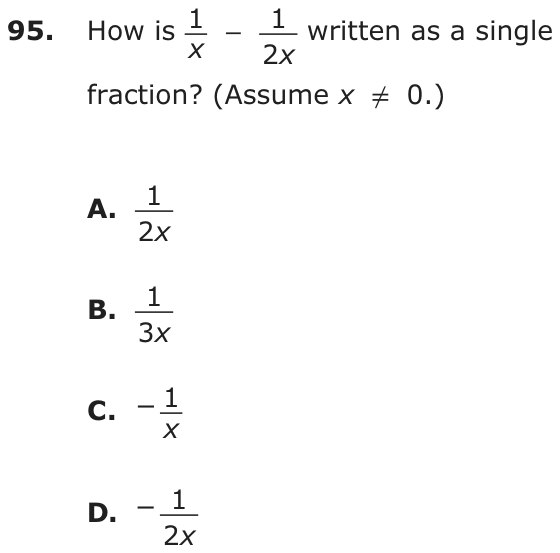
Question 72 of 107
2023 Test B Math, question 40Question
Angle A and angle B are complementary. If the measure of angle B is three times as great as the measure of angle A, what is the measure of angle B?
- A45°
- B67.5°
- C75°
- D135°
Show the answer
Correct answer: B
Let A represent the measure of angle A, and let B represent the measure of angle B, in degrees. Since the angles are complementary, . The question states that , or . Substitute that expression for A in the first equation and solve for B:
Question analysis
A geometry question about two complementary angles, where angle B is three times as large as angle A. Students find the measure of angle B. They must recall what complementary means, since the question does not say, and set up an equation that splits the total in the right proportion.
- Grade level
- Grade 7 content, by NYS standard
- Compared with grade 7
- At grade 7 Writing and solving an equation from complementary angles is a grade 7 standard. This is the familiar version without a figure: one equation from the definition, then a division and a multiplication, typical of grade 7 classwork.
- Estimated difficulty
- Straightforward: two steps or one careful reading.
- Thinking it demands
- Depth of knowledge 2, skills and concepts · mainly apply
- What makes it hard
- Something you must already know moderate
- Turning words into math minor
- Solution
- 3 steps
- Reading level
- Question and choices: about grade 7, 31 words.
- Students, last 30 days
- Not enough answers yet to show (it takes 10).
Why it is hard, traps and wrong answers (shows the answer)
Why it is hard
Once complementary is read as a 90° total, the problem is one equation with a decimal answer, 4A = 90. The 22.5° for angle A is not listed, so stopping at the smaller angle is not rewarded here, but using 180° is: it gives 45° and 135°, and both appear among the choices. Checking that the chosen angle and one third of it add to 90° settles it.
Something you must already know moderate Working it out
The stem never says what complementary means; the 90° total has to be recalled, and a student who confuses it with the supplementary 180° doubles both angles. (Anderson & Krathwohl, 2001)
Turning words into math minor Understanding the question
The clause “the measure of angle B is three times as great as the measure of angle A” has to become B = 3A, so the 90° splits into four equal parts, not three. (Hegarty, Mayer & Monk, 1995; Koedinger & Nathan, 2004)
Strategy: Recall the total that complementary angles share, think of angle A as one part and angle B as three parts, find one part, then multiply for angle B.
Traps
- Wrong formula: Uses a related but wrong formula: perimeter for area, diameter for radius, area for volume, or a misremembered one.
- Misreads the question: Misses or misreads a condition or a word in the question: "at least", "each", "remaining", "not".
The wrong answers, classified
A Misreads the question (Hegarty, Mayer & Monk, 1995)
Splits the 90° evenly, 90 ÷ 2 = 45, using the complementary total but ignoring that angle B is three times angle A.
C Little reason to choose it (Haladyna & Downing, 1993; Rodriguez, 2005)
No common working gives 75°, which would need angle A to be 25° and the pair to add to 100°; it mostly draws guesses.
D Wrong formula (King et al., 2004)
Uses 180°, the supplementary total, so 4A = 180 gives angle A = 45° and angle B = 135°, a pair that is not complementary.
Worked solution, step by step
Formulas used
- Complementary angles
- A and B are the measures of the two angles, in degrees. Complementary angles are two angles that add up to 90 degrees, the size of a square corner. Use this whenever a problem says two angles are complementary.
Sort out the question
Complementary angles are two angles that add up to 90 degrees. Angle B is three times as big as angle A. You need the measure of angle B, in degrees.
Write the facts as equations
Let A and B stand for the two measures. The angles are complementary, so use the formula.
Angle B is three times angle A, so:
Put 3A in place of B
Replace B in the sum with 3A. Then there is only one letter to find.
Think of it as 4 equal parts. Angle A is 1 part, and angle B is 3 parts.
Find angle A
Divide both sides by 4.
Angle A measures 22.5 degrees. That is not the answer yet, because the question asks for angle B.
Find angle B
Angle B is three times angle A.
Angle B measures 67.5 degrees.
Watch out: Angles that add to 180 degrees are called supplementary. Using 180 by mistake gives 45 and 135, choice D. Splitting 90 in half gives 45, choice A. That ignores the fact that B is three times A.
So the answer is B, 67.5°.
Check your answer
Add the two angles: 22.5 + 67.5 = 90. So they are complementary. Now divide: 67.5 ÷ 22.5 = 3. So angle B is three times angle A. Both facts check out.
More questions like this
The original DOE question
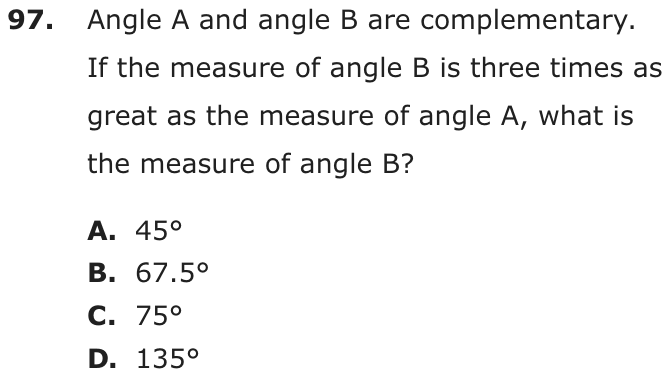
Question 73 of 107
2023 Test B Math, question 45Question
The Barnes family and the Ramirez family each have a pizza of equal size. The first pizza is cut into 18 equal slices, and the second pizza is cut into 15 equal slices. If the Barnes family eats 11 slices from the first pizza, what is the greatest number of whole slices from the second pizza that the Ramirez family can eat without eating a greater percentage of a pizza than the Barnes family ate?
- A6
- B7
- C8
- D9
Show the answer
Correct answer: D
The fraction of the pizza that the Barnes family eats is . Let x represent the number of slices of pizza that the Ramirez family eats. Then the fraction of the pizza that the Ramirez family eats is . Write an inequality and solve for x:
So, the greatest number of whole slices of pizza the Ramirez family can eat is 9.
Question analysis
Two pizzas of the same size are cut into 18 and 15 equal slices, and one family eats 11 slices of the first. Students find the most whole slices of the second pizza the other family can eat without eating a larger share. It tests comparing fractions with different denominators and rounding to a whole number in the right direction.
- Grade level
- Grade 7 content, by NYS standard
- Compared with grade 7
- Above grade 7 Grade 7 inequality problems usually ask for the greatest whole number that fits a budget. This one wraps that idea in a long stem about shares of two pizzas sliced differently, with several conditions to keep straight at once.
- Estimated difficulty
- Hard: combines ideas, needs a plan, and has more than one tempting wrong answer.
- Thinking it demands
- Depth of knowledge 2, skills and concepts · mainly apply
- What makes it hard
- Complex sentences moderate
- Turning words into math moderate
- Error-prone arithmetic minor
- Solution
- 3 steps
- Reading level
- Question and choices: about grade 11, 72 words.
- Students, last 30 days
- Not enough answers yet to show (it takes 10).
Why it is hard, traps and wrong answers (shows the answer)
Why it is hard
The math is one inequality between fractions, but the long final sentence hides it, so students who skim fall back on comparing slice counts. Reasoning that the second pizza has 3 fewer slices, so the Ramirez family should eat 3 fewer, is the strongest pull. Comparing 11/18 with x/15, or turning 11/18 into about 61% and taking 61% of 15, keeps the comparison about shares of a pizza.
Complex sentences moderate Understanding the question
The question is one 42-word sentence ending in a nested condition, “without eating a greater percentage of a pizza than the Barnes family ate”, a reading hurdle rather than more math. (Abedi & Lord, 2001; Freedle & Kostin, 1993; Messick, 1989)
Turning words into math moderate Understanding the question
The limit of no “greater percentage of a pizza” must become the inequality x/15 ≤ 11/18, comparing fractions of two pizzas cut into different numbers of slices, not slice counts. (Hegarty, Mayer & Monk, 1995; Koedinger & Nathan, 2004)
Error-prone arithmetic minor Working it out
Solving gives x ≤ 11 × 15 ÷ 18 = 165/18, a division by 18 that leaves 9 1/6, which must then be cut back to whole slices. (Brown & Burton, 1978; Junker & Sijtsma, 2001)
Strategy: Write the Barnes family's share as a fraction of their pizza, then find the largest whole number of fifteenths that does not exceed it, by cross-multiplying or by converting to decimals.
Traps
- Misunderstands the concept: A wrong belief about a concept: that percents can be added, that area grows like length, that averages can be averaged, that a bigger denominator means a bigger fraction.
- Answers a different question: A choice is right for another quantity: the other unknown, the rest instead of the part, the part instead of the whole.
The wrong answers, classified
A Answers a different question (King et al., 2004; Hegarty, Mayer & Monk, 1995)
Finds that 9 slices is the limit but gives the slices left on the second pizza, 15 − 9 = 6, answering a different question.
B Numbers taken from the question (Hegarty, Mayer & Monk, 1995)
Subtracts the stem’s numbers, 18 − 11 = 7, the slices left on the Barnes family’s pizza, without comparing shares of the two pizzas.
C Misunderstands the concept (Smith, diSessa & Roschelle, 1993; De Bock et al., 1998; Ni & Zhou, 2005)
Reasons that the second pizza has 3 fewer slices, so the Ramirez family should eat 3 fewer, 11 − 3 = 8, comparing by subtraction instead of by fractions.
Worked solution, step by step
Formulas used
- Fraction of a pizza
- The top counts the slices eaten. The bottom counts all the equal slices the pizza was cut into. The fraction tells how much of the whole pizza was eaten. Use fractions to compare pizzas cut into different numbers of slices.
Sort out the question
The two pizzas are the same size. The Barnes pizza has 18 slices, and they eat 11. The Ramirez pizza has 15 slices, so its slices are bigger. You need the most whole slices the Ramirez family can eat without eating a bigger share of their pizza.
Find the Barnes family’s share
Their share is the slices they ate out of all the slices in their pizza. Use the fraction formula.
The Barnes family ate of their pizza.
Write an inequality
Let x be the number of Ramirez slices. Their share is . It must be no more than the Barnes share. The sign ≤ means less than or equal to.
Solve for x
Multiply both sides by 15 to get x by itself.
Now divide. 18 goes into 165 nine times, since 18 × 9 = 162. There are 3 left over.
Pick the whole number
x must be a whole number no bigger than . So the most is 9 slices. 10 slices would be too many.
Watch out: The Ramirez pizza has 3 fewer slices, but that does not mean they eat 3 fewer. Their slices are bigger. Eating 11 − 3 = 8 slices is choice C, which is not the most they can eat.
So the answer is D, 9.
Check your answer
Use decimals. The Barnes share is . Nine Ramirez slices are , just under it. Ten slices are , too much. So 9 is the most.
More questions like this
The original DOE question
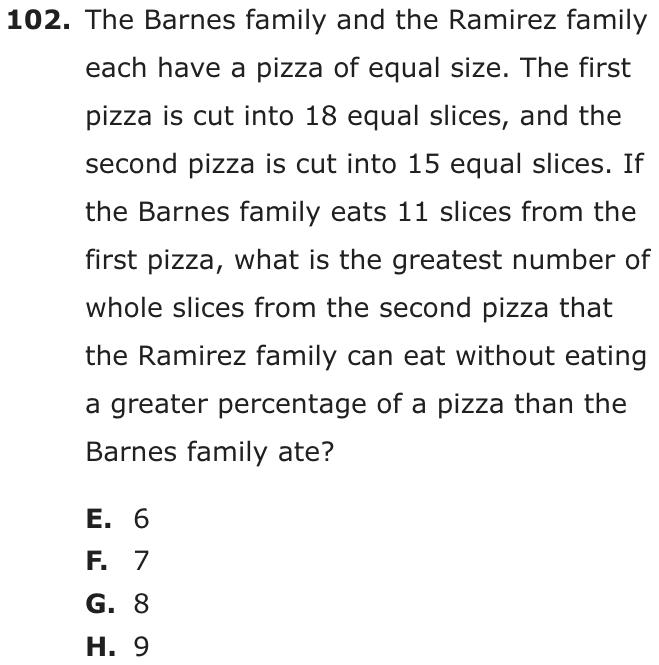
Question 74 of 107
2022 Test A Math, question 2Question
A homeowner has a budget of $135 for the installation of a light fixture. An electrician charges $60 per hour plus a one-time trip charge of $45. What is the greatest amount of time, in hours, the electrician can work on the installation while staying within the homeowner’s budget? Write your answer as a decimal.
Grid-in question: work out the answer and enter it as a number.
Show the answer
Correct answer: 1.5
Let x represent the number of hours the electrician can work.
The cost for the number of hours worked is $60 times the number of hours worked, x. The sum of the one-time trip charge ($45) and the cost of the number of hours worked () must be less than or equal to $135. Express this relationship as an inequality:
Solve the inequality for x:
Written as a decimal, .
Question analysis
A homeowner has $135 to spend, and an electrician charges $60 an hour plus a one-time $45 trip charge. This grid-in asks for the greatest number of hours the electrician can work within the budget, written as a decimal. Students write and solve a two-step inequality, and turning a length of time into decimal hours is the last trap.
- Grade level
- Grade 7 content, by NYS standard
- Compared with grade 7
- At grade 7 Solving a word problem that leads to an inequality of the form px + q ≤ r is the grade 7 standard itself. The numbers are friendly; the only twists are treating the budget as a limit and writing the time in decimal hours.
- Estimated difficulty
- Straightforward: two steps or one careful reading.
- Thinking it demands
- Depth of knowledge 2, skills and concepts · mainly apply
- What makes it hard
- Turning words into math moderate
- An answer in an unexpected form minor
- Solution
- 3 steps
- Reading level
- Question and choices: about grade 8, 52 words.
- Students, last 30 days
- Not enough answers yet to show (it takes 10).
Why it is hard, traps and wrong answers (shows the answer)
Why it is hard
The arithmetic is light, $135 − $45 = $90 and then $90 ÷ $60, so the question is decided by the setup and by the form of the entry. The trip charge is paid once, not every hour, and has to come off the budget before dividing. The time works out to an hour and a half, and students who think in hours and minutes may write it the way a clock shows it rather than as a decimal.
Turning words into math moderate Understanding the question
The stem never says “at most”; the limit comes from “a budget of $135”, and the one-time $45 trip charge is added once while the $60 multiplies the hours, giving 45 + 60x ≤ 135. (Hegarty, Mayer & Monk, 1995; Koedinger & Nathan, 2004)
An answer in an unexpected form minor Choosing the answer
The grid-in demands a decimal, so an hour and a half must be entered as 1.5, not as 1:30 or 90 minutes, with no choices to confirm the form. (Enright, Morley & Sheehan, 2002)
Strategy: Take the one-time trip charge off the budget first, divide what is left by the hourly charge, and give the time in hours as a decimal rather than in hours and minutes.
Traps
- Units or scale: The answer is wanted in other units, or a rate or scale must be converted first.
- Misreads the question: Misses or misreads a condition or a word in the question: "at least", "each", "remaining", "not".
- Stops one step early: A choice is a number from partway through the solution.
The wrong answers, classified
2.25 Misreads the question (Hegarty, Mayer & Monk, 1995)
Divides the whole $135 budget by $60 an hour, 135 ÷ 60 = 2.25, leaving out the one-time $45 trip charge that must come off first.
1.3 Units or scale (King et al., 2004)
Finds that the $90 left pays for 1 hour 30 minutes and writes that as 1.3, as if minutes were tenths of an hour rather than sixtieths.
90 Stops one step early (King et al., 2004; Gierl et al., 2017)
Subtracts the trip charge and enters the $90 left for labor, stopping before dividing by the $60 hourly charge to turn dollars into hours.
Worked solution, step by step
Formulas used
- Total cost with a one-time charge
- C is the total cost. f is the one-time charge, paid once no matter how long the job takes. r is the rate, the cost for each hour. h is the number of hours. The hourly part grows with time, but the one-time charge does not.
- Keeping an inequality balanced
- The sign ≤ says the left side is less than or equal to the right side. a and b are the two sides. c is a positive number. Subtracting c from both sides, or dividing both sides by c, keeps the statement true.
Sort out the question
The homeowner can spend $135 at most. That is the budget. The electrician has a one-time trip charge of $45. One-time means it is paid once, not every hour. On top of that, the electrician charges $60 for each hour. You need the greatest number of hours that keeps the total at $135 or less. The question asks for a decimal.
Write an inequality
Let h be the number of hours. Use the total cost formula with f = 45 and r = 60. The total must be less than or equal to $135. An inequality is like an equation, but it uses a sign such as ≤ instead of =.
Take off the trip charge
Subtract 45 from both sides. This keeps the inequality balanced.
So $90 is left to pay for the hours. Watch out: don’t divide the whole $135 by $60. That leaves out the trip charge, and you would grid 2.25.
Divide by the hourly rate
60 × h means 60 times h. Divide both sides by 60 to get h by itself.
The electrician can work at most 1.5 hours. Watch out: 1.5 hours is 1 hour 30 minutes, but don’t grid 1.3. Thirty minutes is half an hour, 0.5, not 0.3. Also don’t grid 90. That is dollars, not hours. So you would grid 1.5.
Check your answer
Put 1.5 hours back in: . That is exactly the budget. Now try 2 hours: . That is over $135. So 1.5 hours is the most.
More questions like this
The original DOE question
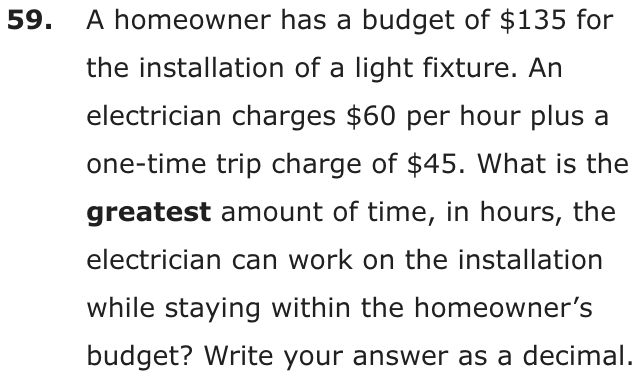
Question 75 of 107
2022 Test A Math, question 12Question
A bus begins its trip with R occupants (including the driver). At each of the 20 stops, 3 people get on and no one leaves. If there are 3 times as many bus occupants at the end of the 20th stop as there are at the end of the 4th stop, how many occupants did the bus have immediately after the 10th stop?
- A12
- B24
- C30
- D42
Show the answer
Correct answer: D
Write an expression to represent the number of occupants after 20 stops. Then, simplify the expression.
Write an expression to represent the number of occupants after 4 stops. Then, simplify the expression.
Write an equation that shows that the number of occupants after 20 stops is 3 times the number of occupants after 4 stops. Then, solve for R.
Write an expression to represent the number of occupants after 10 stops. Then, substitute 12 for R and evaluate.
Question analysis
A bus starts with an unknown number of riders, and 3 people board at each of 20 stops while no one gets off. After the 20th stop it holds three times as many as after the 4th. Students write and solve an equation for the starting number, then find how many were aboard after the 10th stop, a stop the condition never mentions.
- NYS standards
- Grade level
- Grade 8 content, by NYS standard
- Compared with grade 7
- Above grade 7 Grade 7 equations usually have the unknown on one side, as in px + q = r. Here students build two expressions from a story, set one equal to three times the other, solve with the unknown on both sides, then answer a third question.
- Estimated difficulty
- Hard: combines ideas, needs a plan, and has more than one tempting wrong answer.
- Thinking it demands
- Depth of knowledge 2, skills and concepts · mainly apply
- What makes it hard
- Turning words into math major
- Many steps moderate
- Much to keep track of minor
- Solution
- 5 steps
- Reading level
- Question and choices: about grade 8, 60 words.
- Students, last 30 days
- Not enough answers yet to show (it takes 10).
Why it is hard, traps and wrong answers (shows the answer)
Why it is hard
The question hides a linear equation in a story, and the comparison sentence is the hard part: the count that gets tripled is the one at the 4th stop, parentheses and all. Solving gives the starting count, but the question asks about a different moment, the end of the 10th stop, so one more step remains. Labeling each number with its stop, start, 4th, 10th or 20th, keeps the right count from being given for the wrong time.
Turning words into math major Understanding the question
“3 times as many bus occupants at the end of the 20th stop as there are at the end of the 4th stop” must become R + 60 = 3(R + 12), the 3 multiplying the whole smaller count. (Hegarty, Mayer & Monk, 1995; Koedinger & Nathan, 2004)
Many steps moderate Working it out
Two expressions, an equation solved for R = 12, and then a third count at the 10th stop: four stages, and the number asked for appears only at the last one. (Daniel & Embretson, 2010; Enright, Morley & Sheehan, 2002)
Much to keep track of minor Working it out
Three different stops matter, the 4th and the 20th for the equation and the 10th for the question, and each count has to keep the starting R. (Sweller, 1988; Carpenter, Just & Shell, 1990)
Strategy: Let R be the starting count, write the counts after the 4th and the 20th stops in terms of R, make the larger equal to 3 times the smaller and solve, then add the riders from 10 stops.
Traps
- Stops one step early: A choice is a number from partway through the solution.
- Answers a different question: A choice is right for another quantity: the other unknown, the rest instead of the part, the part instead of the whole.
The wrong answers, classified
A Stops one step early (King et al., 2004; Gierl et al., 2017)
Solves R + 60 = 3(R + 12) correctly and stops at R = 12, the occupants at the start, before adding the 30 riders from 10 stops.
B Answers a different question (King et al., 2004; Hegarty, Mayer & Monk, 1995)
Finds R = 12 but gives the count at the end of the 4th stop, 12 + 4 × 3 = 24, instead of the count after the 10th.
C Answers a different question (King et al., 2004; Hegarty, Mayer & Monk, 1995)
Counts only the riders who board at 10 stops, 10 × 3 = 30, leaving out the R occupants aboard from the start.
Worked solution, step by step
Formulas used
- People on the bus after some stops
- N is the number of people on the bus. R is the number at the start, driver included. s is the number of stops so far. 3 people get on at each stop and no one leaves, so each stop adds 3.
- Distributive property
- a is the number outside the parentheses. b and c are the terms inside. A term is a number, a letter, or a number times a letter. Multiply each term inside by a. Use it when a number multiplies a whole sum.
Sort out the question
Occupants are the people on the bus. R is how many there are at the start, counting the driver. At each stop, 3 people get on and nobody gets off. After the 20th stop, there are 3 times as many people as after the 4th stop. You need the number after the 10th stop. That is a third moment, so one more step waits at the end.
Write the counts for two stops
Keep R in each count. The people who started are still on the bus.
Write the equation
The count after stop 20 is 3 times the count after stop 4. The 3 multiplies the whole count after stop 4, so use parentheses.
Use the distributive property: 3 times R, plus 3 times 12.
Solve for R
Subtract R from both sides. Then subtract 36 from both sides. Then divide by 2.
So 12 people were on the bus at the start. Watch out: 12 is choice A, but it is the count at the start. The question asks about the 10th stop.
Count after the 10th stop
Watch out: 24 is the count after the 4th stop, choice B. 30 counts only the people who got on, choice C. It leaves out the 12 who started. So the answer is D, 42.
Check your answer
Test R = 12. After the 4th stop: people. After the 20th stop: people. And . That matches the question, so R = 12 is right, and so is 42.
More questions like this
The original DOE question
Question 76 of 107
2022 Test A Math, question 15Question
If , what is the value of x in terms of y?
- A
- B
- C
- D
Show the answer
Correct answer: A
To find the value of x in terms of y, solve for x. Begin by distributing 5 on the left side of the equation:
Solve for the value of x:
Question analysis
This algebra question gives the equation 5(x − 6y) = 50y and asks for x in terms of y. Students use the distributive property, or divide both sides by 5, and then solve a literal equation with inverse operations. Forgetting that the 5 multiplies both terms inside the parentheses is the classic slip here.
- Grade level
- Grade 8 content, by NYS standard
- Compared with grade 7
- Above grade 7 Grade 7 students solve equations such as 5(x − 6) = 50 with numbers. Solving for x in terms of another letter, through the distributive property, is grade 8 algebra, though the choices can be checked by substitution.
- Estimated difficulty
- Moderate: several steps, or a close reading with one strong distractor.
- Thinking it demands
- Depth of knowledge 1, recall and reproduction · mainly apply
- What makes it hard
- Variables instead of numbers moderate
- Error-prone arithmetic minor
- Solution
- 3 steps
- Reading level
- Question and choices: about grade 6, 16 words.
- Students, last 30 days
- Not enough answers yet to show (it takes 10).
Why it is hard, traps and wrong answers (shows the answer)
Why it is hard
The equation needs only three moves, distribute or divide by 5, add the y term, divide, so the risk lies in the first move. Multiplying only the x by 5 is the classic slip, and it gives 56/5 y, a value that is not listed but sits between two of the choices. Substituting y = 1 and the chosen x back into 5(x − 6) = 50 checks any choice in seconds.
Variables instead of numbers moderate Understanding the question
Both sides hold y and the result must be a multiple of y, so there is no number to check against unless the student substitutes, for instance y = 1. (Koedinger & Nathan, 2004; Enright, Morley & Sheehan, 2002)
Error-prone arithmetic minor Working it out
The 5 has to multiply both terms in the parentheses, giving 5x − 30y, and then 80y ÷ 5 must come out exactly; dividing both sides by 5 first keeps the numbers small. (Brown & Burton, 1978; Junker & Sijtsma, 2001)
Strategy: Distribute the 5 to both terms in the parentheses, or divide both sides by 5 first, then add the y term to both sides; substitute your choice back for x to check.
Traps
- A faulty procedure: A systematic but wrong procedure: adding fractions straight across, applying an exponent to each term of a sum, dropping a sign when moving a term.
The wrong answers, classified
B Little reason to choose it (Haladyna & Downing, 1993; Rodriguez, 2005)
No common working gives 15y; it sits one y below the correct value and would need a slip such as 80 ÷ 5 = 15, so it mostly draws guesses.
C Little reason to choose it (Haladyna & Downing, 1993; Rodriguez, 2005)
No common working gives 57/5 y; multiplying only the x by 5 leads to 56/5 y, or 11 1/5 y, so this mostly draws students who land near it.
D A faulty procedure (Brown & Burton, 1978; Tatsuoka, 1983)
Multiplies only the x by 5, so 5x − 6y = 50y and 5x = 56y, then drops the remainder of 56 ÷ 5 = 11 R1, keeping 11y.
Worked solution, step by step
Formulas used
- Distributive property
- a is the number outside the parentheses. b and c are the terms inside. A term is a number, a letter, or a number times a letter. Multiply each term inside by a. Use it when a number multiplies a whole sum.
- Keeping an equation balanced
- a and b are the two equal sides. c is any number, but not 0 when you divide. Doing the same thing to both sides keeps them equal, like a balanced scale. Use it to get the unknown by itself.
Sort out the question
The equation is . It has two letters, x and y. In terms of y means get x alone on one side. The other side may still have y in it. So the answer will look like a number times y.
Multiply out the parentheses
Use the distributive property. The 5 multiplies both terms inside.
Watch out: the 5 must multiply the 6y too. Multiplying only the x gives . Then x is . That is not a choice, but it sits close to C and D. Don’t pick one of them just because it is close.
Get the x term alone
Add 30y to both sides. This keeps the equation balanced.
Like terms add: 50 y’s plus 30 y’s is 80 y’s.
Divide by 5
5x means 5 times x. Divide both sides by 5 to get x by itself.
So the answer is A, .
Check your answer
Pick y = 1. Then x = 16. Put both into the first equation: . The right side is . Both sides match. A faster route: divide both sides by 5 first. Then , so x = 16y.
More questions like this
The original DOE question
Question 77 of 107
2022 Test A Math, question 28Question
The table shows the income and expenses in a bicycle shop on one day.
BICYCLE SHOP TRANSACTIONS
| Description | Income | Expense |
|---|---|---|
| Paid employees | ||
| Sold 2 bicycles | ||
| Sold clothing | $95 | |
| Bought new door | $500 | |
| Sold bike parts | p |
The sum of all transactions was $70. What is the value of p?
- A−$275
- B−$85
- C$70
- D$155
Show the answer
Correct answer: D
The sum of all transactions ($70) includes the income data (positive values) and the expense data (negative values). Write an equation to determine the value of p by adding all the income data and subtracting all the expense data:
Simplify the expression to determine the value of p:
Question analysis
A table lists one day of income and expenses at a bicycle shop, including two products to work out and an unknown amount, p, from selling bike parts. Given that all the transactions add up to $70, students find p. They must treat income as positive and expenses as negative, then solve an equation.
- Grade level
- Grade 7 content, by NYS standard
- Compared with grade 7
- At grade 7 Grade 7 students solve multi-step money problems with positive and negative amounts. This table adds an unknown income entry, so students treat income as positive and expenses as negative before solving a one-step equation.
- Estimated difficulty
- Moderate: several steps, or a close reading with one strong distractor.
- Thinking it demands
- Depth of knowledge 2, skills and concepts · mainly apply
- What makes it hard
- Turning words into math moderate
- Reading a figure, table or graph minor
- Error-prone arithmetic minor
- Solution
- 4 steps
- Reading level
- Question and choices: about grade 5, 44 words.
- Students, last 30 days
- Not enough answers yet to show (it takes 10).
Why it is hard, traps and wrong answers (shows the answer)
Why it is hard
The table turns a one-variable equation into bookkeeping: each entry must be multiplied out and given a sign by its column before anything is added. The known entries come to a loss of $85, so the bike parts must cover that loss and still leave $70, which is why p is larger than the day's total. Students who stop at the running total, or who copy the $70, never use the equation at all.
Turning words into math moderate Understanding the question
“The sum of all transactions was $70” has to be read with income positive and expenses negative, giving 800 + 95 + p − 480 − 500 = 70. (Hegarty, Mayer & Monk, 1995; Koedinger & Nathan, 2004)
Reading a figure, table or graph minor Understanding the question
Two cells hold products, $120 × 4 and $400 × 2, that must be worked out, and p sits in the Income column beside the sales, so it is added. (Lesh, Post & Behr, 1987; Kirsch & Mosenthal, 1990)
Error-prone arithmetic minor Working it out
The known entries total 895 − 980 = −85, a negative running sum, so p must exceed 70 by 85 rather than fall short of it. (Brown & Burton, 1978; Junker & Sijtsma, 2001)
Strategy: Work out the two products in the table, add the income entries and subtract the expenses, set that total plus p equal to 70, and solve for p.
Traps
- Stops one step early: A choice is a number from partway through the solution.
- Numbers taken from the question: Combines the numbers in the question without a model of the situation, or is simply a number that appears in the question.
The wrong answers, classified
A Little reason to choose it (Haladyna & Downing, 1993; Rodriguez, 2005)
No single mistake gives −275; it takes counting the $95 clothing sale as an expense and then stopping at the known total, 800 − 95 − 480 − 500.
B Stops one step early (King et al., 2004; Gierl et al., 2017)
Totals the known entries correctly, 895 − 980 = −85, and gives that, stopping before solving for the p that brings the sum to $70.
C Numbers taken from the question (Hegarty, Mayer & Monk, 1995)
Picks $70, the stated sum of all the transactions, as the value of the bike parts, without setting up an equation.
Worked solution, step by step
Formulas used
- Sum of all transactions
- A transaction is money coming in or going out. Income is money that comes in, so it counts as plus. Expenses are money that goes out, so they count as minus. The sum is what is left, like money added to and taken from a wallet.
- Keeping an equation balanced
- a and b are the two equal sides. c is any number, but not 0 when you divide. Doing the same thing to both sides keeps them equal, like a balanced scale. Use it to get the unknown by itself.
Sort out the question
The table lists money that came into the shop, called income. It also lists money that went out, called expenses. The bike parts brought in p dollars, an amount you don’t know. All the income minus all the expenses is $70. You need p.
Work out the products in the table
Two cells in the table show multiplication.
So paying the employees cost $480. The 2 bicycles brought in $800.
Write the equation
The income is $800, $95 and p. The expenses are $480 and $500. p sits in the Income column, so it is added.
Combine the known numbers
The known entries come to −85 dollars. That is a loss of $85. Now the equation is shorter:
Watch out: −85 is choice B, but it is not p. You still have to solve for p.
Solve for p
Add 85 to both sides. This keeps the equation balanced.
The bike parts brought in $155. Watch out: $70 is the total for the day, not the bike parts. Don’t just copy it, choice C. So the answer is D, $155.
Check your answer
Put 155 back in. Income: dollars. Expenses: dollars. . That matches. And p should be more than 70, because the bike parts had to cover the $85 loss first.
More questions like this
The original DOE question
Question 78 of 107
2022 Test A Math, question 50Question
Nadia paid $1.00 to mail a letter. The cost to mail a letter is $0.55 for the first ounce of weight plus $0.15 for each additional ounce. What was the weight, in ounces, of the letter Nadia mailed?
- A1.4
- B1.5
- C3
- D4
Show the answer
Correct answer: D
Let x represent the number of ounces Nadia’s letter weighed. The first ounce costs $0.55, so represents the number of ounces that cost $0.15 each.
Given that the total cost is $1.00, the equation that describes the situation can be written and solved as shown.
So the letter Nadia mailed weighed 4 ounces.
Question analysis
Nadia pays $1.00 to mail a letter, and postage costs $0.55 for the first ounce plus $0.15 for each additional ounce. Students find the weight of the letter in ounces. It tests writing and solving a two-step equation from a pricing rule in which the two prices apply to different ounces.
- Grade level
- Grade 7 content, by NYS standard
- Compared with grade 7
- At grade 7 Grade 7 students solve word problems that lead to equations such as px + q = r. This one takes that form once each price is matched to the right ounces, a step that makes it a little more demanding than routine practice.
- Estimated difficulty
- Moderate: several steps, or a close reading with one strong distractor.
- Thinking it demands
- Depth of knowledge 2, skills and concepts · mainly apply
- What makes it hard
- Turning words into math moderate
- Error-prone arithmetic minor
- Solution
- 3 steps
- Reading level
- Question and choices: about grade 4, 35 words.
- Students, last 30 days
- Not enough answers yet to show (it takes 10).
Why it is hard, traps and wrong answers (shows the answer)
Why it is hard
Pricing the letter ounce by ounce, $0.55, $0.70, $0.85, $1.00, reaches the total at the fourth ounce without any algebra. The equation route works too, but the first ounce is easy to lose: dividing the $0.45 left by $0.15 counts only the ounces after the first. The two decimal choices come from merging the two prices or from treating dollars as ounces.
Turning words into math moderate Understanding the question
“$0.55 for the first ounce of weight plus $0.15 for each additional ounce” makes the cost 0.55 + 0.15(x − 1), so the $0.15 covers every ounce except the first. (Hegarty, Mayer & Monk, 1995; Koedinger & Nathan, 2004)
Error-prone arithmetic minor Working it out
The money is in decimals, $1.00 − $0.55 = $0.45 and then $0.45 ÷ $0.15 = 3, and dividing by a decimal invites a misplaced point. (Brown & Burton, 1978; Junker & Sijtsma, 2001)
Strategy: Write the cost of a letter weighing x ounces, $0.55 plus $0.15 for each ounce after the first, set it equal to $1.00 and solve, then check by pricing the letter ounce by ounce.
Traps
- Stops one step early: A choice is a number from partway through the solution.
- Numbers taken from the question: Combines the numbers in the question without a model of the situation, or is simply a number that appears in the question.
- Units or scale: The answer is wanted in other units, or a rate or scale must be converted first.
The wrong answers, classified
A Numbers taken from the question (Hegarty, Mayer & Monk, 1995)
Merges the two prices into $0.70 for every ounce and divides $1.00 by $0.70, about 1.43, which rounds to 1.4.
B Units or scale (King et al., 2004)
Counts the first ounce, then treats the $0.45 left over as 0.45 ounce, getting 1.45 ounces, which rounds to 1.5.
C Stops one step early (King et al., 2004; Gierl et al., 2017)
Finds the 3 additional ounces that the $0.45 left over pays for, 0.45 ÷ 0.15 = 3, and stops before adding the first ounce.
Worked solution, step by step
Formulas used
- Cost to mail a letter
- C is the cost in dollars. w is the weight in ounces. The first ounce costs $0.55. Each ounce after the first costs $0.15, and there are w − 1 of them. Subtracting 1 leaves out the first ounce, which is already paid for.
- Keeping an equation balanced
- a and b are the two equal sides. c is any number, but not 0 when you divide. Doing the same thing to both sides keeps them equal, like a balanced scale. Use it to get the unknown by itself.
Sort out the question
Nadia paid $1.00 to mail a letter. The first ounce costs $0.55. Each additional ounce, meaning each ounce after the first, costs $0.15. You need the weight of the letter in ounces.
Write the equation
Let w be the weight in ounces. The first ounce is 1 of the w ounces. So the extra ounces number w − 1. The cost is $1.00.
Take off the first ounce’s cost
Subtract 0.55 from both sides. This keeps the equation balanced.
So $0.45 pays for the extra ounces.
Find the extra ounces
Divide both sides by 0.15. Multiply both numbers by 100 to make them whole.
There are 3 extra ounces after the first one.
Add back the first ounce
The letter weighed 4 ounces. Watch out: 3 counts only the ounces after the first. It is choice C. Also, don’t join $0.55 and $0.15 into one price. is about 1.4, choice A. So the answer is D, 4 ounces.
Check your answer
Price the letter one ounce at a time. 1 ounce: $0.55. 2 ounces: $0.70. 3 ounces: $0.85. 4 ounces: $1.00. The cost reaches $1.00 at 4 ounces. That matches.
More questions like this
The original DOE question
Question 79 of 107
2022 Test B Math, question 4Question
The total cost of a book is given by the expression , where x is the price of the book before tax. The tax rate is m%. What is the value of m?
Grid-in question: work out the answer and enter it as a number.
Show the answer
Correct answer: 8
The price of a book before tax is x and after tax is . Subtract to determine the tax rate.
, so the tax rate is 0.08.
The tax rate m% can be written as .
Solve for m:
Question analysis
The total cost of a book, tax included, is given by the expression 1.08x, where x is the price before tax, and the tax rate is m%. Students find the value of m and type it in. It tests reading a percent increase from an algebraic expression, and the rate has to be entered as a number of percent, not as a decimal.
- NYS standards
- Grade level
- Grade 7 content, by NYS standard
- Compared with grade 7
- At grade 7 Reading a percent increase from an expression such as 1.08x is a named grade 7 idea. It takes one short step, but students must turn a decimal into a percent and type the value with no choices to check.
- Estimated difficulty
- Straightforward: two steps or one careful reading.
- Thinking it demands
- Depth of knowledge 2, skills and concepts · mainly understand
- What makes it hard
- Solution
- 2 steps
- Reading level
- Question and choices: about grade 3, 33 words.
- Students, last 30 days
- Not enough answers yet to show (it takes 10).
Why it is hard, traps and wrong answers (shows the answer)
Why it is hard
The expression already holds the answer, since 1.08x is the price, 1x, plus a tax of 0.08x. The work lies in pulling the tax apart from the price and then writing it in the form the stem asks for, the number in front of a percent sign. Students who stop at the decimal, or who read the whole 1.08 as 108 percent, grid a value that looks reasonable. Trying a price of $100, which costs $108 with tax, makes the 8 visible.
An answer in an unexpected form moderate Choosing the answer
The rate is asked for as the m in m%, so the 0.08 found from the expression must become 8, and the grid takes 0.08 or 108 just as readily. (Enright, Morley & Sheehan, 2002)
Something you must already know minor Working it out
Nothing in the stem says that multiplying a price by 1.08 adds 8% of it; students must split 1.08x into 1x for the price and 0.08x for the tax. (Anderson & Krathwohl, 2001)
Variables instead of numbers minor Understanding the question
The price is the letter x, never a dollar amount, so the tax has to be read from the coefficient 1.08 rather than worked out from a number. (Koedinger & Nathan, 2004; Enright, Morley & Sheehan, 2002)
Strategy: Split 1.08x into the price before tax plus the tax added to it, then write the tax part's coefficient as a percent.
Traps
- Stops one step early: A choice is a number from partway through the solution.
- Answers a different question: A choice is right for another quantity: the other unknown, the rest instead of the part, the part instead of the whole.
- Numbers taken from the question: Combines the numbers in the question without a model of the situation, or is simply a number that appears in the question.
The wrong answers, classified
0.08 Stops one step early (King et al., 2004; Gierl et al., 2017)
Finds the tax as 0.08x and enters the decimal rate 0.08, one step short of multiplying by 100 to give m as a number of percent.
108 Answers a different question (King et al., 2004; Hegarty, Mayer & Monk, 1995)
Reads 1.08 as 108% and enters it, giving the whole cost as a percent of the price instead of only the tax added to it.
1.08 Numbers taken from the question (Hegarty, Mayer & Monk, 1995)
Copies the coefficient 1.08 from the expression as the rate, without separating the original price, 1x, from the tax added on top.
Worked solution, step by step
Formulas used
- Percent as a fraction
- Percent means out of 100. So m% is m hundredths, the fraction m over 100. To change a decimal to a percent, multiply it by 100. To change a percent to a decimal, divide it by 100.
Sort out the question
x is the price of the book before tax. The total cost with tax is 1.08x, which means 1.08 times x. The tax rate is m%. You need the number m.
The tax rate is the percent of the price that is added on as tax.
Split the total into price and tax
The total is the price plus the tax. Split 1.08 into 1 and 0.08.
The x part is the price you started with. So the extra 0.08x is the tax. The tax is 0.08 times the price.
Change the decimal to a percent
The rate is 0.08 as a decimal. Use the formula and set it equal to 0.08.
To get m alone, multiply both sides by 100.
So the tax rate is 8%.
Give the answer
The question asks for m, the number in front of the % sign. That is 8.
Watch out: 0.08 is the rate as a decimal, one step short. And 1.08, or 108%, counts the price as well as the tax. So you would grid 8.
Check your answer
Try a price of $100. The total is dollars. The tax is 108 − 100 = 8 dollars. And $8 out of $100 is 8%. So m = 8.
More questions like this
The original DOE question
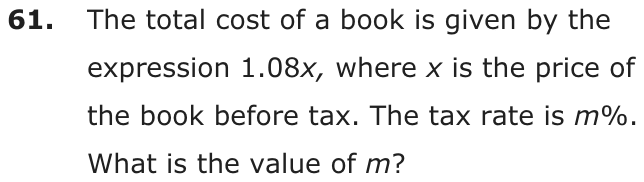
Question 80 of 107
2022 Test B Math, question 7Question
If , what is the value of x in terms of y?
- A
- B
- C13
- D
Show the answer
Correct answer: D
The goal is to isolate the variable x by using inverse operations. First, multiply both sides by 5 and then subtract from both sides.
Another approach is to make the right side of the equation a fraction and then use cross multiplication for the first step.
Question analysis
An equation says that x plus 2y, all divided by 5, equals 3y, and students choose the expression for x in terms of y. This multiple-choice algebra question tests solving a literal equation with inverse operations. Because the 5 divides the whole left side, clearing the fraction first and keeping track of the y terms is the tricky part.
- Grade level
- Grade 8 content, by NYS standard
- Compared with grade 7
- Above grade 7 Grade 7 students solve two-step equations with numbers, such as (n + 4)/3 = 6. Solving for one letter in terms of another, with a fraction to clear first, is grade 8 work and a step beyond.
- Estimated difficulty
- Moderate: several steps, or a close reading with one strong distractor.
- Thinking it demands
- Depth of knowledge 1, recall and reproduction · mainly apply
- What makes it hard
- Variables instead of numbers moderate
- Error-prone arithmetic minor
- Solution
- 2 steps
- Reading level
- Question and choices: about grade 5, 15 words.
- Students, last 30 days
- Not enough answers yet to show (it takes 10).
Why it is hard, traps and wrong answers (shows the answer)
Why it is hard
Two inverse operations solve it, but the fraction bar spans the whole sum x + 2y, so multiplying both sides by 5 has to come first. Students who split the fraction and stop at x/5 find a matching choice, and those who divide 3y by 5 instead of multiplying end up with fifths of y as well. Substituting y = 1, which makes x + 2 equal 15, checks any choice in seconds.
Variables instead of numbers moderate Understanding the question
Both sides hold y, so the result must stay a multiple of y: after clearing the 5, the like terms 15y and 2y are combined, and there is no number to check against. (Koedinger & Nathan, 2004; Enright, Morley & Sheehan, 2002)
Error-prone arithmetic minor Working it out
Multiplying the whole of 3y by 5 gives 15y, but dividing it by 5 or splitting the fraction into x/5 + 2y/5 leaves fifths of y in the working. (Brown & Burton, 1978; Junker & Sijtsma, 2001)
Strategy: Multiply both sides by 5 to clear the fraction, then subtract 2y from both sides; check by putting y = 1 into both the equation and the chosen expression.
Traps
- Stops one step early: A choice is a number from partway through the solution.
- Misunderstands the concept: A wrong belief about a concept: that percents can be added, that area grows like length, that averages can be averaged, that a bigger denominator means a bigger fraction.
- Wrong operation: Adds instead of multiplying, divides the wrong way round, turns a ratio or rate upside down, or undoes a step in the wrong direction (subtracts what should be added back).
The wrong answers, classified
A Wrong operation (Hegarty, Mayer & Monk, 1995; King et al., 2004)
Divides 3y by 5 instead of multiplying, so x + 2y = 3y/5 and x = −7y/5, then takes 7y/5, the choice that matches its size.
B Stops one step early (King et al., 2004; Gierl et al., 2017)
Splits the fraction and subtracts 2y/5 from 3y, reaching x/5 = 13y/5, then stops without multiplying both sides by 5.
C Misunderstands the concept (Smith, diSessa & Roschelle, 1993; De Bock et al., 1998; Ni & Zhou, 2005)
Reaches x = 15y − 2y but drops the letter, as if subtracting like terms cancelled the y, and gives the number 13 instead of 13y.
Worked solution, step by step
Formulas used
- Do the same to both sides
- a and b are two equal amounts, and c is any number. If you do the same thing to both sides of an equation, they stay equal, like a balanced scale. Use it to undo each step until the letter you want is alone.
Sort out the question
The equation says: take x plus 2y, divide the whole sum by 5, and you get 3y. You need x “in terms of y.” That means x alone on one side, with an expression using y on the other. An expression is a math phrase with no equal sign.
Clear the fraction first
The fraction bar divides the whole top, x + 2y, by 5. To undo dividing by 5, multiply both sides by 5.
Watch out: multiply 3y by 5. Don’t divide it by 5. Dividing leaves fifths of y, as in choice A.
Get x alone
Now 2y is added to x. To undo adding, subtract 2y from both sides.
15y − 2y means 15 y’s take away 2 y’s. That leaves 13 y’s, so the y stays.
Give the answer
Watch out: you might split the fraction into x/5 + 2y/5 instead. Then you reach x/5 = 13y/5. Stopping there gives choice B, but you still have to multiply by 5. Dropping the y gives 13, choice C. So the answer is D, .
Check your answer
Pick y = 1. Then x = 13 × 1 = 13. Put both into the equation: . And 3y = 3 × 1 = 3. Both sides match, so x = 13y works.
More questions like this
The original DOE question
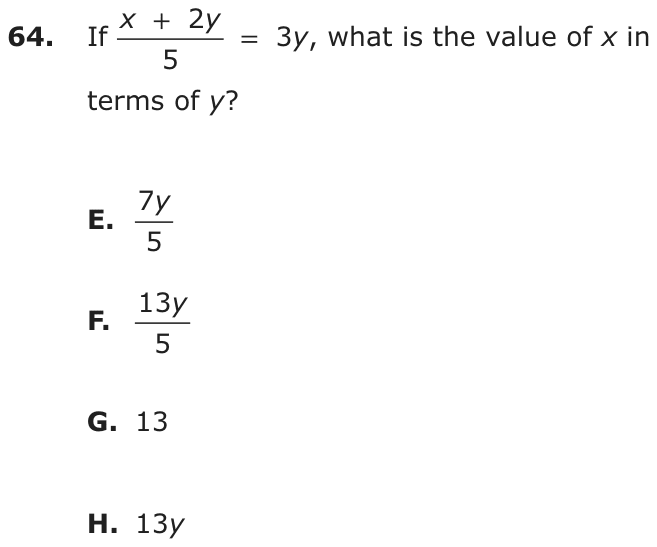
Question 81 of 107
2022 Test B Math, question 12Question
Julie is at a clothing store. She wants to buy a bag for $18.75 and some T-shirts for $9.25 each. She can spend no more than $50.00. Which inequality can be used to find the number of T-shirts, x, Julie can purchase?
- A
- B
- C
- D
Show the answer
Correct answer: C
The question uses the phrase “no more than,” which translates to “less than or equal to” (≤).
Since T-shirts cost $9.25 each and Julie bought x T-shirts, the total cost just for the T-shirts is found by multiplying $9.25 by x, or .
Combining the cost for one bag ($18.75) plus the cost for x T-shirts, the inequality is .
Question analysis
Julie wants to buy one bag and some T-shirts at a clothing store, with a price for each, and can spend no more than $50.00. Students choose the inequality for the number of T-shirts, x, she can buy. It tests writing an inequality from a word problem: the choices swap the two prices and the direction of the sign.
- Grade level
- Grade 7 content, by NYS standard
- Compared with grade 7
- At grade 7 Writing an inequality for a budget with one fixed cost and a cost per item is standard grade 7 work. With choices given, the task is to match each price to its role and the phrase to its symbol.
- Estimated difficulty
- Straightforward: two steps or one careful reading.
- Thinking it demands
- Depth of knowledge 2, skills and concepts · mainly apply
- What makes it hard
- Turning words into math moderate
- A very close wrong answer minor
- Solution
- 2 steps
- Reading level
- Question and choices: about grade 3, 43 words.
- Students, last 30 days
- Not enough answers yet to show (it takes 10).
Why it is hard, traps and wrong answers (shows the answer)
Why it is hard
The choices form a grid of two decisions: which price goes with x, and which way the symbol points. The prices appear in the order they are used, bag first, so the expression is the easier half and most lost points come from the symbol. Pricing the bag with 2 T-shirts, $37.25, and with 3, $46.50, shows that 9.25 is the amount that repeats with each shirt.
Turning words into math moderate Understanding the question
The $18.75 bag is bought once and the $9.25 is paid for each of x T-shirts, and “no more than $50.00” has to become ≤, which allows spending exactly $50.00. (Hegarty, Mayer & Monk, 1995; Koedinger & Nathan, 2004)
A very close wrong answer minor Choosing the answer
The choices 18.75 + 9.25x ≤ 50.00 and 18.75 + 9.25x ≥ 50.00 match term for term and differ only in the direction of the symbol. (Embretson & Wetzel, 1987; Gorin & Embretson, 2006; Ascalon et al., 2007)
Strategy: Price one bag and 2 T-shirts by hand to see which price is multiplied by x, then translate “no more than” into an inequality symbol.
Traps
- Misreads the question: Misses or misreads a condition or a word in the question: "at least", "each", "remaining", "not".
- Misunderstands the concept: A wrong belief about a concept: that percents can be added, that area grows like length, that averages can be averaged, that a bigger denominator means a bigger fraction.
The wrong answers, classified
A Misunderstands the concept (Smith, diSessa & Roschelle, 1993; De Bock et al., 1998; Ni & Zhou, 2005)
Keeps the right symbol but multiplies the number of T-shirts by $18.75 and adds $9.25 once, putting the bag’s price where the price per shirt belongs.
B Misunderstands the concept (Smith, diSessa & Roschelle, 1993; De Bock et al., 1998; Ni & Zhou, 2005)
Puts x on the $18.75 bag and also turns “no more than $50.00” into ≥, so both the expression and the symbol are wrong.
D Misreads the question (Hegarty, Mayer & Monk, 1995)
Builds the total, 18.75 + 9.25x, correctly but reads “no more than $50.00” as at least, so ≥ would make Julie spend $50.00 or more.
Worked solution, step by step
Formulas used
- Total cost
- The one-time cost is paid once, like one bag. The price each is paid again for every item, so it is multiplied by the number bought. Add them to get the total. Use it when one cost happens once and another repeats.
- Spending limit
- The total is what Julie spends, and the limit is $50.00. The sign ≤ means less than or equal to. So the total can be under the limit or exactly equal to it, but never over. That is what the words “no more than” mean.
Sort out the question
Julie buys one bag for $18.75. She also buys some T-shirts for $9.25 each. x is the number of T-shirts. She can spend no more than $50.00. You need the right inequality. An inequality is a math sentence that uses a sign like ≤ instead of =.
Write the cost of the T-shirts
Each T-shirt costs $9.25. For x T-shirts, she pays $9.25 x times.
The bag is bought only once. So its $18.75 is not multiplied by x.
Watch out: putting x on 18.75 prices x bags and one T-shirt. That gives choices A and B.
Add to get the total
Use the total cost formula. The bag is the one-time cost.
Test it with 2 T-shirts: dollars. That is one bag and two shirts, as it should be.
Choose the sign
“She can spend no more than $50.00” means she can spend less than $50.00, or exactly $50.00. That is less than or equal to, the sign ≤.
Watch out: ≥ means greater than or equal to. Choice D says she must spend $50.00 or more, the opposite. So the answer is C, .
Check your answer
Test whole numbers of T-shirts. With 3, the total is 18.75 + 27.75 = 46.50 dollars. That is not over $50.00. With 4, it is 18.75 + 37.00 = 55.75 dollars, too much. Choice C allows 3 T-shirts and rules out 4, which fits.
More questions like this
The original DOE question
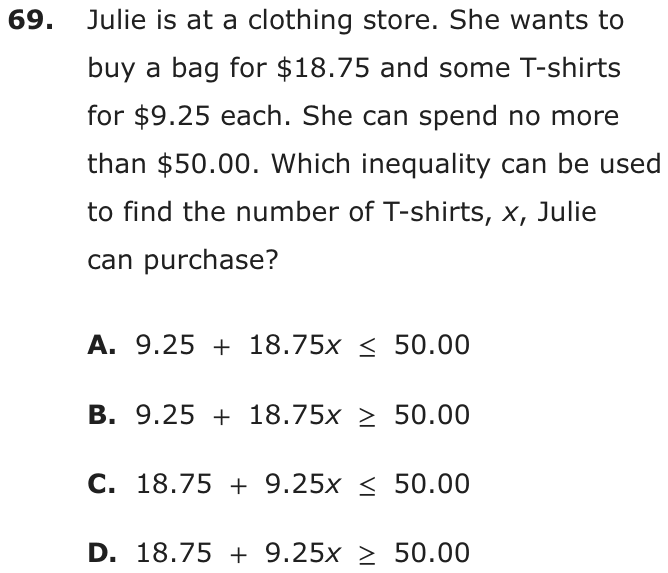
Question 82 of 107
2022 Test B Math, question 51Question
A clothing store buys shirts for a cost of m dollars each. To determine the selling price of the shirts, the manager increases the purchase cost by 55%. Which expression represents the selling price of each shirt?
- A
- B
- C
- D
Show the answer
Correct answer: C
It is given that m represents the purchase cost.
represents 100%. The amount the purchase cost was increased is represented by 55%.
Therefore, the selling price will be .
The selling price can be represented by the expression .
Question analysis
A clothing store buys shirts for m dollars each, and the manager sets the selling price by increasing that purchase cost by 55%. Students choose the expression for the selling price of each shirt. It tests writing a percent increase as an algebraic expression, where a percent of an unknown cost has to be handled in letters.
- NYS standards
- Grade level
- Grade 7 content, by NYS standard
- Compared with grade 7
- At grade 7 Writing a percent markup as an expression is a named grade 7 idea and a common classroom task. This is a direct case with one percent and a letter for the cost, with no further steps such as tax.
- Estimated difficulty
- Straightforward: two steps or one careful reading.
- Thinking it demands
- Depth of knowledge 2, skills and concepts · mainly apply
- What makes it hard
- Turning words into math moderate
- Variables instead of numbers minor
- Solution
- 2 steps
- Reading level
- Question and choices: about grade 5, 40 words.
- Students, last 30 days
- Not enough answers yet to show (it takes 10).
Why it is hard, traps and wrong answers (shows the answer)
Why it is hard
The markup is an increase by 55%, so the selling price is the whole cost plus 55% of it. The commonest mistake writes only the 55% part, which is the markup and not the price. Others subtract the percent as a discount would, or add 55 cents. Choosing a cost of $100 and finding a $155 price picks out the right expression at once.
Turning words into math moderate Understanding the question
“Increases the purchase cost by 55%” means the cost plus 55% of it, 100% + 55% = 155% of m, not 55% of m on its own. (Hegarty, Mayer & Monk, 1995; Koedinger & Nathan, 2004)
Variables instead of numbers minor Understanding the question
The cost is the letter m, so the markup has to be written as 0.55m and added to m, with no dollar amount to test the expression against. (Koedinger & Nathan, 2004; Enright, Morley & Sheehan, 2002)
Strategy: Pick an easy cost such as m = 100 dollars, work out the selling price after a 55% increase, and see which expression gives that price.
Traps
- Stops one step early: A choice is a number from partway through the solution.
- Misunderstands the concept: A wrong belief about a concept: that percents can be added, that area grows like length, that averages can be averaged, that a bigger denominator means a bigger fraction.
- Wrong operation: Adds instead of multiplying, divides the wrong way round, turns a ratio or rate upside down, or undoes a step in the wrong direction (subtracts what should be added back).
The wrong answers, classified
A Wrong operation (Hegarty, Mayer & Monk, 1995; King et al., 2004)
Subtracts the 55% from 100% instead of adding it, writing 0.45m, which is the price after a 55% discount rather than a 55% increase.
B Stops one step early (King et al., 2004; Gierl et al., 2017)
Writes only the amount of the markup, 55% of m, and stops before adding it to the cost the store paid for the shirt.
D Misunderstands the concept (Smith, diSessa & Roschelle, 1993; De Bock et al., 1998; Ni & Zhou, 2005)
Adds 0.55 to m as if the 55% markup were 55 cents, a fixed amount, instead of 55% of whatever the shirt cost.
Worked solution, step by step
Formulas used
- Percent increase
- The old amount is what you start with, here the cost m. The 1 keeps the whole old amount. The percent over 100 adds the increase on top. Use it whenever an amount goes up by a percent.
Sort out the question
Each shirt costs the store m dollars. The manager raises that cost by 55% to get the selling price. You need an expression for the selling price. An expression is a math phrase with numbers, letters and signs, but no equal sign.
Find the amount of the increase
The increase is 55% of m. Write 55% as a decimal by dividing by 100.
So the increase is 0.55m dollars, which means 0.55 times m.
Watch out: 0.55m is only the increase. Stopping here gives choice B.
Add the increase to the cost
The selling price is the cost plus the increase. Since m is the same as 1m, add the numbers in front.
The percent increase formula gives the same thing:
Give the answer
Watch out: 0.45m is a 55% decrease, choice A. And m + 0.55 adds only 55 cents, choice D. The increase must grow when the cost grows. So the answer is C, .
Check your answer
Pick a cost of $100, so m = 100. A 55% increase adds $55, for a price of $155. Now try choice C: . It matches. Choice B gives only 55, and choice D gives 100.55.
More questions like this
The original DOE question
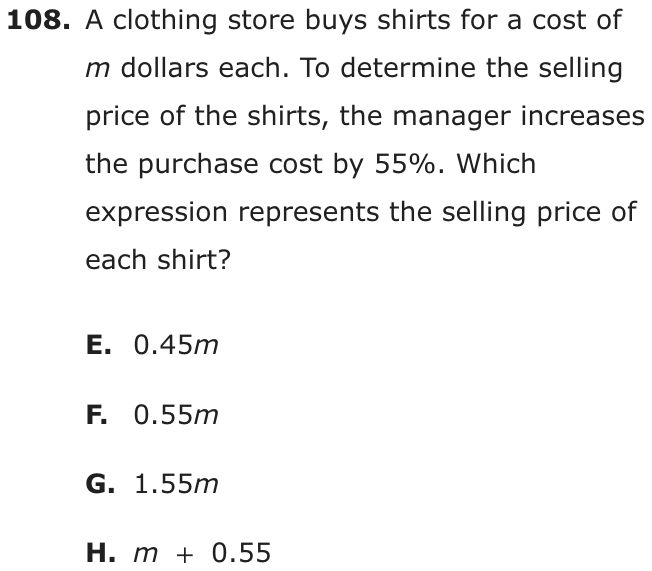
Question 83 of 107
2018 Test A Math, question 5Question
The sum of two consecutive integers is −15. If 1 is added to the smaller integer and 2 is subtracted from the larger integer, what is the product of the two resulting integers?
Grid-in question: work out the answer and enter it as a number.
Show the answer
Correct answer: 63
If x is the smaller consecutive integer, then
is the larger consecutive integer. Use their sum (−15) to find x:
The two consecutive integers are −8 and −7. One is added to the smaller integer:
and 2 is subtracted from the larger integer:
Find the product:
Question analysis
A grid-in problem about two consecutive integers whose sum is −15. Students find the two integers, add 1 to the smaller and subtract 2 from the larger, then multiply the results. Deciding which negative integer is the smaller one, and keeping signs straight through every step, are what make it tricky.
- Grade level
- Grade 7 content, by NYS standard
- Compared with grade 7
- Above grade 7 A typical grade 7 task solves one two-step equation or multiplies signed numbers. This links both: set up a consecutive-integer equation, solve it with negatives, adjust each integer, and multiply, with no choices to check against.
- Estimated difficulty
- Hard: combines ideas, needs a plan, and has more than one tempting wrong answer.
- Thinking it demands
- Depth of knowledge 2, skills and concepts · mainly apply
- What makes it hard
- Error-prone arithmetic moderate
- Turning words into math moderate
- Many steps moderate
- Solution
- 4 steps
- Reading level
- Question and choices: about grade 9, 30 words.
- Students, last 30 days
- Not enough answers yet to show (it takes 10).
Why it is hard, traps and wrong answers (shows the answer)
Why it is hard
Every step is routine, yet the question collects most of the ways students lose points with negatives. The crucial judgment is which of −8 and −7 is the smaller; a student who picks −7 still produces a tidy, wrong product. Gridding the product of the original pair, or giving a negative product, are the other usual losses. Writing each intermediate pair down, rather than holding them in mind, protects against all three.
Error-prone arithmetic moderate Working it out
Every number in play is negative: −8 and −7, then −7 and −9, and a product of two negatives that must come out positive. (Brown & Burton, 1978; Junker & Sijtsma, 2001)
Turning words into math moderate Understanding the question
"1 is added to the smaller integer and 2 is subtracted from the larger" depends on knowing that −8, not −7, is the smaller, since it lies farther below zero. (Hegarty, Mayer & Monk, 1995; Koedinger & Nathan, 2004)
Many steps moderate Working it out
Four linked steps: set up x + (x + 1) = −15, solve for x, adjust each integer, then multiply; an error early in the chain carries through to the product. (Daniel & Embretson, 2010; Enright, Morley & Sheehan, 2002)
Strategy: Halve the sum to see which two integers sit on either side of it, remember that the smaller negative is farther from zero, then adjust each and multiply.
Traps
- Negatives and direction: Arithmetic with negative numbers, the order of a subtraction, or direction on a number line. (Moving a term across the equals sign without changing its sign is a faulty procedure.)
- Misreads the question: Misses or misreads a condition or a word in the question: "at least", "each", "remaining", "not".
The wrong answers, classified
60 Negatives and direction (Brown & Burton, 1978)
Takes −7 as the smaller integer because 7 is less than 8, so adjusts to −7 + 1 = −6 and −8 − 2 = −10, and multiplies to 60.
56 Misreads the question (Hegarty, Mayer & Monk, 1995)
Finds −8 and −7 and multiplies them to get 56, skipping the sentence that adds 1 to one integer and subtracts 2 from the other.
-63 Negatives and direction (Brown & Burton, 1978)
Finds the adjusted integers −7 and −9 correctly but gives their product a negative sign, gridding −63.
Worked solution, step by step
Formulas used
- Consecutive integers
- Integers are whole numbers and their opposites, like −2, −1, 0, 1 and 2. Consecutive integers come one right after another. If n is the smaller one, the next one is n + 1, because each step up the number line adds 1.
- Multiplying two negative numbers
- a and b are positive numbers, so −a and −b are negative. When you multiply two negative numbers, the answer is positive. The two minus signs cancel out.
Sort out the question
Two consecutive integers add up to −15. Integers are whole numbers and their negatives. Consecutive means one comes right after the other, like 4 and 5. You need to do three things:
- Find the two integers.
- Add 1 to the smaller one. Subtract 2 from the larger one.
- Find the product of the two new numbers. The product is the answer when you multiply.
Find the two integers
Call the smaller integer n. Then the larger one is n + 1. Their sum is −15.
Subtract 1 from both sides. Then divide both sides by 2.
So the integers are −8 and −7.
Decide which one is smaller
On a number line, −8 is to the left of −7. Numbers to the left are smaller. So −8 is the smaller integer, and −7 is the larger one. Watch out: 8 is bigger than 7, but −8 is smaller than −7. Mixing them up gives −6 and −10, and the wrong answer 60.
Change each integer
Add 1 to the smaller integer.
Subtract 2 from the larger integer.
The two new numbers are −7 and −9.
Multiply the new numbers
Both numbers are negative, so their product is positive.
Watch out: the answer is not −63, because two negatives make a positive. Also, don’t multiply the first pair, −8 and −7. That gives 56 and skips the changes. So you would grid 63.
Check your answer
Check the pair: , and they are one apart. Half of −15 is −7.5, and −8 and −7 sit on either side of it. Then , and the sign is positive.
More questions like this
The original DOE question
Question 84 of 107
2018 Test A Math, question 7Question
- A
- B
- C
- D
Show the answer
Correct answer: A
Question analysis
An expression question: simplify a sum and difference of two linear expressions in n. Students remove the parentheses, subtract every term inside the second group, and combine like terms. The minus sign in front of the second parentheses is the trap, since it has to change the sign of both terms inside.
- NYS standards
- Grade level
- Grade 7 content, by NYS standard
- Compared with grade 7
- At grade 7 Simplifying linear expressions with a subtracted group is standard grade 7 work. This is a typical textbook exercise in length, with the usual sign trap and no extra steps or real-world context.
- Estimated difficulty
- Straightforward: two steps or one careful reading.
- Thinking it demands
- Depth of knowledge 1, recall and reproduction · mainly apply
- What makes it hard
- Error-prone arithmetic moderate
- A very close wrong answer moderate
- Solution
- 2 steps
- Reading level
- Question and choices: about grade 16+, 5 words.
- Corrected from the DOE handbook
- The handbook’s answer key for this question was corrected.
- Students, last 30 days
- Not enough answers yet to show (it takes 10).
Why it is hard, traps and wrong answers (shows the answer)
Why it is hard
There are only five terms, but two signs decide the answer: the minus in front of the second parentheses and the sign left after 3n − 4n. Each wrong choice comes from one or both of those sign decisions, so all of them look plausible, and checking needs care rather than time. Even the DOE handbook keyed the version with the wrong sign on n.
Error-prone arithmetic moderate Working it out
The minus sign before (4n + 8) has to reach both terms, making −4n and −8, and 3n − 4n leaves a negative n term. (Brown & Burton, 1978; Junker & Sijtsma, 2001)
A very close wrong answer moderate Choosing the answer
5 − n and 5 + n are written alike and share the constant 5; only the sign of the n term, from 3n − 4n, separates them, and the DOE handbook's own key picked the wrong one. (Embretson & Wetzel, 1987; Gorin & Embretson, 2006; Ascalon et al., 2007)
Strategy: Rewrite the subtraction as adding the opposite of each term in the second parentheses, then group the constants and the n terms separately.
Traps
- Order of operations: Working left to right, or distributing a minus sign wrongly, gives a choice.
- Negatives and direction: Arithmetic with negative numbers, the order of a subtraction, or direction on a number line. (Moving a term across the equals sign without changing its sign is a faulty procedure.)
The wrong answers, classified
B Negatives and direction (Brown & Burton, 1978)
Gets the constants right, 7 + 6 − 8 = 5, but writes 3n − 4n as +n, subtracting the smaller coefficient from the larger and keeping a plus sign.
C Order of operations (Brown & Burton, 1978)
Applies the minus sign to 4n but not to 8, so the constants become 7 + 6 + 8 = 21 while the n term comes out right.
D Order of operations (Brown & Burton, 1978)
Makes both mistakes: adds the 8 instead of subtracting it, for 21, and also writes 3n − 4n as +n.
What was corrected from the DOE handbook, and why
- Answer key: The handbook (its question 64) keys this question as F, which is 5 + n (choice B here), in its answer key and in the heading of its explanation. Its own working gives 7 + 3n + 6 − 4n − 8 = 5 − n, which is the handbook’s choice E and choice A here, and that is correct. The key here is A.
Worked solution, step by step
Formulas used
- Subtracting a group in parentheses
- a and b are the terms inside the parentheses. A term is a number, a letter, or a number times a letter. The minus sign in front means you subtract the whole group. So you subtract every term inside, not just the first one.
- Combining like terms
- n stands for an unknown number, and 3n means 3 times n. Like terms have the same letter part, like 3n and 4n. To combine them, add or subtract the numbers in front and keep the letter. Plain numbers combine only with plain numbers.
Sort out the question
You need to simplify the expression, which means write it in a shorter form. An expression is a math phrase made of numbers, letters and signs. Here n stands for an unknown number. Find the choice that matches the short form.
Remove the parentheses
The first group has a plus sign in front. Adding a group changes nothing, so is just . The second group has a minus sign in front. You must subtract both terms inside it.
Watch out: the minus reaches the 8 too. Adding the 8 instead gives 21 for the plain numbers. That leads to choice C or D.
Combine the plain numbers
Group the numbers without a letter. Work them out from left to right.
The plain numbers make 5.
Combine the n terms
You have 3 n’s, and you take away 4 n’s. The numbers in front give 3 − 4 = −1. So you are left with −1n, which is written −n.
Watch out: it is easy to write +n here. That gives 5 + n, choice B.
Put the two parts together
Join the number part and the n part. Adding a negative is the same as subtracting.
So the answer is A, 5 − n.
Check your answer
Pick any number for n and test it. Try n = 1. The original: . Choice A: . They match. Choice B gives , which does not.
More questions like this
The original DOE question
Question 85 of 107
2018 Test A Math, question 9Question
Jenny starts a game with twice as many marbles as Keiko. Jenny gives Keiko 5 marbles, but she still has 10 more than Keiko. How many marbles did Jenny have to start with?
- A25
- B30
- C35
- D40
Show the answer
Correct answer: D
Set up some equations. Jenny (J) has twice as many marbles as Keiko (K):
Jenny gives Keiko 5 marbles, so now they each have: J − 5 and K + 5 marbles. Jenny still has 10 more than Keiko:
To find how many marbles Jenny had to start with, solve J = 2K for K and substitute that into the second equation:
In equation J = 2K, solve for K:
Substitute in for K.
marbles
Question analysis
A two-variable word problem about marbles: Jenny starts with twice as many as Keiko, gives Keiko 5, and still has 10 more. Students set up equations for before and after the trade and solve for Jenny's starting number. The trade changes both players' counts, and the question asks about the start, not the end.
- Grade level
- Grade 8 content, by NYS standard
- Compared with grade 7
- Above grade 7 Grade 7 students solve one equation in one unknown. This needs two related unknowns and a before-and-after change, which leads to a system of equations or a variable on both sides, both grade 8 skills.
- Estimated difficulty
- Hard: combines ideas, needs a plan, and has more than one tempting wrong answer.
- Thinking it demands
- Depth of knowledge 2, skills and concepts · mainly apply
- What makes it hard
- Turning words into math major
- Much to keep track of moderate
- Solution
- 4 steps
- Reading level
- Question and choices: about grade 4, 31 words.
- Students, last 30 days
- Not enough answers yet to show (it takes 10).
Why it is hard, traps and wrong answers (shows the answer)
Why it is hard
Most of the difficulty is in setting up the equations, not solving them. The gift of 5 marbles changes both counts, so the gap between the girls shrinks by 10, not 5, and students who take the marbles from Jenny without giving them to Keiko reach a consistent but wrong answer. Two other choices are true counts from after the trade, so finishing the algebra is not the same as answering the question. Testing the choices backward is a fast, safe alternative.
Turning words into math major Understanding the question
Three relations hide in two sentences: "twice as many", the gift of 5 that lowers Jenny's count and raises Keiko's, and "still has 10 more", which compares the counts after the gift. (Hegarty, Mayer & Monk, 1995; Koedinger & Nathan, 2004)
Much to keep track of moderate Working it out
Each girl has a count before and after the trade, four quantities in all, and the question asks for only one of them, Jenny's at the start. (Sweller, 1988; Carpenter, Just & Shell, 1990)
Strategy: Work backward from the choices: halve each one for Keiko's start, move 5 marbles from Jenny to Keiko, and check whether Jenny ends with exactly 10 more.
Traps
- Misreads the question: Misses or misreads a condition or a word in the question: "at least", "each", "remaining", "not".
- Answers a different question: A choice is right for another quantity: the other unknown, the rest instead of the part, the part instead of the whole.
The wrong answers, classified
A Answers a different question (King et al., 2004; Hegarty, Mayer & Monk, 1995)
Solves correctly for Keiko's start, 20, then reports her count after receiving the 5 marbles, 25, instead of Jenny's starting count.
B Misreads the question (Hegarty, Mayer & Monk, 1995)
Subtracts the 5 marbles from Jenny but forgets that Keiko gains them, solving 2K − 5 = K + 10 to get K = 15 and J = 30.
C Answers a different question (King et al., 2004; Hegarty, Mayer & Monk, 1995)
Gives Jenny's count after she hands over 5 marbles, 40 − 5 = 35, instead of the number she had at the start.
Worked solution, step by step
Formulas used
- Twice as many
- J is the number of marbles Jenny starts with, and K is the number Keiko starts with. Twice as many means 2 times as many, so J equals 2 times K. Because J and 2K are equal, you can write 2K anywhere you see J.
- Keeping an equation balanced
- a and b are the two sides of an equation, and c is any number or term. An equation is like a balanced scale. If you subtract the same thing from both sides, it stays balanced. The same is true if you add the same thing, or divide both sides by the same number that is not zero.
Sort out the question
Let K be Keiko’s marbles at the start. Jenny starts with twice as many, so she has 2K. Then Jenny gives Keiko 5 marbles. After that, “she still has 10 more than Keiko”. You need Jenny’s count at the start, before the gift.
Write the counts after the gift
The gift changes both counts. Jenny loses 5, and Keiko gains 5.
- Jenny now has .
- Keiko now has .
Jenny has 10 more than Keiko. So Jenny’s count equals Keiko’s count plus 10.
Watch out: Keiko gains the 5 marbles too. Taking 5 from Jenny but not adding 5 to Keiko leads to 30, choice B.
Solve for K
Add the numbers on the right side first.
Subtract K from both sides. Then add 5 to both sides. Each move keeps the equation balanced.
Keiko started with 20 marbles.
Find Jenny’s starting count
Jenny started with twice as many as Keiko.
Watch out: 25 is Keiko’s count after the gift, choice A. 35 is Jenny’s count after the gift, choice C. The question asks about the start. So the answer is D, 40.
Check your answer
Start: Jenny has 40 and Keiko has 20, and 40 is twice 20. After the gift, Jenny has 35 and Keiko has 25. , so Jenny still has 10 more. Every fact fits.
More questions like this
The original DOE question
Question 86 of 107
2018 Test A Math, question 13Question
The perimeter of a rectangle is 510 centimeters. The ratio of the length to the width is 3:2. What are the dimensions of this rectangle?
- A150 cm by 105 cm
- B153 cm by 102 cm
- C158 cm by 97 cm
- D165 cm by 90 cm
Show the answer
Correct answer: B
Let = the width and = the length.
Draw the rectangle to help visualize.
Since 2 times width + 2 times length = perimeter, we get
cm and cm
Question analysis
A rectangle word problem that combines perimeter with a ratio: the perimeter is 510 centimeters and the length and width are in the ratio 3 to 2. Students find the rectangle's dimensions. Every choice has the correct perimeter, so only the ratio separates them.
- Grade level
- Grade 7 content, by NYS standard
- Compared with grade 7
- At grade 7 Perimeter and ratio are each familiar from grades 6 and 7, and combining them with a five-part split is a typical grade 7 multistep ratio problem. It asks about the same as classroom work.
- Estimated difficulty
- Moderate: several steps, or a close reading with one strong distractor.
- Thinking it demands
- Depth of knowledge 2, skills and concepts · mainly apply
- What makes it hard
- A very close wrong answer moderate
- Turning words into math minor
- Solution
- 3 steps
- Reading level
- Question and choices: about grade 3, 35 words.
- Students, last 30 days
- Not enough answers yet to show (it takes 10).
Why it is hard, traps and wrong answers (shows the answer)
Why it is hard
The question is built so that the perimeter, the easier condition, rules nothing out: every choice adds to 255. A student who tests the choices against 510 alone will accept whichever comes first, and the first is 150 by 105. Solving with ratio parts, or checking each pair's ratio, avoids that; 3:2 means the length is exactly one and a half times the width.
A very close wrong answer moderate Choosing the answer
153 by 102 and 150 by 105 differ by just 3 cm in each side and give the same 510 cm perimeter; only the ratio, exactly 3:2 against 10:7, separates them. (Embretson & Wetzel, 1987; Gorin & Embretson, 2006; Ascalon et al., 2007)
Turning words into math minor Understanding the question
"The ratio of the length to the width is 3:2" has to become 3 parts and 2 parts of the half-perimeter, 255, not of the full 510. (Hegarty, Mayer & Monk, 1995; Koedinger & Nathan, 2004)
Strategy: Halve the perimeter to get length plus width, split that sum into 5 equal parts, and give the length 3 parts and the width 2.
Traps
- Misreads the question: Misses or misreads a condition or a word in the question: "at least", "each", "remaining", "not".
The wrong answers, classified
A Misreads the question (Hegarty, Mayer & Monk, 1995)
Checks only the perimeter, 2 × (150 + 105) = 510, and accepts the first pair that fits; 150 to 105 is 10:7, not 3:2.
C Misreads the question (Hegarty, Mayer & Monk, 1995)
Confirms that 158 + 97 = 255, half the perimeter, but never tests the ratio; 1.5 × 97 is 145.5, not 158.
D Misreads the question (Hegarty, Mayer & Monk, 1995)
Matches the perimeter, since 165 + 90 = 255, but a 3:2 rectangle 90 cm wide would be 135 cm long, not 165.
Worked solution, step by step
Formulas used
- Perimeter of a rectangle
- P is the perimeter, the distance all the way around the shape. l is the length and w is the width. A rectangle has two lengths and two widths. So you add one length and one width, then double it.
- Sharing a total in a ratio
- In a ratio like 3:2, the amounts are made of equal-sized parts. Add the numbers in the ratio to count the parts. Divide the total by that count to get the size of one part. Then multiply by how many parts each amount has.
Sort out the question
The perimeter of the rectangle is 510 cm. The perimeter is the distance all the way around. The ratio of length to width is 3:2. That means the length is 3 equal parts, and the width is 2 of the same parts. You need the length and the width.
Find length plus width
The perimeter counts each side twice, once for each matching side. So halve it to get one length plus one width.
Length plus width is 255 cm.
Find the size of one part
Length and width together are parts. Share the 255 cm equally among them.
Each part is 51 cm.
Find the length and width
The length is 3 parts and the width is 2 parts.
The length is 153 cm and the width is 102 cm.
Check the ratio, then answer
Watch out: every choice has a perimeter of 510 cm. For example, too. So checking only the perimeter can trick you into choice A. The ratio decides it. 153 is exactly 1.5 times 102, but 150 is not 1.5 times 105. So the answer is B, 153 cm by 102 cm.
Check your answer
Check both facts. Perimeter: . Ratio: and , so 153 to 102 is 3:2.
More questions like this
The original DOE question
Question 87 of 107
2018 Test A Math, question 14Question
Which number line below shows the solution to the inequality ?
- A

- B

- C

- D

Show the answer
Correct answer: D
Multiply each term by 2 to eliminate the fraction, and isolate :
Therefore, must be between −8 and 4.
Question analysis
An inequality question: choose the number line that shows the solution of a compound inequality in which x divided by 2 lies between −4 and 2. Students undo the division in every part and match the graph's endpoints and shading. The four number lines differ in their endpoints and in which part of the line is shaded.
- Grade level
- Grade 7 content, by NYS standard
- Compared with grade 7
- At grade 7 Grade 7 students solve two-step inequalities and graph them on a number line. This compound inequality needs only one operation applied to all three parts at once, so it matches typical grade 7 work.
- Estimated difficulty
- Straightforward: two steps or one careful reading.
- Thinking it demands
- Depth of knowledge 1, recall and reproduction · mainly apply
- What makes it hard
- Reading a figure, table or graph moderate
- Error-prone arithmetic minor
- Solution
- 2 steps
- Reading level
- Question and choices: about grade 11, 11 words.
- Students, last 30 days
- Not enough answers yet to show (it takes 10).
Why it is hard, traps and wrong answers (shows the answer)
Why it is hard
Solving takes one step, multiplying through by 2, so most of the work is matching the result to a picture. The choices pair each common slip with a graph: the bounds left as written, the bounds halved, and the right bounds shaded on the wrong side. Reading the open circles against the labeled ticks at −5 and 5 settles it.
Reading a figure, table or graph moderate Understanding the question
The four number lines are labeled only at −10, −5, 0, 5 and 10, so open circles at −8 and 4, or at −4 and 2, have to be located by counting ticks. (Lesh, Post & Behr, 1987; Kirsch & Mosenthal, 1990)
Error-prone arithmetic minor Working it out
All three parts of −4 < x/2 < 2 must be multiplied by 2, and the negative bound −4 becomes −8; halving instead gives −2. (Brown & Burton, 1978; Junker & Sijtsma, 2001)
Strategy: Multiply all three parts of the inequality by 2 to isolate x, then pick the graph whose open circles and shading match the new bounds.
Traps
- Stops one step early: A choice is a number from partway through the solution.
- Negatives and direction: Arithmetic with negative numbers, the order of a subtraction, or direction on a number line. (Moving a term across the equals sign without changing its sign is a faulty procedure.)
The wrong answers, classified
A Wrong operation (Hegarty, Mayer & Monk, 1995; King et al., 2004)
Divides each part of the inequality by 2 instead of multiplying, getting −2 < x < 1, so the open circles land at −2 and 1.
B Stops one step early (King et al., 2004; Gierl et al., 2017)
Graphs −4 and 2 as the bounds of x, stopping before the step of multiplying through by 2 to clear the fraction x/2.
C Negatives and direction (Brown & Burton, 1978)
Finds −8 and 4 correctly but shades the two rays outside them, as if x had to be less than −8 or greater than 4.
Worked solution, step by step
Formulas used
- Multiplying an inequality by a positive number
- a and b are numbers, and the less-than sign means the left side is smaller. If you multiply both sides by the same positive number, like 2, the smaller side stays smaller. So the sign keeps pointing the same way. A negative number would flip it, but 2 is positive.
Sort out the inequality
An inequality compares two amounts that may not be equal. The sign means less than. Here means x divided by 2. The inequality says x divided by 2 is between −4 and 2. You need the values of x itself. Then you pick the number line that shows them.
Multiply all three parts by 2
To undo dividing by 2, multiply by 2. Multiply all three parts, so the whole statement stays true.
Watch out: multiply, don’t divide. Dividing gives −2 and 1, choice A. Leaving the ends at −4 and 2 is choice B.
Read what the answer means
x is greater than −8 and less than 4. So x is any number between −8 and 4. x cannot equal −8 or 4 exactly. On a number line, that means open circles at −8 and 4, with the part between them shaded.
Find the matching number line
The number lines are labeled only at −10, −5, 0, 5 and 10. Count the tick marks. −8 is 3 ticks left of −5, and 4 is 1 tick left of 5. Watch out: choice C has circles at −8 and 4 but shades the parts outside them. So the answer is D.
Check your answer
Test a number from the shaded part, like 0. , and 0 is between −4 and 2. Now test 6, which is outside. , and 3 is not less than 2. So only the part between −8 and 4 works.
More questions like this
The original DOE question
Question 88 of 107
2018 Test A Math, question 17Question
The sum of the numbers x, y, and z is 50. The ratio of x to y is 1:4, and the ratio of y to z is 4:5. What is the value of y ?
- A4
- B8
- C10
- D20
Show the answer
Correct answer: D
Since both ratios have in common, solve for and in terms of in both equations. Using , solve for in terms of .
Using the ratio , solve for in terms of :
The question states . Substitute from the two equations above and solve for .
Question analysis
A ratio problem with three unknowns: x, y and z add to 50, x to y is 1 to 4, and y to z is 4 to 5. Students merge the two ratios into one three-part ratio and use the sum to find y. The step that is easy to skip is turning ratio parts into actual values.
- Grade level
- Grade 7 content, by NYS standard
- Compared with grade 7
- At grade 7 Grade 7 ratio problems usually involve one ratio. Here two ratios share a term and must be merged before the total is used, though the shared term already matches, which keeps it near typical grade 7 work.
- Estimated difficulty
- Moderate: several steps, or a close reading with one strong distractor.
- Thinking it demands
- Depth of knowledge 2, skills and concepts · mainly apply
- What makes it hard
- No obvious method moderate
- Variables instead of numbers minor
- Many steps minor
- Solution
- 3 steps
- Reading level
- Question and choices: about grade 2, 31 words.
- Students, last 30 days
- Not enough answers yet to show (it takes 10).
Why it is hard, traps and wrong answers (shows the answer)
Why it is hard
The question rewards noticing that y has the same term in both ratios, which turns two ratios into one three-part ratio in a single move. Students who miss this often write x and z in terms of y, as the explanation does, which works but is slower. The wrong choices are numbers taken from the ratios themselves, so a student who never scales up to the total of 50 finds an answer waiting.
No obvious method moderate Working it out
The two ratios have to be merged into one, x : y : z = 1 : 4 : 5, which works only because y is 4 in both; nothing in the wording says to combine them. (Schoenfeld, 1985)
Variables instead of numbers minor Understanding the question
x, y and z are given only through two ratios and their sum of 50, so there is no actual count to anchor the work until the parts are scaled. (Koedinger & Nathan, 2004; Enright, Morley & Sheehan, 2002)
Many steps minor Working it out
Adding the parts, dividing 50 by their total and scaling y's 4 parts are three steps, and the count of parts after the first step is itself a listed choice. (Daniel & Embretson, 2010; Enright, Morley & Sheehan, 2002)
Strategy: Since y is 4 in both ratios, write x : y : z as one combined ratio, find the value of one part from the total of 50, and scale up.
Traps
- Numbers taken from the question: Combines the numbers in the question without a model of the situation, or is simply a number that appears in the question.
- Answers a different question: A choice is right for another quantity: the other unknown, the rest instead of the part, the part instead of the whole.
The wrong answers, classified
A Numbers taken from the question (Hegarty, Mayer & Monk, 1995)
Takes y's term in the ratios, 4, as y's actual value, never using the sum of 50.
B Numbers taken from the question (Hegarty, Mayer & Monk, 1995)
Adds the two 4s that stand for y in the two ratios, 4 + 4 = 8, treating ratio terms as amounts.
C Answers a different question (King et al., 2004; Hegarty, Mayer & Monk, 1995)
Combines the ratios into 1 : 4 : 5 and gives the total number of parts, 1 + 4 + 5 = 10, instead of y's share of the 50.
Worked solution, step by step
Formulas used
- Sharing a total in a ratio
- In a ratio like 3:2, the amounts are made of equal-sized parts. Add the numbers in the ratio to count the parts. Divide the total by that count to get the size of one part. Then multiply by how many parts each amount has.
Sort out the question
The three numbers x, y and z add up to 50. The ratio of x to y is 1:4. The ratio of y to z is 4:5. A ratio compares sizes. You need the actual value of y.
Join the two ratios
y is 4 in both ratios. So the two ratios use the same size parts, and you can join them into one.
This means x is 1 part, y is 4 parts, and z is 5 parts.
Count the parts
There are 10 parts in all. Watch out: 10 is the number of parts, not the value of y. Picking it is choice C.
Find the size of one part
Use the sharing formula. The 10 parts share the total of 50.
Each part is worth 5.
Find y
y is 4 parts.
Watch out: the 4 in the ratio counts parts. It is not the value of y. Picking 4 is choice A. So the answer is D, 20.
Check your answer
Find all three: x = 5, y = 20, z = 25. They add up: . x to y is 5 to 20, which is 1:4. y to z is 20 to 25, which is 4:5. Everything fits.
More questions like this
The original DOE question
Question 89 of 107
2018 Test A Math, question 20Question
Mrs. Cranston bought five bottles of water for $0.90 each and 8 pounds of meat. She paid a total of $26.90 for these items, not including tax. What was the price per pound of the meat?
- A$2.80
- B$3.25
- C$14.40
- D$22.40
Show the answer
Correct answer: A
Let be the price per pound for the meat. Set up an equation to show what Mrs. Cranston spent:
The price per pound for the meat is $2.80.
Question analysis
This money word problem has a shopper buying five bottles of water at a set price plus 8 pounds of meat, for a known total. Students write and solve a two-step equation to find the price per pound of the meat. The decimals call for care, and the question wants a price per pound rather than a total.
- Grade level
- Grade 7 content, by NYS standard
- Compared with grade 7
- At grade 7 Word problems that lead to an equation like px + q = r are the core of grade 7 algebra. This is a standard example with money decimals and no extra twist.
- Estimated difficulty
- Straightforward: two steps or one careful reading.
- Thinking it demands
- Depth of knowledge 2, skills and concepts · mainly apply
- What makes it hard
- Turning words into math minor
- Error-prone arithmetic minor
- Solution
- 3 steps
- Reading level
- Question and choices: about grade 2, 33 words.
- Students, last 30 days
- Not enough answers yet to show (it takes 10).
Why it is hard, traps and wrong answers (shows the answer)
Why it is hard
This is a two-step money problem: take away the water, then divide by the pounds. The listed wrong answers come from doing one of those steps wrongly or not at all, especially stopping at the total cost of the meat, which looks like a finished dollar amount. Checking that 8 pounds at the chosen price plus $4.50 makes $26.90 confirms the answer.
Turning words into math minor Understanding the question
"five bottles of water for $0.90 each" has to become 5 × 0.90 before the total is split, and the unknown is a price per pound, not the meat's total cost. (Hegarty, Mayer & Monk, 1995; Koedinger & Nathan, 2004)
Error-prone arithmetic minor Working it out
Every amount is a decimal of dollars, so 26.90 − 4.50 and 22.40 ÷ 8 must be lined up and worked carefully without a calculator. (Brown & Burton, 1978; Junker & Sijtsma, 2001)
Strategy: Subtract the cost of all five bottles from the total, then divide what is left by the 8 pounds of meat.
Traps
- Stops one step early: A choice is a number from partway through the solution.
The wrong answers, classified
B Misreads the question (Hegarty, Mayer & Monk, 1995)
Misses the word each and subtracts one bottle's $0.90, then divides: (26.90 − 0.90) ÷ 8 = 3.25.
C Wrong operation (Hegarty, Mayer & Monk, 1995; King et al., 2004)
Finds the $22.40 spent on meat and subtracts the 8 pounds from it instead of dividing, getting 14.40.
D Stops one step early (King et al., 2004; Gierl et al., 2017)
Subtracts the five bottles from the total, 26.90 − 4.50 = 22.40, and stops at the meat's total cost without dividing by 8 pounds.
Worked solution, step by step
Formulas used
- Total cost
- C is the total cost. p is the price of one item, or of one pound. q is the quantity, how many items or pounds you buy. Each one costs p, so q of them cost p times q.
Sort out the question
Mrs. Cranston bought five bottles of water “for $0.90 each”. She also bought 8 pounds of meat. Everything cost $26.90 in all. You need the price per pound of the meat, the cost of just 1 pound.
Find the cost of the water
Each bottle costs $0.90, and there are 5 bottles. Use the cost formula.
The water cost $4.50. Watch out: each means every bottle costs $0.90. Taking away just one $0.90 leads to $3.25, choice B.
Find the cost of the meat
Take the water away from the total. What is left paid for the meat.
All 8 pounds of meat cost $22.40. Watch out: this is the cost of all the meat, not of one pound. Stopping here gives choice D.
Find the price per pound
Use the cost formula again. Now C is 22.40 and q is 8 pounds. Divide to find p.
Each pound costs $2.80. So the answer is A, $2.80.
Check your answer
Put it all back together. Meat: . Water: 4.50. Total: . That is exactly what she paid.
More questions like this
The original DOE question
Question 90 of 107
2018 Test A Math, question 28Question
What is the value of the expression shown above?
- A
- B
- C
- D
Show the answer
Correct answer: D
Convert all the fractions to a common denominator (10):
Question analysis
A fractions question: add four mixed numbers whose fractions have denominators of 5, 10, 5 and 2. Students rewrite the fractions over a common denominator, add the whole numbers and the fractions, regroup any extra whole, and simplify. Regrouping and lowest terms both matter, since the choices differ in exactly those places.
- NYS standards
- Grade level
- Grade 7 content, by NYS standard
- Compared with grade 7
- Below grade 7 Adding mixed numbers with unlike denominators is grade 5 content. With four terms and a regrouping step it takes care, but it asks less than typical grade 7 work with negative rational numbers.
- Estimated difficulty
- Straightforward: two steps or one careful reading.
- Thinking it demands
- Depth of knowledge 1, recall and reproduction · mainly apply
- What makes it hard
- Error-prone arithmetic moderate
- A very close wrong answer moderate
- An answer in an unexpected form minor
- Solution
- 3 steps
- Reading level
- Question and choices: about grade 9, 14 words.
- Students, last 30 days
- Not enough answers yet to show (it takes 10).
Why it is hard, traps and wrong answers (shows the answer)
Why it is hard
The numbers are friendly: every fraction converts to tenths, and the whole parts add to 14. The risk is in the bookkeeping, either forgetting to carry the extra whole from the fractions or adding numerators over a made-up denominator. Converting to decimals, 2.2 + 3.3 + 4.4 + 5.5, is a fast check that avoids both.
Error-prone arithmetic moderate Working it out
Four mixed numbers with denominators 5, 10, 5 and 2 must be rewritten as tenths, 2 + 3 + 4 + 5 tenths, and the 14/10 regrouped into a whole and a fraction. (Brown & Burton, 1978; Junker & Sijtsma, 2001)
A very close wrong answer moderate Choosing the answer
15 2/5 and 14 2/5 are written alike and share the fraction 2/5; only the whole carried from 14/10 separates them, so a missed carry is invisible at a glance. (Embretson & Wetzel, 1987; Gorin & Embretson, 2006; Ascalon et al., 2007)
An answer in an unexpected form minor Choosing the answer
The fractions total 1 4/10, but every choice is in lowest terms, so the 4/10 has to be reduced to 2/5 before it matches. (Enright, Morley & Sheehan, 2002)
Strategy: Convert each mixed number to a decimal, since these fractions all convert exactly, add them, and turn the decimal part back into a fraction in lowest terms.
Traps
- Answer in another form: The right answer is written differently from the way you worked it out.
The wrong answers, classified
A A faulty procedure (Brown & Burton, 1978; Tatsuoka, 1983)
Adds the numerators straight across, 1 + 3 + 2 + 1 = 7, and puts them over 20, a common denominator (10 × 2), without rescaling them, so nothing carries.
B An arithmetic slip (Junker & Sijtsma, 2001)
Adds the fractions to 14/10 but keeps only the 4/10 = 2/5 left over, forgetting to carry the whole 1 into 14.
C Little reason to choose it (Haladyna & Downing, 1993; Rodriguez, 2005)
Pairs a correct carry into 15 with the 7/20 from adding numerators, two steps no single line of working combines; it mostly catches guesses.
Worked solution, step by step
Formulas used
- Equal fractions
- a is the top number, called the numerator. b is the bottom number, called the denominator. n is any whole number except zero. Multiplying the top and bottom by the same n gives an equal fraction. Use it to give fractions the same denominator so you can add them.
Sort out the question
You need to add four mixed numbers. A mixed number is a whole number plus a fraction, like . The fractions have different denominators, or bottom numbers: 5, 10, 5 and 2. To add fractions, they need the same denominator.
Add the whole numbers
Add the whole numbers first. You will add the fractions on their own after that.
The whole numbers make 14.
Rewrite each fraction in tenths
Use 10 as the denominator, since 5 and 2 both go into 10.
is already in tenths. Watch out: when you change a bottom number, change the top too. Adding the old tops, 1 + 3 + 2 + 1 = 7, and putting them over 20 gives 7/20. That is in choices A and C.
Add the fractions
14 tenths is more than 1 whole. Ten tenths make 1, so 14 tenths is 1 whole and 4 tenths.
To simplify 4/10, divide the top and bottom by 2.
Put it all together
Add the 14 wholes to the sum of the fractions.
Watch out: carry the extra whole into the 14. Missing it gives , choice B. So the answer is D, .
Check your answer
Change each mixed number to a decimal: . The 0.4 is 4 tenths, which is 2/5. So the sum is .
More questions like this
The original DOE question
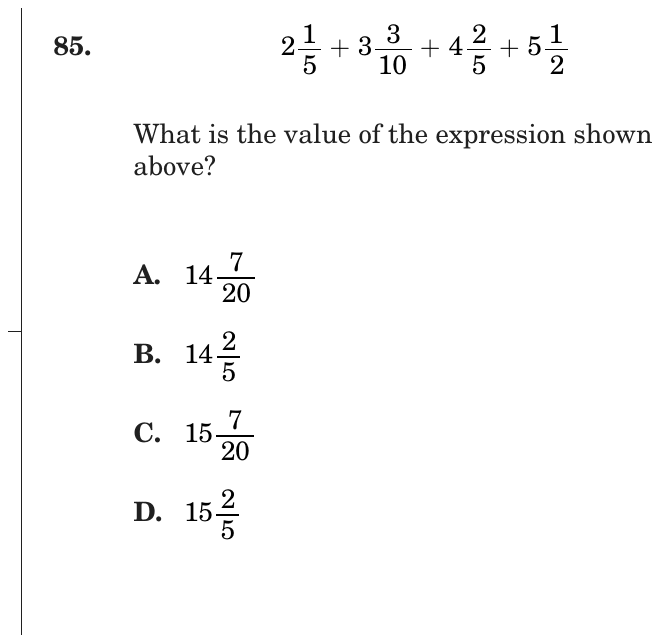
Question 91 of 107
2018 Test A Math, question 32Question
The least of 5 consecutive integers is , and the greatest is . What is the value of in terms of ?
- A
- B
- C
- D
Show the answer
Correct answer: C
The first integer is , so the second is , the third is , then , and finally .
Since is the fifth and greatest of the integers,
Substitute for and simplify:
Question analysis
This algebra question about five consecutive integers calls the least one l and the greatest g, then asks for (l + g)/2 written in terms of l. Students must express g using l and simplify a fraction that contains a variable. Counting how far the fifth integer is from the first is where many students slip.
- NYS standards
- Grade level
- Grade 7 content, by NYS standard
- Compared with grade 7
- At grade 7 Grade 7 students combine like terms in expressions such as 3(x + 4) − x. This item first asks them to build the expression from a description of consecutive integers, then simplify it, with only letters to work with.
- Estimated difficulty
- Moderate: several steps, or a close reading with one strong distractor.
- Thinking it demands
- Depth of knowledge 2, skills and concepts · mainly apply
- What makes it hard
- Variables instead of numbers moderate
- Turning words into math minor
- Every choice must be checked minor
- Solution
- 3 steps
- Reading level
- Question and choices: about grade 8, 26 words.
- Students, last 30 days
- Not enough answers yet to show (it takes 10).
Why it is hard, traps and wrong answers (shows the answer)
Why it is hard
The algebra is short once g is written as l + 4, so most errors come from the fence-post count or from testing numbers carelessly. The wrong choices in front of the answer are exactly the ones a single test value cannot rule out, which punishes students who stop at the first match. Using two test values, or simplifying (2l + 4)/2 directly, avoids both traps.
Variables instead of numbers moderate Understanding the question
Every expression is in l, so the simplification of (l + l + 4)/2 has to be done with letters and cannot be checked against a single number. (Koedinger & Nathan, 2004; Enright, Morley & Sheehan, 2002)
Turning words into math minor Understanding the question
The description "the least of 5 consecutive integers is l, and the greatest is g" must become g = l + 4, four steps up, not five. (Hegarty, Mayer & Monk, 1995; Koedinger & Nathan, 2004)
Every choice must be checked minor Choosing the answer
A single test value fits two choices: l = 1 makes 3l and l + 2 both 3, and l = 2 makes 2l and l + 2 both 4. (Embretson & Wetzel, 1987)
Strategy: Write the integers as l, l + 1, and so on up to the fifth, substitute for g and simplify; then test two different starting values, since one value can match a wrong choice by coincidence.
Traps
- Counting the ends: Inclusive or exclusive ends, fence posts, consecutive numbers: an answer that is one too many or too few, or an endpoint drawn open where it belongs closed (or the reverse).
The wrong answers, classified
A Checks only one number (Schoenfeld, 1985)
Tests only l = 2, where 2 through 6 give (2 + 6)/2 = 4, and takes 2l, the first choice that also equals 4.
B Checks only one number (Schoenfeld, 1985)
Tests only l = 1, where 1 through 5 give (1 + 5)/2 = 3, and stops at 3l, which matches before l + 2 is checked.
D Counting the ends (Brown & Burton, 1978)
Writes the greatest integer as l + 5, counting five steps for five integers, then halves only the 2l in (2l + 5)/2, leaving l + 5.
Worked solution, step by step
Formulas used
- Greatest of 5 consecutive integers
- l is the least (smallest) integer and g is the greatest. Consecutive integers go up by 1 each time. Five integers have only 4 jumps from the first to the last, so you add 4, not 5.
- Dividing a sum
- a and b are the two parts of the top, and c is the number you divide by. To divide a sum, divide each part. You must divide every part of the top, not just one.
Sort out the words
Integers are whole numbers, like −2, 0 and 7. Consecutive integers come one right after another, like 8, 9, 10. There are 5 of them here.
The smallest is called l and the biggest is called g. You must write using only the letter l.
Write all five integers
Each integer is 1 more than the one before:
The fifth one is the greatest, so g = l + 4. Watch out: five integers have only four jumps between them. Writing g = l + 5 leads to choice D.
Put l + 4 in place of g
Swap g for l + 4 in the fraction:
Here l + l is 2l, which means 2 times l.
Split the fraction
Divide each part of the top by 2:
So the answer is C, .
Check your answer
Test two starting numbers. If l = 1, the integers are 1 to 5, and (1 + 5) ÷ 2 = 3, which is 1 + 2. If l = 10, they are 10 to 14, and (10 + 14) ÷ 2 = 12, which is 10 + 2. Use two tests, because l = 1 also makes 3l equal 3, choice B.
More questions like this
The original DOE question
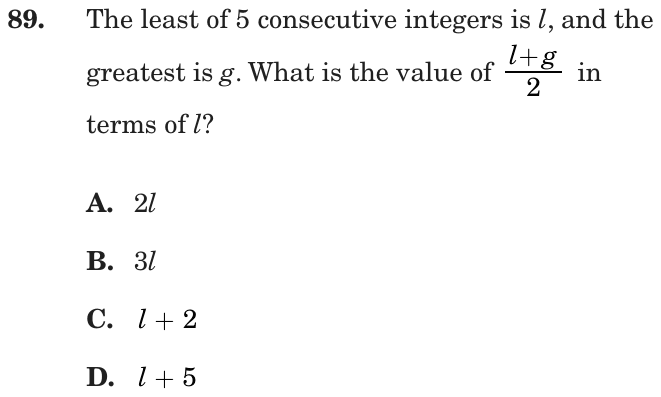
Question 92 of 107
2018 Test A Math, question 52Question
Each week, Leon has fixed expenses of $1,250 at his furniture shop. It costs him $150 to make a chair in his shop, and he sells each chair for $275. What is Leon’s profit if he makes and sells 25 chairs in 1 week?
- A$1,875
- B$2,500
- C$3,125
- D$4,375
Show the answer
Correct answer: A
Each chair costs Leon $150 to make, and he sells the chair for $275.
His profit is found by subtracting the cost from the price:
$275 − $150 = $125 per chair
If Leon makes and sells 25 chairs in a week, his initial profit is
25 × $125 = $3,125
However, Leon has additional fixed expenses of $1,250 per week, so this cost must also be subtracted to arrive at the profit. His final profit is
$3,125 − $1,250 = $1,875
Question analysis
This profit word problem gives Leon's weekly fixed expenses at his furniture shop, the cost to make each chair and its selling price, then asks his profit for 25 chairs in one week. Students must find the profit on each chair, multiply, and account for the fixed expenses. Forgetting the fixed expenses, or adding them, are the main slips.
- NYS standards
- Grade level
- Grade 7 content, by NYS standard
- Compared with grade 7
- At grade 7 Multi-step money problems are standard grade 7 work. This one has three whole-number steps and a familiar profit idea, so it matches typical grade 7 demand, with the fixed cost as the detail to remember.
- Estimated difficulty
- Moderate: several steps, or a close reading with one strong distractor.
- Thinking it demands
- Depth of knowledge 2, skills and concepts · mainly apply
- What makes it hard
- Much to keep track of moderate
- Something you must already know minor
- Solution
- 3 steps
- Reading level
- Question and choices: about grade 3, 39 words.
- Students, last 30 days
- Not enough answers yet to show (it takes 10).
Why it is hard, traps and wrong answers (shows the answer)
Why it is hard
The arithmetic is whole-number and friendly, so the question is about bookkeeping: which amounts are income, which are costs, and which happen once a week. The fixed expenses are named first in the stem and are easy to forget by the time the per-chair profit is multiplied. A final check that revenue minus all costs, 6,875 − 3,750 − 1,250, gives the same result confirms it.
Much to keep track of moderate Working it out
Three dollar amounts play different roles, a weekly fixed expense, a cost per chair and a price per chair, and each must enter the profit with the right sign. (Sweller, 1988; Carpenter, Just & Shell, 1990)
Something you must already know minor Working it out
The bold "profit" is not defined; students must know it means money taken in minus every cost, including costs that do not depend on the number of chairs. (Anderson & Krathwohl, 2001)
Strategy: Subtract the cost from the price to get the profit per chair, multiply by the number of chairs, then subtract the week's fixed expenses.
Traps
- Stops one step early: A choice is a number from partway through the solution.
- Wrong operation: Adds instead of multiplying, divides the wrong way round, turns a ratio or rate upside down, or undoes a step in the wrong direction (subtracts what should be added back).
The wrong answers, classified
B Numbers taken from the question (Hegarty, Mayer & Monk, 1995)
Multiplies the $150 cost by 25 chairs and subtracts the $1,250, treating the cost of making a chair as money earned.
C Stops one step early (King et al., 2004; Gierl et al., 2017)
Finds the profit on 25 chairs at $125 each, $3,125, and stops before subtracting the $1,250 fixed expenses.
D Wrong operation (Hegarty, Mayer & Monk, 1995; King et al., 2004)
Adds the $1,250 fixed expenses to the $3,125 chair profit instead of subtracting them, treating an expense as income.
Worked solution, step by step
Formulas used
- Profit
- P is the profit, the money Leon keeps. I is the income, the money he takes in from sales. C is the total cost: every dollar he spends, including fixed expenses. Profit is what is left after all costs are paid.
Sort out what you know
Leon pays $1,250 each week no matter what. These are fixed expenses, like rent. Each chair costs $150 to make, and he sells each one for $275.
He makes and sells 25 chairs. Profit is the money left after paying all the costs.
Find the profit on one chair
Each chair sells for $275 but costs $150 to make. Subtract to see what he keeps:
He keeps $125 on each chair he sells.
Find the profit on 25 chairs
The chairs bring in $3,125 more than they cost to make. Watch out: $3,125 is choice C, but it is not the final profit. The fixed expenses still have to be paid.
Subtract the fixed expenses
Watch out: the $1,250 is money spent, so subtract it. Adding it gives $4,375, choice D. So the answer is A, $1,875.
Check your answer
Work it the long way. Sales: 25 × $275 = $6,875. Costs: 25 × $150 = $3,750, plus $1,250, which makes $5,000. Profit: $6,875 − $5,000 = $1,875. Same answer.
More questions like this
The original DOE question
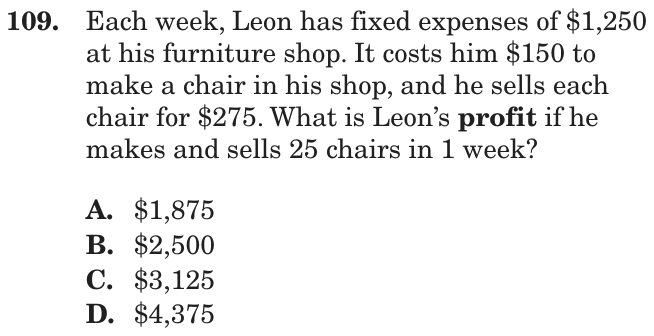
Question 93 of 107
2018 Test A Math, question 55Question
If , what is in terms of ?
- A
- B
- C
- D
Show the answer
Correct answer: C
Question analysis
This algebra question gives the linear equation 4x − 3y = 12 and asks for x in terms of y. Students must isolate the x term and then divide to solve for x. With two variables and a negative coefficient, small sign and division slips each lead to a different wrong choice.
- NYS standards
- Grade level
- Grade 8 content, by NYS standard
- Compared with grade 7
- Above grade 7 Grade 7 students solve one-variable equations like 4x − 3 = 12. Rearranging an equation with two variables to express one in terms of the other is grade 8 algebra, with sign and division slips to avoid.
- Estimated difficulty
- Moderate: several steps, or a close reading with one strong distractor.
- Thinking it demands
- Depth of knowledge 1, recall and reproduction · mainly apply
- What makes it hard
- Variables instead of numbers moderate
- A very close wrong answer moderate
- Error-prone arithmetic minor
- Solution
- 2 steps
- Reading level
- Question and choices: about grade 10, 13 words.
- Students, last 30 days
- Not enough answers yet to show (it takes 10).
Why it is hard, traps and wrong answers (shows the answer)
Why it is hard
The solution is two moves, add 3y to both sides and divide everything by 4, yet each move has a classic slip attached. The four choices are the four combinations of getting the sign right or wrong and dividing the 12 or not, so every partial mistake has a home. Checking one point that satisfies the original equation catches any of them.
Variables instead of numbers moderate Understanding the question
With two variables there is no number to check against unless students invent one; the point x = 6, y = 4 satisfies the equation and separates the choices. (Koedinger & Nathan, 2004; Enright, Morley & Sheehan, 2002)
A very close wrong answer moderate Choosing the answer
The choices x = 3/4 y + 3 and x = −3/4 y + 3 are identical except for the sign of the y term, which only correctly moving −3y across the equals sign settles. (Embretson & Wetzel, 1987; Gorin & Embretson, 2006; Ascalon et al., 2007)
Error-prone arithmetic minor Working it out
Dividing 12 + 3y by 4 must reach both terms, and the negative coefficient −3 has to change sign when it moves, two slips in a short line. (Brown & Burton, 1978; Junker & Sijtsma, 2001)
Strategy: Move the y term to the right side, watching its sign, so only the x term remains on the left, then divide the entire right side, term by term, by 4.
Traps
- A faulty procedure: A systematic but wrong procedure: adding fractions straight across, applying an exponent to each term of a sum, dropping a sign when moving a term.
The wrong answers, classified
A A faulty procedure (Brown & Burton, 1978; Tatsuoka, 1983)
Moves 3y correctly but divides only the y term by 4, leaving the constant 12 undivided.
B A faulty procedure (Brown & Burton, 1978; Tatsuoka, 1983)
Keeps the minus sign on the 3y term when moving it and also leaves the 12 undivided, two errors at once.
D A faulty procedure (Brown & Burton, 1978; Tatsuoka, 1983)
Divides every term by 4 correctly but keeps the minus on 3y, as if a term kept its sign when moved across.
Worked solution, step by step
Formulas used
- Keeping an equation balanced
- a and b are the two sides of an equation, and c is any number. An equation is like a balance. If you do the same thing to both sides, such as adding 3y or dividing by 4, they stay equal.
- Dividing a sum
- a and b are the two parts of the top, and c is the number you divide by. To divide a sum, divide each part. It works because sharing a + b into c groups shares a and b each into c groups.
Sort out what you need
The question asks for x in terms of y. That means get x alone on one side. The other side may have y and numbers, but no x. Start with .
Move the y term
The 3y is being subtracted on the left. Add 3y to both sides to clear it:
Watch out: the term was minus 3y. Adding 3y to both sides makes it plus 3y on the right. Keeping the minus sign leads to choice D.
Divide both sides by 4
x is being multiplied by 4. Divide both sides by 4 to undo it:
Split the fraction
Divide each part of the top by 4:
Watch out: the 12 must be divided by 4 too. Leaving it as 12 gives choice A. The choices put the y term first. So the answer is C, .
Check your answer
Pick y = 4. Choice C gives x = 3 + 3 = 6. Put x = 6 and y = 4 into the start: 4 × 6 − 3 × 4 = 24 − 12 = 12. It works. Choice D gives x = 0, and 4 × 0 − 12 = −12, not 12.
More questions like this
The original DOE question
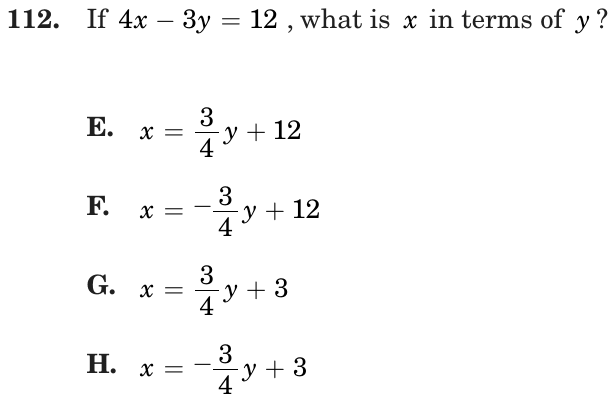
Question 94 of 107
2018 Test B Math, question 2Question
What is the value of in the equation shown above?
Grid-in question: work out the answer and enter it as a number.
Show the answer
Correct answer: 3
Question analysis
This grid-in asks students to solve a two-step linear equation in which an expression containing x is divided by 12 and set equal to 12. The algebra is short, but x is being subtracted from 147, so undoing the operations in the right order and keeping the minus sign straight is where students slip.
- NYS standards
- 7.EE.4a two-step equations
- Grade level
- Grade 7 content, by NYS standard
- Compared with grade 7
- At grade 7 This is exactly the two-step equation practice of grade 7: undo a division, then undo a subtraction. The only twist is that the unknown is being subtracted, so the last step needs care with its sign.
- Estimated difficulty
- Routine: one familiar step, little to misread.
- Thinking it demands
- Depth of knowledge 1, recall and reproduction · mainly apply
- What makes it hard
- Error-prone arithmetic minor
- Solution
- 2 steps
- Reading level
- Question and choices: about grade 6, 12 words.
- Students, last 30 days
- Not enough answers yet to show (it takes 10).
Why it is hard, traps and wrong answers (shows the answer)
Why it is hard
This is a two-move equation that most students finish quickly: multiply both sides by 12, then find what must be taken from 147 to leave 144. Points are lost only at the last move, where the minus sign in front of x invites 144 − 147 or 147 + 144. Substituting the result back into the fraction catches either slip in a few seconds.
Error-prone arithmetic minor Working it out
After multiplying by 12, the unknown sits behind a minus sign in 147 − x = 144, so students must ask what is taken from 147 rather than subtract in the order the numbers appear. (Brown & Burton, 1978; Junker & Sijtsma, 2001)
Strategy: Multiply both sides by 12 to clear the fraction, then ask what number must be taken away from 147 to leave that product.
Traps
- Negatives and direction: Arithmetic with negative numbers, the order of a subtraction, or direction on a number line. (Moving a term across the equals sign without changing its sign is a faulty procedure.)
The wrong answers, classified
-3 Negatives and direction (Brown & Burton, 1978)
Reaches 147 − x = 144 but subtracts in the order the numbers appear, writing x = 144 − 147.
146 Wrong operation (Hegarty, Mayer & Monk, 1995; King et al., 2004)
Divides the right side by 12 instead of multiplying, so sets 147 − x equal to 1 and gets 146.
291 A faulty procedure (Brown & Burton, 1978; Tatsuoka, 1983)
Moves 147 across the equals sign without changing its sign and drops the minus on x, so x = 144 + 147.
Worked solution, step by step
Formulas used
- Undoing division
- a is the top of the fraction, b is the bottom, and c is the result. Division and multiplication undo each other. So if a divided by b gives c, then b times c gives back a. This is the same as multiplying both sides by b.
Read the equation in words
The equation says: start with 147, take away a mystery number x, then divide by 12. The result is 12.
You need to find x. To get x alone, undo the steps in reverse order. Dividing by 12 was done last, so undo it first.
Undo the division by 12
Multiply both sides by 12. Whatever you do to one side, you must do to the other. That keeps the equation balanced.
Watch out: Do not divide 12 by 12. That gives 147 − x = 1 and the wrong answer 146.
Find what was taken away
Now ask: 147 minus what number leaves 144? The gap between the two numbers is x.
Watch out: Do not work out 144 − 147. That gives −3. Since 147 is bigger than 144, x must be positive.
So you would grid 3.
Check your answer
Put 3 back in for x. First, . Then . That matches the right side of the equation, so x = 3 is correct.
More questions like this
The original DOE question
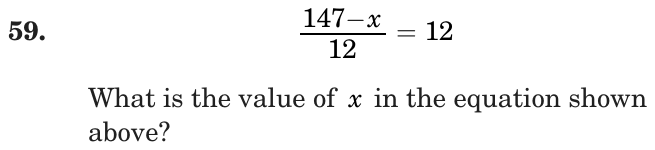
Question 95 of 107
2018 Test B Math, question 8Question
Based on the statement above, which variable has the greatest value?
- A
- B
- C
- D
Show the answer
Correct answer: D
Break the equations apart to each equal :
Pick a number to substitute into the equations, and solve the equations to find the values of , , , , and .
Let . Since all the equations are equal to 2, substitute 2 to find each variable.
Variable has the greatest value.
Question analysis
This algebra question sets five expressions equal to one another and to a positive number, then asks which variable has the greatest value. It tests whether students can rewrite each variable in terms of one shared value and compare them. What makes it tricky is that there are no numbers to compute, so each variable's size has to be reasoned out.
- Grade level
- Grade 7 content, by NYS standard
- Compared with grade 7
- Above grade 7 Grade 7 students rewrite expressions to see how quantities relate, usually one equation at a time. This chain of five linked expressions, with no numbers to compute and a positivity condition to use, is a reasoning task beyond routine grade 7 work.
- Estimated difficulty
- Hard: combines ideas, needs a plan, and has more than one tempting wrong answer.
- Thinking it demands
- Depth of knowledge 3, strategic thinking · mainly analyze
- What makes it hard
- Variables instead of numbers major
- No obvious method moderate
- Much to keep track of minor
- Solution
- 3 steps
- Reading level
- Question and choices: about grade 10, 16 words.
- Students, last 30 days
- Not enough answers yet to show (it takes 10).
Why it is hard, traps and wrong answers (shows the answer)
Why it is hard
The question rewards a strategy, not a calculation: once the shared value is named, each variable follows in one line and R is clearly largest. Without that step, students judge by how the expressions look, and the look is backwards, since the 3 in 3N makes N small and the 7 under R makes R large. The positivity condition at the end is easy to skip but is what fixes the order.
Variables instead of numbers major Understanding the question
There are no numbers to compute: five variables are tied together in the one chain M = 3N = P/4 = Q + 5 = R/7, and each must be compared through the shared value. (Koedinger & Nathan, 2004; Enright, Morley & Sheehan, 2002)
No obvious method moderate Working it out
Nothing says how to compare; the efficient move is to name the common value, or pick one such as 12, and rewrite each variable, which students must think of themselves. (Schoenfeld, 1985)
Much to keep track of minor Working it out
Five relations and the condition > 0 must be held at once; the condition matters, since with a negative common value the order of M, N, P and R would reverse. (Sweller, 1988; Carpenter, Just & Shell, 1990)
Strategy: Call the shared value k, a positive number, and rewrite each variable as an expression in k; or substitute a convenient positive value such as 12 and compare the results.
Traps
- Equation written backwards: Writes a comparison the wrong way round, word for word: "six times as many students as professors" as 6S = P. The bigger quantity gets the bigger number.
The wrong answers, classified
A Equation written backwards (Clement, Lochhead & Monk, 1981)
Reads P/4 and R/7 as a quarter and a seventh of M, the reverse of the truth, so M looks largest of all.
B Equation written backwards (Clement, Lochhead & Monk, 1981)
Reads the 3 in 3N as making N three times as large, when 3N = M actually makes N one third of M.
C Stops one step early (King et al., 2004; Gierl et al., 2017)
Correctly sees that P is four times M but stops there without checking R, which at seven times M is larger.
Worked solution, step by step
Formulas used
- Undoing division
- a is the top of the fraction, b is the bottom, and c is the result. Multiplying undoes dividing. So if a divided by b is c, then a is b times c.
- Undoing multiplication
- b is the number multiplied by a, and c is the result. Dividing undoes multiplying. So to get a alone, divide c by b.
Understand the chain
The statement is a chain of equal signs. It says five expressions all have the same value. The last part says that value is greater than 0, so it is positive.
You need to find which letter has the largest value.
Pick a value to test
All five expressions are equal, so give them one shared value. Pick a positive number that 3 divides evenly. That way N will be a whole number.
Let the shared value be 12. Then , and each of the other four expressions also equals 12.
Solve for each letter
Undo each operation to find each letter. Divide to undo times. Multiply to undo divide. Subtract to undo plus.
Compare the values
The values are M = 12, N = 4, P = 48, Q = 7 and R = 84. R is the largest.
Watch out: 3N does not make N big. It means 3 times N equals M, so N is only one third of M. That trap points to choice B. Also, P is big, but R is bigger. Check every letter before you pick choice C.
So the answer is D, R.
Check your answer
Think without numbers. R divided by 7 is M, so R is 7 times M. P is only 4 times M. N is a third of M, and Q is 5 less than M. Since M is positive, 7 times M is the biggest.
More questions like this
The original DOE question
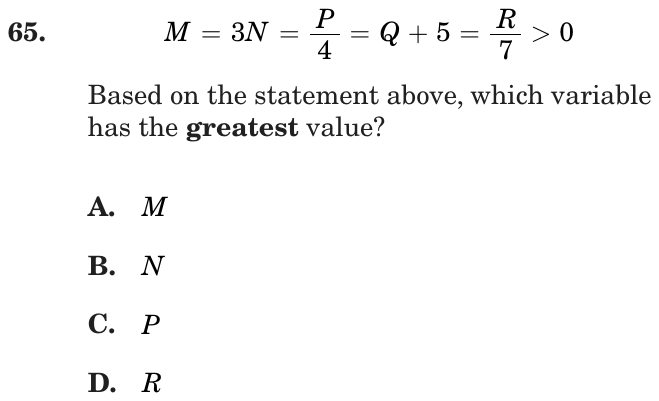
Question 96 of 107
2018 Test B Math, question 10Question
To make party invitations, Macie could buy a package of paper for $10.50, or she could buy x individual sheets of the same paper for $0.15 each. What is the largest value of x that would make buying the individual sheets less expensive than buying the package?
- A60
- B65
- C69
- D70
Show the answer
Correct answer: C
Set up an inequality to compare the costs:
0.15x < 10.50
x < 70
Therefore, 70 individual sheets of paper would cost $10.50, so 69 is the greatest number of individual sheets of paper that Macie can buy that would be less expensive than the package.
Question analysis
This inequality word problem compares buying a package of paper with buying single sheets at 15 cents each, and asks for the largest number of sheets for which the single sheets cost less. Students write and solve an inequality with decimals. The tricky part is interpreting the solution as a whole number of sheets.
- Grade level
- Grade 7 content, by NYS standard
- Compared with grade 7
- At grade 7 Writing and solving an inequality from a real-world situation is a grade 7 standard. This one is short, but it asks students to interpret a strict inequality as a count of sheets, the kind of interpretation grade 7 tests expect.
- Estimated difficulty
- Moderate: several steps, or a close reading with one strong distractor.
- Thinking it demands
- Depth of knowledge 2, skills and concepts · mainly apply
- What makes it hard
- A very close wrong answer moderate
- Turning words into math minor
- Error-prone arithmetic minor
- Solution
- 3 steps
- Reading level
- Question and choices: about grade 10, 45 words.
- Corrected from the DOE handbook
- An inequality sign in the explanation was corrected.
- Students, last 30 days
- Not enough answers yet to show (it takes 10).
Why it is hard, traps and wrong answers (shows the answer)
Why it is hard
The computation leads straight to 70, and the whole question is about what to do with that number. Students who treat the boundary as the answer forget that equal cost is not less cost, while the other choices only catch those who misdivide or ignore the word largest. The question rewards checking the boundary case in the story: 70 sheets cost exactly the package price.
A very close wrong answer moderate Choosing the answer
70 and 69 sheets differ by one, and 70 is exactly where the two costs meet at $10.50; only the strict “less expensive” separates them, ruling out 70. (Embretson & Wetzel, 1987; Gorin & Embretson, 2006; Ascalon et al., 2007)
Turning words into math minor Understanding the question
The words “less expensive than buying the package” must become a strict inequality, 0.15x < 10.50, and “largest value” must then pick the biggest whole number below the boundary. (Hegarty, Mayer & Monk, 1995; Koedinger & Nathan, 2004)
Error-prone arithmetic minor Working it out
Dividing 10.50 by 0.15 means shifting the decimal point in both numbers, a step where a misplaced digit gives a wrong boundary. (Brown & Burton, 1978; Junker & Sijtsma, 2001)
Strategy: Divide the package price by the price of one sheet to see where the two costs meet, then find the largest whole number of sheets that still costs less than $10.50.
Traps
- Counting the ends: Inclusive or exclusive ends, fence posts, consecutive numbers: an answer that is one too many or too few, or an endpoint drawn open where it belongs closed (or the reverse).
The wrong answers, classified
A Misreads the question (Hegarty, Mayer & Monk, 1995)
Checks a round number, 60 sheets for $9.00, sees it is cheaper than the package, and stops without seeking the largest such number.
B An arithmetic slip (Junker & Sijtsma, 2001)
Divides only the $10 by $0.15, about 66.7, ignoring the 50 cents, and settles on the nearest smaller choice.
D Counting the ends (Brown & Burton, 1978)
Solves 0.15x = 10.50 and keeps the boundary 70, but 70 sheets cost exactly $10.50, the same as the package, not less.
What was corrected from the DOE handbook, and why
- Explanation: The handbook sets up 0.15x ≤ 10.50 and x ≤ 70, which would allow 70 sheets, and then says that 70 sheets cost exactly $10.50. Buying the sheets has to be less expensive than the package, so the site uses strict inequalities, 0.15x < 10.50 and x < 70, which make 69 the largest number of sheets.
Worked solution, step by step
Formulas used
- Total cost
- Price of one is what a single sheet costs, here $0.15. Number bought is how many sheets, here x. Multiplying gives the total you pay, because you pay the same price for every sheet.
Sort out the question
The package costs $10.50. Single sheets cost $0.15 each. Macie buys x sheets.
You need the largest x that makes the sheets cost less than the package. Costing the same is not enough.
Write the inequality
An inequality is a math sentence that compares two amounts. The sign < means is less than.
The cost of x sheets is 0.15 times x. It must be less than 10.50.
Find where the costs are equal
First find how many sheets cost exactly $10.50. Divide the package price by the price of one sheet. Multiply both numbers by 100 to clear the decimals.
So 70 sheets cost exactly $10.50.
Pick the largest number below 70
x must be less than 70. You can only buy whole sheets. The largest whole number below 70 is 69.
Watch out: 70 sheets cost the same as the package, not less. That is why choice D is wrong. Choices A and B are cheaper too, but they are not the largest.
So the answer is C, 69.
Check your answer
Test both numbers. , and $10.35 is less than $10.50. But , which is not less. So 69 is the largest number that works.
More questions like this
The original DOE question
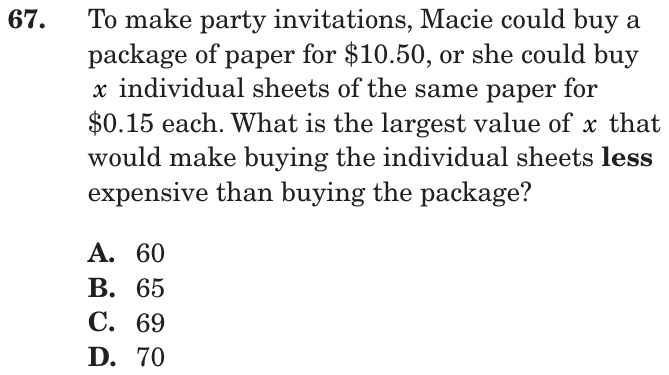
Question 97 of 107
2018 Test B Math, question 18Question
PRICES FOR NEWSPAPER ADVERTISING
| Page Space | Price |
| page | $200 |
| page | $350 |
| full page | $600 |
The table above shows prices for newspaper advertising. A store purchased pages, pages, and full pages of page space in equal numbers for a total of $11,500. What is the total amount of page space the store purchased?
- A pages
- B10 pages
- C pages
- D pages
Show the answer
Correct answer: D
The question says that an equal number () of each type of page space was purchased. To find the number of each type of page space that was purchased, multiply the price per type by and set it equal to the total amount spent, then solve for :
Thus, the store purchased 10 units of each type of page space. To find the total amount of page space purchased, multiply each type of page space by 10, and add:
Question analysis
This word problem gives a table of newspaper advertising prices for quarter-page, half-page and full-page ads, and says a store bought equal numbers of each for a set total. Students write and solve an equation for how many ads of each size were bought. The question wants total page space, which takes a second calculation with fractions.
- Grade level
- Grade 7 content, by NYS standard
- Compared with grade 7
- Above grade 7 Grade 7 students write and solve equations like px = r from word problems. This adds a table, combines three prices into one coefficient and needs a second step with fractions after solving, a longer chain than typical grade 7 work.
- Estimated difficulty
- Hard: combines ideas, needs a plan, and has more than one tempting wrong answer.
- Thinking it demands
- Depth of knowledge 2, skills and concepts · mainly apply
- What makes it hard
- Many steps major
- Turning words into math moderate
- Reading a figure, table or graph minor
- Solution
- 4 steps
- Reading level
- Question and choices: about grade 5, 59 words.
- Corrected from the DOE handbook
- An arithmetic slip in the explanation was corrected.
- Students, last 30 days
- Not enough answers yet to show (it takes 10).
Why it is hard, traps and wrong answers (shows the answer)
Why it is hard
Solving for the number of ads is the obvious goal, and finding it feels like the finish, but the question asks for page space, which needs one more pass through the table. The awkward wording about buying pages in equal numbers slows students before any arithmetic starts. The wrong choices mark each place to stop: one set of ads, the number of each ad, or a slip in adding the fractional pages.
Many steps major Working it out
The work has two phases: turn the money into a count, 1,150x = 11,500 so x = 10, then turn the count into space by multiplying 10 by 1/4, 1/2 and 1 and adding. (Daniel & Embretson, 2010; Enright, Morley & Sheehan, 2002)
Turning words into math moderate Understanding the question
The phrase “purchased 1/4 pages, 1/2 pages, and full pages of page space in equal numbers” has to be read as the same number of ads of each size, so the three prices add to one coefficient. (Hegarty, Mayer & Monk, 1995; Koedinger & Nathan, 2004)
Reading a figure, table or graph minor Understanding the question
Both columns of the table are needed: the price column builds the equation, and the page-space column turns the count of ads into the final total. (Lesh, Post & Behr, 1987; Kirsch & Mosenthal, 1990)
Strategy: Let x be the number of each ad size, add the three prices to write one equation for the total, solve it, then multiply x by the page space in one set of ads.
Traps
- Stops one step early: A choice is a number from partway through the solution.
- Answers a different question: A choice is right for another quantity: the other unknown, the rest instead of the part, the part instead of the whole.
The wrong answers, classified
A Answers a different question (King et al., 2004; Hegarty, Mayer & Monk, 1995)
Adds 1/4 + 1/2 + 1, the page space in one set of the three ads, without using the $11,500 to find how many sets were bought.
B Stops one step early (King et al., 2004; Gierl et al., 2017)
Solves 1,150x = 11,500 for the number of ads of each size and stops there instead of converting the count to page space.
C An arithmetic slip (Junker & Sijtsma, 2001)
Takes ten quarter pages as 1 1/2 pages instead of 2 1/2, so adds 1 1/2 + 5 + 10.
What was corrected from the DOE handbook, and why
- Explanation: The handbook adds 200x + 350x + 600x and writes 1,500x = 11,500. The sum is 1,150x, and the handbook’s next line, x = 10, only follows from 1,150x = 11,500. The site shows 1,150x = 11,500.
Worked solution, step by step
Formulas used
- Number of equal sets
- A set here means one ad of each size. The cost of one set is what one of each costs together. Dividing the total money by it tells how many sets were bought, because every set costs the same.
Sort out the question
The store bought the same number of each ad size: quarter page, half page and full page. It spent $11,500 in all.
You need the total page space. That is not the number of ads, and not the money.
Find the cost of one set
Think of one quarter page, one half page and one full page as a set. The store bought equal numbers of each, so it bought whole sets.
One set costs $1,150.
Find how many sets
The store bought 10 sets. That means 10 ads of each size.
Watch out: 10 is the number of each ad, not the page space. Stopping here gives choice B.
Find the page space in one set
Add the sizes in one set. Write them in quarters so they have the same bottom number.
One set is , or , pages.
Watch out: pages is only one set. That is choice A.
Multiply by the number of sets
There are 10 sets, so multiply the space in one set by 10.
So the answer is D, pages.
Check your answer
Add the sizes another way. 10 quarter pages make 2.5 pages, not 1.5. 10 half pages make 5 pages. 10 full pages make 10 pages. Then , the same answer.
More questions like this
The original DOE question
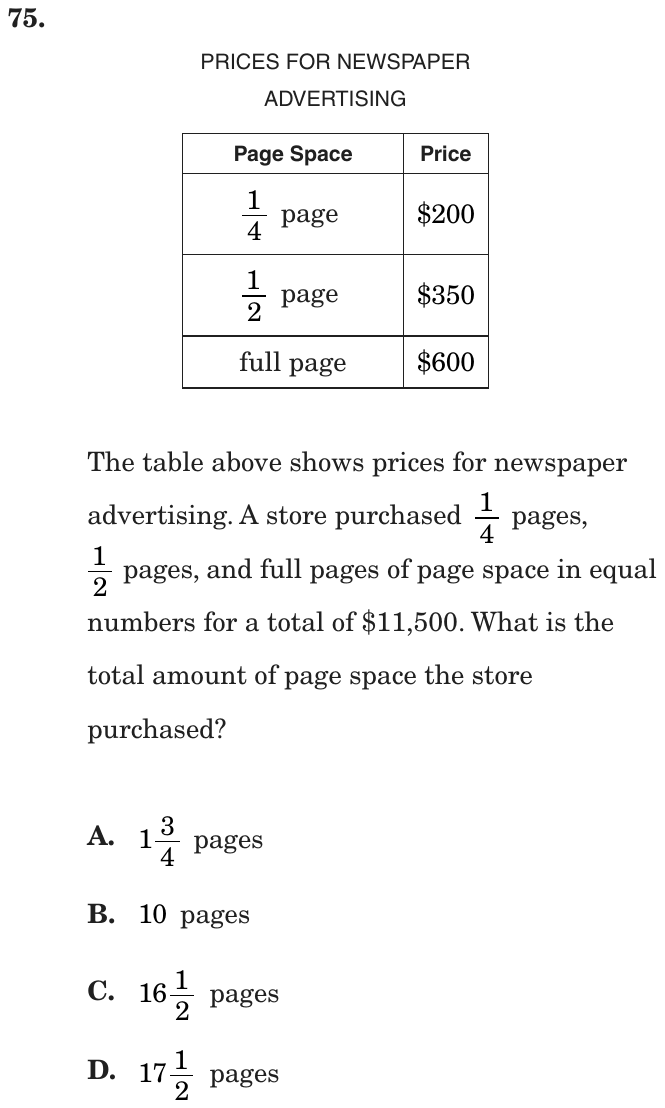
Question 98 of 107
2018 Test B Math, question 19Question
How many positive odd numbers satisfy the inequality ?
- A13
- B14
- C17
- D28
Show the answer
Correct answer: B
Solve the inequality for x.
3x + 8 ≤ 92
3x ≤ 84
x ≤ 28
The positive odd numbers less than or equal to 28 are 1, 3, 5, …, 25, and 27. There are 14 of them.
Question analysis
This question asks how many positive odd numbers satisfy the two-step inequality 3x + 8 ≤ 92. Students solve the inequality and then count the odd whole numbers in the solution. The counting after the algebra is where errors creep in, especially at the end of the list.
- Grade level
- Grade 7 content, by NYS standard
- Compared with grade 7
- At grade 7 Solving a two-step inequality is grade 7 work. Asking for a count of the odd solutions adds a number-property step and an endpoint check, but the total demand stays close to a typical grade 7 problem.
- Estimated difficulty
- Moderate: several steps, or a close reading with one strong distractor.
- Thinking it demands
- Depth of knowledge 2, skills and concepts · mainly apply
- What makes it hard
- A very close wrong answer moderate
- Combines ideas minor
- Solution
- 3 steps
- Reading level
- Question and choices: about grade 16, 9 words.
- Corrected from the DOE handbook
- The explanation’s description of the solutions was corrected.
- Students, last 30 days
- Not enough answers yet to show (it takes 10).
Why it is hard, traps and wrong answers (shows the answer)
Why it is hard
Solving the inequality is routine, and that is the trap: x ≤ 28 looks like an answer and 28 is among the choices. The real task is counting odd numbers from 1 to 27, where the usual shortcut, (27 − 1) ÷ 2, misses the first term. Pairing each odd number with the even number after it, up to 28, gives the count directly and avoids the fencepost slip.
A very close wrong answer moderate Choosing the answer
13 and 14 differ by one, and a rough count of the odd numbers up to 27 cannot separate them; only counting both ends, 1 and 27, gives the exact 14. (Embretson & Wetzel, 1987; Gorin & Embretson, 2006; Ascalon et al., 2007)
Combines ideas minor Working it out
Solving 3x + 8 ≤ 92 is only half the work; counting the positive odd whole numbers up to 28 is a separate number-sense task. (Embretson, 1998; Daniel & Embretson, 2010)
Strategy: Solve the inequality as you would an equation, keeping the direction of the sign, then count odd numbers from 1 up to the boundary by pairing or halving.
Traps
- Counting the ends: Inclusive or exclusive ends, fence posts, consecutive numbers: an answer that is one too many or too few, or an endpoint drawn open where it belongs closed (or the reverse).
- Stops one step early: A choice is a number from partway through the solution.
The wrong answers, classified
A Counting the ends (Brown & Burton, 1978)
Counts the odd numbers from 1 to 27 as (27 − 1) ÷ 2 = 13, forgetting to add one for the first term.
C A faulty procedure (Brown & Burton, 1978; Tatsuoka, 1983)
Moves the 8 across without changing its sign, solving 3x ≤ 100, and counts the odd numbers up to 33.
D Stops one step early (King et al., 2004; Gierl et al., 2017)
Solves the inequality to x ≤ 28 and gives the boundary 28 instead of counting the positive odd numbers up to it.
What was corrected from the DOE handbook, and why
- Explanation: The handbook solves the inequality to x ≤ 28 and then lists “the positive odd numbers less than 28.” The solutions include 28 itself, so the site says “less than or equal to 28.” The count does not change, because 28 is even: the odd numbers are still 1, 3, 5, …, 27, which is 14 numbers.
Worked solution, step by step
Formulas used
- Solving an inequality
- a, b and c are numbers. The sign ≤ means less than or equal to. You may subtract the same number from both sides. You may also divide both sides by the same positive number. The sign stays the same either way.
- Counting odd numbers
- n is an even number. Split the numbers from 1 to n into pairs: 1 and 2, 3 and 4, and so on. There are n ÷ 2 pairs, and each pair holds exactly one odd number.
Sort out the question
You need to count the positive odd numbers that make true.
The sign ≤ means is less than or equal to. Positive means greater than 0. Odd numbers are 1, 3, 5, 7, and so on.
Solve the inequality
Solve it like an equation. Subtract 8 from both sides. Then divide both sides by 3. Dividing by a positive number keeps the sign the same.
Watch out: 28 is the largest x allowed, not the count. That trap is choice D.
List the odd numbers
The positive odd numbers up to 28 are 1, 3, 5, and so on, up to 25 and 27. The number 28 is even, so it does not count.
Count them by pairing
Split 1 to 28 into pairs: 1 and 2, 3 and 4, and so on, up to 27 and 28. Each pair has one odd number.
Watch out: Working out counts the jumps of 2 from 1 to 27, not the numbers. You must add 1 for the first number. That mistake gives choice A.
So the answer is B, 14.
Check your answer
Test the edges. For x = 27: , which is at most 92, so it works. For x = 29: , which is too big. So 27 is the last odd number that works.
More questions like this
The original DOE question
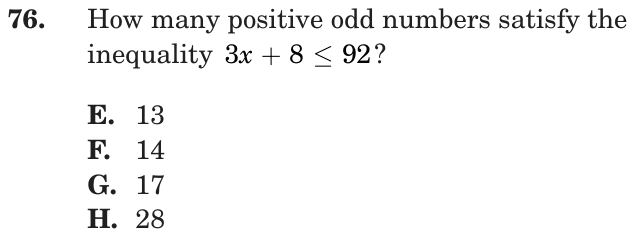
Question 99 of 107
2018 Test B Math, question 27Question
Nicole’s age now is three times Carmen’s age. If Carmen will be 17 in two years, how old was Nicole 5 years ago?
- A38 yr
- B40 yr
- C45 yr
- D50 yr
Show the answer
Correct answer: B
First, find out how old Nicole and Carmen are now.
Let = Nicole’s age now. Let = Carmen’s age now.
(Carmen’s age now)
(Nicole’s age now)
(Nicole’s age 5 years ago)
Question analysis
This age word problem says Nicole is three times as old as Carmen now, and that Carmen will be 17 in two years. Students work out both present ages and then go back five years for Nicole. Keeping the times straight is the tricky part: two years ahead for Carmen, five years back for Nicole.
- Grade level
- Grade 7 content, by NYS standard
- Compared with grade 7
- At grade 7 Grade 7 students write simple equations from word problems. Age problems like this one take three short steps, and the shifts in time are the only real hurdle, so the demand is typical of grade 7.
- Estimated difficulty
- Straightforward: two steps or one careful reading.
- Thinking it demands
- Depth of knowledge 2, skills and concepts · mainly apply
- What makes it hard
- Turning words into math moderate
- Much to keep track of minor
- Solution
- 3 steps
- Reading level
- Question and choices: about grade 1, 25 words.
- Students, last 30 days
- Not enough answers yet to show (it takes 10).
Why it is hard, traps and wrong answers (shows the answer)
Why it is hard
The arithmetic is short, but the question moves through three points in time, and only one of them carries the three-times relationship. Students who find Nicole's present age often stop there, since it is a choice. Labeling each age with its time, now or then, keeps the two-year and five-year shifts with the right person and in the right direction.
Turning words into math moderate Understanding the question
Three points in time appear, now, in two years and 5 years ago, and “three times Carmen's age” holds only for now, so each shift must be applied to the right person. (Hegarty, Mayer & Monk, 1995; Koedinger & Nathan, 2004)
Much to keep track of minor Working it out
Students must hold Carmen's future age 17, her present age 15, Nicole's present age 45 and the 5-year shift while deciding which to report. (Sweller, 1988; Carpenter, Just & Shell, 1990)
Strategy: Find Carmen's age now by going back two years from 17, triple it for Nicole's current age, then subtract five.
Traps
- Stops one step early: A choice is a number from partway through the solution.
- Negatives and direction: Arithmetic with negative numbers, the order of a subtraction, or direction on a number line. (Moving a term across the equals sign without changing its sign is a faulty procedure.)
The wrong answers, classified
A Misreads the question (Hegarty, Mayer & Monk, 1995)
Applies the two-year shift to Nicole as well, subtracting both 2 and 5 from her present age of 45.
C Stops one step early (King et al., 2004; Gierl et al., 2017)
Finds Nicole's present age, three times 15, and stops before going back 5 years.
D Negatives and direction (Brown & Burton, 1978)
Adds 5 years to Nicole's present age instead of subtracting, giving her age 5 years from now.
Worked solution, step by step
Formulas used
- Age at another time
- n is a number of years. To find an age in the future, add n to the age now. To find an age in the past, subtract n instead. Everyone gets older at the same speed, one year per year.
Sort out the times
The question talks about three times: now, two years from now, and 5 years ago. Nicole is 3 times as old as Carmen now.
Carmen will be 17 in two years. You need Nicole’s age 5 years ago.
Find Carmen's age now
In two years Carmen will be 17. So right now she is 2 years younger.
Carmen is 15 now.
Find Nicole's age now
Nicole’s age now is three times Carmen’s age now.
Nicole is 45 now.
Watch out: 45 is her age now, choice C. The question asks about 5 years ago.
Go back 5 years
Going back in time means subtracting.
Nicole was 40 five years ago.
Watch out: Adding 5 gives 50, choice D. Also, the 2 years only apply to Carmen. Taking 2 more years off Nicole gives 38, choice A.
So the answer is B, 40 yr.
Check your answer
Work forward from your answer. Nicole was 40 five years ago, so she is 45 now. Carmen is a third of that, 15. In two years Carmen will be 17. That matches the question.
More questions like this
The original DOE question
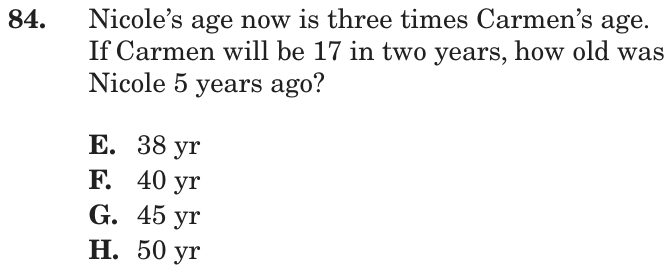
Question 100 of 107
2018 Test B Math, question 29Question
If is an odd integer, which one of the following must be an even integer?
- A
- B
- C
- D
Show the answer
Correct answer: C
One more than an odd integer must be even. One more than is , therefore must be even.
Two times an even integer must be even, therefore is even. An even integer decreased by 2 must be even.
Therefore, must be even.
Question analysis
This algebra question says that w − 1 is an odd integer and asks which of four expressions must be even. It tests reasoning about odd and even numbers written with a variable. The difficulty is that "must be" means even for every allowed value of w, so one example that happens to work is not enough.
- Grade level
- Grade 7 content, by NYS standard
- Compared with grade 7
- At grade 7 Grade 7 work evaluates and rewrites expressions but rarely asks whether one is odd or even for every value. The algebra here is light; the demand is reasoning about parity and reading "must be" carefully.
- Estimated difficulty
- Moderate: several steps, or a close reading with one strong distractor.
- Thinking it demands
- Depth of knowledge 2, skills and concepts · mainly analyze
- What makes it hard
- Variables instead of numbers moderate
- Every choice must be checked moderate
- Something you must already know minor
- Solution
- 2 steps
- Reading level
- Question and choices: about grade 8, 20 words.
- Students, last 30 days
- Not enough answers yet to show (it takes 10).
Why it is hard, traps and wrong answers (shows the answer)
Why it is hard
The question turns on one early inference: since w − 1 is odd, w itself is even. Students who skip that step, or quietly treat w as the odd number, carry the wrong parity into every choice. After that the work is mechanical, because each expression adds an even or an odd amount to an even number. Trying one value, such as w = 4, confirms the choice in seconds.
Variables instead of numbers moderate Understanding the question
The stem gives no number at all: w − 1 is only known to be odd, so the parity of w itself has to be worked out before any choice can be judged. (Koedinger & Nathan, 2004; Enright, Morley & Sheehan, 2002)
Every choice must be checked moderate Choosing the answer
All four choices are built from w or 2w plus or minus 1 or 2, so each one has to be tested for evenness; three of them come out odd for every allowed w. (Embretson & Wetzel, 1987)
Something you must already know minor Working it out
The parity rules are assumed, not stated: one more than an odd number is even, any multiple of 2 is even, and an even number plus or minus 1 is odd. (Anderson & Krathwohl, 2001)
Strategy: Choose a value of w that makes w − 1 odd, evaluate all four expressions, and keep the one that comes out even; then confirm it with a second value.
Traps
- Misreads the question: Misses or misreads a condition or a word in the question: "at least", "each", "remaining", "not".
The wrong answers, classified
A Misreads the question (Hegarty, Mayer & Monk, 1995)
Treats w itself as the odd number, so w + 1 looks even; in fact w − 1 being odd makes w even and w + 1 odd.
B A faulty procedure (Brown & Burton, 1978; Tatsuoka, 1983)
Doubles the odd number w − 1 to make it even but distributes the 2 to w only, writing 2(w − 1) as 2w − 1, which is odd.
D Misunderstands the concept (Smith, diSessa & Roschelle, 1993; De Bock et al., 1998; Ni & Zhou, 2005)
Assumes any expression that starts with 2w is even, overlooking that 2w + 1 is one more than an even number and so always odd.
Worked solution, step by step
Formulas used
- Adding 1 to an odd number
- Odd and even numbers take turns on the number line: 1, 2, 3, 4 and so on. Adding 1 moves you to the next whole number. So the number right after an odd number is always even, and the one after an even number is always odd.
- Doubling makes an even number
- n is any whole number. An even number is one you can split into two equal whole groups. Two times n is always two equal groups of n, so it is always even.
Sort out what you know
You know that is an odd integer. An integer is a whole number, like 3, 0 or −5. An even number can be split into two equal groups, like 4 or 10. An odd number is 1 more than an even number, like 3 or 11.
You need the choice that must be even. Must means it is even for every possible value of , not just one.
Decide whether w is odd or even
The number is 1 more than . One more than an odd number is always even. For example, if is 3, then is 4. So is even.
Watch out: do not treat itself as the odd number. That mistake makes look even and leads to choice A.
Show that 2w − 2 is even
Two times any whole number is even, so is even. Taking 2 away from an even number moves you back two spots. You land on another even number. So is even.
Here is another way to see it. is the same as . That is 2 times a whole number, so it must be even.
Check the other three choices
Each one adds or takes away 1 from an even number. That always gives an odd number.
- A: is even plus 1, so it is odd.
- B: is even minus 1, so it is odd.
- D: is even plus 1, so it is odd.
Watch out: starting with does not make a number even. The +1 in choice D makes it odd.
Give the answer
Only one choice is even for every possible . So the answer is C, .
Check your answer
Pick a number. Let , so , which is odd. Then A is 5, B is 7, C is 6 and D is 9. Only C is even. Try too. You get 11, 19, 18 and 21. C is even again.
More questions like this
The original DOE question
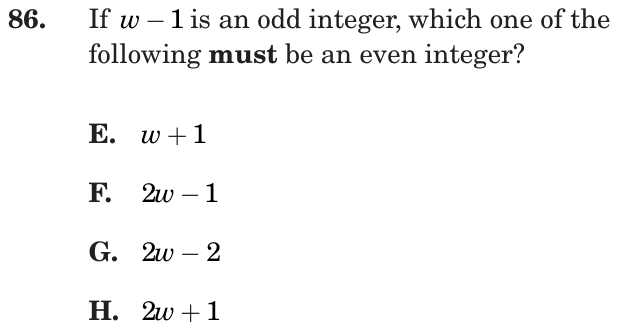
Question 101 of 107
2018 Test B Math, question 31Question
Simplify this expression:
- A
- B
- C
- D
Show the answer
Correct answer: B
4( 7 − 3x ) −( 5 − x) = 28 − 12x − 5 + x = 23 − 11x
Question analysis
This question asks students to simplify an algebraic expression by distributing a number into one set of parentheses, subtracting another set, and combining like terms. It checks the distributive property with a minus sign in front of parentheses. The usual slip is subtracting only the first term inside the second parentheses, which changes the sign of an x term.
- NYS standards
- 7.EE.1 linear expressions with rational coefficients
- Grade level
- Grade 7 content, by NYS standard
- Compared with grade 7
- At grade 7 Expanding and combining linear expressions is core grade 7 work. This is a standard example, two distributions and one subtraction, with nothing beyond what a grade 7 lesson on the distributive property would cover.
- Estimated difficulty
- Straightforward: two steps or one careful reading.
- Thinking it demands
- Depth of knowledge 1, recall and reproduction · mainly apply
- What makes it hard
- Error-prone arithmetic moderate
- Many steps minor
- A very close wrong answer minor
- Solution
- 3 steps
- Reading level
- Question and choices: about grade 16+, 8 words.
- Students, last 30 days
- Not enough answers yet to show (it takes 10).
Why it is hard, traps and wrong answers (shows the answer)
Why it is hard
Every step is routine, but subtracting a whole group is where students go wrong: the minus sign has to reach the −x as well as the 5. Each choice pairs a constant with an x coefficient, so getting the constant right only narrows the field to two. The question rewards writing out both distributions in full rather than doing them mentally.
Error-prone arithmetic moderate Working it out
The minus sign in front of (5 − x) must change both terms, so −x becomes +x and then combines with −12x from the first group. (Brown & Burton, 1978; Junker & Sijtsma, 2001)
Many steps minor Working it out
Two distributions, then collecting the constants 28 and −5 and the x terms separately: four small operations, each a place where a sign can slip. (Daniel & Embretson, 2010; Enright, Morley & Sheehan, 2002)
A very close wrong answer minor Choosing the answer
23 − 4x shares the right constant with 23 − 11x, so getting 23 does not settle it; only the x coefficient, −12x + x rather than −3x − x, separates them. (Embretson & Wetzel, 1987; Gorin & Embretson, 2006; Ascalon et al., 2007)
Strategy: Rewrite the subtraction as adding −1 times the second group, distribute both multipliers, then collect the constant terms and the x terms separately.
Traps
- Order of operations: Working left to right, or distributing a minus sign wrongly, gives a choice.
- Stops one step early: A choice is a number from partway through the solution.
The wrong answers, classified
A Order of operations (Brown & Burton, 1978)
Applies each multiplier to the first term only, the 4 to 7 but not −3x and the minus to 5 but not −x, so 28 − 3x − 5 − x = 23 − 4x.
C Little reason to choose it (Haladyna & Downing, 1993; Rodriguez, 2005)
Pairs 4 × 7 = 28 with −3x − x = −4x and loses the −5 altogether; no single consistent mistake produces this expression.
D Stops one step early (King et al., 2004; Gierl et al., 2017)
Distributes the 4 correctly to get 28 − 12x and stops there, never subtracting the second group, 5 − x.
Worked solution, step by step
Formulas used
- The distributive property
- a is the number in front of the parentheses. b and c are the terms inside. You multiply a by each term inside, not only the first one. This works because a groups of (b − c) is a groups of b take away a groups of c.
- Subtracting a group
- b and c are the terms inside the parentheses. A minus sign in front means take away the whole group. So you change the sign of each term inside. Taking away a minus c is the same as adding c.
Sort out the question
You need to simplify . Simplify means write it in the shortest way. A term is one piece of the expression, like 7 or . Like terms have the same letter part, so and are like terms. Plain numbers are like terms too.
Multiply the 4 into the first group
Use the distributive property. The 4 multiplies both terms inside.
Watch out: the 4 must multiply the too. Writing only is the first slip that leads to choice A.
Take away the second group
The minus sign in front of means subtract the whole group. So change the sign of each term inside.
Taking away a minus gives plus .
Watch out: if you stop before this step, you get . That is choice D.
Combine the like terms
Now you have . Put the plain numbers together. Then put the terms together.
So the expression simplifies to .
Give the answer
The plain number is 23, and the term is . So the answer is B, .
Check your answer
Put in an easy number, like . The original gives . Choice B gives . They match. Choice A would give , which does not match.
More questions like this
The original DOE question
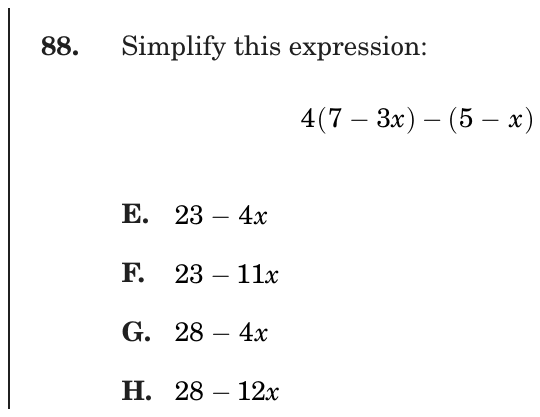
Question 102 of 107
2018 Test B Math, question 33Question
A large container is partially filled with liters of water. Ito adds 10 liters of water to the container, making it 60% full. If Ignacio adds 6 more liters of water, the container will be 75% full. What is the value of ?
- A14
- B15
- C26
- D30
Show the answer
Correct answer: A
Let be the total number of liters the container can hold.
First, solve each equation for :
Equation 1:
Equation 2:
Now, set the two equations equal to each other and solve for .
Question analysis
Water is poured into a large container in two stages: 10 liters make it 60% full, and 6 more liters bring it to 75% full. Students must work out how much water was in it to begin with. This percent word problem hides two unknowns, the starting amount and the capacity, and several in-between numbers look like answers.
- Grade level
- Grade 7 content, by NYS standard
- Compared with grade 7
- Above grade 7 Grade 7 percent problems usually give the whole and ask for a part. Here the whole is unknown and must be found from the change between two percents before a second step reaches the answer.
- Estimated difficulty
- Hard: combines ideas, needs a plan, and has more than one tempting wrong answer.
- Thinking it demands
- Depth of knowledge 3, strategic thinking · mainly analyze
- What makes it hard
- Turning words into math major
- No obvious method moderate
- Many steps moderate
- A very close wrong answer minor
- Solution
- 4 steps
- Reading level
- Question and choices: about grade 7, 40 words.
- Students, last 30 days
- Not enough answers yet to show (it takes 10).
Why it is hard, traps and wrong answers (shows the answer)
Why it is hard
The container's size is the hidden key, and nothing in the stem names it. Students who write an equation for each fill level, or who notice that 6 liters equal 15 percent, get there; others grab a number from the story or stop at the 75% level. Because every wrong choice is a number that appears in the problem or arises while solving it, a careless finish is rewarded with a match.
Turning words into math major Understanding the question
Two percent-full statements about a container of unknown size have to become equations, n + 10 = 60% of the capacity and n + 16 = 75% of it, and the capacity is never given. (Hegarty, Mayer & Monk, 1995; Koedinger & Nathan, 2004)
No obvious method moderate Working it out
The quick route is to see that Ignacio's 6 liters raise the level by 15 percentage points, which fixes the capacity at 40 liters; the wording does not point to it. (Schoenfeld, 1985)
Many steps moderate Working it out
After the capacity, the solution still needs the 60% amount, 24 liters, and a subtraction of Ito's 10 liters, so two unknowns are chased through four steps. (Daniel & Embretson, 2010; Enright, Morley & Sheehan, 2002)
A very close wrong answer minor Choosing the answer
15 sits one unit from the right 14, so a rough estimate of the starting amount cannot choose between them; only solving exactly, 24 − 10, separates them. (Embretson & Wetzel, 1987; Gorin & Embretson, 2006; Ascalon et al., 2007)
Strategy: Compare the two fill levels: the extra 6 liters account for the change in percent, which gives the capacity. Then use the 60% level to work back to the starting amount.
Traps
- Answers a different question: A choice is right for another quantity: the other unknown, the rest instead of the part, the part instead of the whole.
- Numbers taken from the question: Combines the numbers in the question without a model of the situation, or is simply a number that appears in the question.
- Wrong operation: Adds instead of multiplying, divides the wrong way round, turns a ratio or rate upside down, or undoes a step in the wrong direction (subtracts what should be added back).
The wrong answers, classified
B Numbers taken from the question (Hegarty, Mayer & Monk, 1995)
Subtracts the percents, 75 − 60 = 15, and gives a gap in percentage points as a number of liters.
C Wrong operation (Hegarty, Mayer & Monk, 1995; King et al., 2004)
Works back from the 30 liters at 75% full but adds Ignacio's 6 liters instead of removing them: 30 + 6 − 10 = 26.
D Answers a different question (King et al., 2004; Hegarty, Mayer & Monk, 1995)
Finds the 40-liter capacity and its 75% level, 30 liters, then gives the amount after both additions instead of the starting amount n.
Worked solution, step by step
Formulas used
- Percent of a number
- p is the percent. The whole is the full amount, here how much the container holds. The part is p percent of it. Percent means out of 100, so you divide p by 100 and then multiply.
Sort out what you know
The container starts with liters of water. Ito adds 10 liters, and it is 60% full. Then 6 more liters make it 75% full. You do not know how much the container holds when full. Call that its capacity. You need , the starting amount.
See what the 6 liters did
The extra 6 liters raised the level from 60% to 75%.
So 6 liters is 15% of the capacity.
Watch out: 15 is a percent, not a number of liters. Picking 15 gives choice B.
Find the full capacity
If 15% is 6 liters, then 1% is liters. A full container is 100%.
The container holds 40 liters when full.
Find the water at 60 percent
Use the percent formula with 60 for p and 40 liters for the whole.
After Ito adds his water, there are 24 liters.
Undo Ito’s 10 liters
Ito added 10 liters to the starting amount. To go back, subtract them.
The container started with 14 liters.
Watch out: 75% of 40 is 30 liters. That is the amount after both people add water, not at the start. It is choice D.
Give the answer
The question asks for , the amount before anyone added water. So the answer is A, 14.
Check your answer
Run the story forward. Start with 14 liters. Add 10 to get 24 liters, and 24 is 60% of 40. Add 6 more to get 30 liters, and 30 is 75% of 40. Both facts match.
More questions like this
The original DOE question
Question 103 of 107
2018 Test B Math, question 43Question
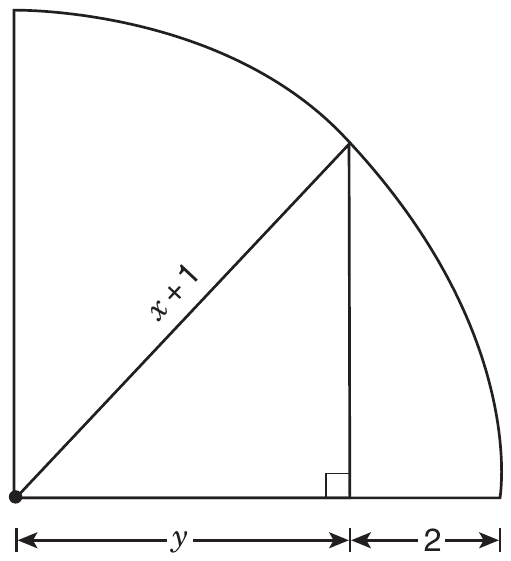
In the quarter circle above, what is in terms of ?
- A
- B
- C
- D
Show the answer
Correct answer: A
Both and are radii.
So, set them equal to each other and solve for .
Question analysis
In a quarter circle, one segment is labeled x + 1 and the bottom edge is split into lengths y and 2, and students must write y in terms of x. It tests basic circle facts together with solving a simple equation. The challenge is seeing which marked lengths must be equal.
- Grade level
- Grade 7 content, by NYS standard
- Compared with grade 7
- At grade 7 Grade 7 circle work centers on area and circumference formulas. This needs only the definition of a radius and a one-step equation, but spotting the relationship in a figure is less routine than plugging into a formula.
- Estimated difficulty
- Moderate: several steps, or a close reading with one strong distractor.
- Thinking it demands
- Depth of knowledge 2, skills and concepts · mainly analyze
- What makes it hard
- Solution
- 2 steps
- Reading level
- Question and choices: about grade 9, 16 words.
- Students, last 30 days
- Not enough answers yet to show (it takes 10).
Why it is hard, traps and wrong answers (shows the answer)
Why it is hard
The figure looks like a right-triangle problem, and that is the trap: the right angle and the slanted radius pull students toward the Pythagorean theorem, which cannot work without the vertical leg. The solution needs only the fact that all radii of a circle are equal, applied to the bottom edge. Students who mark every segment that starts at the center see it at once.
Reading a figure, table or graph major Understanding the question
The labels sit on two different radii: x + 1 on the slanted one, and y + 2 along the bottom edge, which runs from the center all the way to the arc. (Lesh, Post & Behr, 1987; Kirsch & Mosenthal, 1990)
Variables instead of numbers minor Understanding the question
The answer is an expression in x, so there is no number to check; trying x = 5, which makes the radius 6 and y = 4, is the fallback. (Koedinger & Nathan, 2004; Enright, Morley & Sheehan, 2002)
A very close wrong answer minor Choosing the answer
x + 1 differs from the right x − 1 by a single sign; only seeing that y plus the 2-unit piece makes a radius, so the 2 is subtracted, separates them. (Embretson & Wetzel, 1987; Gorin & Embretson, 2006; Ascalon et al., 2007)
Strategy: Look for two lengths in the figure that are both radii of the quarter circle, set their expressions equal, and solve for y.
Traps
- Trusting the picture: The figure suggests something it does not state; work from the given facts.
- Answers a different question: A choice is right for another quantity: the other unknown, the rest instead of the part, the part instead of the whole.
The wrong answers, classified
B Answers a different question (King et al., 2004; Hegarty, Mayer & Monk, 1995)
Sets y equal to the whole radius x + 1, ignoring the 2-unit piece that completes the bottom radius beyond y.
C Wrong operation (Hegarty, Mayer & Monk, 1995; King et al., 2004)
Treats y and the 2 as factors, y × 2 = x + 1, and divides by 2 where it should subtract 2.
D Trusting the picture (Lesh, Post & Behr, 1987)
Trusts the drawing's nearly 45° radius, assumes the triangle's two legs are equal, and solves y² + y² = (x + 1)² for y.
Worked solution, step by step
Formulas used
- Radii of a circle are equal
- A radius is a segment from the center of a circle to its curved edge. r₁ and r₂ stand for any two radii of the same circle. They are always equal, because every point on the curve is the same distance from the center.
Read the figure
The shape is a quarter circle, one fourth of a whole circle. Its center is the corner with the dot. A radius is a segment from the center to the curved edge. The slanted segment, labeled , goes from the center to the curve. The bottom edge is split into two parts, and 2.
Spot the two radii
The slanted segment is a radius, so the radius is . The whole bottom edge also runs from the center to the curve. Its length is , so it is a radius too.
Watch out: the slanted radius only looks like it is at 45 degrees. Do not assume the triangle’s two short sides are equal. That idea leads to choice D.
Set the radii equal
Use the rule that all radii of a circle are equal.
Now you have one equation with and .
Solve for y
Get alone by taking 2 from both sides.
Watch out: is only part of the bottom radius. Setting equal to gives choice B. Dividing by 2 instead of subtracting 2 gives choice C.
Give the answer
is 2 less than the radius, and the radius is . So the answer is A, .
Check your answer
Pick a number. If , the radius is 6. Then , and , which matches the radius. Also, is a short side of the right triangle. It should be shorter than the slanted side, and 4 is less than 6.
More questions like this
The original DOE question
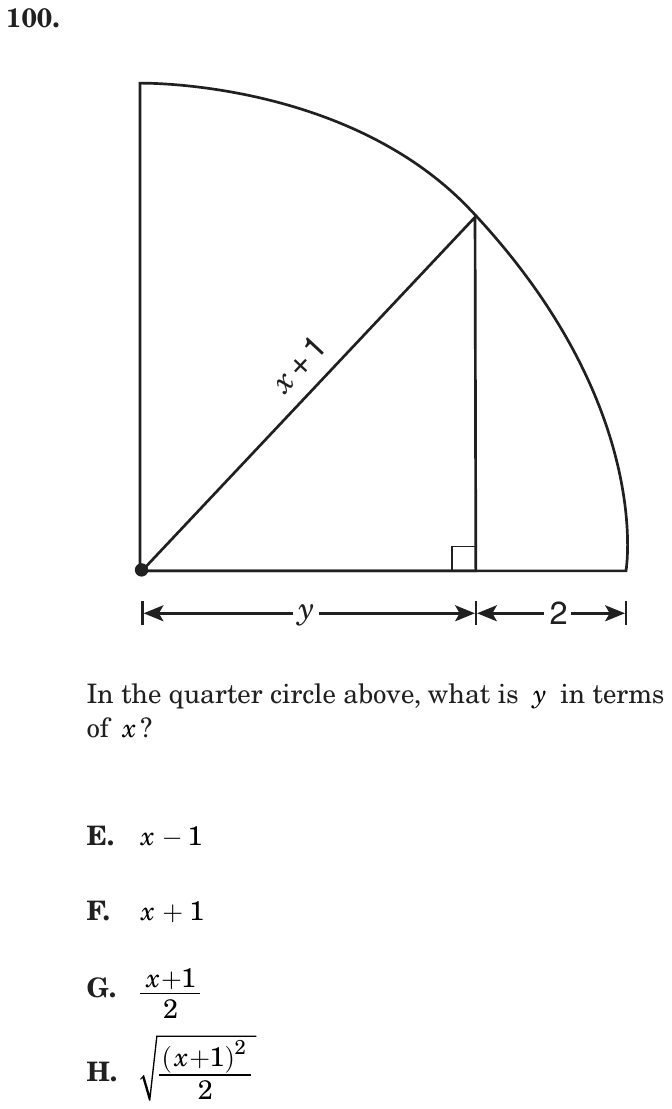
Question 104 of 107
2018 Test B Math, question 45Question
Phan chose an Internet service that charges $18.00 per month plus $0.024 per minute. Deion chose an Internet service that charges $30.00 per month for unlimited usage. At the end of the month, Phan’s and Deion’s charges were identical. For how many minutes did Phan use the Internet service that month?
- A50
- B60
- C100
- D500
Show the answer
Correct answer: D
Let x be the number of minutes Phan used his internet service in the month. Phan’s monthly charges were
18 + 0.024x
Since Deion’s charges were the same as Phan’s, set the expression equal to 30 and solve for x:
18 + 0.024x = 30
0.024x = 12
x = 500
Phan used his service for 500 minutes.
Question analysis
Phan pays $18 a month plus 2.4 cents per minute for Internet service, Deion pays a flat $30, and their bills come out the same. Students find how many minutes Phan used. It tests writing and solving a two-step linear equation, and the small decimal rate makes the division error-prone.
- NYS standards
- 7.EE.4a two-step equations
- Grade level
- Grade 7 content, by NYS standard
- Compared with grade 7
- At grade 7 Solving equations of the form px + q = r from a word problem is central grade 7 work. This is a typical example; only the three-decimal-place rate adds some care to the division.
- Estimated difficulty
- Straightforward: two steps or one careful reading.
- Thinking it demands
- Depth of knowledge 2, skills and concepts · mainly apply
- What makes it hard
- Error-prone arithmetic moderate
- Turning words into math minor
- Solution
- 3 steps
- Reading level
- Question and choices: about grade 5, 48 words.
- Students, last 30 days
- Not enough answers yet to show (it takes 10).
Why it is hard, traps and wrong answers (shows the answer)
Why it is hard
Setting up the equation is routine, so the question is mostly a test of decimal division. Dividing 12 by 0.024 invites a misplaced decimal point, and one such slip gives a choice exactly ten times too small. A quick check, 500 × 0.024 = 12, confirms the answer in seconds.
Error-prone arithmetic moderate Working it out
The last step divides 12 by 0.024, a three-place decimal, and moving the decimal point one place too few gives 50 instead of 500. (Brown & Burton, 1978; Junker & Sijtsma, 2001)
Turning words into math minor Understanding the question
"Phan's and Deion's charges were identical" has to become 18 + 0.024m = 30, with the flat $30 on one side and Phan's fee plus per-minute cost on the other. (Hegarty, Mayer & Monk, 1995; Koedinger & Nathan, 2004)
Strategy: Set Phan's cost, the monthly fee plus the per-minute charge times the minutes, equal to Deion's flat fee, then subtract and divide, checking the decimal places.
Traps
- An arithmetic slip: The right method with a plausible arithmetic error: a digit, a place value or a times-table fact.
The wrong answers, classified
A An arithmetic slip (Junker & Sijtsma, 2001)
Divides 12 by 0.024 but shifts the decimal point one place too few, as if the rate were 24 cents a minute: 12 ÷ 0.24 = 50.
B Little reason to choose it (Haladyna & Downing, 1993; Rodriguez, 2005)
No step with the $12 gap and the $0.024 rate gives 60; it most likely attracts students thinking of the 60 minutes in an hour.
C Little reason to choose it (Haladyna & Downing, 1993; Rodriguez, 2005)
No computation from the given numbers yields 100, and 100 minutes would add only $2.40 to Phan's $18 fee.
Worked solution, step by step
Formulas used
- Cost with a monthly fee
- C is the total cost for the month. f is the fixed fee you pay no matter what. r is the price for each minute, and m is the number of minutes. Use it when a bill has a set fee plus a charge for each unit.
Sort out what you know
Phan pays $18.00 a month plus $0.024 for each minute. Deion pays $30.00 a month, however much he uses. Their bills were the same. You need the number of minutes Phan used. Call it .
Write an equation
Use the cost formula for Phan. His bill equals Deion’s $30.
An equation says two amounts are equal. Here it says the two bills are equal.
Take away the monthly fee
Subtract 18 from both sides. That leaves the minutes part alone.
So Phan paid $12 for his minutes.
Divide to find the minutes
Divide 12 by 0.024. To get rid of the decimal, move the point 3 places right in both numbers.
Phan used 500 minutes.
Watch out: 0.024 is not 0.24. Using 0.24 gives , choice A. Move the point the same number of places in both numbers.
Give the answer
Phan used 500 minutes that month. That is the only choice that makes the two bills equal. So the answer is D, 500.
Check your answer
Put 500 back in. The minutes cost dollars. Add the fee: dollars. That is Deion’s bill, so the bills match.
More questions like this
The original DOE question
Question 105 of 107
2018 Test B Math, question 50Question
Which number line below shows the solution set for when ?
- A

- B

- C

- D

Show the answer
Correct answer: C
Separate the compound inequality into two pieces:
and
Substitute into each inequality and solve for :
The solution is the number line that shows that is greater than or equal to and less than or equal to .
Question analysis
Students substitute y = 1 into the compound inequality 2x − 2 ≤ y ≤ 4x + 10 and pick the number line that shows the values of x that work. It tests solving two-step inequalities and graphing the solution. The four graphs differ in their endpoints and in whether the shading is closed off on both sides, so each endpoint has to be found exactly.
- Grade level
- Grade 7 content, by NYS standard
- Compared with grade 7
- Above grade 7 Grade 7 students solve and graph one two-step inequality. This compound inequality in two variables requires substituting, solving two inequalities and combining them into one interval, a step toward algebra 1.
- Estimated difficulty
- Hard: combines ideas, needs a plan, and has more than one tempting wrong answer.
- Thinking it demands
- Depth of knowledge 2, skills and concepts · mainly apply
- What makes it hard
- Many steps moderate
- Error-prone arithmetic moderate
- Reading a figure, table or graph moderate
- A very close wrong answer minor
- Solution
- 4 steps
- Reading level
- Question and choices: about grade 9, 12 words.
- Students, last 30 days
- Not enough answers yet to show (it takes 10).
Why it is hard, traps and wrong answers (shows the answer)
Why it is hard
Substituting y = 1 is easy; the work is solving two inequalities and matching a fractional interval to a graph. Students who solve only the left inequality find a matching ray, and sign slips on either endpoint produce intervals that shift or flip across zero. The graphs differ by quarter-unit ticks, so reading them carefully matters as much as the algebra.
Many steps moderate Working it out
The compound inequality must be split into 2x − 2 ≤ 1 and 1 ≤ 4x + 10, each solved for x, and the two results joined into one interval. (Daniel & Embretson, 2010; Enright, Morley & Sheehan, 2002)
Error-prone arithmetic moderate Working it out
Both endpoints are fractions, 3/2 and −9/4, and the second comes from dividing −9 by 4, where a lost sign moves the endpoint across zero. (Brown & Burton, 1978; Junker & Sijtsma, 2001)
Reading a figure, table or graph moderate Understanding the question
The graphs are marked in quarter units, so −2 1/4 and 1 1/2 have to be found by counting small ticks between the labeled integers. (Lesh, Post & Behr, 1987; Kirsch & Mosenthal, 1990)
A very close wrong answer minor Choosing the answer
The ray ending at 1 1/2 looks almost like the right segment, sharing its right end; only the left end, an arrow instead of a closed dot at −2 1/4, separates them. (Embretson & Wetzel, 1987; Gorin & Embretson, 2006; Ascalon et al., 2007)
Strategy: Split the compound inequality into two separate inequalities, solve each for x after putting 1 in for y, then combine the two results into a single interval and match it to a graph.
Traps
- Negatives and direction: Arithmetic with negative numbers, the order of a subtraction, or direction on a number line. (Moving a term across the equals sign without changing its sign is a faulty procedure.)
- Stops one step early: A choice is a number from partway through the solution.
The wrong answers, classified
A Negatives and direction (Brown & Burton, 1978)
Gets the left endpoint −2 1/4 right but gives the right endpoint the wrong sign, ending the segment at −1 1/2 instead of 1 1/2.
B Negatives and direction (Brown & Burton, 1978)
Gives both endpoints the opposite sign, so the segment runs from −1 1/2 to 2 1/4, the true interval reflected across 0.
D Stops one step early (King et al., 2004; Gierl et al., 2017)
Solves only 2x − 2 ≤ 1 and graphs every x up to 1 1/2, leaving out the lower bound that 1 ≤ 4x + 10 sets.
Worked solution, step by step
Formulas used
- Solving an inequality
- a, b and c are numbers. The sign ≤ means is less than or equal to. Adding or subtracting the same number c on both sides keeps it true. Dividing both sides by the same positive number also keeps it true.
Sort out the question
The sign means is less than or equal to. An inequality compares two amounts that may not be equal. The statement is two inequalities joined together. You put 1 in place of . Then you need every that makes both parts true.
Split it into two parts
With , the statement becomes two inequalities.
The answer must make both of them true at the same time.
Solve the first part
Add 2 to both sides. Then divide both sides by 2.
So is at most . This is the right end of the answer.
Watch out: the right end is a positive number. Choice A ends its bar at instead.
Solve the second part
Subtract 10 from both sides. Then divide both sides by 4.
So is at least . This is the left end.
Watch out: keep the minus sign. Choice B uses the opposite signs and ends at .
Put the two parts together
The answer is every number from to , with both ends included. On the graph, that is a solid bar with a dot at each end. The small ticks are quarters. So count 1 tick left of −2 and 2 ticks right of 1.
Watch out: choice D uses only the first part. Its arrow goes left forever.
Give the answer
Choice C shows a bar from to , with dots at both ends. So the answer is C.
Check your answer
Test a number on the bar, like . Then and , and 1 is between them. Now test , which is off the bar. Then , and 1 is not less than −2. So the bar must stop on the left, which rules out D.
More questions like this
The original DOE question
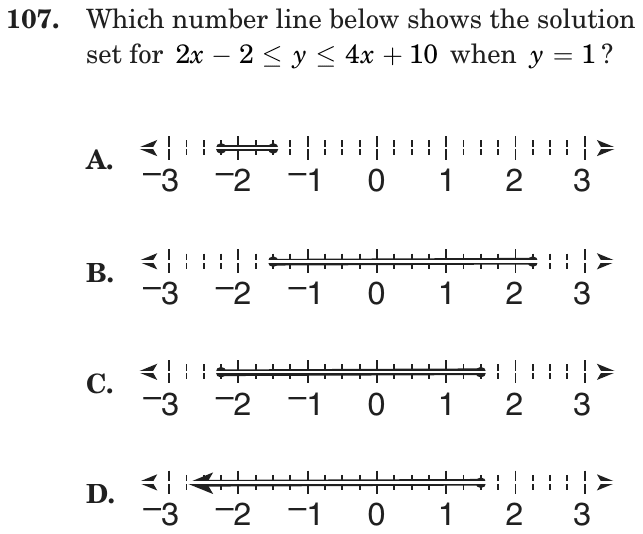
Question 106 of 107
2018 Test B Math, question 53Question
At North High School, a survey asked two questions, Question A and Question B. For each question, students could answer either “yes” or “no.” Of the 800 students who responded to the survey, 720 answered “yes” to Question A, and 640 answered “yes” to Question B. What is the least possible number of these students who could have answered “yes” to both questions?
- A80
- B160
- C560
- D640
Show the answer
Correct answer: C
None of the 80 students (800 − 720) who answered “no” to Question A could have answered “yes” to both questions.
Therefore, the least possible number of students who could have answered “yes” to both questions can be found by subtracting the 80 who answered “no” to Question A from the 640 who answered “yes” to Question B or 640 − 80 = 560.
Question analysis
In a survey of 800 students at North High School, 720 said yes to the first question and 640 said yes to the second. Students must find the smallest possible number who said yes to both. It tests reasoning about overlapping groups, and asking for the least possible overlap rather than an exact count makes it unusual.
- NYS standards
- Grade level
- Grade 7 content, by NYS standard
- Compared with grade 7
- Above grade 7 Grade 7 students work with Venn diagrams and two-way tables when all counts are given. Finding the smallest possible overlap requires reasoning about extremes rather than computing, which is rare in grade 7 and new to most students.
- Estimated difficulty
- Among the hardest on the SHSAT: a non-obvious approach, heavy reading, or a well-hidden trap.
- Thinking it demands
- Depth of knowledge 3, strategic thinking · mainly analyze
- What makes it hard
- No obvious method major
- Turning words into math moderate
- A very close wrong answer minor
- Solution
- 2 steps
- Reading level
- Question and choices: about grade 8, 60 words.
- Corrected from the DOE handbook
- A repeated phrase and a stray comma in the explanation were removed.
- Students, last 30 days
- Not enough answers yet to show (it takes 10).
Why it is hard, traps and wrong answers (shows the answer)
Why it is hard
Most students have never been asked for a smallest overlap, so they fall back on a picture of nested groups and give the largest one. The key move is to push the two yes groups apart as far as possible: only the 80 students who said no to Question A can absorb some of Question B's yes answers. Once that is seen, the arithmetic is one subtraction, so the question rewards reasoning far more than computation.
No obvious method major Working it out
Nothing in the wording points to the method: the smallest overlap appears only when all 80 students who said no to Question A are imagined saying yes to Question B. (Schoenfeld, 1985)
Turning words into math moderate Understanding the question
"The least possible number of these students who could have answered “yes” to both questions" asks for an extreme case, which has to be turned into an arrangement of the 800 students. (Hegarty, Mayer & Monk, 1995; Koedinger & Nathan, 2004)
A very close wrong answer minor Choosing the answer
640 is only 80 above the right 560, so a rough sense of size cannot choose between them; only asking whether the overlap is the least or the greatest separates them. (Embretson & Wetzel, 1987; Gorin & Embretson, 2006; Ascalon et al., 2007)
Strategy: Add the two yes counts and compare the sum with the number of students; any amount above the total must come from students counted in both groups.
Traps
- NOT, LEAST or EXCEPT: The question asks for the exception, the least, or what is not true.
- Stops one step early: A choice is a number from partway through the solution.
- Answers a different question: A choice is right for another quantity: the other unknown, the rest instead of the part, the part instead of the whole.
The wrong answers, classified
A Stops one step early (King et al., 2004; Gierl et al., 2017)
Finds the 80 students who said no to Question A, 800 − 720, and stops before subtracting them from the 640 who said yes to Question B.
B Answers a different question (King et al., 2004; Hegarty, Mayer & Monk, 1995)
Finds the 160 students who said no to Question B, 800 − 640, which bears on the count but is not the overlap asked about.
D Answers a different question (King et al., 2004; Hegarty, Mayer & Monk, 1995)
Assumes everyone who said yes to Question B also said yes to Question A, giving the greatest possible overlap instead of the least.
What was corrected from the DOE handbook, and why
- Explanation: The handbook prints “(800 − 720)” twice in its first sentence, after “80 students” and again after “Question A,” and puts a comma between subject and verb in “the least possible number of students who could have answered “yes” to both questions, can be found.” The site keeps the first “(800 − 720)” and drops the comma.
Worked solution, step by step
Formulas used
- Least overlap of two groups
- a is the size of the first group and b is the size of the second. t is the total number of people. If a + b is more than t, some people must be in both groups. The extra amount is the smallest number that can be in both.
Sort out what you know
There were 800 students. Of them, 720 said yes to Question A and 640 said yes to Question B. You need the least number who could have said yes to both. The overlap is the group in both yes groups. You want the smallest overlap.
Find who said no to A
Students who said no to Question A cannot be in the overlap.
So 80 students said no to Question A.
Watch out: 80 is not the answer. It is only a step, and it is choice A.
Keep the overlap small
To make the overlap as small as you can, put as many B yes answers outside it as possible. The only students outside it are the 80 who said no to A. So pretend all 80 of them said yes to B.
Count the rest of the yes group
The other yes answers to B must come from students who also said yes to A.
So at least 560 students said yes to both.
Watch out: 640 is the most that could say yes to both, not the least. That is choice D.
Give the answer
The fewest students who could say yes to both questions is 560. So the answer is C, 560.
Check your answer
Use the overlap formula: . There are 1,360 yes answers but only 800 students, so 560 students must be counted twice. You can also check the groups. 560 said yes to both, 160 to A only and 80 to B only. That makes .
More questions like this
The original DOE question
Question 107 of 107
2018 Test B Math, question 54Question
Raoul is at least 3 years older than Vahn. Which of the following inequalities gives the relationship between Raoul’s age ( ) and Vahn’s age ( )?
- A
- B
- C
- D
Show the answer
Correct answer: A
Raoul is at least 3 years older than Vahn, which can be written as
r ≥ v + 3
Rewrite this inequality to match the answer options:
r − v ≥ 3
Question analysis
Raoul is at least 3 years older than Vahn, and students choose the inequality that links their ages, r and v. It tests translating a phrase like "at least" into an inequality. The correct form may not match the one students write first, so they need to rearrange carefully and keep the direction of the inequality.
- Grade level
- Grade 7 content, by NYS standard
- Compared with grade 7
- At grade 7 Writing inequalities from words is grade 6 and 7 work. The extra demand is that "at least" must become the right symbol and the choices are rearranged forms, so students must manipulate inequalities rather than just recognize one.
- Estimated difficulty
- Moderate: several steps, or a close reading with one strong distractor.
- Thinking it demands
- Depth of knowledge 2, skills and concepts · mainly understand
- What makes it hard
- Turning words into math major
- An answer in an unexpected form moderate
- A very close wrong answer moderate
- Solution
- 2 steps
- Reading level
- Question and choices: about grade 8, 28 words.
- Students, last 30 days
- Not enough answers yet to show (it takes 10).
Why it is hard, traps and wrong answers (shows the answer)
Why it is hard
Two skills are tested at once: translating "at least … older than" into an inequality, and recognizing that inequality after a rearrangement. The two choices that begin with 3 − v and 3 − r look like legitimate moves but say only that the two ages add up to at least 3. Testing one pair of ages that fits the sentence and one that does not, such as 20 and 12 against 13 and 12, sorts the choices without algebra.
Turning words into math major Understanding the question
"Raoul is at least 3 years older than Vahn" has to become r ≥ v + 3; "at least" calls for ≥, though the word "least" seems to point the other way. (Hegarty, Mayer & Monk, 1995; Koedinger & Nathan, 2004)
An answer in an unexpected form moderate Choosing the answer
No choice is written as r ≥ v + 3, so the natural translation has to be rearranged to r − v ≥ 3 before it can be matched. (Enright, Morley & Sheehan, 2002)
A very close wrong answer moderate Choosing the answer
r − v ≤ 3 is the right r − v ≥ 3 with the symbol reversed; only deciding that "at least" means greater than or equal to separates them. (Embretson & Wetzel, 1987; Gorin & Embretson, 2006; Ascalon et al., 2007)
Strategy: Write the sentence directly as Raoul's age compared with Vahn's age plus 3, then rearrange each choice into that form to see which one matches.
Traps
- Misreads the question: Misses or misreads a condition or a word in the question: "at least", "each", "remaining", "not".
- A faulty procedure: A systematic but wrong procedure: adding fractions straight across, applying an exponent to each term of a sum, dropping a sign when moving a term.
- Answer in another form: The right answer is written differently from the way you worked it out.
The wrong answers, classified
B Misreads the question (Hegarty, Mayer & Monk, 1995)
Reads "at least 3 years older" as at most 3, reversing the inequality, which would even allow Raoul to be younger than Vahn.
C A faulty procedure (Brown & Burton, 1978; Tatsuoka, 1983)
Moves v across r ≥ v + 3 without changing its sign, writing r ≥ 3 − v, which really says only that their ages add up to at least 3.
D A faulty procedure (Brown & Burton, 1978; Tatsuoka, 1983)
Makes the same sign slip and also swaps the roles of r and v, giving 3 − r ≤ v, again only a statement about the sum of their ages.
Worked solution, step by step
Formulas used
- Greater than or equal to
- a and b are two amounts. The sign ≥ means a is greater than or equal to b, so a is b or more. The words at least mean the same thing. The sign ≤ means less than or equal to, or at most.
Sort out the question
The letter is Raoul’s age, and is Vahn’s age. Raoul is “at least 3 years older than Vahn”. That means the gap between their ages is 3 years or more. An inequality is a math sentence that uses a sign like instead of =. You need the one that says this.
Write the age gap
Raoul is older, so the gap is his age minus Vahn’s age. The gap is . For example, ages 15 and 10 have a gap of 5.
Turn at least into a sign
At least 3 means 3 or more. So use , which means greater than or equal to.
This is choice A.
Watch out: the word least does not mean less. Choice B, , says the gap is 3 or less. Then Raoul could even be younger.
Check choices C and D
Add to both sides of choice C. You get . That is about the sum of their ages, not the gap. Choice D works the same way. Neither one says Raoul is older.
Give the answer
Only one choice says the gap is 3 years or more. So the answer is A, .
Check your answer
Test ages that do not fit: Raoul 11 and Vahn 10. He is only 1 year older. Choice A gives , and 1 is not 3 or more. So A rightly says no. Choice B says yes, so B is wrong.
More questions like this
The original DOE question