Also in 2025 Practice Test A Math, question 9.
Question
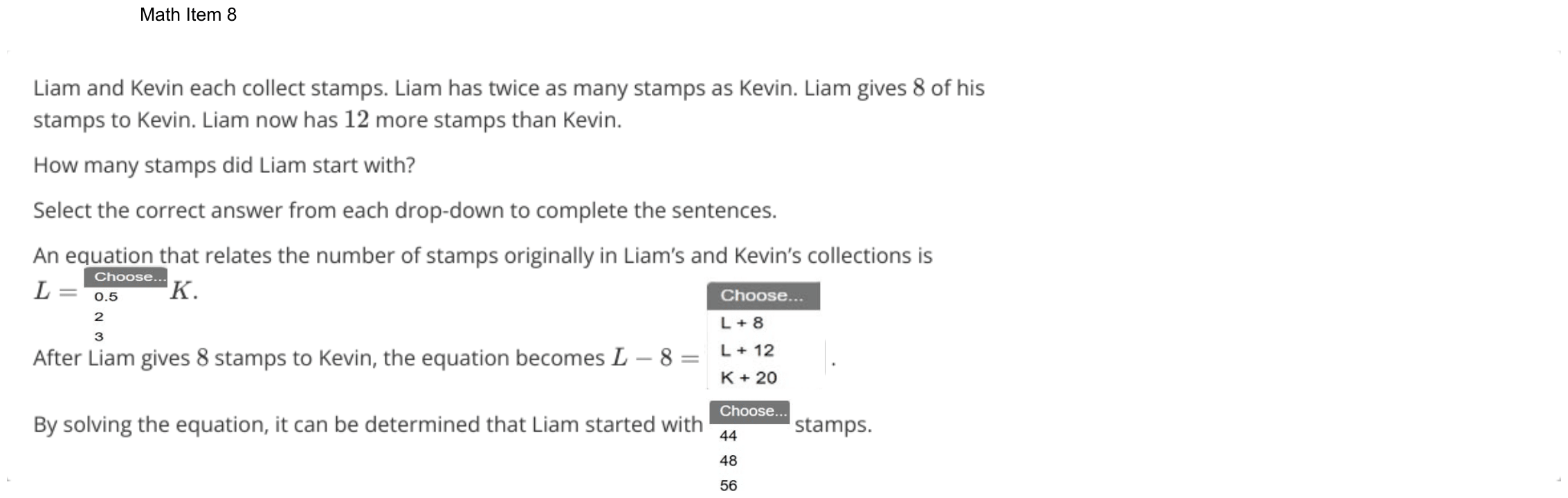
Liam and Kevin each collect stamps. Liam has twice as many stamps as Kevin. Liam gives 8 of his stamps to Kevin. Liam now has 12 more stamps than Kevin.
How many stamps did Liam start with?
Select the correct answer from each drop-down to complete the sentences.
An equation that relates the number of stamps originally in Liam’s and Kevin’s collections is .
After Liam gives 8 stamps to Kevin, the equation becomes .
By solving the equation, it can be determined that Liam started with stamps.
Choose an answer from each menu, then check. The DOE has not published how answers with several parts are scored; this site counts one right only when every part is right.
Show the answer
Correct answer: blank 1: 2; blank 2: K + 20; blank 3: 56
Liam originally has twice as many stamps as Kevin, so the equation is .
After Liam gives 8 stamps to Kevin, the equation becomes , which simplifies to .
Substitute into the equation: .
Solve for K:
Substitute to find L: .
So, Liam started with 56 stamps.
Question analysis
This word problem about two stamp collections is answered with three drop-down menus: an equation for the starting counts, an equation for after Liam gives Kevin 8 stamps, and the number Liam started with. Students turn "twice as many" and "12 more" into algebra and solve. Tracking both boys' counts before and after the gift is the tricky part, and every menu must be right.
- Grade level
- Grade 8 content, by NYS standard
- Compared with grade 7
- Above grade 7 Grade 7 students solve one equation in one unknown. The menus lay out the equations, but the problem still ties two unknowns together before and after a gift, a grade 8 system, and all three menus must be right.
- Estimated difficulty
- Moderate: several steps, or a close reading with one strong distractor.
- Thinking it demands
- Depth of knowledge 2, skills and concepts · mainly apply
- What makes it hard
- Turning words into math moderate
- Much to keep track of moderate
- Solution
- 4 steps
- Reading level
- Question and choices: about grade 5, 86 words.
- Students, last 30 days
- Not enough answers yet to show (it takes 10).
Why it is hard, traps and wrong answers (shows the answer)
Why it is hard
The menus do much of the setting up, since each sentence already shows the shape of its equation. The second menu is the hard one: the 8 stamps leave Liam and join Kevin before the gap of 12 is measured. Solving gives Kevin's 28 first, and K + 20 then equals 48, Liam's count after the gift, which waits on the last menu beside his starting 56. Testing each starting count against the story is a quick check on the last menu.
Turning words into math moderate Understanding the question
The gift changes both counts, so "Liam now has 12 more stamps than Kevin" compares Liam's L − 8 with Kevin's K + 8, and the second menu's K + 20 holds a 20 that appears nowhere in the stem. (Hegarty, Mayer & Monk, 1995; Koedinger & Nathan, 2004)
Much to keep track of moderate Working it out
Each boy has a count before and after the gift, four numbers in all, and all three menus must be right; the last asks for Liam's start, not the 48 he has after giving 8 away. (Sweller, 1988; Carpenter, Just & Shell, 1990)
Strategy: Let K be Kevin's starting count, write each boy's count after the gift in terms of K, and set Liam's 12 above Kevin's; testing each number in the last menu is a fast check.
Traps
- Answers a different question: A choice is right for another quantity: the other unknown, the rest instead of the part, the part instead of the whole.
- Follows a key word: Picks the operation from a single word rather than the situation: "removed" so subtract, "of" so multiply, "more" so add, when the situation needs something else.
- Equation written backwards: Writes a comparison the wrong way round, word for word: "six times as many students as professors" as 6S = P. The bigger quantity gets the bigger number.
The wrong answers, classified
BCB Answers a different question (King et al., 2004; Hegarty, Mayer & Monk, 1995)
Sets up both equations and solves for Kevin's 28, then takes the value of K + 20, 48, which is Liam's count after the gift, not at the start.
BBC Follows a key word (Hegarty, Mayer & Monk, 1995)
Follows the words "12 more" to L + 12, adding 12 to Liam's own count instead of Kevin's, then finds 56 by testing the three counts against the story.
ACC Equation written backwards (Clement, Lochhead & Monk, 1981)
Writes "twice as many stamps as Kevin" backwards, as 2L = K, and picks 0.5, giving Liam half of Kevin's stamps, while the other two menus are right.
Worked solution, step by step
Formulas used
- Twice as many as
- L is the number of stamps Liam starts with, and K is the number Kevin starts with. Twice as many means 2 times as many, so Liam’s count is 2 times Kevin’s. Because L and 2K are equal, you can put 2K in place of L in any equation.
- Doing the same to both sides
- a and b are the two sides of an equation, and c is any number or term. An equation is like a balanced scale. Add the same thing to both sides, or take the same thing away from both, and the scale stays level. This is how you move a term to the other side.
Sort out the question
Let L be Liam’s stamps at the start and K be Kevin’s. You know three facts:
- Liam has twice as many stamps as Kevin.
- Liam gives 8 of his stamps to Kevin.
- After that, Liam has 12 more stamps than Kevin.
The first menu finishes the starting equation. The second finishes the equation after the gift. The third is Liam’s count at the start.
Fill in the first menu
Twice as many means 2 times as many. Liam has twice as many as Kevin, so:
Pick 2 in the first menu.
Watch out: the 0.5 in the menu turns the fact around. would give Liam half as many as Kevin. Liam has more, so his count must be the bigger one.
Write both counts after the gift
The gift changes both counts. Liam loses 8 stamps, and Kevin gains those same 8.
- Liam now has stamps.
- Kevin now has stamps.
Liam has 12 more than Kevin. So Liam’s count equals Kevin’s count plus 12:
Pick K + 20 in the second menu.
Watch out: the 12 goes on Kevin’s count, not Liam’s. Picking L + 12 adds it to the wrong boy.
Solve for K
Now use the first equation. Since , put 2K in place of L:
Subtract K from both sides. Then add 8 to both sides. Each move keeps the scale level.
Kevin started with 28 stamps.
Find Liam’s starting count
Liam started with twice as many as Kevin:
Liam started with 56 stamps.
Watch out: is Liam’s count after the gift. The menu offers 48, but the question asks about the start.
So the menus read 2, K + 20 and 56.
Check your answer
At the start, Liam has 56 stamps and Kevin has 28, and 56 is twice 28. After the gift, Liam has 48 and Kevin has 36. , so Liam has 12 more. Every fact fits.
More questions like this
The original DOE question