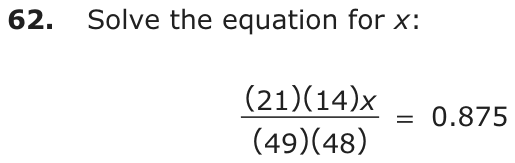
Question
Solve the equation for x:
Grid-in question: work out the answer and enter it as a number.
Show the answer
Correct answer: 7
Question analysis
This equation puts x in a fraction with (21)(14) on top and (49)(48) below, set equal to the decimal 0.875. The grid-in asks for the value of x. Students do best to cancel common factors before multiplying anything out, and it helps to know the fraction that 0.875 equals.
- NYS standards
- Grade level
- Grade 7 content, by NYS standard
- Compared with grade 7
- At grade 7 Seventh graders solve equations like ax = b, usually with a simple coefficient. Here the coefficient is a product of four numbers that is best cancelled first, and a decimal has to be matched with a fraction.
- Estimated difficulty
- Moderate: several steps, or a close reading with one strong distractor.
- Thinking it demands
- Depth of knowledge 1, recall and reproduction · mainly apply
- What makes it hard
- Error-prone arithmetic moderate
- No obvious method minor
- An answer in an unexpected form minor
- Solution
- 3 steps
- Reading level
- Question and choices: about grade 5, 6 words.
- Students, last 30 days
- Not enough answers yet to show (it takes 10).
Why it is hard, traps and wrong answers (shows the answer)
Why it is hard
This is a one-unknown equation dressed in large numbers, and the work is in reducing them without slipping. Students who cancel early find that the whole coefficient is one eighth and that 0.875 is seven eighths, which makes the last step mental. Those who multiply out face a four-digit product and a decimal division, and with nothing to check against, an early slip goes unnoticed.
Error-prone arithmetic moderate Working it out
Multiplied out, the coefficient is 294 over 2,352 and the right side is the decimal 0.875; both invite slips unless 21/49 and 14/48 are cancelled first. (Brown & Burton, 1978; Junker & Sijtsma, 2001)
No obvious method minor Working it out
The quick route pairs 21 with 49 and 14 with 48 before multiplying, so that 3/7 × 7/24 collapses to 1/8; the layout of the fraction does not suggest that pairing. (Schoenfeld, 1985)
An answer in an unexpected form minor Choosing the answer
The result is entered with no choices, so a coefficient’s denominator or a quotient taken the wrong way looks as complete as the right value. (Enright, Morley & Sheehan, 2002)
Strategy: Cancel before multiplying: reduce 21 over 49 and 14 over 48, multiply the simplified fractions, then undo that coefficient, writing 0.875 as a fraction if it helps.
Traps
- Stops one step early: A choice is a number from partway through the solution.
- Wrong operation: Adds instead of multiplying, divides the wrong way round, turns a ratio or rate upside down, or undoes a step in the wrong direction (subtracts what should be added back).
- An arithmetic slip: The right method with a plausible arithmetic error: a digit, a place value or a times-table fact.
The wrong answers, classified
8 Stops one step early (King et al., 2004; Gierl et al., 2017)
Simplifies the coefficient correctly to 1/8 but enters the 8 from its denominator, never multiplying it by 0.875.
0.109375 Wrong operation (Hegarty, Mayer & Monk, 1995; King et al., 2004)
Divides 0.875 by 8 instead of multiplying, undoing the coefficient 1/8 the wrong way, so x comes out as 0.109375.
3.5 An arithmetic slip (Junker & Sijtsma, 2001)
Slips in reducing 14/48, taking it as 7/12 instead of 7/24, so the coefficient becomes 1/4 and x = 0.875 × 4 = 3.5.
Worked solution, step by step
Formulas used
- Multiplying fractions
- a and c are the tops, or numerators. b and d are the bottoms, or denominators. Multiply the tops together and the bottoms together. It also works backward: you can split one fraction into two smaller ones. That lets you simplify before the numbers get big.
Sort out the question
You need the value of x. On top, 21, 14 and x are multiplied. The bottom is 49 times 48. The right side is 0.875.
Multiplying 49 by 48 makes a big number. It is easier to simplify first.
Split the fraction into two
Use the rule for multiplying fractions backward. Pair 21 with 49, and 14 with 48.
Now the equation says these two fractions times x equal 0.875.
Simplify each fraction
To simplify, divide the top and bottom by the same number. Both 21 and 49 divide by 7. Both 14 and 48 divide by 2.
Watch out: 48 ÷ 2 is 24, not 12. Writing leads to 3.5.
Multiply the simple fractions
The 7 on top and the 7 on the bottom cancel, since 7 ÷ 7 = 1. Then divide 3 and 24 by 3 to get . So the equation becomes:
Solve for x
One eighth of x is 0.875. To undo dividing by 8, multiply both sides by 8.
Watch out: 8 is not the answer, and don’t divide 0.875 by 8. So you would grid 7.
Check your answer
0.875 is the same as . One eighth of 7 is , so x = 7 works. You can also multiply it all out: and . Then .
More questions like this
The original DOE question