Question
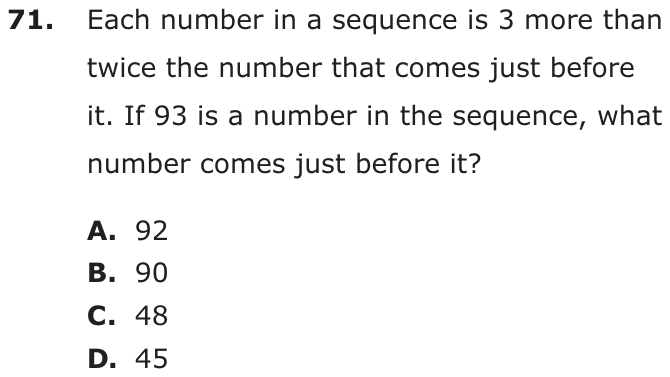
Each number in a sequence is 3 more than twice the number that comes just before it. If 93 is a number in the sequence, what number comes just before it?
- A92
- B90
- C48
- D45
Show the answer
Correct answer: D
Let n represent a number in the sequence, and let x represent the number that comes just before n:
Question analysis
In a sequence, each number is 3 more than twice the number just before it, and 93 is one of the numbers. Students find the number that comes just before 93. That means running the rule backward, undoing the adding and the doubling in reverse order.
- Grade level
- Grade 7 content, by NYS standard
- Compared with grade 7
- At grade 7 Grade 7 students routinely solve two-step equations. The demand here is translating the wordy sequence rule into one, or running the rule backward in the right order, rather than any harder content.
- Estimated difficulty
- Moderate: several steps, or a close reading with one strong distractor.
- Thinking it demands
- Depth of knowledge 2, skills and concepts · mainly apply
- What makes it hard
- Turning words into math moderate
- No obvious method minor
- Solution
- 2 steps
- Reading level
- Question and choices: about grade 5, 29 words.
- Students, last 30 days
- Not enough answers yet to show (it takes 10).
Why it is hard, traps and wrong answers (shows the answer)
Why it is hard
The arithmetic is two short steps, so the question rests on reading a wordy rule correctly and running it in reverse. Each wrong choice marks a different place to go wrong: ignoring the rule, stopping after the subtraction, or undoing the adding with more adding. Checking the answer forward, twice the number plus 3, confirms it reaches 93.
Turning words into math moderate Understanding the question
“Each number … is 3 more than twice the number that comes just before it” must become 2x + 3 = 93, with x the earlier number, not the later one. (Hegarty, Mayer & Monk, 1995; Koedinger & Nathan, 2004)
No obvious method minor Working it out
The rule is stated forward, from a number to the next, but the question runs backward, so each operation has to be undone in reverse order: subtract 3, then halve. (Schoenfeld, 1985)
Strategy: Call the earlier number x, write the rule as an expression in x set equal to 93, and solve it by undoing each operation in reverse order.
Traps
- Wrong operation: Adds instead of multiplying, divides the wrong way round, turns a ratio or rate upside down, or undoes a step in the wrong direction (subtracts what should be added back).
- Stops one step early: A choice is a number from partway through the solution.
- Misreads the question: Misses or misreads a condition or a word in the question: "at least", "each", "remaining", "not".
The wrong answers, classified
A Misreads the question (Hegarty, Mayer & Monk, 1995)
Reads “the number that comes just before it” as the whole number one less than 93, ignoring the sequence’s rule.
B Stops one step early (King et al., 2004; Gierl et al., 2017)
Undoes the adding of 3, 93 − 3 = 90, and stops before undoing the doubling.
C Wrong operation (Hegarty, Mayer & Monk, 1995; King et al., 2004)
Adds 3 instead of subtracting it before halving, (93 + 3) ÷ 2 = 48, undoing the rule in the wrong direction.
Worked solution, step by step
Formulas used
- The sequence rule
- x is any number in the sequence, a list that follows a rule. n is the number right after it. Twice means times 2, so twice x is 2x. Then 3 more means add 3. The same rule links every number to the one after it.
Sort out the question
A sequence is a list of numbers that follows a rule. Here, each number is “3 more than twice the number that comes just before it.” 93 is in the list. You need the number right before 93. Call it x.
Write the rule as an equation
Twice x is 2x. Three more than that is 2x + 3. The rule says this equals the next number, which is 93.
Undo the adding of 3
The rule doubles x first, then adds 3. To go backward, undo the steps in reverse order. First, subtract 3 from both sides.
Watch out: 90 is twice the number, not the number itself. Stopping here gives choice B. And don’t add 3, which leads to 48, choice C.
Undo the doubling
Now divide both sides by 2.
Watch out: “just before” means just before in this list. It does not mean one less than 93, so 92 is wrong. So the answer is D, 45.
Check your answer
Run the rule forward from 45. Twice 45 is 90, and 3 more is 93: . So 45 really does come just before 93.
More questions like this
The original DOE question